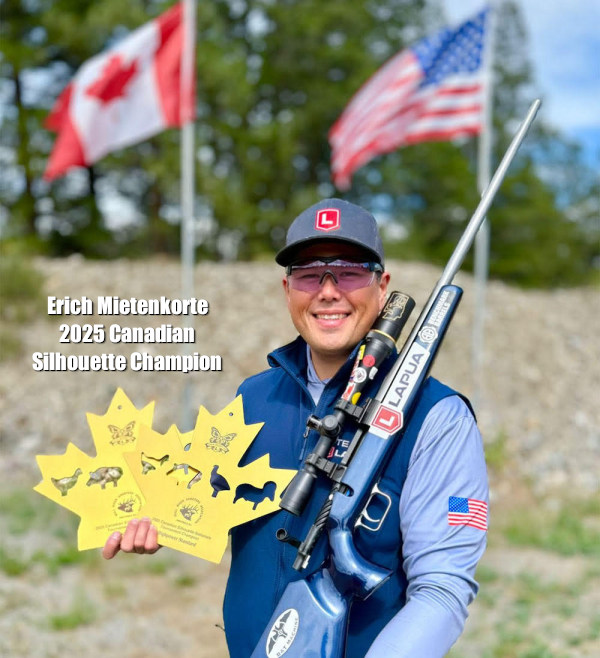
Erich Mietenkorte Wins 2025 Canadian Rifle Silhouette National High Power Championship.
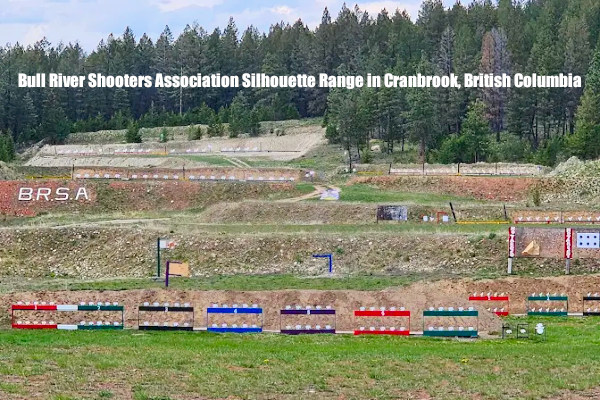
Team Lapua’s Erich Mietenkorte took top honors at the 2025 Canadian High Power Rifle Silhouette National Championships, winning the 240-shot High Power Aggregate with an impressive combined score of 195/240. Held at the Bull River Shooters Association range in Cranbrook, British Columbia, from June 29 to July 5, the national championship featured both Smallbore and High Power rifle disciplines, with competitors engaging steel silhouette targets from the standing offhand position at distances of 200, 300, 385, and 500 meters.
Mietenkorte competed in both High Power categories — Standard Rifle and Hunting Rifle — scoring 99/120 with his 6.5×47 Lapua in the Standard division, and 96/120 with his 6mm BR in the Hunting Rifle division. Mietenkorte’s combined performance earned him first place overall in the High Power aggregate and national titles in both rifle categories.
“Success in this discipline requires absolute confidence in your equipment. When it comes to consistency, reliability, and performance,?Lapua cases and bullets,?Vihtavuori powders, and?Berger bullets?are unmatched,” commented Mietenkorte. “I used Lapua 108gr and 139gr Scenar bullets in my 6.5×47, and Berger 95gr and 115gr bullets in my 6BR, all handloaded with Vihtavuori N140 powder. These components gave me the precision and consistency needed[.]”
What’s next? Mietenkorte will be competing at the U.S. NRA Rifle Silhouette National Championships at the NRA Whittington Center in Raton, NM, July 20-26, 2025.
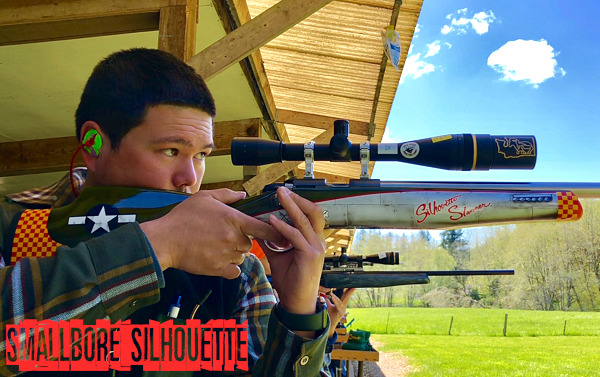
In addition to his success in the Canadian High Power competition, Mietenkorte finished 4th overall in the Smallbore Standard Rifle category. In the video below Eric demonstrates Smallbore Silhouette marksmanship skills.
Silhouette Champion Shares His Skills
In the video below, silhouette champion Eric Mietenkorte explains proper hold: “Consistency is key! Form a solid stance that is repeatable and allows you to have a natural point of aim. If you don’t come down on target adjust your feet, don’t rotate your body with your torso muscles.”
Erich explains his aiming method: “Pick a spot on the target and shoot for that. Try not to hesitate, if you’re on target, take the shot. It’s easy to get locked up by trying to make a great shot better. Make sure to follow through, keep that trigger pulled back. Don’t forget to have fun!”
The CMP’s hugely popular Rimfire Sporter event runs Sunday, July 20, 2025 at Camp Perry, Ohio. Prior to the Sunday match, on Saturday, July 19th, the CMP will host the Rimfire Check-In and a CMP Rimfire Clinic.
New Range Location Will Have E-Targets
Unlike past years, the 2025 National Rimfire Sporter match will be held on Camp Perry’s Petrarca Range — equipped with CMP eTargets. This should please the hundreds of Rimfire Sporter competitors. The Petrarca range features more conveniences, such as a covered firing line and adjacent parking. Moreover, the eTargets should improve the experience for competitors. Brian Williams, CMP Highpower Manager, explained: “The matches should run faster, without the need to hang targets and do the scoring.”
E-Targets for Rimfire Sporter Match This Year
For the first time, this summer the CMP will utilize the electronic targets of Petrarca Range for the National Rimfire Sporter Match. Featuring Kongsberg Target System (KTS) technology, the system includes monitors at each firing point.
The eTargets will permit the Rimfire Sporter Match to run more smoothly and efficiently. Competitors won’t have to walk down-range between relays to change targets, and scores will be tracked and recorded instantly. Monitors placed alongside each competitor will instantly show shot placements during the match, while suspended displays above the firing line will allow spectators to follow along with each shot in real time.
Popular Match for Junior and Adult Competitors
The National Rimfire Sporter Match, one of the most well-attended events of the annual National Matches, is open to both adults and juniors of all experience levels. Using .22 caliber rifles at 25 and 50 yards, participants in the match traditionally chose from three separate classes: Open Sight (O), Telescope Sight (T) and Tactical Unlimited (TU). Due to high demand, the CMP has added an “M-class” for 2025 to give competitors the option to use U.S. military rimfire training rifles during competition. Competitors may enter in Single or Double Entry options and then select the rifle class(es) in which they will fire.
Firing is done at 25 and 50 yards in prone, sitting, and standing positions, in slow and rapid-fire modes. For each Class, awards are offered to High Juniors, High Seniors, and High Women as well as Overall Winners.
If there is a single CMP event at Camp Perry every summer that offers the highest level of shooter satisfaction, the most diverse group of competitors, and the lowest cost of entry, that would have to be the annual Rimfire Sporter Match. Shooters range in age from young juniors to seniors in their 70s and 80s. And persons with disabilities can compete as well, with Adaptive Shooting Programs for physically-challenged competitors.
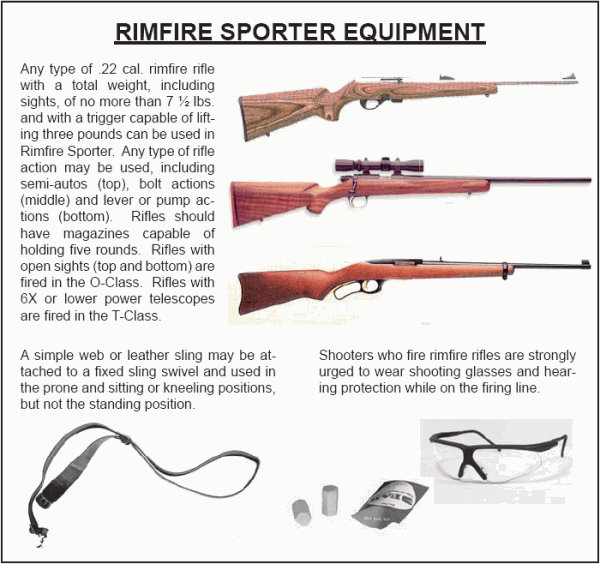
Each year, the Rimfire Sporter Match attracts hundreds of shooters to Camp Perry. National Rimfire Sporter competitors can use affordable sporter rifles with either scopes or iron sights. All you need are a .22 LR rifle, a simple sling, and ammo. Rifles may be manually operated or semi-automatic, in four classes: the standard “O Class” for open-sighted rifles, “T-Class” for telescope-sighted rifles, the “TU Class” for Tactical and unlimited rifles, and the new “M-Class” for Military Rimfire Training Rifles.
Rimfire Sporter Course of Fire
Competitors will complete slow fire prone, rapid fire prone, slow fire sitting or kneeling, rapid fire sitting or kneeling, slow fire standing, and rapid fire standing shot sequences. To learn more about the National Rimfire Sporter Match, CLICK HERE.
Learn more about the National Rimfire Sporter Match at TheCMP.org website.
Guest Article By Michelle Gallagher, Berger Bullets
Let’s face it. In the world of firearms, there is something for everyone. Do you like to compete? Are you a hunter? Are you more of a shotgun shooter or rifle shooter? Do you enjoy running around between stages of a timed course, or does the thought of shooting one-hole groups appeal to you more? Even though many of us shoot several different firearms and disciplines, chances are very good that we all have a favorite. Are we spreading ourselves too thin by shooting different disciplines, or is it actually beneficial? I have found that participating in multiple disciplines can actually improve your performance. Every style of shooting is different; therefore, they each develop different skills that benefit each other.
How can cross-training in other disciplines help you? For example, I am most familiar with long-range prone shooting, so let’s start there. To be a successful long-range shooter, you must have a stable position, accurate ammunition, and good wind-reading skills. You can improve all of these areas through time and effort, but there are other ways to improve more efficiently. Spend some time practicing smallbore. Smallbore rifles and targets are much less forgiving when it comes to position and shot execution. Long-range targets are very large, so you can get away with accepting less than perfect shots. Shooting smallbore will make you focus more on shooting perfectly center shots every time. Another way to do this with your High Power rifle is to shoot on reduced targets at long ranges. This will also force you to accept nothing less than perfect. Shoot at an F-Class target with your iron sights. At 1000 yards, the X-Ring on a long range target is 10 inches; it is 5 inches on an F-Class target. Because of this, you will have to focus harder on sight alignment to hit a center shot. When you go back to the conventional target, you will be amazed at how large the ten ring looks.
Also, most prone rifles can be fitted with a bipod. Put a bipod and scope on your rifle, and shoot F-TR. Shooting with a scope and bipod eliminates position and eyesight factors, and will allow you to concentrate on learning how to more accurately read the wind. The smaller target will force you to be more aggressive on your wind calls. It will also help encourage you to use better loading techniques. Nothing is more frustrating than making a correct wind call on that tiny target, only to lose the point out the top or bottom due to inferior ammunition. If you put in the effort to shoot good scores on the F-Class target, you will be amazed how much easier the long-range target looks when you return to your sling and iron sights. By the same token, F-Class shooters sometimes prefer to shoot fast and chase the spotter. Shooting prone can help teach patience in choosing a wind condition to shoot in, and waiting for that condition to return if it changes.
Benchrest shooters are arguably among the most knowledgeable about reloading. If you want to learn better techniques about loading ammunition, you might want to spend some time at benchrest matches. You might not be in contention to win, but you will certainly learn a lot about reloading and gun handling. Shooting F-Open can also teach you these skills, as it is closely related to benchrest. Benchrest shooters may learn new wind-reading techniques by shooting mid- or long-range F-Class matches.
Position shooters can also improve their skills by shooting different disciplines. High Power Across-the-Course shooters benefit from shooting smallbore and air rifle. Again, these targets are very small, which will encourage competitors to be more critical of their shot placement. Hunters may benefit from shooting silhouette matches, which will give them practice when shooting standing with a scoped rifle. Tactical matches may also be good, as tactical matches involve improvising shots from various positions and distances. [Editor: Many tactical matches also involve hiking or moving from position to position — this can motivate a shooter to maintain a good level of general fitness.]
These are just a few ways that you can benefit from branching out into other shooting disciplines. Talk to the other shooters. There is a wealth of knowledge in every discipline, and the other shooters will be more than happy to share what they have learned. Try something new. You may be surprised what you get out of it. You will certainly learn new skills and improve the ones you already have. You might develop a deeper appreciation for the discipline you started off with, or you may just discover a new passion.
This article originally appeared in the Berger Blog. The Berger Blog contains the latest info on Berger products, along with informative articles on target shooting and hunting.
With the New Year approaching, we thought our readers might enjoy some historical background on the National Rifle Association, an organization which has served American firearms owners and marksmen for over 150 years.
Shooting Sports USA (SSUSA) has a good article on the origins and history of the National Rifle Association. This feature story covers the first 36 years of NRA history from 1871 to 1907. The NRA was founded in 1871, and 1907 marked the first year of Matches at Camp Perry, Ohio.
SSUSA explains the NRA’s original mission: “The NRA’s program during its youthful years centered mainly on improving marksmanship among the military. Rifle tournaments at ranges in Creedmoor (NY), Sea Girt (NJ), and Camp Perry (OH) captured the country’s spirit of nationalism and resulted in key improvements in rifles and target scoring. NRA also set standards for military rifle training and even inspired the federal government to form its own segment within the War Department to focus on promoting rifle practice among soldiers as well as civilians.”
1871 — A group of New York National Guardsmen founded the National Rifle Association to promote marksmanship training. Figures such as Capt. George Wingate had called for better rifle marksmanship to support the nation’s defense.
1872 — The NRA acquires Creed’s Farm in Long Island, New York for $26,250. Renamed “Creedmoor”, this becomes the NRA’s first range. The first match was held in 1873.
1874 — The NRA hosts its first International Match, shot at the Creedmoor Range in New York.
The First-Ever Creedmoor Challenge Match in 1874
The Irish International Shooting team arrived in New York on the 16th of September and proceeded to “take in the sights”, which was understandable, before some practice at the Creedmoor range. On September 26th they presented themselves for the match with confidence and in high spirits. The crowds that day were reported to be between 5,000 and 10,000 strong, which showed the huge support already growing for the fledgling sport in America.
The course of fire was 15 shots to each man at 800, 900, and 1000 yards. Unfortunately, the details of each mans scores at the individual distances have been lost to time but we do know that the Americans were well ahead after the 800-yard shoot. The Irish then caught up after the 900-yard and finished the 1000-yard shoot ahead by 1 point. The Americans still had one man left to shoot and it came down to his very last shot with which he scored a 4 giving the American team the win over the Irish by 3 points.
1892 — The NRA moves its Annual Matches to the Sea Girt Range in New Jersey, which was less than 60 Miles from New York City, NY. The Sea Girt Range was maintained by the New Jersey State Rifle Association, founded in 1878.
1903 — The U.S. War Department sets up a National Board for the Promotion of Rifle Practice (NBPRP). In 1903, an amendment to the War Dept. Appropriations Bill established the NBPRP to promote both Military and Civilian marksmanship. This government advisory board became the predecessor to today’s Corporation for the Promotion of Rifle Practice and Firearms Safety that now governs the CMP.
1907 — The NRA commences National Matches at Camp Perry, Ohio.
History of Camp Perry
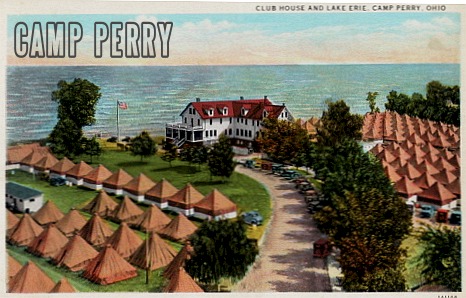
The National Matches have been held at Camp Perry since 1907. The range is located along the shores of Lake Erie in northern Ohio near Port Clinton. The site was first acquired in 1906, in response to the need for a larger facility for military training and the NRA’s shooting programs. In 1906 Gen. Ammon B. Crichfield, Adjutant General of Ohio, ordered construction of a new shooting facility on the shores of Lake Erie, 45 miles east of Toledo, Ohio. The original land for Camp Perry was purchased in 1906, and the reservation was named after Commodore Oliver Hazard Perry, the American naval commander who won the Battle of Put-in-Bay during the War of 1812.
On August 19, 1907, Cpl. L. B. Jarrett fired the first shot at the new Camp Perry Training Site. And that year, 1907, Camp Perry held its first National Pistol and Rifle Championship events. This location has hosted the annual NRA National Matches ever since. Today, over 4,000 competitors attend the National Matches each year, making it the most popular shooting competition in the western hemisphere.
Federal legislation originally launched the National Matches. The 1903 legislation also established the National Matches, commissioned the National Trophy and provided funding to support the Matches.
We’re in the middle of summer now, with the 4th of July holiday just last Friday. Most public ranges and private shooting facilities are now open for business — so there are plenty of places to have fun shooting. Now’s a great opportunity to get out of the house, enjoy some fresh air, and dust off those skills. To help you have fun on your range trips, here are 12 FREE printable targets.
FREE FUN Targets from NSSF
The Billiards Table Target above offers 15 brightly-colored numbered balls with the cue ball at the bottom. Aim for the numbers, shooting 1-15 in sequence, or alternate between stripes and solids. You can also draw an “X” on the white cue ball (or attach a paster), and use that to set your zero. This target is fun for shooting outdoors with rifles at 50 or 100 yards or indoors with pistols. This billiards target is part of a set of 12 Fun Targets from the NSSF. These were issued a couple seasons back for National Shooting Sports Month, held in August of each year.
FREE NSSF Fun Targets — Dartboard, Golf, Billiards, Bowling, Baseball and More…
HERE are a dozen FREE Targets. Along with Bullseye targets, there are some very cool specialty targets here, including a Golf Course Target, Baseball Diamond Target, Billiards Target, Light Bulb Target, Bowling Pin Target, and even a Windmill Target. Enjoy the myriad possibilities with these 12 fun targets.
This impressive 15-round group was shot by Jim See of Elite Accuracy.
Different Shooting Disciplines Demand Different Levels of Precision/Accuracy
In the rapid-fire 3-Gun game, you could probably “clean” most stages with a 2-MOA rifle. By contrast, in the short-range group benchrest game, to compete with the best, you’ll need a rifle that shoots in the “ones” (i.e. 0.1-0.19 MOA) in perfect conditions. In 1000-yard F-Class competition, the top shooters want a rifle that will hold one-third-MOA of vertical at that distance.
What is your standard of accuracy? How good is “good enough”. Jim See, a skilled gunsmith and successful PRS competitor, recently answered that question for his tactical discipline. For the kind of matches Jim shoots, he likes to have a rifle that will hold half-MOA for five (5) shots, 3/4-MOA for 15 shots, and 1 MOA for twenty shots. Remarkably, Jim’s rifle can do that with factory ammo. Above is an impressive 15-shot group shot with .260 Remington Federal Premium Ammo.
“I say it all the time, my loads need to print 5 under 1/2″, 10 under 3/4″, and 20 under 1″. It’s simple, if a hot barrel will keep 20 rounds fired in succession under my standard it will be a good barrel and load for Precision Match Shooting. Federal Premium Gold Metal Match .260 with Sierra bullets made the cut for me today. 15 consecutive shots under 3/4 MOA.” –Jim See
It’s said that you “can never have too much accuracy”, but there are acceptable standards for each discipline, and they’re not the same. A 100/200 yard Benchrest shooter will be sorely disappointed with a rifle/ammo set-up that can only deliver half-MOA. On the other hand, a PRS competitor like Jim See can achieve great success with a lesser degree of precision. This means you can save time and money. You can run your barrels longer between cleanings, and you don’t have to go “full OCD” when loading your ammo. The PRS shooter does not need to weigh-sort primers, or load powder to single-kernel standards. Proof is the performance. Jim See has been a podium finisher at many PRS and tactical events. Learn more about Jim’s gunsmithing and training operations at Jim’s Facebook Page.
Download This Load Development Target
Jim’s target seemed a bit familiar. AccurateShooter.com created this Diamond and Dot Target a few years back. On each aiming point, there are high-contrast black horizontal and vertical lines for aligning your cross-hairs. The gray circle lets you see the bullet impacts above, without obliterating the red diamond, which is quite useful for precise aiming (we put fine cross-hairs on the points of the diamond). This target sheet includes data entry tables below each of the three aim points. There are many other free targets out there, but this format is very popular. We’re pleased to see Jim using it. You can download this and dozens of other FREE Targets from the AccurateShooter.com Target Page.
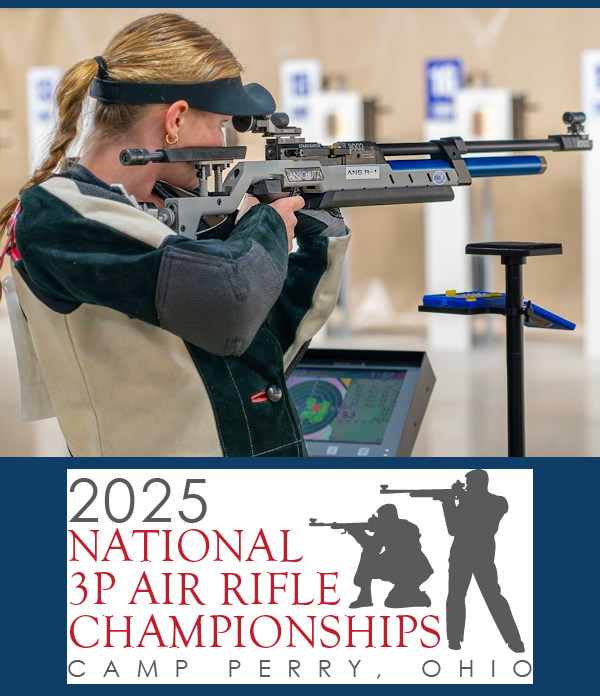
This coming week, July 7-9, 2025, the National 3PAR (Three-Position Air Rifle) Precision Championships take place at Camp Perry, Ohio. This 3-day event for junior shooters is the culmination of a series of shooting competitions organized by the Civilian Marksmanship Program (CMP). The annual CMP 3PAR competition begins with postal matches, followed by regional championships (in multiple states), and culminates in a national championship held at Camp Perry, Ohio. There will be both individual and team competition. All matches will be fired on electronic targets. CLICK HERE for Match Program PDF.
Prizes and Scholarship Awards for Top Competitors
This 3PAR Championship is an event for young shooters — qualifying juniors and high school seniors who have just graduated are eligible. There will be monetary awards for both individual and team winners. In addition, the top three competitors who just graduated from high school will each receive a $1000 CMP Scholarship award. In addition, USA Shooting will present a National Futures Team slot to the top male and female shooters in the precision class.
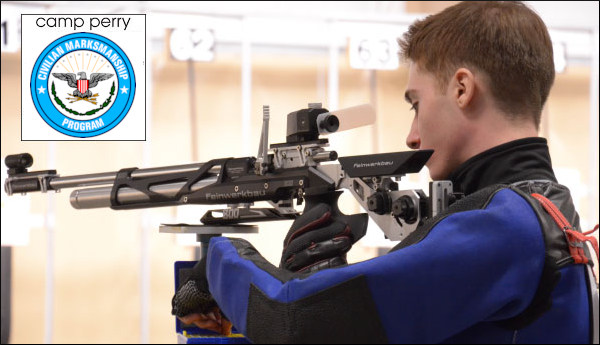
Precision Air Rifle is modeled after Olympic-style shooting and allows the use of very high-tech (and pricey) target rifles and equipment. By contrast, Sporter Air Rifle employ simple, much less expensive rifles. In both types of shooting, competitors fire at targets at a distance of 10 meters in three different positions, prone, standing and kneeling. The Sporter match took place June 21-25, 2025. The Precision match, with the high-tech, ultra-accurate rifles (like the Feinwerkbau shown below), kicks off tomorrow, July 7, 2025.
Location and Facilities: The championships will take place at the Gary Anderson CMP Competition Center, located at Camp Perry Training Site, 1000 N. Lawrence Road Bldg. #5042, Port Clinton, OH 43452.
Course of Fire: The course of fire will be one 3×20 three-position air rifle event on each competition day, with all events fired at 10 meters. Teams will be comprised of four members selected before the competition begins. A final will be fired for the top 8 individuals.
The modern Gary Anderson Competition Center boasts a long row of indoor electronic targets, which can provide multiple target distances from fixed firing points.
Electronic Targets with Results Streamed Online
The Gary Anderson Center boasts state-of-the-art electronic targets that record scores the instant each shot is fired. Shot-by-shot feeds (and scores) are then displayed on large screens. For some matches, live target images are uploaded to the web for display on mobile devices.
About the National 3PAR Championships — Key INFO
Phase 1 Postal Matches: Competitors shoot on their home ranges and submit scores to CMP.
Phase 2 Regional Championships: Top postal match shooters advance to regional competitions.
National Championship Finals: The final event, held at Camp Perry, features both precision air rifle competitions (July 7-9, 2025) and sporter competition (June 19-21, 2025).
3PAR Competition Classes: There are separate competitions for sporter (designed for new competitors) and precision (modeled after Olympic-style shooting) classes.
National Matches: 2025 3PAR competitions at Camp Perry are held in conjunction with the larger National Matches, offering opportunities for additional shooting events.
National Championship Dates: The Sporter Championship was held June 19-21, 2025. The 3PAR Precision Championship takes place July 7-9, 2025 at Camp Perry.
Championship Rules: The 3PAR Championships are conducted under the 2024-2026 15th Edition National Standard Three-Position Air Rifle Rules (NS3PC). CLICK HERE to download the rules from the CMP website.
About the Gary Anderson CMP Competition Center
The Gary Anderson CMP Competition Center in Ohio, is open to the public, year-round. This modern facility features an 80-point range equipped with the CMP’s own electronic targets. The facility also includes a retail center for equipment and memorabilia sales.
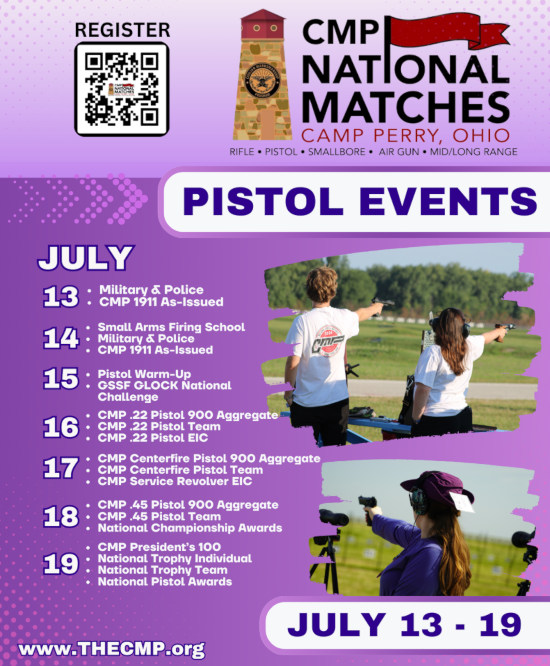
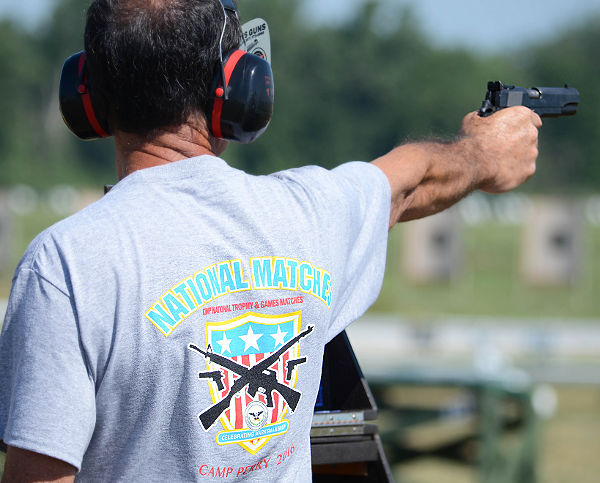
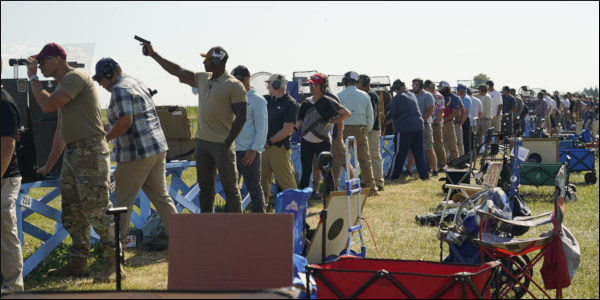
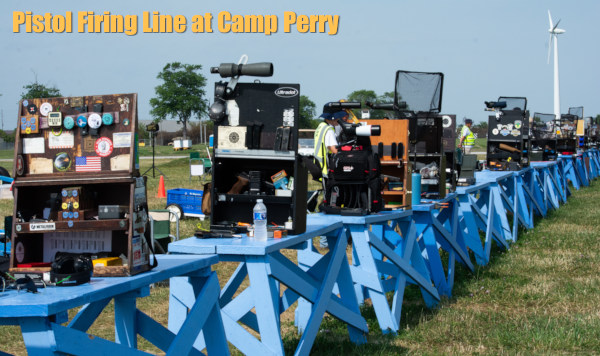
There will be major rimfire and centerfire pistol competitions at the 2025 CMP National Matches at Camp Perry, Ohio. Hundreds of shooters will participate in these popular individual and team events, which commence in mid-July.
The pistol competitions begin on July 13, 2025 with Military & Police and CMP 1911 pistol matches. These continue through the 14th, when the CMP will also conduct a Small Arms Firing School (SAFS) led by USAMU, Military Team, and CMP instructors. Following classroom instruction and practice on the range, SAFS participants will fire an M17 EIC Match.
On July 15 the GSSF Glock Challenge match will be held. On the 16th the .22 Rimfire 900 Aggregate, Team Matches, and Rimfire EIC matches will be held. In the past, these matches have been hugely popular — with 480+ Rimfire competitors from novices to experts.
Following the rimfire pistol matches, there will be centerfire Pistol Aggregate and Team Matches on July 17, followed by .45 Pistol Aggregate and Team matches on July 18. Then, on the 19th, the big President’s 100 Pistol Match, National Trophy Individual Match, and National Trophy Pistol Team Matches will be held. There will be plenty of talent on the firing line. In recent years, over 90% of the top 50 Service Pistol shooters were Distinguished. The Pistol Games conclude on Saturday the 19th, with Pistol Games Awards at the end of the day.
This video shows .45 ACP centerfire pistol competitors at Camp Perry
Interested in competing in the Camp Perry Pistol Matches this summer with either a .22 LR Rimfire pistol or centerfire pistol? It’s not too late to register. CLICK HERE for Pistol Match Online Registration.
Looking downrange at the 600-yard targets. All Camp Perry photos courtesy Dennis Santiago.
The National President’s 100 Match is a famous competition held at Camp Perry every summer. This year’s President’s 100 will take place on July 28, 2025, three weeks away. SEE 2025 Camp Perry NM Calendar.
This is a huge event. in recent years, there have been over 1000 ranked competitors from throughout the nation, making this one of the biggest rifle events of the year. Credit our friend Dennis Santiago for this report. Dennis has competed in the President’s 100 in recent years.
The President’s 100 Rifle Match is richly steeped in history. This unique match was first held in 1878. Above is the view from the line at 600 yards. The top 100 competitors overall in the President’s Rifle Match are designated as the President’s 100. They receive President’s 100 medallions and certificates.
President’s 100 Shoot Off — The Top 20 shooters compete in the Shoot-Off.
President’s 100 Course of Fire
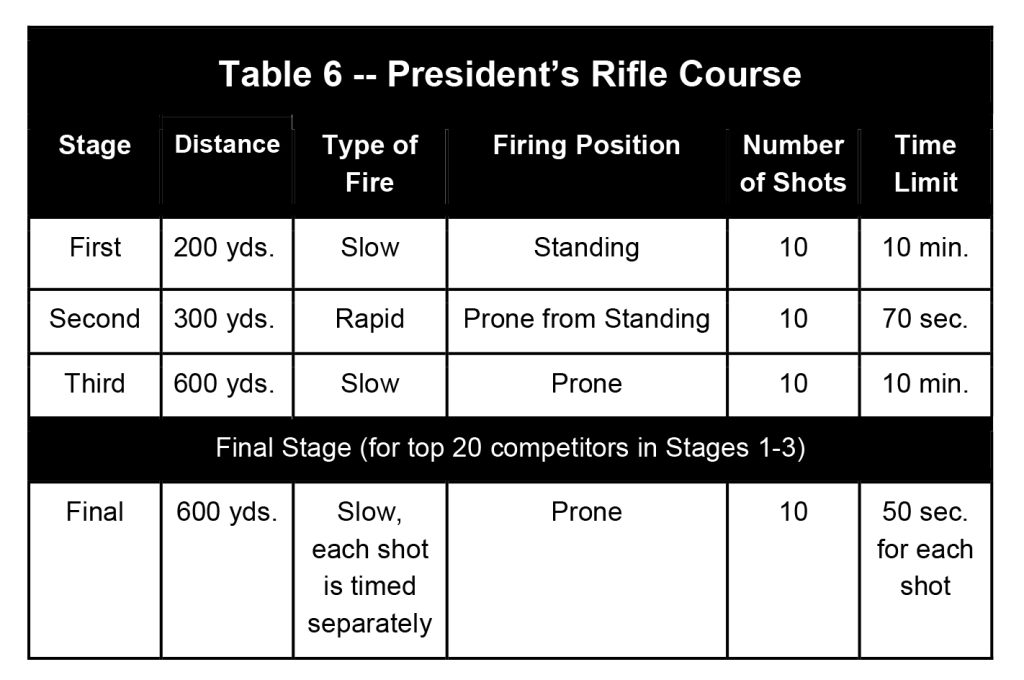
There is a three-yardage, four-stage Course of Fire for the President’s Rifle Match Course of Fire. Firing is done on the SR target at 200 and 300 yards and the MR target at 600 yards. Scores in stages 1-3 determine the President’s 100 and the final rankings of competitors in 21st place and below. Scores in stages 1-4 determine the match winner and the final rankings in places 1-20. If there is a tie for first place (equal total and X-count), the tied shooters will continue to fire one-shot-at-a-time until the tie is broken. No sighters are permitted in National Trophy Rifle Matches.
Origins of the President’s Match The National Rifle Association’s President’s Match was instituted in 1878, as the American Military Rifle Championship Match. In 1884, the name was changed to the President’s Match for the Military Rifle Championship of the United States. It was fired at Creedmoor, New York until 1891. In 1895, it was reintroduced at Sea Girt, New Jersey. Today, the match is held at Camp Perry, Ohio.
The President’s Match was patterned after the Queen’s Match for British Volunteers. That British competition was started in 1860 by Queen Victoria and the NRA of Great Britain to increase the ability of Britain’s marksmen following the Crimean War.
The tradition of making a letter from the President of the United States the first prize began in 1904 when President Theodore Roosevelt personally wrote a letter of congratulations to the winner, Private Howard Gensch of the New Jersey National Guard.
After a hiatus in the 1930s and 1940s, The President’s Match was reinstated in 1957 at the National Matches as “The President’s Hundred.” The 100 top-scoring competitors in the President’s Match were singled out for special recognition.
E-Targets at 2025 National Matches — Rimfire and Centerfire
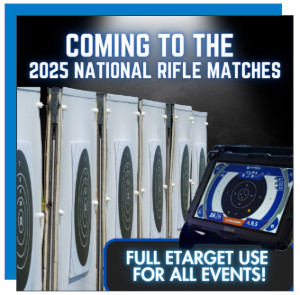
After years of testing, the Civilian Marksmanship Program (CMP) will make full use of eTargets at the 2025 National Rifle Matches at Camp Perry, which run July 20 through August 9, 2025. The advanced Kongsberg eTargets will be used at all Highpower rifle matches, National Trophy Rifle competitions, and Rifle Games events. In addition the eTargets will be used for the Rimfire Sporter Match on July 20 and the National Mid/Long Range Matches in August. The use of eTargets eliminates the need for pit duty, drastically cutting down the duration of each match. CLICK HERE to learn more about Camp Perry eTargets.
These matches are conducted by the CMP and Ohio National Guard. Since their inception, the National Matches have become a huge, national shooting sports event with over 4,500 annual participants.
Editor: America’s birthday, the 4th of July, is just five days away. To help mark this historic occasion, today we feature a pair of patriotic rifles — a Light Gun and a big Heavy Gun both used in 1000-yard competition at the famed Williamsport Range in Pennsylvania. These rifles both feature handsome patriotic graphics featuring the U.S. Constitution and the Stars and Stripes.
Report by Andrew Murtagh
I’ve been a long range shooter for over two decades. Like most shooters in this game I’ve built, bought, and sold many rifles during my tenure. Here’s my tale of two special rifles, a Heavy Gun and a Light Gun, both sporting Patriotic stock graphics. I have shot both of these rifles in competition at Reade Range and The Original Pennsylvania 1000-Yard Club, aka “Williamsport”, where I have served as Club Vice-President.
My two Patriots were both acquired second-hand from a fellow shooter, Mike Bonchack. As purchased, they were very different from what they are now. I first decided to rechamber them using my reamers. The Light Gun (LG) is now chambered in 6×47 Lapua with 0.267″ neck, while the Heavy Gun (HG) is a 6mm Dasher with 0.266″ neck. After re-chambering the barrels, next I decided to get both guns up to maximum weight. The LG already had an adjustable weight system so it was easy to get it to 17 pounds. For the HG, I added an additional 25 pounds of lead/epoxy fill which was milled into the barrel channel and butt stock.
The Story Behind the Patriotic Graphics
I was initially going to have the LG painted until a close friend and fellow shooter, Tom Murtiff, suggested hydrographics. I landed on the patriotic theme because I’m a right-wing leaning Constitutionalist who still believes in the principles upon which our Founding Fathers built this nation. I wanted to express my support of our country’s Constitution and its Amendments. The search for the perfect patriot print was on.
This was my first hydrographic print experience and I was overwhelmed with the sheer number and variety of prints available. I spent a few days searching when I found the Amendment print. I then contacted Rick Schuh, owner of Boyzhid Hydrographics. He then prepped, hydro-dipped, and clear-coated the LG. Late in 2017 I purchased the HG and through a lengthy process in 2018 the metal work and stock additions were completed. I was now back in search of the perfect print. This was also lengthy, and I couldn’t find anything that spoke to me except for a suggestion to have “twin” rifles. I liked the idea — a pair of “Patriots!”
Rick was again employed to dip the Heavy Gun. That became a real undertaking because the stock alone (no metal attached) now weighed 35 pounds. He had to manufacture reinforced hangers to apply the graphics without flaw. The stock came out perfect to my eye, but not to his. On the bottom, which is rarely seen on any HG, he airbrushed a small flag to cover an area that stretched the print. Rick also made a jeweled plate for the toe of the butt.
I’m including this image so everyone can see Rick’s extra effort to make the HG perfect. I often joke with him about the added work no one would see. Well now the world can view his workmanship.
1000-Yard Heavy Gun Specifications:
Kelbly Stolle F-Class Panda dual-port, right eject with Kelbly Picatinny rail
Modified Ryan Miller HG stock bedded/pillared/weighted by David Powley
Bartlein 1:8.5-8″ gain-twist 0.236″ bore barrel
— chambered in 6mm Dasher 0.266″ neck by David Powley
Ryan Miller barrel-block fitted with nylon bushing by David Powley
Harrell’s muzzle brake
Jewell trigger
Optic One: NightForce 12-42x56mm NXS in Vortex rings
Optic Two: Leupold 7-35x56mm Mark 5 HD in Leupold rings
1000-Yard Light Gun Specifications:
BAT Machine B Action RB/LP/RE
McMillan MBR stock bedded by David Powley
Bartlein 1:8″-twist 0.237″ bore 30″ barrel
— chambered in 6×47 Lapua 0.267″ neck by David Powley
Harrell’s radial muzzle brake
Jewell trigger
NightForce 15-55x52mm Competition Scope in Harrell’s rings
Stock Graphics: Both rifles share a Patriot Constitution Hydrographic print (and clear-coat) by Rick Schuh of BoyzHid Hygrogaphics.
How to Succeed in the 1K Benchrest Games — Q & A with Andrew
Q: How Do You Choose a Chambering/Cartridge for a particular Match or Relay?
Andrew: Cartridge choice depends on the wind forecast. I always have several rifles with particular cartridge/loads for each depending on the forecast. If it’s a light wind day, say 4 to 8 mph with light gusts, I’ll be shooting either a 6×47 Lapua or a 6mm Dasher. If it’s blowing around 10 to 12 mph, I’ll campaign a 6×47 on its high node to get it down range flat. But if it’s really blowing or constantly changing direction, I shoot a big .300 WSM with either 200gr or 210gr bullet.
Q: What Is Your Load Development Method?
Andrew: Initial load development is always done over the chronograph at 100 yards until I get low ES/SD for 5 shots utilizing the same 10 pieces of absolutely perfect brass. Once I’m satisfied with the raw data I move to 1000 yards with a set of match brass and shoot 5-shot strings to find the best-performing exact powder charge. I have found this is usually within 0.20 grains of what performs well over the chronograph.
Q: What Brass, Primers, Powders, and Bullets Do You Use?
Andrew: I use Lapua brass for all things 6mm and Norma brass for my big .30 Cal stuff. I never change primers and shoot CCI BR2s or BR4s. I’m a Varget and H4350 fan. I’ve tried other powders, but they never were fruitful at 1K. Currently the only bullets I shoot are Sierra Match Kings. In the 6mm Dasher and 6×47 Lapua I use the 6mm 107gr SMK. In my .300 WSM I use .308-cal 200gr and 210gr SMKs.
Q: What Advice Do You Have for Novice 1000-Yard Competitors?
Andrew: Leave your ego at home and be willing to learn each and every time you come to the range. The discipline evolves rapidly and so must the shooter. It won’t take long to get left behind and become extremely frustrated with the game if you are not willing to learn and adapt. Find a tutor who is a great shooter and who is willing to mentor you. John Hoover and Tom Murtiff helped me and are very dear friends and great 1000-yard shooters. Believe me, having a good mentor takes years off the learning curve. Lastly, enroll in the Benchrest Shooting School offered by The Original Pennsylvania 1000 Yard Benchrest Club. I’m an instructor there and I, along with all the cadre, will help new shooters rapidly advance their skills.
Q: What’s the Secret to Judging the Wind? (In this discipline there are no target markers after each shot.)
Andrew: That’s the million-dollar question. What I do is find the condition that seems to hold. Once I’m committed into the record string, I follow it to the end. At Williamsport the wind flags can change at every distance so you simply need to pick one flag and hope it’s the one that remains truthful.
Long Range Competition Advice from a Leading 1K Benchrest Competitor
FIVE Key points to remember when shooting 1000-Yard benchrest
1. Be positive and have a clear state of mind when competing.
2. Bench set-up and shooting mechanics must always be the same — every shot. Then follow the shot through your optic.
3. Shoot two (2) shots before making a scope adjustment unless you’re under a minute of the sighter period.
4. Trust yourself and your equipment. You never want to second guess anything you put on the line.
5. Once you commit to shooting your record string, DO NOT STOP.
Andrew wanted to give credit to the many talented guys who have helped with his rifle builds and his reloading equipment. In alphabetical order, these are Mike Bonchack, John Hoover, Tom Murtiff, David Powley, and Rich Schuh (Boyzhid Hydrographics).
BONUS Topic — Case Prep and Loading for 1000-Yard Benrchest
Accurate loading, in my opinion, all starts with perfect brass. I always use Lapua or Norma brass, and when I buy it I try to purchase no less than 500 of the same lot. Most shooters sort by weight and I do as well, but it’s the last thing I do instead of the first. My reasoning behind this is simple, if I’m going to uniform primer pocket, ream and debur flash holes, turn necks, trim cases to length I’m removing lots of material. Therefore the weights change drastically from where they started. That said weight sort at the end, period. I do the entire lot at one time — a labor of love.




 E-Targets for Rimfire Sporter Match This Year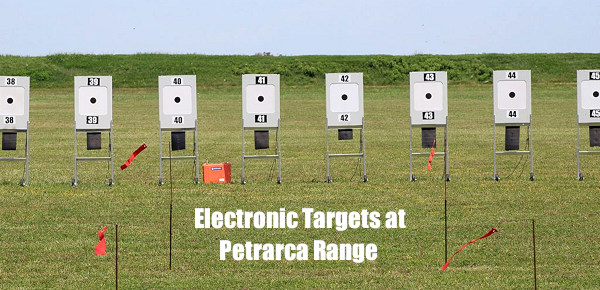



 Position shooters can also improve their skills by shooting different disciplines. High Power Across-the-Course shooters benefit from shooting smallbore and air rifle. Again, these targets are very small, which will encourage competitors to be more critical of their shot placement. Hunters may benefit from shooting silhouette matches, which will give them practice when shooting standing with a scoped rifle. Tactical matches may also be good, as tactical matches involve improvising shots from various positions and distances. [Editor: Many tactical matches also involve hiking or moving from position to position — this can motivate a shooter to maintain a good level of general fitness.]













 The National Rifle Association’s President’s Match was instituted in 1878, as the American Military Rifle Championship Match. In 1884, the name was changed to the President’s Match for the Military Rifle Championship of the United States. It was fired at Creedmoor, New York until 1891. In 1895, it was reintroduced at Sea Girt, New Jersey. Today, the match is held at Camp Perry, Ohio.