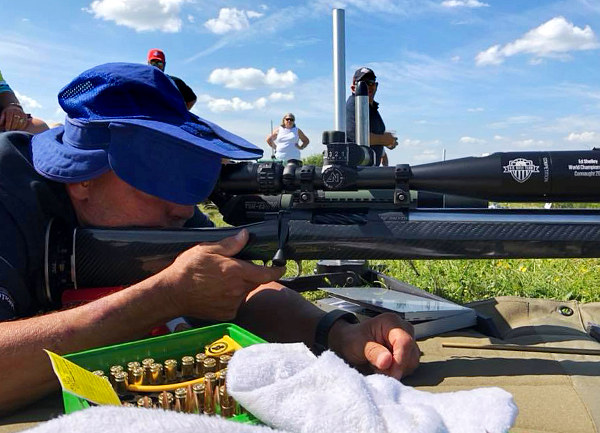
2018 National Matches photo from NRA Competitive Shooting Facebook Page.
National High Power Matches, July 5-24, 2018 at Camp Atterbury Indiana
The NRA National High Power Matches are now underway at Camp Atterbury in Indiana. The Rifle National Matches, running July 5-24, will include the High Power Championship, the Long Range Championship, and the Mid-Range Championship, along with other special events. We are now in the thick of the NRA High Power Rifle Championship, which runs through Wednesday, July 11. Good luck to all the competitors! The Long Range Individual Championship runs the 16th through the 19th, followed by Long Range Palma, and Mid-Range individual and Team Matches.
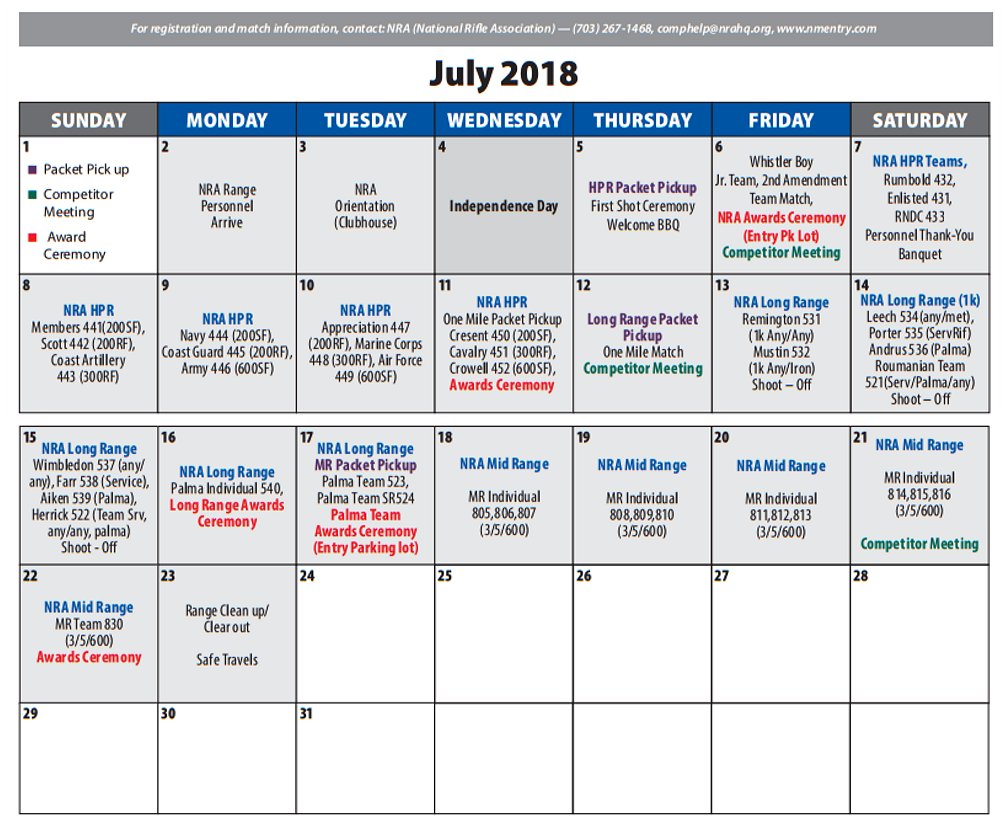
National Matches at Camp Atterbury, Indiana, 2018 Schedule:
Friday, July 6: Whistler Boy JR. Team, 2nd Amend. Team Match, Awards Ceremony, Competitor Meeting
Saturday, July 7 – Wednesday, July 11: NRA High Power Rifle (awards ceremony on concluding day)
Thursday, July 12: Long Range Packet Pickup and Competitor Meeting
Friday, July 13 – Monday, July 16: NRA Long Range (awards ceremony on concluding day)
Tuesday, July 17: NRA Long Range Palma, Palma Team Awards Ceremony
Wednesday, July 18 – Saturday, July 21: NRA Mid Range Individual
Sunday, July 22: NRA Mid Range Teams, Mid Range Awards Ceremony
Monday, July 23: Range Clean Up/Clear Out
Click Calendar to See Large, Full-Screen Version.
Lodging at Camp Atterbury and Nearby
There is on-base lodging — rooms and cabins will be available to all competitors 18 and over. To book a room, or for any questions about lodging, please call (812) 526-1128. Camp Atterbury lodging includes suites and standard rooms as well as the MWR Campground and the MWR Cabins. Lodging is controlled by the Camp Atterbury Lodging Office, not by the NRA. Entry fees DO NOT include lodging costs. There are also a number of hotels nearby, including Charwood Suites. Nearby campground Johnson County Park also offers special rates for High Power competitors.
With the CMP hosting important matches this year at Camp Perry, many rifle competitors will be “commuting” between the two venues this summers, driving 4.5 hours from Indiana to Ohio.
Forum member Keith W. (aka “Cigarcop”) of KW Precision LLC is a talented riflesmith whose projects display outstanding finish work and attention to detail. Keith does some of the best bedding work we’ve ever seen. Here is one of his latest creations. Keith recently completed a stunning F-Class rig for a shooter in Delaware. It’s a beauty, that’s for sure. Keith has posted more details about this rifle in a Shooters’ Forum Thread.
This handsome rifle features a polished Stolle (Kelbly) Panda Action, and two (2) Brux barrels, both chambered for the .284 Winchester cartridge. The real eye-catching component of this rifle is the stunning Cerus F-Open stock. This features multiple laminations with highly-figured Walnut on the sides. This certainly ain’t your “off-the-shelf” laminated stock. This just shows the beauty that can be achieved with carefully-chosen lamination layers (plus 12 coats of clear).
This beautiful F-Open rig features a laminated wood stock with stunning figured walnut on the outside.
Keith of KW Precision LLC is renowned for his bedding work, and this rifle shows why. Keith takes great pride in his work, and his attention to detail is second to none. This bedding job is as good as it gets.
Bringing out the figure in the wood requires multiple finish coats (and careful sanding between coats). But the results are worth it. Shown below is the Cerus stock, BEFORE the finish coats were applied. It took time and effort to transform the “naked” Cerus stock into a true stunner. Keith applied twelve (12) coats of PPG Automotive Clear with wet sanding between each coat.
The 2018 King of 2 Miles (KO2M) event took place July 2-4 in Raton, New Mexico. Conditions were very challenging this year, yet three shooters managed to hit the most distant 3,525-yard plate at least once in five shots, a remarkable accomplishment. At that range the bullet was in flight about six seconds.
Robert Brantley of Team Manners Composite Stocks is the new King of 2 Miles. Congrats to Robert and his team-mates. Robert amassed 85178 points, finishing over 20,000 points ahead of runner-up John Buhay. Paul Phillips of Team Applied Ballistics finished third. FULL K02M 2018 RESULTS HERE.
Here’s Robert Brantley after his superb qualifying performance, which set a new 2018 King of 2 Miles qualifying round record. Going perfect on targets 1, 2, and 3, Robert missed just one shot on Target 4 of the qualifying phase, amassing 51355 points, a new K02M record.
CLICK HERE for a very complete and thorough KO2M report created by The Precision Rifle Blog (PRB). This excellent PRB Report contains complete load and rig specifications for the top five shooters. In addition, the PRB Report includes a full run-down on this year’s event.
Though the trigger pullers get the glory, this is really a three-man game. One guy shoots, a second team member spots for hits and calls corrections, and a third watches mirage and makes wind calls.
Multi-Day, Multi-Distance Competition with Farthest Target at 3525 Yards
The K02M Competition runs in stages, with the distances getting farther with each round. After five shots on target 1 at 1547 yards, there are then three shots per target for the remaining three parts of the Qualifying round. Then, in the three-target Finals phase, there are with five shots per target. You get more points for earlier hits in each string, and there are no sighters during the match. The event started with a tough Cold Bore Challenge — a single-shot at 1689 yards, just shy of one mile. Only three out of 62 competitors made that cold-bore mile shot on a 16″ plate, about 1 MOA at that distance. After that there are two rounds with the targets arrayed as follows.
KO2M Qualification Round
1,547 yards: 5 shots, 24” x 37” rectangle
1,719 yards: 3 shots, 24” x 37” rectangle
1,890 yards: 3 shots, 30” x 37” rectangle
2,095 yards: 3 shots, 30” x 37” rectangle
KO2M Finals Round — July 4
2,727 yards: 5 shots, 33” x 41” rectangle
3,166 yards: 5 shots, 42” x 54” rectangle
3,525 yards: 5 shots, 48” x 60” rectangle
Big Bore Rifles with High-BC Bullets
This year saw the continued evolution of equipment. Top shooter Brantley shot a .416 Barrett with 500gr Cutting Edge bullets. Robert’s massive 44-lb rifle featured a 39″ K&P barrel, McMillan action, and a Manners LRT (Long Range Tactical) stock designed expressly for this KO2M competition.
Second Place John Buhay shot an improved version of the .375 CheyTac, with 353gr Lehigh Defense Match Solid bullets. Buhay’s 37.6-lb rig bosted a BAT action and 36″ Krieger barrel along with a fairly conventional McMillan MBR 1K benchrest stock. Mark King built the rifle.
Third Place Paul Phillips campaigned a .416 Barrett with 550gr Cutting Edge Lazer bullets. Paul’s 42-lb rig featured a BAT action and McMillan Beast 1 stock. Shown below is the latest rifle of 2017 K02M champ Derek Rodgers, a .416 Barrett also in a McMillan Beast. Derek spotted for Phillips in the match.
Optics Options
There was quite a variety of scopes used by Top K02M competitors, evidence that a number of manufacturers now offer optics with abundant elevation and the ability to stand up to heavy recoil. Here are the optics choices for the Top Five Shooters:
1. Bushnell XRS II 4.5-30x50mm with G3 reticle in Badger UniMount
2. Nightforce ATACR 5-25x56mm with MOAR reticle, with ERA-TAC Inclined Mount
3. Nightforce ATACR 5-25×56mm, with Charlie TARAC external Prism System for Elevation
4. Leupold Mark 5HD 5-25×56mm, in Spuhr mount with Charlie TARAC
5. Burris XTR II 5-25x50mm in Barrett rings
Notably, two of the top five used the Charlie TARAC prism system. This provides a ton of extra elevation by essentially shifting the view seen through the scope. The unit fits to the scope’s front objective.
John Whidden of Whidden Gunworks used the .243 Winchester cartridge to win the 2017 NRA Long Range Championship, his fifth LR title at Camp Perry (and second in a row). John selected the .243 Win because it offers excellent ballistics with manageable recoil. John says that, at least for a sling shooter, the .243 Win is hard to beat at long range. Yes, John says, you can get somewhat better ballistics with a .284 Win or .300 WSM, but you’ll pay a heavy price in increased recoil. Here’s John’s story of how he wins with a .243 Win.
Great Ballistics with 6mm 105s at 3275 FPS
Running at an impressive 3275 FPS, Berger 6mm 105 grain Hybrids deliver ballistics that are hard to beat, according to John Whidden:
“My .243 Win shoots inside a 6.5-284 with 142-grainers. Nothing out there is really ahead of [the .243], in 1000-yard ballistics unless you get into the short magnums or .284s and those carry a very significant recoil penalty. In the past I did shoot the 6.5-284. I went to the .243 Win because it had similar ballistics but had much less recoil. It doesn’t beat me up as much and is not as fatiguing.
With the .243 Win, there’s no tensing-up, no anticipating. With the reduced recoil (compared to a 7mm or big .308), I can break and shoot very good quality shots. I find I just shoot better shots with the .243 than I ever did with the 6.5-284.”
The .243 Winchester — Good Enough to Win LR Championships
by John Whidden, Five-Time National Long Range Champion
My experience with the .243 cartridge for use as a Long Range High Power cartridge dates back about 10 years or so. After building a .300 WSM, I realized that the recoil was hurting the quality of my shots. The WSM shot great, but I couldn’t always execute good shots when shooting it. From here I built a 6.5-284, and it shot well. I also had a very accurate 6mmBR at the time, and my logic in going to the .243 Win was to get wind performance equal to the 6.5-284 with recoil similar to the 6mmBR. The experiment has worked out well indeed!
Championship-Winning Load: Berger Bullets, Lapua Brass, and Vihtavuori N160
For a load, currently I’m shooting Lapua brass, PMC primers (Russian, similar to Wolf), VihtaVuori N160 single-base powder, and Berger 105 grain Hybrid bullets. I switched to the Hybrid bullets fairly recently at the beginning of the 2015 season. Previously I shot the 105gr Berger hunting VLDs, and in testing I found that the Hybrids were just as accurate without having to seat the bullet into the lands. The velocity of this combination when shot through the excellent Bartlein 5R barrels (32” length) is around 3275 FPS. Surprising to some, John does load his ammo on a Dillon Progressive press (with help from his ultra-precise Auto-trickler).
For my match ammo, I seat the Berger 105 Hybrids well off the lands — my bullets are “jumping” from .035″-.060″. I only use one seating depth for ammunition for multiple guns (I know some benchrest shooters will stop reading right here!) and the bullets jump further in the worn barrels than in the fresh barrels. The bullets are pointed up in our Bullet Pointing Die System and are moly-coated. The moly (molybdenum disulfide) does extend the cleaning interval a little bit, probably 20% or so. The Lapua .243 Win brass is all neck-turned to .0125″ thickness.
Whidden’s .243 Win Ammo is Loaded on a Dillon
My loading process is different than many people expect. I load my ammo on a Dillon 650 progressive press using our own Whidden Gunworks dies. However powder charges are individually weighed with a stand-alone automated scale/trickler system from AutoTrickler.com (see below). Employing a high-end force restoration scale, this micro-processor controlled system offers single-kernel precision. The weighed charges are then dropped into the cases with a funnel mounted to the Dillon head.
The Lapua .243 Win brass is full-length sized every time, and I run one of our custom-sized expanders in my sizer die. The expander measures .243″ which yields the desired .001″ neck tension. In my experience, the best way to get consistent neck tension is to run an expander in the case neck at some point. When sizing the case neck by a minimal amount such as is the case here, I don’t find any negative points in using an expander in the sizer die.
In my experience, the keys to accurate long range ammo are top quality bullets and the most consistent neck tension you can produce. From these starting points, the use of quality components and accurate powder measurement will finish out the magic.
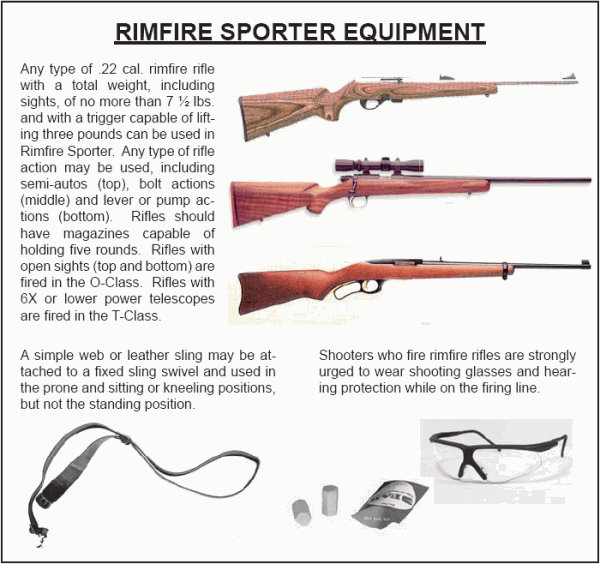
The CMP National Rimfire Sporter Match is a fun competition with affordable smallbore rifles with either scopes or iron sights. All you need are a .22 LR rifle, sling, and ammo.
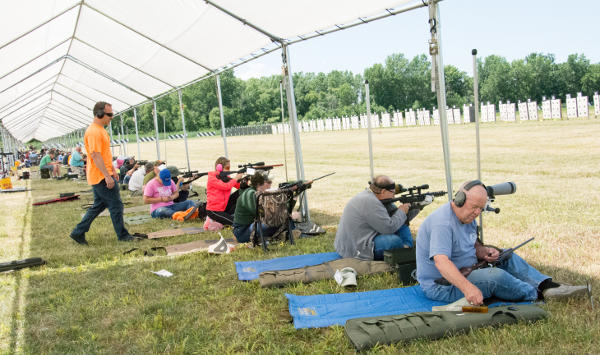
Each year, the Rimfire Sporter Match attracts hundreds of shooters to the shores of Lake Erie. If there is a single CMP event at Camp Perry that offers the highest level of shooter satisfaction, the most diverse group of competitors, and the lowest cost of entry, that would be the annual Rimfire Sporter Match. This year’s match will be held on Sunday, July 22, 2018 on the Viale Range. The Rimfire Sporter Match is for smallbore rifles that weigh 7 1/2 pounds or less with sights. Firing is done at 25 and 50 yards in prone, sitting and standing positions, in slow and rapid fire modes.
On Saturday July 21st, Rimfire Sporter Competitors will check-in, have their rifles weighed, triggers checked, and receive their squad assignment. Also on Saturday there will be a free Rimfire Sporter Seminar held at the Gary Anderson CMP Competition Center.
Rifles may be manually operated or semi-automatic, in three classes: the standard “O Class” for open-sighted rifles, “T-Class” for telescope-sighted rifles, and the “Tactical Rimfire” Class. Firing is done at 50 and 25 yards on a target with a 1.78″ ten-ring. The target is simple enough for a beginner to hit, yet challenging enough that only one competitor in the history of the match has ever fired a perfect 600 score. Here’s the young man who did that, Samuel Payne:
FREE Ammo from Lapua (One 50rd Box per Entrant):
Lapua has graciously donated 50 rounds of Lapua .22 smallbore ammunition for each competitor in the National Rimfire Sporter Match, but this ammunition will not be enough to shoot the entire match. Competitors will need a total of 60 rounds to fire the Rimfire Sporter Match plus any sighters or range alibis.
Getting Ready for the 2018 Rimfire Sporter Match
Preparing for the Match: You need to bring your own .22 cal. Rimfire rifle(s) and ammunition. Special target shooting equipment, shooting jackets, or shooting gloves are not permitted, but feel free to bring a spotting telescope and ground cloth or shooting mat. You will be shooting on a grass firing point. Competitors are strongly urged to you wear hearing and eye protection.
A free Shooters’ Clinic will be held Saturday the 21st from 4:00-6:00PM (no equipment is needed for the clinic). The Clinic covers Rimfire Sporter rules, safety instructions, course of fire, and competition procedures. The Clinic will also demonstrate the firing positions, use of the sling, as well as slow and rapid-fire techniques. Shooters who have not previously attended a CMP Rimfire Sporter Match are strongly encouraged to attend.
Rimfire Sporter Course of Fire
Competitors will complete slow fire prone, rapid fire prone, slow fire sitting or kneeling, rapid fire sitting or kneeling, slow fire standing, and rapid fire standing shot sequences. To learn more about the National Rimfire Sporter Match, CLICK HERE.
Three different classifications of rifles can be used in Rimfire Sporter competition: “O Class” for open-sighted rifles, “T Class” for telescope-sighted rifles and the recently-added “Tactical Rimfire” class. Awards are offered to High Juniors, High Seniors, High Women as well as Overall winners are named for each class.
Do you want to see more match photos? CLICK HERE to view the CMP Zenfolio Archive with 500+ photos from 2016 National Rimfire Sporter Match.
There is a new, ultra-high performance 7mm projectile for F-Open and long-range competitors. Berger has introduced a new 184gr F-Open Hybrid Target bullet, which will be the official 7mm bullet of the U.S. F-Open Rifle Team. The new 184-grainer is an advancement over previous 7mm match bullets. As you can see above, the new bullet is longer and sleeker than Berger’s existing 180gr Hybrid Target bullet. The new design gives the 184gr F-Open Hybrid impressive 0.695 G1 and 0.356 G7 Ballistic Coefficients. Compare that to 0.680 G1 and 0.349 G7 for Berger’s 180gr Target Hybrid bullet.
Bryan Litz of Applied Ballistics designed the new 184gr F-Open Hybrid to be slightly heavier, slightly longer, and have a more aggressive ogive shape. This gives the new 184-grainer a ballistic advantage over Berger’s existing 7mm 180gr Hybrid and VLD Target bullet designs. This bullet complements the .30 Cal 200.20X Hybrid Target bullet that was released last year in collaboration with the U.S. F-TR Rifle Team. As with that 200.20X bullet, for the new 184gr F-Open Hybrid, Berger took a successful, existing design and optimized the ballistic profile to make it even better. Along with .284 Win and 7mm SAUM used by F-Open shooters, this bullet should work well in a variety of 7mm cartridges.
New 184gr Hybrid Bullet Tested Extensively by U.S. F-Open Rifle Team
The U.S. F-Open Rifle Team tested the 184gr F-Open Hybrids thoroughly to ensure that they performed as well on target as they did in theory. The results were very positive, and this bullet has been adopted as the official 7mm bullet for the U.S. F-Open team. “The United States Rifle Team 2021 F-Open is extremely excited about the release of the new Berger 184gr F-Open Hybrid. Many members have tested the prototype bullets with outstanding success,” says Dan Bramley, Team Captain.
Note: On the Berger website, Berger lists a recommended 1:8″-twist rate for this new bullet. However, in its June 25, 2018 product announcement, Berger states the Minimum Twist Rate is 1:9″. MSRP is $61.99 per 100-ct box, Berger Part #28408. Grafs.com price is $54.99/box.
Berger says the bullet, which should be available very soon, will work in a variety of 7mm cartridges including: 7mm-08 Rem, .284 Win (and .284 IMP), 7mm SAUM, 7mm RUM, and 7mm Rem Mag.
Berger Supports U.S. F-Open Team — $1.00 Per Box
Berger states: “F-Class is one of the fastest growing precision rifle shooting disciplines, requiring the very best precision and accuracy to compete at the top levels. Berger has always been dedicated to making the very best bullets for our shooters. To help support the U.S. F-Open Team, Berger Bullets will donate $1.00 for every box of 7mm 184gr F-Open Hybrid bullets sold towards U.S. Team expenses for the upcoming 2021 F-Class World Championships in South Africa.”
Our friend Anette Wachter (aka 30CalGal) is profiled this month on the NRA Family website. Annette talks about how she got into the shooting sports (though a challenge from her ex-husband), and how she has advanced along the way. She is now one of the top female Palma shooters in the nation. She also now competes regularly in Precision Rifle matches — tactical style competitions. She enjoys the challenge of PRS events, and she also competes in 3-Gun matches, with pistol, rifle, and shotgun.
Anette writes about the shooting sports for many publications. She also offers tips and gear reviews through her popular website, 30CalGal.com.
NRA: What type of shooting do you do, and what makes you like it so much?
Anette: Mostly long-range rifle disciplines. I don’t shoot High Power much anymore, but of course I am on the U.S. National Rifle Team and the Palma Team, so that occupies much of my time. My new love is Precision Rifle. This is the new hot and trendy shooting sport that is taking over the industry. It is like a sniper challenge. All unknown distances and usually the matches are out in the field. I also compete in 3-Gun, which is a ton of fun.
NRA: What advice do you have for new shooters who want to get into these sports?
Anette: If you want to get in to any discipline of competition I always suggest going to a local match to watch first. With the Internet you can find out your state competition information. Look for local organizations like the USPSA. See the type of equipment shooters are using and how the sport is run. Ask a lot of questions. Shooters are a very generous culture as well, in my experience. When I started out I was loaned almost everything to try it out.
NRA: From what you have seen, are there a lot more women getting involved in the shooting sports these days?
Anette: I started shooting and competing in 2006. I remember going to NRA Nationals at Camp Perry and, out of almost a thousand competitors, I was one of maybe 20 to 30 women. At local matches I would be one of two. In the past five or six years and especially in the last three, I have seen the numbers jump like crazy. Three years ago a few women in the 3-Gun market decided to put on the first Ladies 3-Gun ProAm in Georgia. We were wondering if anyone would show up. Over 200 women competed. Any of us that had extra guns and equipment were loaning them out. For many of the women it was their first match ever. It changed lives.
In this video Anette offers smart tips for shooting with bipod:
About the 30 Cal Gal Life is short. Go Shoot! — Anette Wachter
Along with being a talented competitive shooter, Anette has her own Gun Blog, 30CalGal.com, and she writes for several gun publications including GunUp Magazine, Shooting Sports USA, Sure Shots Magazine, and Wide Open Spaces. She also designs and crafts custom jewelry items, many of which utilize cartridge cases or other shooting-themed components. You can purchase Anette’s jewelry through her AW Collections webstore.
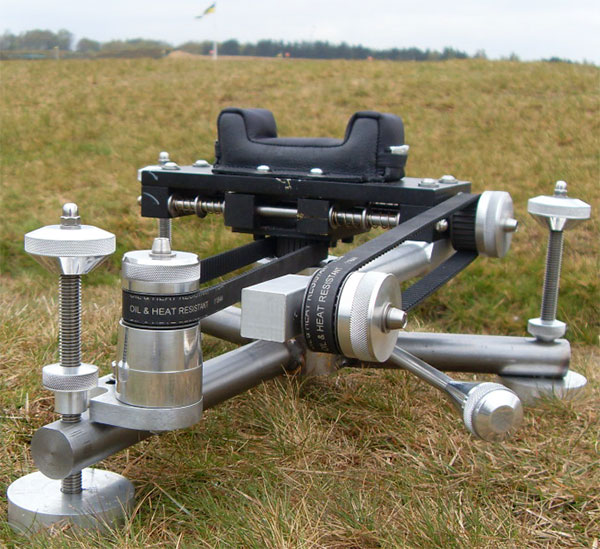
We like Do-It-Yourself (DIY) projects. It takes initiative, creativity, and dedication to make your own hardware, and that’s worth acknowledging. For you dedicated DIY guys, here’s a great project that should inspire. Here is an owner designed and crafted F-Open rig, complete with home-built, belt-drive front rest.
Some of our mechanically-skilled readers chamber their own barrels or bed their own stocks. But these are relatively simple tasks compared to the jobs of constructing an entire rifle plus building an advanced front rest from scratch. Well that’s exactly what Forum member Steve B. (aka Essexboy) did a couple seasons back. He built his own rifle and an impressive twin-belt-drive pedestal rest. (Click photo below for large version). And get this, Steve’s home-made rifle was victorious in its first-ever match. Steve reports: “I shot my first Comp with the rifle … and managed to win with a score of 239-21!” (The match was shot at 300/500/600/1000/1100 with English scoring of 5 points for center bullseye).
Do-It-Yourself F-Open Rig from England
Steve, who hails from Essex in the UK, constructed virtually every component of his skeleton-style rifle except the 28″ HV Bartlein barrel (chambered as a 6mm Dasher) and the Tikka 590 donor action. Steve also did all the design and fabrication work on his one-of-a-kind front rest. Steve tells us: “Over the last year or so, I made this rifle stock and rest. I managed to make it all on a little Myford Lathe, as you can tell I’m no machinist but it saved me a load of money — so far I’ve got about $200 invested plus the barrelled action. The stock is aluminum except for the stainless steel bag runner. The rifle came in at one ounce under weight limit for F-Class Open division.” Steve did get help with the chambering and barrel-fitting, but he hopes to do all the barrel work himself on his next project.
The gun is very accurate. Steve notes: “I have shot the rifle to 1100 yards and it shoots well. Last time out the rifle dropped just one point at 1000 yards and 5 points at 1100 yards [English scoring system]. I know it’s not pretty, but it got me shooting long range F-Class for peanuts.” Message to Steve: Don’t worry how it looks. As another Forum member observed: “Any rifle that shoots well at 1100 yards is beautiful….”
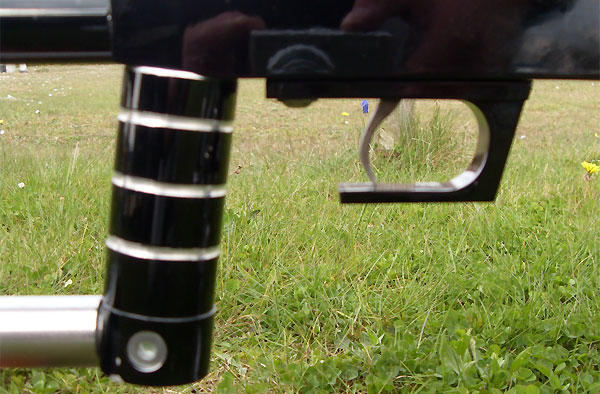
Steve started with a Tikka 590 action: “The whole stock was made on a small (6.5×13) lathe and a vertical slide. This caused a few head scratching moments, figuring out how to hold the T6/HE30 alloy for the milling/turning operations, but it did teach me a few things. The hardest parts were clamping the longer sections (such as the fore-end) and keeping it all square. Due to the short cross-slide travel I had to keep re-setting the parts. I managed to keep all measurements to 0.001″ (one thousandth). I’m most proud of the trigger guard (photo below). This took a full day but came out really well, even if I say so myself.”
Belt-Driven Front Rest
We’re impressed with Steve’s ingenious front rest. Steve explains: “The rest is belt-driven and still in the experimental stage — hence no powder coating or polishing yet. I may have gone over the top as the key moving parts (the pulleys) run on three (3) types of bearings: radial; reamed bush; and a ball race. The main post runs on a radial bearing and the feet even have bearings in them, so when I raise the main body up (for rough height adjustment) the foot stays static.”
Will Steve build another rifle? Steve says he will, and he’s upgraded his tools: “Since building the rifle I have acquired a bigger lathe (Harrison m250) and a milling machine. For the next project I hope to be able to do the barrel work (threading, chambering, crowning) as well.” The next gun might be another Dasher. Steve explains: “After extensive reading on AccurateShooter.com, I chose the 6mm Dasher chambering, as I have a shoulder problem and can’t shoot a rifle with a lot of recoil.”
Report by Craig Arnzen, Area419.com
It’s easy to think about shooting your first precision rifle match and worry about all of the gear and trinkets that you may need to make it through. In reality, the old rules apply — keep it simple.
We wanted to put together for you a no-nonsense list of the Top Five Gear Items you need for your first match. This list focuses on the “must-have” items you’ll need for PRS-Style competitions.
1. A Rifle (That is Reliable and Sub-MOA Accurate)
Your rifle is the most obvious piece of kit, but we can give you a little more information. Most of the guys you’ll find out there are shooting 6.5 Creedmoor. Yeah, there are guys using .308 Wins and 6mm Dashers, but the 6.5 Creedmoor makes up more than half of the rounds shot in PRS competition, when looking at both national and club matches. Your comp rig needs to be mag-fed and shoot better than 1 MOA. It DOESN’T need to be better than 0.5 MOA (half-MOA). With most targets being 2-3 MOA in size, a half-MOA gun will do just fine. More accuracy is better of course, but you don’t need an exotic quarter-MOA rig to win.
[Editor’s NOTE: PRS does offer a Gas Gun division, but most guys start out with a bolt-action rifle, which will be less maintenance-intensive than an AR-platform rig.]
Muzzle brakes, like our Area 419 Hellfire, are also very popular as much of the PRS game is recoil management. If you can’t see your misses, you’re sure to have more of them.
The rifle also needs an optic with repeatable clicks and a reticle with Mil- or MOA-based hashmarks. The clicks can be either Mil system or MOA system (Mil is more common), so long as the click values match the reticle (i.e. you don’t want 1/4-moa clicks with a Mil-marked reticle). How much power do you need? Anything that zooms in the mid-teens will suffice. I could shoot a match with a fixed 12X scope and not feel disadvantaged. We love the Kahles K624i, if you’re looking for a suggestion.
Oh, and you’ll want a bipod — but the choice in bipod deserves a whole separate article by itself. Nothing wrong with starting out with a Harris swivel. Then you might look at different bipods on other competitors’ rifles for comparison.
2. Ammunition — Factory Ammo and Hand-loads
Good ammo is important, but as we discuss above, 0.5 MOA is good enough. Also, speed is great but it matters FAR less than you’d think. Drop can be calculated with precision, and distances are normally known, so a slightly flatter trajectory doesn’t really matter. Wind matters, but the difference you’ll find when eeking out that last 50 fps is very, very small.
Federal, Hornady, and Prime all make quality ammo that is widely used by shooters from local to national matches. Facebook photo by CReece.
Precision Handloads
If you want to run down the rabbit hole of finding that perfect ammo that shoots in the “twos” (0.2 MOA), get yourself an AutoTrickler and some of our billet aluminum accessories — you’ll love the setup.
3. A Versatile Support Bag
There are countless bag options. But there is ONE bag you’ll see everywhere, and for good reason. The Game-Changer from Armageddon Gear is aptly named. Many shooters use it as a barricade bag as well as a rear bag, meaning a guy could get away with using only this bag for an entire match. If you need another bag when you get there, ask someone in your squad, they’ll share. I promise.
4. DOPE (Reliable Ballistics Info)
We’re not talking the kind of Dope you may find in a match outside Denver — we are talking about the kind that feeds you ballistic solutions. The software-enabled Kestrel is a very common item on the range, but you’ll also see lots of guys using mobile Apps such as Shooter or Applied Ballistics Mobile, and they have great results.
It’s also handy to have an armband or an item like the Hawk Hill data card holder for stages with various targets at differing ranges. Once the RO says “engage” and your mind stops working, you’ll appreciate having it written down.
5. Hearing Protection
PRS Competitors shoot with brakes and sometimes in enclosed spaces. That’s why you need serious hearing protection. We recommend NRR 33 earplugs, doubled up with Electronic Muffs to hear range commands. I have used the 33 dB NRR Mack’s foamies at matches for most of the last year, and the Howard Leight NRR 33 Max-1s are also very effective. The budget-priced (under $50) Howard Leight Impact Sport Electronic muffs work well, but premium electronic muffs may be more comfortable.
Growing in popularity are high-tech, in-ear digital units like the ESP Stealth. I have a set of linked ESP Steaths on the way and hope to evaluate them soon. These are supposed to be very good, but the ESP Stealths cost $2100.00 per pair!
Think we missed something? Have more questions? Let us know.
American shooters have been enjoying Irish hospitality this week in Ireland, while attending attending the Emerald 2018 match at Midlands National Shooting Centre of Ireland (Tullamore). Our friends James Crofts, Phil Kelley, and Aussie Jenni Hausler provided these images from the event — both at the range and off. The Yanks are off to a good start. James reports: “Day one scores are out and Team USA is on top. Madison Bramley topped F-Open and I held on for F-TR. I also won the 1000-yard match. My equipment performed flawlessly — rifle built by Keith Weil of KW Precision, Cerus Stock by Will McCloskey, and BRM action by Jim Borden.”
American Phil Kelley posted: “As always our hosts are outstanding. Man, love this range! Ready for the big match starting tomorrow.”
Phil Kelley enjoyed the Team Match and long-range Clays Fun Match which preceded the main event. Phil posted: “A great day, with a busy line at 1100 and 1200 yards in Ireland. Last fun day included some great competition. Team USA did well. After getting completely destroyed at 1100 yards, I was able to win the 1200 yard match; with a miss! First ever board miss, it’s only 6’ wide. 12-14 mph winds with a lying, heavy mirage.”
The day finished with a fun (and challenging) Clay Pigeon Shoot at roughly 1235 yards. Phil noted: “Ellis Berry, James Crofts and myself were one of only a handful to hit the 4.25″ clay target within 5 shots in these conditions.” Think you can do that? That 4.25″ clay bird represents a mere 0.338 MOA at 1200 Yards! Not easy folks…
Competitors in the Clay Pidgeon Shoot at 1200+ yards.
Posting on Facebook, Mias Nieuwoudt had an interesting observation about the challenge of 1200 yards: “On average it seems the old 308s ran out of steam compared to our F-Open rigs at 1200 yards. Maybe a 40° scope rail with the targets angled backwards at 30° so you can lob the points like mortars!”
Touring the Emerald Isle — Countryside and Castles
On June 5, Phil Kelley observed: “Another great group touring day. A morning stop at Donamass Castle ruins provided incredible Irish views, then on to the town of Kilkenny for the Smithwicks Brewery tour, visit to Kilkenny Castle and a walk on the Medieval Mile.”
Interior of Kilkenny Castle
Nancy Tompkins (left) and Michelle Gallagher (right) give a shout out to friends.
The American contingent — enjoying the good life in Ireland.
Facebook Photo Credits: Jenni Hausler, James Crofts, Phil Kelley, Pat Hunt, the Bramleys.








 Note: On the


 The gun is very accurate. Steve notes: “I have shot the rifle to 1100 yards and it shoots well. Last time out the rifle dropped just one point at 1000 yards and 5 points at 1100 yards [English scoring system]. I know it’s not pretty, but it got me shooting long range F-Class for peanuts.” Message to Steve: Don’t worry how it looks. As another Forum member observed: “Any rifle that shoots well at 1100 yards is beautiful….”