At the request of our readers, we provide select “Deals of the Week”. Every Monday morning we offer our Best Bargain selections. Here are some of the best deals on firearms, hardware, reloading components, optics, and shooting accessories. Be aware that sale prices are subject to change, and once clearance inventory is sold, it’s gone for good. You snooze you lose.
1. Sportsman’s Guide — Savage 10 GRS .308 Win for $1049.99
This GRS-stocked Savage can get you into the F-TR game for around a grand (Buyer’s Club price is $999.47). Add a 26-28″ premium, aftermarket Krieger barrel and we bet this Savage could compete with some custom F-TR rifles costing twice as much. Use the original fluted 20″ .308 Win barrel for hunting or tac comps. The GRS Berserk stock is great (at least for right-handers). The grip is very comfortable and you can instantly adjust Cheekpiece Height and Length of Pull (LOP) with the push of a button. This GRS stock is plenty strong — it won’t flex when shooting from bipod. This is a very good deal. The same .308 Win Savage Model 10 rifle sells for $1299.99 on Cabelas.com.
2. Grafs.com — Lyman Pro-Touch Digital Scale, $44.99 (42% Off)
We like this little Lyman Pro-Touch scale for the price — $44.99. No this compact digital scale won’t compete with a $700 Force Restoration balance that can measure a half-kernel. But this little Lyman is good enough for range loading, and for other tasks, such as sorting bullets and brass by weight. Graf’s $44.99 price is a genuine bargain. Lyman says the scale has “accuracy to 1/10th grain with anti-drift technology”. It can run with supplied AC adapter or three AAA batteries. This very same scale sells for $79.59 right now on Amazon. You can save over 40% by buying from Grafs.com this week.
3. Bullets.com — Super Liquidation Prices, Some Items Below Cost
This is big news. Bullets.com, a leading vendor of components, reloading supplies, and tools, is closing up shop. Some of the product lines will still be carried by Grizzly.com, but bullets, brass, powder, and ammo inventories are being liquidated along with many reloading products and gunsmithing tools. You’ll find huge discounts on many top-tier products — such as Lapua brass, Berger bullets, and Hodgdon powder. Some big-name items are selling now below cost. Our Forum members have been grabbing up brass and bullets, but there are still deals to be had. Every serious shooter should visit Bullets.com right now to take advantage of these one-time super savings. We’re very sad to see Bullets.com close up shop, but their loss is your gain. Jump on these deals while you can.
4. Whittaker Guns — Howa 1500 Mini Action 6.5 Grendel, $349.99
With this deal you can get a complete 6.5 Grendel Howa 1500 rifle (Mini Action) with HACT 2-Stage Trigger for just $349.99. That’s $57.00 less than the price of a Howa 1500 barreled action by itself without the nice green stock! ($407.00 at Brownells). This is a no-frills rifle, but its hard to beat the $349.99 price for a solid, multi-purpose rifle. Use “As-Is” for hunting or drop it into a modular stock for tactical/practical games. These are smooth-running actions. NOTE: This Howa 1500 Mini Action rifle is also available in .223 Rem for $349.99.
5. Sportsman’s Guide — Federal .22 LR Ammo, 525 Rds $23.99
Here’s a GREAT deal on name-brand .22 LR Plinking ammo — 525 rounds for $23.99. That’s just 4.5 cents per round (and the Members price is even lower — just $22.79). We’ve tried this copper-nosed .22 LR rimfire ammo in pistols, boat-action rifles, and semi-auto rifles and it functioned fine. Hard to beat this price — $23.99 for 525 rounds with no limit on the amount you can purchase. This Federal Value Pack contains 525 rounds of reliable .22 LR rimfire ammo loaded with 36-grain hollow-point bullets, suitable for target shooting and plinking. Item: # WX2-77445 NOTE: This ammo also qualifies for FREE Products if you spend at least $75.00.
6. Bushnell 30% Off Optics — Scopes, LRFs, Spotters, Binoculars
This may be the best optics rebate you’ll see all year. Now through March 30, 2018, Bushnell will rebate thirty percent (30%) of the purchase price of a qualifying Bushnell optics product. This 30 for 30 Promotion applies to select Bushnell binoculars, riflescopes, laser rangefinders, or spotting scopes. After purchase, submit the rebate form and you’ll receive 30% of your purchase price back in the form of a Bushnell Visa Prepaid Card. You can save a bundle with this rebate. NOTE: Offer excludes Bushnell Golf, Bushnell BackTrack GPS, Bushnell Trail Cameras, Bushnell Elite Tactical Riflescopes, and Bushnell TRS-25 products. GET REBATE FORM.
7. Grafs.com — Magnetospeed Sporter $178.99
If you have been waiting to get a Magnetospeed… wait no longer. Priced at just $178.99 at Grafs.com, the Magnetospeed Sporter model costs less than half as much as Magnetospeed’s V3 models. This chronograph attaches directly to your barrel so you don’t have to go downrange to position tripods and set up skyscreens. For most people the Sporter Model contains all the features they need. Using Magnetospeed’s XFR adapter (sold separately), data can be transferred easily from the display module to your mobile device. READ Magnetospeed Sporter Review.
8. Midsouth — MTM Ammo Rack with Four 50rd Boxes, $14.42
MTM’s innovative new Ammo Rack holds four 50-round ammo boxes, which are supplied with the Rack. This is a good deal at $14.42 for rack AND 4 ammo boxes. Made from high impact polypropylene, MTM Ammo Racks can be stored standing, stacked flat, or hung on a wall to save space and keep your ammunition handy. The Rack’s internal shelves are adjustable for different combinations and four holes are molded into the back for secure mounting to a wall. This MTM ARRS-model Ammo Rack comes with four RS-50 blue ammo boxes that will each hold fifty round of .221 Fireball, .223 Rem, 204 Ruger, or 6×47 Lapua ammunition.
These Six-inch “splatter” targets display a bright yellow ring around each bullet hole. We like these adhesive Glow Shot targets for practice at 300-600 yards. The neon yellow on black provides high contrast so you can easily see 6mm bullet impacts at 600 yards. The 6″-diameter is one-MOA at 600 yards — a good aiming center size. Priced at just $14.99 for a sixty-count package, these are a good value compared to the larger Birchwood Casey Splatter Targets. Note: This Glow Shot target is also available in a Red Circle version, and Tri-Color version (red, yellow, and green).
Good news for fans of vintage military rifles. The Civilian Marksmanship Program (CMP) has received roughly 99,000 M1 Garand rifles from the Philippines and Turkey. These former U.S. Allies had received the rifles from the USA via long-term loans decades ago. Now they are finally coming home.
Gina Johnson, CMP’s general manager, told Guns.com that: “We have roughly 86,000 rifles from the Philippines and roughly 13,000 rifles from Turkey in our possession”. The M1 Garands have been arriving by the container-load over the past month, and the CMP has been moving the rifles into warehouses (see below):
The CMP Moves Tens of Thousands of M1 Garands into CMP Warehouses:
Rifles will Be Inspected, Repaired, Graded and Test-Fired
Over the next few months, the CMP will be “processing” the rifles. Each of the M1s will have to be cleaned, inspected, potentially repaired or rebuilt, and then test fired. Afterward, the M1 Garands will be sorted and graded, which ultimately determines each rifle’s sale price.
“We’ve already begun on the Turkish rifles,” CMP Chief Operating Officer Mark Johnson said in an interview with the NRA. “They’re already filtering into the system and there are some on the racks for sale now.” Apparently neither country added any marks on the rifles, so the repatriated guns are not distinguishable from any other M1 Garand, Johnson said.
While we’ve known about the Philippine Garands for quite some time, Guns.com reports that collectors were surprised to learn about the Turkish Garands: “The Philippino guns have been on the radar for months while CMP has kept the news on the Turkish M1s closer to the vest. The influx of vintage rifles…is one of the biggest stockpiles the [CMP] has received in recent years.”
The arrival of these 99,000 M1 Garands is great news for rifle collectors. Garands have been in short supply in recent years, as the Obama administration opposed repatriation of surplus military rifles from overseas allies. Garands were getting harder to acquire from the CMP. In fact, over the past two years, many common Garand varients have been “sold out” on the CMP site.
If you are looking to obtain an authentic, safe-to-shoot M1 Garand, the CMP is your best bet. Each M1 Garand rifle sold by the CMP is an genuine U.S. Government rifle that has been inspected, head-spaced, repaired if necessary, and test fired for function. Each rifle is shipped with safety manual, one 8-round clip, and chamber safety flag. CMP operations, warehousing, inspection & repair, test firing, sales order processing and distribution activities are headquartered in Anniston, Alabama.
How to Order an M1 Garand from the CMP
To purchase an M1 Garand through the CMP, you must be an adult U.S. Citizen, and a member of an affiliated organization who has participated in a “Marksmanship Activity”. This basically meas you need to join a a gun club and participate in a clinic or match. Proof of club membership and citizenship is mandatory for all ages. However, the marksmanship requirement is waived for those over 60 years. Garands must be ordered by mail or through official CMP Auctions. CLICK HERE to Start Order.
M1 Garands at CMP Retail Store in Anniston, Alabama.
This story, from our Gun of the Week Archives, offers a good intro to the 30 BR cartridge, which is still the leading chambering for short-range Score Benchrest.
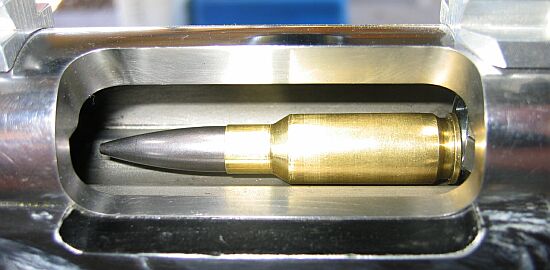
What’s better than one custom-built 30 BR with gorgeous wood and top-shelf components? A matching pair of course. Just ask Australian shooter Greg Roche (“Caduceus” in our Forum). A decade ago, Greg spent two years living and working in the USA. While in America, he commissioned two matched custom rifles to bring back to Australia for Hunter Class BR matches. Though the look-alike rigs are both chambered in 30 BR, one is designed for the Australian “Traditional” centerfire Hunter Class (10-lb limit), while the other is purpose-built for the “Custom” centerfire Hunter Class (14-lb limit). The 10-lb Traditional rifle features a fully-functioning two-round magazine and a 6-power scope. In contrast the Custom Class rifle is a single-shot action, with a 45X Leupold scope. The Custom weighs 13.5 pounds so it can also be used in traditional Heavy Varmint Benchrest matches if desired.
Tale of Two Rifles Story and Photos by Greg Roche (“Caduceus”)
The USA boasts some of the finest precision rifle-builders and Benchrest parts suppliers in the world. Before returning to Australia after two years in the States, I decided to have two special BR rifles built using American components and skilled labor. I wanted a matched pair–twin guns that would be as handsome as they were accurate. The heavier gun of the pair, the 13.5-lb Custom Class rifle, features top-of-the-line (but well-proven) technologies and components. With the 10.5-lb Traditional Class rifle, we had to develop new solutions to allow the 30 BR cartridge to feed from a functional two-round magazine. Here is my saga of how my twin 30 BRs were conceived and built, and how they have performed in competition.
BACKGROUND — The 30 BR for Score Competition
The 30 BR is a wildcat cartridge based on a necked-up version of the 6mmBR Norma case. It originated in U.S. Benchrest circles where it found its niche in Varmint For Score (VFS) matches. Unlike traditional Benchrest, where group size determines the winner, VFS matches are shot on a target with multiple, concentric-ringed bullseyes. Point total is based on “best edge” shot location (one shot per bull). In score competition, the 30 BR’s “supersized” .308-diameter hole offers an advantage over the 6mm hole created by a 6 PPC, the dominant group BR chambering.
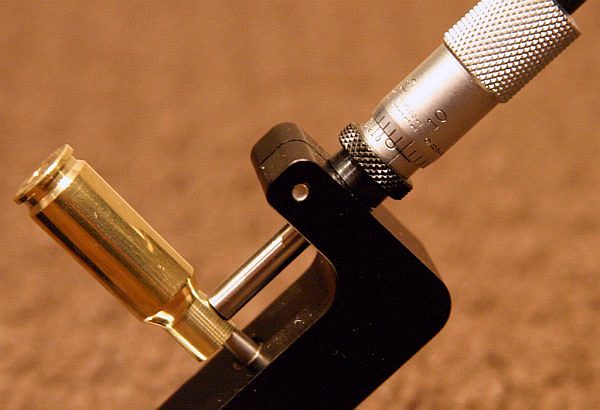
The starting point for loading the 30 BR wildcat is Lapua 6mmBR brass. These are necked up as a single-step operation using a .30 caliber tapered expander ball (or dedicated expander mandrel). This will leave a bulge in the neck, so the expanded case neck is normally turned to bring the thickness down to the correct dimension for the chamber. I turned these necks down to .010″ wall thickness using a Stiller neck-turning tool. It features an eccentric mandrel similar to the Nielson “Pumpkin”. Loaded rounds measure .328″ neck diameter. This gives minimum clearance in my .330″ neck chamber, so very little neck resizing is needed after firing. Cases are trimmed to 1.500″ prior to turning to ensure consistency since the Stiller tool indexes the length of cut off the case mouth. Other than that, cases are just chamfered, loaded and made ready to shoot. No special fire-forming is required.
17-Twist Barrels for Both Rifles
Texan gunsmith Mike Bryant chambered both barrels. Mike also polished both barrels to a high-gloss to match the receivers. In this game, barrels are consumables, much like powder and primers, so most owners wouldn’t bother to polish their barrels. However a 30 BR barrel can provide up to 5000 rounds of accurate life (unlike a 6PPC barrel which might be tossed after 800-1000 rounds.) So, these barrels are likely to be on the rifles for many seasons. Given the high-gloss finish of the Grizzly actions and the beauty of the Red Cedar stocks, it would have been an injustice to leave a dull finish on the barrels.
The chambers were both cut with the same reamer supplied by Dave Kiff of Pacific Tool and Gauge. Randy Robinett, one of the originators of the 30 BR wildcat, specified the reamer dimensions. Randy’s 118gr, 10-ogive custom BIB bullets and the 30 BR cartridge enjoy a winning track record in the USA. The 30 BR Robinette reamer has zero free-bore and a .330″ neck, and is optimized for the BIB 118s. The bullets perform best when seated far enough out to jam firmly into the rifling as the bolt is closed. The long ogive means the bullet’s bearing surface is very short.
Slow Twists for Maximum Accuracy
You may note the unusually slow twist rate of both barrels. In most .30-caliber chamberings, the barrel twist rate is 1:11 or 1:12 to stabilize 150gr to 200gr bullets. The 30 BR is optimized for 115gr to 118gr flat-base bullets and 1:17 provides sufficient stability at muzzle velocities around 2900-3000 fps. In competitive Benchrest, where every thousandth of an inch counts, over-stabilization of projectiles can hurt accuracy, so “just stable enough” is the goal; hence the 1:17 twist.
Case Forming, Case Prep, and Reloading Methods
A Sinclair case neck micrometer indicates neck thickness of 0.010″ after neck turning.
30 BR dies are readily available from a number of manufacturers. I personally use Wilson neck and seating dies with a Sinclair Arbor press, but Redding and Forster both supply high-quality threaded dies for use in a conventional press. For under $100.00 US, custom full-length dies can be obtained from Hornady and CH Tool & Die by sending them reamer prints or a couple of fired cases. Harrell’s Precision offers “semi-custom” dies. Just send them some fired cases and they select a pre-made CNC-cut die that ideally fits your chamber. You can ask the Harrell brothers for a die that’s tighter at the shoulder or base, or otherwise customized to your preferences.
Load Development and Accuracy Testing
With cases formed and bullets selected, load development is simply a matter of choosing the right primer, powder and charge weight, and loading the most consistent ammunition possible. The Lapua BR cases use a small rifle primer. The choice here was Federal 205 Match primers vs. CCI BR4 Benchrest primers. Some shooters have also had success using CCI 450 Magnum primers but it is very unlikely the small case needs this much spark to light off regular extruded powders. In my case, I selected Federal primers because availability tends to be better in Australia.
The relatively large bore-to-capacity ratio of the 30 BR case means that fast burning powders are the order of the day. Once again, US experience suggests H4198 (the Hodgdon equivalent of ADI AR2207) is the choice of match winners. The fact that H4198/AR2207 is an Australian-made product is an added bonus. So, I loaded up test rounds with AR2207 from 32.5 grains to 35.0 grains in approximately 0.3 grain increments. All bullets were seated to jam +0.010″ into the lands. This places the bullet base about two-thirds of the way down the neck and well short of the neck-shoulder junction.
How would you like to represent the United States in top-level International Shooting competitions? Well, if F-Class is your game, here is your opportunity. F-Class Team USA will be conducting try-outs for the United States squads who will represent our country in F-TR and F-Open divisions (plus Under-25) at the 2021 World Championships. The try-outs are open to any competitive shooter with a class-compliant rifle and the will to win. Team leadership expressly welcomes newcomers.
Initial and primary tryouts are planned during the 2018 U.S. National Championships in Raton, NM, and the 2019 SW Nationals in Phoenix, AZ. There may also be an early 2019 tryout date at Butner, NC.
Dan Bramley Invites Shooters to Team USA F-Class Try-Outs
Official Invitation to Team USA F-Class Try-Outs To the F-Class Community–
On behalf of Team USA 2021, we are pleased to invite the best of USA F-class to consider joining our effort for the 2021 World Championships in Bloemfontein, South Africa. We are reaching out with this invitation to provide some general information on our plans for 2021 and for upcoming try-out dates for the unified Team USA: F-TR, F-Open, and Under 25.
We are moving forward with F-Open, F-TR, and Under 25 unified as one USA F-class 2021 Team. This will allow us to take advantage of each team’s strengths and provide needed purchasing power and coordination for event and logistic costs. We also believe this will help encourage and grow our sport. We will share ideas, event/facility dates and best practices within this unified team, however, individual team segments will make their own decisions. Therefore, please direct your responses and inquiries to the appropriate team leadership.
Being part of Team USA is a major commitment of time and resources. We do have wonderful and sizable sponsorship partners who we thank and rely on for moderating individual team member costs. However, due to the location of this World Championship effort, one can expect to help cover a commensurate level of the costs.
We are now moving into the USA “development team” stage of the process. This team is open to newcomers… there are many newer names showing up on the top of leader-boards and many new teams that are making positive impacts. If you are interested in being part of Team USA, please consider making that commitment. We would like to hear from you by March 23, 2018.
Team Time Expectations
Attendance at SWN and US Nationals will be expected for 2019 and 2020. We will also likely expect the final team to attend the Berger SWN in 2021 or have an alternative site for a final practice prior to our trip. We will try to have afternoon or evening team sessions during these events however we may have team days just prior or after these events to maximize the use of individual travel dollars and time. We will also likely have additional team training dates in 2019 and 2020, likely on east coast ranges to facilitate best availability for all.
Shooting/Coaching Position Opportunities
We are equally passionate about developing coaching/shooting teams for winning gold medal efforts in both the Richardson Cup (8-man) and Rutland Cup (4-man) World Championship Events. Obtaining a shooting or coaching spot on one of these teams is an absolute gauntlet of a commitment and consistent strong results will be required as the USA is blessed with wonderful depth. We encourage all, with proven success in our sport, to test themselves at this highest of levels.
Team Try-Out Dates and Locations
Initial and primary tryouts are planned during the 2018 US National Championships in Raton, NM and the 2019 SW Nationals in Phoenix, AZ. There may also be an early 2019 tryout date at Butner, NC.
If you are interested in further information, please contact our Team USA leadership:
Dan Bramley, Captain USA F-Open
usrifleteam2021fopen [at] gmail.com
Phil Kelley, Jr., Captain USA F-TR
usarifle2021 [at] gmail.com
Rick Jensen, Captain USA U25
U25USAFclass [at] gmail.com
Forty-Nine Major PRS Matches — Thousands of Participants
The Precision Rifle Series (PRS) for tactical-style rifles, remains one of the fastest-growing forms of rifle competition. For 2018, there will be more matches, in more venues around the country. This year’s PRS will include 43 Bolt Gun Series matches and six (6) Gas Gun Series matches. The bolt gun matches average 120 to 150 shooters while the gas gun matches typically draw 70 to 100 shooters. In addition to the Pro Series, there’s the PRS Club Series, which is estimated to have 2,000 to 3,000 participants.
The GAP Grind is always one of the most popular PRS matches of the year.
Many of our readers are thinking of trying out PRS-type competition. Along with F-Class, tactical/practical disciplines are the fastest-growing forms of competitive rifle shooting. Rich Emmons, one of the founders of the Precision Rifle Series (PRS), has written an article about getting started in PRS. this Getting Started article will help PRS novices pick the right equipment and understand the game. You may also want to read the PRS FAQ Page.
This Video Shows Highlights from a Major PRS Match
Hornady Commits to $50,000 Sponsorship
One of the reasons for the success of the PRS is the support of major sponsors such as Armalite, Bushnell, Nightforce, and now Hornady. Nebraska-based Hornady Manufacturing has become a sponsor of the 2018 Precision Rifle Series at the $50,000/year Patriot Level. Mollie Tobias, PRS Sponsorship director, explained the importance of sponsors such as Hornady. “Hornady, being one of the most respected brands in reloading components, is the perfect fit to help us appeal to and educate our shooters,” she said. “Hornady’s name recognition and brand reputation are a huge help to our series and communicate to the members that we are a premier series working with premier brands.”
We are pleased to see Hornady as a sponsor. Hornady produces loaded ammo as well as brass and bullets. According to PRS surveys of its members, many of those shooters are interested in reloading, and reloading supplies (bullets, brass, and powder) are among the most requested items for match prize tables.
Pick your passion — High Power, F-Class, Silhouette, Smallbore, Air Rifle, Pistol, Black Powder. The NRA runs National Championships for all these disciplines and more. Attending a National Championship event is a big commitment, but it’s worth it. You can meet new friends, test your mettle against the nation’s best, and record memories that can last a lifetime.
Mark your calendars boys and girls — here is the complete 2018 NRA National Match schedule. This includes the National High Power Championship, National F-Class Championship, Fullbore (Palma) Championship, and a 15 more major national events. The date and location are included for each listing. Click the link for each championship to go directly to the official NRA championship page for that particular discipline to get more information or to register. To get more information, visit compete.nra.org or send email to: comphelp@nrahq.org.
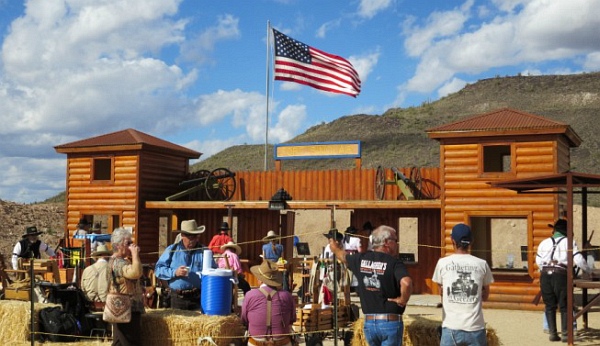
Earlier this month the Ben Avery Range in Phoenix hosted America’s top long-range shooters at the Berger SW Nationals. This upcoming week, 1000 cowboys and cowgirls take over Ben Avery during Winter Range, the SASS National Championship for Cowboy Action Shooting. Winter Range, which runs February 19-25, 2018, is the second largest Cowboy Action event of the year, after End of Trail, the annual Single Action Shooting Society World Championship held each year in Edgewood, New Mexico.
This video, produced a few seasons back by the Arizona Fish and Game Commission, covers the full Winter Range experience, including the main shooting competitions, the side matches, the Western costumes, the socializing, and more. Worth watching if you like action shooting or are just a fan of the Wild West.
Hundreds of cowboy action shooters, ages 12-80, will compete in multiple classifications based on age, and type/caliber of firearms. In addition, this year the Cowboy Mounted Shooting Association and the SASS Mounted Shooters held the exciting Winter Championship in nearby Queen Creek, Arizona. The 3-day event, held February 14-17, drew more than 100 competitors mounted on horses. You’ll see this kind of action:
Cowboy Action Shooting requires that contestants compete with firearms typical of those used in the taming of the Old West: single-action revolvers, lever-action rifles, and period shotguns. Participants each have a registered cowboy shooting alias (such as “Deadeye Dave”), used in SASS events. Competitors, organized in “Posses”, shoot a series of multi-gun stages. This is a fun shooting sport that draws multiple generations of the same family. In addition to the primary competitions, Winter Range 2018 will feature displays of period militaria, exhibitions of western skills and crafts, a fast-draw contest, and nearly 100 vendors selling vintage-style clothing and “sundries”.
After the Berger Southwest Nationals, we had a long chat with John Whidden, five-time NRA Long-Range National Champion, and a past SWN Sling Division winner. When the subject turned to reloading techniques, John reminded us that he uses a Dillon progressive presss to load much of his match ammo — with a system for much more precise control over powder charge weight. Yes John loaded his national-championship winning .243 Win ammo on a progressive. That may not work for the benchrest game, but John proved this method works well for his discipline — long range sling shooting.
John full-length sizes his match brass every time using a Whidden click-adjustable sizing die. The powder charge is dispensed with single-kernel precision using an Auto-Trickler and lab-grade force restoration scale. The process is completed on a Dillon XL 650 to produce more ammo in less time.
Whidden’s .243 Win Ammo is Loaded on a Dillon
John Whidden of Whidden Gunworks used the .243 Winchester cartridge to win the 2017 NRA Long Range Championship, his FIFTH LR title. John loaded his .243 Win ammo using a Dillon: “My loading process is different than many people expect. I load my ammo on a Dillon 650 progressive press using our own Whidden Gunworks dies. However powder charges are individually weighed with a stand-alone automated scale/trickler system from AutoTrickler.com (see below). Employing a high-end force restoration scale, this micro-processor controlled system offers single-kernel precision. The weighed charges are then dropped into the cases with a funnel mounted to the Dillon head.”
John Whidden Explains His Ammo-Loading Process
The Lapua .243 Win brass is full-length sized every time, and I run one of our custom-sized expanders in my sizer die. The expander measures .243″ which yields the desired .001″ neck tension. In my experience, the best way to get consistent neck tension is to run an expander in the case neck at some point. When sizing the case neck by a minimal amount such as is the case here, I don’t find any negative points in using an expander in the sizer die.
Championship-Winning Load: Berger Bullets, Lapua Brass, and Vihtavuori N160
For a load, currently I’m shooting Lapua brass, PMC primers (Russian, similar to Wolf), VihtaVuori N160 single-base powder, and Berger 105 grain Hybrid bullets. I switched to the Hybrid bullets at the beginning of the 2015 season. Previously I shot the 105gr Berger hunting VLDs, and in testing I found that the Hybrids were just as accurate without having to seat the bullet into the lands. The velocity of this combination when shot through the excellent Bartlein 5R barrels (32” length) is around 3275 FPS.
For my match ammo, I seat the Berger 105 Hybrids well off the lands — my bullets are “jumping” from .035″-.060″. I only use one seating depth for ammunition for multiple guns (I know some benchrest shooters will stop reading right here!) and the bullets jump further in the worn barrels than in the fresh barrels. The bullets are pointed up in our Bullet Pointing Die System and are moly-coated. The moly (molybdenum disulfide) does extend the cleaning interval a little bit, probably 20% or so. The Lapua .243 Win brass is all neck-turned to .0125″ thickness.
In my experience, the keys to accurate long range ammo are top quality bullets and the most consistent neck tension you can produce. From these starting points, the use of quality components and accurate powder measurement will finish out the magic.
Great Ballistics with 6mm 105s at 3275 FPS
Running at an impressive 3275 FPS, Berger 6mm 105 grain Hybrids deliver ballistics that are hard to beat, according to John Whidden:
“My .243 Win shoots inside a 6.5-284 with 142-grainers. Nothing out there is really ahead of [the .243], in 1000-yard ballistics unless you get into the short magnums or .284s and those carry a very significant recoil penalty. In the past I did shoot the 6.5-284. I went to the .243 Win because it had similar ballistics but had much less recoil. It doesn’t beat me up as much and is not as fatiguing.
With the .243 Win, there’s no tensing-up, no anticipating. With the reduced recoil (compared to a 7mm or big .308), I can break and shoot very good quality shots. I find I just shoot better shots with the .243 than I ever did with the 6.5-284.”
This story appears courtesy NRABlog.com.
Looking to get started in Multi-Gun competition? The NRA Outdoors 3-Gun School is a two-day course covering all the skills you’ll need to compete in the 3-Gun game. The course, hosted at Peacemaker National Training Center in West Virginia, provides hands-on training for pistol, rifle, and shotgun. Participants experience a fast-paced mix of lessons and firing drills, including actual 3-Gun stages. For 2018, two sessions are scheduled: April 21-22, and June 16-17, 2018.
Video Shows Highlights from NRA Outdoors 3-Gun School Training Sessions:
You don’t even have to bring guns or load your own ammo. The NRA Outdoors 3-Gun School includes everything you need with the $1600.00 price of admission. You don’t need to bring any guns, ammunition or gear! The NRA Outdoors 3-Gun School provides all firearms, ammo and equipment used for the course, including Armalite AR-pattern rifles, Benelli shotguns customized by Hayes Custom Guns, SIG Sauer pistols, and Vortex Optics.
3-Gun Comps — What the Multi-Gun Game is All About
Most 3-Gun matches consist of 8 to 12 stages, with shooters engaging as many as 35 targets per stage. You’ll shoot at paper silhouettes as close as 10 feet away, and steel targets as far out as 600 yards. Time is of the essence — all stages are “on the clock”. You’re racing from station to station, your synapses firing as your transition from shotgun to rifle to pistol, close to long range, around corners, and over barriers.
You’ll encounter spinner wheels, swinging bowling pins and zooming clay pigeons, all while rushing through and around a bevy of walls, barrels, windows and even vehicles. Some 3-Gun matches are shot at night (see above), where the artificial illumination creates an entirely different set of challenges.
How to Participate
You can register now for the NRA Outdoors 3-Gun School. The first class of the year is scheduled for April 21-22, 2018, with another session later in mid-June. If you’re interested, register soon — these programs fill quickly.
CLICK HERE for more information about the NRA Outdoors 3-Gun School. Learn about other training courses by visiting the NRA Outdoors website or call (844) 672-6883.
Hardware for 3-Gun Competition — Guns & Gear
In this NSSF video, Top Shot Finalist Chris Cerino reviews the hardware you’ll need for multi-gun matches. Chris talks about carbine configurations — including barrel, handguard, and optics options. Cerino also demonstrates pistol techniques and explains the key features of a belt/holster rig.
The Civilian Marksmanship Program (CMP) will now be recognizing National Records attained at CMP Travel Games events. Now, outstanding scores will be recorded in the record book for all CMP Travel Games matches. The current listed National Record scores were established after compiling top scores from the following Games events and years:
Oklahoma: 2012-2017
Eastern Games: 2007-2017
Talladega D-Day: 2015-2017
New England: 2016-2017
Western Games: 2005-2017
Talladega 600: 2015-2017
To view the new Travel Games National Records standards, click this link:
Special Travel Games National Record Certificates will be sent to the competitors that currently hold the Overall Travel Games National Records, with additional certificates awarded to those who break records in the future.
National Record scores for each individual match are listed under the match’s results in CMP’s Competitor Tracker – used to display result scores for Travel Games events. A full list of Overall National Records can be found by visiting the CMP Travel Games Homepage.


 30 BR dies are readily available from a number of manufacturers. I personally use Wilson neck and seating dies with a Sinclair Arbor press, but Redding and Forster both supply high-quality threaded dies for use in a conventional press. For under $100.00 US, custom full-length dies can be obtained from

 Being part of Team USA is a major commitment of time and resources. We do have wonderful and sizable sponsorship partners who we thank and rely on for moderating individual team member costs. However, due to the location of this World Championship effort, one can expect to help cover a commensurate level of the costs.




 Oklahoma: 2012-2017


