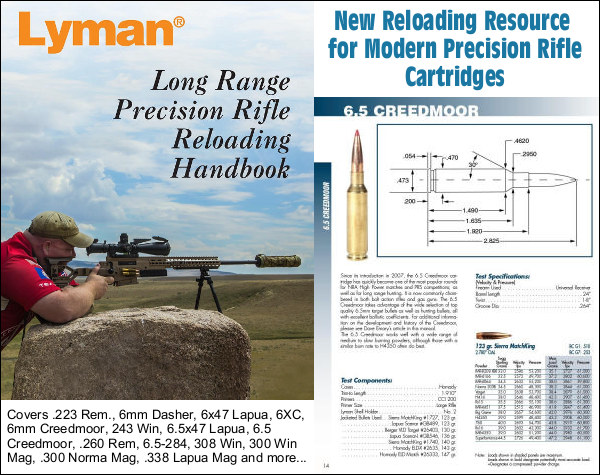
Lyman Products is offering a new reloading resource, the Lyman “Long Range Precision Rifle Reloading Handbook”. With the growing interest in Precision Rifle Series (PRS) events and Extended Long Range matches, Lyman saw the need for an up-to-date, reliable print resource for precision long range competitors. Lyman says this is “The first-ever reloading manual specifically written for the growing sport of precision long range shooting.”
Lyman’s new book covers the most popular cartridge types, and the premium components used by top shooters. The book covers the vast majority of popular cartridge types used in long range precision shooting. You’ll find .223 Rem, 6mm Dasher, 6×47 Lapua, 6XC, 6mm Creedmoor, .243 Win, 6.5×47 Lapua, 6.5 Creedmoor, .260 Rem., 6.5-284 Norma, .308 Win, .300 Win Mag, .300 Norma Mag, .338 Lapua Mag and more. The data section includes Berger and Lapua target bullets, as well as Sierra MatchKings and Hornady ELDs. A wide range of propellants from Accurate, Alliant, Hodgdon, IMR, Norma, VihtaVuori, Ramshot, and Winchester are reviewed.
Lyman Handbook Includes Articles by Leading Experts and Top PRS Shooters
The new handbook also includes articles by top PRS shooters and industry experts. Articles such as “PRS How-To” and “Rifle Systems for PRS” by Matt Gervais provide expert info and tips and techniques to start competing. An authoritative article by Hornady’s Dave Emary, “The History and Design of the 6.5 and 6mm Creedmoor” explains why these cartridges have become so popular for PRS and other applications. Emary’s “Reloading Considerations for Long Range Ammunition” is also highly recommended for both novice and experienced hand-loaders.
“As the leader in reloading data, we saw a need for an accurate and reliable source of reloading data for these precision, long-range loads,” said Trevor Mullen, Lyman’s Global Marketing VP. “Our process of compiling a new reloading handbook … is to work with the best in their field — reloaders, the manufacturers of ammunition and rifles, participants in the PRS sport, and our own staff of highly-skilled, highly knowledgeable test shooters. This new handbook [will help] those looking for that edge in PRS competitions.”
The “Long Range Precision Rifle Reloading Handbook”, priced at $16.98, will be available soon from online retailers. Within a short time you can also purchase the book from the Lyman web store. (It is not yet in stock).
On 1/21/18, new World Records were set under ELR Central rules for verified, consecutive three-shot string without sighters. Competitors started from cold bore, no sighters or ranging shots allowed. That’s a tough standard. In fact the first 12 shooters failed to put three shots on target at 1500 yards before Paul Phillips took his turn. Paul, Lucky number 13, placed all three of his shots on the 36″ x 36″ plate, claiming a first-ever record. Later that afternoon, John Armstrong duplicated that feat, also putting three shots on target at 1500 with no sighters.
But the best performances of all came later. Nate Stallter, shooting a .375 CheyTac, nailed his three shots at over one mile — 1768 yards. But it gets better — Nate broke his own record later in the afternoon, going 3 for 3 at 2011 yards.
David Tubb posted: “Congratulations to my son-in-law, Nate. Today he won the ELR Central World Record competition. This competition allows two separate attempts (spaced four hours apart) and consists of three cold bore shots each time. He took 3 shots and had 3 hits at 1768 yards in the morning and then beat his own record in the afternoon with 3 shots and 3 hits at 2011 yards after the wind had become trickier.”
Stallter used the new Tubb Adaptive Target Rifle (Tubb Gun) with a Dynamic Targeting Reticle and Tubb T7T two-stage trigger. He was shooting the .375 Cheytac with a 364gr Warner flatline bullet that has a patent pending Nose Ring modification in a Schneider 1:7″ twist barrel. Three of the Tubb Rifles are shown below. Note the long barrels.
As we explained, this was a tough challenge. Competitors started with a cold bore, with no sighters alowed — that makes it especially tough.
Watch this video to hear the record-setting shooters describe their equipment — chambering, action, stock, barrel, bipod, and optics. No the video is not sideways! Nearly all this video is correct, horizontal orientation. Click triangle to start correct format.
None of the competitors had shot these kind of distances at this facility, the Front Sight Firearms Training Center in Pahrump, Nevada. And the “no sighters” rule really added to the difficulty — witness the fact that the first 12 shooters failed to put three consecutive hits on a square yard of steel at 1500. Here are the three record-setting shooters:
1. Paul Phillips, 1500 yards (first record) | 2. John Armstrong, 1500 yards (tied record)
Those who understand the challenge were impressed …
Andy McNeill observed: “I’ve shot targets further too, but I didn’t go 3 for 3 with no sighters. These hit cold bore and then two consecutive follow-up shots at specific target sizes. This is what a record should be. Not I hit a target at X distance once after slinging lead at it all day.”
Jacob Scobell liked the match format: “Love that this is intentional, consecutive impacts with a fixed size target and not just a statistical probability of hitting the broad side of a barn with unlimited shots. Excellent to see a standard being set.
Now will all of these other supposed ‘world record holders’ step up and enter this competition? Sure some guy who can impact upon demand beyond 4000 yards would cake walk this right? A registered event with multiple shooters means put up or shut up.”
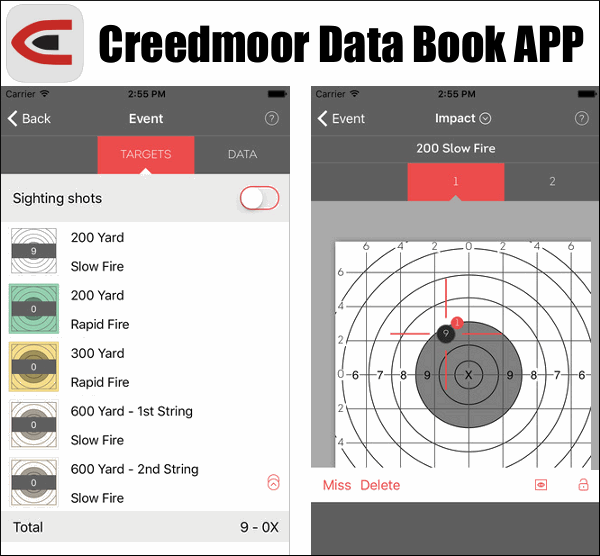
Tired of hauling around an old-fashioned Score Book and making entries with pencil and paper? Well now you can go digital — Creedmoor Sports has released a full-featured Scoring Book App that lets you plot your shot locations using an iPhone, iPod, or iPad (Apple tablet). The price is right — just visit the iTunes store to download the App for FREE.
Record Match and Practice Data
This new App, available for free in the Apple App Store, and the Google Play Store provides all the same functions and capabilities of the traditional Creedmoor print Data Book, but with the convenience and ease of recording your match and practice information with your iPhone or tablet. With this App you can break your 20 shot slow-fire segments into either 10- or 20-shot targets, and also opt for sighting shots. All the specific event data can also be recorded, such as location, wind, light etc., along with wind and elevation adjustments.
COMMUNICATIONS Restrictions: In some matches you are not allowed to have electronic communication ability, so you may have to set your iPhone to “Airplane Mode”, or use this only with an iPod (which does not have two-way communication capability).
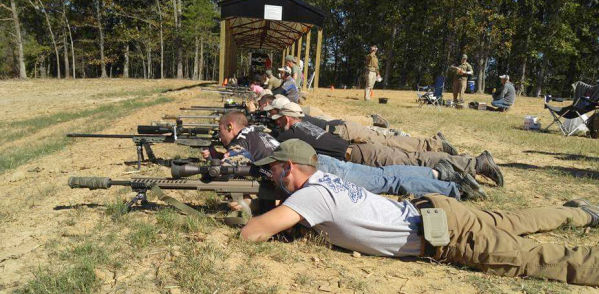
Want to learn long-range benchrest skills from the best in the business? Then head to Williamsport, PA this June. The registration period for the 2018 PA 1000 Yard Benchrest School is now open. This year’s session will be held Saturday and Sunday, June 16-17, 2018, with a “Meet and Greet” on Friday Night. Classes, taught by top 1K shooters, are held at the Original Pennsylvania 1000-Yard Benchrest Club Range, one of the best 1000-yard ranges in the country. The school will be limited to 25-30 students with one instructor for every two students.
Praise from a 1K Benchrest School Grad
Here’s a testimonial from a recent graduate: “I can attest to the knowledge that you gain. I went last year and loved it. Have renewed my membership in the Club and would love to go this year. I would love to take the course again. In the photo above I am in the back row, fourth from the right — sunglasses and blue shirt.” — Bob, Class of 2016
Participants will learn all aspects of long-range benchrest shooting from some of the most skilled marksmen in the country. Much time is spent at the loading bench and on the firing line. Classes cover load development, precision reloading, bench skills, and target analysis. You don’t even need guns and ammo — all equipment and ammunition will be provided.
School instructors tell us: “This year’s benchrest school will be a 2-day weekend event. (There is also an optional ‘Meet and Greet’ gathering Friday evening). The school is a beginner class designed to teach the fundamental skills needed to be competitive at at 600 and 1000 yards. Saturday will be spent in class covering a range of topics including reloading ‘dos and don’ts’, load development and equipment handling. Sunday we will shoot an actual match to see what you’ve learned.”
Cost for the class is $425.00 including lunches on Sat/Sun and dinner on Saturday. Act soon if you want to attend the 2018 school — the school fills quickly. NOTE: To secure your placement, payment must be made in full prior to May 25th, 2018.
Watch Williamsport Benchrest School Slideshow: Please enable Javascript and Flash to view this VideoPress video.
This slideshow was produced by Sebastian Reist an alumnus of the 2009 Williamsport 1000-yard BR school. SEE: www.sreistphotography.com.
Doug Koenig will exchange the Smith & Wesson hat for one with the Ruger logo this season. The 18-time Bianchi Cup Winner has joined Team Ruger, and will shoot Ruger pistols and rifles in 2018.
Doug Koenig, one of the greatest pistol shooters of all time, has a new team. The long-time Team Smith & Wesson stalwart has joined newly-formed Team Ruger as its Team Captain. Doug will shoot Ruger 1911-style handguns and Ruger polymer pistols. Interestingly, Koenig will also field a Ruger Precision Rifle for some PRS-style events. Doug has actually done pretty well in the past shooting long guns. He won the 2015 NRA World Shooting Championship — a multi-day event featuring rifles and/or shotguns in most of the stages.
This is the first time Ruger has ever fielded a full-fledged pro team. It is an interesting development for Ruger, which has a product mix suitable for a variety of disciplines: Rimfire Challenge, Cowboy Action, IDPA/USPSA, Steel Challenge, and even PRS (Factory Class and Gas Gun Division).
Why is Koenig leaving Smith and Wesson? It’s mostly about being “on the same page”. Talking to Jim Shepherd of the Shooting Wire, Doug explained: “I’ve been with Smith & Wesson for a very long time — and I want to be really clear about this – they’ve always been good to me.” But, there had been changes at S&W in recent years: “We were going in different directions, and I’d already told them I wasn’t re-signing this year. And when I was approached by Ruger, they were interested in my thoughts on guns.” Read Shooting Wire Report.
Though best known as a pistolero, Koenig is a great long gun shooter as well. Doug won the 2016 NRA World Shooting Championship, beating a field of talented 3-Gun aces. Photo DougKoenig.com.
Doug was impressed with Ruger’s design staff. He said they have already incorporated upgrades he wanted: “When I talked with Ruger engineers, they asked me what I thought — instead of telling me what they were going to do. So, I told them what I would like to see in a Ruger competition pistol, and it seemed like they were really listening.” In fact, Ruger immediately made upgrades: “A few days after Christmas I got a pair of Ruger pistols with the exact changes I’d talked about already done to them. That is exciting”.
Doug Koenig’s List of Championships:
10-time World Champion
18-time Bianchi Cup winner
2016 NRA World Shooting Champion
More than 70 National Championships
6-time World Action Pistol Championship Winner
3-time World Speed Shooting Champion/Steel Challenge
Watch Doug Koenig’s Championship Season TV show on the Pursuit Channel: Wednesday 5:30 pm (Eastern); Friday 9:00 pm (Eastern); Saturday 1:30 am (Eastern) West Coast prime-time.
This Wednesday (January 10, 2018), Shooting USA TV features the GAP Grind Pro-Am held at the K&M Shooting Complex in Finger, Tennessee. Conducted in association with the Precision Rifle Series (PRS), the GAP Grind features a Pro/Am format with professional and amateur competitors vying for individual glory and team honors. If you are a PRS shooter or are interested in practical, multi-position shooting you should definitely watch this episode.
More Features in January 10, 2018 Hour-Long Episode: 1. CMP Western Games in Arizona. The Western Games feature High Power, Vintage Military Rifle, M1 Carbine, and Rimfire Sporter Matches. Held at the Ben Avery Range in Phoenix, this is one of America’s biggest matches each year. 2. Savage 6.5 Creedmoor Rifles. This week Shooting USA also spotlights two new 6.5 Creedmoor Savage rifles, a bolt action and an AR-platform MSR. 3. Pistol Training with Lasers. Ace shooter Julie Golob uses on-gun lasers to help diagnose and correct common pistol shooting mistakes.
New Broadcast Times for 2018: Wednesday 9:00 pm Eastern and Pacific, 8:00 pm Central
GAP Grind Feature on Shooting USA
Lots of Action, with 20+ Stages
The GAP Grind is a notoriously challenging, “high tempo” match with minimal down-time between stages. Over the course of 20+ stages, competitors will fire 200+ shots at a variety of steel, paper, moving, and reactive targets out to 1,200 yards. Targets vary in size/difficulty based on the shooter’s position, distance, and time allotted. Most stages include “stressors” — i.e. time limits or required movement(s).
Shooting USA Host John Scoutten (in Blue/White shirt) at a past GRIND
Lots of Action, with 20+ Stages
The GAP Grind is a notoriously challenging, “high tempo” match with minimal down-time between stages. Over the course of 20+ stages, competitors will fire 200+ shots at a variety of steel, paper, moving, and reactive targets out to 1,200 yards. Targets vary in size/difficulty based on the shooter’s position, distance, and time allotted. Most stages include “stressors” — i.e. time limits or required movement(s).
Josh Temnnen Facebook photo.
The GAP Grind is held at the impressive K&M Shooting Complex:
GAP Grind Hardware Shelley Giddings, a skilled shooter of both firearms and cameras, snapped these images of state-of-the-art tactical rifles at the 2014 GAP Grind. See more firearms images on Shelley’s Facebook Page.
We first ran this story in 2014, when Angelina was just ten years old. A Forum member recently asked if she was still shooting benchrest, and we can say the answer is yes — under the guidance of her grandfather Lou Murdica. So we are repeating the story today, to inspire all the other granddads who might encourage a little lady to take up the sport…
You have to love this story, supplied by our friend Lou Murdica. It seems that a petite little 10-year-old school girl finished fourth in a 100-Yard Benchrest match in Phoenix, beating some of the best in the business, including many Benchrest Hall of Famers. That’s right, shooting a remarkable 0.1612 Aggregate, little Angelina G. put a whupping on some very big names in the Benchrest game, including Lou Murdica himself. Angelina finished just .008 behind Hall of Famer Gary Ocock, beating other Benchrest superstars such as Bob Brackney, Lester Bruno, and Tom Libby. Angelina also beat legendary bullet-maker Walt Berger, but we’ll cut Walt some slack. Now in his 80s, Walt deserves praise for doing so well at the opposite end of the age spectrum.
Congratulations to Angelina on some great shooting in the Unlimited Class. Her five groups measured: 0.186, 0.172, 0.173, 0.121, 0.155. That’s impressive consistency. You go girl!
Point to ponder: If Angelina was shooting a Rail Gun, her rifle probably weighed more than she did.
Check out the big names who finished behind little Angelina.
AccurateShooter.com supports the candidacy of John Sigler for re-election to the NRA Board of Directors. A past President of the NRA, John is a competitive shooter and an active member of our Shooters’ Forum. John is a high-integrity individual who will capably represent the interest of serious shooters in the country. We’re behind John 100% and call for readers to vote for John Sigler when your NRA ballot arrives. NRA members eligible to vote for the Board of Directors should start receiving ballots around January 20, 2018 in their NRA magazines. John is the only current Director candidate nominated both by NRA Members (through petitions) AND by the NRA Nominating Committee
Lee Williams, writing on TheGunWriter.com stated: “There are a lot of good [NRA Board of Director] candidates and incumbents. There’s one GREAT one — John Sigler.
I’ve said this before — John does more for the Second Amendment in one week than most people do in an entire lifetime. He is the personification of an American Gun Owner and, in my humble opinion, he’s the best president NRA ever had.
He deserves to continue serving on NRA’s Board of Directors.”
John Sigler Key Background
Two-Term Past NRA President (59th)
Two-Term Past NRA 1st Vice President
Current Member of NRA Board of Directors and Executive Council
Endorsed by Eight Major Clubs and NRA State Associations
Competitive Shooter – Member 2017 U.S. F-Open Rifle Team
Current Vice-Chairman, NRA High Power Committee
Avid Hunter – Member Safari Club International
Retired Police Captain, now Practicing Law
U.S. Navy Veteran – 1967-1971
John has a 100% Attendance record as a current Director:
Key Objectives for John Sigler as NRA Board Member
— We must expand our fight to keep our ranges open and to open new ranges.
— NRA’s competitive shooting programs must be renewed, strengthened, revitalized.
— Our right to keep and bear arms must continue to be vigorously defended.
— NRA must redouble its efforts on behalf of hunting and conservation.
I was privileged to serve the NRA and our great nation for two terms as NRA’s Second Vice President, two terms as NRA’s First Vice President, and two terms as NRA’s 59th National President. — Capt. John C. Sigler (Ret.)
Statement by John Sigler
First, I would like to thank all of the NRA members who were instrumental in circulating and signing my most recent NRA Members’ Petition for re-election to the NRA Board of Directors. Because of your efforts, I was able to submit a total of 181 petition pages to the NRA Secretary containing 1,371 signatures of NRA members from 45 separate states, and to be successfully nominated by NRA Members’ Petition. Thank You!
Because of your efforts, I am only one of three candidates, all incumbent Directors, to be nominated by both the NRA Nominating Committee and by the Members through the petition process – Thank You!
Next, I would like to thank the Board of Directors of the Delaware State Sportsmen’s Association, Delaware’s official NRA state affiliate, for their continued support and their endorsement for re-election to the NRA Board of Directors. With DSSA’s endorsement, I have now been endorsed by a total of eight (8) major clubs and NRA State Associations, including the New York State Rifle & Pistol Association; the Firearms Coalition of Colorado; the Ohio Rifle & Pistol Association; the Ohio Gun Collectors Association; the Fifty Caliber Shooters Association; the Florida Sport Shooting Association; the North Carolina Rifle & Pistol Association; and of course, the Delaware State Sportsmen’s Association.
Finally, I want to thank all of the members of the NRA for all that you have done for me over the years to help me fight for our God-given right to keep and bear arms, at the polls, in Congress and the various legislatures, and in the courts. Without your continued help and support I could never have enjoyed the successes I have enjoyed during my 21+ years on the NRA Board, serving the NRA and all of the people of our great nation. Thank You!
NRA Board Member Attendance
I am proud of my 100% NRA Board Member Meeting Attendance record. Because of you, the members of NRA, in 1996 I became the first person from Delaware to ever be elected to the NRA Board. Because of you and your efforts, I was given the opportunity to work with and under NRA’s two greatest presidents, Marion Hammer and Charlton Heston, both of whom believed in me, trusted me, and gave me the opportunity to serve as the Chairman of NRA’s Finance Committee for 10 years and as the Chairman of NRA’s Law Enforcement Assistance Committee for the same 10 years.
Because of you, the valued members of NRA, I was also granted the opportunity to serve on the NRA’s High Power Rifle Committee as both Chairman and Vice-Chairman; the Competitions Rules & Programs Committee; as Vice-Chairman of the Clubs & Associations Committee, the Bylaws & Resolutions Committee, the Committee on Hearings, the Gun Collectors Committee, the Site Selection Committee, the Legislative Policy Committee and as Chairman of the Sub-Committee on State & Local Affairs, and on NRA’s Executive Committee. Additionally, because of you and your continued support, I have also had the privilege and pleasure of serving as a member of the NRA’s Executive Council and on the Board of the NRA Foundation and as a Whittington Center Trustee. Thank You!
And finally, because of you, I was privileged to serve NRA and our great nation for two terms as NRA’s Second Vice President, two terms as NRA’s First Vice President, and two terms as NRA’s 59th national President. Thanks to you, I was given the opportunity to create two new committees specifically designed to help and serve our veterans, the Committee on Military and Veterans Affairs and the Disabled Shooting Sports Committee.
In closing, I come to you, the voting members of NRA and respectfully ask for your vote. In doing so, I ask that you allow me the honor of continuing to represent you and the opportunity to continue the work I have been privileged to perform on your behalf since 1996. Thank you — John Sigler
When two or more guys get together at a shooting range, sooner or later, a challenge will ensue. It’s a guy thing — guys are competitive. We’ve seen it on varmint hunting trips too: “Bet I can hit that P-dog at 700 yards.” “No you can’t.” “Yes I can.” “Wanna Bet?”
You know how it goes. There are challenges for pride, bragging rights, and often some money is involved, or perhaps a six-pack.
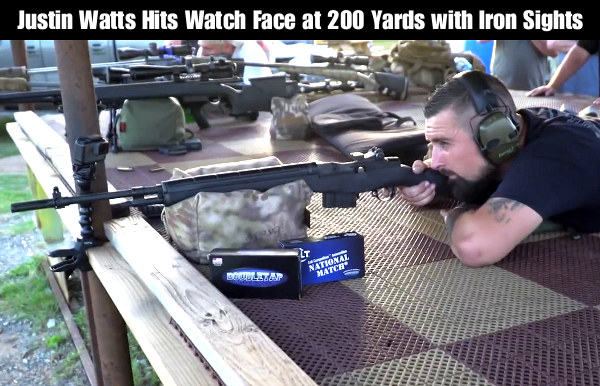
In this GunVenture video, three shooters take on the challenge of hitting the face of a watch at 200 yards using an M1A rifle with standard iron sights. The rules were exact — you had to hit the FACE of the watch, not just the strap. And the bullet had to penetrate the center of the watch — no splash shots or ricochets allowed. Not an easy shot — we figure that watch face is about 1.5″ in diameter or roughly 0.75 MOA at 200 yards. They were shooting factory .308 Win ammo with 155gr bullets — a Palma load.
GunVenture Video — 200 Yard Watch Challenge with Iron Sights M1A
One of the shooters, range owner Justin Watts, rose brilliantly to the challenge. You can see Justin’s remarkable shot at 3:20 time mark. Holding slightly for wind, he drilled the watch face dead center, obliterating it, but leaving most of the band intact. At 4:25 the video reveals that the whole center of the watch (the works) was blown out, leaving nothing but a rubber doughnut. Mighty Impressive.
After making the impressive shot, Justin explained to his buddies what they did wrong. Among other things they did not compensate for the wind. Justin also observed that the first shooter sent his shot right because of the M1A’s heavy trigger pull: “Probably what happened is the trigger pull is so heavy [he] pulled it to the right. Most of the time when you have a right-handed shooter and a heavy trigger like that, it’s going to pull you off to the right.”
Big Bucks. Serious Money. Walther Arms is making a whopping $450,000 in contingency awards available to pistol shooters in 2018. If you shoot pistol games such as USPSA and IDPA, and you “Win with a Walther”, you can go home with a nice check in your pocket. For example the winner of the USPSA Production Nationals will get $6000.00 if he shoots a Walther, while the winner of the IDPA U.S. Nationals will earn $4000. There are prizes for dozens of other competitions as well, with awards in multiple classes for both first and second places. The biggest payout is $6000, the smallest is $150.
Watch Video to Learn How to Win:
Walther has made it easy for shooters to participate in the “Win with Walther” program. For specified classes, Walther will reward top finishers in major pistol tournaments:
1. You must Finish First or Second using a Walther pistol in a Qualifying Tournament.
2. A Walther pistol must be used for the entire tournament. Proof of equipment is required.
3. You MUST email shootingteam@waltherarms.com with proof of your placement and a picture of your winning smile while holding the Walther Pistol you used to win or finish second!
CLICK HERE to learn more about the Walther Contingency Program. Click that link for a list of all qualifying shooting matches (with prize values), plus all the rules and “fine print”.
“We are very excited to not only continue but increase the contingency program for 2018. Walther Arms [will] build on the success of the 2017 contingency program, and increasing the approved events will allow more competitors to participate,” says Kevin Wilkerson, Walther Arms Marketing Manager.




 Tired of hauling around an old-fashioned Score Book and making entries with pencil and paper? Well now you can go digital —


 Want to learn long-range benchrest skills from the best in the business? Then head to Williamsport, PA this June. The registration period for the 2018 PA 1000 Yard Benchrest School is now open. This year’s session will be held Saturday and Sunday, June 16-17, 2018, with a “Meet and Greet” on Friday Night. Classes, taught by top 1K shooters, are held at the Original Pennsylvania 1000-Yard Benchrest Club Range, one of the best 1000-yard ranges in the country. The school will be limited to 25-30 students with one instructor for every two students.




 You have to love this story, supplied by our friend Lou Murdica. It seems that a petite little 10-year-old school girl finished fourth in a 100-Yard Benchrest match in Phoenix, beating some of the best in the business, including many Benchrest Hall of Famers. That’s right, shooting a remarkable 0.1612 Aggregate, little Angelina G. put a whupping on some very big names in the Benchrest game, including Lou Murdica himself. Angelina finished just .008 behind Hall of Famer Gary Ocock, beating other Benchrest superstars such as Bob Brackney, Lester Bruno, and Tom Libby. Angelina also beat legendary bullet-maker Walt Berger, but we’ll cut Walt some slack. Now in his 80s, Walt deserves praise for doing so well at the opposite end of the age spectrum.


 When two or more guys get together at a shooting range, sooner or later, a challenge will ensue. It’s a guy thing — guys are competitive. We’ve seen it on varmint hunting trips too: “Bet I can hit that P-dog at 700 yards.” “No you can’t.” “Yes I can.” “Wanna Bet?”