M1 Garand Springfield Armory July 1941 production. Facebook photo by Shinnosuke Tanaka.
Want an authentic surplus M1 Garand? You can get these classic battle rifles from the Civilian Marksmaship Program (CMP) through direct sales as well as auctions. If you are looking to obtain an authentic, safe-to-shoot M1 Garand, the CMP is your best bet. Each M1 Garand rifle sold by the CMP is an genuine U.S. Government rifle that has been inspected, head-spaced, repaired if necessary, and test fired for function. Each rifle is shipped with safety manual, one 8-round clip, and chamber safety flag. CMP operations, warehousing, inspection & repair, test firing, sales order processing and distribution activities are headquartered in Anniston, Alabama.
M1 Garand Manufacturer Codes: SA (Springfield Armory), HRA (Harrington & Richardson Arms), IHC (International Harvester Co.), WRA (Winchester Repeating Arms)
The federal law that established the new CMP authorizes the Corporation to sell surplus .30 and .22 caliber military rifles, parts and ammunition to qualified U.S. citizens “for marksmanship”. Accordingly, the CMP sells government-surplus M1 Garands, .22 caliber target rifles, and small quantities of other rifles to qualified purchasers.
How to Order an M1 Garand from the CMP
To purchase an M1 Garand through the CMP, you must be an adult U.S. Citizen, who is a member of an affiliated organization, and who has participated in a “Marksmanship Activity”*. This basically meas you need to join a a gun club and participate in a clinic or match. Proof of club membership and citizenship is mandatory for all ages. However, the marksmanship requirement is waived for those over 60 years. Garands must be ordered by mail or through official CMP Auctions. Orders are filled on a first-come, first-serve basis. Rifles of all grades are packed for shipment purely by “luck of the draw”. Most orders ship within 2-4 weeks. If price has changed after an order has been received, customers will be notified before new prices are charged. Free Shipping except Puerto Rico and P.O. Boxes. CLICK HERE for ordering information.
M1 Garands at CMP Retail Store in Anniston, Alabama.
Garands are Going Up in Value
In the past ten years, the M1 Garand, regardless of condition, has become a hot collectors’ item and sound financial investment. The popularity of the M1 Garand continues to grow as hundreds of new Garand “Fun” Matches are being held all across the USA each year.
Over the past 65 years, most M1 rifles have been arsenal rebuilt, refinished, rebarreled or repaired at least once and often several times. Most will show signs of service (often considerable) and replacement of various parts. They are seldom encountered with all original parts and original finish as delivered from the manufacturer. Such “original” rifles, even in well-used condition, are highly prized by collectors.
Download CMP Catalog
The CMP Catalog lists and describes the current rifles and accessories available.
State Legal Compliance
IMPORTANT: If your State or locality requires you to first obtain a certificate, license, permit, or Firearms Owner ID card in order to possess or receive a rifle, you must enclose a photocopy of your certificate, license, permit, or card with the application for purchase. Rifle shipments to WA, NY and NJ must be made to a state licensed dealer. You must provide a copy of the dealer’s license with your order form. (As a result of CT Bill 1160 and Bill 13-220) Rifle shipments to CA must be made to a State licensed dealer or may be made to individual homes, providing that a CA Certificate of Eligibility and a Curio and Relic License are provided. Rifle shipments to WA & CT must be made to licensed or dealer or may be shipped directly to the customer if a C&R license is provided.
WA, NY, NJ and CT customers who have already mailed their rifle orders to CMP should provide custserve@thecmp.org with dealer information or order cancellation instructions. Information can also be faxed to 256-835-3527 or mailed to CMP Customer Service, (Attn: FFL Order), 1401 Commerce Blvd., Anniston, AL 36207.
* You must provide proof of participation in a marksmanship-related activity or otherwise show familiarity with the safe handling of firearms and range procedures. Proof of marksmanship participation can be provided by documenting any of the following:
• Completion of a marksmanship clinic that included live fire training (provide a copy of the certificate of completion or a statement from the instructor).
• Participation in a rifle, pistol, air gun or shotgun competition (provide copy of results bulletin).
• Certification from range or club official or LEO witnessing shooting activity.
• Completion of a Hunter Safety Course that included live fire training.
• Firearms Owner Identification Card that includes live fire training.
• Current or past military or law enforcement service.
• Distinguished, Instructor, or Coach status.
• Concealed Carry License.
• FFL or C&R license.
Registration has opened for the 2018 Berger Southwest Nationals at the Ben Avery Range in Phoenix, Arizona. This is a GREAT match, the best in the West by far. The match runs February 5-11, 2018. By all means, attend if you can. The Grand Agg filled up last year, so we recommend you register soon.
Berger’s SWN team reports: “Registrations for the 2018 Southwest Nationals open on Sunday, August 27th, at 6:00 am (PST). CLICK HERE for the Match Program (it is also available on the Desert Sharpshooters website and Berger Bullets website). We are also moving to an online registration this year, and entry fees will be paid online. Please note that due to our capacity limitations, each stage of the match is listed as a separate event. Please be sure to enter each of the stages you plan to participate in. This will allow us to include as many people as possible. If you have any questions, send email to michelle.gallagher [at] bergerbullets.com.”
Rekindle Old Friendships and Meet New Friends
Some shooters come to to the SW Nationals for the swag (the prize table is amazing). Others come for the sunshine (think warm 75-85° weather). And even more folks come to try out their shiny new toys and to test their skills against the nation’s best shooters.
But we’d say the number one reason most folks make the pilgrimage to Ben Avery every year is the camaraderie — the chance to connect with friends, rekindling connections that may go back decades. Fundamentally, then, the Berger SWN is about the people. For many of us, this is the only time of the year when we get a chance to meet fellow shooters from distant corners of the USA (and other nations).
Compete Against the Best
If you want to test your mettle against some of the best shooters in the world, get yourself to Ben Avery in February. Here you can compete, shoulder to shoulder, against the best Sling and F-Class shooters on the planet. Guys like Derek Rodgers (newly-crowned F-TR World Champion), John Whidden (reigning Long Range National Champion), Nancy Tompkins (the first women to win the National High Power Championship), and Kenny Adams (past World F-Open Class Champion). If you want to play in the Big Leagues, Ben Avery is the place. Having said that, novice shooters will enjoy the experience as well, because you’ll find that these top shooters are (almost universally) happy to share their knowledge.
Just to whet your appetite, here are videos from recent Berger SW Nationals. Yes, this match is as much fun as it looks!
Berger SW Nationals 2017
The North-by-Southwest team set new National Records in winning the 2017 F-TR team event.
Berger SW Nationals 2016
Berger SW Nationals 2015
The Brain Trust — Experts Galore
The best minds of the shooting world come to Ben Avery every year. Got a question about ballistics? Well, Ballistics Guru Bryan Litz (photo below) will be happy to answer your questions between relays. Want some expert advice about wind reading? Seek out Mid Tompkins (usually found hanging around the club-house) or Emil Praslick, one of the most knowledgeable wind coaches on the planet. And if you have a gunsmithing question, you’ll find some of the top barrel-fitters and stock makers, including Doan Trevor and Gary Eliseo.
More and more folks are using Burris Signature Rings these days. These unique rings feature polymer inserts. That allows you to pre-load some elevation in your scope set-up, or you can center-up the windage. Additionally, the polymer inserts hold your scope securely without leaving marks on the tube. Lastly, some folks believe that Signature rings may offer advantages for benchrest competition. Rodney Wagner shot the best 600-yard group in history using Burris Signature Zee Rings (“Zee” denotes the Weaver-rail model). James O’Hara set multiple IBS 1000-yard records using Burris Signature Zee Rings. James will tell you he thinks “all his guns seem to shoot best with these rings”.
Records Have Been Set with Signature Zee Rings
Are Signature Zees good enough for competition? Absolutely. Some folks scoff at these Burris rings, given their low price. A set of 1″-diameter Sig Zees cost just $38.79 at Grafs.com. But consider this, Rodney Wagner shot the smallest 600-yard group in history, a 0.336″ 5-shot stunner, using Signature Zee Rings on his IBS Light Gun. Here’s a photo of Rodney showing the record-setting rifle, outfitted with affordable Signature Zee 30mm rings.
Vendors Have Burris Signature Rings in Stock Now
A quick search of webstores shows that various models of Burris Signature Rings are available from many vendors. NOTE: You may have to check with more than one seller to get the exact size, height, and model you prefer. But right now these vendors have pretty good selections of Signature Zees, including the hard-to-find 30mm High and Extra High models. If you check all three sellers, you’ll probably find what you need.
If you like accurate rifles and reactive targets, you’ll enjoy this episode of Shooting USA TV, which features long-range varmint silhouette competition in Texas, the Lone Star State. We have participated in these kind of matches on the West Coast — they are definitely a ton of fun. The sport combines the pure accuracy of benchrest competition with the fun of knocking down critter targets. These are smaller than standard silhouettes, so it’s quite a challenge to hit them at 300 yards and beyond. In this episode, host John Scoutten competes with his 6.5 Creedmoor PRS rifle. He found that 1-MOA Coyotes offered plenty of challenge at 385 meters! Most shooters use benchrest-grade rifles with premium front rests.
EDITOR: We strongly recommend you take the time to watch this Shooting USA feature — it shows some top-flight benchrest rifles, and also covers the origins of benchrest varmint silhouette in Pennsylvania. There are even some AccurateShooter Forum members on screen. John Scoutten also does nice job explaining the challenges of shooting this discipline with a PRS rig. We think any benchrest or tactical shooter will really enjoy watching this video.
Full 48-Minute Episode of Shooting USA featuring TX Varmint Silhouette:
Travis Frazier of Field & Cave Outfitters says shooters love the reactive targets: “The most exciting thing is seeing your hits — these [targets] really go airborne”. Yep, that’s the best thing about Varmint Silhouette matches — hits deliver instant gratification. Travis designs and produces these steel targets.
This Texas match features multiple target shapes, 10 at each distance: Tiny Prairie Dogs at 200m, 3″x3″ Armadillos at 300m; 3″x5″ Coyotes at 385m; 5″x4″ Hogs at 500m; Chickens (on swingers) at 600 yards; and Pigs (on Swingers) at 750 yards. Competitors are allowed 10 rounds and 10 minutes to hit each set of targets.
BONUS Features in this Shooting USA Episode
Rimfire Challenge World Championship
This episode also includes the Rimfire Challenge World Championship in Alabama (starting at 33:25). This event attracts hundreds of shooters who ring steel with .22 LR rifles and pistols. This may be the ultimate fun match for the whole family. Many of the top shooters are juniors, who can run the all-steel stages in three seconds. The 16 stages each have 5 to 8 steel targets that can be shot in any order, but the last round must go on the red-marked “Stop Plate”.
History of the Gun: Remington 700
This week’s gun history segment of Shooting USA features the Remington 700, one of the most successful bolt-action rifles ever, with over 5 million produced. The Rem 700 has served hunters, military marksmen, and Rem 700 actions have been used for countless competition rifles.
A carpet is used up front for smoother tracking with the Joy-Pod’s flat, ski-style feet. The arms of the Joy-Pod were painted to match the stock. The rear bag features low-drag material on the ears.
The F-Class World Championships recently concluded in Canada. Our friend Derek Rodgers won the individual F-TR Championship using a rifle with a McMillan Xit stock and Kelbly F-Class Panda action. If you’re wondering what a modern F-TR competition rifle looks like, here is a new F-TR build from Forum member DM.Oakes.
Modern F-TR Rig with Borden Action, Krieger Barrel, and SEB Joy-Pod
This handsome .308 Win F-TR rig features a smooth-running Borden BRM action, 30-inch 1:10″-twist Krieger barrel, and an X-Ring Laminated Wood stock. Up front is a coaxial “Joy-Pod” joystick bipod. This is a state-of-the art, wide footprint bipod used by many competitors at the Worlds in Canada. The long joystick allows the “driver” to quickly adjust both elevation and windage in a smooth, continuous motion. The Joy-Pod can be adjusted so it will hold setting during the shot — you don’t have to “hard-hold” the joystick. Many shooters let the joystick slide through their fingers as the rifle moves back on recoil. With a little practice (and careful placement of the rear sand-bag), the tracking is excellent and you can slide the gun right back to point of aim after each shot.
Photo Credits Laura Perry(top) and Kelly McMillan (bottom)
The 2017 F-Class World Championships wrapped up August 17 with the final day of Team competition. Over the past two days, 8-shooter squads competed in the major international challenge match while 4-shooter teams vied for honor in the Rutland match. Team USA F-TR stole the show with a stirring come-from-behind victory over a very strong Australia F-TR squad. Not to be denied, Aussie F-Open shooters countered America’s F-TR success with a solid win for Australia in the 8-shooter F-Open match. It was Deja Vu… this result was a replay of the 2013 Worlds, where Team USA won the F-TR Team Title, while Team Australia won F-Open.
F-TR World Champions: Team USA, Richardson Trophy — Score: 3400-264V
PERRY, LAURA, AL — 419v31
DROELLE, JOHN, MI — 418v27
BARNHART, ALAN, MI — 433v36
HOGG, TRACY, NC — 424v31
KLEMM, IAN, WI — 426v39
RODGERS, DEREK, NM — 435v39
RORER, JEFFREY, NC — 429v35
POHLABEL, DANIEL, OH — 416v26
GROSS, RAYMOND, MI
HARDIN, CARLTON, GA
PHILLIPS, PAUL, MI
LENTZ, DANIEL, WI
LITZ, BRYAN, MI
FULMER, SCOTT, NY
REEVE, KENT, NC
BOYER, DOUGLAS, MI
F-Open World Champions: Team Australia, Farquharson Trophy — Score: 3511-342V
DAVIES, ROD — 441v45
CARTER, PETER — 437v37
LARSEN, PETER — 442v38
LOBERT, MARTY — 437v43
POHL, ADAM — 440v48
BRAUND, STUART — 431v39
BUNYAN, BRETT — 440v40
NUGENT, TIM — 443v52
MCGOWAN, CRAIG
BRAUND, RICHARD
WAITES, MICHAEL
LAZARUS, STEVE
REID, JOSH
FERRARA, BEN
TILLACK, LOWELL
DOBSON, DAVID
Team USA — Three-time World Champions deliver a come-from-behind win at the 900 meter line.
Along with winning F-Open, the Aussies did well in the 8-man F-TR competition, finishing second overall with a score of 3394-237V, six points behind Team USA F-TR (3400-264V). Third in F-TR was Team South Africa, with 3376-250V.
Team Canada (3506-346V) finished second in F-Open, while Team USA (F-Open) finished third with the interesting score of 3500-350V (that’s not a misprint). We believe Calvin Waldner of Canada had the top individual F-Open score for the match — 444-51V.
The F-TR Team Battle — It Paid to Wait
The top two F-TR squads, Team USA and Team Australia, followed very different strategies. The Australians got off to a quick start, while the Americans waited… and waited … and waited. Being patient and waiting for more readable and stable wind conditions proved a winning strategy for the Yanks who overcame a 9-point deficit to finish with a six-point margin as time closed down in the firing period.
Team USA Captain Ray Gross reports: “The match came down to the last yard line. The Australians were up 11 points to start the day and the Canadians were 6 points behind. We made up 2 points at 700m and shot even with the Australians at 800m, leaving us 9 points down going into the final 900m stage.
The Aussies chose to start shooting right away in what looked liked easy conditions and we waited, hoping for better. While we waited the team stayed focused and ready. Luck was on our side, it calmed down and the shooters and coaches performed flawlessly, making up the nine points and finally pulling ahead in the last few minutes of the match.
We were the last team on the line shooting and everyone was behind us watching. After two days of very close competition, the match was not decided until our last two shooters. Our last shooter started with only 12 minutes left in the match and he finished his string of 15 shots in about five minutes. He only dropped two points giving us a six point victory.
We were so focused on delivering our best performance that we weren’t sure how the other teams had finished. After the last shot the Australian captain came over and congratulated me. They had been watching our score after they had finished and knew that we had won the match. Our gritty determination had paid off and it had been one of the most exciting matches that I’ve ever been a part of. Everyone on the team should be proud that they did not let our slim chances discourage them going into that last yard line. They stayed focused and each delivered a top performance.”
American F-Open Squads Dominate 4-Shooter Rutland Match
In the F-Open Rutland competition for 4-shooter teams, American squads dominated, taking the top 4 places. Team USA Blue (1758-177V) won the Rutland title, edging Spindle Shooters by a slim one-point margin. In third place was Team USA Red followed by the Texas State Rifle Association team.
In F-TR Rutland competition, Team “Da Bulls” secured a very convincing win. Da Bulls’ 1709-131V score was a full 14 points ahead of Team KP Ballistics. This was sort of an American victory… though Da Bulls did have one Canadian “ringer” on the squad, Stephen Ireland of Toronto. Runner-up KP Ballistics was just the opposite — KP had all Canadian members except one Yank, Wade Fillingame of New Hampshire.
Above Team Da Bulls member James Crofts waives “good-bye” from the Connaught Ranges in Ottawa, Ontario, Canada. The next F-Class World Championships will be held in South Africa in 2021. ICFRA Web Page for 2021 FCWC.
IBS Scoring Reticle Updated with Brighter Circles
In an ongoing effort to improve the two-piece IBS scoring reticle, a material change has been made to the plate showing bullet diameters. The new material displays white circles that are brighter than the previous version and does not require the circles to be colored.
The complete scoring reticle continues to have two components: 1) the Plate, and 2) the Domed Magnifier. The reverse laser-etched Plate displays 12 bullet diameters: .224, .243, .257, .264, .277, .284, .308, .323, .338, .358, .375 and .408. The etched circles are in direct contact with the target. The 4X domed magnifier provides a clear visual image that aids in accurate scoring.
New Laser-Etched Scoring Plate (12 Bullet Diameters):
UPGRADE Your Scoring Reticle
Plate Only Upgrade for $15.00
The new “plate only” is available to customers who have purchased the complete reticle package in the past. This is an upgrade for past customers. The price for the “plate only” is $15.00 which includes shipping within the USA.
Complete Scoring Reticle for $40.00
The complete reticle package is being shipped with the improved plate. The price for the complete reticle package is $40 which includes shipping within the USA.
If you have questions, contact Frank at: (603) 878-1474 or by e-mail at frank30br@comcast.net
Send your payment to:
Frank Danisienka
P.O. Box 97
New Ipswich, NH 03071
HOW to USE IBS SCORING RETICLE — INSTRUCTIONS
1. Depending on the condition of the hole, it may be necessary to turn the target onto its face and fold the torn pieces of the target back toward the center of the hole.
2. Lay the target face up and place the plate on the target centering the proper circle (bullet diameter) over the bullet hole.
3. At times the scribed hole will be larger than the bullet hole making the positioning of the scribed circle critical for accurate measurement.
4. Place the plate and magnifier on the target over the hole to be scored.
5. With the magnifier remaining on the plate and the scribed circle of the correct diameter PERFECTLY CENTERED over the bullet hole — score the target using the OUTSIDE EDGE of the scribed circle to determine the results.
Scoring Reticle Maintenance
When not in use, place the scoring plate on the magnifier carton to keep it clean and away from abrasive or dirty surfaces. Fine scratch remover, such as Novus #2, can be used with a paper towel to remove scratches.
For sheer “Fun with Firepower” it’s hard to beat a 3-Gun match at Raton, New Mexico. You get to play with lots of guns — rifles, pistols, and shotguns — while enjoying great views in one of North America’s most scenic shooting facilities. This past weekend many of the nation’s top 3-Gun aces were in Raton for the 2017 Rocky Mountain 3-Gun World Championship. This was held August 10-13 at the Whittington Center facility. Stages were conducted both on the designated rifle ranges as well as nearby hillsides.
In 3-gun matches, all stages are “on the clock”. Competitors need to be FAST and accurate.
There was a lot of Army black and yellow on the top of the podium, with USAMU shooters winning two divisions, along with the Team Event. SSG Joel Turner won the Open Division and SSG Tyler Payne won the Heavy Metal Scope Division. SFC Daniel Horner placed second in the Tactical Scope Division, while SFC Kyle McMaster finished second in the Tactical Irons Division. All four soldiers teamed up to win the Team Relay Shoot-Off competition to close out the event.
High-tech AR platform rigs are the rifles of choice for 3-Gun matches.
Who wouldn’t like a chance to shoot at the Whittington Ranges? What a backdrop!
Run ‘N Gun at 6000 feet
The Rocky Mountain 3-Gun (RM3Gun) is an action shooting match in the natural terrain of the NRA Whittington Center near Raton, NM. The riverbeds, mountains, trees and rocks provide props for the stages. There are 5 divisions: Open, Tactical Scope, Tactical Iron, He-Man Scope, and He-Man Iron.
RM3Gun is a very physical match, and Whittington’s 6000′ altitude makes things even tougher. The pace, thin air, and terrain challenge competitors’ fitness levels. The match has a healthy amount of long range rifle shooting. The match organizers state: “We try to strike a balance between rifle, shotgun and pistol, but you will definitely have lots of rifle because it’s one of the only places you can shoot as far in such a beautiful environment. Usually, we have some moving/aerial targets for the shotgun as moving targets are what the gun is designed for.”
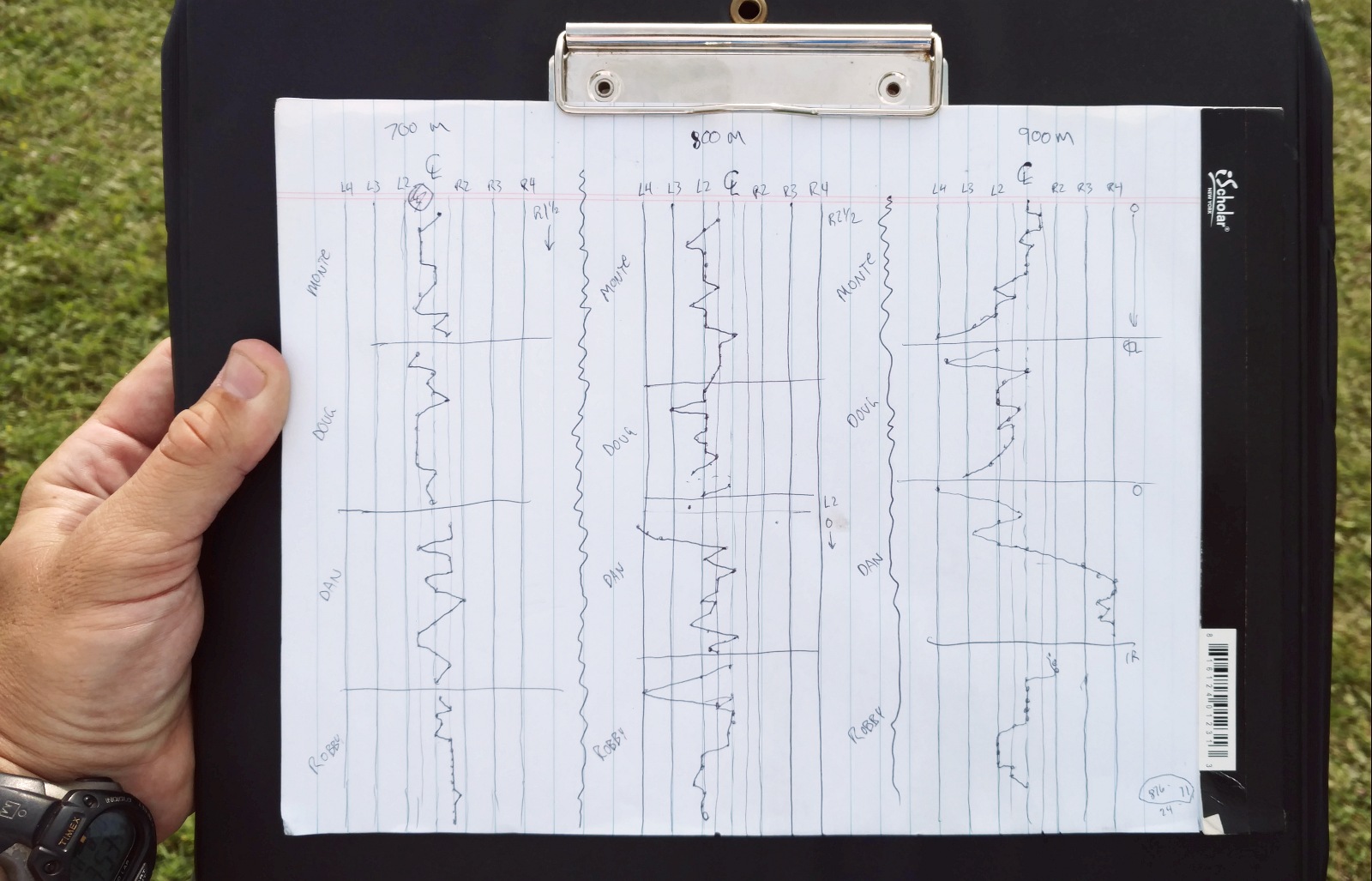
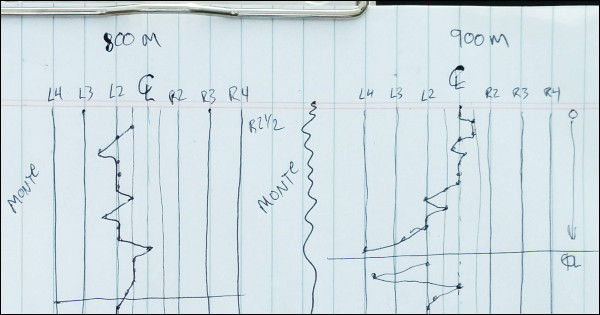
CLICK HERE to see full-screen version of Wind Plot.
The Battle of Nations begins. Today is Day 1 of international team competition at the 2017 F-Class World Championships (FCWC) in Ottawa, ON, Canada. Talented teams, in their nation’s colors, will be competing for glory and national pride.
Team shooting is very different than individual competition. Typically a team coach makes the wind calls for the shooters. In some cases (where the rules allow), the wind coach even dials elevation and windage changes for the active shooter. For the wind coach to do his job effectively, he must follow the changes in the wind and determine what the correct wind call should have been for each shot. (In other words — what was the “right call”)
Past F-TR USA Nat’l Champ Bryan Litz was wind coach for the winning 4-man LUM F-TR Team at the 2017 Canadian F-Class Championships, which preceded the FCWC Worlds. Here Bryan explains how he uses a Wind Plot to make better wind calls, helping his team-mates maximize their scores.
Wind Plot Methodology by Bryan Litz
The wind plot I use is a running history of what the correct wind call was for every shot fired. The more you shoot, the more history you have in a condition, and I find that very useful information. This kind of plot IS NOT showing where the bullet hit, and is NOT showing what you held. It’s showing what you should have held to center each shot. IMO, this is the most valuable information to have when guessing where to hold next for each shot. Here are some key points:
1. I always look for blocks of stable conditions to shoot in and wait out the rest.
2. If the wind plot shows drastic changes, either I’m not picking the right time to shoot or it’s just a really unstable wind condition.
3. When you see many shots using the same hold (e.g. Robby’s 700m and 900m strings on plot), it can indicate very fast shooting and fast pit service.
Q. What are the numbers and Markings on this Wind Plot?
Litz: The wind plot represents the rings on the target. Left 2 for example, is the 5 line on the international target, while Left 2 is the 10 line on the USA target. F-Class shooters and coaches talk about wind holds in relation to these rings. A Left 2 hold isn’t left 2 MOA or 2 MILS, it’s the second ring from center. The vertical lines on the plot represent the rings going out from center, 4 or 5 in each direction. A left or right 5 hold is edge of black on the int’l target.
Q: What Does this Specific Plot Reveal?
Litz: Looking at the plot, from left to right is 700m, 800m, and 900m that we shot progressively through the day. Top to bottom shows each shooter in sequence (shooters names are shown by their blocks). To the right I note what was on the gun for that shooter, and note when it changes. Often times we run the same wind on the gun for several shooters but if it changes, I note what the new windage is and continue on. For example if we’re settled into a condition where we’re shooting Vs with a right 3 hold, I might adjust the scope 1 MOA right because a right 3 hold is equal to 1 MOA. So we can move the scope and start shooting with a center hold.
Q. Are you Plotting Where the Bullet Hits?
Litz: Not exactly. This kind of plot IS NOT specifically showing where the bullet hit, and IS NOT showing what the shooter held. It’s showing what the shooter should have held to center each shot. IMO, this is the most valuable information to have when guessing where to hold next for each shot.
On each shot, the shooter or coach takes a guess about where to hold, and fires the shot. If the bullet hits the center, you plot the point right where you held because it was the correct hold. However, if you miss the call, you plot what hold was required to put that shot in the center. For example if you shoot a right 3 and hit where you held, the correct call would have been “center”. In this way, you’re building a history of what you should have done, which may or may not be what you actually did. This shows you the trends, and brackets which can be used to make future decisions.
Q: Is this Type of Wind Plot Something New?
Litz: I didn’t invent this method, it’s been around a long time. Vertical can be plotted the same way. In team matches, we have a plotter who is advising on elevation trends and suggesting corrections. But, as wind coach, my job is the horizontal so I only keep the wind plot. I have learned lots of strategies from my coaches Emil Praslick and Steve Hardin.
There are many ways to plot and many standard work sheets for this. They’re all tools and the key is to find something that works for you in different situations. I don’t keep a plot when I am personally behind the trigger string firing because I lose more points when I take the time to do it vs. just shooting fast. When pair firing or coaching, I can keep the wind plot without compromising the shooting.
Team Australia used plots and comms linking coaches to help win the 2013 F-Open Team World Championship. We expect other teams will follow suit in Canada in 2017.
Know Your Goal — Keep It Simple
Know your goal of plotting. The simplest plot is where you write the shot number where it hit on a target face. This kind of plotting is useful for evaluating shooter performance because it shows how big the group is (in particular the vertical dispersion). However keeping a plot like this does little to help you figure out the wind. It just shows you what shots you messed up on. It does nothing to help you find the center. [Editor: That’s a whole different matter with many variables.] The wind plot I use is a running history of what the correct wind call was for every shot fired. The more you shoot, the more history you have in a condition, and I find that very useful information.
Wouldn’t it be great if you could have one match rifle that could do double-duty — shoot position matches (with sling), and then function as an F-Open gun with front rest? Now that’s possible with Gary Eliseo’s clever “PickleFork” accessory for his line of tubeguns. This accessory also works great for load testing and varmint hunting.
Competition Machine’s Gary Eliseo is a very smart designer as well as a talented shooter. The inventor/builder of the popular Competition Machine Tubegun chassis systems, Gary has come up with something new, which he calls the PickleForks. These are rails that fit to the sides of the tubular fore-end/handguard on his chassis systems. This allows you to use a pedestal-style front rest for F-Class competition. It also provides a much more stable platform for load testing, varmint hunting, or any kind of rest-assisted precision shooting.
These PickleForks transform a Tubegun into an ultra-stable, straight-tracking rig when used with a competition-style front rest.
Gary explains: “Now you can have the same super low-boreline, long ‘wheelbase’ and vertical sides of our innovative F1 F-Class chassis system for your tube chassis. The new PickleForks attach directly to the sides of the F-Class/Tactical fore-ends, no modifications are required. They are very rigid with no flex or twist and make the rifle track like it’s on rails.” The new Eliseo Competition Machine PickleForks are offered for a very reasonable $70.00 per pair, with Cerakote finish. (You get two metal units, one for each side of the fore-arm). For more information, visit www.GotXRing.com or call (928) 649-0742.
New Product Tip from EdLongrange. We welcome reader submissions.




 More and more folks are using Burris Signature Rings these days. These unique rings feature polymer inserts. That allows you to pre-load some elevation in your scope set-up, or you can center-up the windage. Additionally, the polymer inserts hold your scope securely without leaving marks on the tube. Lastly, some folks believe that Signature rings may offer advantages for benchrest competition. Rodney Wagner shot the best 600-yard group in history using Burris Signature Zee Rings (“Zee” denotes the Weaver-rail model). James O’Hara set multiple IBS 1000-yard records using Burris Signature Zee Rings. James will tell you he thinks “all his guns seem to shoot best with these rings”.


 .
. 


 IBS Scoring Reticle Updated with Brighter Circles