|
|
August 15th, 2017

Hail the new F-Class World Champions: Australian Rod Davies (F-Open) and the USA’s Derek Rodgers (F-TR). The 2017 F-Class Individual World Championships event was memorable — with thunderstorms, tight competition, and wicked winds on the final day. On Day 1, Saturday 8/12/17, only one 700m relay was completed before a massive storm front dropped a deluge. Conditions prior to that were good, with dozens of competitors shooting “clean” — one competitor lamented “I didn’t drop a point but ended up way down the standings on V-Count…”
After one yardage, the FCWC was halted on Saturday (Day 1) by a massive thunderstorm.

Sebastian Lambang photo
F-TR — The King of 2 Miles vs. The Newly-Crowned Canadian Champ
The F-TR event couldn’t have been closer — this went down to the wire. American Derek Rodgers scored 473-36V to win the title on V-Count over Canadia Kevin Chou (473-31V). Kevin is a very tough man to beat on his home range in Ontario. At this same venue, Kevin recently won Canada’s F-TR National Championship, his second F-TR Canadian National title in a row.
This has been a great summer for Rodgers. Last month Derek won the King of 2 Miles competition in Raton, NM. But the World Championship F-TR win didn’t come easy. Not by a long shot. This was a tough, come-from-behind win for Derek. After Day 1, which was halted by rain, Derek was in 77th position. On Day 2, he had climbed to 17th. He moved all the way to the top of the podium on the third and final day by shooting brilliantly in very tough conditions.
Derek told us: “The wind was changing very rapidly on Monday (Day 3). There were radical changes. It was blowing left to right, but there were rapid velocity changes. You might move from holding at the edge of the black ring on the left, then over to the 2 ring on the right from shot to shot.” Derek noted that the match was “pair fire” so you had to wait up to 45 seconds for your partner to shoot. “That means you couldn’t shoot fast. You had to watch the conditions very carefully — watch those big canvas flags and the mirage.” Derek said the mirage was “huge in Canada… but it looks different than what I’m used to in the American Southwest. The mirage off grass is different.”

Many observers had counted Rodgers out when he stood in 17th place after Day 2, but he mastered the tough conditions to move up in the standings as others were dropping points in bunches. Derek said that starting in 17th might have been a blessing in disguise: “Starting 17th, I didn’t feel any pressure on the last day. Once I got the wind ‘roped’ on that last day, it was actually fun. I nailed a bunch of Vs, and that’s what carried me to victory.”

F-Open World Champion Rod Davies (Australia) Receives the Milcun Shield Trophy

Jenni Hausler photo.
Australian Captures F-Open Title with a Powerful Performance
In F-Open, the story was all Rod Davies, the talented Australian. He shot strong and steady throughout the match, to top the field with a 489-41V score. Finishing second was the UK’s Paul Sandie (485-38V), while another Australian, Adam Pohl, took third with 482-38V. Those Aussies do know how to shoot off grass in windy conditions. Five of the top 15 F-Open shooters were from Down Under. The top American was Jim Murphy in fourth place, followed by Erik Cortina in fifth.
Tough Conditions on Day Three
Erik Cortina told us that conditions were very tough on the last day. Wind velocities were changing unpredictably — with disastrous results for some shooters dropped 10 points or more. Somehow, in those rapidly changing winds, Eric nailed the top Aggregate for the last day, out-shooting the field: “I was lucky enough that conditions were very tough on the last day and that I was able to read the conditions good enough to win the Aggregate for the day. I moved up from 27th to 5th (overall) in one day. There were close to 200 of the best F-Open shooters in the World competing at this match, what an amazing experience to share the range with such an outstanding group of people.”

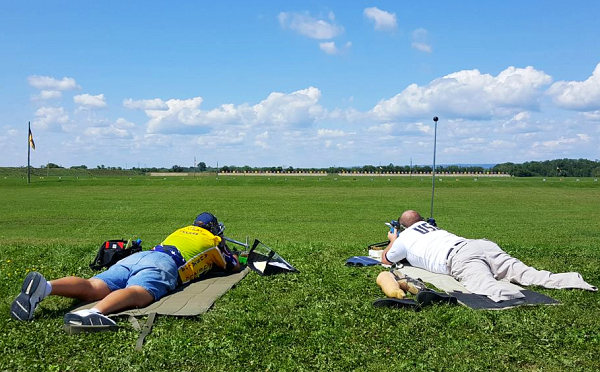
2017 FCWC relays were conducted with Pair Firing, with each shooter alternating shot by shot. Here are Mark Fairbairn (Australia) and Matt Schwartzkopf (USA) on the right. Sebastian Lambang photo.
YOUNG GUNS: At the 2017 FCWC the first-ever Under 25 World Champions were crowned: Mitchell Fitzpatrick (F-TR) and Rhys Ireland (F-Open). Rhys also won the 2017 Canadian National F-Open Championship last week. Mitchell is a past KO2M winner.
The young pit crew members did a great job. Sebastian Lambang photo.

Team Matches Come Next
There is a lay day today, August 15th, after which the Team Competition phase of the F-Class World Championships commence. We can expect a tough battle among the top teams: Australia, Canada, Great Britain/UK, South Africa, and the USA. Here is the schedule/course of fire for the Team Matches:
FCWC Team Competition
Wednesday, August 16: 2+15 @ 700m, 2+15 @ 800m, 2+15 @ 900m
Thursday, August 17: 2+15 @ 700m, 2+15 @ 800m , 2+15 @ 900m
Prize Giving and Closing Ceremonies
August 14th, 2017

Want to see the details? CLICK HERE to view full-screen photo.
Check out those five targets. The Aggregate (average) of all five targets is a tiny 0.0840 inches! These were shot by Gary Ocock at 100 yards in a California benchrest match on August 6, 2017. Though Gary’s 0.0840 Agg beats existing records, this was not a “sanctioned” match, so Gary’s killer Agg will NOT be submitted for IBS or NBRSA records. So, sadly, the Agg won’t appear in the record books, but this remains a spectacular, verified feat of rifle accuracy, accomplished in competition.
The argument can be made that this is the Most Accurate Gun Ever Built. As far as we can determine, no one has ever shot a smaller 5-target Agg anywhere, at any time.
The Unlimited Benchrest Record That Will Never Be (Official)
Report by Boyd Allen
Gary Ocock’s stunning unlimited Aggregate is beyond amazing. That’s an average of five, 5-shot groups of .0840. Shot under sanctioned match rules, but at an unsanctioned 100-yard fun match, this Aggregate is well under the current 100-yard official records of the IBS (.1386), and the NBRSA (.1242). The fourth of the five groups measured a minuscule .018, less than half the size of the existing NBRSA Unlimited record of .049 (also shot by Gary). Check it out:


When the top 15 shooters all post teen Aggs, conditions must be pretty favorable. However there were some light switchy winds — Gary said that he shot better in the left to right condition.
GUN SPECIFICATIONS
Ocock’s red Jay Young Unlimited Railgun features one major difference from Young’s typical Railgun designs. The bottom of the barrel block is integral with the top (moving part), of the gun. The barrel is Ocock’s usual 1:13.5″-twist Krieger chambered for the 6 PPC. The BAT Neuvo action* is unusual in that its lugs are horizontal at lock-up instead of the usual vertical. With horizontal lugs, both lugs maintain contact with their abutments when the action is cocked. In the more normal configuration when cocked the top lug is forced off of its seat by a combination of the angle of the trigger cocking piece interface, the pressure of the striker spring, and bolt clearance at the rear of the action.
LOAD SPECIFICATIONS
Gary shot this remarkable Agg with well-used brass, Vihtavuori N133 powder, and self-made 66gr BT bullets** seated at “jam”. This amazing Agg was shot on the second day of a 2-day Unlimited Benchrest match. On Day 1 Gary had experimented with various loads using both surplus IMR 8208 and Vihtavuori N133, but was not satisfied with the results. For his first group on Day 2, Gary tried a light load of N133. After seeing the result, however, he decided to go to the other extreme — a super stout N133 load — with the same powder. As you can see, Gary’s willingness to experiment paid off.

Notably, Gary used light neck tension. Ocock found that for these bullets and this barrel, light neck tension worked best (contrary to “normal” N133 benchrest practice). Ocock used a bushing that only produces .001″ difference between the diameters of sized and loaded case necks.
Comment on Ocock’s Achievement
Congratulations to Gary Ocock for superb shooting (and smart loading). Even though the match was not sanctioned (so the Agg will never be a record), Ocock has raised the bar very high, and given us a new standard of ultimate accuracy.
Though this 0.0840 Aggregate and 0.018 group will never go into the record group, they are still noteworthy. There’s virtually no doubt that they would have survived inspection by any record committee. Except for the lack of fixed backers, an IBS requirement (for detecting cross-fires), all other conditions were met for an officially-sanctioned match.
*The new BAT Neuvo actions are the result of a collaboration between Dwight Scott, and Bruce Thom, featuring Dwight’s ideas and BAT’s proven manufacturing expertise.
** Ocock shot his own, boat-tail match bullets, made with George Ulrich-crafted dies using Hood cores. Although he said that it had been a while since he had weighed any, his best guess was that they weigh something around 66.5 grains.
August 13th, 2017

 Is long range shooting going to become a big-money sport like golf? Well the North American Long Range Shooting Association (NALRSA) thinks so. This relatively new organization is running a series of matches with huge money pay-outs for the top shooters. Is long range shooting going to become a big-money sport like golf? Well the North American Long Range Shooting Association (NALRSA) thinks so. This relatively new organization is running a series of matches with huge money pay-outs for the top shooters.
The next NALRSA Match is happening next weekend (August 18-20) in Saguache, Colorado. Remarkably, the organizers will be offering $35,000 in total prize money, making this one of the richest rifle matches of the year:
“$35,000 dollar guaranteed payout in Colorado! Yes you read that right! As promised we are adding money into the Format 2 competition. We are going to guarantee $5,000 in each category #5 and #7. So get signed up! We have a vision at NALRSA to turn Long Range Shooting into a ‘real’ sporting event with BIG payouts just like so many other sporting events. Help us grow the sport and become a part of our exciting events!”
NALRSA Facebook Page | NALRSA Website at Long-Range-Shooting.com
This guy knows a thing or two about long range shooting.


Yep, that’s our buddy Erik Cortina (left) with the $6,250 First Prize check he received for finishing first in NALRSA’s Bandera (TX) match held in May.


August 12th, 2017

The F-Class World Championships (FCWC) commence today at the Connaught Ranges outside Ottawa, Ontario, Canada. We wish good luck to all the competitors. Based on the conditions at the recent Canadian F-Class National Championships, conditions could be challenging.
F-Class World Championships EVENT SCHEDULE:
Friday, August 11 (REST DAY – RANGE CLOSED)
Competitor Check-In for FCWC; Rifle Inspection; International Teams Reception
Saturday, August 12: Opening Ceremonies; ICFRA FCWC (Individual)
Sunday, August 13: ICFRA FCWC (Individual)
Monday, August 14: ICFRA FCWC (Individual); Awards Prize Giving
Tuesday, August 15: TEAM PRACTICE DAY
Wednesday, August 16: ICFRA FCWC (Teams)
Thursday, August 17: ICFRA FCWC (Teams): Awards Prize Giving & Closing Ceremonies
Tips for Success at the F-Class Worlds — #1, Avoid Train Wrecks
As an assist to all the competitors, we’re repeating an article by Bryan Litz, which many have found very helpful — how to avoid “Train Wrecks” at major championships.

When you have a major, critical problem at a shooting match, i.e. a “train wreck”, this can be the end of your weekend. In this article, Ballistics Guru Bryan Litz talks about “train wrecks” — the big disasters (such as equipment failures) that can ruin a whole match. A recent USA F-TR Champion, Bryan illustrates the types of “train wrecks” that commonly befall competitors, and he explains how to avoid these “unmitigated disasters”.
 Train Wrecks (and How to Avoid Them) Train Wrecks (and How to Avoid Them)
by Bryan Litz of Applied Ballistics LLC.
Success in long range competition depends on many things. Those who aspire to be competitive are usually detail-oriented, and focused on all the small things that might give them an edge. Unfortunately it’s common for shooters lose sight of the big picture — missing the forest for the trees, so to speak.
Consistency is one of the universal principles of successful shooting. The tournament champion is the shooter with the highest average performance over several days, often times not winning a single match. While you can win tournaments without an isolated stellar performance, you cannot win tournaments if you have a single train wreck performance. And this is why it’s important for the detail-oriented shooter to keep an eye out for potential “big picture” problems that can derail the train of success!
Train wrecks can be defined differently by shooters of various skill levels and categories. Anything from problems causing a miss, to problems causing a 3/4-MOA shift in wind zero can manifest as a train wreck, depending on the kind of shooting you’re doing.
Below is a list of common Shooting Match Train Wrecks, and suggestions for avoiding them.
1. Cross-Firing. The fastest and most common way to destroy your score (and any hopes of winning a tournament) is to cross-fire. The cure is obviously basic awareness of your target number on each shot, but you can stack the odds in your favor if you’re smart. For sling shooters, establish your Natural Point of Aim (NPA) and monitor that it doesn’t shift during your course of fire. If you’re doing this right, you’ll always come back on your target naturally, without deliberately checking each time. You should be doing this anyway, but avoiding cross-fires is another incentive for monitoring this important fundamental. In F-Class shooting, pay attention to how the rifle recoils, and where the crosshairs settle. If the crosshairs always settle to the right, either make an adjustment to your bipod, hold, or simply make sure to move back each shot. Also consider your scope. Running super high magnification can leave the number board out of the scope’s field view. That can really increase the risk of cross-firing.
2. Equipment Failure. There are a wide variety of equipment failures you may encounter at a match, from loose sight fasteners, to broken bipods, to high-round-count barrels that that suddenly “go south” (just to mention a few possibilities). Mechanical components can and do fail. The best policy is to put some thought into what the critical failure points are, monitor wear of these parts, and have spares ready. This is where an ounce of prevention can prevent a ton of train wreck. On this note, if you like running hot loads, consider whether that extra 20 fps is worth blowing up a bullet (10 points), sticking a bolt (DNF), or worse yet, causing injury to yourself or someone nearby.

3. Scoring/Pit Malfunction. Although not related to your shooting technique, doing things to insure you get at least fair treatment from your scorer and pit puller is a good idea. Try to meet the others on your target so they can associate a face with the shooter for whom they’re pulling. If you learn your scorer is a Democrat, it’s probably best not to tell Obama jokes before you go for record. If your pit puller is elderly, it may be unwise to shoot very rapidly and risk a shot being missed (by the pit worker), or having to call for a mark. Slowing down a second or two between shots might prevent a 5-minute delay and possibly an undeserved miss.
 4. Wind Issues. Tricky winds derail many trains. A lot can be written about wind strategies, but here’s a simple tip about how to take the edge off a worse case scenario. You don’t have to start blazing away on the command of “Commence fire”. If the wind is blowing like a bastard when your time starts, just wait! You’re allotted 30 minutes to fire your string in long range slow fire. With average pit service, it might take you 10 minutes if you hustle, less in F-Class. Point being, you have about three times longer than you need. So let everyone else shoot through the storm and look for a window (or windows) of time which are not so adverse. Of course this is a risk, conditions might get worse if you wait. This is where judgment comes in. Just know you have options for managing time and keep an eye on the clock. Saving rounds in a slow fire match is a costly and embarrassing train wreck. 4. Wind Issues. Tricky winds derail many trains. A lot can be written about wind strategies, but here’s a simple tip about how to take the edge off a worse case scenario. You don’t have to start blazing away on the command of “Commence fire”. If the wind is blowing like a bastard when your time starts, just wait! You’re allotted 30 minutes to fire your string in long range slow fire. With average pit service, it might take you 10 minutes if you hustle, less in F-Class. Point being, you have about three times longer than you need. So let everyone else shoot through the storm and look for a window (or windows) of time which are not so adverse. Of course this is a risk, conditions might get worse if you wait. This is where judgment comes in. Just know you have options for managing time and keep an eye on the clock. Saving rounds in a slow fire match is a costly and embarrassing train wreck.
5. Mind Your Physical Health. While traveling for shooting matches, most shooters break their normal patterns of diet, sleep, alcohol consumption, etc. These disruptions to the norm can have detrimental effects on your body and your ability to shoot and even think clearly. If you’re used to an indoor job and eating salads in air-conditioned break rooms and you travel to a week-long rifle match which keeps you on your feet all day in 90-degree heat and high humidity, while eating greasy restaurant food, drinking beer and getting little sleep, then you might as well plan on daily train wrecks. If the match is four hours away, rather than leaving at 3:00 am and drinking five cups of coffee on the morning drive, arrive the night before and get a good night’s sleep.”
Keep focused on the important stuff. You never want to lose sight of the big picture. Keep the important, common sense things in mind as well as the minutia of meplat trimming, weighing powder to the kernel, and cleaning your barrel ’til it’s squeaky clean. Remember, all the little enhancements can’t make up for one big train wreck!
August 11th, 2017

The 2017 Canadian F-Class Championships have concluded. As the event preceded the 2017 F-Class World Championship (in the same venue) by a few days, many of the world’s best F-Class shooters were on hand at the Connaught Ranges outside Ottawa, Ontario. Competition was fierce — as were the winds at times. The challenging conditions gave shooters a good test in preparation for the FCWC which gets underway in earnest on Saturday, August 12, 2017.
All 2017 CDN F-Class Nationals Individual Results | All 2017 CDN F-Class Nationals Team Results
Kevin Chou Wins Second Straight F-TR Canadian Title
Canada’s Kevin Chou (Aurora, ON) shot great to win the F-TR match with a strong 426v30 score. This made was two wins in a row for Kevin, who also took the F-TR Title in 2016. Two Yanks completed the podium, with Jeff Rorer (420v25) taking second place, and Robby Burton (418v25) placing third.

Rhys Ireland Wins F-Open Canadian Championship
The F-Open Championship was a tightly-fought match that went down to the wire. Rhys Ireland won the Individual F-Open Championship with a 434v30. Just one point behind at 433v39 was Australia’s Rod Davies. Third, again just one point back, was Canadian Barry Price (433v30).

Team USA (Litz) Wins F-TR Team Championship
American F-TR Teams managed a clean sweep of the top three places in the 4-shooter LUM Team Match. Team USA Litz secured the team victory with a 875v71 score. Finishing second in F-TR was USA Team Swartzkopf (871v74), followed by Team USA Hardin (870v72).
Who can explain the lines and dots on this shot tracking chart used by Bryan Litz?

F-TR Team USA (Litz) members (alphabetically) Douglas Boyer, Robby Burton, Dan Lentz, Monte Milanuk; Bryan Litz (head coach), Stan Pate (asst.)

Team USA (Nancy) Wins F-Open Team Title
The F-Open 4-shooter Team Competition was also dominated by American squads which finished first and second. Winning F-Open Gold, with a score of 888v98, was Team USA (Nancy), coached by Nancy Tompkins, America’s “First Lady of Shooting”. Finishing second was Team USA (Walker) with 887v100, followed by the Canadian F-Open Team at 887v90.
F-Open Team USA (Nancy) was packed with talent. Shooters were: Shiraz Balolia, Ken Dickerman, James Laney, and Pat Scully. Another American deserves mention, John Myers of the Texas F-Open Team. We believe John’s 225v27 was the high score for the team match, and he was the only competitor to shoot “clean”, not dropping a point.
Sebastian Lambang, inventor/builder of SEB Rests, competed in the Canadian Championships. Over half the competitors used SEB rests — Joy-Pods for F-TR and NEOs and MINIs for F-Open.

Conditions were windy and challenging at the 2017 Canadian F-Class Championships. Will the strong winds continue for the F-Class World Championships (FCWC) starting tomorrow, August 12, 2017. Only the wind gods know for sure. Good luck to all the FCWC competitors from all nations!

August 9th, 2017

American Silhouette shooter Eric Mietenkorte delivered a superb performance at the recent Canadian National Silhouette Championships in Fort Steel, British Columbia. Eric recorded a 1-2-3 Trifecta with 1st Place in Master Standard Rifle, 2nd Place in Master Hunter Rifle, and 3rd place in Master Smallbore Hunter. Eric is coming home with quite the trophy harvest. Other top shooters included Team Lapua members Mark Pharr and Cathy Winstead-Severin.
Erich called this a “target rich environment”…


Eric tells us: “The Canadian National Championships are all wrapped up. Thanks to the Bull River Shooters Association (B.R.S.A.) for hosting an incredible event! What a great [week] of shooting! Such a beautiful range with the nicest people! It was great seeing old friends and making new ones. [There were] definitely some challenging wind and mirage conditions, but lots of great shooting, and I even took home some hardware.” Erich has posted these photos from the event.

Erich was quick on the trigger shooting pigs at 300 meters. He says “I love hearing that clang from hitting the steel.” Click speaker icon to hear audio.
6.5mm Chamberings Favored for Centerfire (High Power) Silhouette
The 6.5mm caliber seems to be the “sweet spot” for High Power Silhouette shooters. Erich says: “I use the .260 Bobcat (6.5×250) wildcat. Most still use the .260 Remington and 6.5×47 Lapua.” Other popular chamberings for High Power Silhouette include the 6.5 Creedmoor, 6mmBR, 6mm Dasher, 6×47 Lapua, and 7mm-08.
One wicked cool paint job — the Fighter Plane graphics on Erich’s smallbore rifle drew admiring glances.

Here Erich spots for fellow American shooters Mark Pharr and Cathy Winstead-Severin of Team Lapua.

The Cranbrook Daily Townsman News did a nice story on the Championships, complete with this informative video.
Fort Steele in British Columbia is a beautiful venue. Stunning scenery all around…

August 6th, 2017

Hall of Fame Class of 2017 — Ed Etzel (top left, WVU photo); David Kimes (top right, USAMU photo); Don Haldeman (bottom left, NRA photo); Martin Gunnarsson (bottom right, USAMU photo).
USA Shooting Hall of Fame Inductions
Four outstanding American marksmen will be inducted into the U.S. International Shooting Hall of Fame on August 26th in Colorado Springs, CO. Ed Etzel, David Kimes, Martin Gunnarsson and Don Haldeman will be the largest group of inductees since the first distinguished class in 1991. Each of these four shooters served in the U.S. Army and shot with the USAMU. The Hall of Fame Induction Ceremony will coincide with the USA Shooting alumni reunion and Biennial Coach Conference.
ED ETZEL
Etzel won the Gold Medal at the 1984 Olympics in Los Angeles in the Men’s English Match Rifle event and was a gold medalist in the 1978 World Championships and 1979 Pan American Games. He was 11-time National Champion and set numerous national rifle records as a member of the U.S. Shooting Team. Later, Etzel coached the WVU Rifle team from 1976-89, with a 101-3 career coaching record. He coached over 30 WVU All-Americans and guided his teams to four NCAA National Championships during the 1980s. He was an active duty officer in the U.S. Army Medical Service Corps for nearly three years during the Vietnam War and subsequently for 10 years in the U.S. Army Reserves.
DAVID KIMES
Kimes earned 14 World Championship medals (team & individual) during his career. A five-time World Team member from 1966 to 1986, Kimes is the only U.S. shooter to win an individual World Championship (1974) while setting a World Record and then repeating the same feat in the next World Championships (1978). He was selected as a 1980 Olympian but was unable to compete due to the U.S. boycott of the Games in the USSR. Reflecting on his induction, Kimes quoted Thoreau: “Our truest life is when we are in our dreams awake.” He reflected back on his last shot of the 1974 World Championships in Switzerland, the cheering of over a thousand Swiss fans as he connected on his final shot for a perfect string of 100, resulting in a world record and title of world champion.

MARTIN GUNNARSSON
Gunnarsson won the bronze medal at the 1968 Olympic Games in the 300m Three-Position Rifle event and was a Pan American and World Championships medalist during his distinguished career. His Pan American medals were both gold and were won in team events at the 1959 and 1963 Pan Am Games 00 in the English match and free rifle event, respectively. At the 1966 World Championships, he also won a gold medal in the free rifle team event. In addition, both free rifle team performances (in 1963 and 1966) earned him a share of the world record.
DON HALDEMAN
A two-time Olympian who competed in the 1972 and 1976 Olympic Games, Haldeman earned an Olympic gold medal in 1976 in Men’s Trap. Haldeman was a member of the gold-medal winning 1973-74 U.S. World Championship Team. He was also a member of the 1975 U.S. Pan American Games Team, winning individual silver along with a team gold medal. He remains the last U.S. team member to earn Olympic gold in Men’s Trap.
About the USA Shooting Hall of Fame
The U.S. International Shooting Hall of Fame was established in 1991 by the NRA International Competitions Committee. Selection is focused on marksmen who excelled in international competition over an extended period of time, and who have been retired from active international shooting at least five years. Living USA Shooting Hall of Fame members and USA Shooting Board of Directors nominate candidates and then join with USA Shooting alumni in voting on the final nominees.
August 5th, 2017

The movie “The Patriot” gave us the phrase “Aim small, miss small”. While that’s a good mantra, aiming strategies for long-range competition are a bit more complicated, as this article explains…
The The F-Class World Championships (FCWC) in Canada are just one week away. This August 11-17, the world’s top F-Class shooters will gather at the Connaught Ranges outside Ottawa, Ontario. Here are some tips that can help F-TR and F-Open shooters aim more precisely, and achieve higher scores. F-Class ace Monte Milanuk reviews reticle choices and strategies for holding off.
In our Shooters Forum, one newcomer wanted some advice on selecting a reticle for F-Class optics. He wondered about the advantage of Front (first) Focal Plane (FFP) vs. Second Focal Plane scopes and also wondered if one type of reticle was better for “holding off” than others.
In responding to this question, Forum regular Monte Milanuk provided an excellent summary of aiming methods used in F-Class. For anyone shooting score targets, Monte’s post is worth reading:
Aiming Methods for F-Class (and Long-Range) Shooting — by Monte Milanuk
 F-Class is a known-distance event, with targets of known dimensions that have markings (rings) of known sizes. Any ‘holding off’ can be done using the target face itself. Most ‘benefits’ of Front (first) focal plain (FFP) optics are null and void here — they work great on two-way ranges where ‘minute of man’ is the defining criteria — but how many FFP scopes do you know of in the 30-40X magnification range? Very, very few, because what people who buy high-magnification scopes want is something that allows them to hold finer on the target, and see more detail of the target, not something where the reticle covers the same amount of real estate and appears ‘coarser’ in view against the target, while getting almost too fine to see at lower powers. F-Class is a known-distance event, with targets of known dimensions that have markings (rings) of known sizes. Any ‘holding off’ can be done using the target face itself. Most ‘benefits’ of Front (first) focal plain (FFP) optics are null and void here — they work great on two-way ranges where ‘minute of man’ is the defining criteria — but how many FFP scopes do you know of in the 30-40X magnification range? Very, very few, because what people who buy high-magnification scopes want is something that allows them to hold finer on the target, and see more detail of the target, not something where the reticle covers the same amount of real estate and appears ‘coarser’ in view against the target, while getting almost too fine to see at lower powers.
Whether a person clicks or holds off is largely personal preference. Some people might decline to adjust their scope as long as they can hold off somewhere on the target. Some of that may stem from the unfortunate effect of scopes being mechanical objects which sometimes don’t work entirely as advertised (i.e. one or two clicks being more or less than anticipated). Me personally, if I get outside 1-1.5 MOA from center, I usually correct accordingly. I also shoot on a range where wind corrections are often in revolutions, not clicks or minutes, between shots.
Some shooters do a modified form of ‘chase the spotter’ — i.e. Take a swag at the wind, dial it on, aim center and shoot. Spotter comes up mid-ring 10 at 4 o’clock… so for the next shot aim mid-ring 10 at 10 o’clock and shoot. This should come up a center X (in theory). Adjust process as necessary to take into account for varying wind speeds and direction.

 Others use a plot sheet that is a scaled representation of the target face, complete with a grid overlaid on it that matches the increments of their optics — usually in MOA. Take your Swag at the wind, dial it on, hold center and shoot. Shot comes up a 10 o’clock ‘8’… plot the shot on the sheet, look at the grid and take your corrections from that and dial the scope accordingly. This process should put you in the center (or pretty close), assuming that you didn’t completely ignore the wind in the mean time. Once in the center, hold off and shoot and plot, and if you see a ‘group’ forming (say low right in the 10 ring) either continue to hold high and left or apply the needed corrections to bring your group into the x-ring. Others use a plot sheet that is a scaled representation of the target face, complete with a grid overlaid on it that matches the increments of their optics — usually in MOA. Take your Swag at the wind, dial it on, hold center and shoot. Shot comes up a 10 o’clock ‘8’… plot the shot on the sheet, look at the grid and take your corrections from that and dial the scope accordingly. This process should put you in the center (or pretty close), assuming that you didn’t completely ignore the wind in the mean time. Once in the center, hold off and shoot and plot, and if you see a ‘group’ forming (say low right in the 10 ring) either continue to hold high and left or apply the needed corrections to bring your group into the x-ring.
Just holding is generally faster, and allows the shooter to shoot fast and (hopefully) stay ahead of the wind. Plotting is more methodical and may save your bacon if the wind completely changes on you… plotting provides a good reference for dialing back the other way while staying in the middle of the target. — YMMV, Monte
August 5th, 2017

 It’s good to see an ammo-maker step up to help the shooting sports. ELEY Ltd. has recently made significant investments in .22LR rimfire benchrest and competition segments within the USA. ELEY has partnered with the American Rimfire Association (ARA) and Professional Shooting League (PSL) to help promote and expand rimfire benchrest shooting, one of the fastest growing .22 LR rimfire competition disciplines worldwide. The ARA and PSL competitions are leading rimfire benchrest organizations within the United States. ELEY’s financial and logistical support will help the ARA and PSL grow the ranks of rimfire benchrest shooters. It’s good to see an ammo-maker step up to help the shooting sports. ELEY Ltd. has recently made significant investments in .22LR rimfire benchrest and competition segments within the USA. ELEY has partnered with the American Rimfire Association (ARA) and Professional Shooting League (PSL) to help promote and expand rimfire benchrest shooting, one of the fastest growing .22 LR rimfire competition disciplines worldwide. The ARA and PSL competitions are leading rimfire benchrest organizations within the United States. ELEY’s financial and logistical support will help the ARA and PSL grow the ranks of rimfire benchrest shooters.

Here’s a record-setting rimfire benchrest rifle owned by our friend Joe Friedrich who competes in ARA matches, primarily using ELEY .22 LR Tenex ammo.
ARA was started in April 1998 by a group of .22 LR shooters who wanted an organization for competitive .22 LR benchrest competition. In 2010, ARA started to transition to what it has become today, with the unique goal of continuing the vision of the ARA founders by providing an honest competitive organization that is true to .22LR shooting.
PSL was founded as a benchrest organization for the true precision shooting professional. With the growth of rimfire benchrest, there was a need to have a professional organization to which shooters would be compensated for their hard work, training and competition success.

Image from National Rimfire Benchrest Association of Ireland (NRBAI)
Among .22 LR rimfire disciplines, benchrest shooting represents the “pinnacle of precision” — the very highest level of accuracy is needed to succeed. As such, ELEY has identified the need to help expand this growing sport. “This support by ELEY will help us bring .22 LR benchrest to the forefront of shooting competitions,” says Dan Killough, Director of ARA & PSL. “The expansion of [rimfire] benchrest … gives shooters a platform to enjoy and participate in rimfire competition that previously may not have been available to them,” stated Mike Corkish, ELEY Director of North America Sales.
August 4th, 2017

Photos courtesy Lapua and Adam Braverman
2017 USA Smallbore Silhouette Champion | 2017 USA High Power Silhouette Champion
2017 Canada Smallbore Silhouette Champion
We don’t know if there is an official “Lady Rifle Shooter of the Year”, but we would nominate Silhouette shooter Cathy Winstead-Severin, based on her amazing shooting so far this summer. Cathy has delivered some truly dominant performances recently. In mid-July, competing at the Ridgway Rifle Club in PA, Team Lapua’s Cathy Winstead-Severin won the 2017 Hunter Rifle NRA Smallbore Silhouette Championship. Cathy scored 110/120 to win her 20th NRA National Silhouette title. Then Cathy went on to win both the Standard and Hunter High Power Rifle Silhouette National Championships.
With those victories, Cathy completed a clean sweep of Smallbore (Rimfire) AND High Power (Centerfire) awards — a stunning achievement. Cathy was using Lapua cases, VihtaVuori powder, and a combination of Lapua and Berger bullets to win her 21st and 22nd National Silhouette Titles.

More Glory Across the Border — Cathy Wins in Canada Too!
Less than three weeks after her wins at the USA National Silhouette Championships, Team Lapua’s Cathy Winstead-Severin ventured north and won the Canadian NFA National Smallbore Silhouette Championship. After the match she also hosted a very informative clinic for other shooters. Congratulations Cathy Winstead-Severin. You have our vote for Lady Shooter of the Year. We also thank Team Lapua for providing support for major Silhouette Championship events.

|


