We congratulate Rebecca Richards of Australia for her incredible shooting in the recent RBA Benchrest Grand Prix at the Sydney International Shooting Centre. Consider this, out of the five (5) benchrest classes competing (two air rifle, and three rimfire) Rebecca won four classes outright while placing third in the fifth class. Wow — that represents complete and total domination. Remarkably, Rebecca dropped only 10 points in four days of shooting.
Rebecca’s amazing 4-day performance was near perfection. Overall, she scored 2740 out of a total of 2750 possible points. She shot four of 11 targets with perfect 250/250 scores, and six more with 249/250. Over the course of the event she hit 152 “dots” (center bulls) out of a total possible 275. That’s pretty amazing if you understand how small those center bulls really are. Take a look at the target photo below — the center dot is tiny.
All in all, this was a performance for the ages — one of the best combined airgun/rimfire benchrest performances in Southern Hemisphere history. Kudos to Rebecca for her brilliant performance.
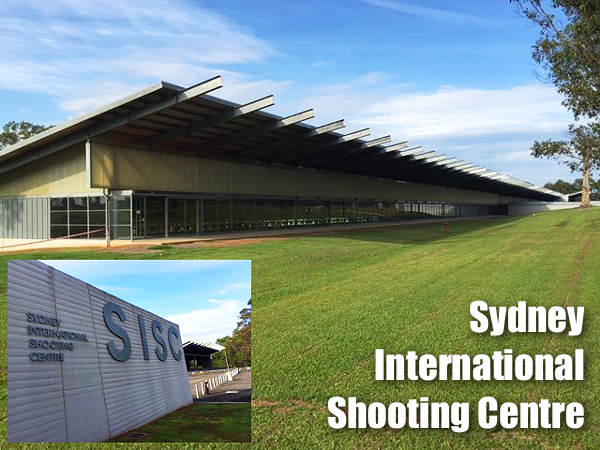
Here’s the modern Sydney International Shooting Centre…
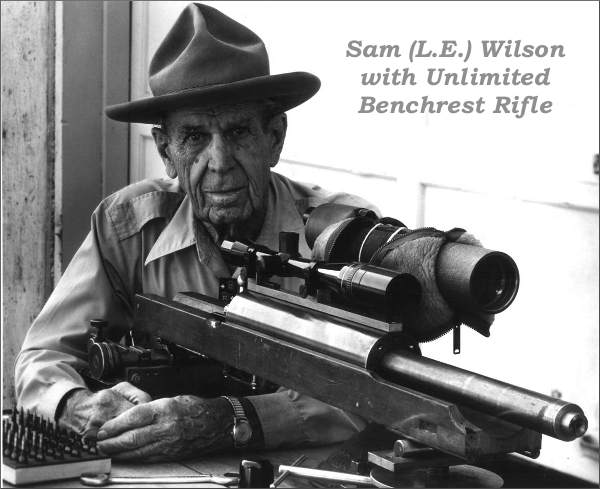
Sam (L.E.) Wilson actively competed in benchrest matches until he passed. He’s shown here with an Unlimited benchrest rifle of his own design.
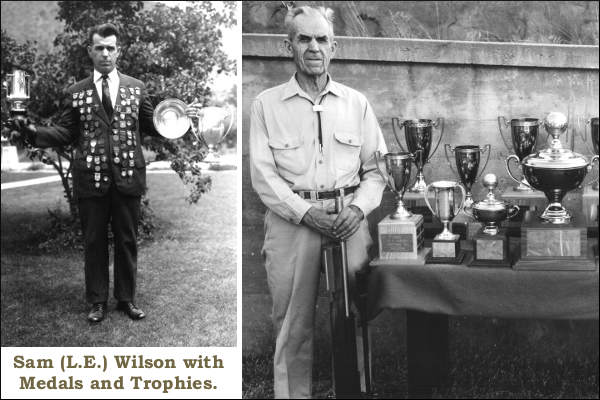
If you’ve used hand dies with an arbor press, chances are you’ve seen the L.E. Wilson company name. You may not know that the founder of L.E. Wilson Inc. was an avid benchrest competitor who pioneered many of the precision reloading methods we used today. Known as “Sam” to his friends, L.E. Wilson was one of the great accuracy pioneers who collected many trophies for match victories during his long shooting career.
The photo above shows Sam (foreground) with all of his children at a shoot. Behind Sam are Jim, Jack and Mary, shooting in the Unlimited Class. What do they say — “the family that plays together stays together”? Note the long, externally-adjusted scopes being used. Learn more about Sam (L.E.) Wilson and his company on the L.E. Wilson Inc. Facebook Page.
Unlimited Class was Sam’s favorite discipline, because in the “good old days” top competitors normally would craft both the rifle and the front/rear rests. This rewarded Sam’s ingenuity and machining/fabrication skills. In the “build-it-yourself” era, one couldn’t just order up an unlimited rail gun on the internet. How times have changed…
Midsouth Shooters Supply, a long-time supporter of AccurateShooter.com, has launched a Newsletter for shooters, the SHOT Report. The SHOT Report will provide product reviews, reloading tips, sales notices, industry news, and more. To view the premiere issue of the SHOT Report, CLICK HERE.
The first-ever SHOT Report newsletter features an article about the million-dollar American Sniper Shootout. Tracking Point, makers of “Intelligent” rifle systems, is sponsoring a challenge match pitting World Shooting Champion Bruce Piatt against Taya Kyle, Chris Kyle’s widow. Taya will be using Tracking Point’s precision-guided firearms, while Bruce will compete using basic military squad-level and sniper firearms. If Bruce wins, he takes home a $1,000,000 prize. The landmark event is set for Saturday, December 5, 2015 in Mason, Texas. Proceeds will benefit the Chris Kyle Frog Foundation.
The American Sniper Shootout is the first of its kind to pit a novice shooter armed with TrackingPoint rifle systems against a World Champion-level shooter in a head-to-head competition featuring a variety of shooting scenarios at multiple distances.
On this Veterans Day, we thought we would reprise this inspirational profile of SGT Robert Evans, a U.S. Army veteran who lost his right hand in combat in Iraq. Remarkably, despite his injury, SGT Evans obtained the Distinguished Rifleman Badge. Read on to learn more about this remarkable young soldier.
Wounded Warrior Goes Distinguished Report based on story by Ashley Brugnone, CMP writer
At the 2013 Western CMP Games, SGT Robert Evans attained what many shooters seek their entire shooting careers — a Distinguished Rifleman’s Badge. Evans earned his DR badge with just one hand, after losing his right hand while serving in Iraq with the U.S. Army.
SGT Robert Evans: Defying the Odds, Single-Handedly
AFter joining the Army in 2003, SGT Robert Evans served two tours in Iraq, suffering a spinal injury on the first tour. On his second tour, his life changed forever. On May 31, 2007, Evans was commanding a Bradley Fighting Vehicle in Iraq. As the Bradley drove under an old Fedayeen guard shack, an IED on top of the guard shack detonated while Evans was reaching out of the turret. The blast amputated Robert’s right hand at the wrist.
Even as a young boy, Evans had always enjoyed shooting. He vowed to stay involved with the sport despite his injury: “I couldn’t give up shooting after I lost my hand. It’s always been too important to me,” he said. “No matter what is going on in my life, when the sights are aligned and the hammer is about to fall, nothing in the world matters at that second. It’s my nirvana.”
Evans worked his way back into the sport by starting in F-Class. The position allowed him to hold hard and pull the trigger, while also being able to use his optics. Then he got involved with J.J. O’Shea’s M1 for VETS Project. The project helps transition wounded combat veterans back into the world of shooting, with equipment arrangements, position training and mental preparations.
Working with the M1 for Vets group, Evans started shooting again. But there were challenges: “The first time I shot after my amputation, it was very frustrating,” he said. “I couldn’t hold still, and shooting left-handed was so foreign.” Being extremely right-eye dominant his entire life, the loss of his right hand caused him to relearn many things, including how to shoot. Learning how to reload and adjust for wind while slung up became a pain for Evans….
In 2008, after several months and rigorous hours of dry firing, Evans found himself crossing the threshold of Camp Perry — a dream he had waited to fulfill his entire life. He scored around 50 points standing, out of 100, on his first trip. Though not bad for someone with an amputation, that wasn’t enough for Evans. He wanted to become a Distinguished Rifleman.
SGT Evans during Team Match at 2013 CMP Western Games.
He began to realize his dream as he earned his first 10 points (towards Distinguished) at Camp Perry in 2012. It took him 15 months to LEG out. His next 6 points came at the 2013 Eastern Games in Camp Butner, NC, followed by 10 more points at the 2013 National Matches. There, hoping to “bronze out,” he managed to one-up himself to actually earn a silver medal.
Then came the 2013 Western Games at the Ben Avery Shooting Facility in Phoenix, AZ. Never giving up hope and remembering his long journey from the hospital bed to the firing line, he received his final 8 points. SGT Robert Evans had become a Distinguished Rifleman.
“There was a lot of pressure, speculation and competition as to who would be the first Combat Wounded Veteran to ‘Go Distinguished’ within M1 for VETS,” he said. “I’m very proud to have earned my badge, but more importantly, I hope that more wounded veterans will realize that it is within their grasp. It’s not an impossibility anymore. I hope it motivates everybody to train a little harder and hold a bit tighter – not just wounded veterans. If I can do it, anybody can.”
IBS Match Report by Bob White
The “Mainville Mania” match marked the last International Benchrest Shooters (IBS) group shoot of 2015 on September 26-27, 2015. It was held at the Mainville Sportsman Club in Mainville, PA, and was attended by 30 shooters. Shooting conditions were good, with light winds and temperatures ranging from the upper 50s to high 70s both days. The “Mainville Mania” Two-Gun Aggregate winner for 2015 was Al Auman who recorded an impressive .2294 Overall Agg. There was some very tight competitition this year — second to sixth place in the Two-Gun Agg was separated by only 0.008. Jeff Peinhardt was the Two-Gun runner-up with 0.2545, while Harley Baker placed third with 0.2569.
The Mainville Sportsman Club is a very scenic venue, set in wooded countryside. Here is the view of the covered rifle benches, as seen from the target bays.
Saturday Start to a Great Event
The Saturday morning warm-up began with Light Varmint (LV) class. Sarah Dolinsky, a first-year rookie, shot the smallest group: 0.111 inch. With the start of the record matches, Barney Small jumped out in front with a 0.139 but his lead was short-lived as Howie Levy shot his second sub-0.2 group in match Two to take over first place. Bill McIntyre’s 0.114 placed him on top after match Three. Bill maintained his lead through match Four with a slightly larger Agg. Following match Five and completion of the yardage, by virtue of his 0.121 final group, Wyatt Peinhardt won with a superb 0.1830 LV Aggregate.
Following lunch in the clubhouse (the “Mainville Cafe”), the Heavy Varmint 100-yard event began with record match number One. Al Auman took the lead with a 0.122 group. After match Two, Auman was still on top. But Harley Baker took the lead with a 0.158 after match Three. A new leader emerged after match Four as Howie Levy posted a 0.217 to take the number one spot on the leader board. On the fifth and final group, Bob White, who had been in third to seventh place all afternoon, fired a 0.121 to steal the HV 100-yard Agg. White’s final group edged out Howie Levy by a mere .002 for the win.
More Mirage on Day Two
Sunday’s weather conditions had more mirage, but were still quite shootable. Once again Sarah Dolinsky claimed small group on the warm-up in the Heavy Varmint (HV) class. Not content with a 0.277, she shot a 0.263 in match One. The lead changed to Al Auman in match Two following his first and second groups in the “threes”. However, Al wasn’t done — he improved with a 0.283 in match Three, giving him a 0.1637 Agg (as corrected for 200 yards). It appeared that a record Agg might be possible. Al maintained his lead throughout the match, finishing with a 0.2068 Agg for a solid win.
In the Sunday Afternoon Light Varmint event, Barney Small’s 0.277 in Match One had him on top. He maintained this spot through match Three, but Bob Brushingham was nipping at Barney’s heels. After match Four, Brushingham took the lead with a 0.2011. The final group gave Bob Brushingham the yardage win with a flat .2100 followed by Barney at 0.265 and first year Rookie Jason Brown in third with his 0.2707.
LV and HV Grand Agg Top Guns
Looking at Grand Agg standings in Light Varmint, Wyatt Peinhardt took third with a 0.2595. In second was Al Auman at 0.2476 and Top Dog was Bob Brushingham with a 0.2366. In the Heavy Varmint Grand Agg, Al Auman was the winner with a fine 0.2112. Harley Baker was second with 0.2395 and Howie Levy placed third with a .2423.
As awards were ending Brian Dolinsky (patriarch of the famous shooting Dolinskys) offered a $100 cash prize for the best Mainville three-match Two-Gun Agg average for the 2016 season. Bob Brushingham won the special award for best three-match Aggregate in 200-yard Light Varmint. The $100 award was donated by Kent Harshman to reward the shooter who excels in what are usually the last five targets shot in two-day match. The Mainville Club welcomes other cash award offers for its 2016 season.
The Mainville Sportsman Club (MSC) was founded in the mid-60s to promote pistol and rifle shooting. With over 400 members, the Club hosts benchrest rifle competitions, pistol matches, Cowboy Action events, Buffalo Shoots, and an annual Ground Hog Shoot.
The Club operates a covered 40-bench rifle range, a 6-lane Cowboy Action Shooting area, plus an indoor meeting facility. The rifle range has targets set at 100, 200, and 300 yards. The club also offers Hunter Safety Courses. The facility is located in the Northeast corner of Pennsylvania near Bloomsburg, PA, about 5 miles east of exit 242 on I-80 near Mainville, PA.
The Mainville Sportsman Club has a rich history. In the early years the organization held Dinner-Dances which were popular throughout the community. MSC also held Beef Shoots featuring 6″ black targets shot off-hand at 100 yards. These events were well-attended, with as many as 100 shooters.
Report based on Story inNRABlog.
It’s official — Indiana is IN and Ohio is OUT. The Chief Wa-Ke-De Range in Bristol, Indiana, is now the permanent home of the NRA National Smallbore Rifle Championships. The Smallbore Championships will no longer be contested at the historic Camp Perry facility on the shores of Lake Erie near Port Clinton, Ohio. After the Smallbore Nationals were relocated to Indiana for the past two years to facilitate the 2015 World Long Range Championships, many competitors expected a return to Camp Perry. However, the NRA Smallbore Committee has decided to make Bristol, Indiana the permanent venue for the Smallbore Championships.
Situated about three hours west of Camp Perry, the Wa-Ke-De Range has some advantages over the Camp Perry facility. First, the 100-point firing line is covered in asphalt instead of grass. In addition, the range sits in a large grove of trees that provide a beautiful setting and shelter from the wind — practically the opposite of Camp Perry’s notorious wind and open fields.
Despite this, many smallbore competitors wished for the Nationals to return to Camp Perry. One poll of shooters ran roughly 3:1 in favor of returning to Perry. On his personal website, Bill Dutton has posted an Open Letter to the NRA which states many reasons why the Smallbore Championships should be returned to Camp Perry. Among other things, Bill notes: “The facilities are perfect for a large Regional but The Chief Wa-Ke’-De Rifle Range lacks the grand scale which a Camp Perry provides. Competitors and parents look forward to browsing vendor row at Camp Perry in order to replenish supplies for the coming season… in addition to trying out the latest shooting equipment. The nearest hotel [was] in Elkhart, about 15 minutes away. Camp Perry has sufficient onsite lodging for hundreds of competitors and their families. I personally had a bill for $1,400 for the hotel I and my daughter stayed in. Compared to a Hut at Camp Perry where four people can sleep for $12.50 per night, translating to equivalent cost of $175 per person for two weeks.”
View Photo Gallery from 2014 Smallbore Championships
2016 Championships Scheduled for July 10-18, 2016
The 2016 Smallbore Championships will be held 10-18 July, 2016, with registration opening on April 1, 2016. As before, the Metric and Conventional Position Championships will fall under the umbrella of the NRA Smallbore 3-Position Championship. Note: The Metric Prone Championship was removed but the 50-yard match was added to the NRA Smallbore Prone Championship. From these two main championships (3-Position and Prone), an overall NRA National Smallbore Rifle Champion will be crowned.
Team championships in both position and prone will still be awarded. 3-Position team matches will be shot as “paper matches,” meaning the scores will be taken from a shooter’s individual performance in the 3-Position Championship. Prone team matches will still be shot on their own and will be held following each day’s individual prone matches.
Here’s a very interesting spotting scope stand, from Forum member (and ace F-Class shooter) Monte Milanuk. You can see this stable rig can be adjusted super-low for prone shooting. The components are from Italian photography accessory maker Manfrotto (but it’s not as expensive as you might think).
Monte tells us about his spotting scope stand, which is really a conventional photography tripod adjusted to a very low position, with a special head:
This stand has a Manfrotto 322RC2 pistol-grip head to make positioning easier. It actually goes even lower, and much, much higher. Both the head and the tripod are about $170-ish each, so it’s a bit more expensive than a Ray-Vin, a little less than a Creedmoor Polecat, and a whole lot more flexible overall.
This Manfrotto 055XPROB Pro Tripod is actually a little on the big side – probably should have gone with a Manfrotto 190 model (couple inches shorter on the legs) so it can be a bit of a hassle to set up when you have to shoot two-to-a-mound a la Fullbore.
It’s probably not as [expensive] as you might think… a Ray-Vin F-Class stand (without head) is about $170 from Creedmoor Sports. A Ray-Vin stand head is $150, plus the outrigger attachment is another $100+. I’ve got two of them downstairs for when I used to shoot conventional prone[.]
Comments from Facebook Fans: Pretty high end setup, should work well for prone, not sure about other positions. — John T.
An excellent and sturdy Manfrotto stand. I have one that I use not only for a spotting scope but to mount the rifle on when allowed for unknown distance tactical matches.–Dennis Santiago
Thinking of getting started in 3-Gun competition? In this NSSF video, Top Shot Finalist Chris Cerino reviews the hardware you’ll need for multi-gun matches. Chris talks about carbine configurations — including barrel, handguard, and optics options. In reviewing shotguns, Chris discusses shotshell caddies and the high-capacity extended tubular magazines now available. Cerino also demonstrates pistol techniques and explains the key features of a belt/holster rig for 3-Gun competition.
Gun Control — Tips on AR Shooting with Jerry Miculek
In another NSSF video, pro shooter Jerry Miculek provides tips on handling an AR-type rifle in 3-Gun matches. First, Jerry recommends a slightly forward stance, with your nose over your front toe. Second, it is important to have a consistent trigger pull. No matter how good your sight alignment, Jerry cautions, you can miss the target with a sloppy trigger pull. Finally, Miculek recommends placing your non-trigger hand well forward on the handguard. That provides better balance, tames muzzle rise, and gives you better control over the rifle for quick follow-up shots. Some shooters use a low hand position on the magwell, but Jerry says that makes the AR-15 feel top-heavy. Having your support hand out front on the handguard lowers the AR’s perceived center of gravity, allowing faster transitions for better stage times.
The 2015 Long-Range F-Class National Championships were tough, with brutal winds on the last couple of days. Two men triumphed over the tough conditions with impressive performances. David Gosnell won the F-Open Division, while Bryan Litz of Applied Ballistics won the F-TR Long-Range title. Both men were coming off strong showings in the Mid-Range Nationals held earlier in the week in Phoenix. Bryan won the F-TR Mid-Range Championship, while David (1792-100X) was a close second in the F-Open Mid-Range event, finishing just two points behind Mid-Range Champ John Myers (1794-111X). Obviously both Litz and Gosnell brought their “A Game” to Ben Avery this year.
Ray Gross, Captain of the USA F-TR Team, observed: “The conditions at this year’s National Championships seemed more challenging than in the past few years. The final couple of days seemed to be the toughest, with the many competitors changing position in the last two matches.” Newly-crowned F-Open Champ David Gosnell said the last couple of days saw “some of the toughest conditions” he’s ever experienced in a match in the United States.
Below, Bryan Litz checks out the conditions…
F-TR Long-Range Championship — Litz Wins Again
Bryan Litz won the Long-Range Championship with a 1558-55X. That was the second big win for Bryan at the Nationals, as he also captured the Mid-Range F-TR Championship. (READ Story HERE.) Bryan was shooting a low-profile John Pierce-built rig with a high-tech Scoville carbon-composite stock. Bryan was shooting Berger 215gr Hybrid bullets with Hodgdon Varget powder. CLICK HERE to learn more about Bryan’s Rifle and his winning strategy. There were a half dozen countries represented at the U.S. Nationals and many of them did quite well. Australia’s Mark Fairbairn came in second in the F-TR division at 1556-56X. Ray Weaver was third, and past F-TR Champs Derek Rodgers and James Crofts were fourth and fifth respectively.
David Gosnell Wins F-Open Long Range Championship
A popular, yet modest, Champion, David Gosnell has been on a tear this year. He recently set a pending F-Open 1000-Yard record at the Deep Creek Range, a masterful 200-17X. At this year’s Mid-Range Nationals, David rode his fast-shooting technique to a solid second place, then it all came together for Gosnell (aka “Zilla” in our Forum) at the Long Range Nationals.
Click above photo to see large version.
David had accuracy to spare at the LR Nationals — he finished with way more Xs (91) than anyone else. David says the stock is part of the secret to his rifle’s exceptional performance: “David Bailey made the stock for me, and it is really, really straight. It tracks beautifully.” David also wanted to credit his gunsmith, Jack Leather of Leather-Built Custom Rifles in Texas.
David was not shooting a super-hot cartridge. His rifle was chambered for the standard .284 Winchester. He pushes pointed 180gr Berger Hybrids to moderate velocities with Hodgdon H4350 powder, loaded to the kernel on a Sartorius force-restoration scale. At the Nationals he used both the new Norma .284 Win brass as well as necked-up Lapua 6.5-284 brass. The action is a BAT MB (RBLPRE), while David’s barrel is a Brux, 32″, 1.25″-diameter straight contour. David says his Brux has proven to be exceptionally accurate, and it cleans up nicely.
Speaking of cleaning up — David employs a conservative barrel cleaning regime. He cleans at the end of the day, so he may have as many as 80 rounds through the barrel (with three strings plus sighters). He does one pass with a bronze brush and Boretech Carbon cleaner followed by wet patches with a copper cleaner.
When asked for the secret to his success at the Nationals, David told us: “You have to have a really flat-shooting gun. When I do my load testing, all I care about is vertical.” David also advised shooters that “consistency is key — you need to address the gun the same way every time, pull the trigger the same way, and make sure the gun is tracking the same from shot to shot.”
David also advises competitors to stay calm and don’t change things near the end of the match. He told us: “In 2011 in Lodi, I was in contention going into the last string. And of course I shot terrible and blew it. But the reason was, I tried to get careful and was trying to ‘guide’ the shots in instead of just shooting my normal style. This past Saturday, going into the last string, I was thinking about that a lot. So I just shot it the way I had been doing all week and it turned out good. So, the moral here I guess is, shoot your normal game.”
That’s good advice David — thanks for sharing. And congratulations on your outstanding performance in Phoenix this past week. AccurateShooter.com is proud to see you holding that big trophy. Well done!
We have two new National Champion F-Class Teams. At the 2015 Long-Range Team Championships in Phoenix yesterday, Team Grizzly won the F-Open Division while the X-Men team secured the F-TR Title. The teams had to deal with tough conditions, requiring wind coaches to bring their “A Game”. James Crofts of the X-Men said: “The highest level of winds in recent nationals memory greeted all on the line today.” And Shiraz Balolia, who finished with the highest score (395-17X) among all shooters, observed: “High winds in the second match really made a huge difference in scores.”
Team Grizzly Wins 2015 F-Open Long-Range National Championship
Team Grizzly finished first in the F-Open Division with a 1560-49X score. In second, nine points back with 1551-49X, was the Tex-Mex Squad, while local favorites the Wide Nines team finished third with 1548-45X. Team Grizzly’s 9-point winning margin was impressive — Leo Ahern joked that: “9 points is more like a spanking than a win!”
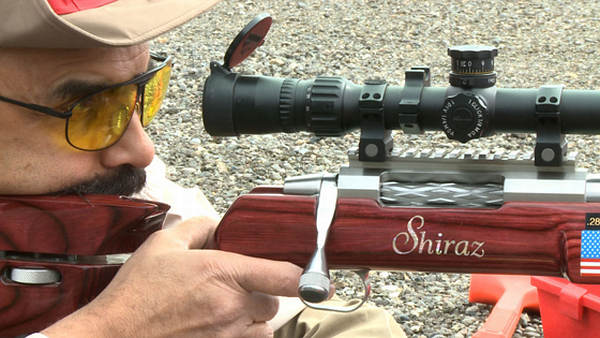
Team Grizzly Captain Shiraz Balolia had the top score (395-17X) of all shooters participating in the team event. (This is a file photo from previous match).
Team Grizzly’s Captain Shiraz Balolia said: “My hat is off to our coach, Trudie Fay, who has coached and won us the last three consecutive Team matches at the National Championships. I have been fortunate to have been a shooter and Captain of all three gold medal wins, three years in a row, one with Team USA and two with Team Grizzly. Trudie did a great job and my Team gun just hammered!” Along with Faye and Balolia, Team members included Kenny Adams, Emil Kovan, and John Myers.
X-Men Team Tops F-TR Field
Hail the Orange and Green invaders. The X-Men are the 2015 US Long Range National F-TR Champions. The Team included shooters Tracy Hogg, Phil Kelley, Ian Klemm, and Dan Lentz, along with Wind Coach James Crofts and Captain Ken Klemm. Crofts said: “Big thanks to our remaining X-men teammates Joseph Conley, Mike Hardy, and Radoslaw Czupryna. Special thanks to Ray Bowman as we were all shooting PR&T hammers. We have great respect for Team Sinclair (that has motivated us for a long time) and Team Michigan, our friends from up North. Today was a good day!”
All four X-Men rifles featured Precision Rifle & Tool (PR&T) Low Boy stocks. PR&T’s Ray Bowman observed: “Ian Klem built his rifle on our stock, PR&T stocked Dan Lentz’s rifle and we built Phil Kelley’s and Tracy Hogg’s “HAMMER” rifles.” Gunsmith Ryan Pierce chambered two of the X-Men barrels.
It was sunny but quite windy on Friday for the Team Match (Sherri Judd Photo).
Finishing second in the F-TR division was the Michigan Rifle Team, winners of the Mid-Range F-TR National Championship. The Team was coached by newly-crowned, Mid-Range F-TR Nat’l Champ Bryan Litz. Shooters include Doug Boyer, Jim Grissom, Bill Litz (Bryan’s father), and gunsmith John Pierce. Grissom shot a great match, finishing with 385-12X, but it was not enough to carry the Michiganders to victory. The squad finished with 1524-29X, six points behind the winning X-Men (1530-33X). Team Sinclair placed third with 1512-35X.






 SGT Robert Evans: Defying the Odds, Single-Handedly


 More Mirage on Day Two
 The
The