Hail the Rail. If you are looking to put multiple shots through one hole, the Unlimited Class benchrest gun, aka “Rail Gun”, is the firearm of choice. These heavy Unlimited rigs are the most accurate benchtop shooting machines ever created. Campaigned by ace competitors in the 100/200-yard benchrest game, rail guns are capable of delivering the ultimate in rifle accuracy — multiple 5-shot groups in the ones and zeros.
Watch Video to Learn More about Rail Guns and See Them in Action:
In this video, YouTuber “Taofledermaus” takes a look at high-tech rail guns on display at the Visalia (CA) shooting range. He says: “The Unlimited Class rail guns are indeed the epitome of precision shooting. [These rifles] resemble something out of a ballistics test laboratory. Each [rail gun] weighs about fifty pounds…”
One-Hole Accuracy with Rail Gun
What kind of accuracy can a top-of-the-line rail gun deliver? Check out this target shot by our friend Lou Murdica in January 2015 in Phoenix. Sometimes superlatives really aren’t necessary. Just look at that target. Yes that is FIVE shots (although it truly appears like one hole). And it is centered! This remarkable group measured at 0.039″. Lou drilled this group with one of his 6 PPC railguns. Rounds were loaded with Accurate LT-32 powder and Berger 65gr BT bullets. The target was submitted to the NBRSA as a potential new 100-yard Benchrest record in the Unlimited (Railgun) Class.
This is a file photo with Lou Murdica with a different rail gun (not the one that shot above target).
Story/video tip by Boyd Allen. We welcome reader submissions.
The most important 2016 CMP rule change allows 4.5X (max) optical sights for Service Rifle shooting.
The new 2016 rulebooks for CMP-governed Service Rifle, Pistol and CMP Games shooting events have just been released. There are some very important changes for 2016, including the authorization of scopes for Service Rifle competition. You can download the new Rulebooks for free with the links below. NOTE: The most important 2016 Rules changes are indicated with underlined text in the new Rulebooks.
The big rule changes in the 2016 CMP competition rules concern the modernization of CMP Service Rifle standards. Starting in 2016, Service Rifle competitors will be able to choose between service rifles with traditional metallic sights or rifles with telescopes with a maximum of 4.5X magnification. These scopes may be fixed-power or variable, with max 4.5 power zoom. This rule change was coordinated with a similar rule change adopted by the NRA.
The CMP states: “The decision to legalize optical sights on service rifles was taken after several years of discussion and a recognition that U.S. military personnel no longer use anything but optical sights on their military rifles. CMP Service Rifle rules have traditionally tried to keep abreast of military rifle and training developments so opening Service Rifle shooting to optical sights became an inevitable change. To quote one comment received by the CMP, “It is very difficult now to say that as-issued ‘AR-15 or M16′ does not include telescopes.”
Another major change in the CMP Service Rifle rules will allow the use of a much wider variety of M16/AR15-type rifles. Legal service rifles will no longer be restricted to rifles that rigidly comply with the M16 service rifle profile. Starting in 2016, Service Rifles can be any “M16 U. S. Service Rifle or a similar AR15 type commercial rifle that is derived from the M16 service rifle design” and that complies with these restrictions:
Chambered for the 5.56 x 45 mm (.223) NATO cartridge.
Designed or modified for semi-automatic fire only.
Have either a gas-impingement system or a piston-operated gas system.
Have a barrel that is no longer than 20 inches, or 21 5/8 inches if the barrel has a flash suppressor.
Must use the same upper receiver and barrel for the entire match.
Have a trigger pull of at least 4.5 pounds.
Quad rails or similar hand guards are permitted, but the front sling swivel location must be fixed at 13 ¼ inches (+/- ½ in.) ahead of the forward edge of the magazine well (8.0 inches on M4 configured rifles).
Use standard service magazines or commercial equivalents.
Have a fixed or collapsible butt-stock that may vary in length and even be adjusted between firing stages. Butt-plates or cheek-pieces may not, however, be adjustable.
Have a standard A1 or A2 pistol grip.
Extended bolt releases and mirror-image left-hand receivers will be permitted.
No Weight Limit For Service Rifles
Before issuing its new rules, the CMP solicited comments. A substantial majority of competitors’ comments supported allowing optical sights and the broadening of the Service Rifle rule. The one rule change that most shooters opposed was a proposed weight limit for Service Rifles with optical sights. After considering these comments, the CMP Rules Committee rejected the the Service Rifle weight limit proposal. Accordingly, in 2016, there will be no weight limits for Service Rifles, whether they have optical or metallic sights.
Iron Sights and Optics Will Compete in the Same Class
The CMP considered having optics-equipped Service Rifles in a separate classification. That idea was rejected. So, for 2016 there will be ONE CLASS for all Service Rifles (both iron-sighted and scoped). The CMP observed that “the arguments for having one unified competitor category competing together for EIC points and Distinguished Badges prevailed. Having separate categories and one Distinguished Badge would have created nightmare administrative challenges. Having two categories and separate Distinguished Rifleman Badges for optical and metallic sighted rifles would have become a formula for diminishing the prestige of the traditional Distinguished Rifleman Badge. The final CMP decision was to keep one strong, unified Service Rifle event instead of two smaller categories[.]”
Rule Change Concerning Malfunctions (No more Alibis)
Another major Service Rifle rule change will abolish allowing extra time or refires for malfunctions. This change will save time because malfunction refires effectively double the length of time needed for rapid-fire relays in big matches. The main reason for this change is to place more responsibility on competitors for having rifles and ammunition that function with complete reliability. Comments received by the CMP concerning this change showed that it is controversial, but a majority of shooters supported the change. One shooter wrote: “The elimination of “alibis” is long overdue. It was always most frustrating to me when it takes longer to shoot rapid fire than slow fire.”
Story Tip by Shiraz Balolia of Bullets.com. We welcome reader submissions.
Here’s a handy training option for F-Class shooters. Forum member SleepyGator is an F-Class competitor, but it’s not convenient for him to shoot at long ranges close to home. Accordingly, he wanted some “reduced-distance” targets he could use at 300 yards for practice. There is an official reduced-distanced standard for 300-yard F-Class matches. This utilizes the NRA No. MR-63FC – F-Class Target Center which is pasted over the MR-63 target. It provides a 1.42″ X-Ring, 2.85″ 10-Ring, and 5.85″ Nine-Ring. (The dimensions of F-Class targets are found in the NRA High Power Rules, Sec. 22, part 4, page 70 — see sample below.)
To duplicate the 300-yard target, SleepyGator has prepared a printable version of the MR-63FC Target Center, along with a pair of training targets with two bulls and five bulls. The two-bull and five-bull targets mirror the scoring rings on the MR-63FC, but they display only the innermost three rings and two rings respectively. All three targets are Adobe Acrobat (PDF) files that can be easily printed. You may need to adjust the scale (sizing) on your printer to get the dimensions exactly correct. As noted above, when printed, the 10-Ring on all three targets should measure 2.85″. This should provide some handy practice targets you can use between matches. Thanks to SleepyGator for providing these targets. You can download all three as a .Zip archive. After downloading the .Zip file, just click on the .Zip archive to extract the individual targets.
SFC Michael McPhail, shown above, is currently ranked #1 in the world in the smallbore 50m prone rifle discipline. He’s one of the favorites to win Gold in 2016.
As the 2015 international shooting season comes to a close, the USAMU shooting teams are preparing for the 2016 Olympic trials and a chance to compete in the Olympic Games in Rio de Janeiro next summer. One USAMU marksman who has already secured a berth for the 2016 Olympics is SFC Michael McPhail of Darlington, Wisconsin.
SFC Michael McPhail, ranked number one in the world in men’s 50-meter rifle prone, already won his spot on the U.S. Olympic team by virtue of his performances in 2015 ISSF World Cup events. McPhail, of Darlington, Wisconsin, won the ISSF World Cup Finals in Munich this September. McPhail also won back-to-back gold medals at the ISSF World Cup events at Fort Benning, GA and Munich, Germany, held in May and early June of 2015.
Michael McPhail Secures Olympic Team Nomination with World Cup Finals Triumph
McPhail said for anyone who wants to participate in the Olympics, the Army provides superior coaching, training, equipment and ammunition. “For a kid who shoots and their goal is to make the Olympics, the Army Marksmanship Unit is the place to go,” McPhail said.
SFC Jason Parker, International Rifle and Pistol Teams coach noted that: “Sergeant First Class McPhail has had a fantastic year. He has a great potential for medaling in the Olympic Games.”
With one seat already taken by McPhail for men’s 50-meter rifle prone, two other USAMU Soldiers are Parker’s top picks for the second and final seat. They are SFC Eric Uptagrafft and SSG George Norton. “Sergeant First Class Uptagrafft is another top contender for making the United States Olympic Team,” Parker said. “In the past, he has won multiple world class medals, he has been to two Olympics already, and he is one of our top shooters. He will be trying to get that last spot in the prone, and I wouldn’t count him out of anything.”
For more information on the U.S. Army Marksmanship Unit, visit www.USAMU.com.
.009″ — The Record That Stood for 40 Years.
In 1973 Mac McMillan shot an amazing 100-yard, .009″ five-shot group in a benchrest match. The .009″ group was measured with a 60x microscope for verification. Mac McMillan shot the group using a handbuilt prototype McMillan rifle with an early McMillan stock.
Mac’s .009″ group was the “Holy Grail” of rifle accuracy. This .009″ record was considered by many to be unbreakable, a record that would “stand for all time”. Well, it took 40 years, but someone finally broke Mac’s record with an even smaller group. In 2013, Mike Stinnett shot a .0077″ five-shot group using a 30 Stewart, a .30 caliber wildcat based on the 6.5 Grendel. Stinnett’s .0077″ group now stands as the smallest 100-yard group ever shot in registered benchrest competition.* Read About .0077″ group HERE.
Stinnett’s success doesn’t diminish the significance of Mac McMillan’s .009″ group in the history of benchrest competition. For four decades Mac’s group stood as the ultimate standard of rifle accuracy*. For those of you who have never seen Mac McMillan’s .009″ group, here it is, along with the NBRSA World Record certificate. The target now hangs in the McMillan Family Museum.
*Somebody else might claim a smaller group, but unless moving backers or electronic targets were used, it cannot be verified. Moving target backers are used at registered benchrest matches to ensure that five (5) shots are actually fired in each group. That eliminates any doubt.
The Civilian Marksmanship Program (CMP) invites young men and women shooters to apply for CMP scholarships for the 2016-2017 school year. The CMP offers $1,000 one-year scholarships to current high school seniors. Since 2005, CMP has awarded over $1 million in scholarship grants.
Last year the CMP authorized over 150 scholarships. Based on merit, selected individuals are high school seniors who are currently enrolled in a team or club that is participating in rifle or pistol marksmanship competitions. Applicants must provide rifle or pistol competition history, list of awards, and future goals in the shooting sports. Applicants must also provide academic GPA and an official high school transcript (3.0 Minimum GPA Required).
Applications are Being Accepted Now for 2016-2017
The CMP is now taking scholarship applications for the 2016-2017 freshman college year. Scholarships are one-year awards that may be used to fund any accredited, post-secondary education or vocational program. (Note: Students planning to enroll in a military academy are not eligible).
The deadline for CMP Scholarship Application is March 20, 2016. Learn more about the program at the CMP Website Scholarship Page. If you have any questions, please contact Kathy Williams at 419-635-2141, ext. 709, or email kwilliams [@] thecmp.org.
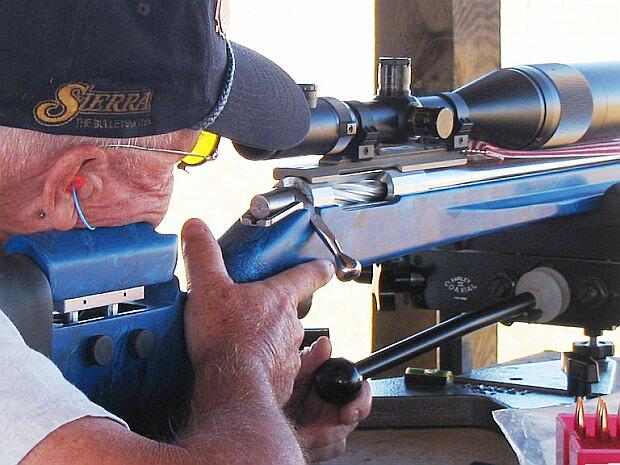
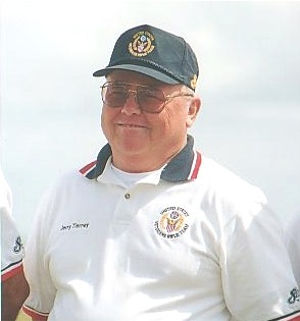
I am very sad to announce that a good friend (and a brilliant shooter) Jerry Tierney, has passed away at age 77. I have worked on this site for 11 years, and Jerry was one of the most helpful and talented men I’ve met along the way. Though he won many championships, Jerry was a modest man who always was there to help other shooters. I will really miss him. AccurateShooter.com owes a debt of gratitude to Jerry. With his technical expertise, he helped me greatly with my understanding of rifle accuracy. Jerry was small in stature, but big in talent. Rest in Peace Jerry. We’ll miss your smarts, your good humor, and your love for the sport. — Paul McM, Editor in Chief.
Jerry Tierney shot competitively for nearly 50 years and won multiple championships in various rifle disciplines. Fellow shooter Donovan Moran noted: “Jerry was the leading member of the NBRSA ‘Long Range Hall of Fame’ — well deserved! He was a very friendly man, a mentor to the sport, and one of the best Long Range competition shooters there’s ever been.”
With great natural talent and the mind of a scientist, Jerry could win events in ways not thought possible. He is certainly the only man I know who won a Benchrest Championship shooting a prone-type tube gun. He pioneered the .284 Win as an F-Open weapon. A self-declared “iron-sight prone guy”, he competed for many seasons in the full-bore and Palma disciplines, but in the last decade he turned his attention to 600-yard and 1000-yard benchrest and F-Class. He won multiple NBRSA Nationals, due in no small part to superb wind-doping skills and mastery of the “mental game”.
A former computer engineer with IBM, Jerry was an extremely bright guy who took a systematic approach to the sport. He made decisions based on hard data. He did things many shooters once considered radical (such as cleaning his barrels infrequently), but he always had the data to back up his methods. He was a forward thinker who wasn’t afraid to depart from conventional wisdom if he found a better way to do things. For me, Jerry Tierney was an important mentor — he showed me how the “state of the art” could be pushed to higher levels with careful experimentation and a willingness to try new things.
We did a lengthy interview with Jerry way back in 2005, when Jerry won the NBRSA 1000-yard Nationals. That performance helped proved the worth of the .284 Win in 1K competition, a cartridge that now is a leading choice for F-Open. Read this interview carefully — even ten years later, Jerry offers many nuggets of advice that can help with your reloading and shooting:
Danny Biggs Remembers Jerry Tierney
Past National F-Class Champion Danny Biggs wrote: “Our long-time shooting friend, Jerry Tierney, left the range last night. Jerry was 77 years old, and was overtaken by bad health over the past year…cancer and other ailments. An accomplished Palma Rifle shooter, his home range was the Sacramento Valley Shooting Center, near Sacramento, CA, and, just 16 miles from his front door, outside Plymouth, CA.
Jerry was a frequent contributor to [Rifle Blogs] in past years. In particular, about 7 years ago, he published considerable results of his testing of the Winchester .284 cartridge. This testing convinced several of us to transition from the venerable 6.5-284 to the straight .284 for both long range ‘sling’ and F-Class Open. Jerry’s testing was primarily in the realm of F-Open; wherein, he fell ‘in cahoots’ with a young F-Open shooter, Charles Ballard, who set an F-Class Open National record that stood for many years. (By the way, Incahoots is the name of Jerry’s favorite restaurant in Plymouth, CA, near his home; where I’ve enjoyed many an evening meal with him.)
Many others have contributed to the legacy of the Winchester .284… but, if you happen to be shooting a .284 in F-Open today, you might just give a thought to Jerry at your next trigger-pull. More than likely, you are shooting some of his data.” — Danny Biggs
Forum Member Killshot added:
“I only new Jerry for a few years, as I began shooting F-Class in 2010 — but he always answered my questions, helped me with my first Wildcat chambering and I never, ever, saw or heard of him ‘Big Timing’ anyone. I’ll miss his gap-toothed grin, like he knew something you didn’t. (and probably did!)
We’re better off for knowing him and worse off for not having him around any longer. So, appreciate your friendships and shoot small… Jerry would.”
Applied Ballistics LLC will offer its first-ever Ballistics Seminar early next year in Tustin, Michigan. This two-day seminar will feature Ballistician Bryan Litz and other experts including Eric Stecker, President of Berger Bullets, and Ray Gross, Captain of the U.S. F-TR Rifle Team. Bryan, the primary speaker, will present material from his books, the Applied Ballistics Lab, and his experience shooting in various disciplines. Bryan recently won both the Mid-Range and Long-Range F-TR National Championships. Bryan will be assisted by Nick Vitalbo, Owner of nVisti Tactical Innovations and lead engineer for Applied Ballistics. The seminar, held February 29 through March 1, 2016, will include classroom sessions followed by live fire demonstrations with sophisticated instrumentation.
Ballistic Solvers – How they work, best practices, demos.
Weapon Employment Zone (WEZ) Analysis – How to determine and improve hit percentage.
Optics and Laser Technology — State of the Art.
The seminar costs $500.00. But consider this — each seminar participant will receive the entire library of Applied Ballistics books and DVDs, valued at $234.75, PLUS a free copy of Applied Ballistics Analytics software, valued at $200.00. So you will be getting nearly $435.00 worth of books, DVDs, and software. In addition, a DVD of the seminar will be mailed to each attendee after the seminar concludes.
Bryan Litz explains: “Subjects will be introduced from an academic-first, principles perspective. Once the scientific basis for the material is established, the ideas are further demonstrated with examples from instrumented live fire. We explain the science, and then present examples of the principles in action. You’ll leave with an understanding of the subject matter, as well as a knowledge of how to apply it in the real world.” To learn more about the Ballistics Seminar, read this AccurateShooter Forum Thread.
Early Bird Special — Save $100.00
If you register before the end of December, 2015, you’ll receive $100.00 off the regular $500 registration fee. This $400.00 Early Bird Special price can be secured by registering through the Applied Ballistics online store.
The two-day seminar will be held at the Kettunen Center in Tustin Michigan. Lodging costs range from $115-$240 (all-inclusive). This price includes three meals each day, and starts at 3:00 pm the day before the seminar, and goes to breakfast the morning after the seminar concludes. Contact the Kettunen Center directly to reserve accommodations.
Click Calendar above to download large-size 2016 National Match Calendar PDF.
It’s never too early to start planning for the National Matches at Camp Perry, Ohio. Here is the official calendar for next year’s National Matches to be held in the summer of 2016. Registration for the CMP National Trophy Rifle & Pistol Matches and CMP Games Events will open on April 1, 2016. Competitors should note that most events and matches have returned to the previous dates before the adjustment for the Palma (Fullbore) World Championships in 2014 and 2015. However, the Smallbore National Championships will be held at the Wa-Ke-De facility in Bristol, Indiana, rather than at Camp Perry.
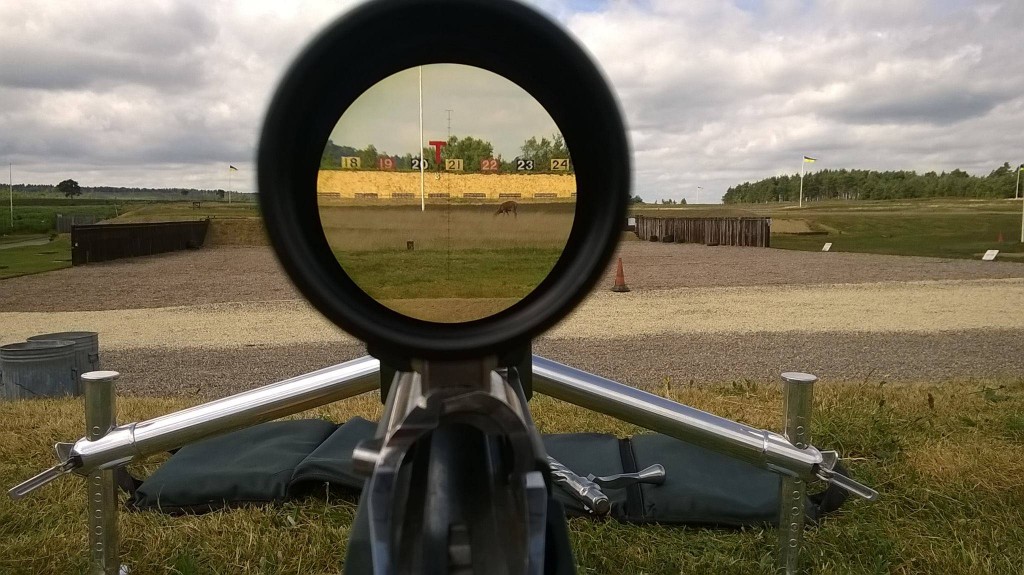
What’s wrong (or right?) with this picture? Does the “F” in F-class stand for “Fauna”? Look carefully at this Bisley Range photo taken by Australian R. Hurley while looking downrange through his March 8-80X scope. The photo was taken earlier this year at the Bisley National Shooting Centre in the UK.
The Story Behind the Photo
British shooter T. Stewart reports: “I was there when this photos was taken. All I can say was that Mr. Hurley was firmly reminded that should said deer accidentally jump in front of his bullet … he would spend five years “At Her Majesty’s Pleasure”. That morning we had five deer moving across the targets, literally blocking the V-Bull. Since we were on the 900-yard Firing Point, and elevated for such, obviously the bullet would pass well above them. But they do NOT move or flinch at the noise or passing bullets since they are not hunted on the Bisley Ranges. Earlier this year we saw a herd of 20 or so deer grazing slowly across the Range.”
More Fauna Findings…
Apparently Bisley is not the only place were “the deer and the antelope play”. In Canada, on the Connaught Ranges near Ottawa, Ontario, shooters often encounter a variety of wildlife. William McDonald from Ontario says: “Animals are a common sight on the Range. Along with deer we see geese, turkeys, and coyotes on a daily basis.”
Likewise, E. Goodacre from Queensland, Australia often sees ‘Roos on his home range: “I shoot at Ripley, Australia, and shooting is regularly interrupted by kangaroos. Our last silhouette match was delayed by an hour while 30 ‘Roos dawdled across — silly buggers!”
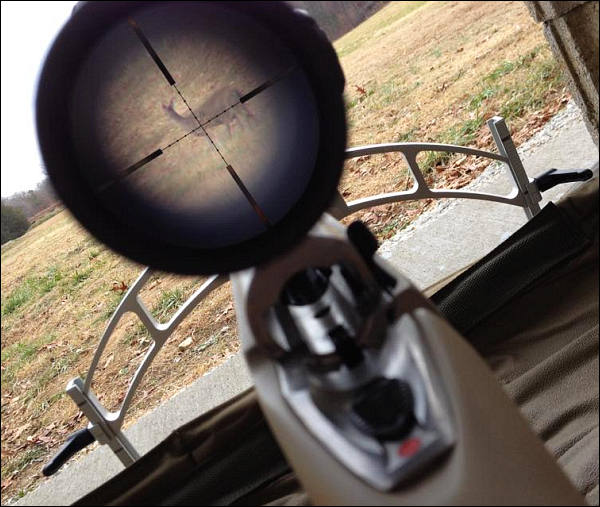
R. Hurley wasn’t the first fellow to view deer through his F-Class rifle’s scope. After seeing Hurley’s photo from Bisley, B. Weeks posted this image, saying: “Been there, done that!”


 As the 2015 international shooting season comes to a close, the USAMU shooting teams are preparing for the 2016 Olympic trials and a chance to compete in the Olympic Games in Rio de Janeiro next summer. One USAMU marksman who has already secured a berth for the 2016 Olympics is SFC Michael McPhail of Darlington, Wisconsin.
 .009″ — The Record That Stood for 40 Years.


 The Civilian Marksmanship Program (CMP) invites young men and women shooters to apply for CMP scholarships for the 2016-2017 school year. The CMP offers $1,000 one-year scholarships to current high school seniors. Since 2005, CMP has awarded over $1 million in scholarship grants.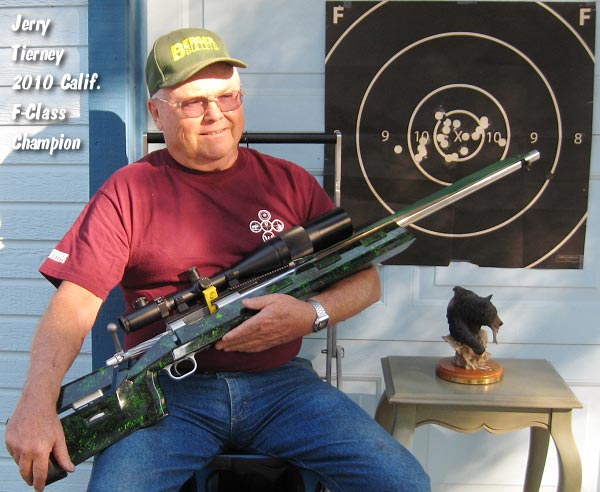

 Danny Biggs Remembers Jerry Tierney