The new F1 Chassis System from Competition Machine is now in production. This straight-line, all-metal chassis with ultra-low bore axis is optimized for F-Class competition. Designer/builder Gary Eliseo tell us that Competition Machine is now accepting F1 Chassis orders for fall 2015 delivery. To order or if you have questions, email Gary via his website contact page.
Gary tells us: “The new F1 Chassis System, designed specifically for F-Open class, has already begun to rack up awards. The system has several innovations that make it an excellent choice for your next build.” F1 Chassis has many design features that improve tracking and tame torque effect:
Low COG — Super low rider fore-end keeps the center of gravity as low as possible
Long Wheelbase — The long separation from front of stock to rear bag-rider improves tracking and reduces the tendency to jump or twist (torque).
Adjustable Offset — The bag-rider section of the fore-end can be adjusted left to right. This adjustable horizontal offset allows you to choose if you want the fore-end offset left, right or center.
Adaptable to All Shooters — The F1 Chassis System features adjustable length of pull, buttplate drop, and cheekpiece height.
Unique Bonded Barrel Block™ System
Stress is the enemy of accuracy. For this reason the F1 Chassis system features a “zero stress” barrel mounting system which uses a barrel block securely bonded to the barrel (with an epoxy-type adhesive). This allows the action to float, relieving all stress from the threaded joint between the barrel and action and all flexing of the action. With this unique “floating action” design, the F1 chassis is compatible with ANY round rifle action. Replacement barrel blocks are available so you can run multiple barreled actions with your F1 chassis. When it’s time to replace the barrel, the barrel block can be “unbonded” and adapted to a new, same-diameter barrel.
Report by IBS President Jeff Stover
The ancient benchrest alchemists once predicted a perfect storm for small groups. The recipe is: one part near ideal shooting conditions, 90 of the best benchrest shooters in North America and mix with the shooters’ best barrels and bullets. Place the entire concoction at the shooting benches for seven minutes at time. The result in Heavy Varmint (13.5-lb rifles) at 100 yards, for example, was that the top 17 shooters averaged under .200 for their five targets! Yes, nearly the entire Top 20 in HV100 shot a “teen agg”. Ten or fifteen years ago, that would have been unthinkable. Sure, the winners or top two or three would be in that rarefied air, but not half of an entire relay of 40 shooters. Remarkable.
Another landmark of the 2015 IBS Nationals was that 17-year-old Wyatt Peinhardt of Quarryville, PA won the 200-yard stage of Heavy Bench. That meant he earned his first point toward the U. S. Benchrest Hall of Fame (HOF). You need ten to get in, but young Wyatt has plenty of time to get the other nine. He is no ‘flash in pan’. The young Mr. Peinhardt has been shooting since 2009 and now runs full speed with the big dogs of the sport. He was in the Top 20 in this year’s Super Shoot 2-gun results. Frequently he battles his dad, Jeff for supremacy at the bench. Strangely enough, here at Weikert in the Sporter Grand Aggregate (average of five targets at both 100 and 200 yards) Wyatt and his father tied right down to four decimal places: 0.2317!
Six Days of Competition with Four Classes
Some say that the Group Nationals are a marathon — six long days of competition at both 100 and 200 yards with four classes of rifles: Light Varmint (10.5 lb); Sporter (10.5 lb – 6mm minimum caliber); Heavy Varmint (13.5 lb) and Heavy Bench (known as ‘Unlimited’ in NBRSA-land). The first three are simply known as the “bag guns”. Most competitors use a 10.5-lb rifle in 6PPC and compete in all three classes. The Heavy Bench (HB) class requires 10-shot groups as opposed to the 5-shot ones for the bag guns. There is no prohibition to shooting your 10.5-pound rifle in HB, but a shooter is simply outclassed by the rail guns, especially for 10-shot groups.
As mentioned, the week’s weather was very good. After what seemed like weeks of on and off rain, the central Pennsylvania weather gods smiled on what is considered one of the most beautiful ranges in the USA. The shooters had nice sunshine and instead of the usual Weikert blow, they were treated to light zephyrs. It was a glorious week to be at a rifle match.
Course of Fire — First 100, then 200
The sequence of competition groups has 100-yard targets shot the first three days followed by three days at 200 yards. It is done this way to require only one change of wind flags. Nationals competition requires ‘full rotation’. That means that every time a shooter goes to the line for the next match target, he or she must move a requisite number of benches to the right. At the end of the day a shooter will shoot across the full width of the line. Some ranges offer unique properties that render some parts of the range harder or easier to shoot small groups. Bench rotation is important to even out those factors.
Monday morning saw the Heavy Bench (HB) shooters hauling the big rail guns to the line. Old pro Jack Neary led the way at 100 yards with .2186 Aggregate. The 200-yard stage for HB would not be held until Saturday morning. The winner there, of course, was Wyatt Peinhardt with his .2993 (MOA conversion for 200-yard scores). On Tuesday the bags guns came out for Light Varmint (LV) and Sporter (SP). Conditions allowed for quite a few very good groups. The top thirteen shooters in Sporter shot ‘teen aggs’ with Bart Sauter leading the way at a .1666. In Light Varmint, Wayne Campbell shot a tiny .1556. Both his warm-up and first record target were in the ‘zeroes’ (.096 and .088)!
Wednesday’s 100-yard Heavy Varmint match enjoyed what were probably the best conditions of the week. You needed to average under .200 for five targets to finish in the Top 20 or nearly so. Harley Baker won with a .1616. The talk in the loading area was Baker’s fourth record target — a tiny 0.050 bughole centered right in the center ring (usually called the ‘mothball’). It was probably the prettiest target most had ever seen. Better yet, the standing IBS HV 100 record is a 0.052 shot way back in 1980. Harley’s target is being submitted to the IBS Measuring Committee as a potential IBS record.
Wednesday afternoon saw the moving of flags for the 200-yard stage of the competition. The SP and LV 200-yard targets were Thursday’s course of fire. In LV, Andy Shifflett shot a .1966 Aggregate to pick up a HOF point. At 200 yards, Aggregates are logged in MOA units. Therefore, Andy’s .1966 Aggregate translates to an average 200-yard target measurement of slightly less than .400″. The afternoon was reserved for SP targets. Billy Stevens shot a .2060 to win the afternoon’s contest.
Powderpuff Event at the IBS Group Nationals
For decades IBS has hosted an exhibition shoot on the afternoon of a day when only one Aggregate is contested instead of two. It is called the Powderpuff and is intended to allow family members and others that do not shoot competitively to give benchrest shooting a try. Each shooter is assisted by a coach who instructs the shooter. World-class shooters such as Gene Bukys and Lester Bruno give their time and talents to assist novice shooters. There is no time limit to rattle the inexperienced shooters.
2015 Powderpuff Winners Jaydin Johnson (left) and Pam Campbell (right)
Barbara Hottenstein continued as the Powderpuff chair and assembled a large array of awards and prizes. The competition is financially supported by the IBS President’s Fund. This year we had 12 youth and adult competitors. Pam Campbell won the adult category while Jaydin Johnson (shown above with coach Nancy Scarbrough) won the youth division.
On Friday, a single Aggregate of five record targets were shot-for Heavy Varmint (HV) at 200 yards. Harley Baker had his mojo working with a .1896 Aggregate. That performance, coupled with Harley’s .1616 at 100 yards meant that his average in the HV class was a .1756 Grand Aggregate. That is small. Really small.
On Friday afternoon, many of the awards for bag guns were given out. Saturday was reserved for HB 200. Since some of the bag gun shooters do not shoot a rail gun, a number of competitors left Friday afternoon. The rail guns came out to contest 200 yards on the last day of the Nationals. The winner was Wyatt Peindardt. His .2993 was the only Aggregate under .300. Wayne Campbell was second with a .3028. Winning the HB Grand Aggregate was two-time Super Shoot winner, Larry Costa.
IBS recognizes Aggregate performances as follows: Grand (100 + 200) Aggregates in each of four classes; Two-Gun (all HV and LV targets in 100 + 200); Three-gun (HV, LV, SP in 100 + 200) and 4-gun (HV, LV, SP and HB in 100 + 200). In the multi-guns, Harley Baker won the Two-Gun. Gene Bukys added more HOF points by winning the Three-Gun. In the Four-Gun, Virginia’s Wayne Campbell who took the overall four-class Agg with an excellent .2326.
Praise for the Range Crew and Sponsors
The IBS Group Nationals requires a ton of work to run smoothly. The Weikert range’s sparkplugs are Mark Trutt and Dale Boop. This shoot does not happen without those two. This year’s registration and general admin fell to Nancy Scarbrough, who ran a flawless operation. She was assisted by Will Baylor in the scoring and by Stacy Hynes. Steve Dodge oversaw the entire target crew while Larry Hertzog alternated with Mark Trutt as Range Officer.
The benchrest cottage industry should be commended for giving back to the shooters. This year’s sponsors included: BAT actions, Black Hills Shooters Supply, Boops Sporting Goods, Bruno Shooters Supply, Hart Rifle Barrels, Jewel Triggers, JDS Bullets, K&M Precision Shooting, Krieger Rifle Barrels, L. E. Wilson, Pacific Tool & Gauge, and Shilen Rifle Barrels.
Parting Shot — Some Competitors tried to keep up with work while reloading …
Jay Christopherson, our Forum admin and dedicated F-Open shooter, recently ventured to the “dark side”, crossing disciplines and trying his hand at F-TR, shooting off a bipod. Jay wasn’t using just any old F-TR rig. He used a purpose-built rifle, designed to mimic the handling of his Open rifle. With this rig, Jay won two of the three matches he’s shot in, including the F-TR division at the Washington State Long Range Championships. Jay’s last 600-yard match featured two clean scores with excellent X-Counts, including a 200-13X and a 200-15X (one off the national record) for a total score of 599-36X.
The 2015 Washington State Long Range Championships was held at the infamous “Rattlesnake” range in Richland, WA, which has some of the most challenging wind conditions in the USA. At the LR Championships, shooting his .308 Win F-TR rig, Jay was right up there with the F-Open shooters. Until the final relay, Jay was within three points of the overall F-Open leader, and still finished second overall in X-Count and score. This demonstrates the capability of a state-of-the-art F-TR rig.
In this story, Jay describes his F-TR rifle and set-up. Knowledgeable readers will recognize that Jay’s gun is similar to John Pierce-built rigs successfully fielded by Michigan F-TR Team shooters.
JOINING THE “DARK SIDE”
by Jay Christopherson
I originally decided to build a F-TR rifle to shoot at local mid-range club matches. I keep burning through F-Open barrels (and components) because I shoot a lot more local club matches than “big” matches – maybe 2:1 or 3:1. The end result is that I’d be endlessly tweaking loads and burning up barrels and I just got tired of it. The endless tweaking also caused me some trouble at large matches and I thought shooting a .308 Win would be more “relaxing” from a technical point of view. It’s a very well understood round at this point.
I’d been kicking around the idea of shooting F-TR for a couple of years, but I didn’t want an F-TR rig that handled completely different than my Open gun. I didn’t want to learn different habits from a different stock or position that would cause issues on race day. I use a Terry Leonard/Speedy Gonzales designed F-Class Open stock that is designed more along benchrest lines than the traditional prone stocks you see most F-Class shooters using. I don’t like to use any hand grip at all and my preferred position is very light pressure into the shoulder and just enough cheek touch to index. So, when I saw Eric Stecker at the 2014 Berger SWN (and later Bryan Litz) shooting an F-TR rig that was designed along the same lines, I decided to get serious about it.
The Stock is the Secret
The stock is a Scoville carbon-fiber-over-balsa model set up for a Panda action (which I had on hand). This stock is extremely stiff and stable. I purpose-built the rifle to shoot 215gr Berger bullets and I knew that I would keep my velocity relatively low-ish – in the 2500+ fps range. If I ran those 215s much faster, the recoil would become an issue for me. I bought and chambered a Benchmark 1:9″-twist barrel, in a heavier-than-normal contour. This was finished at 28″. I custom-throated the chamber with a PTG .30 Cal Uni-Throater to accommodate the longer-than-normal OAL I wanted.
I modified my Phoenix bipod based on some of the pictures I’ve seen of John Pierce’s modifications and after talking to John at the 2015 Berger SWN. I sure do appreciate how open he is with the modifications he’s done. I doubt I would have thought of putting together a rifle like this without his example.
Proofing at Mid-Range
From the get-go, this F-TR rifle has been a shooter. It handles extremely well, and recoil is not a problem at my velocities. The 215s still maintain a significant wind advantage over the more usual 155gr and 185gr bullets at long distances. Ballistics Performance is not quite in the same class as the 7MM 180gr bullets I shoot in my F-Open rifle, but not that far off either.
Below is a 300-yard target shot while proofing my load in preparation for 600-yard matches. I decided to shoot a “match” string (2 “sighters” + 20 “record” shots). Looking at this target, I’m thinking that if I had clicked left one or two clicks, this might have been a 200-20X.
On Race Day
I’ve shot three matches with my F-TR rifle now, two 600-yard club matches and the WA State Long Range Championships at the infamous “Rattlesnake” range in Richland, WA. The LR Championship was the first time I’ve shot the rifle at long range. At the 600-yard club matches, I’ve had several “cleans”, including a 200-13X and a 200-15X (finishing 599-36X at the last one, which is just within my normal Open scoring range). At the WA State Long Range Championship, I managed to win the F-TR division in extremely hot conditions (100+ degrees over two days of shooting) and managed to post the second highest X-count and finish second overall among all F-Class shooters (F-Open and F-TR combined). I was “in the running” for the overall win until the last relay.
Seduced by the “Dark Side” — The Lure of F-TR
I still plan to shoot my Open rifle at “big” matches, but I doubt I’ll be able to leave the F-TR rifle in the safe for all of them. My reference to the “dark side” is an inside joke between myself and another shooter. I kept saying that shooting F-TR was just for fun… that I wasn’t taking it too seriously. However, the more I shoot F-TR, the deeper into the “Dark Side” I seem to fall. F-TR is a different animal than F-Open (I use a Nascar vs. Formula 1 analogy), but it’s addicting. And not having to carry 30 pounds of front rest doesn’t make me sad when I’m traveling!
Top Three F-TR shooters at WA State Championships: Jay Christopherson (Winner), Monte Milanuk (second), and Laton Crawford (third).
Story Based on Report by NSSF
American shooters, along with Brownells and Redding, are providing help to the South African Palma (Target Rifle) team members, who will be competing at the Long Range World Championships at Camp Perry in early August, 2015. The ability of the South Africans to compete has been jeopardized by the unexpected seizure of their pre-shipped match ammo by U.S. Customs and ATF. We don’t know why the Feds seized the South Africans’ match ammo, but without it, the South African Team’s ability to participate in the Long Range World Championships has been threatened.
To rectify this situation, American F-TR and Palma shooters, backed by Brownells and Redding, have secured reloading equipment (presses, dies) and ammo components (brass, bullets, powder) so that the South Africans can assemble the needed .308 Win ammo on their arrival in the USA at the end of July.
According to industry sources, the shipment of match ammo for the South African Palma team was seized at the U.S. port of entry by U.S. Customs and ATF agents. When Ray Gross, captain of the U.S. F-TR rifle team, learned about this, Ray contacted Geoff Esterline, Product Category Manager at Brownells. Esterline immediately turned to Robin Sharpless, Executive VP of Redding Reloading, for help.
“I won’t go into the full list of presses and accessories we’ve gathered up, but I can say it’s extensive,” Sharpless told NSSF. “A member of the U.S. F-TR team who lives near Camp Perry has agreed to take our shipment and those from Brownells and the other companies providing brass, powder and bullets so that, when the South African team arrives in the U.S. during the last days of July, they can get started immediately on hand-loading. The U.S. team is even building benches for the press setups, so the South African team should be able to knock this out and get to the more important task at hand, and that is shooting at Camp Perry.”
The 2015 Palma Match and Long Range World Championships will be held August 3-15, in conjunction with the annual NRA National Matches at Camp Perry, Ohio.
Ray Gross reports: “The folks who deserve credit for this are the members of the U.S. Palma Team, Ryan Henning, Geoff Esterline of Brownells, and the folks at Redding. Members of the Palma team had donated much of the needed equipment within hours of U.S. Palma Team Captain Dennis Flaharty putting the word out.
My contribution was limited to a few emails to Brownells. They coordinated with Redding to provide the remaining equipment. This is a great example of international shooting camaraderie, but my part in it was very small.”
The CMP’s National Trophy Infantry Team Match (NTIT) has been a staple at the National Matches since 1922. Also known as the “Rattle Battle,” the event is one of the most unique in the competitive rifling world — scoring is based on how many hits six-person teams can score on a bank of targets during a series of 50-second firing periods at four yardages. Teams begin the NTIT match with 384 rounds of ammunition, which they fire upon eight silhouette targets from 600, 500, 300 and 200 yards during successive 50-second periods. After each rapid-fire string, team members move forward (to the next-closest distance) carrying all equipment from firing line to firing line. The match emphasizes extremely fast, accurate fire and good communication among teammates. The Rattle Battle is always an exciting competition for spectators to watch. View NTIT match results on the CMP website.
Watch CMP ‘Rattle Battle’ Video — 50 Seconds of Rapid Fire…
The video shows the California Grizzlies, one of the top junior squads. The lead photo shows the U.S. Army Reserve (USAR) Team in action during the NTIT match. See more in USAR “Rattle Battle” Video.
Garand matches are among the most popular and well-attended of the CMP competition disciplines. When obtained directly from the CMP, Garands are fun to shoot and affordable. However, with these classic battle rifles, you need to ensure that the headspace is set properly to ensure safe function and good brass life.
In the archives of The FIRST SHOT, the CMP’s online magazine, CMP Armorer John McLean has written an excellent article entitled: “Everything You Ever Wanted to Know about Checking M1 Garand Head Space.” We recommend all Garand shooters read the article.
McClean explains: “Excessive headspace will cause the brass to stretch more than it should and increases the likelihood of a case failure. Insufficient headspace may contribute to slam fires, light strikes on primers, misfires and more wear on parts due to the additional force needed to chamber the rounds.”
Garand Head Space Gauges
McClean writes: “Both Forster and Clymer make fine gauges but we have found that there are differences between the two companies’ gauges that make the Clymer gauges best for use with the M1. The headspace that the original manufacturers of the M1 considered correct can be determined by checking new or nearly new rifles that we have here at CMP. With that information we have determined that Springfield Armory and the other manufacturers of the M1 used gauges that were very close to the Clymer dimensions… and therefore we use, and recommend using only the Clymer gauges.”
How to Check for Proper Headspace
In the article, McClean goes on to show how to properly use the “GO”, “NO GO”, and “FIELD” gauges. You’ll want to read the Complete Article. One of the important points McClean makes is that the ejector can affect headspace reading. Accordingly, “the bolt must be disassembled and the ejector removed, or clearance notches must be made on the headspace gauges so there will be no contact between the headspace gauges and the ejector.”
Report by Kyle Jillson from NRABlog.com. Sergeant First Class (SFC) Keith Sanderson of the U.S. Army Reserve has been crowned the 2015 NRA National Pistol Champion. After six wet days at Camp Perry along the shores of Lake Erie, Sanderson unseated defending champion Brian Zins by 14 points – 2655 to 2641.
Sanderson, who served eight years in the Marine Corps and eight years in the U.S. Army, is a renowned sport shooter who holds an Olympic record and won an unprecedented three medals (gold, silver, and bronze) in three World Cups in 2009.
Wet Conditions at Camp Perry this Year
At Camp Perry, you can always expect a little rain to come off the lake, but the midwest is experiencing torrential storms this summer and parts of the range – especially along the firing line – became flooded ponds. This year some shooters even stuck “No Wake” signs in the larger puddles to keep attitudes light despite the muddy situation.
Some competitors wore rubber boots to help navigate the puddles.
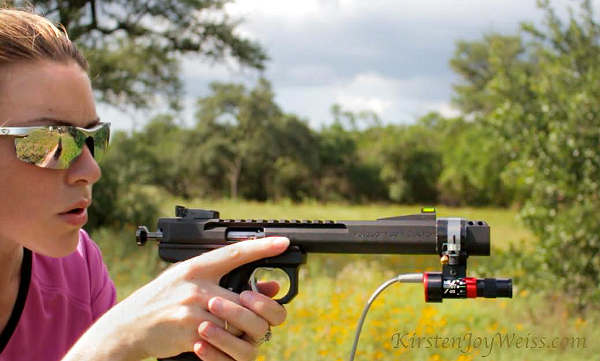
“SCATT” — if you’re an Olympic Class air rifle or smallbore competitor you know what SCATT means. The Russian-made SCATT is a marksmanship training system with an electro-optical sensor that fits on the end of a barrel. The sensor “sees” the target and then tracks your muzzle movement relative to the center of the target, recording a “trace” that can be displayed on a computer. The latest SCATT MX-02 unit works for live-fire training as well as dry-fire training. To learn more about the SCATT electronic trainers, visit SCATTUSA.com.
Pro shooter Kirsten Joy Weiss demonstrates the SCATT MX-02 electronic training system:
The system traces and records valuable information such as hold pattern, shot hold duration, follow-through, recoil pattern, and much more. The latest SCATT MX-02 systems can be used both indoors and outdoors up to 300 meters (and possibly more). READ FULL SCATT MX-02 TEST HERE.
SCATT traces reveal muzzle movements during the aiming process.
Kirsten Joy Weiss, a top-level competitive position shooter, has tested the latest SCATT MX-02 training systtem. She put the MX-02 through its paces, and then produced an informative video that shows how it works. Click on the video above to see Kirsten use the MX-02 with her Anschütz rifle and other guns.
Kirsten was impressed with the SCATT MX-02 she tested:
“We live with tech woven into our every day, so if you had the chance to work with a computer to make you a better shooter — would you? Can a computer train you as well as your favorite coach or, dare to say, better than a human?”
Weiss says it’s like having a little coach with you recording your every move. “If R2D2 had a cousin who knew how to shoot,” Weiss quips, “his name would be the MX-02″.
The SCATT MX-02 can also be used with target pistols.
This Friday, July 17th, the CMP hosts the Vintage Sniper Rifle Match at Camp Perry. One of the most popular vintage rifle matches held each summer at Perry, this is a two-man team competition using scoped rifles of WWI and WWII Vintage. Many competitors use some version of the M1903 Springfield, but you’ll also see scoped M1 Garands, K31s, Mausers, and even a Lee-Enfield or two.
Two-person teams will fire 10 rounds in 20-second intervals from scoped vintage military rifles set on sand bags. One team marksman shoots from the prone position at 300 and 600 yards, while the other serves as a spotter to relay shot position. Marksman and spotter switch positions on the firing lines, allowing each teammate to play both roles. Scores are then combined for an Aggregate team total.
Two M1 Garands, fitted with scopes and lace-on cheekpads.
Who can identify this rifle, with its unusual scope mount?
Our friends at Criterion Barrels have written an interesting article about last year’s Vintage Sniper Rifle Match. It you want an “insider’s perspective” on the 2014 Match, plus Vintage Sniper gunsmithing tips, read this article. Here are some highlights:
About the Match and the Rifles
The Vintage Sniper Match was the brainchild of Hornady’s Dave Emary. The competition was inspired by his father, a World War II scout sniper, who carried a rifle similar to the 1903A4 rifle builds that can be found today on the Camp Perry firing line. Bob Schanen worked alongside Dave and the CMP staff in establishing the various competition rules prior to the first official Vintage Sniper Match in 2011. The match developers made a point to offer some level of flexibility in rifle configuration, allowing specific types of non-issue optics and rifle rebuilds. This helped make the match more inclusive.
Hornady’s Dave Emary and “Gunny” R. Lee Ermey (right):
Bob Shanen has two vintage sniper competition rifles. Both builds are based off of the USMC Model 1941 sniper rifle, a design similar to the M1903A1 National Match rifle. Bob’s rifles both carry 8x Lyman Junior Target Spotter scopes with a thin crosshair reticle. Bob attributes a large part of his rifle’s accuracy to the Criterion M1903 match-grade barrels installed on each rifle by Rick Humphreys, a Milwaukee area gunsmith. These tack-driving barrels are capable of half-MOA accuracy.
Camp Perry — The Venue
The hallowed grounds of Camp Perry have hosted some of the nation’s finest shooters each summer for more than a century. Some of the world’s greatest marksmen have accomplished remarkable feats on the ranges of this lakeside military outpost. Located on the coast of Lake Erie, Camp Perry is positioned just outside of the scenic town of Port Clinton, Ohio. It is our firm belief that every shooter should make the pilgrimage to the Camp Perry at least once in their lifetime. If not participating in an event, visitors should at least make an attempt to meet the competitors, witness the wide selection of firearms used by participants, and pay a visit to the various vendors on base.
Bench Barrels for Sound Attenuation
There’s something unusual about this range. Competitors are required to shoot through hoops. Vince Bottomley explains: “Competitors have to shoot with the rifle barrel inside a foam-lined plastic barrel, in an attempt to cut down on noise. This was a condition imposed by the local police but in practice, you don’t notice it as you are looking through a scope.” That looks pretty strange to us. Hopefully we won’t see these kind of restrictions imposed in the USA.
Here’s good news to report from the United Kingdom. The UK’s second 1000-yard benchrest facility just opened up in Scotland, near the town of Castle Douglas in the south of Scotland. Until now, Diggle was the only range running 1000-yard benchrest matches in all of the UK. With interest in long-range benchrest competition growing in the UK, it’s good to see a new 1K venue opening for business.
The new Ingleston Range in Castle Douglas is operated by the Galloway Small Arms Club. This club is affiliated with the United Kingdom Bench Rest Association (UKBRA), so any records established will be recognized by the UK governing body for benchrest shooting. Light Gun and Heavy Gun Classes are run according to American IBS rules. And, per UKBRA standards, there is also a third, Factory Rifle Class. Vince Bottomley reports: “The Range is located on a working farm and the GSAC members have worked tremendously hard to create a 1000-yard range from what is basically open countryside.”
Here’s the view looking downrange. What a beautiful place to shoot…


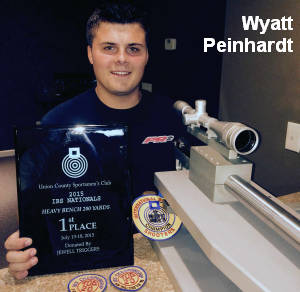 Another landmark of the 2015 IBS Nationals was that 17-year-old Wyatt Peinhardt of Quarryville, PA won the 200-yard stage of Heavy Bench. That meant he earned his first point toward the U. S. Benchrest Hall of Fame (HOF). You need ten to get in, but young Wyatt has plenty of time to get the other nine. He is no ‘flash in pan’. The young Mr. Peinhardt has been shooting since 2009 and now runs full speed with the big dogs of the sport. He was in the Top 20 in this year’s Super Shoot 2-gun results. Frequently he battles his dad, Jeff for supremacy at the bench. Strangely enough, here at Weikert in the Sporter Grand Aggregate (average of five targets at both 100 and 200 yards) Wyatt and his father tied right down to four decimal places: 0.2317!




 According to industry sources, the shipment of match ammo for the South African Palma team was seized at the U.S. port of entry by U.S. Customs and ATF agents. When Ray Gross, captain of the U.S. F-TR rifle team, learned about this, Ray contacted Geoff Esterline, Product Category Manager at Brownells. Esterline immediately turned to Robin Sharpless, Executive VP of Redding Reloading, for help.


 In the archives of

 Sergeant First Class (SFC) Keith Sanderson of the U.S. Army Reserve has been crowned the 2015 NRA National Pistol Champion. After six wet days at Camp Perry along the shores of Lake Erie, Sanderson unseated defending champion Brian Zins by 14 points – 2655 to 2641.