Garand matches are among the most popular and well-attended of the CMP competition disciplines. When obtained directly from the CMP, Garands are fun to shoot and affordable. However, with these classic battle rifles, you need to ensure that the headspace is set properly to ensure safe function and good brass life.
In the archives of The FIRST SHOT, the CMP’s online magazine, CMP Armorer John McLean has written an excellent article entitled: “Everything You Ever Wanted to Know about Checking M1 Garand Head Space.” We recommend all Garand shooters read the article.
McClean explains: “Excessive headspace will cause the brass to stretch more than it should and increases the likelihood of a case failure. Insufficient headspace may contribute to slam fires, light strikes on primers, misfires and more wear on parts due to the additional force needed to chamber the rounds.”
Garand Head Space Gauges
McClean writes: “Both Forster and Clymer make fine gauges but we have found that there are differences between the two companies’ gauges that make the Clymer gauges best for use with the M1. The headspace that the original manufacturers of the M1 considered correct can be determined by checking new or nearly new rifles that we have here at CMP. With that information we have determined that Springfield Armory and the other manufacturers of the M1 used gauges that were very close to the Clymer dimensions… and therefore we use, and recommend using only the Clymer gauges.”
How to Check for Proper Headspace
In the article, McClean goes on to show how to properly use the “GO”, “NO GO”, and “FIELD” gauges. You’ll want to read the Complete Article. One of the important points McClean makes is that the ejector can affect headspace reading. Accordingly, “the bolt must be disassembled and the ejector removed, or clearance notches must be made on the headspace gauges so there will be no contact between the headspace gauges and the ejector.”
Report by Kyle Jillson from NRABlog.com. Sergeant First Class (SFC) Keith Sanderson of the U.S. Army Reserve has been crowned the 2015 NRA National Pistol Champion. After six wet days at Camp Perry along the shores of Lake Erie, Sanderson unseated defending champion Brian Zins by 14 points – 2655 to 2641.
Sanderson, who served eight years in the Marine Corps and eight years in the U.S. Army, is a renowned sport shooter who holds an Olympic record and won an unprecedented three medals (gold, silver, and bronze) in three World Cups in 2009.
Wet Conditions at Camp Perry this Year
At Camp Perry, you can always expect a little rain to come off the lake, but the midwest is experiencing torrential storms this summer and parts of the range – especially along the firing line – became flooded ponds. This year some shooters even stuck “No Wake” signs in the larger puddles to keep attitudes light despite the muddy situation.
Some competitors wore rubber boots to help navigate the puddles.
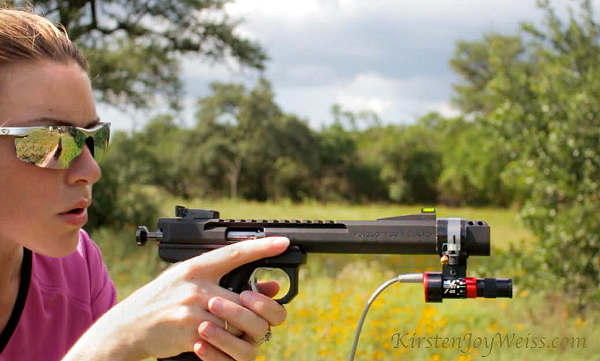
“SCATT” — if you’re an Olympic Class air rifle or smallbore competitor you know what SCATT means. The Russian-made SCATT is a marksmanship training system with an electro-optical sensor that fits on the end of a barrel. The sensor “sees” the target and then tracks your muzzle movement relative to the center of the target, recording a “trace” that can be displayed on a computer. The latest SCATT MX-02 unit works for live-fire training as well as dry-fire training. To learn more about the SCATT electronic trainers, visit SCATTUSA.com.
Pro shooter Kirsten Joy Weiss demonstrates the SCATT MX-02 electronic training system:
The system traces and records valuable information such as hold pattern, shot hold duration, follow-through, recoil pattern, and much more. The latest SCATT MX-02 systems can be used both indoors and outdoors up to 300 meters (and possibly more). READ FULL SCATT MX-02 TEST HERE.
SCATT traces reveal muzzle movements during the aiming process.
Kirsten Joy Weiss, a top-level competitive position shooter, has tested the latest SCATT MX-02 training systtem. She put the MX-02 through its paces, and then produced an informative video that shows how it works. Click on the video above to see Kirsten use the MX-02 with her Anschütz rifle and other guns.
Kirsten was impressed with the SCATT MX-02 she tested:
“We live with tech woven into our every day, so if you had the chance to work with a computer to make you a better shooter — would you? Can a computer train you as well as your favorite coach or, dare to say, better than a human?”
Weiss says it’s like having a little coach with you recording your every move. “If R2D2 had a cousin who knew how to shoot,” Weiss quips, “his name would be the MX-02″.
The SCATT MX-02 can also be used with target pistols.
This Friday, July 17th, the CMP hosts the Vintage Sniper Rifle Match at Camp Perry. One of the most popular vintage rifle matches held each summer at Perry, this is a two-man team competition using scoped rifles of WWI and WWII Vintage. Many competitors use some version of the M1903 Springfield, but you’ll also see scoped M1 Garands, K31s, Mausers, and even a Lee-Enfield or two.
Two-person teams will fire 10 rounds in 20-second intervals from scoped vintage military rifles set on sand bags. One team marksman shoots from the prone position at 300 and 600 yards, while the other serves as a spotter to relay shot position. Marksman and spotter switch positions on the firing lines, allowing each teammate to play both roles. Scores are then combined for an Aggregate team total.
Two M1 Garands, fitted with scopes and lace-on cheekpads.
Who can identify this rifle, with its unusual scope mount?
Our friends at Criterion Barrels have written an interesting article about last year’s Vintage Sniper Rifle Match. It you want an “insider’s perspective” on the 2014 Match, plus Vintage Sniper gunsmithing tips, read this article. Here are some highlights:
About the Match and the Rifles
The Vintage Sniper Match was the brainchild of Hornady’s Dave Emary. The competition was inspired by his father, a World War II scout sniper, who carried a rifle similar to the 1903A4 rifle builds that can be found today on the Camp Perry firing line. Bob Schanen worked alongside Dave and the CMP staff in establishing the various competition rules prior to the first official Vintage Sniper Match in 2011. The match developers made a point to offer some level of flexibility in rifle configuration, allowing specific types of non-issue optics and rifle rebuilds. This helped make the match more inclusive.
Hornady’s Dave Emary and “Gunny” R. Lee Ermey (right):
Bob Shanen has two vintage sniper competition rifles. Both builds are based off of the USMC Model 1941 sniper rifle, a design similar to the M1903A1 National Match rifle. Bob’s rifles both carry 8x Lyman Junior Target Spotter scopes with a thin crosshair reticle. Bob attributes a large part of his rifle’s accuracy to the Criterion M1903 match-grade barrels installed on each rifle by Rick Humphreys, a Milwaukee area gunsmith. These tack-driving barrels are capable of half-MOA accuracy.
Camp Perry — The Venue
The hallowed grounds of Camp Perry have hosted some of the nation’s finest shooters each summer for more than a century. Some of the world’s greatest marksmen have accomplished remarkable feats on the ranges of this lakeside military outpost. Located on the coast of Lake Erie, Camp Perry is positioned just outside of the scenic town of Port Clinton, Ohio. It is our firm belief that every shooter should make the pilgrimage to the Camp Perry at least once in their lifetime. If not participating in an event, visitors should at least make an attempt to meet the competitors, witness the wide selection of firearms used by participants, and pay a visit to the various vendors on base.
Bench Barrels for Sound Attenuation
There’s something unusual about this range. Competitors are required to shoot through hoops. Vince Bottomley explains: “Competitors have to shoot with the rifle barrel inside a foam-lined plastic barrel, in an attempt to cut down on noise. This was a condition imposed by the local police but in practice, you don’t notice it as you are looking through a scope.” That looks pretty strange to us. Hopefully we won’t see these kind of restrictions imposed in the USA.
Here’s good news to report from the United Kingdom. The UK’s second 1000-yard benchrest facility just opened up in Scotland, near the town of Castle Douglas in the south of Scotland. Until now, Diggle was the only range running 1000-yard benchrest matches in all of the UK. With interest in long-range benchrest competition growing in the UK, it’s good to see a new 1K venue opening for business.
The new Ingleston Range in Castle Douglas is operated by the Galloway Small Arms Club. This club is affiliated with the United Kingdom Bench Rest Association (UKBRA), so any records established will be recognized by the UK governing body for benchrest shooting. Light Gun and Heavy Gun Classes are run according to American IBS rules. And, per UKBRA standards, there is also a third, Factory Rifle Class. Vince Bottomley reports: “The Range is located on a working farm and the GSAC members have worked tremendously hard to create a 1000-yard range from what is basically open countryside.”
Here’s the view looking downrange. What a beautiful place to shoot…
by Dennis Santiago
Tricked-out match guns are fun but, if you want to prove that you’ve got an eagle eye and steady hands, a true test of skill is the Civilian Marksmanship Program’s As-Issued Four Gun Aggregate.
The Four Gun Aggregate encompasses a series of CMP John C. Garand 30-shot matches (200-yard As-Issued Military Rifle Match Course A) on NRA SR targets at one of the CMP Regional Games or the Nationals officiated by the CMP. These are the only places you can earn the coveted neck-ribbon CMP achievement medals.
You will need four as-issued rifles. The first is the M-1 Garand. (The course of fire is named after this rifle’s inventor.) This remarkable battle rifle will test your prowess at slow prone, rapid prone, and offhand. The match winner will put almost all bullets into a saucer.
You do get to hear that classic “ping” when the en bloc clip ejects with this gun. It’s a good idea to write your firing point number on your hand for each match because you will move around over the course of the tournament.
Next comes the hyper-accurate 1903 Springfield. You can use either the WW I M1903 or the later WW II M1903A3 model with peep sights. A Springfield will typically shoot groups half the size of a Garand with the same ammunition. Think potential in terms of tea cups instead of saucers.
McMillan has developed a new stock for F-TR competition. The front half is like a prone stock while the rear section has a straight underside (toe) section for smooth tracking in the rear bag. This stock appears to be designed for hard-holding, with a vertical grip and a fairly tall adjustable cheekpiece. The stock weighs just five pounds complete with adjusting hardware, so F-TR rigs built with this new stock should “make weight” easily. (The F-TR limit is 8.25kg or 18.188 pounds including bipod.)
Paul Phillips of Team Sinclair revealed the new McMillan stock on his Facebook page. Paul reports: “McMillan has been a leader in the industry for 40 years. I can’t thank the McMillan family enough for all they have done for our Military, Law Enforcement and Competitive shooting communities. Kelly McMillan and Team Sinclair worked together on what stock profile and features would be the best for FTR competition and this is what came out of the oven. Kelly also came up with some strong, super-light hardware that put the entire weight of the finished stock after bedding at 5 pounds even.
After Alex Sitman from Masterclass Stocks bedded my new stock, he told me that this new stock design is a true work of art and will fill a huge void in F-TR. Derek Rodgers set the current 1000-Yard F-TR record, 200-12X, with a McMillan prone-style stock. Team Sinclair holds the current 1000-Yard Team Record, 792-38X, and McMillan also contributed to that. McMillan [helps sponsor] the USA F-TR Team and Team Sinclair. Team USA will also be using these stocks in the upcoming 2017 World Championships hosted in Ottawa, Canada.”
Making Weight in F-TR — Every Ounce Counts
One Facebook reader asked why the new F-TR stock was so light. Here is Paul’s response:
Question: Paul, 5 pounds seems a little light. My Anschutz [stock] is heavier. Wouldn’t you want a heavier stock for stability, particularly for long range shooting?
Answer: It’s a fine line making an 18.18-pound weight limit. We need longer barrels to get the velocity to push 185- and 200-grain bullets. We also have a scope and bipod that add weight. It’s a balancing act. As I mentioned before, the current National record is with the same weight McMillan prone stock, just different profile. It works.
Nick Till in 2009 M1A Match. Nick was the 2007 Service Rifle Nat’l Champion. Photo courtesy NRA Blog.
The 2015 NRA National Rifle & Pistol Championships at Camp Perry, Ohio are just a couple weeks away. You can still register for one or more of the matches. Just click the orange “Register” button (below) to register online.
Many of the finest civilian and military marksmen in the United States will square off for weeks of rifle and handgun competition while vying for the NRA’s historic and prestigious trophies. From pistol, to smallbore rifle, high power rifle, and long-range high power rifle, the National Matches have something for just about everybody.
The MOA Long Range Handgun Match was held June 18-20, 2015 near Sundance, Wyoming. This three-day event features handgun shooting at 500, 750, and 1000 yards. Shooters start at 500 on the first day, and then move to 750 on Day 2, and 1000 on Day 3. Sierra Bullets Media Relations Manager Carroll Pilant joined the action this year (as he has every year since the event’s inception). Here is his report…
Article based on report by Ashley Brugnone, CMP Writer
The 2015 CMP National National Three Position Air Rifle Championships will be held June 21-23 and June 24-26 at the Civilian Marksmanship Program’s (CMP) South Competition Center in Anniston, Alabama. Junior JROTC, 4-H and club team precision and sporter marksmen involved in the competition began their journey with the CMP Postal Competition in November, where CMP-issued targets were mailed into Headquarters in Ohio for official scoring. Top shooters in the Postal Competition were invited to compete in the Regional Championships in March and April, with the top individuals and teams from that match qualifying for the National Championship.


 In the archives of The FIRST SHOT, the CMP’s online magazine, CMP Armorer John McLean has written an excellent article entitled: “Everything You Ever Wanted to Know about Checking M1 Garand Head Space.” We recommend all Garand shooters read the article.
 Sergeant First Class (SFC) Keith Sanderson of the U.S. Army Reserve has been crowned the 2015 NRA National Pistol Champion. After six wet days at Camp Perry along the shores of Lake Erie, Sanderson unseated defending champion Brian Zins by 14 points – 2655 to 2641.




 The Four Gun Aggregate encompasses a series of CMP John C. Garand 30-shot matches (200-yard As-Issued Military Rifle Match Course A) on NRA SR targets at one of the CMP Regional Games or the Nationals officiated by the CMP. These are the only places you can earn the coveted neck-ribbon CMP achievement medals.


