|
|
January 24th, 2015
Our friend Dennis Santiago found two interesting rifles at SHOT Show. At first glance, these look just like the legendary M1 Garand and the M1A (civilian version of the M14). The size is right and the stocks look authentic. But take a closer look and you see these are NOT chambered for .30-06 (Garand) or 7.62×51 (M1A) cartridges. Rather, these Baby Battle Rifles are rimfire clones, chambered for the .22 LR. We like the concept — this gives Garand Match and M1A Match competitors the ability to cross-train with low-cost rimfire ammo. Plus, who wouldn’t want a rimfire Garand for a little low-recoil plinking fun? We bet these will produce smiles when folks at the range see them for the first time. And a .22 LR Garand is definitely going to be softer on the ears (and your shoulder)!

Dennis tells us: “These were kind of neat. The form factors and ergonomics are accurate. The weight is a pound or two lighter than the real deal. Trigger is Ruger’ish. It might be fun to show up with one of these at a CMP .22 Sporter match.”

The two Baby Battle Rifles are sold by Kingston Armory. You can visit KingstonArmory.com, but there’s really nothing to see yet — Kingston’s website is still “under construction. If you have questions you can call Kingston at 845-292-3222.
January 18th, 2015
ELEY .22 LR ammunition has certainly been the choice of champions in high-level international smallbore competition. But ELEY is not resting on its laurels. ELEY’s engineers have worked hard to develop two new types of rimfire ammo — one fast (“force” high-velocity), one slow (“contact” subsonic). ELEY force and ELEY contact, the latest additions to ELEY’s product line, will be officially launched at SHOT Show in Las Vegas next week.

Black Casings — Not Just for Looks
Designed for power, ELEY force is a new, high-velocity .22LR round that delivers both superior energy AND accuracy. ELEY force features a new propellant with a distributed pressure curve. This provides more energy during the in-barrel “burn time”, accelerating the bullet to a high velocity. Force is optimized for semi-auto rimfire rifles.
The cartridge brass for ELEY force is matte black, the result of a patented oxidisation process, first used with Eley edge (introduced in 2013). ELEY force is now the second type of ammo with black cases, which are dark for a good reason. According to ELEY’s engineers: “The black oxidized case finish increases friction between the case and projectile. This regulates and controls the force required to release the bullet, stabilizing the projectile and increasing ballistic consistency and accuracy.”
ELEY Contact — The Subsonic Solution
ELEY contact is a subsonic semi-automatic .22LR round designed for extreme accuracy, reduced noise, and minimal recoil. The reduced recoil allows the shooter to recover his sight picture more quickly. This is especially important for rapid-fire shooting with semi-automatic rimfire rifles.
Both ELEY force and ELEY contact are engineered with a heavier 42 grain bullet for high energy and are coated in a specially-formulated paraffin wax to minimize build-up in actions and magazines.

ELEY’s History — A Success Story Spanning Two Centuries
A company with a rich heritage, ELEY has been making ammunition for 187 years. The company was first established in 1828 in London and was later moved to Birmingham, beginning a long and proud tradition. (Learn about ELEY’s history.) Over the years, ELEY has pioneered many technical innovations. ELEY now specializes in .22 LR caliber cartridges, and ELEY’s match ammo has a remarkable track record in competition. At the 2012 Olympics, 14 out of 18 smallbore shooting medals were won by shooters using ELEY ammunition.

ELEY Test Facilities in USA, UK, and Germany
ELEY tells us the “every current ISSF Smallbore World Champion uses ELEY Tenex ammo”. That success can be attributed (at least in part) to ELEY’s technical testing facilities in the UK, Germany, and the USA. At these test centers, competitive shooters can test ammo lots in their particular match rifle to ensure the best match of barrel and ammunition. To learn more about the ammunition testing facilities and ELEY products, visit www.Eley.co.uk.

January 16th, 2015

It may be cold and wintry in Camp Perry, Ohio. But it’s warm inside — inside the Gary Anderson CMP Competition Center that is. And dozens of competitors will be there for the next three days (Jan. 16-18) at the Ninth Annual Camp Perry Open Air Gun Tournament.


The Camp Perry Open is one of the biggest mid-winter air gun events in the nation. This year’s match will include a three-position air rifle competition, a 60-shot standing air rifle event, a 60-shot Air Pistol event as well as a Clinic. The 3X20 plus final three-position air rifle competition will take place on Friday, 16 January 2015. A clinic for interested junior shooters will be held on Saturday afternoon. The 60-shot international events will be fired on Saturday and Sunday (January 17th and 18th).
Electronic Targets with Results Streamed Online
The Gary Anderson Center boasts state-of-the-art electronic targets that record scores the instant each shot is fired. Shot-by-shot feeds are then displayed online through as Live Target Images that can be viewed anywhere there is an Internet connection. CLICK HERE to See Live Target Feeds

How Electronic Targets Work
Each electronic target is equipped with four microphones — one in each corner of the target. As the pellet strikes the target, it generates a sound wave that propagates to the microphones. The sound waves are used to determine the shot location by calculating the amount of time it takes for the sound to reach the microphones. That’s physics so the results are precise — machine-calculated shot locations are accurate to one hundredth of a millimeter.

January 10th, 2015
Mark your calendars for the “Mother of all Airgun Matches”. The 33rd Annual Canadian Airgun Grand Prix, the largest airgun competition in North America, will be held in Toronto on February 6 – 8, 2015. Competitors from several countries will be in attendance. All events will take place in the International Plaza Hotel conveniently located only 5 kms from the Toronto Pearson airport.

70-Position Shooting Range with Electronic Targets for Finals
The main shooting range for the Canadian Airgun Grand Prix features 70 positions for air rifle and air pistol, including positions designated for access by adaptive athletes, with electric target carriers on all positions. This will provide state-of-the-art hardware for the competitors.
See How Electronic Targets Work:
The Grand Prix Finals will be shot on SIUS electronic targets and will follow the new ISSF format. The top 8 in each of the Men’s and the Women’s events, including International Juniors and Sub-juniors will compete in Finals to determine the “Open” winners. For more info and updates, visit the Canadian Airgun Grand Prix Facebook Page. Competitors can register at: http://nfap.ca/cagp/cagp.nsf.
January 7th, 2015

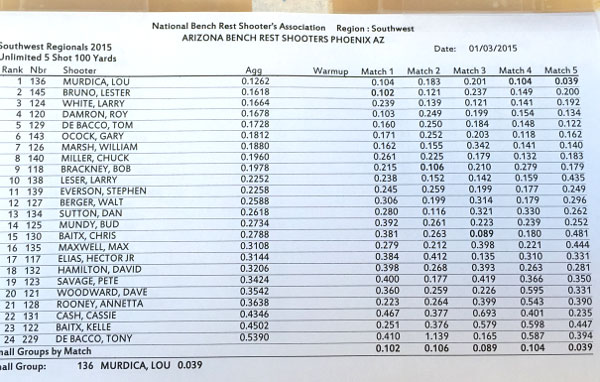
Sometimes superlatives really aren’t necessary. Just look at that target. Yes that is FIVE shots (although it truly appears like one hole). And it is centered! This remarkable group, measured at 0.039″, was shot by Lou Murdica in Phoenix on January 3, 2015. Lou drilled this group with his 6 PPC railgun. Rounds were loaded with Accurate LT-32 powder and Berger 65gr BT bullets. The target will be submitted to the NBRSA as a potential new 100-yard Benchrest record in the Unlimited (Railgun) Class. The current NBRSA record small group (Unlimited) is a 0.049 shot by Hall-of-Famer Gary Ocock in 2009.

This is a file photo with a different railgun.
This wasn’t the only tiny group shot by Lou over the weekend. Murdica shot a sizzling 0.1262 five-target 100-yard Unlimited Aggregate. That 0.1262 Agg will also be submitted for consideration as a possible record. Here are the individual group sizes: 0.104, 0.183, 0.201, 0.104, 0.039. At this match Lou won both the Unlimited and Sporter class. “It was a great weekend” Lou reported.
About the Gun
What kind of rifle can put five shots in one hole? Lou was shooting an Unlimited-class railgun. This return-to-battery rig (a Kensler railgun) allows the shooter to focus on firing at the perfect time for the conditions. Lou’s Kensler railgun (see below) features a Kelbly top-loader Grizzly action, Shilen 6-groove barrel, and March 10-60X scope. The Shilen is chambered for the 6 PPC cartridge. But there’s something special about this particular 6 PPC — read on….
Click photo for larger version:

Radical New Reamer Design from PT&G
Lou used a new chamber reamer from Pacific Tool & Gauge (PT&G) with special geometry in the leade/throat section. Called a “Bore Rider” (or sometimes “bore-runner”), this new reamer design cuts a staged, variable taper in the leade/throat area that is quite different than the taper in a typical throat. It’s a little hard to explain, so we’ve included the 6 PPC Bore Rider reamer print below. (Download the PDF file for a better view.) Experts should look at the leade angle(s), freebore, and throat dimensions. You may be surprised. Dave Kiff of PT&G says this Bore Rider design has worked successfully for other cartridge types/calibers as well. Apparently this design helps the bullet center up smoothly in the bore before the bullet engages “hard” in the rifling — or so we’ve been told.
CLICK HERE to DOWNLOAD Reamer Print as PDF File.

January 6th, 2015
 It’s much easier to see bullet holes “in the white” than in the black center of a High Power or F-Class Target. That’s why some shooters use “negative” black-to-white targets for practice sessions. Also, even those who compete at 800-1000 yards find it useful to practice at 300 yards. At that shorter distance, you can, on most days, see bullet holes with a good spotting scope. (Forget trying to see bullet holes at 1000 yards with any spotting scope, no matter how expensive).
The only problem with practicing at 300 yards is finding a correctly “shrunken” version of the target actually used in long range competition. Well guys, you’re in luck. One of our Forum members, Sleepygator, has produced “reduced-distance” targets (with black ring-lines on white background) for practice use at 300 yards. Only the center 10 and X rings are black, so you can see bullet holes easily “in the white” on most of the target (and this uses less ink when printing). There is an official reduced-distanced standard for 300-yard F-Class matches. This utilizes the NRA No. MR-63FC – F-Class Target Center which is pasted over the MR-63 target. It provides a 1.42″ X-Ring, 2.85″ 10-Ring, and 5.85″ Nine-Ring. (The dimensions of F-Class targets are found in the NRA High Power Rules, Sec. 22, part 4.)

CLICK HERE to Download F-Class 300-yard Target Centers (.Zip archive with three targets)
To duplicate the 300-yard target, Forum member SleepyGator has prepared a printable version of the MR-63FC Target Center, along with a pair of training targets with two bulls and five bulls. The two-bull and five-bull targets mirror the scoring rings on the MR-63FC, but they display only the innermost three rings and two rings respectively. All three targets are Adobe Acrobat files that can be easily printed. You may need to adjust the scale (sizing) on your printer to get the dimensions exactly correct. As noted above, when printed, the 10-Ring on all three targets should measure 2.85″. This should provide some handy practice targets you can use between matches. Thanks to SleepyGator for providing these targets. You can download all three as a .Zip archive. After downloading the .Zip file, just click on the .Zip archive to extract the individual targets.
January 4th, 2015
The 2014 F-Class National Championships were held in Phoenix this past October. It was a well-attended match with nearly 170 competitors from around the nation. In a tight battle, James Crofts (1574-59X) edged past champion Derek Rodgers (1573-65X) by a single point in the F-TR division. In F-Open, Emil Kovan (1587-83X) shot well to beat Danny Biggs (1585-83X) by a two-point margin. Both Kovan and Biggs racked up 83 Xs — that’s mighty impressive shooting. Overall, conditions were generally good (if hot), and many new records were set. The course of fire was 160 shots, all at 1000 yards.

An excellent, detailed day-by-day report on the F-Class Nationals appears in the January edition of Shooting Sports USA, just released. Prepared by past National F-Open Champion Larry Bartholome (aka “LBart” in our Forum), this article provides unique insights by one of the leading competitors in the game. Larry may be a senior citizen but he can still shoot. In fact, Larry observes that age is no barrier to success in the F-Open division: “In the ten-year history of F-Class, the F-Open discipline has been won four times by senior or grand senior shooters. John Brewer was 73 when he won in 2004. In 2007 Bob Bock won as a 65-year-old senior in Raton, NM. Jim Murphy was a 65-year-old senior when he won in lodie, WI. Finally, Larry Bartholome won in 2013 at Raton at the age of 73, even though he felt like 103. All of these senior/grand senior champions are members of Team Berger, and still shoot.”
Another highlight of the 2014 F-Class Nationals was the performance of Team Long Shots. Team members pleased the crowd by shooting in their Halloween costumes on October 31st. The colorful costumes (Snow White and the four dwarfs) didn’t seem to hurt their performance. In fact it may have brought the Long Shots some luck. All four marksmen went through the match without dropping a single point. This gave Team Longshots an 800-42X score at the end of the day to secure the team win, setting a new team record in the process. Larry Bartholome writes: “This is the first-ever 800-point team score in the history of F-Class.”

You can read the FREE eZine version of Shooting Sports USA online. Along with Larry’s F-Class article, this January edition includes coverage of various state and regional shooting championships, plus a field test of the new Match-Grade .30-06 Springfield Ammunition from Creedmoor Sports. This is excellent stuff, produced with premium Lapua brass and Lapua Scenar bullets. Tester Art Merrill reported this ammo was very straight, and demonstrated excellent accuracy on target. If you shoot Garand matches, you may want to get your hands on this high-quality ammo. See the test results below.
New Creedmoor Sports .30-06 Ammo Reviewed:

January 2nd, 2015
Scheduled to open in spring 2015, the CMP’s new Talladega Marksmanship Park will be one of the largest, most elaborate public shooting ranges in the nation. State-of-the-art electronic targets will be utilized for both competition and practice, with groups and scoring viewable via electronic monitors. Sporting Clays, Trap, and 5-Stand venues will offer fully automated clay target-launching systems utlizing swipe card technology. For more info, visit the Talladega Marksmanship Park website.


CMP Talladega Marksmanship Park
Plans were approved in March 2012 by the CMP Board of Directors for a 500-acre marksmanship park located two miles from the Talladega International Motor Speedway in Talladega County, Alabama. The new CMP Talladega Marksmanship Park will feature a 600-yard rifle range with 50 electronic firing points, 100 yard multi-purpose range with 40 electronic firing points, 50 yard pistol range with 25 electronic firing points, 50 foot pistol qualification range, 15 action pistol bays, trap field with 5 stand overlay with automated trap machines, and 15 station sporting clays field with automated trap machines. The facility address is: 4387 Turner Mill Road, Talladega, Alabama.

Park Usage Fees:
| Range (Centerfire/Rimfire)
|
1/2 Day (4 hr) Adult
|
1/2 Day Junior (age 10-17)
|
All Day (8 hr) Adult
|
All Day Junior (age 10-17)
|
| 100-yard Electronic Targets |
$15 |
$8 |
$25 |
$13 |
| 50-yard Electronic Targets |
$15 |
$8 |
$25 |
$13 |
| 50-Foot Paper Targets |
$10 |
$5 |
$20 |
$10 |
| 200, 300, 600-yard Electronic Targets |
$20 |
$10 |
$35 |
$18 |
| 10-Day Pass (10 visits All Day or Half Day) |
|
|
$200 |
$100 |
| Note: All juniors (age 10-17) must be accompanied by a responsible adult. Both the junior and responsible adult must successfully complete the CMP Marksmanship Park Safety class prior to participating in live fire on park property. |
December 23rd, 2014
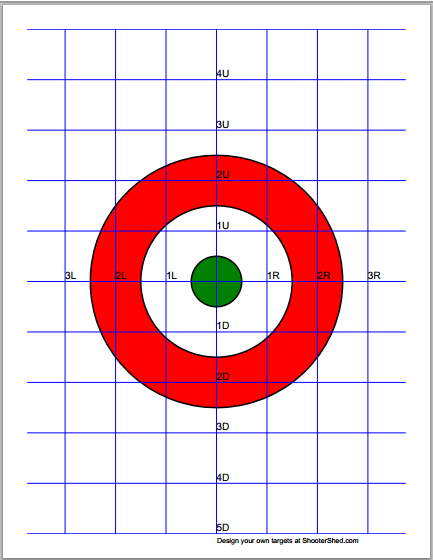
Are you creative? Do you like to design and customize things? Then you’ll love the Target Generator from the folks at ShooterShed.com. This free, interactive webpage allows you to design a variety of fun targets, including grids, benchrest-type Score Shooting targets, sight-in targets, and even playing card targets. Choose the paper size and orientation (vertical or horizontal), then select the number of target elements on the page. For example, you could have four (4) bulls or 52 playing cards. You can include a grid on the target, or tell the program to include load information blocks. For bullseye targets, you can control the number, color, and spacing (diameter) of the rings. LINK to TARGET GENERATOR.
 |
 |
The program provides a preview of each target you generate. If you like a particular design, save the file, and then print as many targets as you want. Check it out, this program is fun and handy to use. Here are five (5) targets your Editor created this morning just for this article. With a bit of practice, you can be generating your own custom targets in minutes. Have fun.

About the Creator of the Target Generator
The excellent Target Generator program was created by Rod Brown of Sheridan, Wyoming. Rod tells us: “I build custom rifles and coach shooters. I’ve got a 100-yard range out my back door. I shoot short- and long-range benchrest competitively around the country. I’m a full-time software development consultant and an FFL holder. When I’m not developing custom software for my clients, I’m usually fiddling in the shop, building a custom benchrest rifle, traveling to a match, chambering a barrel, or reloading some ammunition.
Story tip from Boyd Allen. We welcome reader submissions.
December 20th, 2014
Tactical matches are becoming more and more popular every season. Along with F-Class, the tactical discipline is one of the fastest-growing forms of competitive rifle shooting. Rich Emmons, one of the founders of the Precision Rifle Series (PRS), has written an insightful article about getting started in the tactical game. Here are highlights from Emmon’s PRS — Intro to Competition article.

Precision Rifle Series — Intro to Competition
by Rich Emmons, PRS President
Tactical Shooting with a precision rifle is not like other disciplines, there is no set course of fire or format. That is what makes it so fun!

First, you have to ask yourself what do you want to accomplish. When I was introduced to long range shooting, immediately a light turned on for me, once I saw how easy it was to hit 300–600 yard targets. What I quickly learned from my first competition and the many that followed was there is so much to learn and shooting in competition put everything you thought you knew to the test. So back to the question: “What do YOU want to accomplish?”. The reality is you may not know yet, you just think it is cool to have a bad ass rifle and scope that can make almost any shot. Now if you’ve got that rifle and scope, it’s time to take it to the next level.
Watch PRS 2012 Championship (Click arrows icon to view full-screen version.)
Getting Started — What to Expect
If you’re reading this, you have probably already have been bitten by the long range shooting bug. It can seem quite intimidating to just jump in with a new bunch of shooters you don’t know and shooting lingo you don’t quite understand yet. But here is the key — show up and shoot! I guarantee you if you show up to a match as a new shooter, other experienced shooters will guide you along and give you help on anything you need.
|
AUDIO: Click Button to hear Rich Emmons Talk about the Precision Rifle Series. |
Now, a couple things you should just expect. You’re not as good as you think you are. Don’t expect to come into your first match and beat all the veterans. That just doesn’t happen unless you have had some really good coaching or other shooting competition experience to get you ready for this type of competition. If possible, find a local rifle club that has monthly long range matches, or any type of match will help prepare you for a larger PRS event. Getting involved with a rifle club and starting out shooting monthly matches is definitely the way to jump into competition shooting.
The Gear You Need
The first question that many ask is: “What kind of rifle/caliber/scope do I need?” The easiest answer to this is, the best you can afford. It’s no secret the gear is expensive. It took me several years of buying sub-par gear and eventually trading up to figure this out. Now, a guy can get a real sense of pride of doing it on the cheap, or with a factory rifle. I’ve seen many old Savage 10FPs take down custom rigs that cost 10 times as much. And if that’s all you can afford, then eventually you will learn the limitations of yourself or your gear. As for choice of cartridge/caliber, the Precision Rifle Blog has analyzed three years worth of match results from the best tactical shooters in the nation. CLICK HERE to read an article that reveals what the “top guns” use.

Making Good Ammo
Producing quality reloads is something you have to master. It’s not hard at all, you just have to pay attention to detail, and eventually you are going to do something stupid like mis-priming your brass, or skip a row of brass when dumping your powder. Everybody has their own horror story of some reloading failure that cost them a stage or even a match. So load to perfection, work with your rifle to find what load it likes the best, then start your practice.

Practice Makes Perfect
You want to become ONE with your rifle, learning everything you can about its functionality. Getting comfortable with the operation of your rifle is key. Learn the feel of your trigger, dry-firing until you wear the paint off your bolt handle. Learn how the rifle works best — pay attention to little things like the sound and feel of the bolt feeding a round from the mag (or when it doesn’t). Learn how to remove a jammed round quickly, learn how to reload a magazine quickly. Learn to scan across a field and find targets in a quick manner, seeing the targets with your eye and coming into the scope on target. These are some of the basic practices that separate the new shooters from the seasoned ones.


|


