|
|
October 29th, 2014
UPDATE: On October 29th, at the Nationals, Derek Rodgers beat his own new record, with a 200-12X!
Congratulations to Derek Rodgers for setting a new 1000-yard National Record with a score of 200-11X at the Arizona Long Range Regional in Phoenix. A past national F-Class Champion, Derek is a member of Team Sinclair and the U.S. National F-TR team. Derek’s rifle is built on a Kelbly action, using a Bartlein barrel and a McMillan stock. It is topped with a Nightforce Optics scope. His ammo was made using Berger bullets, Lapua brass and Hodgdon Powder.

F-Class competition continues this week at the Ben Avery Shooting Facility in Phoenix Arizona this week. The 2014 F-Class National Championhip runs October 28 through November 2, 2014. The F-Class National Championship is a multi-day match comprising of all shots at 1000 yards. There will be a mix of individual and four person team matches. The competition consists of two different Divisions: F-Open and F-TR (Target Rifle). Each Division is made up of five different Categories: High Master, Master, Expert, Sharpshooter and Marksman.
October 25th, 2014
“Rumble on the Range”, the 3-Gun Nation (3GN) Championship, takes place today, October 25th at the U.S. Shooting Academy in Tulsa, Oklahoma. The 2014 FNH USA 3-Gun Nation Pro Series culminates in this season-ending event. This is a big money match, with serious prize money going to the winners. Top 3GN Pro Series competitors will duel in a head-to-head, no holds barred shoot-off for cash, prizes and the championship title.

 There are 40 competitors — 32 men and 8 women — with separate classes for the guys and the gals. In the men’s championship, the top 32 male finalists will compete for a $50,000 cash payday sponsored by Leupold and NRA Sports. Shooters will use pistols, AR-platform rifles, and shotguns — all tricked out for maximum speed and high capacity. There are 40 competitors — 32 men and 8 women — with separate classes for the guys and the gals. In the men’s championship, the top 32 male finalists will compete for a $50,000 cash payday sponsored by Leupold and NRA Sports. Shooters will use pistols, AR-platform rifles, and shotguns — all tricked out for maximum speed and high capacity.
The 3-Gun Nation Ladies Professional Series, sponsored by Samson Manufacturing, concludes with the top eight (8) ladies competing for $25,000 Cash. The shooters to beat are 2013 Mens’ Champion SSG Daniel Horner of the USAMU and 2013 Ladies’ Champion Lena Miculek (at right).
Watch Video from 2013 3-Gun Nation Championship

HOW IT WORKS:
The event will feature 3 stages of fire (shoot-off stages). Each of the top 32 (males) and 8 (females) will be paired against each other based on series rank. The first of the paired competitors to complete the course of fire will advance. Stage 1 will feature 32 males; 8 females. Stage 2 will feature 16 males; 4 females. Stage 3 will feature the final 8 males; final 2 females. The final male will win the $50,000 cash prize. The final female will win the $25,000 cash prize.
|
Where:
U.S. Shooting Academy
6500 East 66th St N
Tulsa, OK 74117
(918) 948-7856 |
When:
Saturday, October 25
All Day 8:00 AM-6:00 PM
Grand Finale: 4:00-6:00 PM |
USShootingAcademy.com
MAP HERE |
3-Gun Nation Side Stage
A special Side Stage will be open to the public with guns and ammo provided. Spectators can try their hands at 3-Gun, shooting pistols, AR-type carbines, and shotguns. The top score wins a DPMS AP4 Carbine!
Machine Gun Shoot
A machine gun demo featuring a wide variety of full-auto firearms with be open to the public, under the direction of the U.S. Shooting Academy Range staff. Ammo fees apply.
Sneaky Ladies. Maggie Reese (left) and Janna Reeves (right) try to steal the big $25,000 check!

October 20th, 2014
A while back we published an Introduction to .50-Caliber Shooting authored by James Patterson. James has written a companion piece for Sinclair’s Reloading Press that covers the “care and feeding” of the big .50 Cal match rifles.

Owning and Feeding ‘The Big Bore’
Is The Challenge Of Big Bore Extreme Range Shooting And Hunting Right For You?
By James Patterson
Handling a 50 BMG
Is a 50 BMG caliber rifle difficult to shoot? Not at all. The relatively heavy weight of a standard rifle at 30 pounds or more combined with a very efficient muzzle brake makes it a pleasure to shoot. The typical recoil can be compared to a .243 rifle or a 12 gauge trap load. On the other hand, the burning of a typical load of 230 grains of powder combined with that muzzle brake makes the muzzle blast experience exhilarating. A first time shooter will fire, pause for a moment in awe at the muzzle blast, and then break out into what has become known as “The 50 caliber Grin”, almost impossible to wipe from ones face. My daughter started competing with the 50 BMG at 18 (115 lbs of tall skinny girl) and happily shoots 100+ rounds in the course of a match, her grin on the last round is as wide as on the first! Many members and competitors in the FCSA are women and many have distinguished themselves as excellent marksman having set world records on numerous occasions.

Cost of Big-Bore Shooting
Is owning and shooting a 50 BMG caliber rifle expensive? Relatively speaking yes, but one must put it into perspective. Rifles may run from $2500 to $7000, maybe even more for a top of the line custom rifle. A good scope will set you back $500 to $1500. And while excellent commercial ammo is available it runs from $3 to $5 a round. Most serious shooters start reloading for the rifle as soon as practical, not only for the economics of reloading but also for the ability to fine tune custom ammo for their specific rifle. It’s a very rare match that is won shooting commercial ammo. I recently compared the cost of my hobby — owning, shooting, and competing with the 50 BMG — with a friend whose hobby is snowmobiling. Factoring in the cost of equipment, licensing, gasoline, clothing, etc. it was soon obvious that my hobby was significantly less expensive than his.


Getting Started
 So how does one get started? You could do as I did, purchase a rifle not knowing what you were really getting into; or you could come out to a FCSA-sponsored event, shoot a number of different rifles, rub shoulders with those who have already taken the plunge, and see if this sport is right for you. While membership in the Fifty Caliber Shooters Association (FSCA) is required to compete at a FSCA event, membership is not required to come and experience first hand what is going on. If you have any inclination that you are interested in the extreme sport of long rang, big bore shooting then a year’s membership in the FCSA is only $60 ($20 for active duty military) a significant bargain if it helps you make just one well-informed equipment choice. In addition one of the primary functions of the FCSA is helping to identify active members near you who can help you understand just what is involved and help you ‘get your feet wet’ in this challenging sport. So how does one get started? You could do as I did, purchase a rifle not knowing what you were really getting into; or you could come out to a FCSA-sponsored event, shoot a number of different rifles, rub shoulders with those who have already taken the plunge, and see if this sport is right for you. While membership in the Fifty Caliber Shooters Association (FSCA) is required to compete at a FSCA event, membership is not required to come and experience first hand what is going on. If you have any inclination that you are interested in the extreme sport of long rang, big bore shooting then a year’s membership in the FCSA is only $60 ($20 for active duty military) a significant bargain if it helps you make just one well-informed equipment choice. In addition one of the primary functions of the FCSA is helping to identify active members near you who can help you understand just what is involved and help you ‘get your feet wet’ in this challenging sport.

Photos courtesy FCSA Photo Gallery.
October 19th, 2014
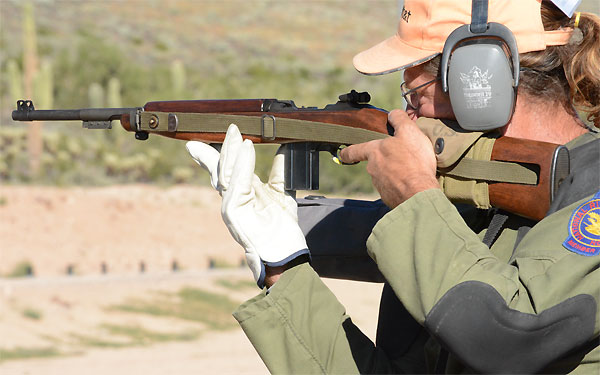
One of the CMP’s most popular competitions is the M1 Carbine Match. The little carbines are easy to hold and easy to shoot, with relatively low recoil compared to an M1 Garand or M1903 shooting the full-power .30-06 cartridge. Unfortunately, genuine GI-issue M1 Carbines are now hard to find at affordable prices. The CMP has announced: “CMP’S Carbine Inventory has been exhausted and we do not expect to receive any additional shipments.” Authentic, “all-original” M1 Carbines are going for $1500 to $1800.00 these days on Gunbroker.com.
CMP M1 Carbine Match at Western CMP Games
New Production M1 Carbines
Thankfully, you can now get a brand new, American-made M1 Carbine clone for hundreds less than an old CMP rifle. MKS Supply is now offering American-made Inland Mfg. brand .30-Caliber M1 Carbines that look, feel, operate and shoot just like the originals.

These made-in-the-USA, newly manufactured M1 Carbines are faithful copies of the original Inland Manufacturing carbines from the World War II era. (Inland was once a division of General Motors, but this is a new company with the same historic name.) They feature 1944-style peep sights and even include Arsenal cartouches on the stocks. All Inland M1 Carbine models come with a cloth sling and oiler resembling those given to GIs during WWII. MKS Supply will offer three (3) Inland M1 Carbine models:
M1 1944 wood stocked original design without bayonet lug — MSRP $1049.00
M1 1945 wood stocked original design with bayonet lug — MSRP $1049.00
M1A1 Paratrooper original design with folding heavy wire buttstock — MSRP $1179.00
NOTE: The new Inland carbines are so precisely copied from the original specifications that the company marks the underside of the barrel and the inside of the stock of these current models to prevent potential fraudsters from passing these new carbines as mint WWII originals.
GunsAmerica.com reporters recently compared new Inland M1 Carbines side-by-side with original vintage M1 Carbines: “We had to get in close to tell the difference. Overall, the two examples we were able to handle looked great and held up when next to the originals. The stampings are even close to correct with a few minor differences that were chosen to stop the new Inlands from being mistaken for originals. Take a look at the photos and see for yourself.”
CLICK HERE for GunsAmerica Article.

CMP M1 Carbine Matches — Growing in Popularity
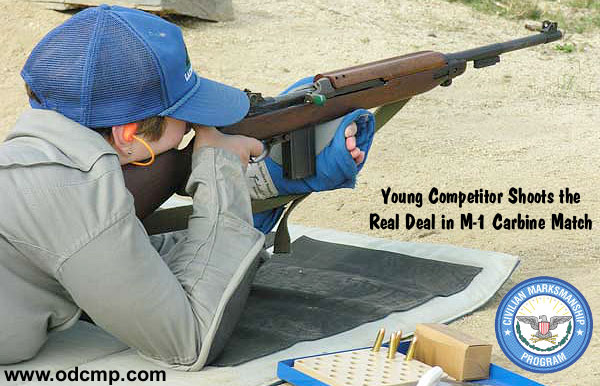
The CMP M1 Carbine Match is part of the CMP Games program that already includes Garand, Springfield and Vintage Military Rifle Matches. “As-issued” U. S. Military M1 Carbines are fired over a 45-shot course of fire at 100 yards on either the old military “A” target (or the SR target, if A targets prove to be too difficult to obtain). The course includes 5 sighters and 10 shots for record prone slow fire in 15 minutes, a 10-shot rapid fire prone series in 60 seconds, a 10-shot rapid fire sitting series in 60 seconds and 10 shots slow fire standing in 10 minutes. An M1 Carbine Match was fired during the National Matches in the early 1950s, and now is back. As a CMP Games event, it also can now be conducted as a CMP-sanctioned competition.

October 17th, 2014
This past week, the Western CMP Games have been underway in Phoenix, Arizona. (The Creedmoor Cup matches continue through Sunday, October 19.) The CMP has just released a large collection of photos from the 2014 Western Games. Here are some of our favorites. You’ll find over 1300 more images from this week’s activities online. CLICK HERE to view all the 2014 Western CMP Games photos, organized by day, October 10 through October 14.

M1 Carbine Match was very popular.

There was some shade for the Rimfire Sporter Match, at least during the prone stage.


Eye, Ear, and Cranial (Sun) Protection

Vintage Sniper Rifle Match competitors try to keep cool

A Small Arms Firing School (SAFS) was conducted on Friday, October 10.

Checking out the line-up of M1 Garands at the CMP Sales tent.

Two competitors sported vintage U.S. Marine Corps uniforms. Semper Fi!
 

DCM Emeritus Gary Anderson demonstrates use of sling in military rifle clinic.


October 16th, 2014
IBS Match Report by Jim Bauer
This year’s IBS 600-yard National Championship was held September 27-28 at the Memphis Sport Shooting Association (MSSA) range, a wonderful 185-acre shooting facility. The 600-yard Nationals event was well-attended with 70 shooters. This was tough field of talented trigger-pullers, including world record-holders and past 600-yard champions. One competitor commented, “You don’t have to make much of a mistake and you are in the middle of the pack. Make two mistakes and you are at the back.” This says a lot for the quality of shooters attending this year’s event.

To demonstrate the talent of the shooters, and the accuracy of their rifles, consider these numbers. During the event, the field of competitors shot a total of 1,128 targets. Amazingly, 210 targets, roughly one-fifth of the total, had 5-shot groups under 2.10 inches. And 62 were less than 1.5 inches. Eleven targets had 5-shot groups measuring under one inch! Yes, sub-inch at 600! The smallest group shot at the Nationals was a tiny 0.624″ by Ben Peters. Donna Matthews shot the best overall target of 0.859″ with a score of 50. Amazingly, Donna’s 0.859″/50 was just one of ninety (90) perfect, 50-point scores.

CLICK HERE for Complete Results from 2014 IBS 600-Yard Nationals
Scroll to Bottom of Document for Top 20 Equipment List
Astonishing Rifle Precision at 600 Yards
There were sixty-two groups under 1.5″ (i.e. sub-quarter MOA) shot during the IBS 600-yard Nationals. And there were eleven groups under 1 inch. (All groups are five shots.) What’s more, three shooters had 16-target Aggregates under 2 inches (i.e. under 1/3-MOA). That’s stunning — the level of precision in today’s 600-yard game is amazing.
Total Targets Shot – 1128
Sub-2″ Groups Fired – 210
Groups Fired Less than 1.500″ – 62
Sub-1″ Groups Fired – 11
Small Group – 0.624″ (Ben Peters)
Best Single Target – 0.859″/50 Score (Donna Matthews)
Perfect Scores of 50 – 90
These impressive numbers demonstrate how competitive the 600-yard game is these days, and how hard it is to win (even when Mother Nature cooperates).
Ryan Hunt Wins Championship in Tight Battle
When the smoke cleared, Ryan Hunt was the Two-Gun winner, earning the title of 2014 IBS 600-yard National Champion. Congrats to Ryan, who finally won the Championship after finishing near the top three years running. Closely following Ryan were Steve Wilson in second and Darrell Dacus in third. To prove how tough this year’s event was, consider this: Hunt’s 16-target Group Aggregate was a mere 1.8868″, while second place Steve Wilson had a 1.9524″, and third-place Darrell Dacus had a 1.9744″. Those three marksmen all shot stunning, sub-2″, 16-target Aggregates! And the difference between first and third place (with 16 targets shot over two days) was a mere 0.0876″. Think about that….

The top three shooters in Light Gun (LG) overall were Bo Wass, followed by Ryan Hunt and Steve Wilson. LG group winners were Ryan Hunt followed by Spencer Lamm and Johnny Powers. In LG score, Bo Wass was #1, followed by Justin Roberson and past champion Sam Hall. Heavy Gun Group was won by Steve Wilson with Ben Peters and Mike Moses in second and third. (NOTE: Bo Wass shot a standard 6mmBR, not a 6BR improved, showing the parent cartridge is still competitive at 600.)
The top three shooters in Heavy Gun (HG) overall were Darrell Dacus, followed by Steve Wilson and Ryan Hunt. (Note: Darrell shot a straight 6mmBR with Berger 105s, not a Dasher.) HG score was won by Jim Bauer followed by Andy Ferguson and Darrell Dacus. Top Youth shooter was Rory Jacobs (5th Place Heavy Gun Overall). Among the lady shooters, Sally Bauer took top honors, finishing in 7th place in the Two Gun Overall. Donna Matthews also shot well finishing with 5th place in Light Gun score. To see all the standings, with complete match results, visit the IBS Long Range Results webpage.

Equipment: 6mm Dasher and Vapor Trail Bullets Dominate Memphis Match
The 6 Dasher was definitely the dominant cartridge shot this year, with the original 6mmBR a distant second. In the action department BAT was a runaway first with only two other manufacturers being listed. Barrels were a little more evenly distributed. Krieger and Brux had 8 entries each and Bartlein with 3. Nightforce scopes were well represented with 16 out of the Top 20 shooters (Top 10 LG and Top 10 HG). March, Leupold, and Sightron filled out the rest of that list. Lapua made a clean sweep with no other brass manufacturer listed. To our surprise, ALL Top 20 shooters used CCI 450 primers. Varget was the powder of choice with LRM (Long Range Match pull-down), IMR 8208 XBR, and Norma 203B each being mentioned once. Notably, in the bullet category, there was a new “most popular projectile” this year. Vapor Trail bullets were used by 10 out of the Top 20 competitors with Berger coming in second with 7 of the Top 20. Spencer and Fireform bullets each had one Top 20 selection.
Great Conditions in Memphis
We had great weather conditions to shoot this year. Mornings had temps in the mid 50s with minimal wind to start. The mirage showed up later in the morning but didn’t seem to affect the competition. The three full relays enjoyed temperatures in the mid-80s with mostly sunny skies. The afternoons were relatively calm and sunny to finish the shooting day. On both days, shooting finished around 2:00 and the rest of the day’s events were completed by 4:00 to 5:00 pm, leaving plenty of time to get cleaned up to go out for the evening.

Praise for the Match Organizers
We have to give lots of credit to the Range Official Malcom Koleas and the target crews for their flawless and determined execution of Relay changes, along with providing, clear, repetitive directions to the shooters. All competitors could easily see the results of the many hours of hard work that went into making this match run so well. Many thanks to Mike Moses, David Dorris, and the rest of the crew that made this shoot so special.
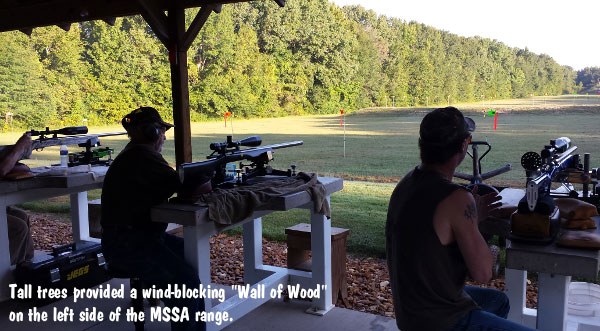
Thanks again to Memphis Sport Shooting Association and all other range owners for giving us a place to practice the shooting disciplines we enjoy. The MSSA range is open to their membership 7 days a week and can host almost every shooting discipline one can imagine. If you have get a chance, please take the time to visit this facility, a first rate club for sure.
October 12th, 2014
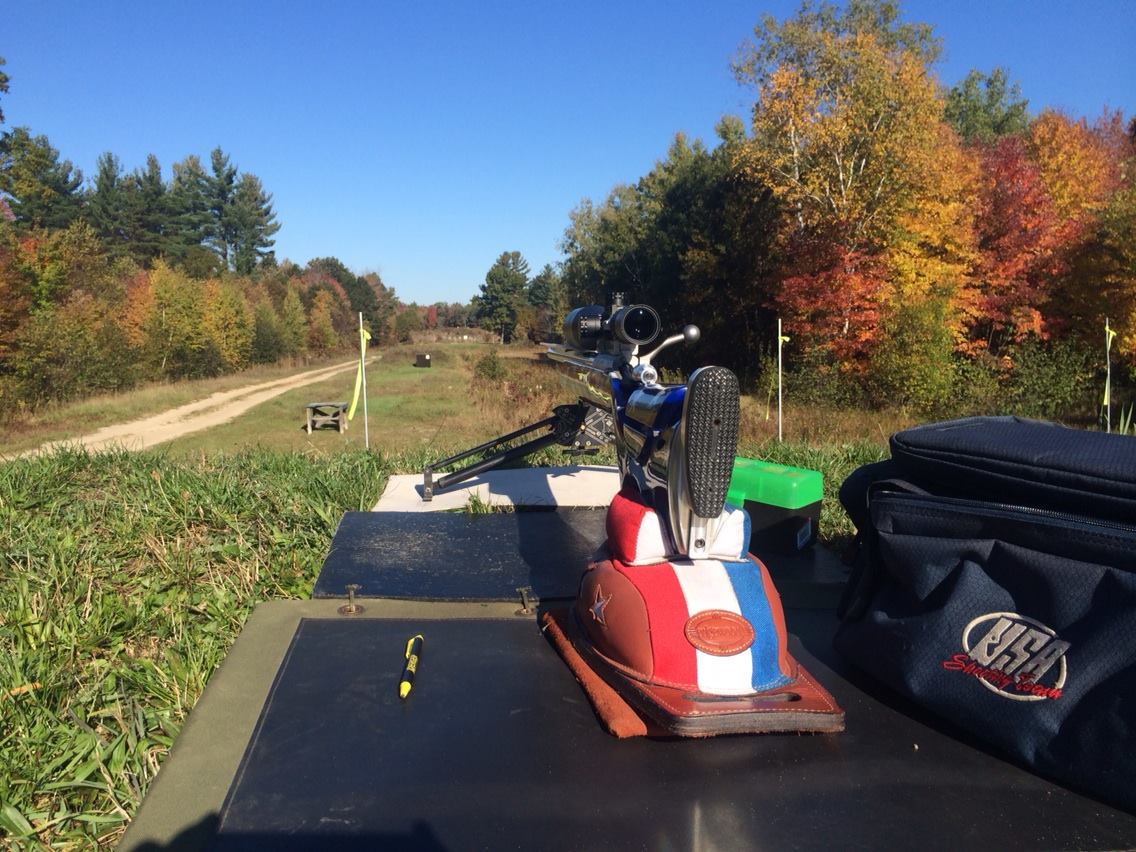
The USA F-Class National Championships will be held October 28 – November 2, 2014 in Phoenix, AZ. Many top competitors are out practicing, perfecting their technique and their loads. Here’s a photo from our friend Paul Phillips, a member of the World Championship F-TR Team USA. Paul enjoyed the colorful fall foliage at his Michigan home range: “It was a great day to practice for the Nationals. My load and rifle are shooting great. Now I need to load 300 rounds with my recipe.”
CLICK IMAGE for Desktop Wallpaper-Worthy Full-Screen Version

Under Two Inches at 500 Yards
To be competitive at the Nationals, one needs a tack-driving rifle and an ultra-accurate load. Shown below is one of Paul Phillips’s load development targets at 500 yards. The total 5-shot group size is under two inches. Impressive. That’s with 200gr Bergers, Varget powder, and large primer Lapua brass. Paul tell us: “At the upcoming Nationals we will be competing at 1000 yards. The X-Ring is 5 inches at 1000 (equivalent to 2.5 inches at 500). We strive to be all in the X-Ring. However, wind is the big obstacle. A gust of wind can move you 1-2 feet away.”

Paul Phillips at Raton in 2013

F-Class National Championship
The 2014 National F-Class Shooting Championship will be held in Phoenix, Arizona at the Ben Avery Shooting Facility. Preparations are well underway to host competitors from around the world. One of the largest events of its kind in USA, the NRA-sanctioned F-Class Nationals will be hosted by the Desert Sharpshooters Rifle Club.
CLICK HERE for 2014 F-Class Nationals Program and Entry Form.
The F-Class National Championship is a multi-day match with all shooting at 1000 yards. There will be a mix of individual and four-person team matches. The competition consists of two different Divisions: F- Open and F-TR (Target Rifle). Each Division is made up of five different Categories: High Master, Master, Expert, Sharpshooter and Marksman.
Entry Deadline: The deadline for entries is 6:00 PM Monday, 20 October 2014. Entries after this time are considered late entries and may be accepted to fill vacancies on existing relays only. An additional $20.00 will be charged for late entries, above the normal $200.00 Entry Fee.
October 12th, 2014
The Western CMP Games and Creedmoor Cup Matches are underway right now in Phoenix, at the Ben Avery Shooting Facility. One of yesterday’s match winners was Dennis DeMille, General Manager of Creedmoor Sports, and a past National High Power Rifle Champion (2005). In the Military Rifle Match, Dennis showed how it was done, firing a 286-9X, to win the match. Below, shooting his 7.62×51 M1A, Dennis demonstrates his flawless form in standing.


Other Western Games shooters offered these comments about Dennis DeMille:
“CWO DeMille was my former OIC at Edson Range. I was part of the MCRD Shooing Team when he was the OIC as well. This man is Marksmanship — a true Gun Slinger and good friend.” — K.S.
“I have shot along side him before. [Dennis] just plain rocks in Service Rifle.” — Mike M.
“Other than the additional grey hair, some things never change.” — Mark T. V.M.
“Except for that ‘7’, standing!”  — Emil P. — Emil P.
Match photos courtesy the Shooter’s Journal Facebook Group Page. File photo lower left courtesy First Shot Online Magazine.
October 8th, 2014

Forum member Rick Curtis, a shooter from the Phoenix area, put together an interesting video showing some of the F-Class shooters at a recent club match at the Ben Avery Shooting Facility. Rick notes: “As you can see (hear) at the beginning of the video the first relay was fired in a ‘frisky’ headwind.” (Don’t worry about the awful wind noise — it moderates 35 seconds into the video.) It is interesting to see the different shooting styles, and the wide variety of hardware on the line.
Watch F-Class Shooting Video from Ben Avery Range in Phoenix, AZ
One fellow who watched the video made an interesting comment: “A couple of those shooters sure do a lot of moving around before and after the shot. I shoot sling and jacket and definitely try to minimize my movement. Is minimizing movement as important in F-Class?”
Rick Curtis replied: “I sent some of the individual videos back to the shooters who were in them with some recommendations that included minimizing movement, spotting scope placement, shot routine suggestions and a few other observations.”
October 7th, 2014
The digital archives of Shooting Sports USA feature an interview with Olympic smallbore shooter Lones Wigger. This constitutes the third and final part in a series by Jock Elliott on pressure during a match and the methods top shooters use to handle their nerves. Read Part I | Read Part II.

The Fine Art of Not Cracking Under Pressure – Part III
by Lones Wigger, Smallbore Rifle Olympic Medalist
 It’s pretty complicated — this subject of dealing with pressure. I’m a precision shooter and have learned to excel in that discipline. You’ve got to learn to shoot the desired scores at home and in training. And once you’re capable of shooting the scores, you may not shoot the same way in the match because of the match pressure. As a result, it takes 3-4 years to learn how to shoot, and another 3-4 years to learn how to win — to deal with the match pressure. It takes several more years to learn how to do it when it counts. It’s pretty complicated — this subject of dealing with pressure. I’m a precision shooter and have learned to excel in that discipline. You’ve got to learn to shoot the desired scores at home and in training. And once you’re capable of shooting the scores, you may not shoot the same way in the match because of the match pressure. As a result, it takes 3-4 years to learn how to shoot, and another 3-4 years to learn how to win — to deal with the match pressure. It takes several more years to learn how to do it when it counts.
To win, there are several things you have to learn how to do. You have to do it from within. You have to learn how to train just as if you were in a big competition. You work on every shot. You have got to learn to treat it just like a match — to get the maximum value out of every shot. You have got to use the same technique in practice and in training. A lot of shooters have a problem because they change their technique from practice to the match. In competition, you work your ass off for every shot. You have to approach the training the same way.
A second way to combat pressure is to shoot in every competition you can get into so that you become accustomed to it.
Do Everything Possible to Prepare
The third technique is preparation. Before you are going to shoot in a big competition, train hard to do everything you can to raise your scores. So when you’re in the match, you know that you have done everything humanly possible to get ready for the competition. If you have self-doubt, you will not shoot well. You have to have the will to prepare to win.
When Gary Anderson was a kid, he couldn’t afford a gun or ammunition. He had read about the great Soviet shooters. With his single shot rifle, he would get into position, point that gun and dry fi re for hours at a time in the three different positions. He had tremendous desire. He wanted to win and he did whatever he could to get there. When he finally got into competition, he shot fantastic scores from the beginning.
Visualize Winning to Train the Subconscious Mind
A little bit of psychology: You picture in your mind what you want to do. You have to say, OK, I’m going to the Olympics and perform well. Picture yourself shooting a great score and how good it feels. You are training your subconscious mind. Once you get it trained, it takes over. A coach taught me to visualize the outcome, and it worked. Eventually you train your subconscious and it believes you can win. At first I didn’t know about teaching the subconscious to take over, but now I do it all the time. And it certainly worked for me at the 1972 Olympics. What it really takes is training and doing the same thing in training as at a match. If you are “just shooting,” you are wasting your time. READ MORE….
CLICK HERE to READ FULL ARTICLE featuring interviews with Brian Zins, Bruce Piatt, Carl Bernosky and Ernie Vande Zande. (Article take some time to load.)
Story courtesy The NRA Blog and Shooting Sports USA.
|