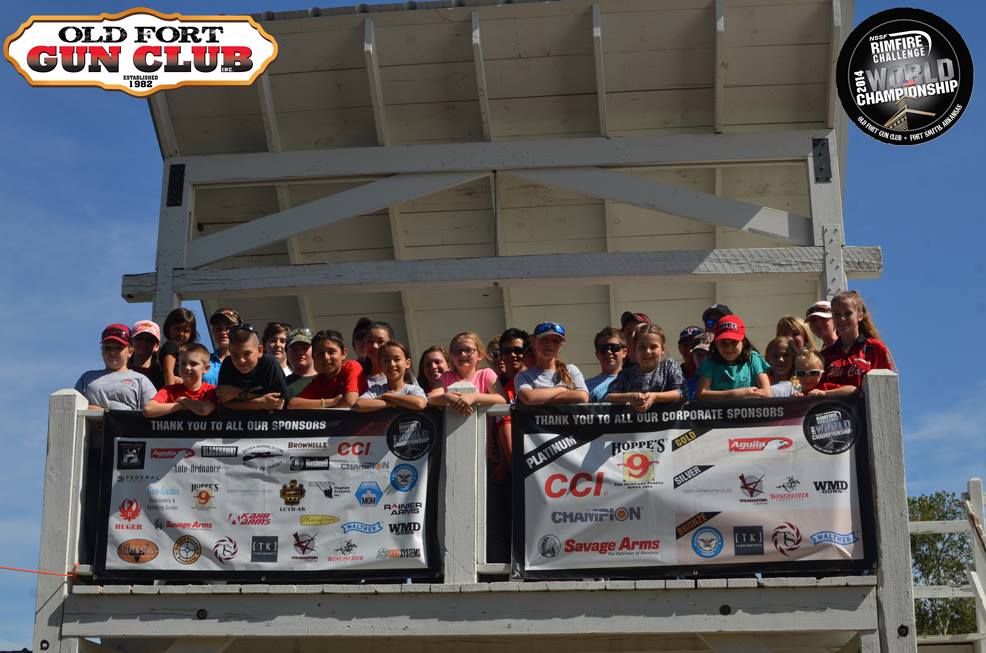
This is the kind of shooting match we like to see — with competitors of all ages having fun without having to shell out gobs of hard-earned money. More than 170 shooters competed at the NSSF Rimfire Challenge World Championship, held this past weekend (October 3-5) at the Old Fort Gun Club in Fort Smith, Arkansas. (Notably, that is ten more competitors than attended the much-ballyhooed Trijicon World Shooting Championships last month.) And, for many competitors, the Rimfire Challenge was very much a family affair — with mom, dad, and the kids all joining in the fun.
Kids Having Fun — Youth Competitors at NSSF Rimfire Challenge World Championship.
Rimfire Challenge attendance was up 60 percent this year compared to 2013. Shooters ranged in age from seven years to 83 years, with a big turn-out of junior (age 13-17) and youth (12 and under) shooters. “We are extremely pleased at the caliber of sportsmanship and camaraderie shown at Old Fort Gun Club this weekend,” said Zach Snow, NSSF Manager of Shooting Promotions. “Entire families traveled from all across the country to be here. It’s exactly this kind of supportive and family-friendly atmosphere that makes the Rimfire Challenge what it is: fun for everyone.”
B.J. Norris walked away with the top prize of World Champion. Shooting in the Open Division, Norris’ total time over the more than a dozen stages was 161.11 seconds. In second place overall was young Caleb Partch of Missouri. Caleb also won the Junior Open Division. Wayne Seale was the top Limited Division Shooter. Top Lady Shooters were Cassie Beahr of Iowa (Open) and Cheyenne Dalton (Limited and Junior). CLICK HERE for complete match results.
You’ve heard of “Adrenalin Junkies”? Well many readers of this website could rightly be called “Accuracy Junkies”. And for true accuracy junkies nothing can beat the “rush” you get with a rail gun. These heavy Unlimited rigs are the most accurate benchtop shooting machines ever created. Campaigned by ace competitors in the 100/200-yard benchrest game, rail guns are capable of delivering the ultimate in rifle accuracy — multiple groups in the zeros one after another.
RAIL GUNS GALORE — Video shows many current Rail Guns (Ocock Rail at 0:35 Mark):
Ultimate Benchrest Accuracy
How accurate can rail guns be? Hall-of-Fame shooter (and skilled gunsmith) Gary Ocock recently shot a terrific five-target Agg this past weekend in a match at Visalia, California. The range-measured Agg (average group size of all five targets) is an amazing 0.1088″, with four “zero” groups out of five. Though it won’t be submitted for a new record, this Agg is still a stunning demonstration of the accuracy these big rigs can deliver. The current NBRSA Unlimited 5-target, 100-yard Agg record is 0.1242 by Jerry Lahr. Congrats to Gary for a fine performance. The cartridge was a 6 PPC loaded with Gary’s own custom-made boat-tail bullets. The rifle is a modified Jay Young Rail, fitted with a 1:13.5″-twist Krieger barrel.
Gary’s rail gun features a round hole in the barrel block and a Delrin sleeve placed between block and barrel. The rail gun also has been modified to save weight for bench rotations. The lead photo (at top) is from an earlier match when Gary’s rail had a BAT action. Currently Gary is running a Marsh Saguaro action, shown in the photo below.
NOTE: Gary does not aim through two scopes at the same time, in binocular fashion. However, he does have a twin mount option so he can periodically check one scope against another, to ensure the scopes are holding point of aim. Gary tells us he normally just runs one scope. But at this match he wanted to ensure that his primary scope (the black Bausch & Lomb on left) was performing 100%. So he would cross-check it from time to time using the silver Weaver (on right). Gary notes that, unlike many rail gun shooters, he looks through his scope before each shot, and sometimes makes a very minor aiming correction using the rail controls. His scopes are boosted to very high power (55X), so even when the shots are falling in a tiny “bug-hole” cluster he can see if the last shot edged a bit left or right. He then adjusts aim accordingly.
Story and photos by Boyd Allen. We welcome reader submissions.
In these two videos from the Rekyyli Ja Riista (Recoil and Game) YouTube Channel, you can see how a modern, short-range benchrest rifle is shot. Note how the gun tracks superbly, returning right on target, shot after shot. As a result, the shooter doesn’t have to adjust the rifle position after firing (other than pushing the gun forward), so he can quickly load and fire within seconds of the previous shot. Good rests and consistent, smooth bolt actuation keep the gun from rocking.
It does take practice to perfect the right technique for shooting free recoil (or nearly free recoil — with just a pinch on the trigger guard). And, of course, you must have a very good bag/rest set-up and the stock geometry and rifle balance must be perfect. The ammo caddy also helps by placing the cartridge up high, right next to the left-aide loading port. Hats off to Forum member Boyd Allen for finding these videos. Boyd told us: “Watch carefully — Now this is how it’s done.” [Work Warning: Loud gunshot noises — Turn Down Volume before playback.]
We’re just a week away from the Western CMP Games and Creedmoor Cup. This big event will be held at the Ben Avery Shooting Facility in Phoenix, Arizona, on 10-19 October 2014. The Western CMP Games Matches run 10-14 October 2014. The Creedmoor Cup Matches take place on 15-19 October 2014. All interested shooters are invited to participate in these prestigious competitions.
If you are wondering what the fuss is all about, here’s a great Slide Show featuring images from the 2013 CMP Games and Creedmoor Cup. This slide show features photos by some of our Forum members. How many of your buddies do you recognize in the photos?
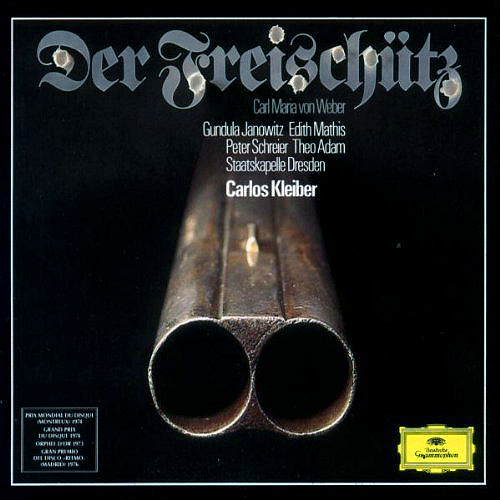
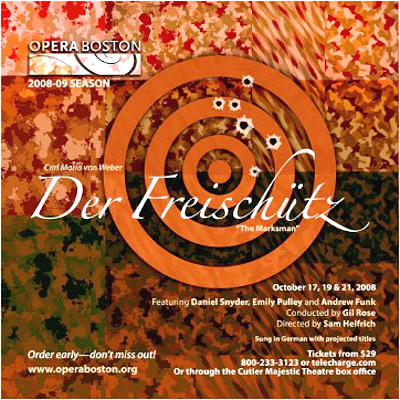
Not an opera fan? Well you should be. Here’s an interesting bit of trivia. Did you know that one of the most famous German operas is all about competitive rifle shooting? Believe it or not, the popular von Weber opera Der Freischütz (“The Marksman”), features shooting matches and precision bullet-making.
The opera’s story should “strike a chord” with our readers. In order to win an important shooting match, the hero, Max, casts seven “Magic Bullets”. He is lured into this occult reloading practice by a fellow shooter with a hidden, not-so-nice agenda. (Sound familiar you guys?) But what our hero Max doesn’t realize is that the devil is at work, and if Max uses the magic bullets at the big match he will forfeit his soul and suffer eternal damnation. Lesson to our readers — don’t try to win matches with Magic Bullets. CLICK HERE for the full story…
The overture and the Jägerchor (“Hunters’ Chorus”) from Act 3 of Der Freischütz are often performed as concert pieces. Listen to a stirring performance of the Jägerchor in the video below. This features full orchestra, mass male choir, and the ‘Jagdhornverein Edelweiss’ horns. You’ll enjoy it…
Jägerchor (Hunters’ Chorus) from Der Freischütz by Carl Maria von Weber
Andre Rieu with the ‘Jagdhornverein Edelweiss’ and the Männerchor ‘Maastrichter-Staar’.
Der Freischütz (usually translated as “The Marksman” or “The Freeshooter”) is an opera in three acts by Carl Maria von Weber, with libretto by Friedrich Kind. It premiered on 18 June 1821 at the Schauspielhaus, Berlin. It is considered the first important German Romantic opera. The plot is based on the German folk legend of the Freischütz and many of its tunes were inspired by German folk music. Despite its daring innovations, it quickly became an international success, with some 50 performances in the first 18 months after the premiere. Among the many artists influenced by Der Freischütz was a young Richard Wagner.
Jägerchor (Hunters’ Chorus) — full version with procession of ‘Jagdhornverein Edelweiss’ in Maastricht.
Top Der Freischutz illustration from a Gruselkabinette CD (Episode 15) sold byTitania Medien.
The 2014 IBS 600-Yard Benchrest Nationals will take place this upcoming weekend in Memphis, Tennessee at the Memphis Sport Shooting Assn. (MSSA) Range. The match runs Friday, September 26th through Saturday, September 27th. Set-up and practice sessions will be held on Wednesday and Thursday. The for-record matches will commence with the Light Gun division at 8:05 am on Friday. Heavy Gun matches will be held on Saturday.
IMPORTANT — You can still join in the fun. It’s not too late to register for this event. You can register at the range up to 6:00 pm on Thursday, September 25th. Mike Moses is the Match director. The MSSA Range is located about 25 miles northeast of Memphis, TN. Click here for directions and hotel links.
Light Gun Competition – Friday, Sept. 26th.
Sign in by 7:30 A.M. Firing will begin 8:05 A.M.
Relays will fire in sequential order #1, #2, #3 & #4.
Heavy Gun Competition – Saturday, Sept. 27th.
Sign in by 7:30 A.M. Firing will begin 8:05 A.M.
Relays will fire in the order of #3, #4, #1 & #2.
Practice and Set-Up Sessions:
Wednesday Sept. 24th – 12:00 Noon until 6:00 pm
Thursday, Sept. 25th – 8:05 am until 6:00 pm
Registration and Fees
The current Match Registration fee is $200. (This includes lunch for both days). Registration deadline is 6:00 pm, Thursday, September 25th.
If you will register on site, fees may be paid to Mike Moses (Match Director). The organizers say: “If a competitor is delayed en route and is not pre-registered, please let us know as early as possible! We’ll make every effort to allow a late entry.”
Mike Moses, Match Director
Phone: 901-493-1687
Email: ashlinmetalworks [at] bellsouth.net
4224 Coleman Rd.
Memphis, TN 38128
10-year-old Rory Jacobs competed at last year’s IBS 600-yard Nationals in St. Louis, Missouri.
Event tip by Samuel Hall. We welcome reader submissions.
Story based on report by Lars Dalseide forNRABlog
A strong argument can be made that Robert Vadasz is the greatest law enforcement pistol shooter of all time — in this galaxy or any other. This past week Border Patrolman Vadasz captured an unprecedented sixth NRA National Police Shooting Championship (NPSC). That’s five in a row for Robert, and six titles in the last seven years. How do you spell dominance? V-A-D-A-S-Z.
Robert Vadasz Blazes his Way to a Sixth NPSC Title.
This year Robert had to overcome a jammed pistol in one of his relays, but he still managed to shoot top score for the day and finished with the highest Grand Aggregate, 56 points ahead of the next-best competitor. The NPSC involves a variety of timed, action shooting events for revolvers, semi-automatic pistols, and police shotguns.
400+ Competitors at NPSC
The competition began on September 14th and wrapped up yesterday (the 18th) with the team championships. Shooters vying for the overall title take part in sixteen different individual matches in four separate categories: Open Class Revolver, Open Class Semi-Automatic Pistol, Individual Service Pistol, and Law Enforcement Shotgun. More than 400 law enforcement officers from across the globe gathered in Albuquerque, New Mexico to take part in the competition.
Vadasz shot well in all the different events. For example, in the Open Class Revolver Championship, Vadasz scored 1498 out of 1500 possible points, a near perfect performance. That score, along with his 1495 total from the Open Class Semi-Automatic Championship, gave the Border Patrol Agent another title — the Open Class 3000.
Report by Dick Grosbier for IBS
Over the weekend of September 13-14, 2014, the Ashe County Wildlife Club of Laurel Springs, North Carolina hosted the 44th annual IBS 100/200 Score Nationals. Sixty-two shooters were on the line for the event, including many record holders and major match winners.
The shooters traveled from as far away as Florida, Wisconsin, and Maine. Considering the miserable weather forecast for Saturday it was really a pretty nice day. We did have rain but thanks to the way the roof overhangs the firing line (photo below) the competitors stayed dry, only the target crew got wet. In spite of this they did an excellent job — they were fully prepared as the forecast was for a very high percentage chance of rain. Saturday got into the high 70s and actually got a little muggy. Sunday was overcast cooler and little if any rain fell.
This was my third visit to Ashe County this year and I must say it gets better each time. They have a great crew of people and a wonderful facility. There are 30 covered benches located next to a very large (40’x160’) reloading, scoring, dining, and clubhouse facility. The entire range is built on the side of a big hill. They have literally moved thousands of cubic yards of dirt (50,000+) to build this facility.
Breeden Busts Record — 1000-59X Two-Gun Total May Be Best Ever!
This year’s IBS Score Nationals saw a performance for the ages. Dean Breeden put together one of the most impressive feats of score shooting in history. Dean’s Two-Gun total score (for VFS and Hunter) was a stunning 1000-59X. This is a pending new Two-Gun IBS world record. Think about that — this means that Dean did not drop a single point through twenty (20) total matches (i.e. 20 targets), while alternating between two different rifles, one with a puny 6-power scope! That’s 100 “Tens” in a row on 100 Bullseyes, without fail. That’s really a remarkable achievement. As least Dean does not have to console the old record-holder, because the pre-existing record, 1000-52X, was set by (you guessed it), Mr. Dean Breeden. In besting his own record by seven Xs, Breeden won the Two-Gun award at this year’s IBS Score Nationals and earned a new entry in the record books. Congrats to Dean!
Bullet-maker Randy Robinett was amazed at Breeden’s 1000-59X performance. “Some years ago, I held the Two-Gun score record with a 999-52X. What Dean has accomplished with his 1000-59X is truly noteworthy — this really is a BIG deal. Let me tell you, getting 1000 points is really hard to do. You have to switch between two different rifles, and adjust from a high-power scope to a 6X scope, changing rests and equipment all the time. This is very tough.”
Looking at the Equipment List (Editor’s Comment)
The Equipment List from the 2014 IBS Score Nationals is quite revealing. As you’d expect, this match was very much a 30-caliber affair, but we were surprised to see such dominance by cut-rifled barrels, and Hodgdon H4198 powder.
1. All of the Top 15 VFS shooters ran cut-rifled barrels. There were mostly Bartleins and Kriegers, with two Brux barrels and one Rock Creek.
2. Hodgdon H4198 is definitely the powder of choice, used by 14 of the Top 20 VFS shooters. Federal 205M primers were used by at least 13 of the Top 20 shooters.
3. Randy Robinett’s BIB bullets were the most popular, used by four of the Top 10 shooters.
4. Every VFS shooter and every Hunter Class shooter was running a 30-caliber cartridge. Most VFS shooters ran 30BRs, but the 30×47 cartridge was favored by half the Hunter shooters.
5. Two gunsmiths smithed six of the Top 10 rifles. Three were by Mike Niblett and three were by Sid Goodling (who also smithed #11 and #12).
6. BAT Machine actions are still #1. BAT actions were used by 14 of the Top 20 shooters.
Mike Niblett (above) had a typical VFS rig: BAT action, Krieger cut-rifled barrel, with a Nightforce 12-42X scope. Mike used H4198 of course, but he shot Hill bullets in his 30BR, rather than BIBs.
Many 250s with 20 or more Xs Shot on Saturday
Saturday, at 100 yards, it was the Kevin and K.L. show. Kevin Donalds Sr. and K.L. Miller took the lead in Varmint For Score, and Hunter classes respectively all day long. Kevin turned in a fine score of 250-22X followed closely by Dean Breeden with 250-21X. Dean was just barely short of the win all weekend in both classes. Mike Niblett was third with 250-20X, ahead of five other 250-20X scores based on tie-breaker. There were four 19X and eight 18X scores. K.L. Miller turned in a fine 250-18x score in Hunter Class followed closely by Peter Hills and Frank McKee (both with 250-16Xs). It was moderately windy and switchy all day and since the Nationals involve shooting each record match from a different bench you essentially faced a new set of conditions each time you came to the line.
‘Top Guns’ at the Score Nationals: Kevin Donald Sr., K.L. Miller, and Dean Breeden.
Sunday it was overcast and cooler but not as rainy. Anthony Isner stepped up and took the lead in VFS class turning in a fine 250-16X score. Second place went to, you guessed it, Dean Breeden. Dean’s 250-15X was followed closely by Kevin Donalds Sr. also with 15X. In Hunter class it was Randy Jarvais’s turn to win an Aggregate. Randy’s 250-9X score beat out Dean’s 250-8X and Miller’s 250-7X scores.
In the VFS Grand Aggregate, Kevin Donalds Sr. topped the field with 500-37X, followed by Dean Breeden with 500-36X, and Anthony Isner with 500-34X. K.L. Miller won the Hunter Grand Agg handily — his 500-25X easily topped Dean’s 500-23X and Randy’s 500-20X totals. The IBS 2-Gun award went to Dean Breeden with a record score of 1000-59X. This is a potential new 2-Gun record as he bested his own record by seven Xs.
Praise for the Match Organizers and Staff
All in all it was a very well run match at a great new facility. This was the first Nationals event to be held there but it will not be the last. Hats off to E.T. Weaver and his helpers. The target crew deserves special mention. They were very good and very fast. A match with full bench rotation can be a nightmare for any target crew but these guys handled it like old pros even though it was their first-ever attempt. Well done guys and gals!
The Ashe County Wildlife Club put on a great event, complete with delicious country Barbecue.
Report by Vince Bottomley
For this year, the European F-Class Championships moved from its traditional November date to mid-September. England can be smitten with some dreadful weather in November and previous Championships have suffered everything from rain and mist, to sub-zero temperatures. It proved to be a wise decision and competitors enjoyed balmy, sunny weather for the whole week, with matches on September 12-14, 2014. The event was well attended with 206 individual entries and over 20 teams. With competitors from a dozen nations, this is one of the biggest F-Class events in the world.
Congratulations to Scotland’s Des Parr, the new F-Open champion (on V-count over James Finn), and congrats to Giulio Arrigucci of Italy, who won the F-TR title. Both Parr and Finn dropped only five points over the entire two-day individual competition. For more information (and full listing of match results) visit www.GBFclass.co.uk.
F-Open Individual Results
F-TR Individual Results
1. Des Parr (Scotland): 470.48V (possible 475)
2. James Finn (Ireland): 470.41V
3. Marco Been (Holland): 467.49V
4. Mik Maksimovic (GB): 465.38V
5. Daniel McKenna (Ireland): 464.40V
6. Dave Lloyd (GB): 463.36V
1. Giulio Arrigucci (Italy): 455.30V
2. Francisco Franco Mosquera (Spain): 454.30V
3. Sergii Gorbon (Ukraine): 452.36V
4. Tom Bond (GB): 449.29V
5. Valentin Pomomarenko (Ukraine): 449.29V
6. Russell Simmonds (GB): 449.29V
Over the past few years, numbers have increased steadily and this year, over 200 shooters assembled on Bisley’s famous Stickledown range on the Friday morning for the first of two days of individual competition, followed by Team Matches on the Sunday. The four days preceding the Championships were available for practice and informal competitions.
With near-perfect conditions for the first 800-yard stage, some excellent scores were recorded. Scotsman Paul Crosbie’s F-TR score of 75.12V not only took the stage win but also set a new GB record and equaled the top F-Open score (by Italian Gian Antonio Quaglino). Maximums were also recorded at 900 yards by both classes but at 1000 yards, Scotsman Des Parr’s 74.11V was a clear winner, with Italy’s Andrea Ceron’s recording a 72.6V in F-TR.
The Famous Stickledown Range at Bisley
At the end of Day One, Des Parr was leading Open Class by a single point and Spain’s Francisco Franco Mosquera had a two point lead in F-TR. The following day, competitors tackled the same course of fire to decide the title of European Champion.
Although a little overcast for the start of Day Two, the sun soon broke through and the fact that the top 36 Open shooters didn’t drop a single point at 800 yards gives an indication of conditions. Even the top 15 F-TR shooters ‘cleaned’ the target but, some relays experienced less favorable conditions.
At 900 yards, again the top nine Open competitors shot ‘possibles’ but, in F-TR, Ukraine’s Sergii Gorban’s excellent 74.9V was the top score. For the final 1000-yard shoot – a 2 and 20 this time, Ireland’s Kevin Clancy’s 95.5V was a great F-TR score but Dave Lloyd’s winning Open score of 99.6V was absolutely stunning.
In the end, Scotland’s Des Parr and Ireland’s James Finn tied on points with 470 of 475 possible, but Parr took the 2014 European F-Open title based on V-bull count: 48 for Parr vs. 41 for Finn. Italy’s Giulio Arrigucci won the F-TR Championship by one point over Francisco Franco Mosquera.
We were delighted to have American shooter Francis ‘Biff’ Conlon join us – shooting a borrowed rifle in F-TR (second from left in the above photograph). Biff shot as part of one of the F-TR Teams in the pre-Championship competitions and picked up a gold medal – note the unusual trophy! Maybe a few more Americans might think it worthwhile making the trip to shoot in next year’s Europeans.
TEAM Matches
The Championships end with the Teams Matches on the Sunday. These matches are for eight-man teams so, not all countries are able to field a team but four Open Teams and five FTR teams were fielded. Ranges are 900 and 1000 yards with 15 shots at each distance. Wind coaches are permitted.
Report from David Lloyd, current Great Britain F-Open Team Captain
I’ve just got back from the F-Class European Championships. The minor 4-man teams match was held last Thursday afternoon and was shot over 1000 yards with 2 + 20 to count. I was part of the victorious Team March (388.26V). In second place was the Midland Precision Guns Team with 383.26V.
The conditions were good and the level of competition was very high. Team March was captained by Gary Costello the UK and European importer of March scopes. The coach was Tony Marsh and he did a superb job of coaching the team to victory (he coached me to a score of 100-6Vs). The shooters were: Gary Costello, David Lloyd, Ian Boxall, Darren Stewart. Peter Walker was reserve shooter and register keeper.
Daniel Horner of the USAMU has been crowned the World Shooting Champion, and he has a $50,000 check to prove it. In the first running of the Trijicon World Shooting Championship (TWSC), 159 of the world’s top shooters competed in a grueling 4-day, multi-discipline event. To do well at the TWSC you had to be an expert with rifle, shotgun, and pistol — and you couldn’t have any real weaknesses. You needed mastery of speed pistol, trap shooting, long-range rifle shooting, cowboy action disciplines, “run and gun”, and defensive action scenarios.
SSG Daniel Horner (File photo — not from TWSC)
Horner topped the field with 966.856 points. In second place was Bianchi Cup Ace Bruce Piatt with 924.895. The legendary Jerry Miculek took third with 870.153. Jerry’s performance gave hope for us old guys. There must also be something about Miculek DNA — Jerry’s daughter Lena was the top female competitor, finishing 28th overall. We also want to acknowledge young Brian Nelson who, competing as a Junior, finished fourth overall, a great accomplishment. Other than Nelson, most of the top finishers are professional 3-Gun competitors. These folks know how to put rounds on target quickly and transition smoothly from one firearm to the next.
For four days, the shooters competed in twelve equally-weighted disciplines from various shooting sports. The match combines pistol shooting (action and bullseye), rifle shooting (action, smallbore, high-power, and F-Class), and Shotgun (Sporting Clays/trap/tactical). All firearms and ammunition were provided for each event.
Horner won the big prize through consistency. Out of the 12 shooting events, he finished in the top 10 in all but two. Writing in the Shooting Wire, Jim Shepherd reports: “Horner took outright stage wins in the Wobble Trap Doubles (100%) and NRA Action Rifle (100%) and used them to overcome his two worst scores, a 28th-place finish in F-Class rifle and a 13th-place in .22 rifle. For his achievement, Horner wins the $50,000 prize, and the dubious honor of now knowing that every competition shooter in the world has him solidly in their sights now, not just the 3-gun shooters he regularly tests … and bests.”
Big Cash Awards and Unrivaled Prize Table
Competitors came to the Peacemaker National Training Center in Glengary, WV for a chance to be crowned the “World Shooting Champion” and receive a $50,000 first place cash prize. This match carried “multi-gun” competition to a whole new level, with BIG MONEY at stake:. There were cash payouts for most stages and over $150,000 worth of hardware on the prize table.
First Place Overall: $50,000
Lady Champion: $5,000
Pistol Segment Winner: $5,000
Rifle Segment Winner: $5,000
Shotgun Segment Winner: $5,000
Second Place Overall: $3,000
Third Place Overall: $2,000
Fourth Place Overall: $1,000
Stage Winner $2,000
Side Match Winner: $1,000
Meanwhile, in Spain — the ISSF World Shooting Championships
The next TWSC will be held October 15-17, 2015. This inaugural event went well, and it will surely grow in prestige as time passes. However, we do question the notion that this was truly a “World Championship”. The TWSC took place in West Virginia at the same time that the ISSF World Championships were being held in Granada, Spain. That means that virtually none of the world’s top shotgun aces or top prone/3P rifle shooters attended the TWSC — they were in Spain instead. Over 2000 shooters are competing at the 2014 ISSF World Championships, including hundreds of Olympians. The TWSC had less than 200 competitors, and few Olympians. TWSC was, then, more realistically, a North American Multi-Gun Championship. Let’s hope that, in the years to come, the TWSC will attract more foreign-born competitors. That way it can properly be called a “World Shooting Championship”.




 Ultimate Benchrest Accuracy

 In these two videos from the
  We’re just a week away from the Western CMP Games and Creedmoor Cup. This big event will be held at the Ben Avery Shooting Facility in Phoenix, Arizona, on 10-19 October 2014. The Western CMP Games Matches run 10-14 October 2014. The Creedmoor Cup Matches take place on 15-19 October 2014. All interested shooters are invited to participate in these prestigious competitions.

 Der Freischütz (usually translated as “The Marksman” or “The Freeshooter”) is an opera in three acts by Carl Maria von Weber, with libretto by Friedrich Kind. It premiered on 18 June 1821 at the Schauspielhaus, Berlin. It is considered the first important German Romantic opera. The plot is based on the German folk legend of the Freischütz and many of its tunes were inspired by German folk music. Despite its daring innovations, it quickly became an international success, with some 50 performances in the first 18 months after the premiere. Among the many artists influenced by Der Freischütz was a young Richard Wagner.



 IBS 600-YARD NATIONALS – 2014

 400+ Competitors at NPSC


 At 900 yards, again the top nine Open competitors shot ‘possibles’ but, in F-TR, Ukraine’s Sergii Gorban’s excellent 74.9V was the top score. For the final 1000-yard shoot – a 2 and 20 this time, Ireland’s Kevin Clancy’s 95.5V was a great F-TR score but Dave Lloyd’s winning Open score of 99.6V was absolutely stunning.


