|
|
March 6th, 2014

Here’s a handy training option for F-Class shooters. Forum member SleepyGator is an F-Class competitor, but it’s not convenient for him to shoot at long ranges close to home. Accordingly, he wanted some “reduced-distance” targets he could use at 300 yards for practice. There is an official reduced-distanced standard for 300-yard F-Class matches. This utilizes the NRA No. MR-63FC – F-Class Target Center which is pasted over the MR-63 target. It provides a 1.42″ X-Ring, 2.85″ 10-Ring, and 5.85″ Nine-Ring. (The dimensions of F-Class targets are found in the NRA High Power Rules, Sec. 22, part 4, page 70 — see sample below.)

CLICK HERE to Download F-Class 300-yard Target Centers (.Zip archive with three targets)
To duplicate the 300-yard target, SleepyGator has prepared a printable version of the MR-63FC Target Center, along with a pair of training targets with two bulls and five bulls. The two-bull and five-bull targets mirror the scoring rings on the MR-63FC, but they display only the innermost three rings and two rings respectively. All three targets are Adobe Acrobat files that can be easily printed. You may need to adjust the scale (sizing) on your printer to get the dimensions exactly correct. As noted above, when printed, the 10-Ring on all three targets should measure 2.85″. This should provide some handy practice targets you can use between matches. Thanks to SleepyGator for providing these targets. You can download all three as a .Zip archive. After downloading the .Zip file, just click on the .Zip archive to extract the individual targets.
CLICK HERE to Download NRA High Power Rules with F-Class Target Dimensions

February 23rd, 2014

Larry Bartholome (aka “LBart” on our Forum) is the current F-Open USA National Champion. He also won the F-Open division at the recent Berger Southwest Nationals. A “Senior Citizen” now, Larry is still at the top of the F-Class game. If you were to pick the top ten F-Open shooters on the planet, Larry would be on the short list, that’s for sure.
In a recent AccurateShooter Forum thread, there was a discussion of caliber/cartridge choice for F-Open shooting — specifically whether 6mm cartridges can be competitive at long-range (as opposed to mid-range).
Larry, who currently shoots a 7mm-270 WSM, offered some wise words. Here’s some sage advice from Larry, a champion who has triumphed at the highest level, against the toughest competition. F-Class competitors will benefit from reading what Larry has to say, and taking it to heart:
Cartridge Choice for F-Class — What Really Matters
Matches are won with what people decide to shoot. The people win matches, not the calibers. A person makes his decision on what he is going to shoot with and [that person] wins or loses based on the decision.
The smaller cases and bore sizes have advantages in less recoil and more inherent accuracy. They are easier to shoot well. Because they shoot smaller groups on average they make the 10 ring seem bigger. With light winds that helps.
When the wind gets to changing and picking up this advantage is negated by the wind drift advantages of the larger calibers. Once the switches and velocity changes get beyond the mind’s ability to stay up with them, the small caliber advantage is minuscule.
My own thought is I need all the help I can get. I know I can’t read the wind. I play the percentages. [My 7mm offers] good grouping, good wind drift, lower recoil than the 30s. My 7mm/270 WSM was shooting very well in Phoenix, just as the other Bartlein barrels shot well in Raton. The points lost were mine, not the rifle’s or the caliber.
When the wind flags and mirage are telling you to hold left and your bullets are going left, no caliber in the world will help you. You are the one steering those bullets.
Larry Bartholome
Team Berger/Norma

February 21st, 2014
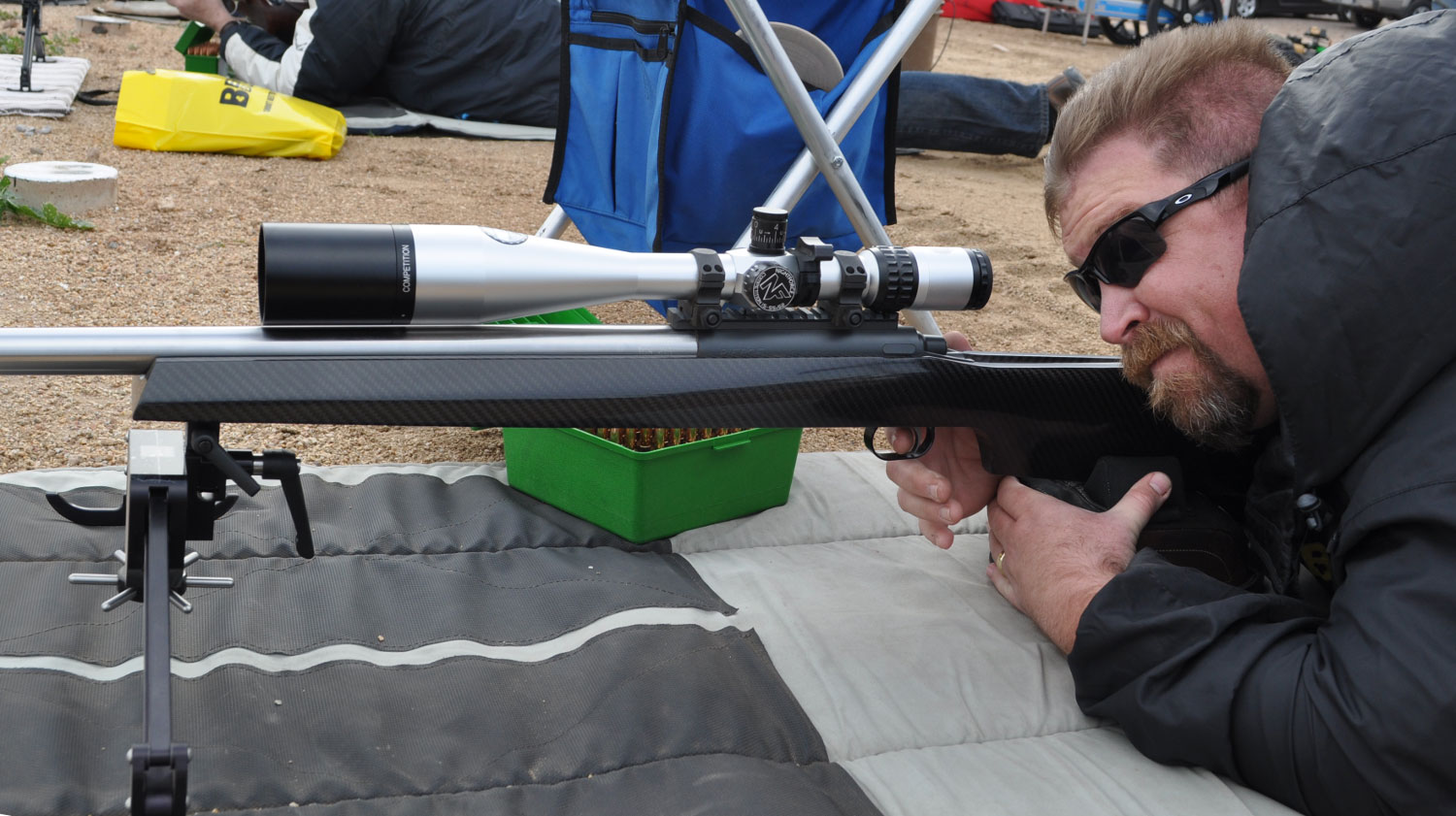
Most F-TR rifles are essentially prone rifles adapted for use with bipod and rear bags. They feature prone or tactical-style stocks designed to allow a firm grip on the gun, with cheek, hand, and shoulder contact. This has worked very well. Unquestionably, a skilled F-TR shooter can achieve outstanding scores with such a configuration — it works. However, “there’s more than one way to skin a cat”.
At the Berger Southwest Nationals, Eric Stecker introduced a new type of rifle, and a new type of gun-handling, to the F-TR ranks. Shooting “free-recoil” style* (i.e. with virtually no contact on his rifle) Eric managed to finished second overall in F-TR (with the highest X-count), beating some past national champions in the process. Thinking “outside the box” worked for Stecker in Phoenix. The success of Eric’s benchrest-style rifle and shooting technique definitely drew the attention of other F-TR shooters.
Click photo to zoom

|
VOICE FILE: Eric Stecker Talks About the SWN and his Radical F-TR Rifle. |
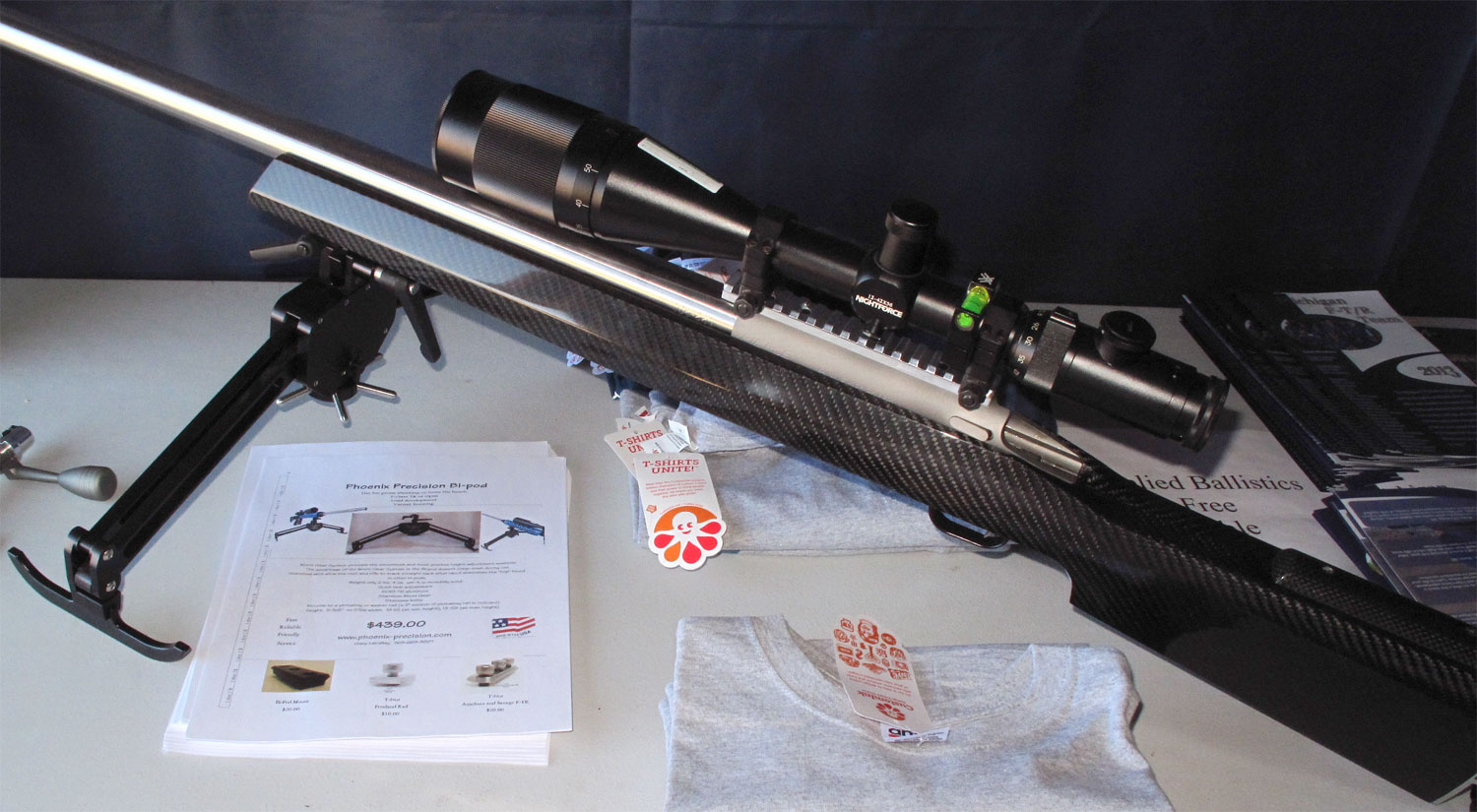
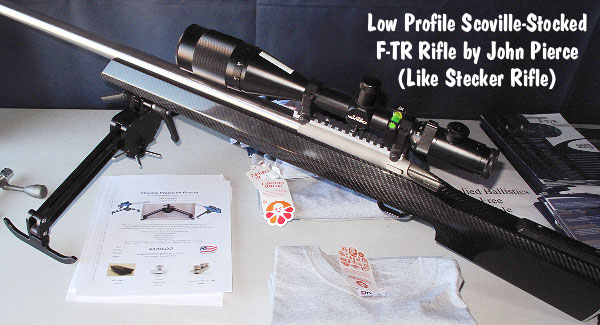
Eric’s F-TR rig was built by John Pierce using a stiff, light Scoville carbon-fiber stock. The stock is so light that Eric’s rifle came in 1.5 pounds under the F-TR maximum weight limit (8.25kg or 18.18 pounds). The gun features a Pierce action, Bartlein barrel, Jewell trigger, and a Gen 1 Nightforce 15-55X52mm Comp scope. From the get-go, Eric’s strategy was to “aim small” and shoot his rig like a bench-gun. He actually focused on shooting really small groups rather that just trying to keep shots within scoring rings and “hold waterline”. With a .308 Win that could shoot bugholes at 100 yards, this strategy paid off.
 Rifle builder John Pierce explains the thinking behind this rifle: “The stock choice was mine — I had built two prototype rifles last year based on the premise that the game is Benchrest in the prone position. I still feel very strongly regarding [this concept]. I chose Bob Scoville for obvious reasons — he is an artisan and his stocks have won so much, they just flat work. We built Eric the latest configuration along these lines, and the tool worked for him. Without a doubt, Eric is a shooter, and we were all pleased to watch him perform so well.” Rifle builder John Pierce explains the thinking behind this rifle: “The stock choice was mine — I had built two prototype rifles last year based on the premise that the game is Benchrest in the prone position. I still feel very strongly regarding [this concept]. I chose Bob Scoville for obvious reasons — he is an artisan and his stocks have won so much, they just flat work. We built Eric the latest configuration along these lines, and the tool worked for him. Without a doubt, Eric is a shooter, and we were all pleased to watch him perform so well.”
Eric sets up rifle before match. During live fire his hands do not contact the stock.

Eric employed a benchrest-style shooting technique with his F-TR rig — he shot pretty much free recoil, with no cheek pressure, no hand contact, and just a “whisper” of shoulder contact. Eric explains: “I shoot what’s called ‘free recoil’. Now the rifle is butted up against my shoulder very lightly, but no other part of my body touches the rifle except for my finger on the trigger.” Eric has even used this technique when shooting a 7mm cartridge in F-Open at other matches: “Someone suggested that this style wasn’t possible with the larger [7mm] cartridges, but I found it very successful so I continue to do it that way.”
|
VOICE FILE: Eric Stecker Talks About Shooting F-TR with Benchrest Technique. |
Eric also employed an unconventional strategy — he was focused on shooting small groups (not just holding ring values): “Since I have started shooting F-Class, I treat [the target] like a benchrest target. What I mean by that is that I regard the center as my first shot, and so my objective is to create the smallest group. So, I will hold whatever… is required to end up with the bullet ending up in the center — that’s probably true of any F-Class shooter, but I guess the perspective’s a little different when you have a benchrest background.” Eric explained that “maybe I aim a little smaller than others might”, because in the benchrest game, “the slightest miss ends up costing you quite dearly”.
Click to Zoom Photo (This is not Eric Stecker’s rifle, but a “sistership” built by John Pierce.)
Eric Talks about F-TR Trends
Will other F-TR shooters build rifles suited for free-recoil-style shooting? Eric isn’t sure: “I don’t know if this type of rifle is the future of F-TR. I shoot a lot of benchrest, so putting those kinds of components into an F-TR gun made a lot of sense to me. One thing I like about F-TR is that there are a lot of different types of approaches being tried and some of them are successful. So I think it’s still pretty wide-open[.] But I think the really great part of what we found at the Southwest Nationals is that shooting [with] a benchrest-style approach certainly doesn’t hurt you. What I mean by that is … aiming small, trying to make the group as tight as possible rather than trying to hit a particular area. I actually tried to shoot tight groups — that was a focus and that worked for me — I had quite a high X-Count.” NOTE: Eric finished with 51 Xs, 14 more than F-TR Grand Agg winner Radoslaw Czupryna (37X). James Crofts had the second highest X-Count with 48 Xs.
Even Berger’s Boss did pit duty at the Berger SW Nationals.

*”Free Recoil” style shooting has its variations. Some would say “pure free recoil” would not even allow shoulder contact. Eric Stecker lightly touches the back of the stock with his shoulder.
February 19th, 2014
The 2014 National Matches Program Calendar has just been released. CLICK HERE for Calendar PDF.

The National Matches were first held in 1903, moved to Camp Perry, Ohio, in 1907 and continue to take place every summer at Camp Perry. The National Matches have become a huge, national shooting sports festival with well over 6,000 annual participants.

The National Matches include the CMP National Trophy Rifle and Pistol Matches, the Pistol and Rifle Small Arms Firing Schools, CMP Games rifle events, and the NRA National Pistol Championships, High Power Rifle Championships, Long Range High Power Championships, and Smallbore Championships. NOTE: For the next two (2) years, the Smallbore Championships will be held at the Chief Wa-Ke-De Range in Bristol, Indiana instead of Camp Perry, Ohio.
February 17th, 2014
 Online registration is officially open for the 2014 NRA National Matches. Each summer, at the NRA National Rifle & Pistol Championships, the nation’s finest civilian and military marksmen and women square off for weeks of rifle and handgun competition. From pistol, to smallbore rifle, high power rifle, and long range high power rifle (including F-Class), the national matches have something for just about every serious shooter. Online registration is officially open for the 2014 NRA National Matches. Each summer, at the NRA National Rifle & Pistol Championships, the nation’s finest civilian and military marksmen and women square off for weeks of rifle and handgun competition. From pistol, to smallbore rifle, high power rifle, and long range high power rifle (including F-Class), the national matches have something for just about every serious shooter.
As usual, the pistol, High Power, and High Power Long Range Championships will be held at Camp Perry, Ohio, on the shores of Lake Erie. However, for 2014 and 2015, the NRA National Smallbore Position Championships and Smallbore Prone Championships will be held at the Chief Wa-Ke-De Range in Bristol, Indiana, this year and next. The smallbore championship venue is being shifted to accommodate the 2015 World Palma Rifle Championships at Camp Perry. (The World Palma teams will arrive this summer to do a practice run for next year.)
Head on over to the Camp Perry Sign-up Page and get started on this year’s application.

NRA Also Seeks Target Pullers for Nat’l Matches — $75/day plus housing
The NRA is seeking experienced persons to pull targets during the 2014 National Fullbore Championships, August 4 – 10, 2014, at Camp Perry, Ohio. Accepted applicants will receive a $75 per day pay rate and free housing. Candidates must have 2+ years of target pulling of high-power scoring experience to apply. Interested parties should apply before the May 1, 2014 deadline using the form linked below. For more information, email comphelp @ nrahq.org.
CLICK HERE for Target Puller Job Application (PDF).
February 17th, 2014
Gene F. (aka “TenRing” in our Forum), provides this basic intro to Groundhog matches, East-Coast style.
 Groundhog Matches Are Growing in Popularity Groundhog Matches Are Growing in Popularity
Though Groundhog matches are very popular in many parts of the country, particularly on the east coast, I’ve found that many otherwise knowledgeable “gun guys” don’t know much about this form of competition. A few weeks ago, I ordered custom bullets from a small Midwest bullet-maker. He asked what type of competition the bullets would be used for, and I told him “groundhog shoots”. He had not heard of these. It occurs to me that perhaps many others are unfamiliar with this discipline.
Groundhog matches have grown rapidly in popularity. There are numerous clubs hosting them in Pennsylvania, Maryland, and Delaware, as well as other venues. They are usually open to the public. Most Eastern clubs have five to twenty cement benches, and overhead roofs. At this time, there is no central source for match schedules. If you’re interested in going to a groundhog match, post a query in the AccurateShooter Forum Competition Section, and you should get some info on nearby opportunities.

How Matches Are Run — Course of Fire and Scoring
Unlike NRA High Power Matches, there is no nationwide set of standard rules for Groundhog matches. Each club has their own rules, but the basics are pretty similar from club to club. Paper groundhog targets are set at multiple distances. There are normally three yardages in the match. Some clubs place targets at 100, 200, and 300 yards. Other clubs set them at 200, 300, or 400 yards. At my club in Shippensburg, PA, our targets are placed at 200, 300 and 500 meters.
The goal is to score the highest total. The paper targets have concentric scoring rings. The smallest ring is normally worth ten points while the large ring is worth five points. The course of fire varies among the various clubs. Most clubs allow unlimited sighters and five shots on the record target in a given time period. Only those five shots on the scoring rings are counted, so that with three yardages, a perfect score would be 150 points. Tie breakers may be determined by total number of dead center or “X” strikes; or, by smallest group at the farthest distance.

Types of Rifles Used at Groundhog Matches
The same benchrest rigs found at IBS and NBRSA matches can be utilized (though these will typically be put in a ‘custom’ class). Though equipment classes vary from club to club, it is common to separate the hardware into four or five classes. Typical firearm classes can include: factory rifle; deer hunter; light varmint custom (usually a limit of 17 lbs.with scope); and heavy varmint custom (weight unlimited). Some clubs allow barrel tuners, others do not. Scope selection is usually unlimited; however, some restrict hunter class rifle scopes to 20 power. Factory rifles usually cannot be altered in any way.
Good, Simple Fun Shooting — Why Groundhog Shoots Are Popular
Forum member Danny Reever explains the appeal of groundhog matches: “We don’t have a governing organization, or have to pay $50 a year membership just to compete in matches. Sure the rules vary from club to club, but you adapt. If you don’t like one club’s rules, you just don’t shoot there. It’s no big deal.
There are no National records, or Hall of Fame points — just individual range records. If you want to shoot in BIG matches (with big prizes), there is the Hickory Ground Hog Shoot among others. If competition isn’t your bag, many clubs offer mid-week fun matches that you can shoot just for fun. You shoot the same targets but with a more relaxed atmosphere with no time limits.
The best part is you don’t have to shoot perfect at every yardage. You always have a chance because in this sport it really isn’t over until the last shot is fired. Typically ALL the entry money goes to the host club, with much of the cash returned back to the shooters via prizes. Junior shooters often shoot for free, or at a reduced rate. The low entry cost also encourages young guys to get involved who don’t have $4000 custom rifles or the money to buy them.
There isn’t a sea of wind flags to shoot over or to put up and take down. If the range has a couple of flags so much the better, but after all it is a varmint match. No pits to spot shots and slow things down either. If you can’t see your hits through your rifle scope or spotting scope well you are in the same boat as everybody else. That’s what makes it interesting/ sometimes frustrating!
February 16th, 2014
 If you want to learn how to shoot accurately at very long range, one of the very best places to learn is the Williamsport 1000-Yard Benchrest School. The 7th Annual Benchrest School will be held Friday June 6 through Sunday June 8, 2014. Classes, taught by top 1K shooters, are held at the Original Pennsylvania 1000-Yard Benchrest Club Range, one of the best 1K ranges in the country. View the range on the Williamsport website, PA1000yard.com. If you want to learn how to shoot accurately at very long range, one of the very best places to learn is the Williamsport 1000-Yard Benchrest School. The 7th Annual Benchrest School will be held Friday June 6 through Sunday June 8, 2014. Classes, taught by top 1K shooters, are held at the Original Pennsylvania 1000-Yard Benchrest Club Range, one of the best 1K ranges in the country. View the range on the Williamsport website, PA1000yard.com.
Prospective students will be taught all aspects of long-range benchrest shooting by highly skilled instructors. All areas are covered: load development, precision reloading, bench skills, and target analysis. Much time is spent at the loading bench and on the firing line. And you don’t even need guns and ammo — all equipment and ammunition will be provided. For $300 students will enjoy 1 night and 2 days of intensive training under the guidance of some of our top 1000-yard shooters. The sign-up deadline is June 1st. To reserve a spot or get more info, email School Director/Vice President Ryan Miller: ryanmiller @ htva.net.

School Schedule, Friday Through Sunday
On Friday night (June 6th), students will meet their mentors. Saturday (June 7th), the class moves to the range for a full day of hands-on technical training. Topics will include precision reloading, load development, gun handling, use of chronograph, analysis of shooting results, gun cleaning, and target analysis. The club will provide the rifles and all reloading components. Saturday’s training sessions are followed by a steak dinner which is included in the $300 seminar price.
On Sunday (June 8th), after an early training session covering bench set-up and match strategies, students will participate in a 1000-yard match, spending time both behind the trigger and in the pits. Instructors will explain how to read conditions, and will demonstrate target measuring and analysis after the relays. The program wraps up by 4:00 pm on Sunday.
To see what the 1K Benchrest school is like, watch the slide show/video below, produced by Sebastian Reist, an alumnus of the 2009 Williamsport 1000-yard BR school. Sebastian, a talented professional photographer, captured the highlights of his Williamsport 1K training weekend:
Please enable Javascript and Flash to view this VideoPress video.
Story Tip from EdLongrange. We welcome reader submissions.
February 14th, 2014
 If you’ve been following the Winter Olympics in Sochi, no doubt you’ve been watching Biathlon events. This combination of Nordic-style skiing and precision shooting is hugely popular in Europe. Biathlon requires great physical fitness levels, superior marksmanship skills, and of course, a very accurate .22 LR rifle. If you’ve been following the Winter Olympics in Sochi, no doubt you’ve been watching Biathlon events. This combination of Nordic-style skiing and precision shooting is hugely popular in Europe. Biathlon requires great physical fitness levels, superior marksmanship skills, and of course, a very accurate .22 LR rifle.
This video shows biathletes at previous winter Olympics. Note how the straight-pull actions allow competitors to shoot rapidly without breaking their position (at the 1:00″ mark, the shooter takes five shots in ten seconds). Target racks are located 50m from the firing line. The targets, which flip from black to white when hit, are 45mm (1.8″) in diameter for prone, and 115mm (4.5″) in diameter for standing.
Watch Olympic Biathlon Competition (Archive Footage)

Biathlon rifles are sophisticated. The top competitors use rigs with slick, straight-pull actions, integrated magazine carriers, and ergonomic stock designs that work well for both prone and standing positions. The advanced slings use “bungee cords” to allow rapid deployment from on-the-back carry position (while skiing) to the shooting position.

One of the most popular Biathlon rifles is the Anschütz model 1827F Fortner. This features a straight-pull action with a two-stage trigger typically adjusted to 550 grams (19 ounces). The sprint version of the model 1827F weighs just 3.7 kg (8.16 pounds). Remarkably, even the magazines are optimized for “high-speed, low-drag” performance: “Shortened 5-shot magazines were laterally incorporated into the stock to reduce the surface on which the wind can act. Non-slip magazine bottoms make the handling of the loading process easier. An additional magazine release lever on the side makes an even faster exchange of the magazines possible.” (Anschütz brochure).

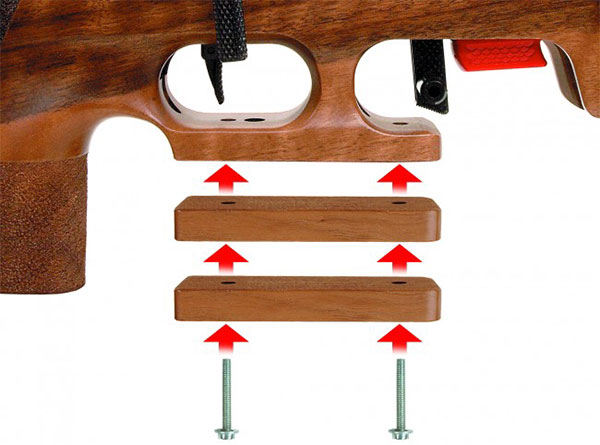


Credit Chris Cheng, Top Shot Season 4 Champion, for finding these photos of the model 1827F Fortner on the Anschütz website.
February 13th, 2014
Staff Sergeant (SSG) Brandon Green of the USAMU has been named the Military Marksmanship Association (MMA) 2013 Soldier of the Year (SOY). Green, a native of Covington, Louisiana, received SOY honors at the MMA’s annual meeting last week.

“I’m very proud to be a member of this unit … and proud to be the Soldier of the Year,” said Green, a member of the Service Rifle Section. USAMU marksmen are extremely competitive, Brandon told us: “You have all of these outstanding shooters and anytime they pick up anything it becomes a competition. Whether we’re training on a different range or a different discipline, it’s that world-level competition that drives us to be as good as we are.”
Here is SSG Green with the Tubb 2000 rifle, chambered in .260 Remington, that Brandon used to win the 2013 High Power Championship. The other shooter is Brandon’s younger brother Braxton.

 Green won the 2013 NRA National High Power Rifle Championships at Camp Perry, OH. It was his first national championship after several second and third place finishes. Also in 2013, Green captured the Interservice Individual Championship for the fourth time and Brandon was a shooter on the winning USAMU Interservice team. He also helped his team break records and earn team wins at Camp Perry. Green won the 2013 NRA National High Power Rifle Championships at Camp Perry, OH. It was his first national championship after several second and third place finishes. Also in 2013, Green captured the Interservice Individual Championship for the fourth time and Brandon was a shooter on the winning USAMU Interservice team. He also helped his team break records and earn team wins at Camp Perry.
Other MMA 2013 Soldier of the Year nominees were: SSG Patrick Franks, Cross Functional Team-Pistol; SSG Daniel Horner, Action Shooting Section; SSG Michael McPhail, International Rifle Section; SPC Reuben Anderson, Custom Firearm Shop; SSG Glenn Eller, Shotgun Team member; SGT John Joss, Paralympics Team member; and SGT Curtis Yetman, Instructor Training Group.
The MMA supports the goals and objectives of the USAMU and provides a link to the history of the unit while hosting ceremonies and social events. The organization has more than 500 members. The USAMU is part of the U.S. Army Accessions Brigade, Army Marketing and Research Group and is tasked with enhancing the Army’s recruiting effort, raising the standard of Army marksmanship and furthering small arms research.
February 11th, 2014
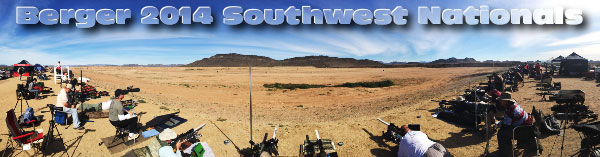
The 6-day-long Berger Southwest Nationals has drawn to a close. And what a week it was. National records were set, $60,000 worth of prizes were distributed, a talented newcomer took the F-TR title, the Arizona sun was warm, and fun was had by all. Congratulations to the individual Grand Aggregate winners: Larry Bartholome (F-Open, 1238-61X), Bryan Litz (Sling/TR, 1239-64X), and Radoslaw Czupryna (F-TR, 1216-37X). Topping the team competition were: Team Grizzly (F-Open), Team Michigan (F-TR), and USA-National-Tompkins (Sling/TR).

Here are some “Take-Aways” from the 2014 Berger Southwest Nationals.
- Heavy .30-caliber bullets (200-215 grains) have become the “hot ticket” in F-TR.
- In F-Open, the 7mm caliber is still King of the Hill (it hasn’t been overtaken by the 30s quite yet). At least in the relatively calm conditions this week, and in the capable hands of Larry Bartholome, a 7mm cartridge still came out on top. The 7mms deliver competitive ballistics, great accuracy, and less recoil than the big 30s.
- F-Open front rests are so good now that folks are looking to rear bag set-ups for improvements in tracking/stability. Any old rear bag won’t cut it anymore.
- In Sling/TR class, the 155s can still do the job. The London Scottish team finished second overall shooting 155s in their .308s. (Members: Michael Barlow, Angus McLeod, Lindsay Peden, Ian Shaw).
- Eric Stecker is more than a “master bulletsmith”. The man can flat-out shoot. Eric finished second overall (1213-51X) in the F-TR Grand Agg, ahead of past National Champions. But as for the cash/bullets prizes, Mid Tompkins joked: “Eric can now pay himself with his own money and wait in line for bullets like everyone else.”
- Many top shooters in F-Open and F-TR are cleaning their barrels less — a LOT less, shooting long strings between cleanings, and then doing very little brushing, letting Wipe-Out and solvents do most of the work.
- We saw HBN-coated bullets, but there were very few moly-coated bullets in the ammo caddies on the firing line. Are black bullets a thing of the past?
- Men dominate sling shooting by weight of numbers. But there are some incredibly talented ladies in this discipline. Ladies such as Trudie Fay, Nancy Tompkins, and Anette Wachter are world-class competitors who set a great example for young female shooters starting out.
- If there is a better-run mid-winter long-range match, at a better location, with a bigger prize table, it must be in another galaxy far, far away.

Top Shooters
| Sling/TR Top Five |
F-Class T/R Top Five |
F-Open Top Five |
Bryan Litz, 1239-64X
Trudie Fay, 1235-65X
Nancy Tompkins, 1232-68X
Tom Whittaker, 1232-51X
Alan Thomas, 1231-60X |
Radoslaw Czupryna, 1216-37X
Eric Stecker, 1213-51X
James Crofts, 1212-48X
Kevin Scott Harris, 1211-32X
Alton Britt, 1211-29X |
Larry Bartholome, 1238-61X
Freddy Haltom, 1238-54X
David Gosnell, 1237-66X
Kenny Adams, 1235-69X
Robert Bock, 1230-48X |

Top Teams
|
F-TR:
1. Michigan F-TR TEAM, 2532-78X
2. USA F-TR Dev Team, 2525-93X
2. True North, 2514-97X |
F-Open:
1. Team Grizzly, 2574-135X
2. Team Berger, 2573-127X
3. Long Shot, 2566-125X |
Sling:
1. USA Nat’l-Tompkins, 2580-132X
2. London Scottish, 2566-128X
3. Competition Machine, 2557-112X |
Winning Sling/TR USA National Team

Get Complete Match Results
Here are the Grand Aggregate Scores, for all matches and all divisions, in MS DOC format. For a Complete listing of ALL scores for ALL matches, click the link for full results. This is a zip file with 18 MS Word documents, six for each discipline.
CLICK HERE for SLING Results | CLICK HERE for F-TR Results | CLICK HERE for F-OPEN Results
CLICK HERE for FULL RESULTS (.zip file)

Newcomer Scores Big F-TR Victory
If there was a crowd favorite among the big winners, it was Radoslaw (“Radek”) Czupryna, the overall F-TR winner. Competing as an “Expert”, Radek outshot all the Masters and High Masters to win the F-TR Title convincingly. We’re told Radek also set a new SWN High Score for F-TR in the process. The sky’s the limit for this talented young man. He has only been competing seriously for three years or so. Originally from Poland, he now lives in Chicago. New talents like Radoslaw represent the future of the sport. Watch out for this guy at the 2014 Nationals. While Radek is built like an NFL linebacker, there’s a soft spot inside that tough exterior. Radek dedicated his victory to his daughters: “When I travel to matches, I can’t be with my daughters. So I want them to know, this win is for them.”

Radek shoots a .308 Win rifle built by John Pierce using a Pierce Titanium Action. Radek loads Varget powder behind 215-grain Berger bullets jumped .015″. I asked Radek if Ben Avery offered any “cruel surprises” this week. He nodded, saying: “Yes, a few times I got some vertical out of nowhere, but I think everybody had the same problem.”
Patience was a virtue at Ben Avery this week, according to Radoslaw: “Conditions looked stable, but that [could be] deceptive. Conditions were changing out of nowhere. So the key, I think, was being patient, and just waiting for the right conditions to come back.”
He offered this advice for other relatively inexperienced shooters: “Don’t be scared to compete. Just come out and do your best. Don’t be nervous, don’t be shy. It’s there… just go and get it.”

Over the next few days, we’ll post additional highlight reports from the Berger SWN featuring competitor and team profiles, video clips, and plenty of photos. Our media team shot over 2000 still images during the week-long match. Credit Steve Fiorenzo for most of the photos in today’s article.
|