|
|
April 7th, 2014
Ten shots… 1000 yards … 2.6872″. Think about that. Ten shots you could cover up with a coffee cup. That’s some amazing shooting. Is this a world record? Consider this — we believe this is the smallest 10-shot group ever shot at 1000 yards in any form of rifle competition, by anyone, anywhere, anytime. It is smaller than the existing Williamsport Light Gun and Heavy Gun 1K records. The IBS and NBRSA do not shoot 10 rounds for Light Gun, but this 2.6872″ group is smaller than the current IBS (3.044″) and NBRSA (4.322″) ten-shot HEAVY GUN records.

This amazing group was shot by Jim Richards at the Deep Creek Range outside Missoula, Montana during the 4th Light Gun Relay of a 1000-yard match. Jim was shooting the small 6mm Dasher cartridge with 105gr Berger bullets. Fellow Deep Creek Shooter Tom Mousel says this should be a new world record. The Deep Creek Range shoots under Williamsport rules, with ten shots for Light Gun. The current Williamsport Light Gun record (as listed) is 3.835″ by Cody Finch in 2006, but we’re told that Paul Martinez shot a 3.505″ at Williamsport last year. If approved at 2.6872″, Jim Richards’ new record is 23% smaller than the 3.505″ previous record. That’s remarkable — Jim Richards utterly demolished the previous mark. (As measured, Jim’s group is also smaller than the current Williamsport Heavy Gun record, 2.815″ by Matt Kline in 2010.)
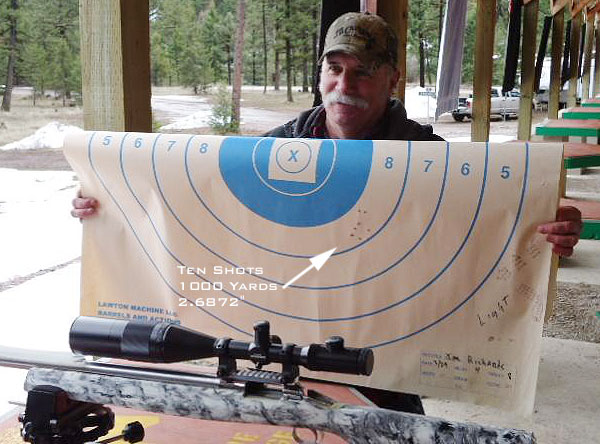
The Record-setting rifle features a Borden action, Shehane ST 1000 fiberglass stock, and Nightforce Benchrest scope. The Krieger barrel was chambered by King Machine for the 6mm Dasher, with a 0.269″ neck and 0.103″ freebore. Jim Richards was running Berger 105gr Hybrid bullets.
The rifle was purchased used from Tim Claunch. We suspect Tim wishes he had not parted with it! Any gun that can put ten shots under three inches at 1000 yards is a “keeper”, that’s for sure.
Forum member Wayne B. says: “I am really happy for Jim. He has asked 1000 questions, slept in his pickup, upgraded his equipment, bought a rifle from another friend of mine and now he is a world record-holder. The men and women who shoot at Deep Creek in Missoula Montana are the best group of shooters in the world bar none! They will give you all the info you need to win and if you don’t have what you need they will loan it to ya, up to and including a rifle and ammo.”
April 6th, 2014
The National Shooting Sports Foundation (NSSF) has taken over the Ruger Rimfire Challenge program. Now called the NSSF Rimfire Challenge, the program retains the format that has made it so popular. This remains a two-gun timed competition with rimfire rifles and pistols. Shooters engage steel targets at relatively close distances. The matches are for young and old alike, all skill levels, with mentoring by experienced shooters. The emphasis is on fun and safety.

The use of .22 caliber pistols, revolvers and rifles make the Rimfire Challenge more affordable than most centerfire matches. “The affordability of this program is something that participants really like and keeps them coming back,” said Zach Snow, NSSF’s Manager of Shooting Promotions. “Event fees are affordable as well.”
For participants, NSSF Rimfire Challenge offers categories for everyone — Open and Limited Divisions, plus Special Recognition competitions. To learn more about on program equipment, rules, courses of fire, scheduled matches and the first NSSF Rimfire World Championship, visit NSSF.org/Rimfire.
NSSF Rimfire Challenge Basics
- This is a two-gun event so you need a rifle and a handgun (which can be either a semi-auto pistol or revolver).
- Bolt-action rifles and lever-action rifles are allowed, but self-loading (semi-auto) rifles are most popular because they can shoot quickly.
- It is suggested that your firearms hold at least ten rounds each, as there is no reloading allowed during the actually stages.
- It is a good idea to have five (5) magazines per gun (5 each for rifle and pistol). That way you don’t have to reload between stages. If you have a 10-shot revolver, you can reload manually, or use speed loaders.
- At Rimfire Challenge Matches, each competitor get five (5) runs through each target stage.
- Eye and ear protection is required on the range at all times. This is true for spectators as well as competitors.
NSSF Rimfire Challenge Courses of Fire | NSSF Rimfire Challenge Rulebook
Many different stage designs can be employed at Rimfire Challenge matches. Here are two examples from the NSSF Rimfire Challengs Suggested Courses of Fire:
 
April 5th, 2014
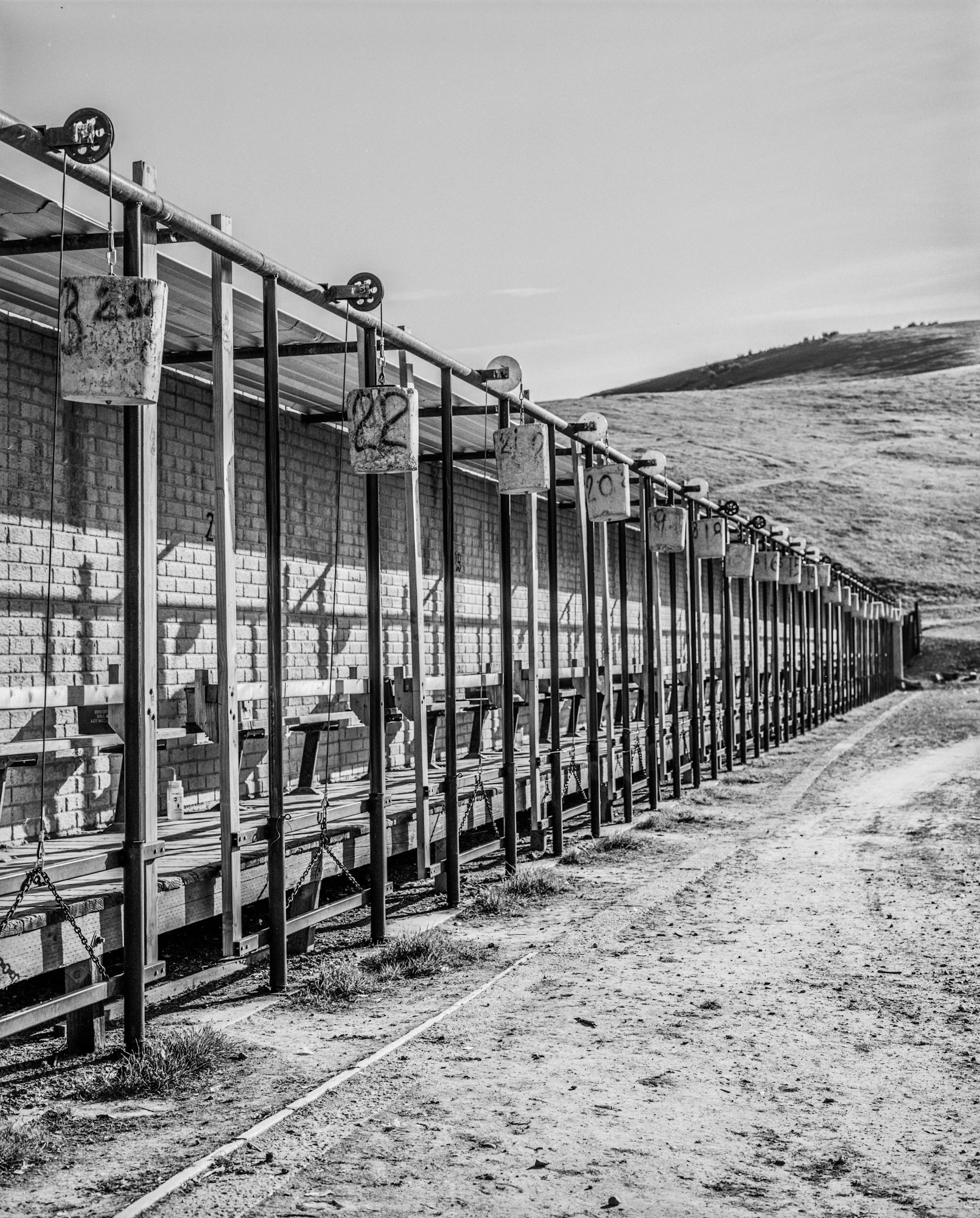
One of our readers, Joshua Targownik, is a very talented photographer. Last year he captured an evocative series of photos at the 2013 California State Palma Championships, hosted at the Coalinga range. Joshua reports: “I shot all these images on good old-fashioned medium format black and white film”. We like Joshua’s images — they have a classic “old school” look which seems to suit the Palma (Full-bore) discipline. The black and white photography seems appropriate to the world of iron sights, leather shooting coats, and “hard-holding” marksmen.
Images by Joshua Targownik. To see more of Joshua’s photos, visit TargoPhoto.com.
Click Image to see full screen version


CLICK HERE to View Full PHOTO GALLERY (17 images).
April 4th, 2014
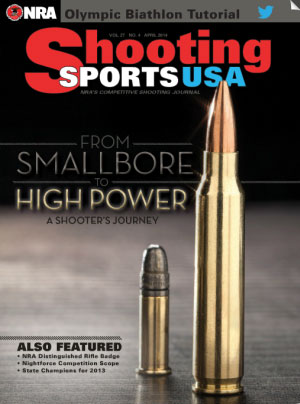 The April 2014 Digital Edition of Shooting Sports USA is now available online (for free). This month’s issue has many articles of interest to competitive shooters. The cover story From Smallbore to High Power, profiles Col. Denise Loring, an international smallbore competitor who recently made the transition to High Power shooting. This is an excellent article. The April 2014 Digital Edition of Shooting Sports USA is now available online (for free). This month’s issue has many articles of interest to competitive shooters. The cover story From Smallbore to High Power, profiles Col. Denise Loring, an international smallbore competitor who recently made the transition to High Power shooting. This is an excellent article.
Col. Loring “compares and contrasts” smallbore and High Power, providing fascinating insights into the differences between the disciplines: “I was very nervous about having only two sighters for NRA High Power matches. Then, I heard about the CMP style of HP where there are no sighters and could not believe you could shoot a match without them. We have unlimited sighters in smallbore and I took full advantage of that aspect. In NRA conventional smallbore you can even return to the sighter bull once you have begun shooting for record.”

Biathlon — Shooting at 180 Beats Per Minute
There is also an interesting feature on Biathlon shooting. This tutorial covers the basics of this challenging Olympic sport that combines Nordic skiing and smallbore position shooting. This in-depth article profiles the top athletes, explains the rules, and provides interesting details of the hardware: “Most athletes use a Fortner (straight-pul bolt) action, although traditional bolt-action guns are allowed. The rulebook regulates biathlon rifles by minimum width, trigger resistense, dimensions and shape[.] Magazines may be spot-checked before or after an event to ensure they contain only five rounds[.]”

The April issue of Shooting Sports USA also includes a complete round-up of 2013 State Champions for all NRA shooting disciplines, from BB Gun to Black Powder Cartridge Rifles.
April 4th, 2014
Here’s a way you can support competitive shooting, while getting a tax deduction. Donations to the NRA Competitive Shooting & National Championships Endowment can be tax-deductible. Started in 2007 by then NRA President John Siegler, the Endowment provides direct funding for shooting programs, including the NRA National matches at Camp Perry. This is a permanent Endowment, with investment income channeled to shooting programs.
According to the NRABlog: “Donations go right into the fund and stay there. They are never touched. 85% of the earnings (or interest) generated by the fund are dispersed to the Competitive Shooting Division for their yearly budget. The other 15% goes back into the principal. By never touching the principal, and reinvesting a portion of the earnings, the endowment will always grow. Simple as that.”

You can contribute in one of two ways — as a gift or as a tax-deductible donation. No matter what path you choose, the money still goes towards the overall cost of running the competitions. To make a contribution to the fund, download the Competitive Shooting & National Championships Endowment flyer, fill out the form and send it to:
NRA Treasurer’s Officer
11250 Waples Mill Road
Fairfax, Virginia 22030
“Once [the Endowment] is big enough, it could pay for all of competitive shooting. That’s something every competitor would benefit from.” — Dennis Willing, NRA Competitive Shooting Director.
April 3rd, 2014
This week’s big story from the ISSF World Cup in Fort Benning involves a lanky Army Reserve Marksman from Montana, Nick Mowrer. The shooting world was shocked when this “pistol guy” (a 50m Free Pistol shooter for the 2012 USA Olympic Team) took a bronze medal in a World Cup rifle competition. Yes, we said “rifle”. And get this — in the process of earning that World Cup bronze medal, Nick racked up enough points to become a triple distinguished marksman (three disciplines).
In the highest level of ISSF competition, it is very unusual for a pistol shooter to even compete in a rifle match. It is unheard-of that a pistol shooter would actually earn a medal. That is like an Olympic 100m spinter also medaling in the Marathon. It just doesn’t happen.

 USAR Team shooter Nick Mowrer pulled off this remarkable accomplishment at the 2014 ISSF World Cup at Fort Benning. It’s not known whether a pistol specialist has ever earned a World Cup medal in rifle competition. In fact none of the experts from USA Shooting can recall another shooter who has even competed in both rifle and pistol categories at the same World Cup event. It appears Mowrer made history with his smallbore rifle Bronze medal. Competitive pistol shooters aren’t supposed to be good rifle shooters as well. Mowrer’s bronze-medal-winning performance has changed that view. USAR Team shooter Nick Mowrer pulled off this remarkable accomplishment at the 2014 ISSF World Cup at Fort Benning. It’s not known whether a pistol specialist has ever earned a World Cup medal in rifle competition. In fact none of the experts from USA Shooting can recall another shooter who has even competed in both rifle and pistol categories at the same World Cup event. It appears Mowrer made history with his smallbore rifle Bronze medal. Competitive pistol shooters aren’t supposed to be good rifle shooters as well. Mowrer’s bronze-medal-winning performance has changed that view.
Cross-Training Works Well Mowrer Says
Will we see more pistoleros “cross the aisle” and shoot rifle? Only time will tell. But Mowrer believes that “cross-training” with both rifle and pistol has improved his overall marksmanship skills: “I have used prone smallbore (rifle) as cross training for pistol for years now and I am very excited to have the unique opportunity to represent the USA not only in pistol but rifle as well. I shoot multiple events, not only prone, but the reason is just the same; I use other shooting disciplines to be able to compete in more matches and gain more experience that I am able to then use in my pistol shooting! It also keeps shooting fun and exciting.” Read related USAR story.
Mowrer’s medal at Fort Benning has caused a stir among top-level World Cup shooters. The reigning Olympic gold medalist in Women’s 3-P rifle, Jamie Gray, recently posted:
“Today is an amazing day…our Olympic Pistol Shooter Nick Mowrer broke into the medals in Men’s Prone [rifle event]! Couldn’t be more excited for him and obviously his amazing shooting abilities! Nick… [took] a Prone Rifle Bronze, nothing more to say than AWESOME!”
April 2nd, 2014
Maggie Reese, one of the nation’s top female 3-gun shooters, recently signed as a factory-sponsored Team Colt shooter. It seems that blue and white suits Maggie just fine. Maggie just won the Ladies Open Division title at the Superstition Mountain Mystery (SMM) 3-Gun match in Mesa, Arizona. This marked the third time Reese finished as “High Lady” at this competition. Maggie told us: “The SMM 3-Gun is a competition I’ve gone to since the start of my shooting career, and it’s always a pleasure to go back.”
Photo credit: Yamil Sued

Reese used a Colt LE6920 for the rifle portion of the SMM 3-Gun. “There was a lot of accuracy involved in this particular match,” said Reese. “Having a dependable rifle made all the difference in trusting my shot placement.”

 The stages also included distance targets up to 350 yards, along with some unique challenges. One stage had competitors strapped to a chair that was rotated to a 90-degree angle (See video below). “Shooting sideways was a fun experience,” said Reese. “Body placement was so important for this stage, along with being comfortable with your rifle. Up next for Reese is the 3-Gun Nation Pro Series Event in Tulsa, followed by the USPSA Multi-Gun Nationals on April 16 in Las Vegas. To follow Maggie Reese and other Team Colt members this season, visit Facebook.com/ColtFirearms. The stages also included distance targets up to 350 yards, along with some unique challenges. One stage had competitors strapped to a chair that was rotated to a 90-degree angle (See video below). “Shooting sideways was a fun experience,” said Reese. “Body placement was so important for this stage, along with being comfortable with your rifle. Up next for Reese is the 3-Gun Nation Pro Series Event in Tulsa, followed by the USPSA Multi-Gun Nationals on April 16 in Las Vegas. To follow Maggie Reese and other Team Colt members this season, visit Facebook.com/ColtFirearms.
Superstition Mountain Tilting-Chair Stage (Benny Hill style)
This video, by Brett Russo, features Jamie Franks, Taran Butler, Craig Outzen, Maggie Reese, Peter Jonasson, Chris Cheng, Jessica Hook, and others.
Here is Maggie with other shooters at SMM 3-Gun. Can you name the people in the picture?

March 30th, 2014
The 2014 ISSF World Cup at Fort Benning is underway, and some events have already finished, such as the 10m Air Rifle and 10m Air Pistol. The World Cup, which has attracted many of the world’s top rifle and pistol shooters, continues through April 3, 2014. Here are some photo highlights from the first three days of the Fort Benning World Cup. There were plenty of exotic, expensive rifles and pistols on display — plus a few small toy animals (favored by the lady shooters).

 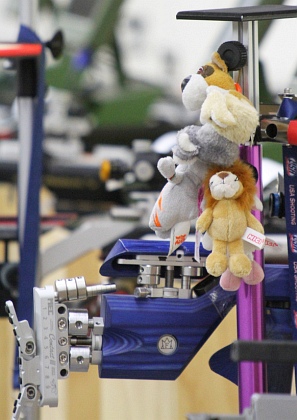
ISSF Fort Benning World Cup Photo Stream
Young Russian Wins First Gold of the Competition
Nazar Luginets, 24, from the Russian Federation, won the first medal match of the competition, the 10m Air Rifle Men event. With 209.4 points, the Russian athlete beat Serbian Milutin Stefanovic, who finished just one tenth behind Luginets. The 2013 Euro Champion, Sergey Richter from Israel, finished third.
10m Air Rifle Winner Nazar Luginets

 New Air Pistol Record Set New Air Pistol Record Set
Hoang Xuan Vinh, from Vietnam, won the 10m Air Pistol Men final, setting a new world record in the process. Currently ranked 8th in the world, The Vietnamese pistol shooter pocketed the Gold medal with a record score of 202.8 points in the final, breaking the previous 202.3-point record set by the 2008 Olympic Champion Pang Wei of China. Hoang beat Russians finalists Sergey Chervyakovskiy, and Vladimir Gontcharov, 36, who finished in second and third place with 202.3 and 181.3 points, respectively. This was an important comeback for Gontcharov, a 14-time ISSF World Cup medalist. Vladimir who started competing back in 1990, had been far from ISSF podiums since 2012.


Photos © International Shooting Sport Federation.
March 24th, 2014
If you only know Bryan Litz from his Applied Ballistics Books and DVDs, you may not realize that this guy is a great marksman (along with being an actual rocket scientist). This guy can shoot. At the recent Berger Southwest Nationals (SWN), Bryan took top honors among all sling shooters — and he managed to do that while performing many other important match duties. The pay-off for Bryan was getting his name on a really cool “ghost dancer” perpetual trophy. Litz joked: “With what the wind gods can do at shooting matches, it makes sense to have a trophy that puts you in touch with the spirit world.”

This is actually the second time Litz has finished first in Sling class at the Southwest Nationals. After his impressive win, we asked Bryan if he had any advice for other long-range competitors. First Bryan provided three tips concerning Ballistics, his special area of expertise. Next Bryan offered three more general tips about long-range competition — how to analyze your shooting, how to choose your ‘wind strategy’, and how to avoid the most costly mistakes, i.e. how to avoid the “train-wrecks”.

Litz Ballistics Tips
Ballistics TIP ONE. If you’re having trouble getting your ballistic software to match actual drops, you need to look at a number of possible reasons. Here are some common issues that can cause problems.
Click Values Are Not Exact. Scopes and iron sights don’t always produce accurate adjustments. In other words, if your ballistics program predicts 30 MOA of drop, and you dial 30 MOA but hit low, it might be that your sight actually only moved 28 MOA (for example). To see if your sight is adjusting accurately, shoot a tall target at 100 yards and measure group separation when dialing your sight.
Barometric vs. Station Pressure. This is a commonly misunderstood input to ballistics programs. You can avoid this pitfall by remembering the following: station pressure is the actual measured pressure at your location, and you don’t need to tell the program your altitude when using station pressure. Barometric pressure is corrected for sea level. If you’re using barometric pressure, you also have to input your altitude.
Muzzle Velocity. Chronographs are not always as accurate as shooters think they are — your true MV may be off by 10-20 fps (or more). If your drop is different than predicted at long range, it might be because your muzzle velocity input is wrong.
Mixing Up BC (G1 vs. G7). Knowledgeable long range shooters know that the G7 standard is a more representative standard for modern LR bullets. However, using G7 BCs isn’t just a matter of clicking the ‘G7′ option in the program. The numeric value of the BC is different for G1 and G7. For example, the G1 BC of the Berger 155.5 grain Fullbore bullet is .464 but the G7 BC is .237. If you were to enter .464 but click on G7, the results would be way off.
Ballistics TIP TWO. A properly installed level is absolutely essential for long range shooting. Without a good level reference, your long range wind zero will be off due to minor canting of the rifle from side to side. You can verify that your level is installed correctly on a 100-yard ‘tall target’. Draw a plumb line straight up the target and verify that your groups track straight up this line as you go up in elevation.
Ballistics TIP THREE. If your long range ballistic predictions aren’t tracking, always come back and verify your 100-yard zero. Sometimes a simple zero shift can be misconstrued as errors in long range ballistics predictions.
Litz Competition Shooting Tips
Competition TIP ONE. Improving your scores in long range competition is a constant process of self-assessment. After each match, carefully analyze how you lost points and make a plan to improve. Beginning shooters will lose a lot of points to fundamental things like sight alignment and trigger control. Veteran shooters will lose far fewer points to a smaller list of mistakes. At every step along the way, always ask yourself why you’re losing points and address the issues. Sometimes the weak links that you need to work on aren’t your favorite thing to do, and success will take work in these areas as well.
Competition TIP TWO. Select your wind shooting strategy carefully. For beginners and veterans, most points are typically lost to wind. Successful shooters put a lot of thought into their approach to wind shooting. Sometimes it’s best to shoot fast and minimize the changes you’ll have to navigate. Other times it’s best to wait out a condition which may take several minutes. Develop a comfortable rest position so you have an easier time waiting when you should be waiting.
Competition TIP THREE. Actively avoid major train wrecks. Sounds obvious but it happens a lot. Select equipment that is reliable, get comfortable with it and have back-ups for important things. Don’t load on the verge of max pressure, don’t go to an important match with a barrel that’s near shot out, physically check tightness of all important screws prior to shooting each string. Observe what train wrecks you and others experience, and put measures in place to avoid them.

Photos by Steve Fiorenzo
March 23rd, 2014
The International Shooting Sports Federation (ISSF) World Cup season kicks off right here in the USA, March 26 through April 3, 2014, in Fort Benning, Georgia. Many of the world’s best rifle and pistol shooters will be on hand — more than 400 competitors from 50 nations are expected to compete at the home of the U.S. Army Marksmanship Unit (USAMU).
ISSF World Cup (Fort Benning) 2013 50m Rifle Prone Winner Valerian Sauveplane of France.

At the last Rifle/Pistol World Cup USA back in May 2013, the USA earned two medals with Will Brown winning a gold medal in Men’s 10m Air Pistol and Dempster Christenson winning a silver medal in Men’s Air Rifle. Highlights from last year’s ISSF World Cup at Fort Benning are featured in the 24-minute video linked below. The video covers both rifle and pistol disciplines.
Here is last year’s women’s 50m 3P winner at the Fort Benning World Cup, Andrea Arsovic of Serbia.


Complete ISSF World Cup (Fort Benning) Match Schedule
If you want to watch the matches,or meet some of the shooters here is a schedule for the all the events, starting with training sessions on March 27th.
CLICK HERE for General Match INFO (PDF)
CLICK HERE for list of competitors, grouped by Nation (PDF).

Photos ©2014 ISSF | Competitor Photos: Marco Dalla Dea
|