|
|
April 29th, 2014
The Sloughhouse Benchrest Shooters hosted the 2014 National Benchrest Shooters Association (NBRSA) 600-Yard and 1000-Yard National Championships April 23-27, 2014. The match was shot in generally good conditions at the Sacramento Valley Shooting Center. Richard Duncan won the 1000-yard championship, finishing 8 points ahead of past Champ Richard Schatz. In the 600-yard Championship, Steven Raeder edged runner-up Wayne Courand. Bill Johnston set three, NBRSA 1000-Yard Heavy Gun Group Records* during the course of the match. Jim O’Connell reports that the sponsors were very generous again this year. Jim notes: “I think the big raffle winner this year was Bill Hubina who won a Nightforce scope and a Bat action. Congratulations to all the winners and thank you for your support of the Sloughhouse Benchrest Shooters. Hope to see you again next year for the 2015 Nationals.”
File photo from past event.

The three linked MS Word documents include results of the 600-Yard Nationals, the 1000-Yard Nationals, and the F-Bench Match. Click and download these files to view complete Group, Score, and Aggregate results, with rankings of all the individual competitors.
NBRSA 1000-Yd Nationals Results | NBRSA 600-Yd Nationals Results | NBRSA F-Bench Results
|
1000-Yard Overall Two-Gun Results
1. RICHARD DUNCAN – 13 (Nat’l Champion)
2. RICHARD SCHATZ – 21
3. BILLY COPELIN – 25
4. BRUCE BANGEMAN – 25
5. ROBERT HOPPE – 28
6. SHAWN GREENE – 30
7. BILL JOHNSTON – 34
8. GREG WILSON – 37
9. CANADA CUMMINS – 41
10. PETER WHITE – 44 |
600-Yard Overall Two-Gun Results
1. STEVEN RAEDER – 12 (Nat’l Champion)
2. WAYNE COURAND – 15
3. TOM ESSER – 28
4. DAVID LLOYD – 31
5. JOSEPH MCKEE – 41
6. GREG WILSON – 46
7. KENNETH SCHROEDER – 48
8. JERRY TIERNEY – 49
9. TERRY BALDING – 51
10. SHAWN GREENE – 56 |
*Bill Johnston set the following Heavy Gun records at the Nationals: Single Target Heavy Gun Group, 4.219″; Three-Target Heavy Gun Group Agg, 5.056; Six-Target Heavy Gun Group Agg, 5.899.
April 27th, 2014
 The NRA’s Program Materials Center now offers high-visibility vests for both Range Safety Officers (RSO) and Chief Range Safety Officers (CRSO). These $25.00 fluorescent yellow vests come in three sizes, all with reflective strips and “NRA RSO” screen-printed on the back of the vest. The NRA’s Program Materials Center now offers high-visibility vests for both Range Safety Officers (RSO) and Chief Range Safety Officers (CRSO). These $25.00 fluorescent yellow vests come in three sizes, all with reflective strips and “NRA RSO” screen-printed on the back of the vest.
We strongly recommend that clubs consider providing Hi-Vis safety vests to Range Safety Officers. We’ve noticed that when range-masters wear official safety gear (and carry a bull-horn), everyone on the firing line seems to stay more alert.  If the RSO needs to go downrange, the enhanced visibility of the vest helps ensure that shooters, particularly novices, handle their firearms safely. If the RSO needs to go downrange, the enhanced visibility of the vest helps ensure that shooters, particularly novices, handle their firearms safely.
In addition to the bright yellow vests, the NRA sells fluorescent yellow caps ($9.75), yellow or orange knit caps ($17.00), and bright orange shirts ($14.95- $24.95) for RSOs and CROs. These items are all offered through the Program Materials Center.
April 24th, 2014
Soldiers from the U.S. Army Marksmanship Unit (USAMU) Action Shooting team won two titles at the 2014 U.S. Practical Shooting Association Multi-gun National Championships, April 18-20. SSG Daniel Horner won the 2014 overall title, while finishing first in the Tactical Ops Division for an unprecedented sixth time. USAMU teammate SGT Matthew Sweeney won the Heavy Metal Tactical Division.
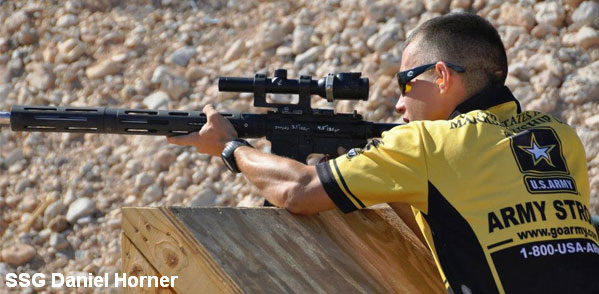
 It has been an impressive April for Horner. Daniel started off the month winning the U.S. Special Operations Command Int’l Sniper Competition with teammate SGT Tyler Payne. After that, he won his second straight 3-Gun Nation Pro Series Tour win before securing this latest national championship. The win marks Horner’s sixth national title in the Tactical Ops Division, the first shooter to ever accomplish that feat. It has been an impressive April for Horner. Daniel started off the month winning the U.S. Special Operations Command Int’l Sniper Competition with teammate SGT Tyler Payne. After that, he won his second straight 3-Gun Nation Pro Series Tour win before securing this latest national championship. The win marks Horner’s sixth national title in the Tactical Ops Division, the first shooter to ever accomplish that feat.
Even after six national titles and a ranking as one of the best sniper teams currently in the world, Horner said he’ll never get to a point where he thinks he knows it all.
“I learn something every day,” Horner concluded. “I can learn something from every single person shooting and use it to help someone else or help me.”
Unlike other competitions that focus on short-range shooting and shooting on the move, the Practical Shooting Association Multi-gun National Championships test shooters using odd-positions, barricades, stage planning, and long-range rifle targets in addition to moving quickly through stages.
“This year the shooting was difficult, but the speed at which you had to make the shots was so high that you couldn’t make any mistakes,” Horner said. “You would run out of shotgun ammo at some point if you missed one shot and (that’s a ten point penalty.)”
Horner and Sweeney Train Deploying Soldiers
Highlighting the difference between AMU shooters and their civilian counterparts, after the USPSA awards ceremony, Horner and Sweeney jumped on a plane to train soldiers preparing for deployment. The USAMU applies lessons learned from marksmanship competitions to training Soldiers for combat and raising the Army’s Marksmanship proficiency.
April 23rd, 2014
 Congrats to Taran Butler, who won the Open Division title at the USPSA Multi-Gun National Championships held last week at the Desert Sportsman’s Range outside Las Vegas. Butler also won this event in 2012, becoming the first person in history to win all three USPSA Multi-Gun divisions: Open, Tactical, and Limited. This year, Taran packed some serious firepower, with extra-long magazines for both carbine and shotgun. Shown below is the rig Taran used to win the 2012 Open Class Nationals. Taran reports: “This is a custom AR that TTI built with parts from Vltor, LaRue, PRI, Surefire, Noveske, Trijicon, and JP. Its called the Taran Tactical Innovations 17″ Signature Series Rifle. The optics I use are the Trijicon TR24R 1-4 power and the RMR. This is by far the fastest optic setup on the planet.” Congrats to Taran Butler, who won the Open Division title at the USPSA Multi-Gun National Championships held last week at the Desert Sportsman’s Range outside Las Vegas. Butler also won this event in 2012, becoming the first person in history to win all three USPSA Multi-Gun divisions: Open, Tactical, and Limited. This year, Taran packed some serious firepower, with extra-long magazines for both carbine and shotgun. Shown below is the rig Taran used to win the 2012 Open Class Nationals. Taran reports: “This is a custom AR that TTI built with parts from Vltor, LaRue, PRI, Surefire, Noveske, Trijicon, and JP. Its called the Taran Tactical Innovations 17″ Signature Series Rifle. The optics I use are the Trijicon TR24R 1-4 power and the RMR. This is by far the fastest optic setup on the planet.”

In this video, Taran talks about multi-gun competition and how he maintains his drive to win even after having a bad stage. Top competitors like Taran are able to stay focused and come from behind to win.
Taran Butler Talks about the Multi-Gun Game
When he’s not competing at matches, or testing products for Taran Tactical Innovations, Butler works as a firearms expert in Southern California. He often works with celebrities, training Hollywood stars for action movie roles. Here he is with leading man Johnny Depp and songstress/actress Rihanna.


April 21st, 2014
Based on Report by Lars Dalseide for NRABlog.com
I first read about Lauren Phillips in 2012. Back then she part of a spitfire quartet known as the West Seattle/Vashon Thunderbirds. Fresh off her team’s NRA National Junior Sectional victory, she decided to start taking a more serious approach her shooting career.

Since then, she hit the road for matches in Fort Benning, Georgia, Anniston, Alabama, Camp Perry, Ohio, and Colorado Springs, Colorado. What did that travel catalog get her? How about a scholarship to the University of Nebraska and a spot in the National Junior Olympic Shooting Championships. Once she earned that Junior Olympics spot, well, let’s just say she’s been difficult to stop. So much so that she walked away with the overall Women’s Three-Position Rifle title yesterday.
To get a full breakdown of Phillip’s performance at the National Junior Olympic Shooting Championships, take a look at the press release from USA Shooting:
Phillips Dominates Women’s Three-Position Rifle at NJOSC
No one could catch Lauren Phillips. Before she even stepped on the line for the Women’s Three-Position Rifle Final at the National Junior Olympic Shooting Championships (NJOSC), Phillips (Seabeck, Wash.) already had the title in the bag.
Phillips, a freshman at the University of Nebraska, built a dominating eight-point lead over the closest competitor in the 66-shooter field. Champions at this year’s NJOSC are determined through a modified selection format similar to that of USA Shooting’s National Championships: Points are awarded points earned in each day of competition with Nebraska freshman Lauren Phillips takes a moment at the National Junior Olympic Shooting Championships additional points awarded for performance in the Final – Eight for first, seven for second and so on. Phillips finished fifth in the Final, but it didn’t really matter.
“The Qualification was just like I was planning for – build an early lead so it takes the pressure of the Final,” Phillips said. “That’s just what I did. Went in Day One with a personal best and Day Two two points lower, but stayed consistent…I went in gunning for a record Final but it didn’t happen today. There were some excellent performances by my fellow collegiates.”

April 14th, 2014
The 8th Annual Eastern CMP Games and Creedmoor Cup Matches will be held at Camp Butner, North Carolina, May 2-11, 2014. The Eastern CMP Games run May 2-6, while the Creedmoor Cup Matches take place on May 7-11. All interested shooters, of all experience and skill levels, are invited to participate in this popular event, which offers a wide variety of shooting competitions, including: Rimfire Sporter Match, M16 Match, M1 Garand Match, Springfield Match, M1-Carbine Match, Vintage Military Match, Modern Military Match, Vintage Sniper Match, Pistol Matches and more.

CMP Games Information Page | CMP Games Program 2014 | CMP Games Photo Galleries.

Great Place to Get Started in Competitive Shooting
The CMP Games matches are ideal events for shooters who have not participated in previous competitions. Shooters are permitted to coach or assist each other in these matches. Experienced shooters are encouraged to assist new shooters with positions, slings, loading and the rules.

To learn more about the Eastern CMP Games, email croguski [at] thecmp.org or call (888) 267-0796, extension 1114. If you have questions about the Creedmoor Cup contact Dennis DeMille, demille [at] creedmoorsports.com or call (800) 273-3366 M-F, 9:00 am – 6:00 pm Central Time.


April 14th, 2014
The NRA, on the recommendation of the NRA High Power Committee, has appointed Ray Gross as the new United States F-TR Team Captain, to serve through the 2017 World Championship cycle. Ray brings a wealth of experience in both national and international competition. As a member of the World Championship-winning 4-person U.S. F-TR team, and the hugely successful Team Sinclair F-TR squad, Ray is a skilled coach, a top-flight shooter, and a great guy who is respected by his peers. Ray brings a unique combination of skills to the team as its new leader.
Ray Gross (center with gray hat), with fellow Team USA F-TR Shooters at Raton, NM.

Ray has asked James Crofts to serve as US F-TR Vice Captain. James comes from a military background, having served 20 years in the US Navy aboard fast attack submarines. James has also been a shooting member of the 8-man F-TR Team USA, and he is always one of the top shooters in any F-TR competition.
James told us: “It’s official, I have been named the new Vice Captain for the USA F-T/R National Team. Now the work begins but with Ray Gross as Captain I think we can handle it. Tough act to follow, Darrell Buell and Mike Miller set the bar extremely high with back to back world championship gold medals.”
James Crofts — Photo by Kent Reeve.

April 11th, 2014
 The 2014 National Junior Olympic Shooting Championships (NJOSC) take place this month in Colorado Springs, Colorado. The prestigious event, which runs through April 26th, kicked off yesterday with air pistol matches. The 2014 National Junior Olympic Shooting Championships (NJOSC) take place this month in Colorado Springs, Colorado. The prestigious event, which runs through April 26th, kicked off yesterday with air pistol matches.
Following the pistol competition, Women’s Rifle takes to the range April 16-20, and then the NJOSC will conclude with Men’s Rifle, April 22-26. Both rifle weeks will include both Air Rifle and Three-Position (smallbore) competition.

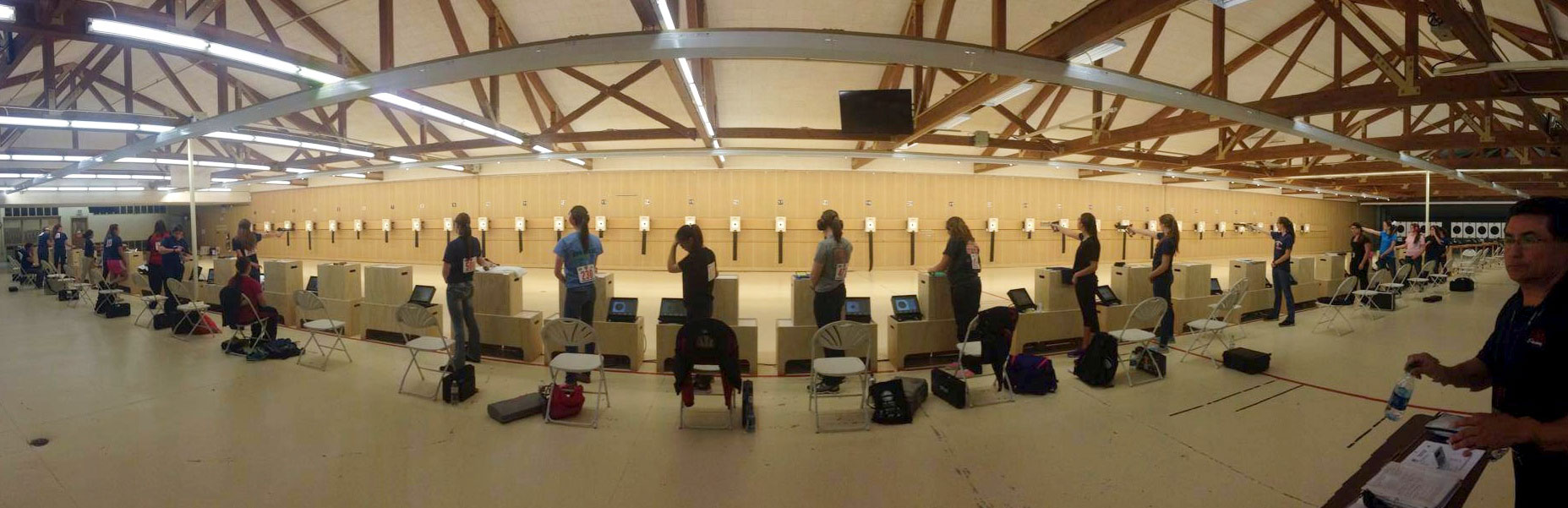
For the first time in the history of the National Junior Olympics, all competitors will shoot on electronic targets. USA Shooting completed a massive range upgrade to improve lighting and enhance the spectator experience by incorporating more than 70 new electronic targets. This is cutting-edge technology that allows both real-time scoring and even live video streaming on the internet. Shown below are the target print-outs for Air Pistol.

In our dreams we could hope for electronic scoring at high power and long-range centerfire events. Wouldn’t it be cool to have scores appear instantaneously, in real time? In addition, after firing a relay you could get a print-out that would show the exact placement of your shots in the scoring rings. That would be handy for analyzing your wind calls. But best of all, with electronic targets, shooters would no longer have to pull pit duty in the hot sun! Over time we may see more of this technology for centerfire competition. We’re told that the new 500-acre, $20 million CMP Talladega Marksmanship Park, being built in Alabama, will have some electronic scoring capabilities.
USA Shooting Video Streaming of Junior Olympics Events
On its YouTube channel, USA Shooting will provide Live and recorded events from the USA Shooting Olympic Training Center Ranges in Colorado Springs. As we write this, the NJOSC 2014 Men & Women Air Pistol Day 2 Air Pistol Relays are streaming. CLICK Here for NJOSC Videos and Streamed Events.

April 10th, 2014
 The CMP Games – Oklahoma kicked off yesterday with a Small Arms Firing School session. The 2014 CMP Games – Oklahoma run 9-13 April at the Oklahoma City Gun Club. This popular 5-day event features clinics, SAFS/M16 match, EIC Rifle Match, GSMM Four Gun Aggregate, Vintage Sniper Match, CMP As-Issued 1911 Pistol Match, Military & Police Service Pistol Match, EIC Pistol match, and several other activities. The CMP Games – Oklahoma kicked off yesterday with a Small Arms Firing School session. The 2014 CMP Games – Oklahoma run 9-13 April at the Oklahoma City Gun Club. This popular 5-day event features clinics, SAFS/M16 match, EIC Rifle Match, GSMM Four Gun Aggregate, Vintage Sniper Match, CMP As-Issued 1911 Pistol Match, Military & Police Service Pistol Match, EIC Pistol match, and several other activities.
Below, Leon Rutherford, CMP Master Instructor, helps a shooter on the firing line during the CMP Small Arms Firing School. The SAFS teaches safety, positions, how to load and clear the rifle, how to loop a sling and prepare for practice firing. Students are issued AR-15 rifles to use during the school and will fire the M16 EIC Rifle Match on April 10.
On April 11-13 there will be Garand/Springfield/Vintage and Modern Military Matches, a Carbine Match, and a Vintage Sniper Match. There will also be Pistol Matches held each day from April 10 – 13, 2014. To see match results, visit the CMP Competition Tracker Webpage.

NOTE: The young shooter in the above photo IS wearing eye protection, an all-clear set of eyewear. This close-up shows the eye protection better.

April 8th, 2014
 1000-yard Benchrest competitor James O’Hara set four (4) new IBS Records in 2013. These multi-match Light Gun Agg records were secured with O’Hara’s solid performance at the 2013 Virginia 1000-yard Benchrest State Championship. Here are the new records set by O’Hara in 2013: 1000-yard Benchrest competitor James O’Hara set four (4) new IBS Records in 2013. These multi-match Light Gun Agg records were secured with O’Hara’s solid performance at the 2013 Virginia 1000-yard Benchrest State Championship. Here are the new records set by O’Hara in 2013:
10-Match Score Aggregate 47.5
6-Match Score Aggregate 49.5
6-Match Score Aggregate 49.83
6-Match group Aggregate 3.072”
During the VA state championships, O’Hara was on fire. All four groups were centered for 50s, with three groups under 3″ and the fourth a 3.715″. That’s consistency.
Target 1- Group 2.996” Score 50.2
Target 2- Group 2.433″, Score 50.1
Target 3- Group 3.715″, Score 50.4
Target 4- Group 2.188″, Score 50.1
Group Average 2.833″, Score Average 50.2
On 1000-yard benchrest targets, the 10-ring is just seven inches in diameter, while the X-Ring is a mere 3 inches in diameter. At the Virginia 1K Championships, James managed to keep all his shots within the seven-inch 10 Ring with eight of the shots inside the 3 inch X-Ring. That is amazing accuracy and consistency. David Goodridge says: “This is truly a remarkable example of superb marksmanship, rifle design, assembly, load development and equipment maintenance.” (O’Hara had previously set a 10-match Aggregate Light Gun World record of 4.5389″ in 2012).
Click image for Full-screen view


James O’Hara Talks About Record-Setting Rifles and Ultra-Accurate Long-Range Loads
James generously agreed to share his knowledge and experiences on the many facets of IBS 1000-yard benchrest preparation, reloading and shooting techniques in an intereview with Australian David Goodridge. This feature originally appeared in Australian Target Rifle Magazine. A few of O’Hara’s responses have been updated, based on a conversation with James on April 8, 2014.
Goodridge: James on behalf of the Australian LRBR community I would like to congratulate you on your achievements in 1000-yard Benchrest and thank you for [doing this] interview. To begin, could you provide an outline on your background and the reasons or factors that led you to becoming involved in 1000-yard BR at the Virginia Club.
O’Hara: I started short-range Benchrest in 1996 for a brief time and won my first 100-yard IBS match and I was hooked. Loss of eye-sight in one eye put a damper on it and I quit shooting for while, and I started shooting trap to try to switch over to left-handed. It worked and I started to pick up a gun left-handed so I went back to the rifle and built a tube gun.
I tried the local groundhog matches but the rules changed every match. I then found the Reade Range and 1000-yard matches. I restocked my gun with a long-range stock and started 1000-yard Benchrest. Finding I enjoyed the challenges associated with long range benchrest, I began 1000-yard Benchrest competition at Harry Jones Range and White Horse Range, two IBS ranges in West Virginia. I basically started after the year was under way in 2011 and I must say it was a very humbling experience. I soon learned that my previous short range [techniques] were not working.
New scales, a K&M arbor press with a force indicator, led to improvements. Then designing and obtaining reamers to my own specifications led to further substantial improvements, with the end result being that the same loads now seem to work from barrel to barrel.
James O’Hara Equipment Details
Gunsmithing: I do all the work myself, except barrel chambering/fitting is done by Dave Bruno.
Favored Caliber: I use a 6mm Dasher with a .266 neck and a .135 free bore. My load is a 103gr Spencer bullet trimmed and pointed with Hoover tools. Load is Alliant Reloder 15, 33.0+ grains weighed on a GD503 scale, with a CCI 450 primer. Right now I’m jumping the bullet about .006″. Previously, I shot them about .010” into the rifling but it was pulling the bullets or pushing them back.
Actions: For the IBS record groups I used a Bat 1.350” Bat B action in a Roy Hunter Stock. Other actions in use include a 1.530” Bat B and a Kelby F-Class Panda.
Barrels: The record barrel was a Brux Heavy Varmint, 1:7.83″ twist, finished at 28″, and fitted with a Harrell’s brake.
Stocks: I have two Roy hunter stocks and a PR&T and all track very well. They are balanced at two inches ahead of the receiver. All three stocks are glued with liquid Devcon and are pillared, so they are “glued and screwed”. I think this is the best system.
Scopes: The PR&T-stocked rifle has a March 10-60X and the two Hunter-stocked guns have Nightforce 12-42x56mm NXS scopes.
Rests: My front rest is a Sinclair Competition model that I modified with a cartridge holder that holds cartridges up by the port. I use the new super slick bag by Protektor and a rear Doctor Bag with leather ears.
Scope Mounts: Rings are Burris Signature Extra High (the ones with inserts).
Case Preparation and Reloading Techniques:
My cases are three years old, with close to 100 firings. They are all from the same lot. I anneal the cases dirty to save some work and I anneal every time to have consistent neck tension. I punch the primers out and clean the pockets and run the flash hole uniformer in to make sure there is no carbon build-up. You can use the same tool as you use to prep the new cases. Flash holes are uniformed to .0625″. (Flash holes, “out of the box”, are less consistent than you may think.)
I turn necks to .0102″ with a K&M tool. Some competitors don’t turn necks, but without uniform neck tension you will have vertical. I use a K&M VLD chamfering tool and a Wilson case trimmer for new cases and when I trim fired cases. I use a nylon brush for inside the necks and clean the cases outside with 0000 steel wool using a small power station or a drill to spin them. The cases are sized on a Forster Coax press with a Harrell’s full length bushing die. Priming is done by hand using a K&M priming tool. I throw a “close” charge with Harrell’s bench rest powder measure. That charge goes in the pan of my Sartorius GD503 scale and then I trickle up to weight with an Omega powder trickler.

For bullet seating, I now use the 21st Century Hydraulic arbor press with seating force indiciation. I previously used the K&M arbor press with force indicator — it was good, but the 21st Century unit is more sophisticated, more precise, and easier to read. I have a loading block that is color-coded in the pounds of force needed to seat the bullet. I try to keep rounds in sets of 3-lb seating force settings. Each loaded round is put in the appropriate column (based on measured seating force). All loaded rounds are color-coded to avoid mixing. Leftovers from matches are used at a later date.
Click image for Full-screen view

I have now made a tool from an old bearing surface comparator. It will contact the ogive of the loaded round and it will check the seating depth while it is sitting on a granite block. Relying completely on the force and feel of the dial indicator allows seating depths to be held to .0005″ (i.e. one-half-thousandth). Compared to others means, this seems a more accurate way to check seating depth.
Bullets are spun on a Juenke machine after they are trimmed on a Hoover trimmer and pointed on the Hoover tool. For the next step, a Tubb Bearing Surface Comparator is used to sort bullets to plus/minus .0005″. I don’t discard any bullets — if I have some small lots of bullets that have a shorter or longer measurement they are used for testing. With the Spencer and BIB bullets there are not many that are not within plus/minus .001”. I quit weighing cases because of the outside variations. I only do what makes a difference [on target] and I only test and do load development at 100 yards, where I can control the conditions.
 Barrel Freezing (Cryogenic treatment) Barrel Freezing (Cryogenic treatment)
For the 2013 season, I cut barrels back to 28″ and had them “frozen” (cryo-treated) at Cryo Plus. I think that both barrels are average in the wind, but the first shot from a clean barrel is in the group. I shot around seven 100s with my other Light Gun. In Heavy Gun, I even won the group Aggregate at the Virginia State shoot. I have cryo-treated all of my barrels and I believe I have proof that it does produce benefits. I talked to George Kelbly about this before I did it. My results agreed with what George had indicated: fire cracking was less, chambering was easier and the major benefit was that the groups did not ‘walk’ as the barrels became heated.
Bench Set-up and Shooting Procedures
I use a spotting scope to help see the flags and the mirage. The mount is a Sinclair for the bench. This really helps because I can’t see the flags far out. I think the most important part of the set up is getting the gun to track, it has to come back in the box every time and shooting under the same condition every shot. I know everybody likes to run them — I do if the condition holds — but if it doesn’t you must pick them one at a time. This is where the direction and the speed of the wind come into play; you must shoot in the same condition you zero in.
When I set up to shoot, I line up the gun on my target and I move it back and forth till I can get it coming back in the ten ring and then I set my scope. I load my record rounds in my holder and I use my sighters out of the box. I now am watching and timing the conditions and I now make the decision of the one I will use and this is the only one I sight-in with. If I have some big guns beside me with brakes, I will wait till they are done or try to get in between their shots (this doesn’t always work).
Trigger control is a must and you have to be consistent. I will give up a perfect sight picture for a perfect trigger pull. I use free recoil and only my finger is on the trigger. After the rifle recoils back, I hold the fore-arm and open the bolt — you have to be careful not to upset the gun in the bags. After loading the next round, I close the bolt and push the gun forward with my right hand on the fore-arm. I am guiding [the stock] forward in between the bags. This gives me less chance to make a mistake, and maybe half of the shots need no or very little adjustment. I know it’s hard to get accustomed to, but try not to take your eye out of the scope so you are watching the mirage and not to get caught in a change. For the best part, I shoot free recoil and do all my testing at 100 yards in my backyard range. I zero dead on at 100 and come up 24 minutes for 1000 yards.
Bore Cleaning Procedures
I never try to get the gun super clean at a match, I like to see a little gray on a clean patch. I don’t want the barrel to be squeaky clean — I like to see a little haze on a patch. When it’s like that, after one fouling shot, the next shot usually goes right where it’s supposed to. When it’s squeaky clean, it may take five shots to foul in.
I used a product called WartHog 1134, and it has served me well for a long time but now that the Hazmat stopped the shipment of it, so I went to over-the-counter products and all are equally bad compared to what I had used but they do the job, it just takes longer. I never pull a patch or brush back through (across the crown), I go one way only (outward) out and then unscrew the brush or take the patch off at the muzzle. I use a 50/50 mix of Hoppies and Kroil after I clean. Just before I shoot I run a smaller patch down the bore to leave a very thing film of oil in the bore. I never want to shoot over a dry bore. If you shoot over a squeaky clean, dry bore, you’ll get copper every time.
What the Future Holds for O’Hara
My goal last season was to set the Agg records. Now I only have one more goal — that is the single target group, so I will back off shooting the Heavy Gun. I have three excellent Light Guns and a bunch of barrels to do it… so maybe! I think the greatest enjoyment is the people you shoot with, the common interest is the bond I guess but I wouldn’t change it for anything. — James O’Hara
Goodridge: James, on behalf of all Australian IBS 1000-yard BR competitors, I would like to thank you for your great patience and cooperation in preparation of this article, and for the valuable and interesting insight that you have provided into what is required to achieve success at the highest levels of 1000-yard BR competition. Not that you need it, but good luck for the 2014 shooting season.
|