|
|
May 17th, 2014

Click photo for full-screen image suitable for desktop wall-paper.
Field Report by Jeff Stover, IBS President
In IBS-land you know that spring has sprung when the Memorial Shoot at Weikert, PA comes along. This year was the 28th edition which honors the memories of Nate Boop and Rich Altemus. These two gentlemen started the benchrest program at the Union County Sportsmen’s Club. This is one of the finest ranges you will find anywhere in the country. Both the range itself and its setting are world-class.
Boop Shoot Match Results Summary (.XLS File) | Boop Shoot Top 10 Equipment List (.XLS File)
This year 42 shooters hit the benches at the Weikert range. Saturday’s 100-yard targets were shot in somewhat tricky, but shootable conditions — attested by four teen Aggs. Shooters enjoyed the readable conditions on Saturday but the 200-yard stage on Sunday was another matter — with strong breezes that switched on a thin dime. Red with tails out for 10 seconds, then green with tails out for 8 seconds. Then there was a nice mix of both — with tails erect all around. Some of us love to shoot tailwinds, which were there for a few fleeting moments. But there is a lot of target real estate — over an inch — between a tailwind with a wee bit of green and a tiny smidge of red.
Though Weikert is a gorgeous range, it has one drawback. The central Pennsylvania countryside only allowed for an east-facing range. So, on a sunny day, the first three targets or so are shot with most shooters hanging blue tarps from the range roof to block the sun. This works well and does not inhibit small groups.

Curtis Nelson lines up for first shot, with blue tarp sun shade in place.
The Light Varmint 100-yard stage looked to be all Harley Baker, one of the newest inductees into the U.S. Benchrest Hall of Fame. Harley arrives at any match with impeccably prepared equipment tuned to a knife’s edge. He is tough to beat at any range. He was cruising to yet another Agg win, with Smiley Hensley pretty far behind. To finish off with a flourish, Harley nailed a very nice .190 on his last target.
Many times at the last match of an Aggregate, shooters will banter, “last chance to be a hero”. It is so trite as to not get much reaction from the line. Well, some days a hero does emerge. Smiley shot a .071″ group in Match 5 to win the LV 100 Aggregate with a .1902. Harley settled for a flat .2 and second place. Smiley may have won the battle, but not the war, as we shall see.
 
Most Shooters Use 10.5-pounders Even in Heavy Varmint Class
In the Heavy Varmint class shooters could be shouldering a 13.5-pound rifle. Most, however, stick to their 10.5-pound Sporters (a Light Varmint rifle with a 6mm bore) for an entire weekend. Many times in the loading area you’ll hear, “what are we shooting?” Yes, there a few shooters that will pull out a favored “real” Heavy Varmint, but that is pretty rare these days.
The competition in Heavy Varmint 100 was pretty fierce. Small groups were shot. Teen Aggs were possible. Al Auman shot a fine .1808 to win the Agg. Other Aggregates under 0.2 were shot by Harley Baker (.1950) and master accuracy gunsmith Sid Goodling (.1990).
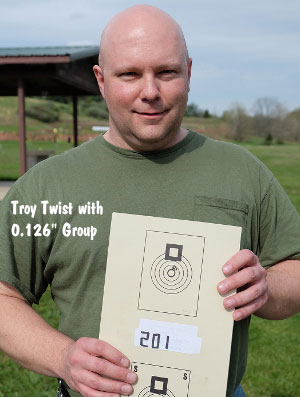
First Time’s a Charm for Troy Twist. Benchrest Novice Shoots 0.126″ Group.
Shooting a .126 group would make any Benchrest shooter happy. If you accomplish that feat the very first time you ever shot a bench rifle, and in a real match to boot, then you have Troy Twist’s story.
Troy works with Dale Boop and was always talking guns. Dale convinced Troy to show up for the 100-yard stage and Dale let Troy shoot one of Dale’s rifles. Troy performed like a champ, drilling a 0.126″ group — not too bad for a rookie! Nothing like a small group to get a new shooter interested in our game.
|
Sunday was beautiful with sunny skies and pleasant temps. The wind was another matter. The Heavy Varmint 200-yard stage was conquered by Harley Baker with a .2689 Aggregate. No Match 5 heroes emerged to take away another Agg win from Harley. The only other Aggregate under 0.3 was posted by Jeff Peinhardt. Jeff is a newer shooter that is making a name for himself in Benchrest. Finishing off the top three in the Agg was Wayne Shaw. Wayne is sometimes more associated with score shooting, but he is a top-flight group shooter as well.

The afternoon was set for Light Varmint 200 while the kaleidoscope of rapidly-changing flag colors continued. Jeff Stover led the way with a .2602 Agg. He tried to shoot whatever tail wind was available, and do it as fast as possible. Jeff got away with this sometimes dangerous tailwind strategy for four targets; on the fifth he was not burned as bad as he might have been. Closing in towards the end was Russell Rains with a .2904. Canadian Andy Laidlaw snuck into third place with a .2937 with the only remaining Aggregate under 0.3.

Andy Laidlaw from Canada loads between stages.
In the overall 2-Gun, Harley Baker was the class of the field with a .2466 for twenty targets. Stover followed with a rather distant .2791. Steady Kent Harshman finished close behind with a .2833. Interestingly, both Stover and Harshman were shooting pull-down 8208 powder (from the Vietnam War era) rather than Vihtavuori 133 or the new kid on the block, Accurate Powder LT-32.
 Two-Gun Top 3: Kent Harshman (Third), Harley Baker (Winner), Jeff Stover (Second). Two-Gun Top 3: Kent Harshman (Third), Harley Baker (Winner), Jeff Stover (Second).

Moving backers are used in 100/200/300 yard benchrest competition.

Dale and Russ Boop, shown above, are the sons of Nate Boop, in whose honor this Match has been held for 28 straight years. The Brothers Boop have been shooting Benchrest since they were little kids. Russ is in the Benchrest Hall of Fame and Dale is currently only two points out.
Father and Son Team — The Peinhardts
Jeff Peinhardt from Quarryville, PA owns PR2 Racing Technology. His company does national level motorcycle race engine development and tuning. His operation is a sophisticated engineering facility with CNC and the latest equipment. He has brought this analytical outlook and expertise to Benchrest.

Jeff is relatively new to the game, but has already excelled. His 16-year old son, Wyatt, has now moved from Junior Shooter to Rookie to Tough Competitor. Wyatt now runs with the “big dogs”. His father says the tougher the conditions, the better Wyatt does; he is a force to be reckoned with in the coming years.
May 14th, 2014
What do you call a shooting match that draws 125 competitors (ages 7 to 70), with 30 first-ever shooters, 36 ladies, and 17 juniors? We call that a rip-roaring success. Credit the Old Fort Gun Club in Arkansas for hosting such a successful event on April 26-27, 2014. The impressive turn-out shows the appeal of the NSSF Rimfire Challenge format, a fun match with FREE ammo provided by sponsors.
Video Shows Rimfire Challenge Fun Match.
The match attracted target shooters from 10 states. More than 30 participants said it was their first time competing in a shooting event. Thirty-six of the 125 competitors were female, 17 were juniors, and 17 were seniors. This is the kind of match that is fun for all age levels.

The NSSF Rimfire Challenge is a program of the National Shooting Sports Foundation, the trade association for the firearms, ammunition, hunting and shooting sports industry. NSSF Rimfire Challenge was developed to introduce newcomers to target shooting by providing individuals and families with a safe, fun and exciting first-time experience using .22-caliber handguns and rifles and steel targets.
Awards were given to the top three finishers in Open and Limited Divisions, along with the top finisher in the Juniors, Seniors, Ladies, and Cowboy/Cowgirl categories. All registered shooters were also eligible to win sponsor-provided prizes.

Support for the match was provided by Volquartsen Custom, Brownells, Ruger, Hogue, and other companies. “I’d like to thank NSSF for supporting these matches,” said Bill Striplin, match director and Old Fort Gun Club president. “In my opinion, the NSSF Rimfire Challenge is the most fun shooting game in the world.” Learn more about the NSSF Rimfire Challenge at www.NSSF.org/rimfire. That web site also has a schedule of future Rimfire Challenge matches around the country.

May 14th, 2014
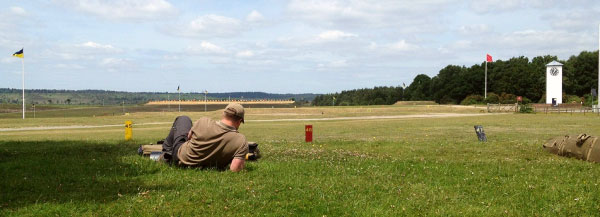
What does a 1000-yard target look like when viewed through a 25-power* First Focal Plane scope? Here’s the answer, thanks to our Dutch friend Jim de Kort. This interesting photo shows the Stickledown Range at the National Shooting Centre in Bisley, England.
Click any image for larger view.

Jim has published some other interesting images on his Facebook Page. Here is a view looking downrange at a 300m shooting facility. Jim says “It was nice to have 300m all to ourselves”. The overhanging baffles stop stray shots that might otherwise fly out over populated areas. This photo was taken at the Schietsportcentrum Emmen in the Netherlands.

How many of these cartridge types do you shoot? Jim has quite the collection of calibers.

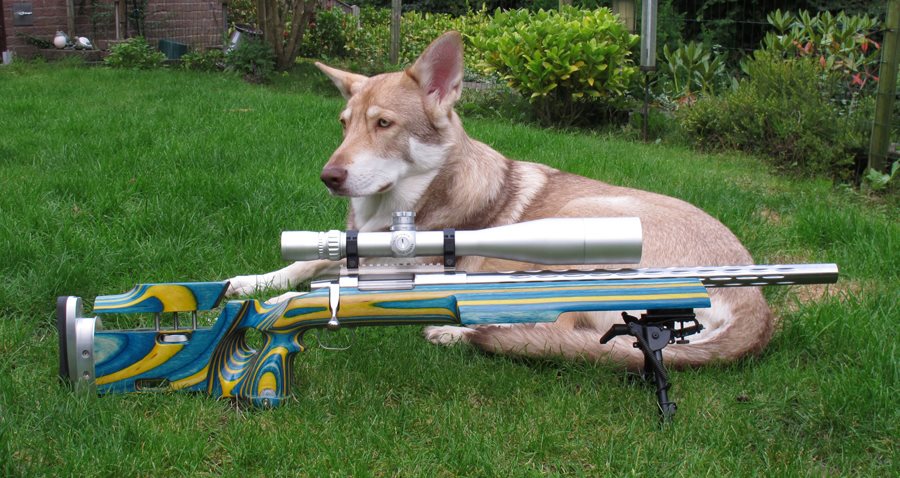
Jim likes faithful canines and accurate rifles. We know the feeling, and we bet many of our readers share Jim’s “favorite two hobbies” — dogs and guns. Jim says: “Dogs are like guns…. They bark, smell, eat expensive food, need cleaning once in a while and you have to take them outside regularly.”


*NOTE: The scope in the top photo is a Premier 5-25x56mm ER-MOA with 1/4 MOA clicks, “set at 20x so [Jim] can watch both neighbors”.
May 10th, 2014
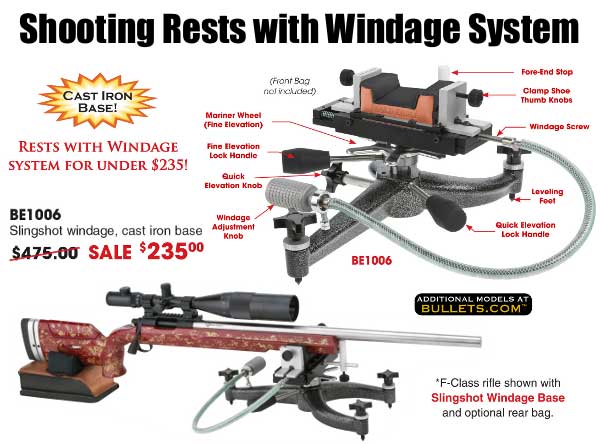
Need a high-quality front rest at an affordable price? Here are some of the best deals we’ve seen in years. Bullets.com just announced a massive price cut on its Bald Eagle brand front rests. Both the regular rests and the deluxe rests with flex-shaft windage adjustments are on sale. (These windage-adjustable rests are great for F-Class shooting.) Windage-adjustable rests start at just $215.00, while the conventional rests are marked down to $179.95 (less than half the original price!) Choose from Cast Iron or Aluminum bases, triangle or slingshot (wishbone) footprints. These are high-quality rests, with CNC-machined parts. They have been used successfully by many top F-Class and benchrest shooters.

Bullets.com tells us: “These rests were originally designed by a Benchrest shooter and refined by a member of the U.S F-Class Open Rifle Team. The rests have been thoroughly tested and proven to be reliable and capable of quick and accurate adjustments during string shooting.”
Bald Eagle Shooting Rests with Windage System ON SALE
BE1004 – Triangle, Aluminum, Reg. $425.00 — SALE $215.00
BE1005 – Slingshot, Aluminum, Reg. $425.00 — SALE $215.00
BE1006 – Slingshot, Cast Iron, Reg. $475.00 — SALE $235.00
Bald Eagle Shooting Rests without Windage System ON SALE
BE1128 – Triangle, Aluminum, Reg. $375.00 — SALE $179.95
BE1130 – Slingshot, Cast Iron, Reg. $399.95 — SALE $179.95
BE1129 – Slingshot, Aluminum, Reg. $375.00 — SALE $179.95

Along with offering super deals on front rests, Bullets.com has also slashed prices on its front and rear sand bags. Front Bags are marked dow to $27.50, while Rear Bags are on sale from $52.50 – $64.50. Large-diameter F-Class rest feet are also on sale currently. Get more details at Bullets.com.
May 7th, 2014
We first ran this story a year ago. Since then, many readers asked us: “Is there a good article that explains how to get started in F-Class?” Indeed there is… Rod Vigstol provides tips for F-Class rookies, plus a checklist of items to bring to the range.
How Easy it is to Have Fun with Rifles and Equipment You Probably Already Have….
Forum member Rod Vigstol (aka Nodak7mm) has written a great Introduction to F-Class for shooters getting started in this rewarding discipline. Rod’s article, which appears in German Salazar’s Rifleman’s Journal website, covers F-Class basics and addresses concerns that “newbies” may have when trying a new shooting sport. Rod stresses that most guys who own a varmint-hunting or tactical rig likely have nearly all the gear they need to give F-Class competition a try.

CLICK HERE to read Rod Vigstol’s ‘Getting Started in F-Class’ article on Rifleman’s Journal.com
Rod explains: “If you’re reading this, you have more than just a general interest in the shooting sports and in the awesome rifles that shoot tiny groups at insane distances. You probably even have friends that enjoy shooting as much as you do. The quandary you may find yourself in is your friends haven’t quite jumped into it head-first like you have and they haven’t spent a lot of money and time obtaining the equipment you have to go shoot these matches. But you know what? Your prairie-dog shooting buddy or coyote-hunter friend can attend these matches and shoot alongside with you. He or she more than likely already has the basic equipment needed to shoot a match.” Most varmint shooters already have a suitable, accurate rifle and the following equipment:
• A variable-power scope in the 4.5-14x range or higher.
• A front bipod like the trusty old Harris 9″-13″, or maybe even a basic pedestal front rest.
• A rear sand-bag or similar sand-sock to rest the butt stock.
• A basic shooting mat from Midway or at least a piece of carpet or canvas to lay on.

Rod also provides a handy checklist of items to bring to the range. These include: Canvas or carpet strip (to set under bipod), Notebook, Kitchen Timer, Cleaning Rod, Camp Chair, Elbow Pads, Shooting Hat, and Open Bolt Indicator (OBI). Along with rifle, bipod (or front rest), rear bag, and ammo, that’s pretty much all you need.

Rod encourages all shooters to give F-Class a try — even novices. Rod explains: “We have all been rookies, newbies, new kids on the block or whatever. So we all have a good idea of what may be going on in your mind, the questions and concerns you may have. I’m telling you this sport is full of fantastic people who deep down find it far more fulfilling to help a new shooter get started than running a clean target. You just have to take the first step to get involved.”
CLICK HERE To read the entire article on Rifleman’s Journal.com. We’ve only provided a small sample of Rod’s article; it is definitely worth reading in its entirety.
May 7th, 2014
Forum member Eric has built an innovative specialty pistol for long-range benchrest. The gun is chambered in 6.5-284 and built for IBS 1000-yard shooting. Eric originally built the gun with a 3″-wide fore-end, then decided to go with a 6″-wide offset design since the IBS no longer restricts Light Gun Forearms to three inches. Eric explained: “After building the 3″-wide stock I looked at the IBS 1000-yard benchrest rules and found out that there was not a width limit and rails were allowed for a Light Gun stock. I set out to design a 6″ version. I was thinking it should be offset also to help control torque and track straighter. I had a new 6.5mm, 1:8.5″ twist, 1.250″ HV-contour Krieger barrel. I chambered the barrel for 6.5-284 and bedded the stock.”


Eric feeds his pistol Sierra 142gr MatchKings with a load of 51.0 grains of H4831sc. Estimated muzzle velocity with this load is 2900 fps — respectable speed from the short barrel. The gun tracks remarkably well, with very little torque effect, as you can see in the video below.
After initial testing, Eric added a muzzle brake to the barrel. This tamed the recoil considerably. To learn more about Eric’s long-range 6.5-284 pistol, visit our Shooters Forum and READ this POST. To see more videos of the pistol in action (with muzzle brake), visit Eric’s PhotoBucket Album.

May 6th, 2014
 USAMU Service Rifle shooter/instructor SSG Brandon Green set a new national record this past week, shooting a 500-33X in the individual Aggregate, National Match Course (NMC) with metallic sights. Green was near-perfect in the 200-yard Rapids, shooting an amazing 100-9X. Green was shooting a Tubb 2000 bolt-action rifle chambered in 6XC. He set the new record using Norma factory ammo. Yep, this was factory 6XC ammo, right out of the box. USAMU Service Rifle shooter/instructor SSG Brandon Green set a new national record this past week, shooting a 500-33X in the individual Aggregate, National Match Course (NMC) with metallic sights. Green was near-perfect in the 200-yard Rapids, shooting an amazing 100-9X. Green was shooting a Tubb 2000 bolt-action rifle chambered in 6XC. He set the new record using Norma factory ammo. Yep, this was factory 6XC ammo, right out of the box.
National Record Score Card of SSG Brandon Green

SSG Green is the current NRA High Power National Champion and Interservice Rifle Champion. He and the rest of the USAMU rifle team have trained hard for the 2014 season. Yet Brandon joked about his record-setting performance, noting that the record was shot with his “back-up” gun. On his Facebook page, Brandon posted: “500-33X NMC. Not positive, possibly a record [Editor: Yes it was.] Not too bad for a #2 gun.” Not too bad indeed, Brandon. Congratulations on this achievement. This bodes well for Green’s goal to win a second straight National High Power Championship at Camp Perry this summer.
Note: After setting a National Record with 500-33X during the individual match with his Tubb 2000, SSG Green followed with a 498 the following day using a Service Rifle during the team match. Remarkable.

File photo of Green with Service Rifle (posed publicity photo).
May 5th, 2014

The 2014 Eastern CMP Games and Creedmoor Cup Matches are underway at Camp Butner, NC. This popular event, held May 2-11, offers a wide variety of shooting competitions, including: Rimfire Sporter Match, M16 Match, M1 Garand Match, Springfield Match, M1-Carbine Match, Vintage Military Match, Modern Military Match, Vintage Sniper Match, Pistol Matches and more. The Eastern CMP Games kicked off Friday, May 2nd. Set for the next two days are the Garand/Springfield/Vintage & Modern Military Match (two days), Carbine Match (Monday), and Vintage Sniper Team Match (Tuesday). The Creedmoor Cup Matches segment commences on May 7th with a Highpower Clinic and 4-man Team Match.
CLICK HERE for Complete CMP Eastern Game Results
CLICK HERE for Complete Creedmoor Cup Matches Results
View Eastern Games Booklet With Event Info, Match Schedule, and Rules


May 4th, 2014
We recently wrote about a spectacular 2.6872″ ten-shot group shot at 1000 yards in Montana. Well Australian Peter Varley recently turned in another amazing group at 1000 yards — this time 2.010″ for FIVE shots. And he did it with a borrowed gun! That’s not the smallest 1K group ever shot on the planet*, but it’s still an Australian and (we believe) a Southern Hemisphere record. Varley shot the 2.010″ group with a borrowed 17-lb Light Gun at a Canberra Rifle Club match in March of this year. Congrats to Peter for his outstanding shooting. And “hats off” to fellow Queenslander John McQuire, who loaned Peter the rifle.
Shown below is Peter Varley with his target, plus a close-up. You’ll note that two of the five (5) shots go through a paster. You’ll find pasters all over these targets because the Canberra Club “recycles” these large 1K targets many times.


Peter reports: This was shot at a 1000-yard match on the Canberra Rifle Range on Sunday, March 9, 2014. I traveled 1300 kilometers (807 miles) from Nambour (Sunshine Coast) Queensland to Canberra in the Australian Capital Territory.
I had left my rifle case keys at the motel and resigned myself to target butts duty or a lazy day. A friend, John McQuire from Mackay (Central Queensland Coast) said: “Get my 6.5 x 47 out, clean up, and you’re in the first detail (relay)”. So it was a borrowed gun for the shoot. The match commenced around 9:00 am. Conditions were very good — winds were very light with no mirage to speak of. Everything fell into place.”
Gun Specifications: Lawton 7500 action with Jewell trigger, PacNor barrel chambered for 6.5×47 Lapua, home-made custom stock, March 10-60x scope
6.5x47L Load: Lapua 123gr Scenars, with CCI 450 primers and Varget (ADI 2208) powder.

*The current NBRSA Light Gun 1000 Yard 5-shot group record is 1.473″ by Bill Schrader in 2002. Tom Sarver is credited with an even smaller 5-shot IBS Light Gun record.
May 2nd, 2014
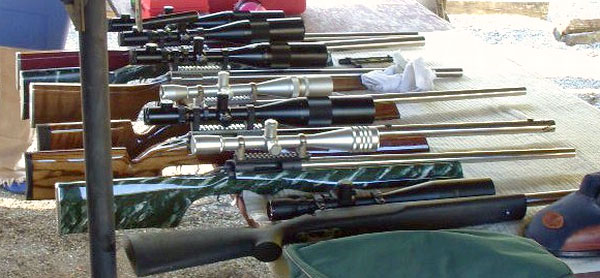
 With all the talk about Dashers, 6.5×47 Lapuas, or the big 7mms, it’s worth remembering that the “plain Jane” 6mmBR Norma really is a superb mid-range cartridge. That was demonstrated recently at the 2014 Roanoke Egg Shoot, a clay-bustin’ multi-distance match with targets at 330, 425, and 500 yards. At Roanoke, the 6mmBR (aka 6BR) was the most popular chambering. In fact, 25 out of 43 rifles (58%) were 6BRs. And this little cartridge did most of the winning. In Factory Class, seven of the Top 10 were 6BRs, including first and second place. In Open Class, eight of the Top 10 were 6BRs, including second and third place. And the Open Class winner, a 6BRX piloted by Forum member Mark Schronce, was a 6BR Improved, formed from 6mmBR parent brass. With all the talk about Dashers, 6.5×47 Lapuas, or the big 7mms, it’s worth remembering that the “plain Jane” 6mmBR Norma really is a superb mid-range cartridge. That was demonstrated recently at the 2014 Roanoke Egg Shoot, a clay-bustin’ multi-distance match with targets at 330, 425, and 500 yards. At Roanoke, the 6mmBR (aka 6BR) was the most popular chambering. In fact, 25 out of 43 rifles (58%) were 6BRs. And this little cartridge did most of the winning. In Factory Class, seven of the Top 10 were 6BRs, including first and second place. In Open Class, eight of the Top 10 were 6BRs, including second and third place. And the Open Class winner, a 6BRX piloted by Forum member Mark Schronce, was a 6BR Improved, formed from 6mmBR parent brass.
Mark tells us the conditions were great this year: “We had eleven clean scores [of 15] in Open class. One of the 15s was shot by 8-year-old Cash Brown. Watch out for this young man, he is a shooter!”. With so many cleans there were many shoot-offs to determine the Top Three in each class. Mark explains: “We shoot one round each, no sighter at 500 yards, on 3.5″ clays, until one guy wins.”

*Mark also shot a 15 with his second rifle, chambered in 6mmBR Norma. Mark’s Open Class-winning 6BRX rifle featured a Bat B action and Mike Davis-chambered 26″ Krieger 1:8.5″-twist barrel. Mark loaded Berger 105gr VLDs, pushed by Varget and Fed 205M primers.
Young Guns Shine at Roanoke
Forum member Greg M., (aka Coleridge), also attended the Roanoke Match: “I made it into the Open Class Shoot-Off with two separate guns (6BR and 6-6.5x47L) … only to get whipped by both of the two youngest shooters there (one with my own gun!).” Greg noted that: “the Open Class Second Place finisher was also a youngster, Blake, my 15-year-old son. It won’t be long before Blake and [8-year-old] Cash are whipping us way too often. I’m just glad neither one of them was shooting in factory class!”

Course of Fire
The main match at Roanoke encompasses three yardages. All guns engage 15 clay targets: five 2.5″ clays at 330 yards, five 3.5″ clays at 425 yards, and five 4.5″ clays at 500 yards. Shooters are allowed TWENTY rounds, (no separate sighters). All rounds must be shot in one setting, with a 10-minute time limit. Shooters can shoot targets in any order.
Class Rules
In the primary clays-shooting competition, there are two (2) classes, Open and Factory. In the Open class there is a 30-lb weight limit and no rail guns are permitted. Beyond that, pretty much “anything goes”. The Factory Class is more tightly controlled — this is a true factory class, no customs allowed, not even Coopers. The only upgrades allowed are bedding and trigger job/replacement.
 Egg Shoot Is Challenging Egg Shoot Is Challenging
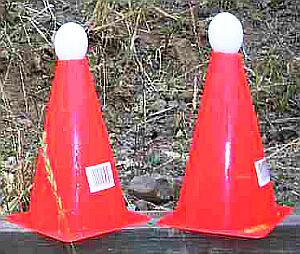
In addition to the main clays-shooting match, there is an actual Egg Shoot, conducted separately. For the Egg Shoot, there are no classes — competitors pick their best rifle. After a five-minute warm-up, competitors get two shots to hit one egg at 500 yards. It costs two bucks for each entry — and you can shoot until your money or ammo runs out. All competitors who hit an egg then go into a Shoot-Off for glory and cash awards. Jonathan Dunn, shooting a 6BRX, won the Egg Shoot scoring 3 of 4 hits on eggs in the Shoot-Off stage.
|