|
|
June 12th, 2014
Creedmoor Sports has hired ace marksman Tyrel Cooper “as the newest addition to the Creedmoor Sports family”. Ty brings with him a wealth of knowledge and experience as a service rifle shooter, match rifle shooter, and long range shooter. Cooper’s shooting resume includes five national championships (one each in 2008, 2011, 2012, and two in 2013). He is the current (2013) NRA National Long Range Champion, and reigning (2013) NRA National Service Rifle Champion.

Creedmoor’s General Manager, Dennis DeMille, states: “I’ve known Ty and watched him progress from the time he was 14 years old attending matches with this parents, Lonnie and Lupe, and his sister Sam. Even at that young age his maturity and potential was obvious. His 10 years as a member of the elite USAMU squad allowed him to realize that true potential, becoming one of best service rifle shooters of all time…and he’s not done. Customers who call Creedmoor Sports to get advice on shooting equipment, or shooting in general, will be able to get that advice from either Ty or myself. His quiet, polite and humble demeanor make him a perfect champion and representative for Creedmoor. When we heard Ty might be available we couldn’t risk missing an opportunity to get him on board.”

Below is a 2012 file photo of SSG Ty Cooper shooting a service rifle. Cooper won the 2013 NRA National High Power Rifle Long Range Championships with a final score of 1243-71X. In the Long Range Championships, Cooper used a Nesika-actioned bolt gun with long barrel chambered in 7mm SAUM.

June 8th, 2014
 This is the result a high power competitor dreams of seeing: 100-10X. This was shot recently by 2013 National High Power Champion SSG Brandon Green during the 200-yard sitting stage at the Tennessee Regional match. Another high power shooter commented: “Brandon Green [shot] about a two-inch group, rapid-fire sitting from 200 yards! Most competitors have never seen one of these.” This is the result a high power competitor dreams of seeing: 100-10X. This was shot recently by 2013 National High Power Champion SSG Brandon Green during the 200-yard sitting stage at the Tennessee Regional match. Another high power shooter commented: “Brandon Green [shot] about a two-inch group, rapid-fire sitting from 200 yards! Most competitors have never seen one of these.”
Brandon shot 100-7X on the next string, to end up with 200-17X for the sitting stage. He had 199-13X standing. Overall, when the dust settled and he completed his other yardages, he finished with 798-53X for the day. That’s impressive shooting by a great marksman. We believe Brandon was shooting a Tubb 2000 bolt-action rifle chambered in .260 Remington.

June 7th, 2014
Report by Randy Jarvais for IBS
On Memorial Day weekend we honor fallen heroes. And for score shooters, that time of year also means the Maine Firecracker and 100-200-300 State Championship. The Firecracker represents one of four opportunities in IBS score shooting to earn the coveted 750 sticker. In score shooting you fire one record shot per bullseye, with five scored bulls per target sheet (plus a sighter bull), and five sheets per yardage. Thus, there is a maximum score of 250 per yardage, or 750 points for a 3-day championship.

CLICK to Zoom Photo of the Whole Gang

What started years ago as a two-day affair in July (hence the name “Firecracker”), morphed to three yardages in two towns. To allow for three days of shooting, the event shifted to Memorial Day weekend. Orrington Rod & Gun Club hosts the 100- and 200-yard stages, but since Orrington lacks a 300-yard option, the venue shifts to the Lincoln County Rifle Club (Damariscotta, ME) for the third and final leg.
| Grand Agg Winners — 2014 Maine Firecracker and 100-200-300 State Championship |
|
Varmint for Score:
1. Wayne France 743-21X
2. Kim Llewellyn 742-31X
3. Frank Danisienka 742-19X |
Hunter Class
1. Gary Long 736-22X
2. Charles Brock 731-14X
3. Dean Breeden 728-23X |
| Grand Agg winners were a repeat of 2013. Like last year, Wayne France shoot consistently well to take VFS honors (though he did not win a yardage). Gary Long won two of the three yardages in Hunter Class to take the Grand. Dean Breeden was the Two-Gun winner with 1469-58X. He was the only shooter to shoot two guns. Dean had High X-Count in each class with 35X and 23X respectively. |
| CLICK HERE for Spreadsheet with Complete Firecracker and 100-200-300 Match Results |
There were 36 guns for Saturday’s start at Orrington. The field included the top 5 finishers in last year’s Varmint for Score (VFS) Shooter of the Year standings, and 6 of the top 7 Hunter Class shooters. The forecast for the weekend called for showers early with some breaks of sun plus the added possibility of thunder showers during the 300-yard stage. For the most part, the forecast was correct.
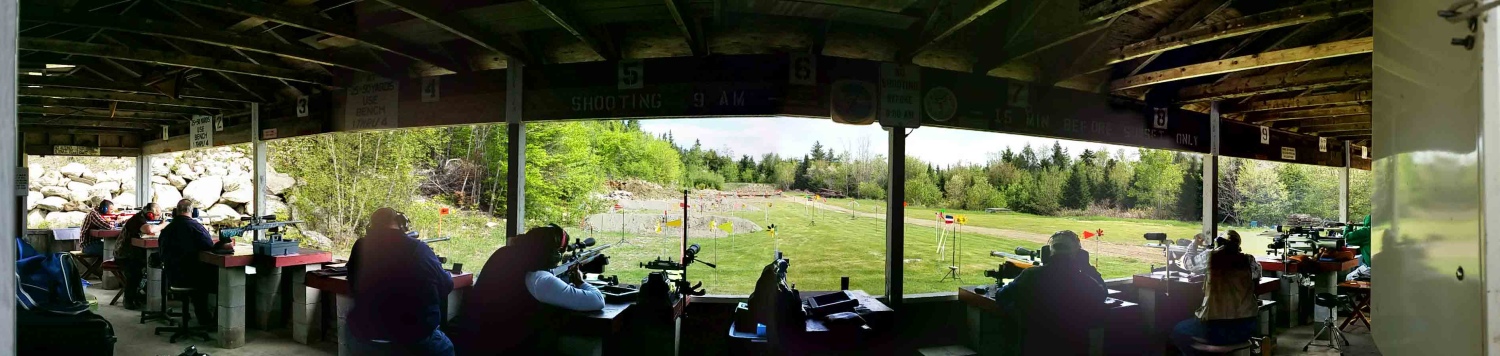
Firing Line at Orrington — CLICK to Zoom. (Hillary Martinez panorama photo)
Butch Randall with a Patriotic Rig

Last-Minute Enhancements at Orrington
As shooters arrived on the eve of the tournament to register, I am sure they didn’t believe their eyes. The Orrington club had literally just finished pouring concrete for a modular system of target frames at two hundred yards. The 100-yard version was poured that morning. An excavator sat in front of a huge mound of dirt at 75 yards, while a bulldozer was back-filling around the freshly poured concrete at 100 yards. Amazingly the range was finished and the new target frames were ready to go the next morning. Orrington is quite rural despite being just a few miles away from Bangor,one of the larger cities in Maine.

Hillary Martinez Shows the Boys How It’s Done at 100 Yards
The VFS 100-yard leg at Orrington was a run-away. While most struggled with the switchy 7-15 mph conditions, one shooter found her stride early and put a whupping on the other competitors. Hillary Martinez, a third year Breeden protégé, was marvelous throughout the day. Coming off a recent 200-yard win at Fairfax, Virgina, Hillary took the lead in match 2 and then ran away from the field. On a range where 18 or 19 Xs are usually good enough to win, Hillary hit the dot 23 of 25 times. That’s outstanding to say the least! Greg Palman, the Orrington match director, creedmoored Dick Grosbier for second place. Both men garnered 250-19X scores.

In Hunter Class, veteran shooter Gary Long jumped out to an early lead with a 50-4X target. Not to be outdone, Scott Garman followed up with a 50-4X target of his own in Match 2. Dean Breeden and Charles Brock then moved ahead. At day’s end, Dean’s finished first with a 250-11X, followed by Charles at 250-10X. Third went to Orland Bunker.
With similar conditions as Saturday, Sunday’s 200-yard stage started with overcast skies and mild winds. In VFS, Wayne France put up a 50-4X for an early lead. Dean shot a masterful 50-5X in Match 3. By day’s end, four shooters shot clean to earn a 500 sticker. Dean Breeden shot a 250-12X for the win, followed by John Cascarino with a 250-10X. Third went to Randy Jarvais with 250-8X. The 4th “clean” shooter was Wayne France with a 250-7X. Gary Long was the lone 6-power shooter clean after Match 1. Long finished with a 248-5X, good enough for first place. After two days at Orrington, awards were handed out. The Top Performers for the 100-200 Grand Agg at Orrington were:
VFS: Dean Breeden 500-31X; John Cascarino 500-23X; Randy Jarvais 500-22X
Hunter: Gary Long 496-20X; Charles Brock 496-13X; Dean Breeden 495-21X
Setting Up the Wind Flags and Wind Probes at Orrington
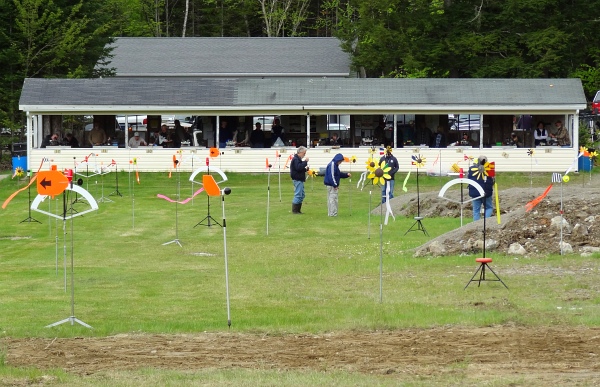
The View Down-Range with Flags in Place at Orrington (click to enlarge).

Moving On to Lincoln County
 The Lincoln County Rifle Club resides in Damariscotta, Maine which is a community surrounded by lakes and coastal waterways. The ocean is but a few miles away thus the wind conditions at the range can be adversely affected by the tides, or so goes the tale. Whether true or not, only five people in the history of this range had ever shot a 250 at 300 yards and this range has participated in IBS score shoots for decades. Three of the five were present to try again. The Lincoln County Rifle Club resides in Damariscotta, Maine which is a community surrounded by lakes and coastal waterways. The ocean is but a few miles away thus the wind conditions at the range can be adversely affected by the tides, or so goes the tale. Whether true or not, only five people in the history of this range had ever shot a 250 at 300 yards and this range has participated in IBS score shoots for decades. Three of the five were present to try again.
Tough Conditions at 300 Yards
After Match 1, of the 35 guns, only six VFS and one Hunter managed a 50. That left but three shooters with hopes of earning a 750 sticker. The wind became the story of the day as it continued to accelerate and switch directions irregularly and constantly. By the conclusion of Match 2 at Lincoln County, no one was getting a 250 sticker and the leaders were down by two. This author shot on Relay 1 and I can categorically tell you it did not lull on my watch!
Under the Eaves at the Lincoln County Rifle Club, Damariscotta, Maine


It became a game of survival and it was not a matter of if you were going to drop a point (or two, or three) but when and how many. Ask Jim Goody or John Cascarino about their errant shots during Match 4 that went from one scoring box all the way to another resulting in a minus 10 points with one shot. Don’t forget that they were holding wide for the wind already. Oh, by the way, they were on Relay 1 and were in or near the “honey hole”. Yeach, right! Both dropped 14 points in the one match.
So… who best survived the tough conditions at 300 yards? VFS honors go to Frank Danisienka (245-0X), Andy Buzzell (244-4X), and Kim Llewellyn (244-3X). In Hunter Class, the top three were Gary Long (240-2X), Peter Hills (239-2X), and Charles Brock (235-1X).
The Long Walk to the 300-yard Targets at Lincoln County

June 4th, 2014
Report based on story by Ashley Brugnone, CMP Writer/Editor
Would you like to learn AR marksmanship under the tutelage of world-class USAMU team members? Then consider attending the Civilian Marksmanship Program’s Rifle Small Arms Firing School (SAFS), held Wednesday, July 16-17, during the National Rifle and Pistol Matches at historic Camp Perry. SAFS courses have been conducted at the National Matches since 1918. Hundreds of rifle participants are expected this year.

The school is structured toward teaching new shooters, so no past firearm experience is required. Intermediate shooters are also welcome to participate. Students will learn basic firing practices and competition skills. In addition to the live fire practice, students will compete in an EIC Match. All participants will be instructed by members of the U.S. Army Marksmanship Unit (USAMU) and coached by Military Rifle Team Members or CMP Rifle Master Instructors.
CLICK HERE for Small Arms Firing Schools INFO | CLICK HERE for Rifle SAFS Registration.
For those already familiar with rifle shooting, an Advanced Rifle Course will also be held to provide additional class instruction and the chance to fire in a special Excellence-In-Competition (EIC) Match. Whether an experience shooter or picking up a firearm for the first time, come enjoy a day of fellowship and fun in one of America’s oldest pastimes with the security and knowledge of some of the best marksmen in the country!

May 25th, 2014
This September, the NRA will host The 1st Annual Trijicon World Shooting Championship (WSC) at the Peacemaker National Training Center in Glengary, WV. Intended to be the “mother of all shooting matches”, this event involves four days of multi-discipline shooting at ranges from 15 to 1500 yards (and beyond). Competitors must be skilled with pistol, rifle, and shotgun. The goal of this match is to assemble the top 400 shooters from all the leading shooting sports, and then crown one undisputed World Shooting Champion. The “top guns” will share in $300,000 worth of cash and prizes.
The organizers of the WSC have just published the Official Rules and Course of Fire for the 4-day event. This is now available, for free, in PDF format. This WSC Rules Document provides a Match Overview, Match Scoring Rules, Description of each stage, Course of Fire for each stage, and List of Firearms for each stage. CLICK HERE for World Shooting Championship Rules and Stage Descriptions.

Stage 5: NRA F-Class
Basic Stage Description: The NRA F-Class Stage is [a] long range bulls-eye course of fire, and is governed by the NRA F-Class Rule Book. In this particular stage an FNH USA SPR 308 Rifle with a 20 inch barrel will be used to measure a shooters ability to shoot at long range.
Course of Fire: From the 500 yard line, shooters will fire a total or maximum of 3 sighter shots and then fire a total of 10 shots for record on the official 500 yard F-Class target. Shooters will have a maximum of 10 minutes to complete the “for record” period of fire.
All shooters will compete over the course of four days in twelve equally weighted, officially sanctioned disciplines from various shooting sports. All firearms and ammunition will be provided for each event thus shooters will compete with common firearms and ammunition. This will also alleviate the need for new equipment to be purchased for unfamiliar events; and assist with international and domestic travel for all competitors.
Match Information:
Actual Match Dates: September 10, 2014 – September 13, 2014 (Check-In on Sept. 9th)
Location: Peacemaker National Training Center, Glengary, West Virginia
Contact: info@peacemakernational.com or call 304-229-GUNS (4867)

May 24th, 2014

Report by Jaime Hammer, IBS Social Media Manager
On Saturday, May 10, 2014, Piedmont Gun Club in Rutherfordton, NC (located near the Chimney Rock and Lake Lure area) held a 600-yard benchrest match. Weather conditions could not have been better. The air was cool, the sky was overcast, and there was very little wind. It rained for about thirty minutes in the morning, but that didn’t interfere with shooting, and the remainder of the day was dry. The match began at 9:00 AM with the Light Gun (LG) class, and the Heavy gun (HG) class shot in the afternoon. Thirty-three competitors (including many of the nation’s top 600-yard shooters) attended the event.

Dominant Performance by Paul Isenhour
Paul Isenhour took home first place prizes for LG score, LG group, and HG group. He potentially set a new Two-Gun Group Size Aggregate record (the current record is 1.7797″ by Mike Hanes). In the LG class, Paul’s score total was 195 points, and his group size Agg was 1.708″. In HG class, Paul’s score total was 180, and his group size Agg was 1.769″.
In Light Gun class Paul was on fire right out of the gate — he shot a stunning 1.130″ (50-2X) on the first Light Gun target, followed by a superb 1.330″ (50) on the second LG target. That’s right, Paul shot two, 50-point, sub-1.5″ groups back to back. That is truly spectacular shooting. And Paul was quick to credit the stock-maker (Paul made the handsome stock himself). Paul’s 6mm Dasher features a Stiller Viper action, Bartlein barrel, and Leupold 45X scope. He was running Berger 105g Hybrid bullets pushed by Varget powder and Federal primers.

Paul Isenhour was on fire in Light Gun! Back to back, he shot a 1.130″ with 50 points, followed by a 1.330″, again with 50 points. That is astounding accuracy!
In the LG class (score), Larry Wheeler came in second place with a score of 193. Reggie Wilson came in third place, with a score of 192. In the LG class (group), Reggie Wilson came in second place with a score of 1.861. Chad Jenkins came in third place with a score of 2.000. In the HG class (score), Chris Childers came in first place with a score of 197. Mike Hanes came in second place with a score of 193. Richard DeSimone came in third place with a score of 190. Finally, in the HG class (group), Richard DeSimone came in second place with a score of 1.917. Jeff Godfrey came in third place with a score of 2.217. Top shooters received beautiful plaques for their great shooting. All winners and shooters competed with outstanding skill and sportsmanship.
Download Piedmont 600-Yard Full Results .XLSX | (Download smaller XLS Version)
Download Piedmont 600-Yard Equipment List .XLSX | (Download smaller XLS Version)

Chad Jenkins, Jeff Godfrey, Paul Isenhour, Mike Hanes, Rich DeSimone, Reggie Wilson, Chris Childers.

Piedmont Gun Club has been the host club to several record-setters, three of whom (Rodney Wagner, Mike Hanes, and Chad Jenkins) attended this match. Rodney, Mike, and Chad set their records in May and July of 2013 for Group, Score, Group Aggregate, and Score Aggregate in Light Gun class, respectively. Rodney shot a spectacular 0.336″ group at Piedmont last year. An IBS Light Gun record, that was the smallest 600-yard group in history — the smallest 5-shot group ever shot at 600 yards by anyone, anywhere, in any type of shooting match. Initially measured at 0.349″, Rodney’s record group was certified at 0.336″. That is a record for the ages.
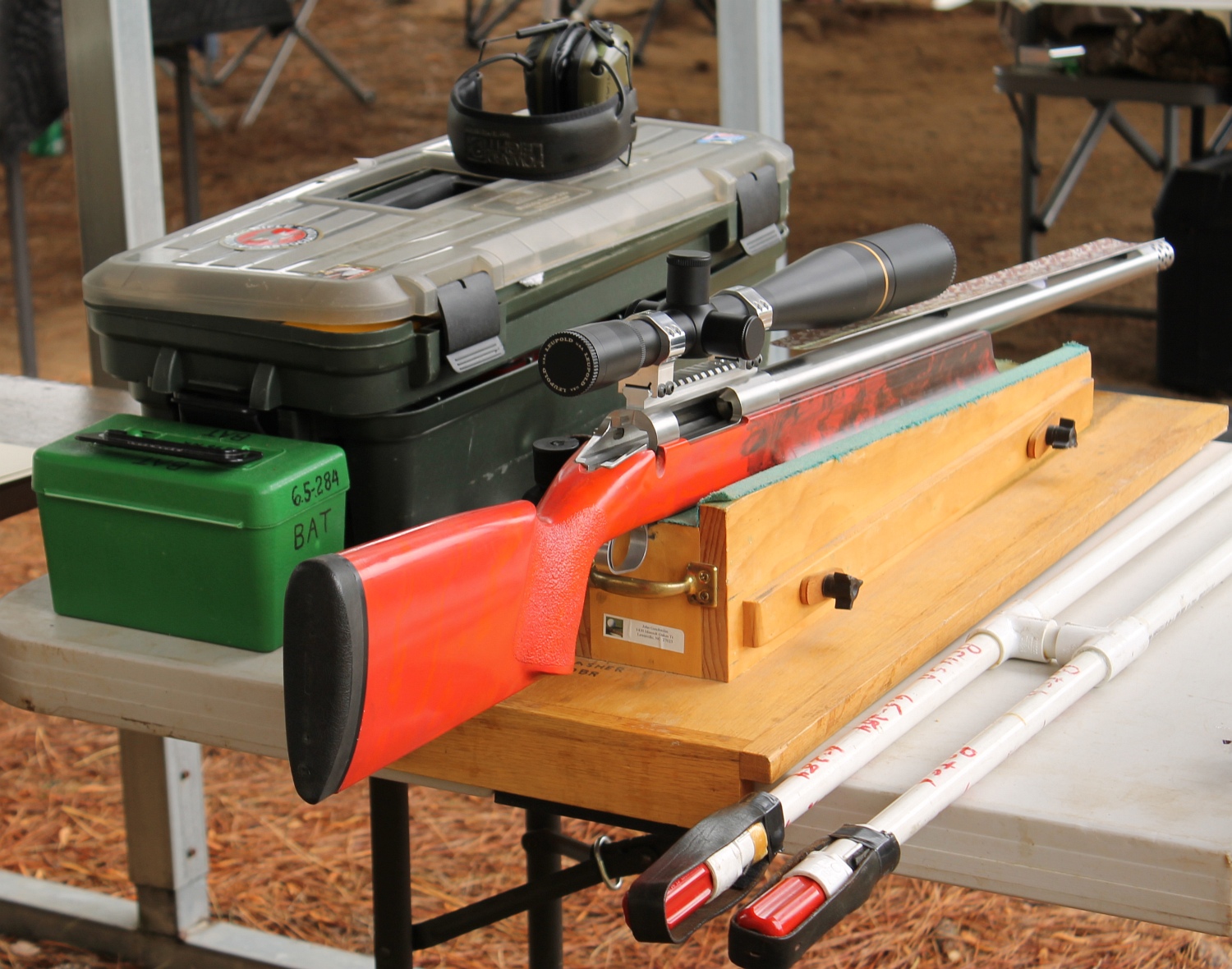
Table-Top Rifle-Cleaning Cradles
Among the interesting gear on display at Piedmont were a variety of hand-made cleaning cradles designed to fit on table tops. These typically employ a box-style design, with layer of cloth or other padding to cushion the underside of the stock. On display were both single-rifle cleaning cradle/boxes and dual-rifle rigs. This is a good do-it-yourself project that can be built with simple tools.
Click Photos to View Large Versions

Notice that these cradle-boxes feature an extended lower section in the rear. This lower “lip” butts up against the edge of the table so the whole assembly stays in place. In the photo above it appears that the lower section may actually be cut from a rubber block, but we’re not sure.


Piedmont Runs a Great Show
Everyone at the match was extremely welcoming, friendly, and helpful. As a rookie, I found that other shooters were quick to answer any questions I had regarding shooting, reloading, the match, or the club. Rookie shooter Paul Hammer said, “The shoots at Piedmont Gun Club are always well-run and organized. Everyone is nice and willing to help new shooters.” You don’t have to win a trophy to have a great time. One shooter observed that he doesn’t really pay much attention to his score — he attends matches to have fun and socialize.

Check out this nice bench set-up with an angled ammo caddy, custom “back-stop” for ejected brass, and a big, stable “gator”-style rear sandbag. If you look carefully, you’ll see another sandbag positioned just to the right side of the butt-plate. This bag helps support the shooter’s forearm for his trigger hand.
If you are interested in shooting at Piedmont, a schedule of events can be found by selecting the “Schedule” tab at the top of the website. Match registration is held at the beginning of each event. You can join the Piedmont Gun Club by logging in to PiedmontGunClub.com. Click the “About” tab at the top of the Home Page, select “Member Application”, and print that form. Once you’ve filled the form out, mail it to the address supplied on the application.
All shooters, myself included, are very appreciative of Piedmont Gun Club for hosting such a smoothly running match, where the level of camaraderie among shooters is very high. The quality of the facilities, experience in organizing events, and helpfulness of participants all came together to create a prime environment for benchrest rifle shooting.

Here’s a handsome Light Gun with an Obeche “Indian Paint” laminated Shehane Tracker stock. Click the photo to see a larger full-screen version showing the whole rifle.
May 22nd, 2014
Richard Schatz, the “Duke of Dashers”, has done it again. Just look at that group! Believe it or not, that is five shots at 600 yards. There are four shots in one ragged hole, with one a bit to the right. The group, initially measured at between 0.402″ and 0.410″, is very close to an IBS World Record. Assuming (on the high side) that that group measures 0.410″, that works out to 0.065 MOA. Wow.


Schatz, a past IBS 600-yard National Champion, shot this group in a Heavy Gun relay on May 18, 2014 at the Columbus Sportsman’s Association range in Columbus, Wisconsin. Richard was using his trusty 6mm Dasher, a 17-lb Light Gun that he has been shooting for years. His ultra-accurate load consisted of 103gr Spencer Bullets pushed by Varget and CCI 450 primers. The Lapua brass had recently been annealed and he batched his record rounds “by feel” based on the force needed to seat the bullets.

Richard said the group involved a good bit of luck, and perfect timing. The conditions were generally “switchy and difficult” at the match. However, in one Heavy Gun relay, Richard said “the wind flags just dropped straight down at the end of the sighter period. It’s like the range went dead.” Richard had windage on his scope so he just held off to correct for the calm. “I didn’t guess the hold-off correctly”, Richard admitted, “that’s why the shots ended up at the edge of the 9 Ring.”
Twenty Seconds of Near-Perfect Shooting
Richard got his five record rounds down range in about 20 seconds. He can shoot faster but, given the exceptional conditions, he took a little more time to aim: “Because the flags dropped and conditions stayed calm, I slowed down a little. I made more of a deliberate attempt to shoot a small group — a conscious effort to aim more precisely. Normally I’ll try to shoot the quickest I can get the dot close to the center of the X. I was trying to be a little more precise this time.”
Whatever Richard did, it sure worked. That’s a spectacular group — one of the smallest ever shot at 600 yards. Richard, a modest guy, credited the group to good conditions, and good luck: “Like I always say ‘the wind can blow ‘em in just as easy as it blows ‘em out’.” Richard says this rifle, with the current Krieger barrel, can typically put five shots in about two inches at 600 yards, in calm, stable conditions.

Very Close to an IBS Heavy Gun Record
The current IBS 600-yard, five-shot Heavy Gun group record is 0.404″, set by John Lewis in 2008. This recent group by Richard Schatz is very, very close to that mark. At Columbus, Wisconsin, four different measurers examined Richard’s group on May 18th. The four measurements were: 0.402″, 0.403″, 0.410″, and 0.409″ (see photo). Whether or not this is a new record will be determined by the IBS official measurement committee to which the target is being submitted. It’s worth mentioning that Richard Schatz currently holds the IBS 600-yard Heavy Gun score record, with a value of 50 points (and 0.634″ tie-breaker).

Rifle Specifications:
Nesika Action
Krieger 1:8″ twist barrel, 27″ length, 0.236″ bore
Chambered for 6mm Dasher with 0.272″ neck
and 0.104″ Freebore
Shehane “Baby Tracker” stock
Nightforce 8-32x56mm NSX Scope |
Load Specifications:
Clay Spencer 103gr bullets
Lapua 6mmBR brass (formed to Dasher)
Cases skim-turned for .0035 total clearance
Hodgdon Varget powder, 32.2 grains
CCI 450 primers
Muzzle Velocity 2980 FPS |

May 22nd, 2014
The Bianchi Cup is underway. A record-setting 295 competitors are competing in the 35th anniversary of the NRA Bianchi Cup, which runs May 21-24 at the Green Valley Rifle & Pistol Club outside Columbia, Missouri. The first day at the 2014 MidwayUSA & NRA Bianchi Cup has just wrapped up and there’s plenty of shooting left. Scores are low and it’s still – theoretically – anyone’s game.

Story based on report by Kyle Jillson for NRABlog.com.
The richest and most prestigious handgun shooting tournament in the world, the NRA Bianchi Cup draws skilled pistol shooters from all over the globe. They come for glory… and the loot. This year there will be $500,000 worth of cash and prizes up for grabs.

This event was founded in 1979 by former police officer and holster maker John Bianchi. Success in the Bianchi Cup requires a perfect balance of speed and accuracy. The 192-shot championship allows a maximum aggregate of 1920 points across four timed events: Practical, Barricade, Moving Target and Falling Plate. In addition to being grouped by age, gender, and shooting skill, competitors may opt to shoot in the Open, Metallic, or Production divisions.


Last year’s Open champion, Doug Koenig, is looking to notch his 16th Overall Title and his strong start at the Practical Event is a good first step. Among the other defending champions, past Ladies champion Jessie Duff (photos below) is eyeing a fourth title. National Police Shooting Championship legend Robert Vadasz hopes to earn a sixth Bianchi Cup title in the Metallic Sight Division.


Special Prizes for First-Time Bianchi Competitors
Shooters making their first appearance at the Bianchi Cup will be eligible for a special award from title sponsor MidwayUSA. The top three first-time men, women, and juniors will receive cash prizes of $2,500 for first place, $1,500 for second, and $750 for third.
May 20th, 2014
To be honest, we’re not sure how we feel about the whole zombie-theme marketing efforts in the gun industry. However, if you’re into green-tipped bullets, and blasting replicas of the undead, then get ready for the biggest Zombie-themed shooting match of the year. Hornady’s epic Zombie in the Heartland Pandemic is two weeks away. This event will take place May 30 – June 1, 2014 at the Heartland Public Shooting Park in Grand Island, Nebraska. The Pandemic traditionally has a rich prize table worth over $150,000. Prize include pistols, rifles, shotguns, scopes, AR uppers, gun parts, and gear of all kinds. Get more info (and watch videos from last year) at www.ZombiesintheHeartland.com.


Thanks to Hornady and other sponsors, the Pandemic is a veritable theme park for shootists, with many fun stages and innovative targets. Many new and reactive zombie targets have been developed specifically for this match. The use of paper zombie targets has been minimized. Shotguns, rifles and handguns will be used on most stages.
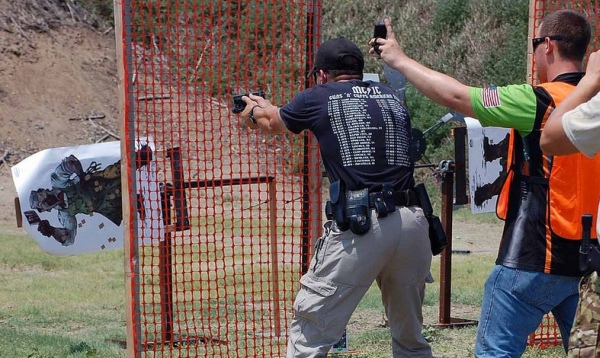

In 2013, there were 10 Competitive Stages and 5 Sidematch Stages. Match directors expect at least the same number of stages for Pandemic 2014. Each presents a different shooting challenge, and a different threat. View the Zombie Guide Page for general information and firearms classifications.
2014 Zombie Pandemic General Guide | 2014 Zombie Pandemic Rules
May 19th, 2014

Two months ago, the Daily Bulletin featured Six Shooting Tips by Bryan Litz. That article was hugely popular with our Bulletin readers and Facebook fans. In that article, as his Competition Tip Number Three, Bryan told readers to “Actively avoid major train wrecks”. In other words, you must avoid the big disasters (such as equipment failures) that can ruin a whole match. In this follow-up article, Bryan illustrates the types of “train wrecks” that commonly befall competitors, and he explains how to avoid these “unmitigated disasters”.
Urban Dictionary “Train Wreck” Definition: “A total @#$&! disaster … the kind that makes you want to shake your head.”
 Train Wrecks (and How to Avoid Them) Train Wrecks (and How to Avoid Them)
by Bryan Litz of Applied Ballistics LLC.
Success in long range competition depends on many things. Those who aspire to be competitive are usually detail-oriented, and focused on all the small things that might give them an edge. Unfortunately it’s common for shooters lose sight of the big picture — missing the forest for the trees, so to speak.
Consistency is one of the universal principles of successful shooting. The tournament champion is the shooter with the highest average performance over several days, often times not winning a single match. While you can win tournaments without an isolated stellar performance, you cannot win tournaments if you have a single train wreck performance. And this is why it’s important for the detail-oriented shooter to keep an eye out for potential “big picture” problems that can derail the train of success!
Train wrecks can be defined differently by shooters of various skill levels and categories. Anything from problems causing a miss, to problems causing a 3/4-MOA shift in wind zero can manifest as a train wreck, depending on the kind of shooting you’re doing.
Below is a list of common Shooting Match Train Wrecks, and suggestions for avoiding them.
1. Cross-Firing. The fastest and most common way to destroy your score (and any hopes of winning a tournament) is to cross-fire. The cure is obviously basic awareness of your target number on each shot, but you can stack the odds in your favor if you’re smart. For sling shooters, establish your Natural Point of Aim (NPA) and monitor that it doesn’t shift during your course of fire. If you’re doing this right, you’ll always come back on your target naturally, without deliberately checking each time. You should be doing this anyway, but avoiding cross-fires is another incentive for monitoring this important fundamental. In F-Class shooting, pay attention to how the rifle recoils, and where the crosshairs settle. If the crosshairs always settle to the right, either make an adjustment to your bipod, hold, or simply make sure to move back each shot. Also consider your scope. Running super high magnification can leave the number board out of the scope’s field view. That can really increase the risk of cross-firing.
2. Equipment Failure. There are a wide variety of equipment failures you may encounter at a match, from loose sight fasteners, to broken bipods, to high-round-count barrels that that suddenly “go south” (just to mention a few possibilities). Mechanical components can and do fail. The best policy is to put some thought into what the critical failure points are, monitor wear of these parts, and have spares ready. This is where an ounce of prevention can prevent a ton of train wreck. On this note, if you like running hot loads, consider whether that extra 20 fps is worth blowing up a bullet (10 points), sticking a bolt (DNF), or worse yet, causing injury to yourself or someone nearby.

3. Scoring/Pit Malfunction. Although not related to your shooting technique, doing things to insure you get at least fair treatment from your scorer and pit puller is a good idea. Try to meet the others on your target so they can associate a face with the shooter for whom they’re pulling. If you learn your scorer is a Democrat, it’s probably best not to tell Obama jokes before you go for record. If your pit puller is elderly, it may be unwise to shoot very rapidly and risk a shot being missed (by the pit worker), or having to call for a mark. Slowing down a second or two between shots might prevent a 5-minute delay and possibly an undeserved miss.
 4. Wind Issues. Tricky winds derail many trains. A lot can be written about wind strategies, but here’s a simple tip about how to take the edge off a worse case scenario. You don’t have to start blazing away on the command of “Commence fire”. If the wind is blowing like a bastard when your time starts, just wait! You’re allotted 30 minutes to fire your string in long range slow fire. With average pit service, it might take you 10 minutes if you hustle, less in F-Class. Point being, you have about three times longer than you need. So let everyone else shoot through the storm and look for a window (or windows) of time which are not so adverse. Of course this is a risk, conditions might get worse if you wait. This is where judgment comes in. Just know you have options for managing time and keep an eye on the clock. Saving rounds in a slow fire match is a costly and embarrassing train wreck. 4. Wind Issues. Tricky winds derail many trains. A lot can be written about wind strategies, but here’s a simple tip about how to take the edge off a worse case scenario. You don’t have to start blazing away on the command of “Commence fire”. If the wind is blowing like a bastard when your time starts, just wait! You’re allotted 30 minutes to fire your string in long range slow fire. With average pit service, it might take you 10 minutes if you hustle, less in F-Class. Point being, you have about three times longer than you need. So let everyone else shoot through the storm and look for a window (or windows) of time which are not so adverse. Of course this is a risk, conditions might get worse if you wait. This is where judgment comes in. Just know you have options for managing time and keep an eye on the clock. Saving rounds in a slow fire match is a costly and embarrassing train wreck.
5. Mind Your Physical Health. While traveling for shooting matches, most shooters break their normal patterns of diet, sleep, alcohol consumption, etc. These disruptions to the norm can have detrimental effects on your body and your ability to shoot and even think clearly. If you’re used to an indoor job and eating salads in air-conditioned break rooms and you travel to a week-long rifle match which keeps you on your feet all day in 90-degree heat and high humidity, while eating greasy restaurant food, drinking beer and getting little sleep, then you might as well plan on daily train wrecks. If the match is four hours away, rather than leaving at 3:00 am and drinking five cups of coffee on the morning drive, arrive the night before and get a good night’s sleep.”
Keep focused on the important stuff. You never want to lose sight of the big picture. Keep the important, common sense things in mind as well as the minutia of meplat trimming, weighing powder to the kernel, and cleaning your barrel ’til it’s squeaky clean. Remember, all the little enhancements can’t make up for one big train wreck!

|