|
|
March 21st, 2014
 Mid-sized 6.5mm cartridges proved themselves at the recent Shoot for the Green match in northwest Oklahoma. Four out of the top five shooters ran a rifle chambered for the 6.5×47 Lapua, with the fifth shooting the slightly larger 6.5 Creedmoor cartridge. 53 shooters from as far away as California showed up to test their skills in the stiff March winds in NW Oklahoma. The course of fire was challenging, with improvised field shooting positions and targets set as far as 1300 yards out. And there were “Troop” stages that competitors have come to expect in Oklahoma. Match winner Rick Reeves stated, “I enjoyed the troop stages more than anything else, even though I didn’t shoot them the best.” Mid-sized 6.5mm cartridges proved themselves at the recent Shoot for the Green match in northwest Oklahoma. Four out of the top five shooters ran a rifle chambered for the 6.5×47 Lapua, with the fifth shooting the slightly larger 6.5 Creedmoor cartridge. 53 shooters from as far away as California showed up to test their skills in the stiff March winds in NW Oklahoma. The course of fire was challenging, with improvised field shooting positions and targets set as far as 1300 yards out. And there were “Troop” stages that competitors have come to expect in Oklahoma. Match winner Rick Reeves stated, “I enjoyed the troop stages more than anything else, even though I didn’t shoot them the best.”

Steve Elmenhorst shooting a Troop Stage.

Rich Emmons, who steered his 6.5x47L to fourth place, has written a match report for PrecisionRifleSeries.com. Day One saw temps around 70 degrees with only light, switchy winds. But Day Two was brutal, Emmons reports: “On Sunday… 40-50 mph winds hit NW Oklahoma hard and most competitors were woken up. To say that shooting in the 15-30 mph winds with temps in the high 30s [was really tough] is an understatement. All competitors struggled a bit and scores were understandably lower on Day Two. Conditions were brutal and both the ROs and the competitors deserve a gold star for toughing it out and finishing the match.” CLICK HERE for Complete Match Results
| Top 5 Shooters Equipment List
Rick Reeves
6.5×47 Lapua, 140 Berger Hybrid, Surgeon Action, McMillan A-5 Stock, Bartlein Barrel, Rem trigger, Vortex Razor scope, Built by DMFJ, Tab Sling & bag, Harris Bipod, AAC Suppressor.
Adam Roberts
6.5 Creedmoor, Desert Tech Armory (DTA), Benchmark Barrel, 123 Lapua Scenar, H4350 powder, Silencer Tech Suppressor, S&B PMII scope w/ H2CMR reticle.
Justin Shireman
6.5×47 Lapua, Surgeon/ Parry Custom Gun, Silencer Tech Suppresor, Benchmark Barrel, McMillan Stock, Harris Bipod, Swarovski binoculars.
Rich Emmons
6.5×47 Lapua, Surgeon Rifle, Bartlein Barrel, Mcmillan Stock, Berger 140 Hybrids, Harris Bipod, S&B PM II MSR, Vortex Binoculars, MGM Switchview, 5.11 gear, JEC brake.
John Sommers
6.5×47 Lapua, Surgeon Rifle, Bartlein Barrel, Mcmillan Stock, Lapua 139, Harris Bipod, S&B PM II MSR, Vortex Binoculars, AAC Suppressor. |
March 21st, 2014
 The 2014 CMP Games – Oklahoma will take place 9-13 April at the Oklahoma City Gun Club. This popular 5-day event will feature clinics, SAFS/M16 match, EIC Rifle Match, GSMM Four Gun Aggregate, Vintage Sniper Match, CMP As-Issued 1911 Pistol Match, Military & Police Service Pistol Match, EIC Pistol match, and several other activities. Want to join the fun? CLICK HERE to Register. The 2014 CMP Games – Oklahoma will take place 9-13 April at the Oklahoma City Gun Club. This popular 5-day event will feature clinics, SAFS/M16 match, EIC Rifle Match, GSMM Four Gun Aggregate, Vintage Sniper Match, CMP As-Issued 1911 Pistol Match, Military & Police Service Pistol Match, EIC Pistol match, and several other activities. Want to join the fun? CLICK HERE to Register.
The CMP Games – Oklahoma commence with Small Arms Firing School and the M16 Match on April 9, 2014, and an EIC Rifle Match on April 10. On the April 11-13 there will be Garand/Springfield/Vintage and Modern Military Matches, a Carbine Match, and a Vintage Sniper Match. There will also be Pistol Matches held each day from April 10 – 13, 2014.
Competitors should consult the official Match Program for the 2014 CMP Games – Oklahoma as many of the Rifle and Pistol Matches are fired at the same time. The competition features special hospitality events and prize awards. Please note than competitors must supply their own ammunition for all events including the GSM matches. The CMP will be selling ammo for the Garand, Springfield, and Carbine matches. However, no .223/5.56×45 ammo for the Modern Military Rifle Match will be available for sale.

CMP Games – Oklahoma Match Program | CMP Games – Oklahoma Entry Form

March 20th, 2014
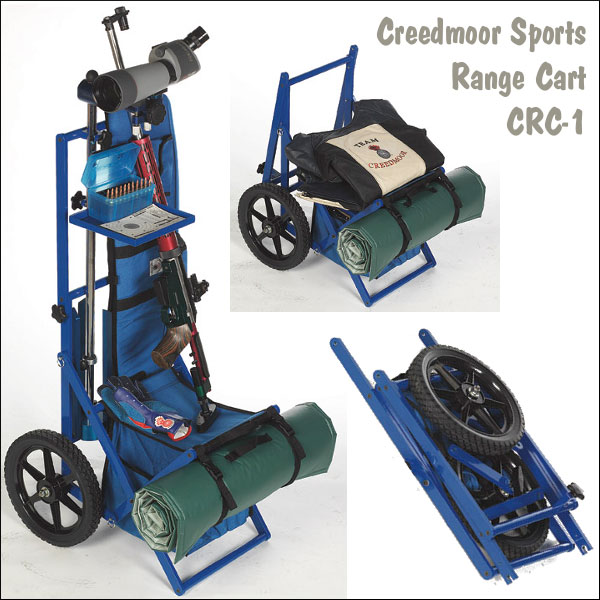 High Power and F-Class shooters have a ton of gear they need to carry out to the firing lines. To do the hauling, you can certainly purchase a factory-made, purpose-built cart that folds up and has all the bells and whistles. The Creedmoor Sports CRC-1 (photo right) is a proven, quality product that works great. You’ll find these used by top shooters at Camp Perry. But the Creedmoor CRC-1 cart costs $499.95. High Power and F-Class shooters have a ton of gear they need to carry out to the firing lines. To do the hauling, you can certainly purchase a factory-made, purpose-built cart that folds up and has all the bells and whistles. The Creedmoor Sports CRC-1 (photo right) is a proven, quality product that works great. You’ll find these used by top shooters at Camp Perry. But the Creedmoor CRC-1 cart costs $499.95.
For a tenth that price ($49.99), plus a few dollars more for do-it-yourself enhancements, you can have a heavy-duty cart that will haul all your gear just fine, though it doesn’t fold up.
 Check out the Harbor Freight Welding Cart, item #65939. This cart is ON SALE right now for just $49.99. Overall size is 29-1/2″ L x 20″ W x 49″ H, and width between side rails is 18″. The wheels (with tires) are 20 3/4″ in diameter for smooth rolling. Consider that, if you made your own cart from scratch you could easily pay $30.00 or more just for the large-diameter wheels and axle. Do note — this cart has air-filled tires. Be sure to inflate before you go to the Range! Check out the Harbor Freight Welding Cart, item #65939. This cart is ON SALE right now for just $49.99. Overall size is 29-1/2″ L x 20″ W x 49″ H, and width between side rails is 18″. The wheels (with tires) are 20 3/4″ in diameter for smooth rolling. Consider that, if you made your own cart from scratch you could easily pay $30.00 or more just for the large-diameter wheels and axle. Do note — this cart has air-filled tires. Be sure to inflate before you go to the Range!
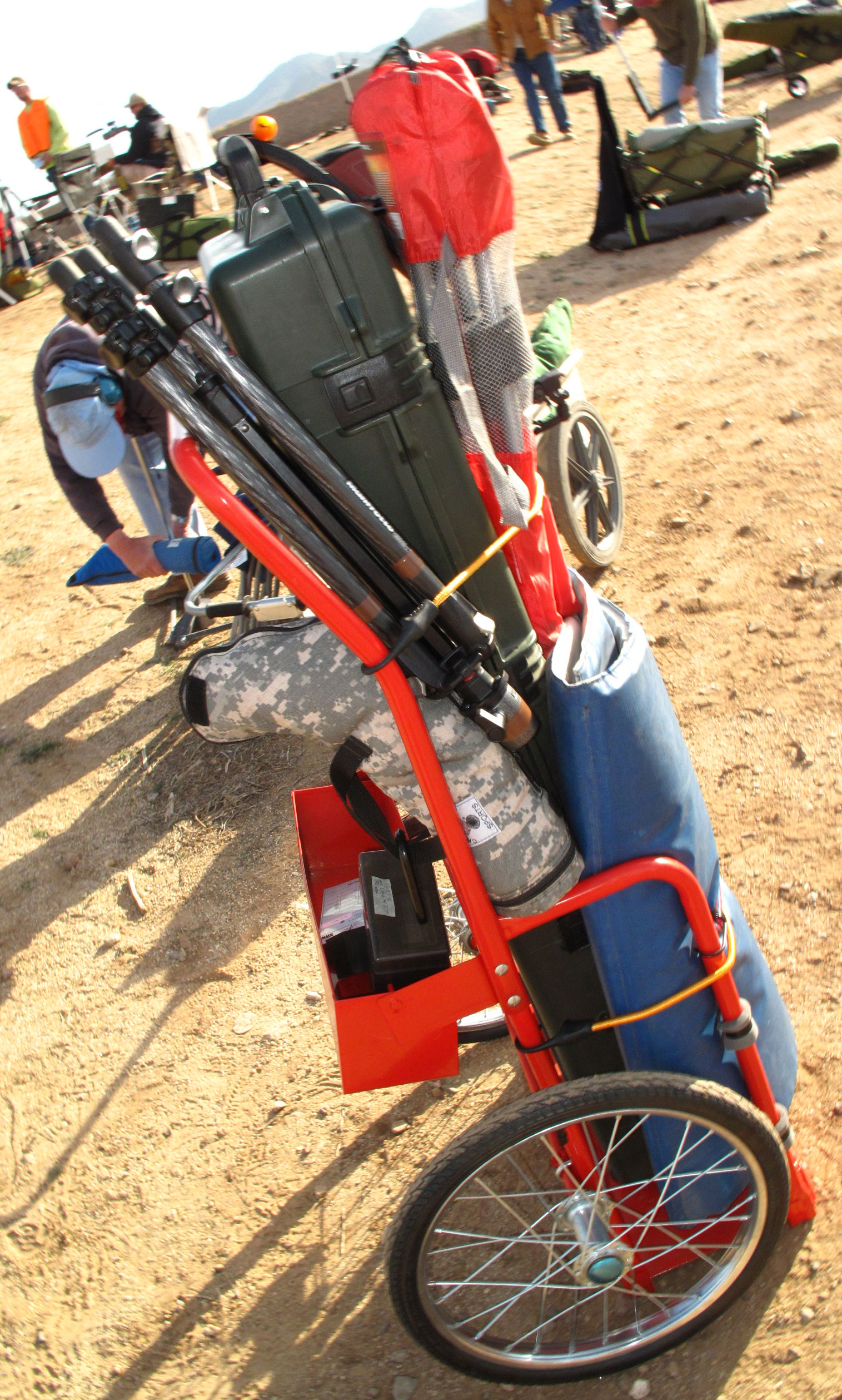
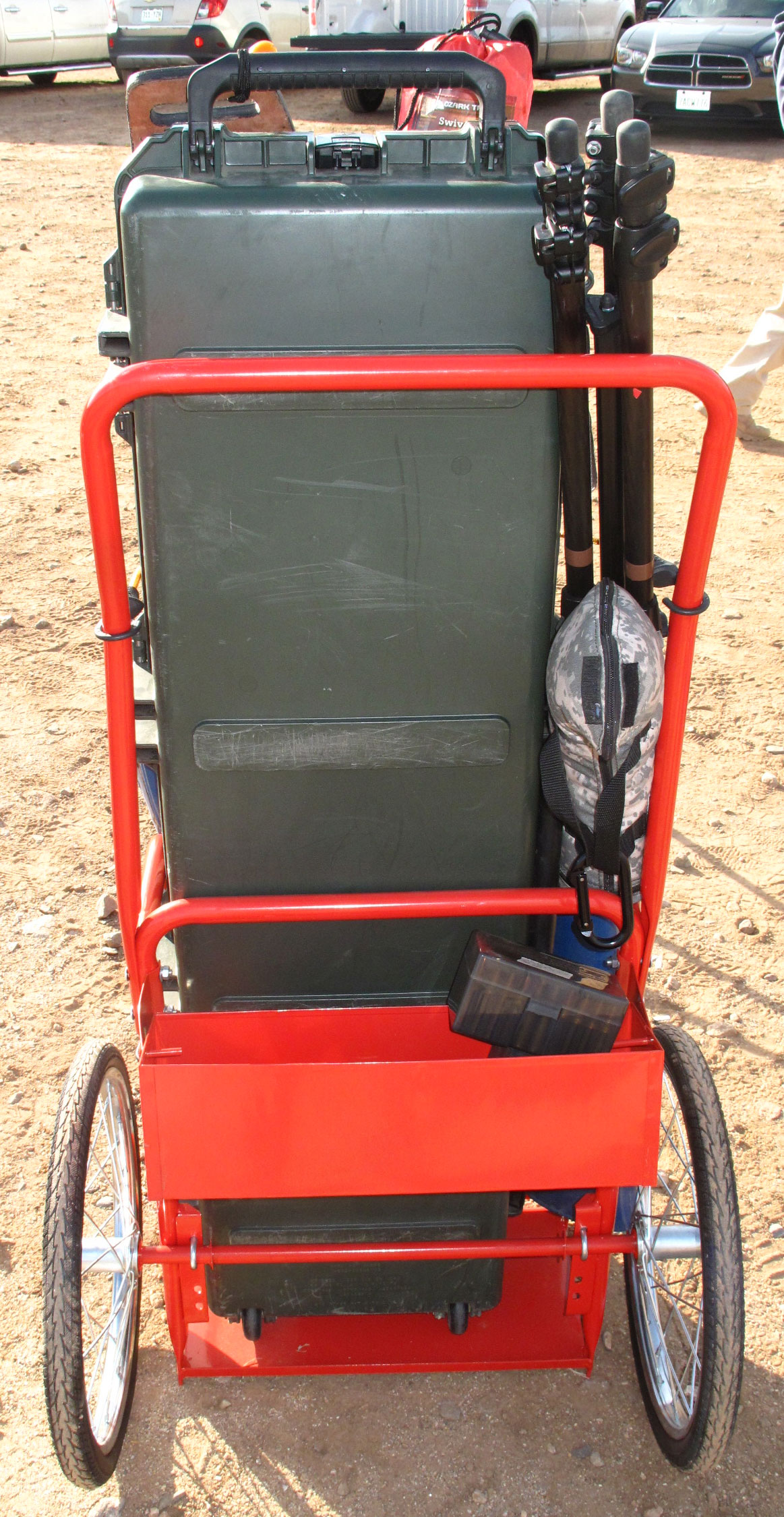
As sold, the Harbor Freight Welding Cart isn’t ideal for range use. But with a few bungee cords (and some creativity), the cart can be adapted pretty easily to hauling your gun gear. Check out this example we saw at the Berger Southwest Nationals. It’s carrying a rifle in hard gun case, bipod, folding chair, shooting mat, tripod, spotting scope, rear sand-bag, and ammo box. If you want to enhance the basic cart, it’s easy to add plastic side-panels on the bottom unit, and fit a barrel-holding system on the cross-tube. This ensures rifles and gear won’t flop forward. (A small piece of wood under the bottom panel provides a bit of extra lift that will keep the bottom plate out of the dirt and gravel.)

Click Photos Below to Zoom
 
How to Upgrade Welding Cart for Range Use
Get a block of hard foam rubber. Cut keyhole slots in the rubber to grip the barrel and umbrella/scope stands. Mount the rubber block to the cross piece with self-tapping screws, or drill a horizontal channel in the rubber so the whole block fits over the cross-tube. On the lowest leading edge of the welding cart box (at ground level, front), fit a block of wood 2″ high (you can also fabricate metal extensions). This will make the cart lean back a little more, which helps stabilize the contents on sloping terrain.
 You may want to enclose the sides of the bottom box area so small items don’t fall out. You can tack-weld aluminum side-plates if you want a fancy appearance. I prefer to just cut sheet plastic from a home improvement store. These plastic panels can be attached with screws or even zip-ties around tubing. You may want to enclose the sides of the bottom box area so small items don’t fall out. You can tack-weld aluminum side-plates if you want a fancy appearance. I prefer to just cut sheet plastic from a home improvement store. These plastic panels can be attached with screws or even zip-ties around tubing.
Run the plastic side panels up high enough that stuff like hats and muffs don’t fall out. After transport you can transfer ammo boxes and small items to the upper box (attached to the back side of the cross-tube).
The hardest component to find may be the hard rubber blocks for the barrel keeper, but you can also make a barrel-holding block out of wood, with some carpet to protect the barrels. The nice thing about the rubber is that it can be cut to snap over the barrels so you don’t need straps. Likewise, you can drill a hole transversely through the rubber, then slot it from the bottom and it will slide over the horizontal tubing with no fasteners needed.
Comment: This cart is heavy and it takes up a lot of space. You’ll need a station wagon, SUV or pickup truck to haul it around. But it’s cheap. The money you save on a range cart could pay for a new Krieger or Bartlein barrel, AND some new brass. Those things (new barrel and brass) will likely improve your scores more than having a fancy $500.00 range cart.
March 19th, 2014
A large contingent of the Scottish rifle team came to Sacramento, California last week for the 23rd Annual American-Canadian and Long Range matches. A great time was had by all. Members of the U.S. Long Range Rifle team say: “Thank you for making the journey over and we hope to see you all again this fall at Camp Perry and/or Canada Nationals.”
Click Photo for Full-screen View
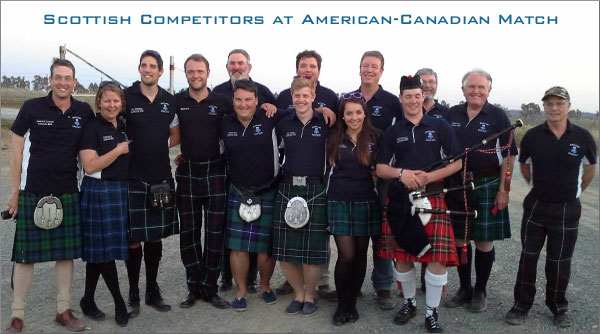
 Congratulations to Scottish Team member Ian Shaw for winning the American-Canadian Full Bore Match! Here is Ian celebrating his victory with his winning mug. We met with Ian in February after the Berger Southwest Nationals. At the Phoenix airport, this Editor shared a quick meal with Ian and two of his Team London-Scottish comrades before the trio jetted home across the Atlantic. Congratulations to Scottish Team member Ian Shaw for winning the American-Canadian Full Bore Match! Here is Ian celebrating his victory with his winning mug. We met with Ian in February after the Berger Southwest Nationals. At the Phoenix airport, this Editor shared a quick meal with Ian and two of his Team London-Scottish comrades before the trio jetted home across the Atlantic.
As we chatted, I quickly learned how serious and dedicated these guys are. It’s no surprise to me that Ian took the top prize at the American-Canadian match. During our airport interview, Ian talked about target rifle shooting in the UK, and he invited American full-bore shooters to attend the Queen’s Prize Match held each year during the Imperial Meeting at the Bisley Range. Ian said, “Tell your American readers to come. This is a big match every year, with 900 competitors, about 700 of whom are from the UK.” Here’s a video explaining the history of the Queen’s Prize Match.
History of the Queen’s Prize Match (BBC, 1986)
H.M. The Queen’s Prize
The Queen’s Prize Match was first shot in 1860 when the Sovereign (Queen Victoria) gave a prize of £250 for the winner. This amount has remained unchanged to this day although in the original days, it was a considerable sum. The winner earns the right to have the initials ‘GM’ after his or her name. As detailed in the section below, there are three stages to the competition, the winners of the second stage earn the initials ‘SM’. The final stage is shot on the last Saturday of the NRA Imperial meeting held in July.
Photos from U.S. Long Range Rifle Team.
March 16th, 2014
Most long-range benchrest stocks are three inches wide because that used to be the max width under the rules for Light Gun Class. Many folks may not realize that the IBS, the NBRSA, and the Williamsport organizations have all modified their Light Gun rules to allow wider forearm widths in registered competition. A wider stock provides increased stability and resists rotation (torquing) as the gun is fired. If you’re building a new Light Gun, you may want to consider a 4″-wide or 5″-wide forearm. Do check the rules of your local club or regional organization to ensure the wider width is allowed in the matches you attend. And if you plan to shoot F-Class as well, stick to 3″. Under F-Class (Open) rules, “the width of the rifle’s forend shall not exceed 76mm (approximately 3 inches)”.
Wider Forearm Stock Options
Most stock-makers still only offer a 3″-wide forearm width with their Light Gun long-range benchrest stocks. However, there are some other options. On request, Joel Russo, Russo Rifle Stocks, can cut a stock with 4″-wide forearm, but that’s not a standard pattern.
If you want a 4″-5″ wide version of the popular MBR Tooley-style long-range stock, Bill Shehane offers a ‘Big Dawg’ version of his MBR Tracker stock. This features a longer, deeper, and wider fore-end for added stability and more resistance to torque with the heavy calibers. Along with having a wider forearm, the Big Dawg stock is cut 4″ longer than a standard Shehane ST-1000 Tracker. This provides a “longer wheelbase” for better balance with very long (30″+) barrels. (The ST-1000 itself is 3″ longer than most benchrest stocks.) The Big Dawg is available with a 4″-wide or 5″-wide forearm, and will handle barrels up to 40″ in length and 1.5″ in diameter. In the top photo, taken by Forum member Preacher, you see a 4″-wide Big Dawg next to a normal ST-1000 Tracker. (Both stocks are symmetrical; there is distortion caused by wide-angle lens.)


This color pattern is what Bill calls “Prairie Dog Camo”, a Rutland laminate in orange and dark gray, with olive ‘accent’ layers. The price for a ‘Big Dawg’ in Rutland laminate is $625. In African Obeche wood (any color choice), the price is $855.00. For more info, contact Bill Shehane at (704) 824-7511, or visit his website, www.ScopeUsOut.com.
Wide Stocks for Rimfire Benchrest
Ultra-wide stocks are also legal in many rimfire benchrest disciplines. Shown below is a rimfire rifle built with a 4″-wide Shehane Big Dawg stock. This gun is used in ARA Unlimited competition. Extra-wide stocks like this can also be used in the IR 50/50 Unlimited Class and RBA Unlimited Class.
Why use a wide stock for rimfire where recoil is not an issue? The extra width definitely provides more stability in the bags. This is noticeable when cycling the action during the loading process — the gun shows less “wiggle” when opening and closing the bolt. The larger mass of wood also, potentially, provides additional vibration damping. A wider stock design carries more weight (per inch of length) and more mass is distributed outboard. Initial testing shows that the wide stocks work well for rimfire shooters who like to grip their gun — the gun feels “planted” with less wobble when the stock is gripped or cheeked by the shooter.

March 10th, 2014
At the 2013 Western CMP Games, SGT Robert Evans attained what many shooters seek their entire shooting careers — a Distinguished Rifleman’s Badge. Evans earned his DR badge with just one hand, after losing his right hand while serving in Iraq with the U.S. Army.

CLICK HERE to Read Full Story on CMP Website
Report based on story by Ashley Brugnone, CMP Writer/Editor
 SGT Robert Evans: Defying the Odds, Single-Handedly SGT Robert Evans: Defying the Odds, Single-Handedly
AFter joining the Army in 2003, SGT Robert Evans served two tours in Iraq, suffering a spinal injury on the first tour. On his second tour, his life changed forever. On May 31, 2007, Evans was commanding a Bradley Fighting Vehicle in Iraq. As the Bradley drove under an old Fedayeen guard shack, an IED on top of the guard shack detonated while Evans was reaching out of the turret. The blast amputated Robert’s right hand at the wrist.
Even as a young boy, Evans had always enjoyed shooting. He vowed to stay involved with the sport despite his injury: “I couldn’t give up shooting after I lost my hand. It’s always been too important to me,” he said. “No matter what is going on in my life, when the sights are aligned and the hammer is about to fall, nothing in the world matters at that second. It’s my nirvana.”
Evans worked his way back into the sport by starting in F-Class. The position allowed him to hold hard and pull the trigger, while also being able to use his optics. Then he got involved with J.J. O’Shea’s M1 for VETS Project. The project helps transition wounded combat veterans back into the world of shooting, with equipment arrangements, position training and mental preparations.

Working with the M1 for Vets group, Evans started shooting again. But there were challenges: “The first time I shot after my amputation, it was very frustrating,” he said. “I couldn’t hold still, and shooting left-handed was so foreign.” Being extremely right-eye dominant his entire life, the loss of his right hand caused him to relearn many things, including how to shoot. Learning how to reload and adjust for wind while slung up became a pain for Evans….

In 2008, after several months and rigorous hours of dry firing, Evans found himself crossing the threshold of Camp Perry — a dream he had waited to fulfill his entire life. He scored around 50 points standing, out of 100, on his first trip. Though not bad for someone with an amputation, that wasn’t enough for Evans. He wanted to become a Distinguished Rifleman.
SGT Evans during Team Match at 2013 CMP Western Games.

He began to realize his dream as he earned his first 10 points (towards Distinguished) at Camp Perry in 2012. It took him 15 months to LEG out. His next 6 points came at the 2013 Eastern Games in Camp Butner, NC, followed by 10 more points at the 2013 National Matches. There, hoping to “bronze out,” he managed to one-up himself to actually earn a silver medal.
Then came the 2013 Western Games at the Ben Avery Shooting Facility in Phoenix, AZ. Never giving up hope and remembering his long journey from the hospital bed to the firing line, he received his final 8 points. SGT Robert Evans had become a Distinguished Rifleman.

“There was a lot of pressure, speculation and competition as to who would be the first Combat Wounded Veteran to ‘go Distinguished’ within M1 for VETS,” he said. “I’m very proud to have earned my badge, but more importantly, I hope that more wounded veterans will realize that it is within their grasp. It’s not an impossibility anymore. I hope it motivates everybody to train a little harder and hold a bit tighter – not just wounded veterans. If I can do it, anybody can.”
Posted Courtesy of the Civilian Marksmanship Program, www.TheCMP.org
Author: Ashley Brugnone, CMP Writer/Editor
Commentary by German Salazar
Robert Evans’ inspirational effort is a fresh reminder of the value of marksmanship in creating a focused challenge and reward that can help our wounded warriors regain the confidence and motivation to succeed in all aspects of life.
Robert’s effort is very reminiscent of that of Karoly Takacs, a Hungarian pistol competitor who lost his right hand in a grenade accident in World War II. Determined to overcome the injury, Takacs taught himself to shoot left-handed after the war and earned gold medals in the 1948 and 1952 Olympic Games. Robert brings that Old World grit and determination into the modern day and into the context of our nation’s most historic and cherished award for marksmanship. Robert’s Distinguished badge will shine brightly as a beacon to those who face challenges in their lives and can find a path to renewal in the brotherhood of marksmen. We salute him for his efforts and for the inspiration he brings to us all.
Editor’s Note: Our contributor German Salazar is a Distinguished Rifleman, Distinguished Pistol Shot, Distinguished Smallbore Rifleman (NRA) and a dedicated student of shooting history. You can find many technical and shooting history articles at his RiflemansJournal.com website.
March 8th, 2014
The nation’s top junior air-rifle shooters recently competed at the 2014 U.S. Army National Junior Air Rifle Championship hosted by the USAMU at the Pool Range Complex in Fort Benning, GA. Juniors (ages 14-18) competed for national titles in two divisions–Sporter and Precision — under the watchful eye of the USAMU’s shooter/instructors. More than $31,000 in endowment money was awarded to teams and individuals from the Georgia Youth Sport Shooting Foundation.

Ashley Durham and her JROTC teammates from Dalton McMichael High School in North Carolina, brought home the Sporter Division title. Durham led the way, adding the Sporter Division individual championship to her collection of trophies. David Sink, from Columbia, Md., took home top honors in the Precision Division while he and his teammates from Queen Anne’s 4-H won the Precision national team championship.
Taking time out from training for the upcoming competition season, USAMU soldiers from the International Rifle section provided instruction and mentorship for the competitors. “I shot this very competition when I was a junior,” said Sgt. 1st Class Hank Gray. “It was hosted by the [National] Guard back then. It’s rewarding to go from a competitor to host and do the same thing for the future generation of shooters.”
Competitors and USAMU instructors

Attendees said that the professionalism of the USAMU is what stood out the most at this year’s event. “Being here has been very uplifting,” said retired Air Force Master Sgt. Scott Davis, who brought the McMichael High team to the match. “The USAMU made it more than just a fun match — they provided a learning environment. They were the first to step in and show the kids how to do something[.]”
March 6th, 2014

Here’s a handy training option for F-Class shooters. Forum member SleepyGator is an F-Class competitor, but it’s not convenient for him to shoot at long ranges close to home. Accordingly, he wanted some “reduced-distance” targets he could use at 300 yards for practice. There is an official reduced-distanced standard for 300-yard F-Class matches. This utilizes the NRA No. MR-63FC – F-Class Target Center which is pasted over the MR-63 target. It provides a 1.42″ X-Ring, 2.85″ 10-Ring, and 5.85″ Nine-Ring. (The dimensions of F-Class targets are found in the NRA High Power Rules, Sec. 22, part 4, page 70 — see sample below.)

CLICK HERE to Download F-Class 300-yard Target Centers (.Zip archive with three targets)
To duplicate the 300-yard target, SleepyGator has prepared a printable version of the MR-63FC Target Center, along with a pair of training targets with two bulls and five bulls. The two-bull and five-bull targets mirror the scoring rings on the MR-63FC, but they display only the innermost three rings and two rings respectively. All three targets are Adobe Acrobat files that can be easily printed. You may need to adjust the scale (sizing) on your printer to get the dimensions exactly correct. As noted above, when printed, the 10-Ring on all three targets should measure 2.85″. This should provide some handy practice targets you can use between matches. Thanks to SleepyGator for providing these targets. You can download all three as a .Zip archive. After downloading the .Zip file, just click on the .Zip archive to extract the individual targets.
CLICK HERE to Download NRA High Power Rules with F-Class Target Dimensions

February 23rd, 2014

Larry Bartholome (aka “LBart” on our Forum) is the current F-Open USA National Champion. He also won the F-Open division at the recent Berger Southwest Nationals. A “Senior Citizen” now, Larry is still at the top of the F-Class game. If you were to pick the top ten F-Open shooters on the planet, Larry would be on the short list, that’s for sure.
In a recent AccurateShooter Forum thread, there was a discussion of caliber/cartridge choice for F-Open shooting — specifically whether 6mm cartridges can be competitive at long-range (as opposed to mid-range).
Larry, who currently shoots a 7mm-270 WSM, offered some wise words. Here’s some sage advice from Larry, a champion who has triumphed at the highest level, against the toughest competition. F-Class competitors will benefit from reading what Larry has to say, and taking it to heart:
Cartridge Choice for F-Class — What Really Matters
Matches are won with what people decide to shoot. The people win matches, not the calibers. A person makes his decision on what he is going to shoot with and [that person] wins or loses based on the decision.
The smaller cases and bore sizes have advantages in less recoil and more inherent accuracy. They are easier to shoot well. Because they shoot smaller groups on average they make the 10 ring seem bigger. With light winds that helps.
When the wind gets to changing and picking up this advantage is negated by the wind drift advantages of the larger calibers. Once the switches and velocity changes get beyond the mind’s ability to stay up with them, the small caliber advantage is minuscule.
My own thought is I need all the help I can get. I know I can’t read the wind. I play the percentages. [My 7mm offers] good grouping, good wind drift, lower recoil than the 30s. My 7mm/270 WSM was shooting very well in Phoenix, just as the other Bartlein barrels shot well in Raton. The points lost were mine, not the rifle’s or the caliber.
When the wind flags and mirage are telling you to hold left and your bullets are going left, no caliber in the world will help you. You are the one steering those bullets.
Larry Bartholome
Team Berger/Norma

February 21st, 2014
Most F-TR rifles are essentially prone rifles adapted for use with bipod and rear bags. They feature prone or tactical-style stocks designed to allow a firm grip on the gun, with cheek, hand, and shoulder contact. This has worked very well. Unquestionably, a skilled F-TR shooter can achieve outstanding scores with such a configuration — it works. However, “there’s more than one way to skin a cat”.
At the Berger Southwest Nationals, Eric Stecker introduced a new type of rifle, and a new type of gun-handling, to the F-TR ranks. Shooting “free-recoil” style* (i.e. with virtually no contact on his rifle) Eric managed to finished second overall in F-TR (with the highest X-count), beating some past national champions in the process. Thinking “outside the box” worked for Stecker in Phoenix. The success of Eric’s benchrest-style rifle and shooting technique definitely drew the attention of other F-TR shooters.
Click photo to zoom

|
VOICE FILE: Eric Stecker Talks About the SWN and his Radical F-TR Rifle. |
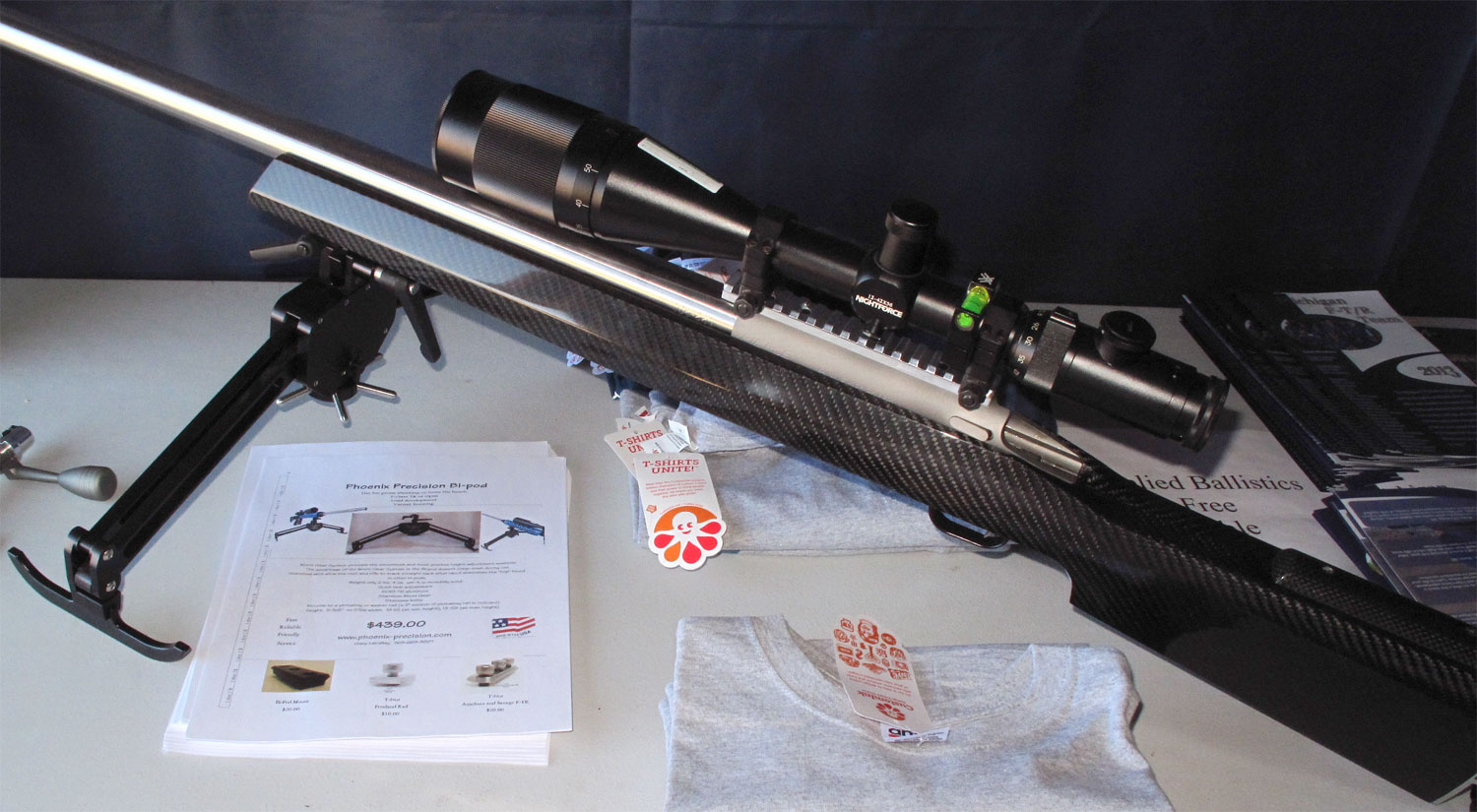
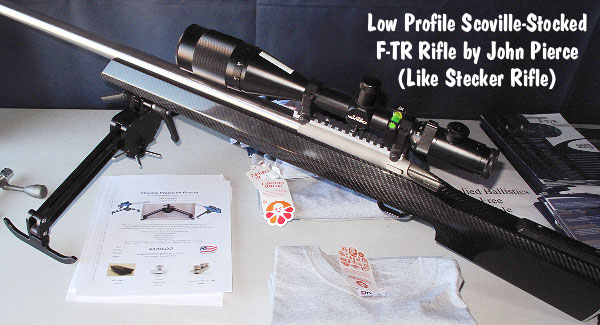
Eric’s F-TR rig was built by John Pierce using a stiff, light Scoville carbon-fiber stock. The stock is so light that Eric’s rifle came in 1.5 pounds under the F-TR maximum weight limit (8.25kg or 18.18 pounds). The gun features a Pierce action, Bartlein barrel, Jewell trigger, and a Gen 1 Nightforce 15-55X52mm Comp scope. From the get-go, Eric’s strategy was to “aim small” and shoot his rig like a bench-gun. He actually focused on shooting really small groups rather that just trying to keep shots within scoring rings and “hold waterline”. With a .308 Win that could shoot bugholes at 100 yards, this strategy paid off.
 Rifle builder John Pierce explains the thinking behind this rifle: “The stock choice was mine — I had built two prototype rifles last year based on the premise that the game is Benchrest in the prone position. I still feel very strongly regarding [this concept]. I chose Bob Scoville for obvious reasons — he is an artisan and his stocks have won so much, they just flat work. We built Eric the latest configuration along these lines, and the tool worked for him. Without a doubt, Eric is a shooter, and we were all pleased to watch him perform so well.” Rifle builder John Pierce explains the thinking behind this rifle: “The stock choice was mine — I had built two prototype rifles last year based on the premise that the game is Benchrest in the prone position. I still feel very strongly regarding [this concept]. I chose Bob Scoville for obvious reasons — he is an artisan and his stocks have won so much, they just flat work. We built Eric the latest configuration along these lines, and the tool worked for him. Without a doubt, Eric is a shooter, and we were all pleased to watch him perform so well.”
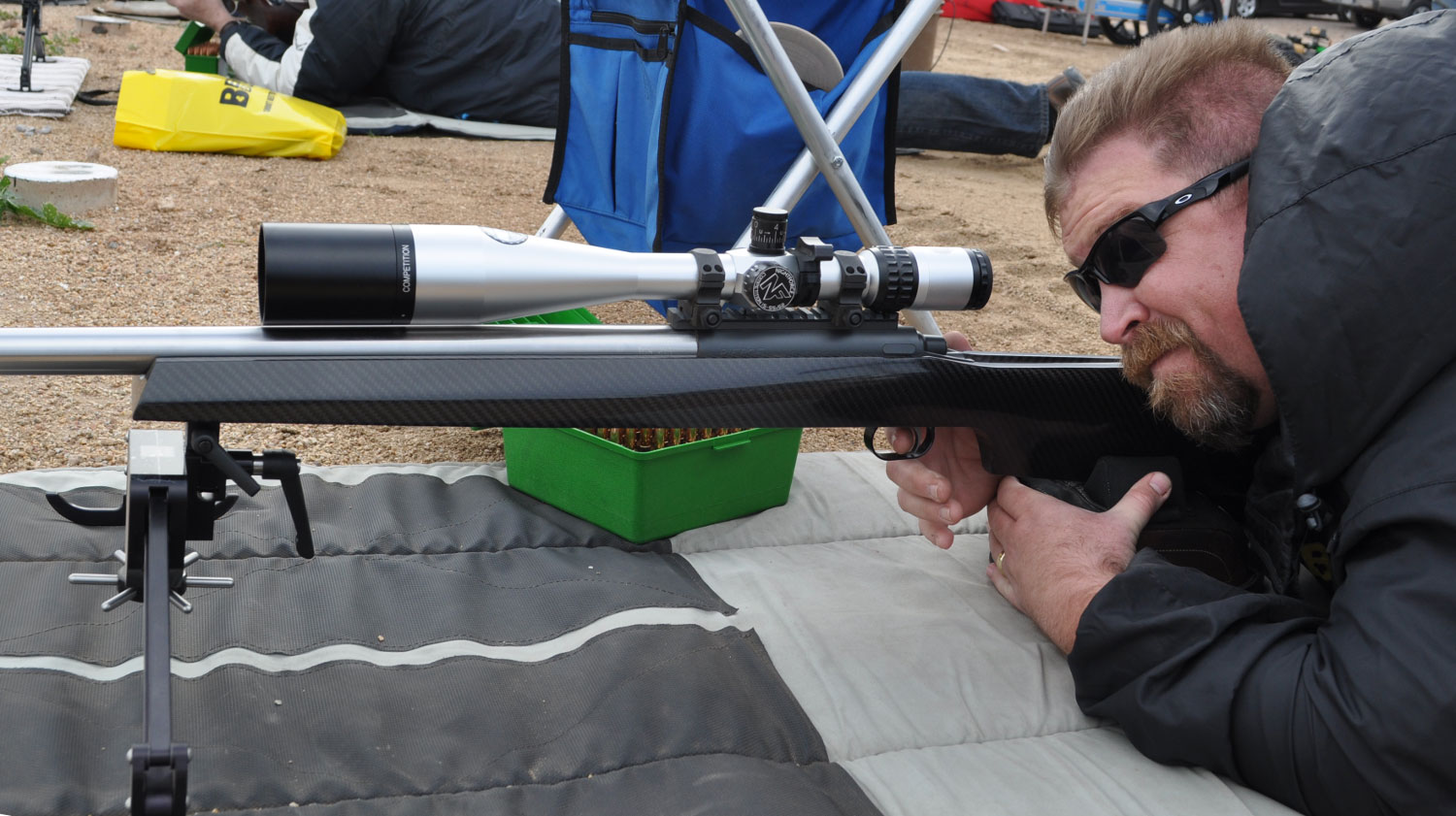
Eric sets up rifle before match. During live fire his hands do not contact the stock.

Eric employed a benchrest-style shooting technique with his F-TR rig — he shot pretty much free recoil, with no cheek pressure, no hand contact, and just a “whisper” of shoulder contact. Eric explains: “I shoot what’s called ‘free recoil’. Now the rifle is butted up against my shoulder very lightly, but no other part of my body touches the rifle except for my finger on the trigger.” Eric has even used this technique when shooting a 7mm cartridge in F-Open at other matches: “Someone suggested that this style wasn’t possible with the larger [7mm] cartridges, but I found it very successful so I continue to do it that way.”
|
VOICE FILE: Eric Stecker Talks About Shooting F-TR with Benchrest Technique. |
Eric also employed an unconventional strategy — he was focused on shooting small groups (not just holding ring values): “Since I have started shooting F-Class, I treat [the target] like a benchrest target. What I mean by that is that I regard the center as my first shot, and so my objective is to create the smallest group. So, I will hold whatever… is required to end up with the bullet ending up in the center — that’s probably true of any F-Class shooter, but I guess the perspective’s a little different when you have a benchrest background.” Eric explained that “maybe I aim a little smaller than others might”, because in the benchrest game, “the slightest miss ends up costing you quite dearly”.
Click to Zoom Photo (This is not Eric Stecker’s rifle, but a “sistership” built by John Pierce.)
Eric Talks about F-TR Trends
Will other F-TR shooters build rifles suited for free-recoil-style shooting? Eric isn’t sure: “I don’t know if this type of rifle is the future of F-TR. I shoot a lot of benchrest, so putting those kinds of components into an F-TR gun made a lot of sense to me. One thing I like about F-TR is that there are a lot of different types of approaches being tried and some of them are successful. So I think it’s still pretty wide-open[.] But I think the really great part of what we found at the Southwest Nationals is that shooting [with] a benchrest-style approach certainly doesn’t hurt you. What I mean by that is … aiming small, trying to make the group as tight as possible rather than trying to hit a particular area. I actually tried to shoot tight groups — that was a focus and that worked for me — I had quite a high X-Count.” NOTE: Eric finished with 51 Xs, 14 more than F-TR Grand Agg winner Radoslaw Czupryna (37X). James Crofts had the second highest X-Count with 48 Xs.
Even Berger’s Boss did pit duty at the Berger SW Nationals.

*”Free Recoil” style shooting has its variations. Some would say “pure free recoil” would not even allow shoulder contact. Eric Stecker lightly touches the back of the stock with his shoulder.
|