The 2025 Southwest Nationals kicked off yesterday at the Ben Avery Range outside Phoenix. The individual 600-yard match was held for F-Open, F-TR, and Sling shooters. There was a good turn-out, particularly in the F-Open class. Shooting was impressive, with 11 F-Open competitors recording 600 points over the course of three 20-rd sessions — not dropping a single point all day. F-Open Ace Peter Johns was the top finisher, with 600-47X.
Modern F-TR rifle looking down-range at Ben Avery Shooting Facility.
Tracy Hogg took the F-TR division with 598-36X. In the sling division, which had both “A” (Any Sight/Any Rifle*) and “P” (Palma) classes, David Luckman topped the field with a stellar 600-48X score. Robert Gustin (in “A” class) had the next highest score, 600-46X. That’s mighty impressive for a older marksman who competes as a Grand Senior.
Today, February 13th, there will be mid-range Team Competition at 600 yards. Expect this match to go down to the wire, and probably be decided on X-Count. CLICK HERE for a Squadding List of teams with target assignments.
Multi-time National High Power Champion Brandon Green is competing this week at Ben Avery. On his Facebook page, Brandon posted: “If anyone wants to follow along with the 2025 Southwest Nationals here’s the link: DesertSharpshooter.com/2025-southwest-nationals. An incredible amount of talent on the range this week! The individual Long Range Championship event will start this Friday.”
2025 Southwest Nationals F-Open, F-TR, Sling 600-Yard Top 10
F-Open 600 Top Ten
PETER JOHNS 600-47X *MW*
ALAN KULCAK 600-47X
TED WEDELL 600-45X
SHILOH PLUE 600-44X HiJr
PAT WOOD 600-42X HiSr
DAVID ROLLAFSON 600-42X
DAN BRAMLEY 600-40X
NORMAN HARROLD 600-37X
TIM VAUGHT 600-35X
AMOS WISHERD 600-34X
F-TR 600 Top Ten
TRACY HOGG 598-38X *MW*
ERIC BISSON 596-37X
BRAD SAUVE 596-35X HiSr
KEITH TRAPP 595-36X
RANDY LITTLETON 595-34X HiGS
ALAN BARNHART 595-33X
JEREMY NEWELL 595-31X
JOSH SIEPERT 594-30X
CARLTON BRAY 594-27X
SCOTT KYLE T 594-25X
SLING 600 Top Ten
DAVID LUCKMAN P 600-48X *MW*
ROBERT GUSTIN A 600-46X HiGS
CURTIS GORDON P 600-34X HiSr
TRUDIE FAY P 599-44X HiWo
BRANDON GREEN P 599-41X
OLIVER MILANOVIC P 599-37X
MICHAEL STORER P 599-36X
MATTHEW BUTTON P 599-32X
PARAG PATAL P 598-42X
KIMBERLY ROWE A 597-45X
The shooting by the top F-Open shooters was mighty impressive. The top 11 finishers all had 600 scores, not dropping a point. And the next dozen shooters finished with 599 scores, just one point back. Among the 599ers, Brandon Zwahr had a 599-47X, matching the X-count of F-Open 600-yard winner Peter Johns.
Stunning F-Open rifle with SEB Mini front rest with Blake Machine accessories.
Top competitors show focus and concentration in SWN mid-range match 2022.
Bird’s Eye Ben Avery — A Look at the Range
If you’ve never visited the Ben Avery Facility north of Phoenix, Arizona, here’s a video that shows the 1000-yard range (including drone footage). The desert range at Ben Avery is something special — check out this “birds-eye view”. This 2016 video also includes an interview with Derek Rodgers, F-TR World Champion, King of 2 Miles, and the only man who who has earned both F-Open AND F-TR USA National titles.
Sling Shooters in Palma Division
For the Palma division, the cartridge of choice is the .308 Winchester (7.62.x51). This versatile cartridge is still capable of extreme accuracy. Never underestimate a skilled sling shooter with a good Palma rifle. Below is multi-time NRA National Long-Range Champion John Whidden in action at Ben Avery a few seasons back. John’s rifle featured a centerfire action in an aluminum Anschutz small-bore stock.
* Brandon Green explains: “The ‘A’ is for Any rifle/Any sight (so basically unlimited up to .338 with either iron sights or optics). And ‘P’ is Palma division”, which is limited to iron sights rifles with .223 Rem (5.56) or .308 Winchester (7.62×51) chamberings.
NRL Hunter is a popular series of competitions for all levels of hunters — both newcomers and experts. Matches that showcase hunting skills are hosted through the country with multi-distance, walk-around shooting courses similar to PRS/NRL, but limitations on weight and equipment cost make this more affordable and practical. These events provide a competitive format for new and seasoned hunters to learn about skills, gear, and local hunting terrains. To participate in matches, hunters must purchase a $100 Annual NRLH membership ($75.00 for Young Guns). For more information, visit NRLHunter.org.
In this video top NRL Hunter Pro division competitor Jon Pynch shows the gear he uses to win. He talks about gear used for spotting and ranging targets, building positions, and making shots. Jon also gives his tips on how to cope with broken down equipment and bad weather. Check out the video and try an NRL Hunter match in your state.
Here are upcoming NRL Hunter events slated for the next 8 weeks. CLICK HERE to visit the full NRL Hunter Match Calendar showing all 31 events scheduled in 2025. Registration is still available for most of these matches. You’ll need to become an NRL Hunter Member and then pay match fees which are typically $250-$275 Individual, $500-$550 Team, and $150-$185 Skills.
This is only partial listing. CLICK HERE for all 28 NRL Hunter 2025 events.
Here is the most recent NRL Hunter Podcast, released 1/29/2025. In this episode William Righter, Mike Lilly, Sarah Beard, and Nick Mowrer join Travis Ishida at the 2025 NRL Hunter PRO-AM held in Arizona last month. They review how NRL Hunter competitions run, and how to get the best results. CLICK HERE to visit the NRL Hunter Podcast page with dozens of other informative podcasts, all accessible at no cost to you.
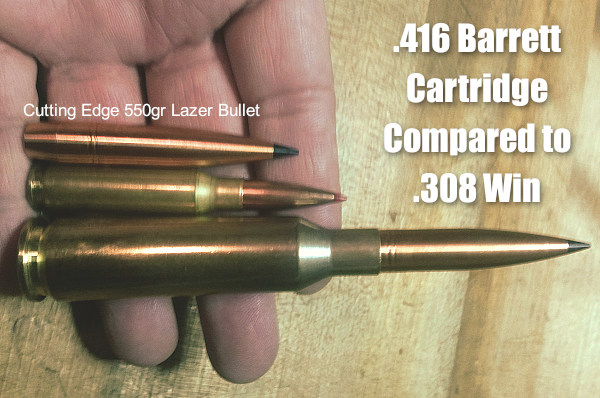
In the ELR game, particularly the King of 2 Miles (KO2M), it’s “go big or go home”. The top shooters run large-capacity cartridges that push large-caliber, ultra-high BC bullets at very high velocities. Bullets launched by cartridges such as the .416 Barrett can sustain supersonic velocities at Extreme Long Ranges — and that’s what it takes to win. The .416 Barrett can launch a 550-grain solid bullet at 3000+ FPS.
Photo from ELR Competitor Corbin Shell.
2018 and 2019 Kings of 2 Miles Loaded on RCBS Presses
So how do you load jumbo cartridges such as the .416 Barrett? It takes a big, heavy, super-strong reloading press. We’ve learned that two recent King of 2 Miles champions, Paul Phillips (2019) and Robert Brantley (2018) both loaded their KO2M ammo on RCBS AmmoMaster .50 BMG presses. Phillips loaded .416 Barrett ammo, while Brantley loaded a similar .416 MCS cartridge.
In 2018, Robert Brantley topped the field using his custom .416 MCS cartridge. Then in 2019, Paul Phillips won the K02M competition shooting a .416 Barrett, with Brantley a close second. Both Phillips and Brantley use the RCBS AmmoMaster .50 BMG single stage press kit and RCBS .416 Barrett dies to hand-load for extreme long-range. “My ammo has been much more consistent after switching to the RCBS press and dies,” remarked Phillips, who runs the Global Precision Group. Brantley said he uses RCBS products for most of his reloading needs — from the dies and AmmoMaster, to the ChargeMaster and Brass Boss. His custom .416 MCS loads launch a 550-grain bullet more than 3,100 fps.
Loading with RCBS AmmoMaster .50 BMG Press
This video shows reloading with the RCBS AmmoMaster .50 BMG press. While this video shows .50 BMG cases being loaded, the principles are the same for loading the .416 Barrett cartridge or other big rounds. Big cases need big presses!
The 2025 Southwest Nationals (SWN) start 2/12/2025 at the Ben Avery Range outside Phoenix, AZ. The big event starts with a 600-yard Mid-Range Match. Many of the nation’s most talented F-Class and sling shooters will be there. But no matter what your skill level, it is still possible to make major mistakes that can spoil the day and/or put you out of the running for the entire match. This article aims to help competitors avoid the big errors/oversights/failures, aka “train wrecks”, that can ruin a match.
Photo by Sherri Jo Gallagher.
In any shooting competition, you must try to avoid major screw-ups that can ruin your day (or your match). In this article, past F-TR National Mid-Range and Long Range Champion Bryan Litz talks about “Train Wrecks”, i.e. those big disasters (such as equipment failures) that can ruin a whole match. Bryan illustrates the types of “train wrecks” that commonly befall competitors, and he explains how to avoid these “unmitigated disasters”.
Urban Dictionary “Train Wreck” Definition: “A total @#$&! disaster … the kind that makes you want to shake your head.”
Success in long range competition depends on many things. Those who aspire to be competitive are usually detail-oriented, and focused on all the small things that might give them an edge. Unfortunately it’s common for shooters lose sight of the big picture — missing the forest for the trees, so to speak.
Consistency is one of the universal principles of successful shooting. The tournament champion is the shooter with the highest average performance over several days, often times not winning a single match. While you can win tournaments without an isolated stellar performance, you cannot win tournaments if you have a single train wreck performance. And this is why it’s important for the detail-oriented shooter to keep an eye out for potential “big picture” problems that can derail the train of success!
Train wrecks can be defined differently by shooters of various skill levels and categories. Anything from problems causing a miss, to problems causing a 3/4-MOA shift in wind zero can manifest as a train wreck, depending on the kind of shooting you’re doing.
Below is a list of common Shooting Match Train Wrecks, and suggestions for avoiding them.
1. Cross-Firing. The fastest and most common way to destroy your score (and any hopes of winning a tournament) is to cross-fire. The cure is obviously basic awareness of your target number on each shot, but you can stack the odds in your favor if you’re smart. For sling shooters, establish your Natural Point of Aim (NPA) and monitor that it doesn’t shift during your course of fire. If you’re doing this right, you’ll always come back on your target naturally, without deliberately checking each time. You should be doing this anyway, but avoiding cross-fires is another incentive for monitoring this important fundamental. In F-Class shooting, pay attention to how the rifle recoils, and where the crosshairs settle. If the crosshairs always settle to the right, either make an adjustment to your bipod, hold, or simply make sure to move back each shot. Also consider your scope. Running super high magnification can leave the number board out of the scope’s field view. That can really increase the risk of cross-firing.
2. Equipment Failure. There are a wide variety of equipment failures you may encounter at a match, from loose sight fasteners, to broken bipods, to high-round-count barrels that that suddenly “go south” (just to mention a few possibilities). Mechanical components can and do fail. The best policy is to put some thought into what the critical failure points are, monitor wear of these parts, and have spares ready. This is where an ounce of prevention can prevent a ton of train wreck. On this note, if you like running hot loads, consider whether that extra 20 fps is worth blowing up a bullet (10 points), sticking a bolt (DNF), or worse yet, causing injury to yourself or someone nearby.
3. Scoring/Pit Malfunction. Although not related to your shooting technique, doing things to insure you get at least fair treatment from your scorer and pit puller is a good idea. Try to meet the others on your target so they can associate a face with the shooter for whom they’re pulling. If you learn your scorer is a Democrat, it’s probably best not to tell Obama jokes before you go for record. If your pit puller is elderly, it may be unwise to shoot very rapidly and risk a shot being missed (by the pit worker), or having to call for a mark. Slowing down a second or two between shots might prevent a 5-minute delay and possibly an undeserved miss.
Photo by Sherri Jo Gallagher.
4. Wind Issues. Tricky winds derail many trains. A lot can be written about wind strategies, but here’s a simple tip about how to take the edge off a worse case scenario. You don’t have to start blazing away on the command of “Commence fire”. If the wind is blowing like a bastard when your time starts, just wait! You’re allotted 30 minutes to fire your string in long range slow fire. With average pit service, it might take you 10 minutes if you hustle, less in F-Class. Point being, you have about three times longer than you need. So let everyone else shoot through the storm and look for a window (or windows) of time which are not so adverse. Of course this is a risk, conditions might get worse if you wait. This is where judgment comes in. Just know you have options for managing time and keep an eye on the clock. Saving rounds in a slow fire match is a costly and embarrassing train wreck.
5. Mind Your Physical Health. While traveling for shooting matches, most shooters break their normal patterns of diet, sleep, alcohol consumption, etc. These disruptions to the norm can have detrimental effects on your body and your ability to shoot and even think clearly. If you’re used to an indoor job and eating salads in air-conditioned break rooms and you travel to a week-long rifle match which keeps you on your feet all day in 90-degree heat and high humidity, while eating greasy restaurant food, drinking beer and getting little sleep, then you might as well plan on daily train wrecks. If the match is four hours away, rather than leaving at 3:00 am and drinking five cups of coffee on the morning drive, arrive the night before and get a good night’s sleep.”
Keep focused on the important stuff. You never want to lose sight of the big picture. Keep the important, common sense things in mind as well as the minutia of meplat trimming, weighing powder to the kernel, and cleaning your barrel ’til it’s squeaky clean. Remember, all the little enhancements can’t make up for one big train wreck!
The 2025 Southwest Nationals (SWN) in Arizona commence Wednesday, February 12, 2025. We know many of our readers will be flying into Phoenix to attend the SW Nationals — one of the biggest rifle matches of the year. This article offers very important advice for anyone flying with firearms and ammo.
You need to familiarize yourself with current Federal Regulations on gun transport before you get anywhere near an airport. Thankfully, the Transportation Security Administration (TSA) has an official INFO page that states the important requirements for airline passengers traveling with firearms and/or ammunition.
You’ll want to visit the TSA Firearms and Ammunition webpage, and read it start to finish. In addition, before your trip, check the regulations of the airline(s) with which you will fly. Some airlines have special requirements, such as weight restrictions.
We have two other key tips: 1) WEIGH Your Guns and ammo (as packed) BEFORE you get to the airport — so you comply with all airline flight limits without being surcharged; 2) Carry a printed copy of TSA and airline baggage regulations pertaining to firearms — this can help when dealing with airline personnel.
TSA offers this general advice: “You may transport unloaded firearms in a locked, hard-sided container as checked baggage only. Declare the firearm and/or ammunition to the airline when checking your bag at the ticket counter. The container must completely secure the firearm from being accessed. Locked cases that can be easily opened are not permitted. Be aware that the container the firearm was in when purchased may not adequately secure the firearm when it is transported in checked baggage.”
Traveling by Air with Firearms — Advice from Legal Expert
This video by Washington Gun Law President William Kirk explains the key things you need to know to fly safely, and legally, with a firearm in the USA. Kirk, an expert attorney, states: “While many believe this is a complicated formula of various state laws, in actuality TSA regulations govern all travel domestically with a firearm. There are very specific rules which must be followed in order to do this correctly.”
Colion Noir — Air Travel with Packed Firearms
Popular YouTube host and lawyer Colion Noir has created a good video about traveling with firearms. Colion says: “Don’t risk making costly mistakes — get informed and ensure your firearm journey is hassle-free and lawful.” In this video, Colion covers these key points:
1. Bag Check: Learn the crucial pre-flight checklist to avoid any unwanted surprises at the TSA checkpoint.
2. Airline Check: Discover the differences in airline policies and ensure a smooth journey by reviewing your chosen carrier’s firearm guidelines.
3. Law Check: Stay on the right side of the law by understanding the gun regulations in every state you’ll visit during your trip.
4. The Gun Case: Explore the essential details about the TSA-required hard-sided lockable case and find out which one is my top choice.
5. Ammo Transport: Learn the correct way to transport ammunition separately from your firearm, all while staying within the weight limit.
Step-By-Step Guide to Gun Transport — Good Tips
This 18-minute Spiritus Systems video provides some very valuable practical tips for gun owners traveling by air. The host explains what to look for in a rifle case and locking system. He also explains how to pack the rifle and gear efficiently and how to label and track your gun/ammo cases. If you’re new to airline travel with guns, this video is worth watching start to finish. Here are highlights are listed by video times:
00:01 Introduction and Regulations
00:51 Storage Container Options
2:50 Type of Lock You Should Use
6:25 Tape Tip
7:16 Contact Information, and Labeling Your Bag
8:07 Firearm Considerations / Configuration
10:03 Documents
12:30 Tracking Your Bag
13:20 Packing Your Ammo
16:00 Prepping Your Magazines
How to Efficiently Pack Your Rifles and Gear
Our friend F-Class John, who often travels by air to major F-Class matches, will be flying to Phoenix this week. John has learned how to transport valuable match rifles and optics most efficiently and economically. In this video F-Class John shows how to pack your rifles and equipment, and how to employ carry-on bags to secure optics and other non-regulated equipment.
With the major Southwest Nationals competition just 3 days away we thought our readers would enjoy a look at a contemporary F-TR competition rifles campaigned by a talented, multi-discipline lady shooter. Texan Tracy Slayton is a gifted action pistol and 3-Gun competitor who now also competes in F-Class, F-TR Division. Under F-Class rules, F-TR shooters are limited to two caliber types: .223 Rem (5.56 NATO) and .308 Win (7.62x51mm).
A while back, on Facebook, Tracy posted a nice training session with her Krieger-barreled .308 Winchester F-TR rifle. Her rifle features a McMillan composite stock with a SEB JoyStick bipod attached up front. The optic is a Kahles SFP 1/8 MOA zoom optic (10-50x50mm we believe). You can watch her shooting video HERE on her Facebook page. She used a battery-powered, Chamber Chiller fan unit to cool the barrel.
On her Facebook page, Tracy posted: “Very, very windy day today but pulled off a 444/450 18X which is a High Master score. My Krieger barrel is the bomb and my Kahles scope allows me to see that target at 600 yards clearly. My Chamber Chiller really cools my barrel down in between matches and my Stiller action is as smooth as butter.”
Click Photo for short video of Tracy’s shooting session, with shots called on audio:
Match-Winning F-TR .308 Win Load INFO
Texan Tracy Slayton (featured above) did not supply her .308 Win load data for this article. However, we’ve got something even better! For our readers who compete in F-TR, we obtained .308 Win F-TR load information from top F-TR shooter, Peter Johns. A U.S. Navy veteran, Peter won the 2020 Berger SW Nationals F-TR title, after finishing second at that same event in 2019. Here is Peter’s load profile, a very good place to start for any .308 Win F-TR shooter…
F-TR .308 Win Match Load and Reloading Methodology
Loading for .308 Win F-TR — Do What Matters
Peter told us: “My loading technique has evolved almost full circle from where I started. I went from the basics to doing every step a person could conceive. Then I decided to start testing all the different steps to see what didn’t matter or made things worse. I am now back to almost no steps in my reloading process.
I don’t clean brass anymore. I just wipe the case off, lube, size, prime, and load. I anneal when I feel the necks getting inconsistent when seating the bullets. I pre-load all my ammo for matches. I tried seating them at the match but I didn’t find it to matter on the score card and it takes my focus away from conditions.
Peter’s 2020 SWN-winning .308 Win load consists of Berger 200.20X bullets, Lapua Palma brass, Federal 205M primers, and Varget powder. Peter revealed: “The Berger 200-grainers are running in the mid-2600 fps range. I have tried them much faster but found the best consistency at this speed.”
Peter measures powder to the kernel and also weighs/sorts other components. He runs Berger 200.20X bullets slightly off the lands in a 0.170 freebore chamber. Notably he tests a variety of powders, ascertaining each barrel’s particular preference: “In the last few years I have tried N140, N150, H4895, and Varget. I think they are all good powders for F-TR and the 200.20X bullet. This year I was using Varget. At the 2018 SWN I placed 4th with H4895, in 2019 SWN I got 2nd with N140. I find what powder my particular barrel likes best. I also test CCI BR4 and Fed 205M to see which my rifle likes best. This year I was using Fed 205M. I have been using Lapua Palma brass and it seems to last forever.” Peter full-length sizes with a Redding bushing FL die. He seats his Berger bullets with a Wilson inline seater.
Berger Bullets on SALE Now at Creedmoor Sports
Right now Creedmoor Sports is running a major Berger bullet sale. You’ll find many .30-cal Berger match bullet types that work great for .308-caliber F-TR rigs like today’s featured rifle. Berger .30-cal match bullets, ranging from 155gr to 220gr in weight, are currently in stock with many types discounted.
In addition to the .30-cal Bergers, Creedmoor Sports has significant supplies of Berger .17, .20, .223, .243 (6mm), .257, .264 (6.5mm), .270, and .284 (7mm) caliber bullets in stock now at good prices. There are a wide variety of bullet types for various discplines. Choose target hybrids, varmint bullets, Elite Hunters or other bullet types for your next match or hunt.
The 2025 Southwest Nationals (SWN), one of the major long-range rifle matches of the year, kicks off next week in Arizona. Running from February 12th through 16th, the match commences with the Mid-Range event on Wednesday, February 12th, and concludes with the 2-day 1000-yard match on Saturday the 15th and Sunday the 16th. On Thursday and Friday there are team and individual Palma Matches at 800, 900, and 1000 yards. CLICK HERE for the official 2025 SW Nationals Program PDF.
For this Saturday Showcase, we provide videos from past SWN events, plus informative videos that explain how to prepare for the event and pack your gear for air travel and/or lengthy overland trips.
Tips for New Competitors at the Southwest Nationals
Headed to the SW Nationals for the first time? Never shot at the Ben Avery range before? Then definitely watch this F-Class John video. It provides a series of smart tips for SWN first-timers.
Highlights from 2024 SW Nationals with Past Champ Erik Cortina
This video follows long-range competitors at the 2024 Southwest Nationals. The video shows match preparation and competition. There are interviews with participants and highlights of the challenging conditions. The video concludes with the announcement of class winners. 2024 F-Open winner Jay Christopherson is interviewed starting at 12:18 time-mark.
Analyzing Conditions at 2022 SW Nationals
In this video past SWN Champion Erik Cortina and F-Class John analyze relays from the 2022 match, discussing shot holds for specific wind conditions. You can learn quite a bit from this dialog with two top F-Open shooters. Erik won the F-Open LR SWN event in 2023.
Packing Gear for Air Travel — Tips from F-Class John
It can be very challenging to travel via airline to a major shooting event because of all the gear you’ll need to bring, along with your rifle(s). F-Open shooters must bring a heavy, bulky front rest and rear bag, while F-TR shooters will need a large front tripod and rear bag. Then you’ll need to transport a spotting scope with its adjustable mount, plus a LOT of loaded ammunition. Some shooters will also bring a press and dies to do final seating of their ammo. That’s a lot of gear. In this video, F-Class John shows how to pack rifles, gear, and ammo efficiently so air travel can go safely and smoothly.
Southwest Nationals Video SHORTS
Bird’s Eye Ben Avery — A Look at the Range
If you’ve never visited the Ben Avery Facility north of Phoenix, Arizona, here’s a video that shows the 1000-yard range (including drone footage). The desert range at Ben Avery is something special — check out this “birds-eye view”. This 2016 video also includes an interview with Derek Rodgers, F-TR World Champion, King of 2 Miles, and the only man who who has earned both F-Open AND F-TR USA National titles.
Sling Shooters in Palma Division
For the Palma division, the cartridge of choice is the .308 Winchester (7.62.x51). This versatile cartridge is still capable of extreme accuracy. Never underestimate a skilled sling shooter with a good Palma rifle. Below is multi-time NRA National Long-Range Champion John Whidden in action. John’s rifle features a centerfire action in an aluminum Anschutz small-bore stock.
Ballistics wizard Bryan Litz shoots at the 2015 SW Nationals. Notice how steady he holds his rifle.
This site is for and about accurate shooters. So today we feature the short-range group Benchrest game, where it’s all about shooting tiny groups in the ones and even “zeros”. Seeing the tiny groups 6 PPC aces produce, it’s easy to think the precision is all about the equipment. But there is a lot more involved. A talented human still has to watch the flags, run the gun properly, and tune his loads for the conditions. Here are some tips from one of the world’s best benchresters, Charles Huckeba.
Texan Charles Huckeba was the top individual shooter at the 2013 World Benchrest Championships (WBC) held near Sydney Australia in October 2013. In this video, 2013 WBC Two-Gun Overall winner Charles shoots a 1/8th MOA group at 200 yards — “a little bitty dot” as a fellow Team USA shooter observes. That’s impressive. If you can describe Huckeba’s style in a nutshell it would be “smooth, consistent, and rapid but not hurried”.
Charles also employed some unusual hardware. In the video, take a close look at the joystick on the Farley Coaxial front rest. There’s no knob at the end. In its place is a small, wood ammo caddy. Charles removed the standard knob from the handle of his Farley rest and replaced it with a home-made wood block that holds cartridges for the record target. The 10.5-lb Light Varmint rifle is chambered in 6PPC with a BAT Machine Action and a composite wood and carbon-fiber stock.
Watch Charles Huckeba Shoot 1/8 MOA, 200-yard group at World Benchrest Championships
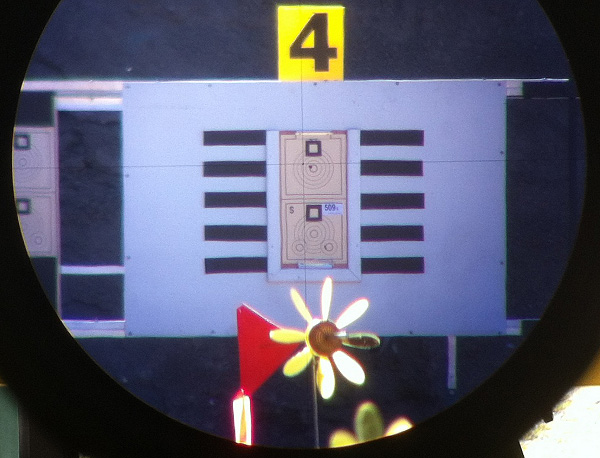
Here is the actual 200-yard, 5-shot group Charles shot in the video. Photo (by Stuart Elliot) taken through the lens of Huckeba’s 50X March scope (reticle has 1/16th MOA Dot).
Analyzing the Fine Points — What Makes Huckeba So Good
Short-range benchrest shooter Boyd Allen saw some interesting things in Huckeba’s WBC performance, as captured on video. Boyd noticed Huckeba’s smooth gun-handling and efficient loading. But Boyd also spied some interesting equipment, including an innovative joystick “handle-caddy”.
1. Low Friction Bags — When Huckeba slid his rifle, there was very little apparent friction. The front bag features the new 3M material (ScotchLite) on the sliding surfaces. The rear Protektor bag has ears of the same low-friction material.
2. Pause Before Chambering — While he was watching the flags and deciding when to start firing, Charles kept his first round in the action, but out of the barrel’s chamber, probably so as not to heat the cartridge and change the round’s point of impact.
3. Ammo Caddy on Joystick Arm – Charles shoots a Right Bolt/Left Port action, so he pulls his rounds with his left hand. Note that Huckeba’s record rounds rest in a small, wood ammo caddy attached to the end of the joystick shaft. Look carefully, you’ll see the wood ammo block in place of the normal black ball at the end of the joystick. That allows Charles to pull shots with the absolute minimum of hand movement. Ingenious! Huckeba is very fast, with a great economy of motion. I believe that because his ammo was literally at hand, Charles was better able to keep his focus on aiming and the flags.
4. Smooth-Cycling BAT Action — Note how smoothly Huckeba’s action operates. When Charles lifts the bolt handle (to extract a round and cock the firing pin), this does not disturb the rifle. Likewise, as he closes the bolt, the gun doesn’t wobble. The smooth action allows Charles to hold point of aim even when shooting relatively quickly. Huckeba’s BAT action is chrome-moly steel. Some shooters believe this metal makes for a smoother action than stainless steel or aluminum.
5. Long-Wheelbase Stock — The wood and carbon fiber stock is light, long, and stiff. Yet, importantly, the stock is also well-damped. The longer-than-average stock length (with extended forearm) seems to help the gun track well without jumping or rocking. The longer forearm allows a longer “wheelbase”, effectively shifting the weight distribution rearward (less weight on the front, more weight on the rear). This places a greater share of the gun’s weight on the rear bag, as compared to a more conventional benchrest stock. Huckeba’s stock, built by Bob Scoville, is at the cutting edge of short-range benchrest design. Its light-weight balsa wood and carbon fiber construction provides a combination of stiffness and vibration damping that allows its relatively long fore-end to be fully utilized to increase the weight on the rear bag (always an issue with 10.5-pound rifles).
To learn more about this benchrest stock design, read the comments by stock-builder Bob Scoville in our PPC with Pedigree story in our Gun of the Week Archives. Bob observed:
“There is a lot more to the structure of the stocks than meets the eye. The carbon fiber skin with which I cover the stocks creates a light, tough exterior surface. However, this contributes very little to the overall performance of the stocks. The real strength and stiffness is the result of an internal beam utilizing balsa core/carbon fiber technology.
This type construction can be found in aircraft, race cars, powerboats, and sailboats. It is interesting to note, balsa has the highest strength to weight ratio of all woods and carbon fiber is one of the lowest stretch (modulus of elasticity) relative to weight of all materials. The marriage of these two materials is common in the high-performance world. Additionally, balsa is used commercially for vibration dampening and sound reduction.”
Video find by Boyd Allen. Video by Stuart Elliot of BRT Shooters Supply, Brisbane, Australia.
Here is a video every shooter should watch. It reminds us that our sport demands 100% attention. Lose track of individuals down-range and the results could be tragic. This video will give you chills (starting at about the 0:25 mark). We need to remember to follow all the firearms safety rules, and apply them all the time. At the range, all it takes is one brief moment of inattention to create a life-threatening situation. Never assume the downrange area is safe. Use your own eyes and ears.
This video shows a competitor shooting a stage at an action pistol match. He starts when instructed by the Range Safety Officer (RSO). But unbeknownst to both RS0 and competitor, a volunteer is downrange working on targets. Watch carefully. At 0:27 the shooter sweeps left to right, engaging a paper silhouette target to his right. Then, at 0:30, as he begins a mag change, his head turns downrange. A few yards away is a white-shirted range worker! The shooter yells “Hey what’s going on?!”
What’s going on indeed… The RSO should have ensured that nobody was downrange before the shooter even stepped up to the firing line. If other competitors standing to the side had been alert, they might have seen the worker changing targets and called for a halt. And the target-worker himself — even if he was wearing earmuffs, he should have noticed that live fire had commenced just yards away…
We also have to wonder about the stage design. This set-up made it very difficult to see downrange. The white panels (see 0:10-0:20) definitely hid the target worker from view. In hindsight, given the way the stage was laid out, this was truly an “accident waiting to happen”. It’s fortunate that no one got injured in this incident. But this chilling video provides a lesson to all shooters — “Safety First”.
How could this “near-fatality” have been averted? Post your comments below.
The Southwest Nationals (SWN), 2025’s biggest centerfire rifle match west of the Mississippi, is coming up next week in Arizona. The 2025 SWN will be held at the Ben Avery Shooting Facility on February 12-16, 2025. We know that many of our regular readers will be flying to Phoenix to attend the SWN. Here are some travel tips from experts in the industry.
If you’ll be traveling by air in the days ahead, be careful when transporting firearms through airports. It is important that you comply with all Homeland Security, TSA, and Airline policies when transporting guns and ammunition. Following the rules will help ensure you (and your gear) make it to your destination without hassles, delays or (God forbid), confiscations.
Good Advice from an Airport Police Officer
To help our readers comply with rules and regulations for air travel, we offer these guidelines, courtesy “Ron D.”, a member of our Shooters’ Forum. Before he retired, Ron D. served as a Police Officer assigned to Chicago’s O’Hare airport. Here Ron offers some very important advice for shooters traveling with firearms and expensive optics.
First, Ron explains that airport thieves can spot bags containing firearms no matter how they are packaged: “Don’t think you’re safe if your guns are placed in cases designed for golf clubs or trade show items. Baggage is X-Rayed now and cases are tagged with a special bar code if they contain firearms. It doesn’t take long for bad guys to figure out the bar coding for firearms.”
Carry-On Your Scopes and Expensive Items
Ron advises travelers to avoid placing very expensive items in checked baggage: “When traveling by air, carry on your rangefinder, spotting scope, rifle scope, medications, camera, etc. You would be surprised at the amount of people that carry-on jeans and shirts, but put expensive items in checked baggage. Better to loose three pairs of jeans than some expensive glass.”
Mark Bags to Avoid Confusion
Ron notes that carry-on bags are often lost because so many carry-on cases look the same. Ron reports: “People do accidentally remove the wrong bag repeatedly. I frequently heard the comment, ‘But it looks just like my bag’. When de-planing, keep an eye on what comes out of the overhead that your bag is in. It’s easy to get distracted by someone that has been sitting next to you the whole flight. I tie two streamers of red surveyors’ tape on my carry-on bag.” You can also use paint or decals to make your carry-on bag more distinctive.
General Advice for Air Travelers
Ron cautions: “Keep your hands on your items before boarding. One of the most often heard comments from theft victims was, ‘I just put my computer down for a minute while I was on the phone.’ Also, get to the baggage claim area quickly. If your family/friends can meet you there, so can the opportunists. Things do get lost in the claim area. Don’t be a Victim. Forewarned is forearmed.”
Choosing a Rifle Transport Case
Forum member David C., who will compete at the 2020 Berger SWN, offers this advice: “If you plan to fly with your rifle, a 55″-long case such as the Pelican 1770 may be too big and heavy. The 1770 is 36 pounds on its own and is quite unwieldly to move around. I would recommend going with a smaller case such as the Pelican 1720 with 42″-long interior. It weighs 19 pounds and if you separate your stock from the barreled action, everything fits just fine, as you can see below.” Editor: Note that you can also store a full-size spotting scope in the case along with your rifle:
Retired Airport Police Officer Ron D. advises: “Buy the best [rifle case] that you can afford. Don’t cry when your $3,000+ Benchrest rifle has a cracked stock or broken scope. Think about what it would be like to travel across the country and arrive with a damaged rifle. Baggage handling is NOT a fine art. There is no guarantee that your rifle case will be on top of all the other baggage. Then there is shifting of baggage in the belly of the plane. Ponder that for a while. Rifle and pistol cases must be locked. It doesn’t take a rocket scientist to figure out that a simple pry tool will open most case locks. There is not much that you can do to disguise a rifle case. It is what it is, and opportunists know this. Among thieves, it doesn’t take long for the word to get around about a NEW type of case.”
Great Deal on Large All-Weather Case at Harbor Freight
If you need a good, sturdy airline-compliant hard case to transport your rifle to the Southwest Nationals, here’s a very good option at a great price. The sturdy APACHE 9800 Weatherproof Protective Rifle Case is currently on sale for $149.99. This 53″-long APACHE case is $190.00 less than an equivalent-size Pelican 1750 case ($339.95 on Amazon). Constructed from durable polypropylene, this quality hard case can protect long guns from from impact, moisture, and dust. The built-in purge valve equalizes pressure so you can open the case after changing elevations. NOTE: Case interior dimensions are 50⅜” by 13⅝”.




 Train Wrecks (and How to Avoid Them)


 4. Wind Issues. Tricky winds derail many trains. A lot can be written about wind strategies, but here’s a simple tip about how to take the edge off a worse case scenario. You don’t have to start blazing away on the command of “Commence fire”. If the wind is blowing like a bastard when your time starts, just wait! You’re allotted 30 minutes to fire your string in long range slow fire. With average pit service, it might take you 10 minutes if you hustle, less in F-Class. Point being, you have about three times longer than you need. So let everyone else shoot through the storm and look for a window (or windows) of time which are not so adverse. Of course this is a risk, conditions might get worse if you wait. This is where judgment comes in. Just know you have options for managing time and keep an eye on the clock. Saving rounds in a slow fire match is a costly and embarrassing train wreck.



 3. Ammo Caddy on Joystick Arm – Charles shoots a Right Bolt/Left Port action, so he pulls his rounds with his left hand. Note that Huckeba’s record rounds rest in a small, wood ammo caddy attached to the end of the joystick shaft. Look carefully, you’ll see the wood ammo block in place of the normal black ball at the end of the joystick. That allows Charles to pull shots with the absolute minimum of hand movement. Ingenious! Huckeba is very fast, with a great economy of motion. I believe that because his ammo was literally at hand, Charles was better able to keep his focus on aiming and the flags.


 First, Ron explains that airport thieves can spot bags containing firearms no matter how they are packaged: “Don’t think you’re safe if your guns are placed in cases designed for golf clubs or trade show items. Baggage is X-Rayed now and cases are tagged with a special bar code if they contain firearms. It doesn’t take long for bad guys to figure out the bar coding for firearms.”


