Report by Kyle Jillson for NRABlog.com
This year you can catch all the action at the 2013 NCAA Rifle Championships in real time thanks to a live stream from the match venue in Columbus, Ohio. Just hop on over to the NCAA Live website and dive right in. (The NCAA also provides live streaming coverage of other winter championship events.) The individual finals are set to stream live at 4:30 pm Eastern time.
Relay #3 is underway now (as this story is released) and the finals begin at 4:30 PM Eastern. In Relay #1, Alaska-Fairbanks’ Ryan Anderson took the lead with a 586-35X. After shooting a perfect 200 from prone, Anderson faltered slightly while standing and shot a 191, dropping nine. In kneeling, the final leg, he warded off the other shooters in his relay with a 195 to stay at the top.
High-Tech Hits the Road
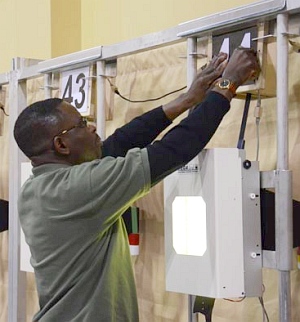
The Civilian Marksmanship Program (CMP) has a portable air gun range that travels around the country in trailer rigs. The CMP’s new $425,000 mobile range features 60 electronic targets, automated target lifts, target monitors (for 60 stations), and jumbo viewing screens for spectators. Positioned on tables along the firing line (photo below), the 60 MEGALink color screens show scores in real time. The high-tech electronic targets provide quick and accurate results, and spectators can watch a “live feed” on eight big-screen LED television monitors. The entire system is controlled by a trio of computers which do the scoring and operate the targets, lifts, and TVs.
The CMP’s state-of-the art, mobile air gun range boasts 60 electronic MEGAlink targets produced in Norway. MEGAlink is the same target system used at CMP North and South stationary air ranges. The MEGAlink target “boxes” are each connected to a lift system than can raise and lower the targets for 3-position shooting. All of the components are designed so that the range can be quickly constructed using as few as three people. A large trailer can haul all 60 targets plus all the related monitors, computers, tables, chairs, and hardware in one load-out.
“With travel being difficult for competitors to make it to Ohio or Alabama, the idea of the mobile range arose to transport electronic targets to the shooters instead of them coming to us,” said James Hall, CMP Program Outreach Supervisor. Because of its versatile design, the range can be used as either a 60-point range or broken down into three sets of 20 targets or two sets of 30 targets. “The range can be set up in almost any combination of targets, which allows small gyms and conference centers to host a match with maximum target use,” said Hall.
The first “trial” match of the Mobile Range was at the Montgomery Bell Classic in Nashville, TN in October 2012. “The match was a success, not only for the Montgomery Bell Academy, but also for the CMP,” Hall said. “The targets ran well, and we received a positive response from spectators.” Other CMP events where the range has been put to the test include the 5th Brigade Championship in Kerrville, TX in December 2012 and the Bass Pro 600 in Leeds, AL in January 2013.
All packed up and ready to go, the CMP’s Mobile Range will roll on to future events, including the JROTC Service Championship in Salt Lake City, UT, 4H Nationals in Grand Island, NE, the American Legion Championship in Colorado Springs, CO and various CMP summer camps and clinics. “The Mobile Range has generated a great response,” Hall admitted. “We hope it continues to give shooters out west and other areas of the United States a chance to compete.”
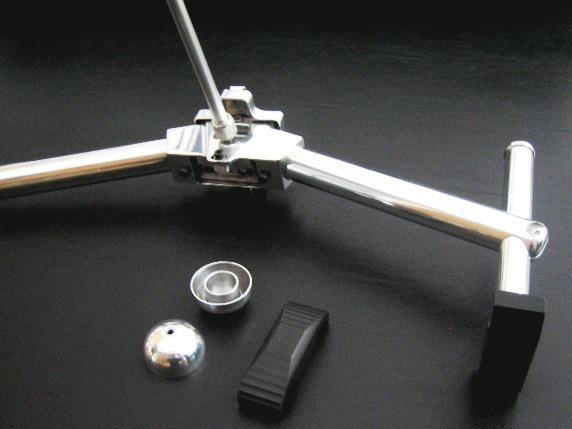
Seb Lambang of SEB Coaxial has revealed the GEN 2 version of his revolutionary joystick bipod (aka “Joy-Pod”). The latest version is lighter yet more rigid. The GEN 2 design features a longer handle plus built-in cant adjustment. Seb’s first-generation Joy-Pod was tested last year in Great Britain. Laurie Holland has been testing a modified version of the GEN 1 design, and he reports that it is working great.
The GEN 2 design incorporates lessons learned with the first prototype. It offers more reach and less weight. A clamp on each leg allows for easy coarse height adjustment.
Importantly, the head unit now allows +/- 14° of cant adjustment. This allows the shooter to fine-tune the cant of his rifle to suit the terrain, or his preferred rifle orientation. Currently cant is adjusted with a screw on the Joy-Pod head unit, but the production version will adjust cant via a handy locking lever.
Lighter Yet Stronger Design
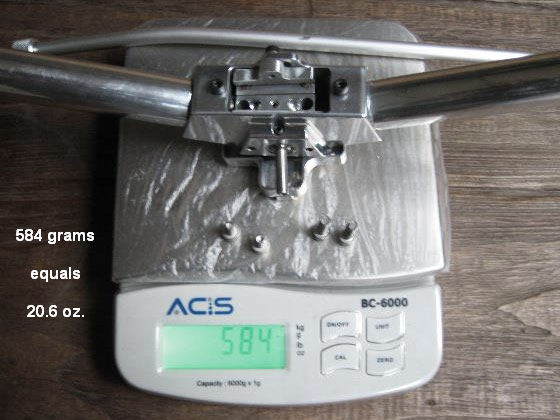
Seb tells us: “The GEN 2 design weighs just 20.6 ounces (584 grams) — very light for a joystick bipod — yet the new design is more rigid than my first prototype. This new design can accept about 50 pounds of weight with almost no flex.”
Seb has experimented with a variety of bipod configurations, including an offset design (shown below) with asymmetrical arms. One horizontal arm is longer than the other. This moves the rifle’s mass to one side (so it is not centered between the two feet). The goal of the offset design is to counter torque and rocking when the gun is fired. Will the offset design work? No one really knows yet.
Seb plans to offer a variety of feet/sled options — including round bases, plastic runners, and aluminum cone-style bases with spikes. In addition, at our request, Seb may experiment with large, cylindrical style feet, like those used on the Jennings chassis with integral bipod.
Seb’s joystick bipod is still in the prototype stage, so no price has been set yet. However, Seb hopes to have production versions available before the end of 2013. Perhaps a few pre-production units may be ready in time for the F-Class Worlds in Raton, NM in August.
This week (March 8-17) the U.S. Army Marksmanship Unit (USAMU) hosts the Army Strong Collegiate Shooting Championships at Fort Benning, Georgia. More than 300 elite junior and collegiate shooters are expected to compete. This event involves six distinct championships: the NRA Intercollegiate Pistol Championships; the NRA Intercollegiate Rifle Club Championship; the Scholastic Steel Challenge (SSC) Collegiate Championship; the Scholastic Clay Target Program (SCTP) Challenge; the Scholastic Pistol Program (SPP) Collegiate Championship; and the Association of College Unions International (ACUI) East Coast Clay Target Championship.
Colleges and Universities competing at this year’s championships include Clemson, Ohio State, Univ. of Michigan, U.S. Military Academy, U.S. Naval Academy, Penn State, and the Virginia Military Institute. Junior shooters from Georgia, Tennessee, Kansas, Massachusetts, and other states will compete in the SCTP Challenge. The Scholastic Steel Challenge (SSC) provides the opportunity for junior and collegiate shooters to participate in the exciting and challenging family sport of “speed steel.” The competitive format is based on the Steel Challenge, the nation’s most successful handgun competition. West Point will be among the favorites at this year’s SSC match.
The USAMU’s facility at Fort Benning “is the ideal location to hold a shooting competition of this magnitude,” said Lt. Col. Don King Jr., USAMU commander. “These collegiate and junior championships are on par with the World Cups, Olympic Trials and National Championships we have hosted throughout the years here at the ‘Home of Champions'”. For a complete schedule of events, go to www.usamu.com.
This past weekend, top pistol shooters from 28 states, one U.S. territory and three foreign nations competed at the 2013 Smith & Wesson IDPA Indoor National Championships in Springfield, Massachusetts. Robert Vogel successfully defended his Stock Service Pistol division title for the sixth straight year. Second place in the SSP division went to Rob Tate who claimed first Master and the High Military Veteran title.
In another impressive performance, our friend Randi Rogers won the High Lady title for the fifth year in a row. You go girl! Randi Rogers also claimed second Master. High International title went to Luis Ricardo Zanotti of Venezuela.
Vogel Dominates SSP Division
Vogel, the first IDPA shooter to claim the sport’s Distinguished Master classification in all three pistol divisions, won all but two stages in the championship to outpace his nearest competitor by nearly 30 seconds and finish with a final time of 154.37. That’s dominance. In addition to winning the SSP title, Vogel earned High Law Enforcement and High Industry honors.
“Bob Vogel is riding an incredible win streak in IDPA that extends back to the 2007 IDPA Nationals.” said Joyce Wilson, executive director of IDPA.
The Nightforce NP-2DD (Double Dot) reticle is popular with both match shooters and long-range varminters. The uncluttered reticle gives you an unobstructed view of the target — and that’s especially important for 1000-yard shooting. You can also use the “gap” between center dot and horizontal lines to judge wind hold-off (this “gap” is 1.1 MOA at 42X and 2.0 MOA at 22X). Some guys use the lower dot for hold-overs when shooting at different distances. At 22X the second dot is 8 MOA lower than the top dot. At full 42X power, the lower dot is 4.3 MOA lower than the top dot.
Clicking Elevation vs. Hold-Over with Double Dots If you have a Nightforce scope with NP-2DD reticle should you click for elevation changes, or hold-over using the second dot? The answer is: “It depends”. Danny Biggs, multi-time U.S. F-Class F-TR National Champion, offered this advice is our Shooters’ Forum: “There is nothing wrong with [using] the NP-2DD ‘over and under’ dots. Try it, and if it works for you, fine. However [in most situations] I would not bother to use it. Rather, I just click up/down the elevation going from 600 to 1,000 yards.
There is one exception though where I regularly use the lower dot! That is for 1,200-yard shooting — a fad at the Midwest Palma Championships held annually up at Lodi, WI. Here I fully employ [the hold-over method].
Following the 1,000-yard match, I click up 2-3 minutes of elevation depending on the load being used for my 7mm RSAUM, go to 42 power, and use the ‘lower’ dot. For me, the lower (and smaller diameter dot) at 42 power provides a preferable aiming dot for the much diminished size/appearance (at 1200) of the 1,000-yard target face. In this instance, I’m really not too lazy to just ‘click up’. By using the smaller aiming dot I ‘uncover’ the 10/X rings as much as possible as they are obscured by the larger upper dot. [This also allows] a better hold on the rings horizontally for windage purposes.” — Danny
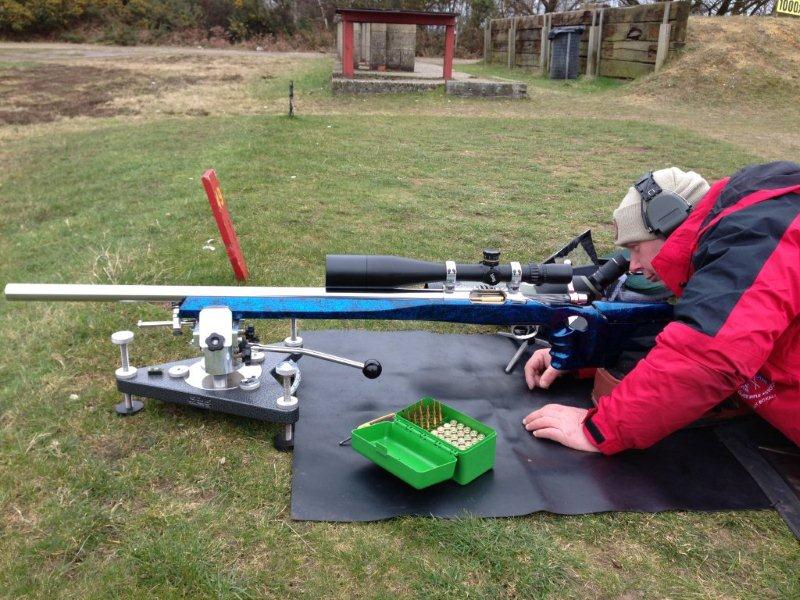
To kick off a new week, we are featuring a splash of color — the beautiful blue 7mm-270 WSM of Forum member Ian B. (aka “Elwood”) from Great Britain. A very knowledgeable guy, Ian is one of the UK’s top F-Class shooters. And he’s the proud owner of a very “Flash” F-Class rig.
About the Shooter — Ian’s Background
Ian tells us: “I started shooting F-Class Open four years ago when a good friend invited me to Bisley to shoot with the Dorset Riflemen. I found it very enjoyable and a real challenge. The next year I attended the GB F-Class league’s Introduction to F-Class course, and soon afterwards started to compete in the GB F-Class league, while still shooting once a month with the Dorset Riflemen. In this short time frame, I’ve managed to finish 8th in the league last year, 12th in the Europeans, and I was a part of the GB squad that won the team event at the European Championship. I was then selected for the GB F-Open World Championship Team. Unfortunately, due to work commitments, I have had to withdraw.”
Ian’s Beautiful Blue 7mm-270 WSM F-Class Rifle
Report by Ian B. (aka “Elwood”)
Having spent my first year competing with a magazine-fed 7mm WSM tactical/sporting rifle (Surgeon action and AICS mag) and doing reasonably well with it, I then moved on to a .284 Shehane (.284 Winchester Improved). I love the Shehane and still use it but this year I wanted something for those windy long-range days and so there was only one logical choice, the 7 WSM. This time I chose a 7mm-270 WSM as I quite enjoy case prep (just kidding). Actually, there’s not much to do really. The quality of Norma brass is well known and the Norma 270 WSM brass is quite easy to obtain in the UK.
The action is a Right Bolt, Left Port (RBLP) Stolle Panda F-Class action, with Jewell trigger. There wasn’t any particular reason behind the RBLP configuration — it was more of a case of that’s what I could get at the time. I had a 1.250″-diameter, straight-profile Bartlein barrel finished at 32 inches and chambered for the Berger 180gr VLD with a .313″ neck diameter. All my metal work and quite a bit of the wood work is done by the excellent Neil McKillop of McKillop Engineering. As with all top gunsmiths, Neil is meticulous to a point of obsessiveness and he’s the name behind quite a few winning rifles including several used by the GB Open and F-TR teams. Neil also inletted the stock from a blank and did the bedding for the action and the front bag runners.
Loading for the 7mm-270 WSM
I have one “tried and tested” load: 7mm Berger 180gr VLDs, seated .020″ into the lands, Vihtavuori N165 powder and CCI BR2 primers. This load is supremely accurate, but at 2990 FPS it’s a bit slow. To get more speed, I’m currently testing H1000 with good results, but it looks like I may have a slow barrel. I have another Bartlein barrel chambered and ready to screw on when the weather gets warmer. If that new barrel shoots well, the current barrel will probably be used as a practice barrel.
Loading Procedure
I do full case prep, neck-turning, uniforming primer pockets after the first firing, chamfering necks inside and out, and removing burrs around flash holes. Even the best brass sometimes suffers from imperfect quality control. I try to use Redding dies if possible, and will use bump dies, neck bushing dies, and competition seating dies.
I use a RCBS ChargeMaster 1500 to throw a charge just slightly under my desired weight and then trickle-up to final weight using the superb Dandy trickler and a Gem Pro 250 scale.
I anneal every other firing using a Bench-Source machine. Before this I used a Ken Light and also did them by spinning them in a drill. Never again will I do that after using the Bench-Source. After I have annealed, I always run a nylon brush wrapped in 0000 wire wool into the neck to remove any debris.
I keep to the same lot numbers of primers, powders, and bullets. Even the Bergers can vary from lot to lot — I have two different lots of 7mm 180gr VLDs that vary .020″ from bullet base to the ogive. I trim and point my bullets. Pointing may be a mental thing — I had a fantastic shoot while using trimmed and pointed bullets so I do it all the time now. ( A fellow GB team shot refers to them as “Pointless Dies” — I have witnessed him shoot a 99-14V at 1000 yards with bullets that weren’t trimmed or pointed). My next move will be to start measuring bearing surface…where does it all end?
Custom Wood Stock Was Modified by Ian and Treated to a Fancy Paint Job
The stock is a custom-made design crafted by Joe and Simon West of Joe West Rifle Stocks. I had several modifications done to one of their existing stock designs. Having done a lot of my shooting with the AICS, I was quite used to a thumbhole stock, so thought I would try one in F-Class. I told Simon what I wanted and he sent me down a prototype made from very inexpensive Tulip wood. We had a few discussions and then made some more mods..
I made two main changes to the stock. First, I removed the lip at the bottom of the pistol grip because I felt I might rest my hand on this and possibly disturb the rifle. Second, I had the protruding pistol grip base removed so that the bottom of the stock was completely flat like the Precision Rifle & Tool F-Class stock. Simon also made the finger grips to fit my hand and flattened them off to allow for a bit more movement. The stock was then sent to Hydro Graphics in the UK to have a custom exterior finish. The paint color is a Marbleized Candy Oriental Blue. As always, Hydro Graphics did a great job.
Optics and Rings
The scope is the excellent 5-50x56mm March with the MTR-2 reticle — far and away the best reticle I have used for F-Class. March makes great optics. During the 2012 European individual F-Class event, using another March (my 8-80x56mm), I could see my shooting partner’s impacts in the white V-Bull at 800 yards! And just recently at a club match I called two V-Bulls at 900 yards using the 8-80X (not at full power). Granted the light has to be perfect to be able to do this, but my highest praise for the Deon Optics glass is that it rivals that of Schmidt & Bender. Having owned both March and S&B scopes and compared them side-by-side, I feel that I can make this statement fairly.
UK-based Third Eye Tactical made the nice, 34mm rings. The UK is now producing some excellent products. We now have UK-made custom actions, rings, rails, stocks and more. It would be nice to think we could have a 100% British-made rifle, and not rely completely on USA-made products. I think all we need is the trigger? But I can’t see there ever being a UK-made scope!
Last weekend, at a 100/200 benchrest match in Visalia, CA, Walt Berger, founder of Berger Bullets, won both the Light Varmint (LV) and Heavy Varmint (HV) Grand Aggregates, as well as the Two-Gun Overall title. That’s an impressive sweep.
Walt, who is in his mid-eighties, beat a field of talented shooters who were 20-40 years younger. What’s that line: “Old age and treachery always triumphs over youth and skill”? Actually, Walt has plenty of skill and it wasn’t treachery that earned Walt his Visalia victories. He made the right wind calls, aimed true, and he had good equipment.
Walt was shooting a Saguaro-actioned rifle fitted with the new Nightforce 15-55x52mm Competition Scope. The light weight of the Saguaro action (just 26.6 oz.) and a shorter-than-usual 20 1/4″ barrel allowed Walt to make weight in the 10.5-lb Light Varmint Class, even with the 27.87-ounce Nightforce Comp Scope. Walt did switch to a heavier barrel for the 13.5-lb Heavy Varmint class. But his LV results suggest that Walt could have won the HV Agg using the lighter barrel as well. Walt was using 6mm Berger Column FB bullets for both LV and HV.
L to R: Jim Nicolas, Tom Price, Don Nielson, Walt Berger, Bill Summers, George Pizzillo, Duke Rovarino, George Lozano, Joe Stanovich. CLICK HERE for full Match Results.
Shorter, Lighter Barrels for Short-Range Benchrest? — Boyd Allen
Given Walt Berger’s success with a 20.25″ barrel at Visalia, I wondered how much weight one could save with a shorter barrel and the svelte Saguaro action. I ran some models using Dan Lilja’s FREE Barrel Weight Calculation software which predicts stiffness and barrel weight. Using this software, I could model different barrel profiles and diameters, with the goal of saving weight without sacrificing stiffness.
I came up with an optimized barrel contour with a shorter cylinder length and more taper (.800″ at muzzle). The Lilja program said this barrel (at 20.5″) would be just as stiff as a typical 21.5″ benchrest barrel, but would be roughly 13.5 ounces lighter. That’s right, by changing the barrel profile and trimming 1″ from the barrel OAL we can save over thirteen ounces without losing stiffness (at least the software says so).
A Saguaro action is 3.9 ounces lighter than a Stolle Panda. Combine that with the 13.5-ounce weight saving from a shorter barrel (with optimized contour) and you get a total weight savings of 17.4 ounces — more than a pound! That opens up a whole new world for 10.5-lb LV rifles. That extra pound lets a shooter run a heavier scope, or he can put another pound of weight into the stock and/or tuner.
I discussed the topic of shorter, reduced-weight benchrest barrels with two world record-holding benchrest shooters who were at the Visalia match. They both observed that, while shorter barrels shot well, shorter barrels produced more blast/noise, causing flinch problems. Accordingly, both of these shooters stopped using shorter barrels. I wonder if “double coverage” ear protection (with custom molded plugs and electronic muffs) would attenuate the blast enough to make the shorter barrels more “shootable”. Perhaps, then, we would see more shorter, lighter-contour barrels at matches.
A digital version of the NRA Tournament Operations Guide is now available FREE online. While supplies last, there are still some copies of the previous version available through the NRA Program Materials Center. However, the newer, free online version will replace it.
The 56-page NRA Tournament Operations Guide is loaded with information that will help your club or organization run efficient events. Featured topics include tournament planning, range operations, statistics, awards, and much more. A great resource for all match directors, the new guide covers eight different shooting disciplines.
Read the Complete Tournament Guide Right Here
A full version of the Tournament Guide is embedded below. Use the white arrows to move from page to page within the document. The down arrow advances one page at a time. Or, you can simply use the scroll bar on the right. NOTE: The “+” control zooms the page to 100% (or larger) for easier reading:
This story by Kerrin Brinkman courtesy the NRA Blog.
Can you imagine a shooting match that draws a couple hundred thousand spectators? Amazing right? Well that’s how many people turned out to watch the 2013 Int’l Biathlon Union (IBU) World Biathlon Championships (WBC) recently held in Nové Město in the Czech Republic.
At the 2013 WBC, event organizers constructed a stadium and filled it with 201,000 spectators to watch the best biathletes in the world. Among national teams at the WBC, Norway dominated, winning an incredible eight of the eleven competitions, including all three relays. Tora Berger and Emil Hegle Svendsen each won two individual events and contributed to the relay Golds. Tarjei Boe added Gold in the mass start. These eight Gold medals were a record for the IBU World Championships; no other nation has been so prolific or dominant.
On the other hand, biathletes from 12 different countries won medals — and that was a new record for medal distribution. In 2011 at Khanty Mansiysk, Russia, 11 nations took home a medal. This year 12 nations won at least one medal. Tim Burke from the USA earned a Silver Medal in the 20K event. This was the first medal for the red, white, and blue since Josh Thompson won the 20K Silver in 1987.
Lapua Polar Biathlon .22 LR Ammo Wins 97% of all 2013 WBC Medals
In the world of precision shooting, it’s unusual for one ammo-maker to completely dominate a major shooting event. But that’s exactly what happened at the 2013 World Biathlon Championships. An amazing 32 out of 33 total medals awarded in Nova Mesto went to biathletes shooting Lapua ammuntion, specifically Lapua .22 LR Polar Biathlon. That works out to 96.9% of ALL medals at this year’s IBU World Championships. Hats off to Lapua for producing the winningest biathlon ammunition ever made.


 Story based on report by Ashley Brugnone for


 “With travel being difficult for competitors to make it to Ohio or Alabama, the idea of the mobile range arose to transport electronic targets to the shooters instead of them coming to us,” said James Hall, CMP Program Outreach Supervisor. Because of its versatile design, the range can be used as either a 60-point range or broken down into three sets of 20 targets or two sets of 30 targets. “The range can be set up in almost any combination of targets, which allows small gyms and conference centers to host a match with maximum target use,” said Hall.

 The GEN 2 design incorporates lessons learned with the first prototype. It offers more reach and less weight. A clamp on each leg allows for easy coarse height adjustment.





 This past weekend, top pistol shooters from 28 states, one U.S. territory and three foreign nations competed at the 2013 Smith & Wesson IDPA Indoor National Championships in Springfield, Massachusetts. Robert Vogel successfully defended his Stock Service Pistol division title for the sixth straight year. Second place in the SSP division went to Rob Tate who claimed first Master and the High Military Veteran title.
 Vogel Dominates SSP Division

 If you have a Nightforce scope with NP-2DD reticle should you click for elevation changes, or hold-over using the second dot? The answer is: “It depends”. Danny Biggs, multi-time U.S. F-Class F-TR National Champion, offered this advice is our




 Optics and Rings
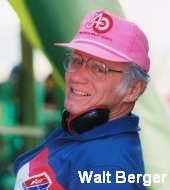 Last weekend, at a 100/200 benchrest match in Visalia, CA, Walt Berger, founder of

 A digital version of the
  At the 2013 WBC, event organizers constructed a stadium and filled it with 201,000 spectators to watch the best biathletes in the world. Among national teams at the WBC, Norway dominated, winning an incredible eight of the eleven competitions, including all three relays. Tora Berger and Emil Hegle Svendsen each won two individual events and contributed to the relay Golds. Tarjei Boe added Gold in the mass start. These eight Gold medals were a record for the IBU World Championships; no other nation has been so prolific or dominant.


