|
|
February 15th, 2013
There was quite a bit of interest in our recent Bulletin post about ‘negative’ black-to-white targets for F-Class practice. After seeing that story, some readers wanted to obtain reduced-sized “negative targets” for 300-yard F-Class training. Well guys, you’re in luck. One of our Forum members, Sleepygator, has produced “reduced-distance” targets (with black ring-lines on white background) that he could use at 300 yards for practice. Only the center 10 and X rings are black, so you can see bullet holes easily “in the white” on most of the target (and this uses less ink when printing). There is an official reduced-distanced standard for 300-yard F-Class matches. This utilizes the NRA No. MR-63FC – F-Class Target Center which is pasted over the MR-63 target. It provides a 1.42″ X-Ring, 2.85″ 10-Ring, and 5.85″ Nine-Ring. (The dimensions of F-Class targets are found in the NRA High Power Rules, Sec. 22, part 4.)
CLICK HERE to Download F-Class 300-yard Target Centers (.Zip archive with three targets)
To duplicate the 300-yard target, Forum member SleepyGator has prepared a printable version of the MR-63FC Target Center, along with a pair of training targets with two bulls and five bulls. The two-bull and five-bull targets mirror the scoring rings on the MR-63FC, but they display only the innermost three rings and two rings respectively. All three targets are Adobe Acrobat files that can be easily printed. You may need to adjust the scale (sizing) on your printer to get the dimensions exactly correct. As noted above, when printed, the 10-Ring on all three targets should measure 2.85″. This should provide some handy practice targets you can use between matches. Thanks to SleepyGator for providing these targets. You can download all three as a .Zip archive. After downloading the .Zip file, just click on the .Zip archive to extract the individual targets.

February 13th, 2013
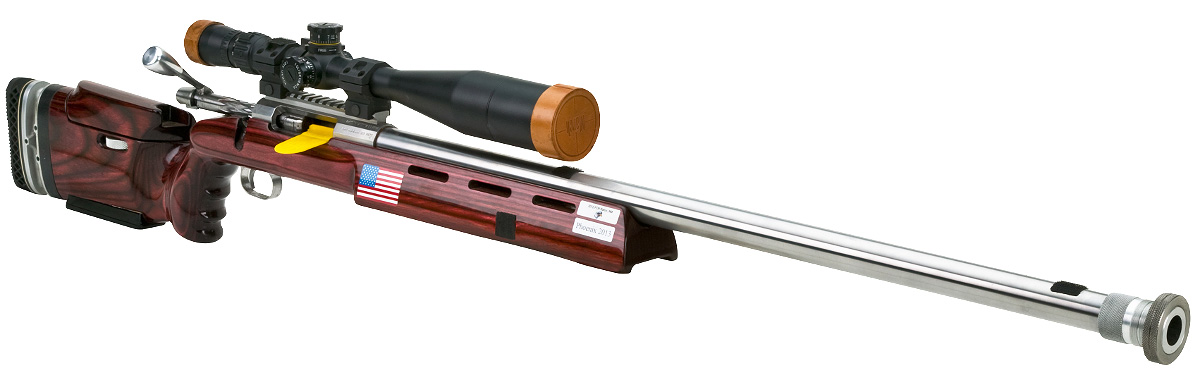
After Shiraz Balolia (President of Grizzly Industrial) won the F-Open Division at the 2013 Berger Southwest Long Range Nationals, folks wanted to know more about Shiraz’s match-winning .300 Winchester Short Magnum (WSM) rifle. That gun is a great piece of work, we can assure you. The Masterclass stock was extensively customized by Shiraz himself, who is a talented wood-worker (as well as a superb F-Class trigger-puller). CLICK PHOTO to see large “centerfold” shot of rifle.
 

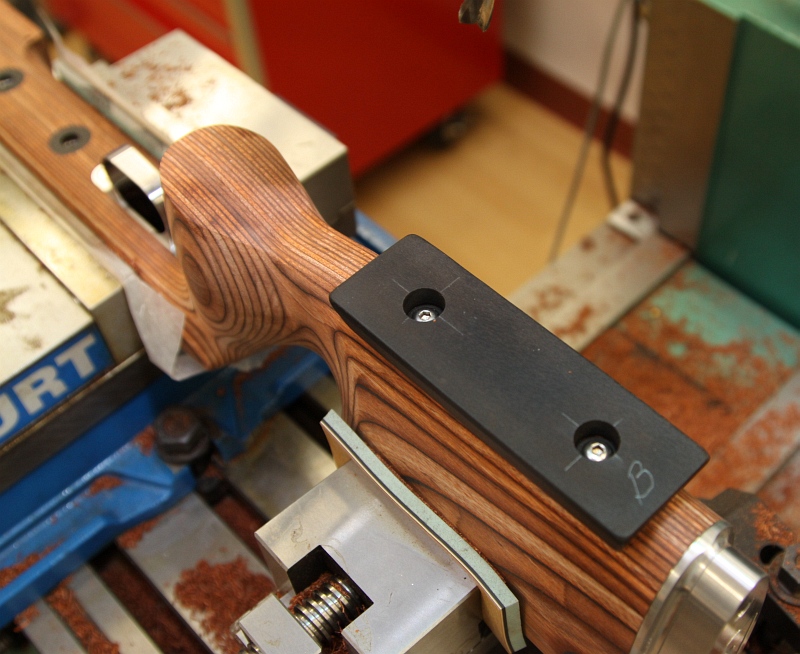
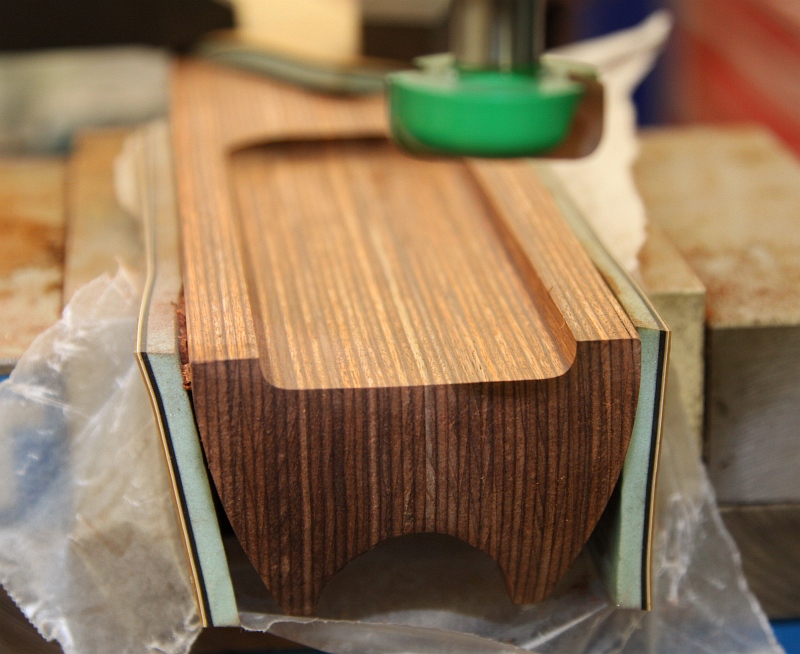
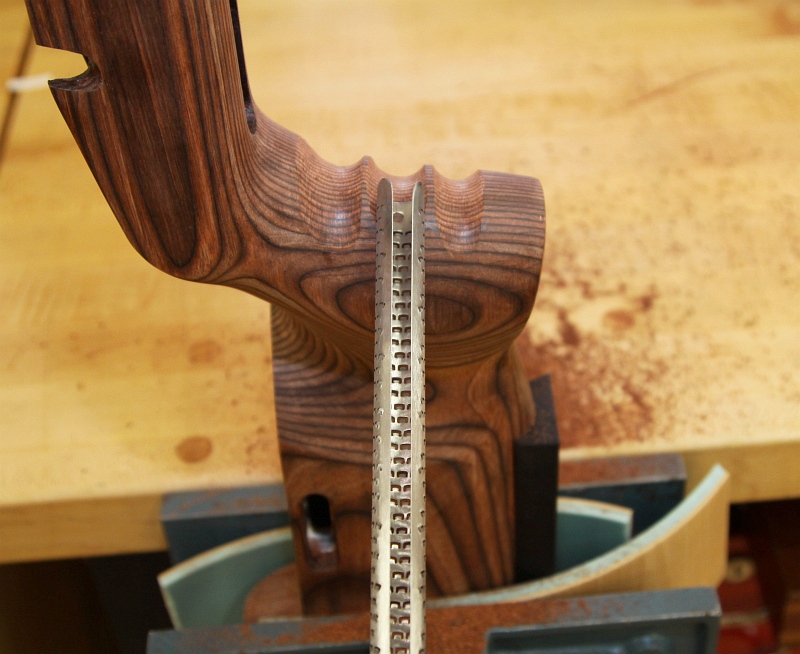
The rifle features a BAT Machine ‘M’ action, with a 32″, 1:10″-twist Bartlein barrel. Metal work was done by Gordy Gritters. The scope is a March 10-60x52mm, which sits on a +20 MOA angled rail. The primary stockwork, including fitting of the adjustable cheek-piece and buttplate, was done by Alex Sitman of Masterclass Stocks. Shiraz customized the stock with finger grooves, fore-end channel, and a bottom rear slide. Shiraz did the final stock finishing as well.

Listen to Shiraz Balolia Talk about his F-Open Victory (Click PLAY to Launch Audio File)
[haiku url=”http://accurateshooter.net/Video/shirazmemo1.mp3″ title=”Shiraz Talks about F-Open”]
Q&A with Shiraz Balolia

Q: Is the .300 WSM the “next big thing” in F-Open Competition?
Shiraz: The .300 WSM takes a bit to get used to. With more powder you have a bigger bang next to your head, plus you have to deal with the mule kick. My gun recoils so hard that it was coming to rest down on the neighbor’s target. I had to be careful about not cross-firing. Once you get these behind you it can be a very accurate caliber to shoot because of the great .30 cal bullet choices. There were about five .300 magnums in Phoenix, but only one in the top ten. You still have to read the wind!

Q: What’s your match load for the .300 WSM?
Shiraz: I use Norma brass with turned necks. At the Berger SW Nationals I used Berger 215gr Hybrids, Fed 215 LR magnum primers, and a stout load of Hodgdon H4831 SC. This drives the 215s at around 2910 FPS. If that sounds fast, remember I’m using a a 32″-long barrel.
Q: Can you tell us about your chamber and your fire-forming process?
Shiraz: On the .300” WSM [I run] a tight-neck .336” chamber for turned necks. Basically, I fire-form all my brass in a fire-form barrel and save the good barrels for matches. Gordy is so good that he can chamber different barrels to within .0002” in the headspace dimension. That way I can have several same-caliber barrels and can use the same brass for all those barrels. I use a .0005″ shoulder bump for my brass. I load the bullets so that the bearing surface sits above the doughnut ring.
Q: Do You Think Tuners Will Become Popular in F-Class?
 Shiraz: Tuners are a double-edged sword. In order to use them most efficiently you need to load test the barrel in many different conditions and record the results, fine tuning and turning the dials to find the best harmonic of that barrel in a given condition. When you encounter a similar condition at a match to what you tested previously, you would look up your notes and turn the dials so that it matches your tested condition. I am over-simplifying this, as it is quite complex and there are many articles about tuners. I do not see tuners catching on in F-Class as 99% of the users would not want to go through the aggravation. Shiraz: Tuners are a double-edged sword. In order to use them most efficiently you need to load test the barrel in many different conditions and record the results, fine tuning and turning the dials to find the best harmonic of that barrel in a given condition. When you encounter a similar condition at a match to what you tested previously, you would look up your notes and turn the dials so that it matches your tested condition. I am over-simplifying this, as it is quite complex and there are many articles about tuners. I do not see tuners catching on in F-Class as 99% of the users would not want to go through the aggravation.
Q: The stock looks highly customized. What special work did you do?
Shiraz: The stock is a Master Class F-Class stock that was highly modified by me. I channeled out the fore-end so the stock would ride on two “rails” on the front bag and not rock. I also added a wide 1.25″ base on the bottom of the stock that rides on the rear bag. There is a matching rear bag with a wide slot in it. The gun slides back and forth nicely and is very stable. I wanted finger grooves that fit my hand so I carefully filed those by hand with a round file, making sure to fit it many times during the process. Once all the modifications were complete I sanded and sprayed the stock with clear UV lacquer. My UV booth cures the spray in minutes. I usually assemble the gun the same day I spray it. As you know, I build guitars as a hobby as well.
February 12th, 2013
Report by Bryan Litz
The 2013 Berger Southwest Nationals is in the record books. No matter how you shot, those who traveled from the east were happy to escape the brutal winter weather, at least for a while. But that’s not to say there wasn’t some fine shooting!
Sling Shooting Results
In the sling class, Nancy Tompkins was far in the lead, followed by second place Bryan Litz, and Trudie Fay (who shot a Palma rifle) in third. It’s noteworthy that, after all the smoke had cleared, Bryan, Trudie, and 4th place Angus McLeod were tied in score, with only Xs separating second through fourth place. It was an exciting finish to say the least, especially for Bryan Litz whose poor performance in the Palma course started him in 25th place on Day One. Bryan went on to win both 1000-yard days, dropping only 2 points in 4 matches to climb to 2nd place overall. Trudie, who finished third overall among all sling shooters, also deserves recognition. Shooting a .308 Win Palma rifle with aperture sights the whole match, Trudie beat all but two Any/Any shooters who were allowed to use scopes and run any cartridge type they preferred.

F-Class Results
In the F-Open Class, Shiraz Balolia finished first shooting a .300 WSM. Freddy Haltom was second and Danny Biggs took third place. In the F-TR Division, John Hayhurst topped the field, followed by Lige Harris (second), and James Crofts (third place). CLICK HERE for more info and F-Class Top 10 Lists.
Listen to Shiraz Balolia Talk about his F-Open Victory (Click PLAY to Launch Audio File)
[haiku url=”http://accurateshooter.net/Video/shirazmemo1.mp3″ title=”Shiraz Talks about F-Open”]

Profile of Winning F-TR Team from Michigan
The Michigan F-TR Team had a very successful debut, breaking the National record for the 4-man F-TR Palma team course. However, that same day Team USA Blue coached by Mid Tompkins shot two points higher to set the new official record. The Michigan F-TR team came back on the second day of team matches (4-man 1000 yards) and won by a decisive 15-point margin to win the day and the overall F-TR Team Aggregate. Coached by Bryan Litz, firing members of the Michigan F-TR team included: Al Barnhart (Captain), Doug Boyer, Bill Litz, and Dale Sunderman. Team members Charlie Hayes and Jennifer Litz (adjutant) were also present and contributed to the team’s success. In all it was a very successful and educational first tour for the Michigan team, considering it was only formed this winter and it only practiced together one time before traveling to Phoenix. One interesting technical note is that 3 out of 4 Michigan Team shooters used the new Berger 215gr Hybrid bullet. That’s a very heavy projectile for the .308 Winchester case, but the Michiganders certainly showed the potential of the heavy Hybrid in F-TR competition.

Michigan F-TR team, from left to right: Dale Sunderman, Al Barnhart, William Litz, Jennifer Litz, Doug Boyer, Bryan Litz, Charlie Hayes.
February 11th, 2013

 The 2013 Berger Southwest Long Range Nationals (at Ben Avery in AZ) have wrapped up, and some divisional results have arrived. (Stay tuned for more complete results — as they are made available.) Congratulations to Grizzly Industrial President Shiraz Balolia, who won the F-Open Division. The 2013 Berger Southwest Long Range Nationals (at Ben Avery in AZ) have wrapped up, and some divisional results have arrived. (Stay tuned for more complete results — as they are made available.) Congratulations to Grizzly Industrial President Shiraz Balolia, who won the F-Open Division.
The F-Open competition was very close right down to the end, and the conditions were unforgiving. Shiraz finished with a 1226-55X score, one point ahead of F-Open runner-up Freddy Haltom (1225-60X), who had high X-count among Open-classers. We’re told that Shiraz was using a “shoulder-busting” .300 Win Short Mag in Phoenix. We’ve been promised photos of Balolia’s winning rig as soon as Shiraz gets back from Arizona.


The Top 10 F-Open shooters are listed in the chart above. Note, the 9th and 10th best Aggregate Scores were shot by two “Masters”, who out-shot dozens of “High Masters” to make the Top 10 overall. Steven Blair, who placed 8th Overall in F-Open, told us: “When conditions and competitors are as tough as they were in Phoenix, the winners deserve our accolades. It was no accident or luck that they finished as they did.” Forum member Kelbro agreed: “Except for the practice days, this was a challenging week. Double congrats to the top dogs. They earned it.”

In the F-TR division, John Hayhurst shot well throughout the Nationals to finish first with 1210-25X. Runner-up Lige Harris had 35 Xs, but ended six points down, finishing with 1204-35X. James Crofts, a past F-TR National Champion, finished third with 1203-24X. In F-TR Team Competition, the new Michigan F-TR team coached by Bryan Litz proved to be a powerhouse, securing an impressive team win. Shooters were: Al Barnhart (captain), Doug Boyer, Bill Litz (Bryan’s father), and Dale Sunderman. The second- and third-place teams were both USA F-TR Development squads. USA Team Blue grabbed second place, while USA Team Red took third. We’re told that USA Team blue set a new F-TR Palma record on Saturday. However, Team Michigan came back with a big win in Sunday’s 1000-yard team match, securing the Team Aggregate title.
In F-Open division, we’re told that Team UHaul finished first, with great shooting by Matt Davis, Herb Edwards, David Gosnell, and David Mann. Team Tex-Mex was second, with strong performances by Bryan Chatwell, Freddy Haltom, Ben Milam, and Cory Bizzel. Team Grizzly ended up third despite a cross-fire in one match. Team Grizzly is composed of F-Open winner Shiraz Bilolia, Emil Kovan, John Myers, and Tony Robertson.
February 8th, 2013
It’s February, so it must be time for Berger Southwest Long Range Nationals again. Hosted by the the Desert Sharpshooters at the Ben Avery Range outside Phoenix, this popular event kicked off on February 5th, and runs through Sunday, February 10th. As always, there has been a huge turnout (200+ shooters from throughout the USA and Canada), and the match is very well-organized. We’ll provide complete results when the match is complete, but here are some early highlights…

In F-Open competition, Team Grizzly won the Palma (800, 900 and 1000 yards) 4-person team match at the Berger SW Nationals against some of the fiercest competition in the country. Trudie Fay served as coach and the shooters were Shiraz Balolia (team captain), Emil Kovan, John Myers, and Tony Robertson.
Congratulations go to the USA F-TR Team “Blue” for winning the Palma Team Match. USA Team Blue narrowly edged out an excellent Michigan Team coached by Bryan Litz. The top F-TR shooter of the day was Dan Pohlabel (creator of the FLEX Bipod) who shot an impressive 443-17X, edging Matt Schwartzkopf of USA F-TR Team “Red” who scored 443-14X.

February 7th, 2013
How Easy it is to Have Fun with Rifles and Equipment You Probably Already Have….
Forum member Rod Vigstol (aka Nodak7mm) has written a great Introduction to F-Class for shooters getting started in this rewarding discipline. Rod’s article, which appears in German Salazar’s Rifleman’s Journal website, covers F-Class basics and addresses concerns that “newbies” may have when trying a new shooting sport. Rod stresses that most guys who own a varmint-hunting or tactical rig likely have nearly all the gear they need to give F-Class competition a try.

CLICK HERE to read Rod Vigstol’s ‘Getting Started in F-Class’ article on Rifleman’s Journal.com
Rod explains: “If you’re reading this, you have more than just a general interest in the shooting sports and in the awesome rifles that shoot tiny groups at insane distances. You probably even have friends that enjoy shooting as much as you do. The quandary you may find yourself in is your friends haven’t quite jumped into it head-first like you have and they haven’t spent a lot of money and time obtaining the equipment you have to go shoot these matches. But you know what? Your prairie-dog shooting buddy or coyote-hunter friend can attend these matches and shoot alongside with you. He or she more than likely already has the basic equipment needed to shoot a match.” Most varmint shooters already have a suitable, accurate rifle and the following equipment:
• A variable-power scope in the 4.5-14x range or higher.
• A front bipod like the trusty old Harris 9″-13″, or maybe even a basic pedestal front rest.
• A rear sand-bag or similar sand-sock to rest the butt stock.
• A basic shooting mat from Midway or at least a piece of carpet or canvas to lay on.

Rod also provides a handy checklist of items to bring to the range. These include: Canvas or carpet strip (to set under bipod), Notebook, Kitchen Timer, Cleaning Rod, Camp Chair, Elbow Pads, Shooting Hat, and Open Bolt Indicator (OBI). Along with rifle, bipod (or front rest), rear bag, and ammo, that’s pretty much all you need.

Rod encourages all shooters to give F-Class a try — even novices. Rod explains: “We have all been rookies, newbies, new kids on the block or whatever. So we all have a good idea of what may be going on in your mind, the questions and concerns you may have. I’m telling you this sport is full of fantastic people who deep down find it far more fulfilling to help a new shooter get started than running a clean target. You just have to take the first step to get involved.”
CLICK HERE To read the entire article on Rifleman’s Journal.com. We’ve only provided a small sample of Rod’s article; it is definitely worth reading in its entirety.
February 5th, 2013
Congrats to 2012 Olympian Sarah Scherer who set an NCAA record with a 597 in smallbore this past weekend in a showdown with UTEP Rifle Team. She also tied the NCAA record with a 1,195 aggregate in leading the defending NCAA Champion TCU Women’s Rifle Team to their 22nd consecutive victory.

Sarah shot her record scores at a match at UTEP on Saturday. The TCU Horned Frogs topped the UTEP Miners 4,694-4,511. Sarah Scherer set an NCAA record in smallbore, firing a 597. Scherer added a 598 in air rifle to tie the NCAA Aggregate record with a combined 1,195. In smallbore, Sarah shot a perfect 200 in prone, a 199 in standing and a 198 in kneeling. In air rifle, she fired five perfect strings of 100, including the final four strings. Her lone 9s came in the second string of shots when she shot a 98.

Scherer’s record-breaking smallbore shooting lead TCU to victory in the rimfire competition, with the Horned Frogs winning 2,335-2,223 over UTEP. TCU had the top four smallbore shooters, and TCU also boasted five of the top six shooters in air rifle to help TCU to a 2,359-2,288 win. TCU will fire one more match before the NCAA Championships in March.
Large photo courtesy USA Shooting.
January 30th, 2013
 Jeffrey Block has created a great new FREE software program, OnTarget, that measures shot groups quickly and precisely. All you need is a photo or scan of your target. The program allows you to set your target distance, and provides caliber-specific tools to precisely mark the center of each shot. Once you’ve marked each bullet hole, Jeff’s OnTarget program automatically calculates group center, maximum group spread (CTC), average distance to center, group width and height, and group offset from point of aim. The program will even measure multiple groups on the same target. Jeffrey Block has created a great new FREE software program, OnTarget, that measures shot groups quickly and precisely. All you need is a photo or scan of your target. The program allows you to set your target distance, and provides caliber-specific tools to precisely mark the center of each shot. Once you’ve marked each bullet hole, Jeff’s OnTarget program automatically calculates group center, maximum group spread (CTC), average distance to center, group width and height, and group offset from point of aim. The program will even measure multiple groups on the same target.
CLICK HERE to Download OnTarget Group-Measuring Software (v1.10 FREE; v2.10 $11.99)
 After just a few minutes spent learning the program’s tool buttons, we were able to plot shot groups on a variety of targets with ease. Once you select the target distance and bullet diameter, figuring group size is a simple matter of centering a circle tool over each bullet hole. Then the program “connects the dots” and provides all the info you could want automatically. After just a few minutes spent learning the program’s tool buttons, we were able to plot shot groups on a variety of targets with ease. Once you select the target distance and bullet diameter, figuring group size is a simple matter of centering a circle tool over each bullet hole. Then the program “connects the dots” and provides all the info you could want automatically.
The program worked with bullet holes as small as 17 caliber and as large as 50 caliber. It is very precise, but remember that if your target photo was taken at an angle, distorted perspective can cause slight errors in measurement. Therefore, for the ultimate precision, you want to start with a flat scan of the target.
OnTarget Compared to Measuring Manually
We found OnTarget to be especially useful for groups with widely dispersed bullet holes, or very small bullet holes, such as 17 caliber holes. We’ve found that it’s difficult to measure 17-cal group sizes with a standard caliper, because the tool itself obscures the tiny holes. With OnTarget, the program can zoom up your target view, making it much easier to plot the center of each shot. And with a widely dispersed group of shots, the program automatically finds the two most distant shots. You can’t mistakenly pick the wrong pair of shots to measure.
Flash Tutorial Shows How It Works
Jeff created an excellent animated Animated Tutorial demonstrating OnTarget’s functions. It shows how to import a target image or scan, how to set target distance and scale, how to set bullet size and circle each bullet hole, and how to save the marked and measured target. VIEW OnTarget TUTORIAL
| MEASURING REAL TARGETS — Actual Examples |
Here are examples we created with OnTarget. The first photo shows a 17 Mach 2 target. These tiny 17-cal holes are notoriously hard to measure. With OnTarget, it’s a snap. You just load the target image into the program, zoom in with the controls, and then click on the center of the holes. The program automatically calculates group size, displaying measurements in both inches and minutes of angle (MOA)
Original Target (with ruler for scale)

Target Captured and Displayed in Program

Detail of Group, Enlarged by Program

10-shot Groups? — No Problem
Here’s another target, showing 6mm bullet holes at 600 yards. The first image shows the target image loaded into the program with the ten holes circled in red.
Target Displayed in Program

For this target we have used the Aiming Point option. The Aim Point was set at the center of the “X” and the program calculates average distance from the Aim Point. Very cool.
Detail of 10-Shot Group, Enlarged by Program

No Scanner Needed
The OnTarget program grabs target scans directly from a flatbed scanner using Microsoft’s Windows Image Acquisition system. But don’t worry if you don’t have a scanner. You can just take a digital photo of your target and OnTarget will import it quickly and easily. To set target scale, a simple tool allows you to mark a known length on the target (such as the diameter of the “X” Ring), and the program will then size the target accordingly. Is OnTarget precise and accurate? Here’s what Forum Member Steve W. says: “I used the extreme spread measurement of a group on one of my 600-yard match targets… as it was officially scored at the match. By clicking the +—+ icon, then clicked the cursor in the centers of the two extreme spread holes, I then entered that value in the reference window. After that it was simple because the bullet placement cursor’s circle was the same size as the black outline of the actual bullet holes on the picture of the target. OnTarget’s measurement came up within .006″ of the official 2.772 inch measurement of the group. That’s pretty darned close; well inside the human judgment of aligning the tips of a micrometer on the bullet holes.”
Bottom Line — Great Program — Download It Today
Jeffrey Block has done a great service for shooters by creating the FREE OnTarget program. It is easy to learn, it functions great, and it can save you time and effort measuring targets. It also lets you easily archive and compare multiple targets produced during load development or rifle testing. You can record ammo type, date, location, weather etc. in note fields accessed by “Group Info” and “Target Info” tabs.
Keep in mind that OnTarget was NOT created to replace existing methods for scoring competition targets. But for all other target measuring purposes it does a great job. Visit Jeff’s website, OnTargetShooting.com, view the tutorial, and check out OnTarget for yourselves.
To learn more about OnTarget, see more measuring samples, and read advanced Power-User Tips, visit our full OnTarget Product Review.
January 29th, 2013


Vintage Military Rifle Matches
Across the country, vintage military rifle matches are growing in popularity. It’s easy to understand why — the matches are fun, the rifles are affordable, and the rules discourage the use of expensive aftermarket sights and fancy triggers. It comes down to good marksmanship… and good ammo.
To help competitors in the Vintage military rifle game, Hornady has devleoped a line of Vintage Match ammunition. Currently available in four cartridge types, Vintage Match ammunition replicates the original military performance specifications of older military rifles. To function safely and reliably in older guns, this Vintage Match ammo is loaded to pressures well below CIP max.

Vintage Military Rifle Match photo from CMP Zenfolio Image Archive on the web.
Hornady Vintage Match ammunition was developed for shooters involved in the increasingly popular CMP Vintage Rifle and Vintage Sniper Matches. This “Vintage Match” product offers an off-the-shelf, match-grade alternative to surplus or hand-loaded ammunition. The four varieties of Vintage Match ammo are: 6.5×55 Swede, .303 British (Enfield), 7.62x54R (Moisin Nagant), and 8×57 IS/JS (Mauser)*.

*From Norma Website: The “J” in the name originated with confusion over the word “Infanterie”. English translators mistook the Gothic “I” for a “J”. The “J” has no significance as to proper bullet size. In 1905, Germany increased working pressure of this cartridge and switched from a 226gr, 0.318-inch, round-nose bullet (2095 fps) to a 154gr, 0.323-inch, spitzer bullet (2880 fps). The “S” in the designation stands for “Spitzer” and also indicates that the bore was either originally made for, or was altered for, 0.323-inch bullets. It is extremely rare to find a sporting rifle chambered and barreled for the original 8×57 J (0.318-inch groove). However, this is possible. So, if in doubt, have the bore slugged to determine if it is safe to fire loads using 0.323-inch bullets.
Match photos © Civilian Marksmanship Program, used by permission.
January 14th, 2013
 Kruger of Germany produces match targets for the ISSF and major World Championships. Kruger’s quality control is second to none. Now officially-licensed NRA targets are available from Kruger Premium Targets in the USA. With elite competitions being decided by thousandths of an inch in shot placement, shouldn’t your club use the best-quality targets available? Kruger targets are made from premium-grade paper to permit precise, reliable measurements. For example, to ensure that target holes do not have irregular edges, Kruger’s NRA Air Rifle and Air Pistol targets are printed on machine-smoothed 210 gram board made from short-fiber materials. Mike Krei, Director of the NRA’s Competitive Shooting Division, has stated: “It is generally accepted that Kruger has the best heavy pulp target paper in the world and that directly relates to the excellent clean bullet holes which are essential for precise scoring.” Kruger of Germany produces match targets for the ISSF and major World Championships. Kruger’s quality control is second to none. Now officially-licensed NRA targets are available from Kruger Premium Targets in the USA. With elite competitions being decided by thousandths of an inch in shot placement, shouldn’t your club use the best-quality targets available? Kruger targets are made from premium-grade paper to permit precise, reliable measurements. For example, to ensure that target holes do not have irregular edges, Kruger’s NRA Air Rifle and Air Pistol targets are printed on machine-smoothed 210 gram board made from short-fiber materials. Mike Krei, Director of the NRA’s Competitive Shooting Division, has stated: “It is generally accepted that Kruger has the best heavy pulp target paper in the world and that directly relates to the excellent clean bullet holes which are essential for precise scoring.”

Kruger offers the full array of official NRA air rifle, air pistol, international pistol, and smallbore targets. In addition, Kruger sells photo-realistic Animal Targets, plus a cool series of Fun Targets for plinking and informal practice. Kruger targets can be ordered online through www.Kruger-US-Targets.com or you can call Kruger’s USA distributor, MK Tactical, at (503) 746-6816. MK Tactical is located in Hillsborough, OR.
|