|
|
January 13th, 2013
Following shoulder surgery, our Contributing Editor German Salazar moved to F-TR shooting, replacing his sling and iron sights with bipod and scope. German has done remarkably well for an F-TR newbie, winning his first two 500-yard matches (in F-TR class) at Phoenix-area ranges. German has been shooting his “old Palma rifle with a scope and bipod attached”. This rig features a Gilkes-Ross action in a Robertson/Sitman Highpower Prone stock with an Anschütz 5020 trigger and 30″ 1:11″-twist Krieger barrel. The rifle is fitted with a Canadian-made Rempel “Ski” bipod and a Leupold BR 24X scope.
On his Riflemans’ Journal website, German has crafted a helpful article with advice for “sling shooters contemplating a busman’s holiday into F-Class.” Even seasoned F-Class shooters can learn something from German’s observations in his F-TR: Scoping it Out article. Here are some highlights from the article:
Carpet Under the Bipod
“I quickly learned that a piece of carpet was an essential component under the bipod. Without the carpet, [on dirt surfaces] the bipod tends to dig into the dirt with every shot, resulting in odd elevation shots. On the concrete it isn’t quite as essential, but it smooths the recoil movement appreciably and is worthwhile. [I used] a short-nap carpet remnant for this, but my car floor mat also worked well.”

Clicking vs. Holding Off
“I’ve been shooting iron sights and clicking sight knobs for most of my life; trying to hold off made me very uncomfortable and the reflex pull of the trigger just wasn’t there. Once I returned to holding center and clicking, I was more comfortable and was able to execute my shots more quickly and cleanly. By zeroing the windage knob I can also easily return to a previous setting when conditions warrant.”
Reading Mirage with Spotting Scope
“In conversations with other F-Class shooters in our club, I found that few were using a spotting scope to see mirage; they were largely relying on the rifle scope. However, the rifle scope is focused on the target, as it must be to eliminate parallax, and thus cannot show mirage with the same clarity as a spotting scope that is focused roughly halfway down the range.”

Positioning Your Spotting Scope
“I position the spotting scope in the same manner as I did when shooting from the sling. It is very close to me and can be used without moving the head from the cheekpiece. The object, as always, is to minimize movement in order to maintain a consistent position and to minimize the time lost between the last glance at the mirage and breaking the shot.”
CLICK HERE to Read Full F-TR Article by German Salazar
German’s F-TR article first appeared in 2011. Since then German has had another shoulder surgery, but he is progressing well.
January 4th, 2013

In 2012’s final week, the Port Malabar Rifle & Pistol Club of Palm Bay, Florida held the Fifth Annual Snowbird X-Miss Midrange Prone and F-Class Match. This NRA Registered Tournament drew almost 60 competitors from around the country plus Fritz Braun from Brazil. For the first time ever, the Snowbird had a 300/500/600 event the first day with 600-yard match the second two days. Competitors saw various kinds of weather varying from chilly to 74 degrees. There were some drizzles on the last day of the individual matches but the rain held off long enough for all to complete the event
Kent Reeve took the High Overall 3-Day aggregate for the Mid-Range Prone with a score of 1797-132X. Second overall went to Sam Yarosh with a score of 1793-109X. Third overall to Wayne Forshee with 1788-91X. In F-Open, reigning FL State F-Open Champion Mark Finizio won the 3-day event with a score of 1790-100X. Second was Ken Adams, 1780-77X and third place overall went to Tom Goodman, 1778-68X. Complete results are listed on www.pmrpcrifle.com.

Many Record-Setting Performances at the X-Miss Match
Numerous NRA National Records were set at the 2012 Snowbird X-Miss event. Kent Reeve shot an incredible 200-22X at 600 yards. LeeAnn Finizio set F-Open Ladies’ records at two yardages: 300 yards, (197-[?X]); 600 yards ( 200-14X). Sam Yarosh shot a new record of 197-12X in the 500-yard any sight police category.
Team Event on Sunday
On Sunday, December 30, 2012, there was a team match. The F-Class Open Division saw a tight race among Miami’s Signal 20 F-Class Team, the S&S Precision Rifle Team, and the BNX F-Class team. Team BNX ended up in first place ahead of runner-up S&S Precision Team, shown below.

The Snowbird X-Miss Match was conceived to let folks shoot in the dead of winter when they can’t compete at home. At the Snowbird X-Miss Match NRA classifications are used AND rifles are classed by type: Palma, Iron Sight, Service Rifle, and Scoped Rifle. And the usual F-Open and F-TR divisions are recognized. Awards are given to all these types. Thus a shooter with a 6.5-2284 scoped rifle is not competing against someone with an iron-sighted AR15 Service Rifle. The Snowbird will be held again next season at the end of 2013.
Major sponsors this year included Sinclair International, S & S Precision Rifles, D & B Supply, Bartlein Barrels, Krieger Barrels, Berger, and Sierra. Others included Creedmoor Sports, PMA, K & M, Lee Precision, Forester Products, Redding, Dewey, Precision Reloading, and Jim Owens.

December 28th, 2012
 Benchrest shooter Gene Bukys has smashed the existing Sporter Class 100+200 yard Grand Aggregate record, lowering the NBRSA record from 0.1886 to 0.1777. That’s a big deal in the short-range benchrest game. This record was shot in October, 2012 at the Arizona Nationals. Benchrest shooter Gene Bukys has smashed the existing Sporter Class 100+200 yard Grand Aggregate record, lowering the NBRSA record from 0.1886 to 0.1777. That’s a big deal in the short-range benchrest game. This record was shot in October, 2012 at the Arizona Nationals.
On Benchrest Central, NBRSA SW Regional Director Tom Libby reported:
“Yes it’s said that ‘Every Thing is Bigger in Texas’. Well in this case ‘Smaller is Better’ and Gene has done it with his new World Record for five 5-shot groups at both 100 and 200 yards in the Sporter Class Grand Aggregate.
The Old Record: .1886
The New Record: .1777
[That includes five targets at EACH distance, ten targets total.]
Great Job Eugene G. Bukys!
It is my understanding that Gene has bought a new special cowboy hat to start putting his awards on it but don’t get to close to him as the brim will hit you in the head.”
Bukys and Barrel Tuners
Commenting on Buky’s record-setting performance, Boyd Allen writes: “Gene has a fine record as a shooter, and his rifles have tuners (at least the bag guns do, I’m not sure about the rail.) In contrast to other users of tuners, I’m told that Gene tunes his to the middle of a node, locks it down, and does not move it again, preferring to tune with normal means. I think that the effectiveness of this approach is pretty evident — the proof is now in the record books! Gene would tell you that he has never seen a barrel’s accuracy increased by the addition of a tuner, but that, with a tuner, accuracy nodes are wider. I would add that, while Gene’s tuner is an important component, we must acknowledge Gene’s outstanding shooting skills — this man can win with or without a tuner.”
December 27th, 2012
Story based on report by Kyle Jillson for NRAblog
As we enter the new year, the NRA National Indoor Rifle and Pistol Championships kick off with the first set of sectional tournaments starting January 1, 2013. With thousands of participants, the Indoor Championships are the NRA’s biggest competition. And the addition of BB Gun and Light Rifle in 2013 is expected to draw even more competitors.

Unlike NRA matches shot at one location such as the Bianchi Cup or the National Matches at Camp Perry, the Indoor Championships are fired at local sectional tournaments. The results of particular Sectional events are sent to the NRA and and then tallied alongside results from around the country. The championships are open to anyone and everyone in the country as long as you can make it to a sectional tournament. After scores are compiled, results are announced and awards are mailed out.
Unlike the NRA’s traditional tournaments, the Indoor Championships run throughout the winter:
January 1 through March 18: Open Sectionals
January 1 through February 12: Collegiate Sectionals
January 1 through April 15: Junior Sectionals (There may be over 300 of these in 2013).
The NRA National Indoor Championships are a lot of fun and the perfect chance to try out any new gifts you got this holiday season. Want to host a sectional or learn more about shooting in one? Send email to the Rifle Department at rifle@nrahq.org, or give the NRA a call:
Rifle: Dian Bullock, (703) 267-1482
Pistol: Ann Boyd, (703) 267-1452
Collegiate: Tori Croft, (703) 267-1473
December 25th, 2012
The Arizona Desert Sharpshooters website offers a complete collection of competition plot sheets. These plot sheets were created by shooter Reid Perry. High Power and F-Class shooters can use these to mark their shot locations and record their wind calls. All the Plot Sheets are created in Adobe Acrobat (.pdf) format so they’ll print consistently from any computer. See sample plot sheet for 600 Yards.
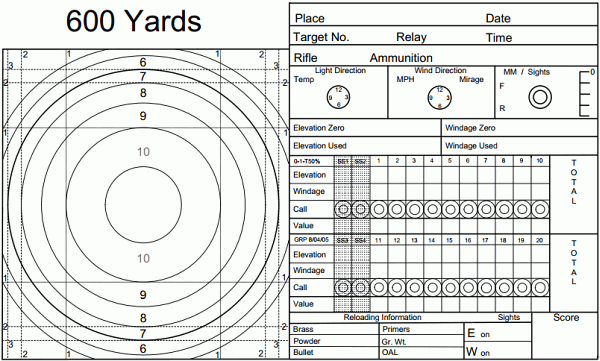
Right click and “save as” the links below to download full-size plot sheets. On the Desert Sharpshooters site you’ll find other free plot sheets, including ISSF (300m) and ICFRA Plot Sheets (300 to 1000 yards), plust sight-setting and score-keeping plot sheets.
|
|
DCRA (Canada) Plot Sheets
|
December 20th, 2012
 We live in a digital, electronic era. The very story you’re reading right now consists of digital data packets transmitted electronically around the globe. Because of cost factors, 99+% of shooting matches in the USA still rely on old-fashioned manual scoring methods. However, target scoring can be done faster and more precisely with electronic scoring systems. Olympic and international CISM shooting competitions now employ electronic target systems. And electronic scoring is widely used in Europe. Virtually all the rifle and pistol events at the recent ISSF World Championships in Munich featured electronic scoring — complete with large, overhead digital displays so the audience could track the action, shot for shot. We live in a digital, electronic era. The very story you’re reading right now consists of digital data packets transmitted electronically around the globe. Because of cost factors, 99+% of shooting matches in the USA still rely on old-fashioned manual scoring methods. However, target scoring can be done faster and more precisely with electronic scoring systems. Olympic and international CISM shooting competitions now employ electronic target systems. And electronic scoring is widely used in Europe. Virtually all the rifle and pistol events at the recent ISSF World Championships in Munich featured electronic scoring — complete with large, overhead digital displays so the audience could track the action, shot for shot.
Below is a video showing an electronic scoring system developed by Norway’s Kongsberg Mikroelektronikk AS. Watch as a prone shooter puts five rounds on a 300m target. You can see the group form on the video screen at his shooting station. He’s a good shooter (with an accurate rifle). The first three shots are touching.
As you can see from the video, viewing shots on the monitor is easier than using a spotting scope and waiting for targets to be marked. And, electronic targets eliminate the need for target pullers in the pits.
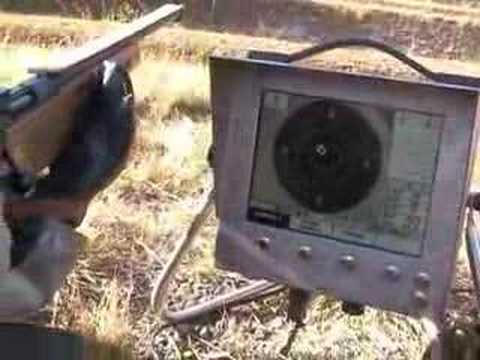
The Kongsberg target systems, like the electronic systems produced by Sius Ascor of Switzerland, do more than just display shot locations to the shooter. The target units automatically calculate scores, which are transmitted to a central computer. This can provide updated competitor rankings, and can even display the results to event spectators on large view screens.


CLICK HERE for a longer streaming Flash VIDEO showing how electronic target systems work. This video, produced by Sius Ascor, shows Olympic target systems in action.
December 14th, 2012
 The National Bench Rest Shooters Association (NBRSA) now has its own eZine, Precision Rifleman, which covers NBRSA events and provides notices to members. The editors do a good job providing follow-up reports on popular matches with profiles of notable NBRSA members. The National Bench Rest Shooters Association (NBRSA) now has its own eZine, Precision Rifleman, which covers NBRSA events and provides notices to members. The editors do a good job providing follow-up reports on popular matches with profiles of notable NBRSA members.
Along with match reports, you’ll find a list of upcoming events plus a handy directory of NBRSA-affiliated clubs across the country, complete with full contact information.
While Precision Rifleman is funded in part through NBRSA member dues, you can read the digital version online for free — you do not have to be a paying NBRSA member. (A print version goes out to NBRSA members).
CLICK HERE to read latest December 2012 issue of Precision Rifleman

December 11th, 2012
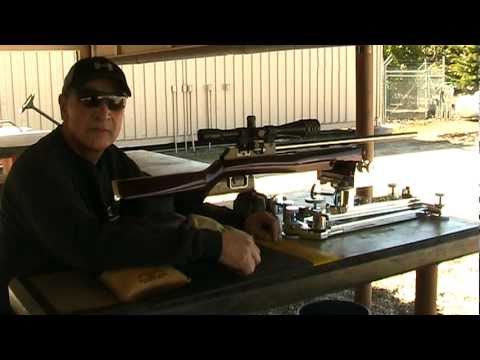
Our friend and product tester Joe Friedrich is the proud owner of a spectacular front rest from James Pappas. This rest is used for both air rifle and rimfire benchrest matches. The fancy Pappas front rest is a shortened, front-support-only version of the Pappas one-piece rest, which is popular with rimfire benchresters. Pappas engineered this rest to comply with air rifle benchrest rules which do not allow use of integrated (one-piece) front and rear rests. The end result was a 30.8-lb masterpiece of machining.


The workmanship on this Pappas front rest is astounding. Accurately described as a “work of art” by Joe Friedrich, this rest, crafted of aircraft-grade aluminum, sets new standards for “Benchrest BLING”. It looks like it should be on display in an art museum. Nearly all components of this rest, including the adjustment controls, have been polished to a mirror finish.

Convenient Rear Windage and Elevation Controls
The Pappas front rest features separate fine-tuning controls for windage and elevation, plus a central gross-elevation control. Normally, once the rest is centered-up on the target, you can make all needed elevation and windage adjustments with the rear (fine-adjustment) controls. In the video below, Joe explains how the controls work as he practices with his modified Theoben Rapid MFR air rifle. Joe hopes to use this new Pappas rest in the upcoming Air Rifle Benchrest Worlds to be held in South Carolina this summer. (Note: In the last minute of the video, the back-lighting was so intensely bright that we lost detail in the foreground. We apologize for that flaw, but you can still hear the audio.)
Price for this Masterpiece? Don’t Ask…
If you are interested in getting a similar rest, visit PappasRimfireProducts.com, or call James Pappas directly at (817) 735-9883. Be forewarned — James said “If you need to ask about the price, you probably can’t afford it.” This is truly the “Rolls-Royce” of front rests, and it will be priced accordingly.
December 9th, 2012
This article originally appeared in the SAVAGE ACCURACY Blog
Stan Pate is the Captain of Savage’s National Championship F-TR Team. In this article, Stan explains how to adjust the action-screw tension on a three-screw Savage target action to achieve the best accuracy. The procedure described here can be used for any Savage action, including the two-action-screw models. However, the optimal settings for each particular rifle may vary slightly.
 Match shooters need to get that extra accuracy edge from our ammunition and firearm. It is easy to get one of the Savage rifles to shoot accurately — even to match standards. If you are looking for that little bit more from your rifle, then please read a method that I have found that works for me. For those of you that are familiar with tuning a receiver (such as a match rimfire action), this article will be nothing new. For the rest of you, this might be new material. The goal here is to find the “sweet spot” for the rifle in relation to the torque settings used on the receiver screws. The proper torque settings [can vary] from rifle to rifle, but they will usually have a noticeable effect on consistent group sizes. A properly-torqued rifle will optimize the “harmonics” of the barreled action using the receiver screws so that the gun delivers peak consistency. Match shooters need to get that extra accuracy edge from our ammunition and firearm. It is easy to get one of the Savage rifles to shoot accurately — even to match standards. If you are looking for that little bit more from your rifle, then please read a method that I have found that works for me. For those of you that are familiar with tuning a receiver (such as a match rimfire action), this article will be nothing new. For the rest of you, this might be new material. The goal here is to find the “sweet spot” for the rifle in relation to the torque settings used on the receiver screws. The proper torque settings [can vary] from rifle to rifle, but they will usually have a noticeable effect on consistent group sizes. A properly-torqued rifle will optimize the “harmonics” of the barreled action using the receiver screws so that the gun delivers peak consistency.
Here is the process I have found that works for me in tuning a Savage rifle receiver to peak accuracy. To use my process you first must already have a load that shoots accurately and consistently in your rifle, and I always use a fouled barrel like I’d be shooting in a match. This process works for me in both the model 10 (two receiver screws), and the model 12 (three receiver screws).

Seat Recoil Lug and Start with Front Action Screw(s)
On the model 12, I will first ensure that the recoil lug is seated securely against the stock by just lightly tightening up the front receiver screw then gently but firmly bumping the butt pad against the floor. Next I will tighten up the front two receiver screws to 30 inch-pounds starting at 20 inch-pounds and working up to the 30 inch-pounds in 5 inch-pound increments, and always tightening the front screw first and then the second screw. Once the front two receiver screws are torqued to the final torque setting, I will set the rear receiver screw to 5 inch-pounds and shoot a 5-shot group [to evaluate accuracy].
Increase Torque Incrementally on Rear Action Screw
After the group is shot and I am satisfied that I called all of the shots as good shots I will allow the rifle to cool off to about the temperature that the fist group was shot at. I will then add 5 inch-pounds to the rear receiver screw and shoot another five-shot group and allow the rifle to cool again. I repeat this process until I have tightened the rear receiver screw to 40 inch-pounds or have seen the groups get smaller and then start getting larger again. Once you have seen the groups decrease and then start to increase in size then you will have found the area of torque to work in. You can then can fine tune this to the exact inch-pound torque settings.
Tuning a Model 10 with Two Receiver Screws
The Savage model 10 action, which has two receiver screws, uses the same process as the three-screw model 12. Measure your group sizes and place the measurements in front of you so that you can see the bell curve showing where your best groups were achieved. NOTE — there may be a better way of doing this and if you should have one, I’d be very interested in hearing it. Good shooting and I hope to see you all on the range. – Stan Pate
 |
This is on the Palma rifle using the torque settings of 30 inch pounds on the front two reciever screws, and 15 inch pounds on the tang screw, it is approximately 1/2″ center to center. |
 |
This is my second torque setting which for this rifle and this load is the optimal setting of 30 inch pounds on the front two reciever screws and 25 inch pounds on the tang screw, this group is approximately .180″ center to center. |
 |
This is the third torque setting which for this rifle is moving away from the optimal torque setting towards the heavy side of the scale. This torque setting results shows that you will usually see a “bell curve” of accuracy as you move into the optimal torque setting. This group is almost .7″ and the torque setting was 40 inch pounds. |
This article was edited for length to appear in the Daily Bulletin.
December 8th, 2012
by Steven Blair, 2012 California State Long Range F-Open Champion
Assess the Terrain and How the Wind Will Interact with It
Before you begin a match, take a few minutes to look around the range at the terrain, any obstructions, range topography (berms and backstop), and trees, buildings or structures that could affect wind flow over the range. Imagine what might happen if the wind was from the left or right, headwind or tailwind. Depending upon the direction, significant effects may be seen on range. A head or tail wind may ripple across the berms, causing elevation changes, both high and low. A tall side berm, like the east side berm at Ben Avery, may cause turbulence when the wind comes from that direction. Blocking features might shield most of the wind but a break along the range can funnel strong gusts through the gap with no other indications. Take a few notes about the effects of different wind directions and refer to them if the prevailing direction changes. (Tip courtesy Tony Robertson.)

Use a Spotting Scope, Even When Shooting a Scoped Rifle
A good spotting scope can “see” mirage much more clearly than even an expensive rifle scope. Take your spotting scope to the line and position it as sling shooters do, close enough to use without much movement. Focus the scope approximately 1/3 of the way down range or where the most significant wind effects are likely to occur. Take a quick look while waiting for pit service, glance at the flags and compare to your scope sight picture. I often see ambiguous indications at the target through the rifle scope, but see a clear indication of wind direction and speed through the spotting scope at the shorter distance. When shooting the Arizona Palma Championship at Ben Avery last weekend, I was scoring while the wind was coming from the east. Shooters up and down the line were out to the left, losing points. Mirage at the target looked moderate and the flags weren’t indicating strong wind. As I focused the spotting scope back, the mirage suddenly looked like it was flowing twice as fast around 500 yards than it was closer or farther. It wasn’t until I realized that the access road cut through the berm there that I understood what was happening. (Tip courtesy Gary Eliseo.)

Don’t Over-React to Something That May Be an Anomaly
On ranges with sizable berms, a headwind or tailwind can cause significant elevation problems. It is generally not possible to see or predict when this will occur. When the conditions exist that cause elevation changes and other competitors are experiencing the same problem, the best strategy is to ignore it. Certainly, avoid shooting when the head or tail wind is gusting, the same as you would in a crosswind. But, if you react to random, range-induced elevation changes, the only likely result is to make it worse. Whether the problem is caused by range or ammunition, maintain your waterline hold until you have evidence that something has fundamentally changed.

My .284 Shehane will usually require a click or two down during a string as the barrel warms. That is normal and manageable. But, if your shots are just bouncing up and down in the 10 ring, leave it alone. The same is also true of an occasional gust pushing a shot into the 9 ring. If the conditions have not changed and one shot just went out, it may be the result of a random occurrence that was not predictable. (Tip courtesy “School of Hard Knocks”.)
Adjust Spotting Scope Focus and Magnification as Needed to View Mirage vs. Target Details
In F-Class we only need to see mirage, spotters, and scoring disks. That does not take a lot of magnification. My scope is a Nikon 25-75x82mm ED. It is a superb scope for the money and makes it trivial to see minor variations in mirage. It is good to have the high magnification available, and it can always be reduced if necessary. I use different power settings for different situations.
 Setting Magnification Levels Setting Magnification Levels
During a match, in very good viewing conditions, I set my spotting scope at 75X, full power. The mirage is more subtle in the morning and greater magnification is needed.
During a match with heavy mirage I set my spotting scope at about 40X. I have no problem seeing mirage, even at this magnification.
When practicing at 300 yards or closer I set my spotting scope at max power (75X) so I can see the little 6mm holes from my 6BR rifle. I usually need to focus back and forth between shots to see both bullet holes and mirage.
Steven Blair, 2012 California State Long Range F-Open Champion, has been shooting since childhood and competing for over 30 years. Before retiring, Steve spent 16 years in Engineering and IT with General Atomics. He has held Engineering and Marketing positions with several firearms companies and worked on projects from pistols to 155mm howitzers.
|


