|
|
April 14th, 2012
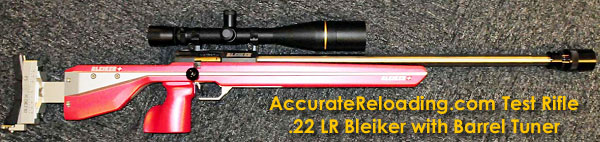
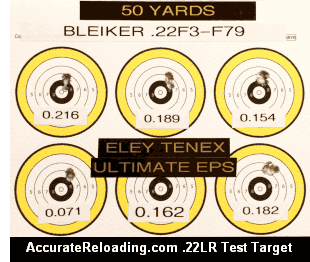 In 2010, the staff of AccurateReloading.com Forum completed a massive .22LR Rimfire Ammunition Testing Project. Some 55 different types of ammo were tested, using a highly-accurate Swiss-made Bleiker rifle, with a 2-stage trigger. All ammo varieties were tested at 50 yards, 75 yards, and 100 yards, shooting five, 5-shot groups at each distance. Though these tests were completed some time ago, many readers have requested a “reprint” of the ammo rankings, so we’ve republished this data below. In 2010, the staff of AccurateReloading.com Forum completed a massive .22LR Rimfire Ammunition Testing Project. Some 55 different types of ammo were tested, using a highly-accurate Swiss-made Bleiker rifle, with a 2-stage trigger. All ammo varieties were tested at 50 yards, 75 yards, and 100 yards, shooting five, 5-shot groups at each distance. Though these tests were completed some time ago, many readers have requested a “reprint” of the ammo rankings, so we’ve republished this data below.
The results are fascinating to say the least (and perhaps eye-opening). The tester observed: “I got some amazing groups, and some which are, frankly, absurdly bad! This has re-enforced what I had experienced with 22 ammo in the past — that is being consistently inconsistent.”
While we strongly caution that .22LR rimfire ammo may work well in one gun and not another, and ammo performance can be improved through the use of barrel tuners, the AccurateReloading.com research provides invaluable guidance for smallbore shooters. Overall, the testers burned through over 4,000 rounds of ammo, and you can see the actual test targets online. To read all the test reports, and view target photos visit AccurateReloading.com.
The lists below rank the average accuracy (by brand) of five, 5-shot groups shot at 50, 75, and 100 yards. CLICK HERE for Complete Test Results with target photos.
| 50-Yard Results |
75-Yard Results |
100-Yard Results |
0.162 Eley Tenex Ultimate EPS
0.164 Lapua Midas Plus
0.177 Lapua Polar Biathlon
0.187 Eley Match EPS
0.193 Eley Match
0.203 Lapua Midas M
0.215 Lapua Center X
0.216 Western Value Pack
0.229 Lapua Signum
0.241 Lapua Master L
0.243 Eley Pistol Match
0.256 Olin Ball
0.256 Akah X-Zone
0.261 Lapua Midas L
0.261 Lapua Master M
0.263 Eley Tenex Semi Auto
0.270 Lapua Super Club
0.272 Eley Tenex
0.303 Lapua Standard Plus
0.312 CCI Standard Velocity
0.319 RWS R 50
0.319 Eley Standard
0.328 SK High Velocity
0.339 Eley Club Xtra
0.340 Winchester T22
0.356 Federal Champion
0.362 Eley Subsonic HP
0.371 CCI Mini Mag
0.376 Federal American Eagle
0.377 Norinco Target
0.380 Sellier & Bellot Club
0.384 Eley Club
0.387 Eley Sport
0.388 Totem
0.392 Swartklip Match Trainer
0.398 Federal Gold Medal
0.403 Swartklip HV
0.409 Eley Match Xtra Plus
0.424 Sellier & Bellot Std
0.443 Remington Target
0.461 Lapua Crow HP
0.475 Eley Silhouex
0.479 Magtech
0.498 Eley High Velocity
0.513 Winchester Super X
0.516 Kassnar Concorde
0.539 CCI Blazer
0.560 Winchester Supreme Pistol
0.576 Norinco Pistol Revolver
0.593 SK Standard
0.611 Sellier And Bellot HP
0.626 SK Standard HP
0.686 Logo HV
0.956 Pobjeda Target |
0.274 Lapua Center X
0.283 Lapua Standard Plus
0.295 Eley Tenex Ultimate EPS
0.307 Lapua Midas M
0.329 Lapua Master M
0.346 Eley Match
0.373 Lapua Polar Biathlon
0.399 RWS R 50
0.432 Lapua Midas L
0.448 Eley Tenex Semi Auto
0.467 Eley Match EPS
0.474 Lapua master L
0.491 Eley Match Xtra Plus
0.494 CCI Standard
0.496 Eley Subsonic HP
0.507 Eley Sport
0.512 Federal American Eagle
0.513 SK High Velocity
0.514 Eley Standard
0.516 Eley Tenex
0.516 Lapua Crow HP
0.532 Western Value Pack
0.533 Fed. Champion Target
0.535 Lapua Midas Plus
0.564 Akah X Zone
0.566 Olin Ball
0.573 Eley Club Xtra
0.616 Lapua Signum
0.631 Winchester T22
0.639 Swartklip HV HP
0.641 Eley Club
0.642 Eley Silhouex
0.647 CCI Mini Mag
0.679 Eley Pistol Match
0.682 Swartklip Match Trainer
0.690 Federal Gold Medal
0.692 Remington HV
0.703 Lapua Super Club
0.720 Winchester Super X
0.738 Eley High Velocity
0.759 Kassnar Concorde
0.765 Sellier And Bellot Club
0.770 Winch. Supreme Pistol
0.770 Norinco target
0.775 CCI Blazer
0.802 Norinco Pistol Revolver
0.841 LVE Logo HV
0.855 Sellier & Bellot Std
0.871 Magtech
0.923 Sellier & Bellot HP
0.934 SK Standard HP
1.017 Remington Target
1.257 Totem Standard
1.442 SK Standard
1.578 Pobjeda target |
0.455 Eley Match
0.510 Lapua Midas Plus
0.549 Lapua Midas M
0.611 Lapua Polar Biathlon
0.611 Eley Tenex Ultimate EPS
0.619 Eley Match EPS
0.622 Eley Club
0.630 Lapua Center X
0.631 RWS R50
0.679 Eley Tenex Semi Auto
0.694 Lapua Midas L
0.729 Eley Tenex
0.739 Lapua Master L
0.753 Lapua Super Club
0.785 Lapua Master M
0.831 Eley Sport
0.851 Eley Match Xtra
0.859 Lapua Standard Plus
0.867 Akah X-Zone
0.877 Eley Pistol Match
0.907 Norinco Target
0.924 Eley Silhouex
0.939 CCI Standard
0.952 Eley Subsonic HP
0.963 Magtech
0.970 Olin Ball
0.978 Kassnar Concorde
0.995 Eley Club Xtra
1.009 Western Value Pack
1.032 Federal Champion
1.087 Norinco Pistol Revolver
1.100 CCI Mini Mag
1.112 Lapua Crow HP
1.143 Winchester T22
1.142 Federal Gold Medal
1.144 federal American Eagle
1.156 Swartklip Hollo Point
1.165 Lapua Signum
1.170 Swartklip Match Trainer
1.175 Fed. Champion Value Pk
1.182 SK high Velocity
1.201 Totem
1.224 Winchester Super X
1.358 Eley Standard
1.367 Remington High Velocity
1.375 CCI Blazer
1.414 Eley High Velocity
1.450 Remington Target
1.504 LVE Logo
1.813 SK Standard
1.879 S&B Club
1.947 S&B Hollow Point
2.073 SK Standard HP
2.221 S&B Standard
2.266 Pobjeda Target |
April 11th, 2012
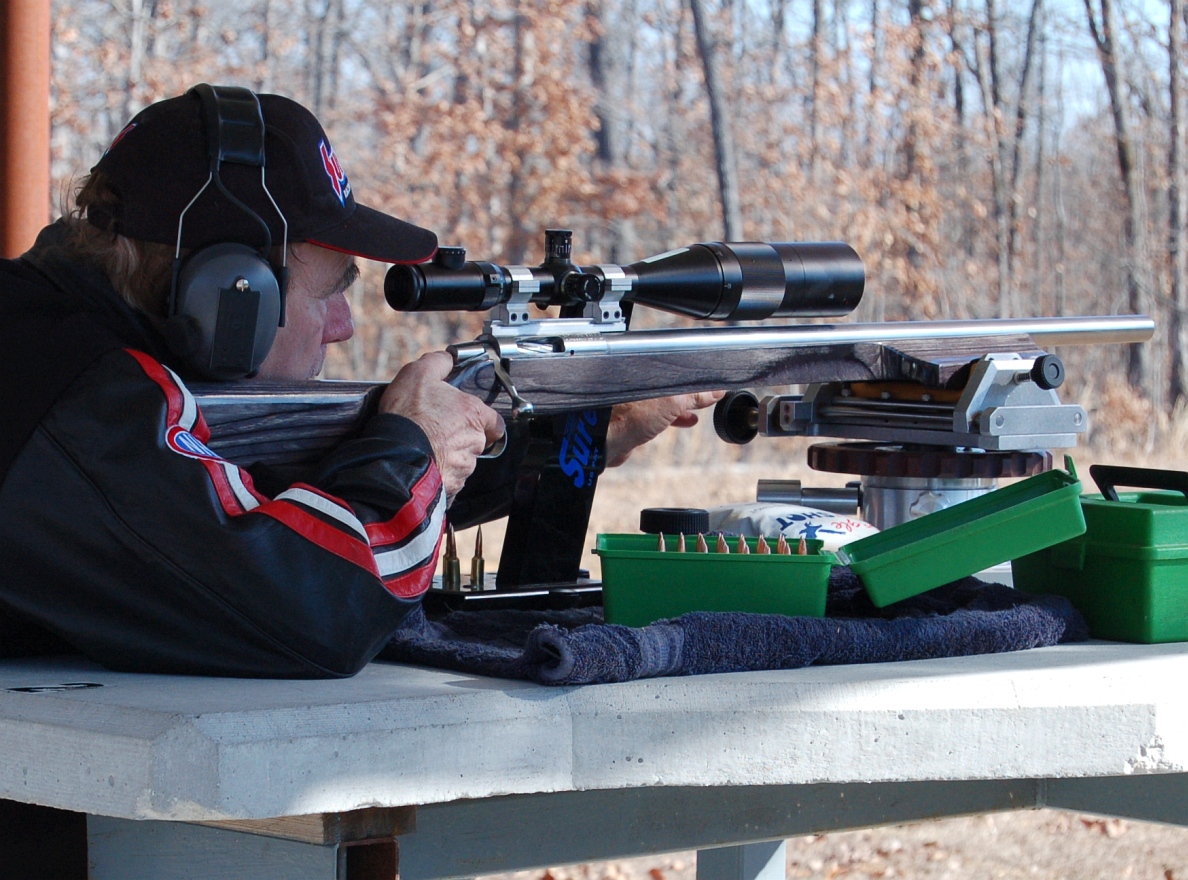
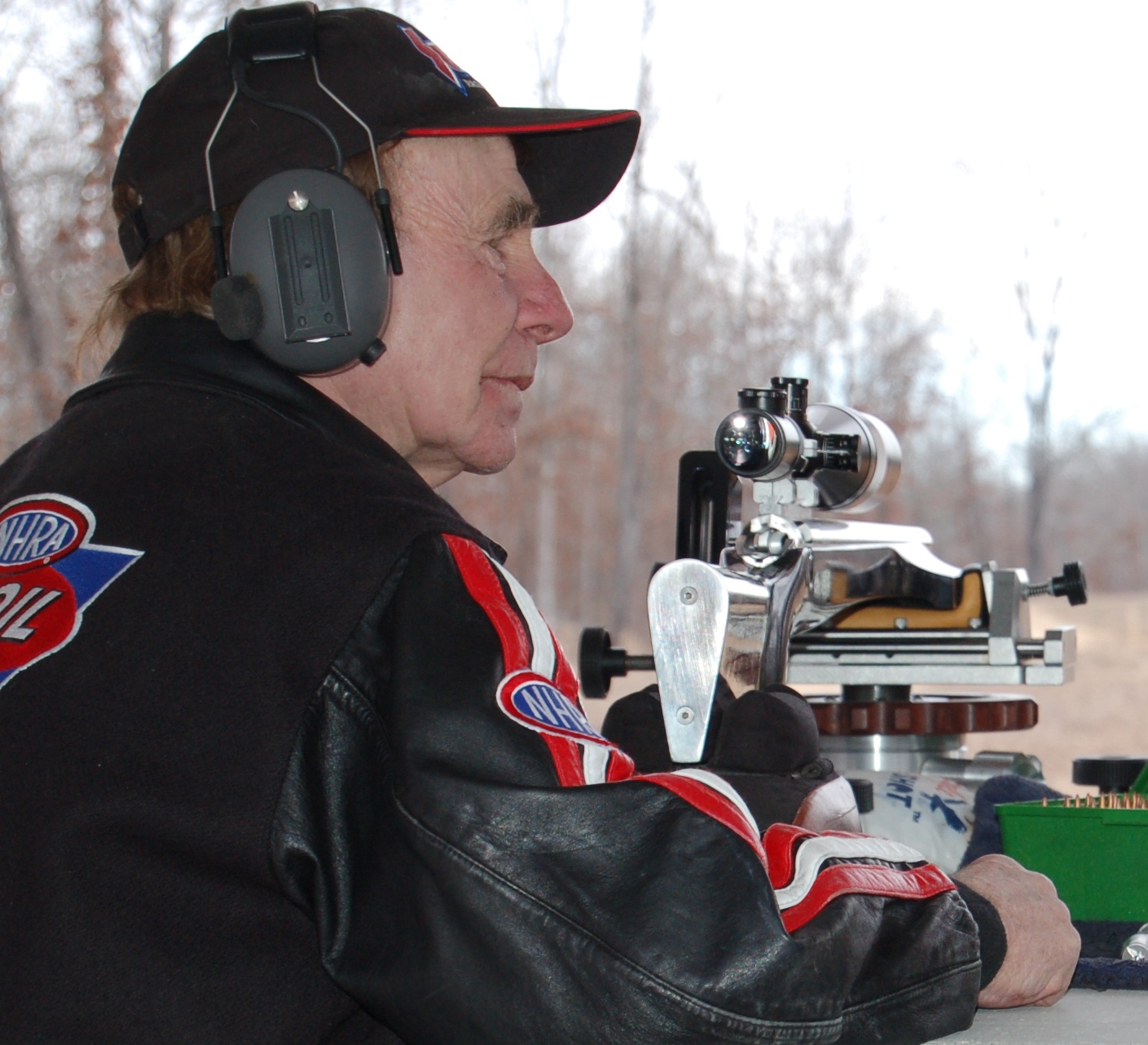
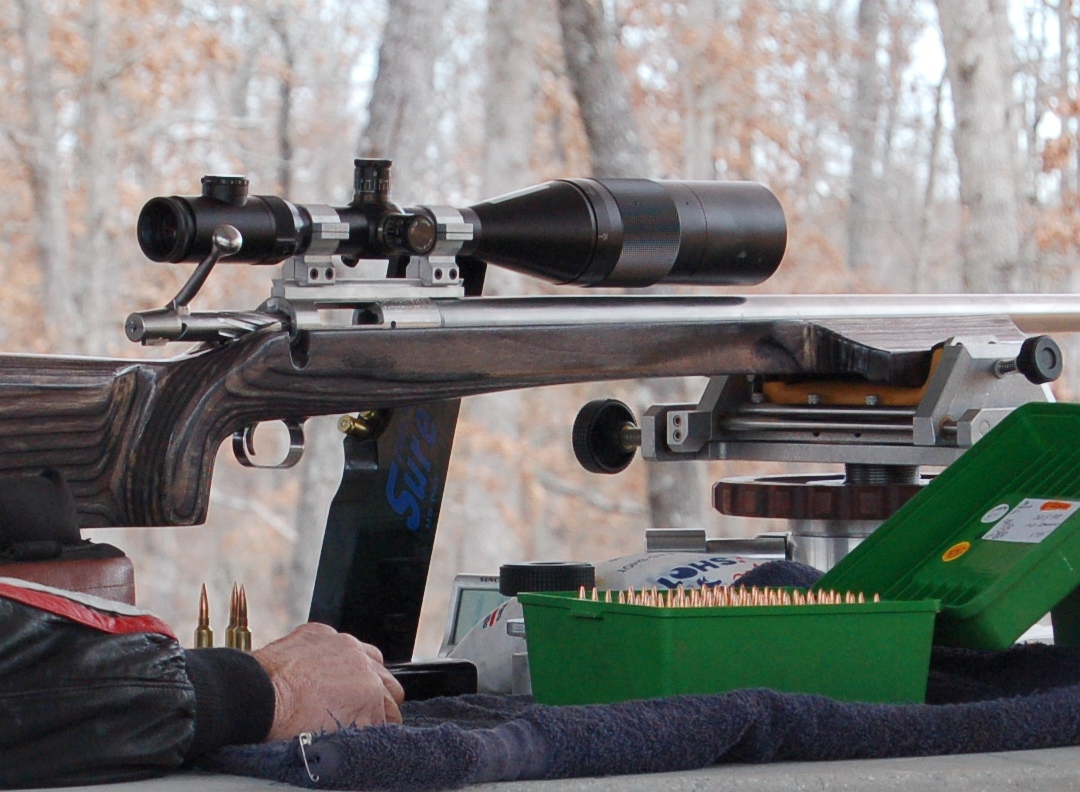
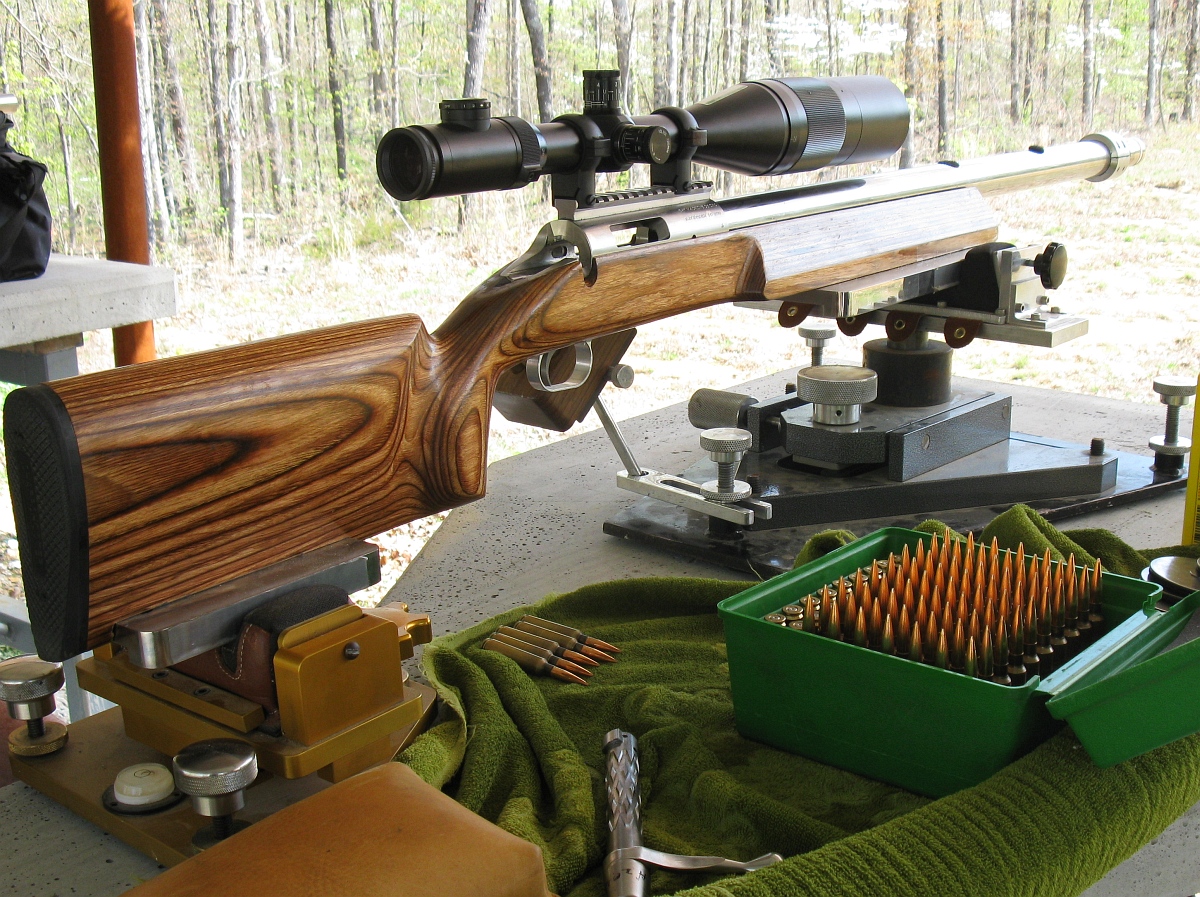
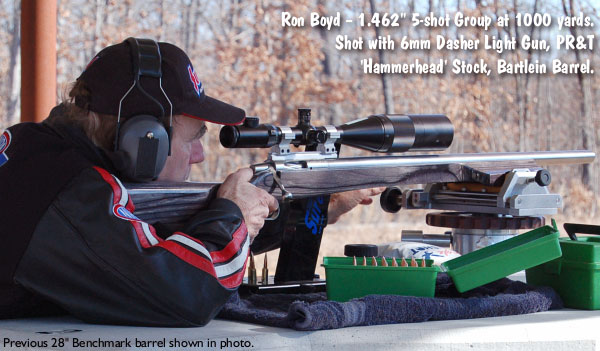
After we ran our Bulletin news item about Ron Boyd’s amazing 1.462″ 5-shot group at 1000 yards, many readers wanted to see some close-up photos of Ron’s rig. Thanks to Robert Ross of the MidWest Benchrest Club, we have some photos of Ron with his ultra-accurate 6mm Dasher 17-lb Light Gun. This rifle features a BAT SV action, Precision Rifle & Tool (PR&T) “Hammerhead stock” with 5″-wide front wings, Nightforce 12-42 Benchrest scope, and Jewell trigger. Ron had just added a 30″ 1:8″-twist Bartlein barrel to the gun before shooting the 1.462″ group. That barrel only had about 40 rounds through it when it produced the near-record group. The barrel in photos below was a 28″ Benchmark, recently replaced with the new Bartlein. Ron’s ultra-accurate 6 Dasher load consists of surplus Long Range Match powder, with Spencer 103gr bullets. Ron also anneals his Dasher brass after every firing.
CLICK Small gallery photos to view full-size images
Henry Pasquet’s .284 Win Heavy Gun
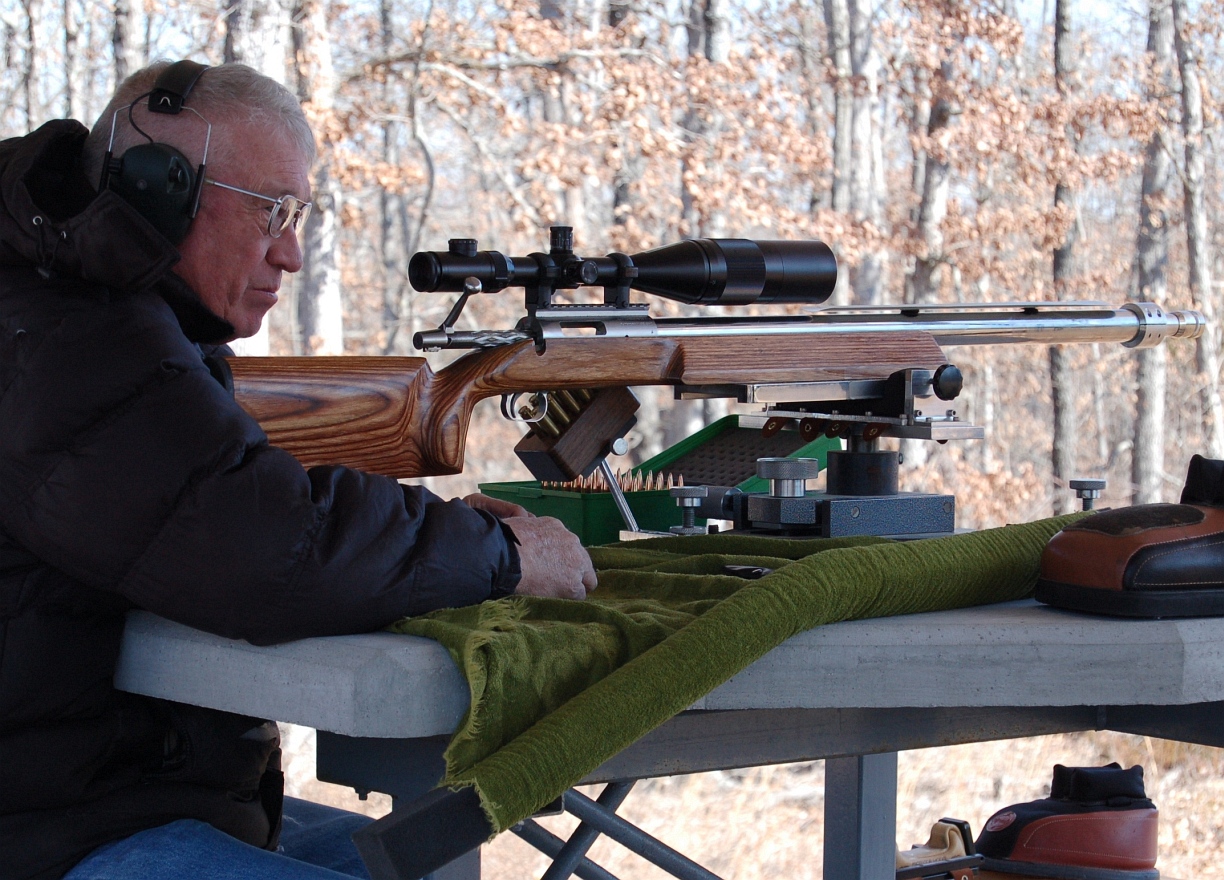
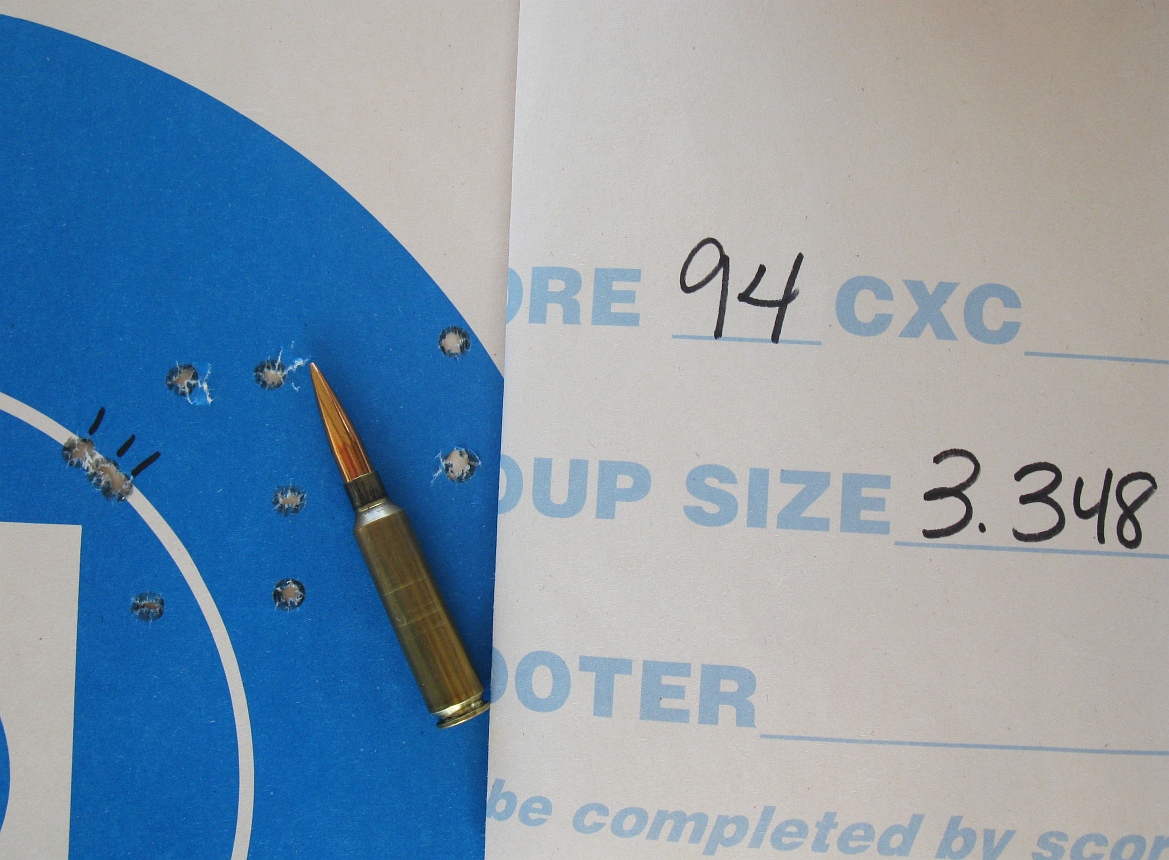
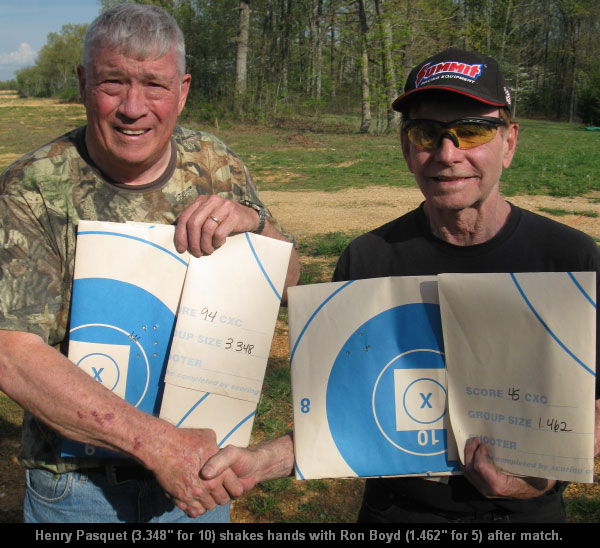
At the same Midwest Benchrest Club IBS match where Ron shot his small five-shot group, Henry Pasquet drilled a very impressive 3.348″ ten-shot group. This group was just .304″ off the IBS 10-shot Heavy Gun record of 3.044″ shot by Joel Pendergraft in 2009. We are told that Henry was running a straight .284 Winchester. You can see in the inset photos below that Henry uses a tuner on his barrel. He also has fitted an extra-wide front sled and a machined rear “keel” to reduce torque and improve tracking. Henry can adjust windage and elevation with BOTH his Fulghum front rest (from Randolph Machine) and his adjustable rear rest.
CLICK Small gallery photos to view full-size images
April 10th, 2012
 Now competing with major sponsorship from Taurus firearms, Jessie Duff (formerly Jessie Harrison) thoroughly dominated the ladies’ division of the recent U.S. Steel Challenge Nationals in Florida, winning the Steel Master title. It seems like you can put any makers’ firearm in Jessie’s capable hands, and she comes out a winner. Now competing with major sponsorship from Taurus firearms, Jessie Duff (formerly Jessie Harrison) thoroughly dominated the ladies’ division of the recent U.S. Steel Challenge Nationals in Florida, winning the Steel Master title. It seems like you can put any makers’ firearm in Jessie’s capable hands, and she comes out a winner.
Jessie defended her 2011 titles in Ladies Limited, Open and Steel Master, making this her 6th year in a row to win the Ladies Steel Master title. “Competing for Steel Master is a lot more difficult than you would think,” Duff says. “You have to be just as proficient with all three guns, as someone would be with one. A lot of time goes into training for it, and thankfully it paid off this weekend!”
At the U.S. Steel Challenge Nationals, Jessie competed in three divisions: .22 Optic Rimfire, Limited, and Open. All three divisions qualify her for the Steel Master title, an Aggregate score of all three divisions. After the match Jessie commented, “This match was the first match of the year for me, and I wanted to kick the season off with a victory, especially with my new relationship with Taurus. I was very proud to come home with three national titles!” Mark Kresser, President and CEO of Taurus USA comments, “We are very pleased with Jessie’s performance. Jessie is … taking Taurus to a new level and breaking open the door of the competition world.”

April 7th, 2012
 This past weekend, Forum member Ron Boyd shot a 1.462″ five-shot Light Gun group at 1000 yards in an IBS benchrest match at the MidWest Benchrest Club in Yukon, Missouri. Ron shot a 6mm Dasher with Bartlein barrel and PR&T stock. Ron’s 1.462″ group is 0.065″ off the existing IBS 1000-yard Light Gun record. Ron’s group also happens to be .011″ smaller than the current NBRSA 1K Light Gun record, 1.473″ shot by Bill Schrader in 2002. (But this is not counted by the NBRSA since Ron shot in an IBS match.) Ron’s group was shot in the first relay of the day, in good conditions. The group had three (3) shots clustered in under one-third inch (0.03 MOA)! This past weekend, Forum member Ron Boyd shot a 1.462″ five-shot Light Gun group at 1000 yards in an IBS benchrest match at the MidWest Benchrest Club in Yukon, Missouri. Ron shot a 6mm Dasher with Bartlein barrel and PR&T stock. Ron’s 1.462″ group is 0.065″ off the existing IBS 1000-yard Light Gun record. Ron’s group also happens to be .011″ smaller than the current NBRSA 1K Light Gun record, 1.473″ shot by Bill Schrader in 2002. (But this is not counted by the NBRSA since Ron shot in an IBS match.) Ron’s group was shot in the first relay of the day, in good conditions. The group had three (3) shots clustered in under one-third inch (0.03 MOA)!
 This is truly a spectacular achievement. We think this has to been one of the smallest five-shot groups ever shot at 1000 yards, and probably the smallest ever with a 6mm cartridge. At 1000 yards, 1 MOA is 10.47″. This means that Ron’s group measured in at 0.1396 MOA! To give you an idea of how small Ron’s group really was, at left is a 1.462″ circle shown at 100% scale, along with a quarter at 100% scale.* The circle represents the center-to-center distance of Ron’s five shots at 1000 yards. Total vertical dispersion was just under 1.2″ for five shots. The vertical for the top four shots (measured with OnTarget software) was just 0.398″! Shown below is a flat-bed scan of the actual target. Notice the tight cluster of 3 shots touching. That’s a dime in the photo added for scale. This is truly a spectacular achievement. We think this has to been one of the smallest five-shot groups ever shot at 1000 yards, and probably the smallest ever with a 6mm cartridge. At 1000 yards, 1 MOA is 10.47″. This means that Ron’s group measured in at 0.1396 MOA! To give you an idea of how small Ron’s group really was, at left is a 1.462″ circle shown at 100% scale, along with a quarter at 100% scale.* The circle represents the center-to-center distance of Ron’s five shots at 1000 yards. Total vertical dispersion was just under 1.2″ for five shots. The vertical for the top four shots (measured with OnTarget software) was just 0.398″! Shown below is a flat-bed scan of the actual target. Notice the tight cluster of 3 shots touching. That’s a dime in the photo added for scale.
 Ron Boyd’s 6mm Dasher Load Ron Boyd’s 6mm Dasher Load
 Ron loaded a stout charge of Long Range Match surplus powder with Spencer 103gr bullets seated about .010″ OFF the lands. The bullets were “right out of the box”, NOT pointed. This powder has burn-rate characteristics very similar to Alliant Reloder 15, and Ron used his regular RL15 charge, adjusted by half a grain or so. Ron was using no-neck-turn “brown-box” Lapua 6BR brass formed into the 40° improved 6mm Dasher case. The unturned, loaded case necks measure about 0.2695″, yielding .0015″ total clearance in a 0.271″ chamber. The brass used for the 1.462″ group had seven previous firings. Ron anneals his brass after every firing using a Benchsource annealing machine. Ron told us: “The Benchsource is the greatest annealing machine there is, as far as I’m concerned.” Ron ultrasonically cleans his brass and then tumbles his brass after the ultrasound process. He does NOT use an internal neck lubricant. He does NOT uniform his primer pockets and he does NOT ream his flashholes. Ron believes this load was running “right around 3000 fps”, but he has not chron’d it yet using the new Bartlein barrel. Ron loaded a stout charge of Long Range Match surplus powder with Spencer 103gr bullets seated about .010″ OFF the lands. The bullets were “right out of the box”, NOT pointed. This powder has burn-rate characteristics very similar to Alliant Reloder 15, and Ron used his regular RL15 charge, adjusted by half a grain or so. Ron was using no-neck-turn “brown-box” Lapua 6BR brass formed into the 40° improved 6mm Dasher case. The unturned, loaded case necks measure about 0.2695″, yielding .0015″ total clearance in a 0.271″ chamber. The brass used for the 1.462″ group had seven previous firings. Ron anneals his brass after every firing using a Benchsource annealing machine. Ron told us: “The Benchsource is the greatest annealing machine there is, as far as I’m concerned.” Ron ultrasonically cleans his brass and then tumbles his brass after the ultrasound process. He does NOT use an internal neck lubricant. He does NOT uniform his primer pockets and he does NOT ream his flashholes. Ron believes this load was running “right around 3000 fps”, but he has not chron’d it yet using the new Bartlein barrel.
Ron Boyd’s 6mm Dasher Light Gun
Ron’s 17-lb Light Gun featured a BAT SV Action, Bartlein 30″ 1:8″ twist, 0.237″ land barrel, and Precision Rifle & Tool “Hammerhead” benchrest stock with 5″-wide wings in front. This stock weighs 4 lbs 1 oz. with an aluminum butt plate and is about 36.5″ long with integrated rails on the bottom of the “wings”. Ron’s friends Rich Griffin and Jerry Kloeppel did the chambering and bedding. Ron recently put the Bartlein barrel on the gun. Ron estimates that the barrel had only 40 rounds through it when it produced the 1.462″ group. Ron tells us: “This new barrel is great, and the 5″ PR&T stock really works. I luckily pulled the trigger at the right time.” Ron told us that this rifle shot in the high ones/low twos at 100 yards during testing.
PR&T Hammerhead Stock (catalog photo)

*The circle and quarter should appear “true size” when viewed at the most common monitor resolution. If you are running a higher resolution on your monitor, the illustration will appear small than actual size.
April 4th, 2012
This 8-minute video, filmed at the Ojai Valley Gun Club in California, shows a 200m metallic silhouette match for handguns. Noted IHMSA shooter Jim Harris describes the course and shooters demonstrate their technique. With these iron-sight, single-shot centerfire pistols, when shooting “freestyle”, most shooters prefer the lying down, feet-first Creedmoor position. This allows them to steady their pistols along the side of the front leg. In the 1800s, long-range rifle shooters also commonly used a Creedmoor position, sometimes resting the barrel on the toes of their boots.
In this second video, Jim compares two “Unlimited” pistols, one in 6.5 BR and the other in 7mm BR. Jim explains the pistols’ features and chamberings. Then the video offers a “shooter’s eye” view of Jim and Scott Mann firing the pistols at half-size pig silhouettes. Watch Jim and Scott both “clean” all five of their respective targets at 100m.
Shown below is an Anschütz Model 1416 MSP E Silhouette pistol, similar to the custom pistols you’ll see in the video. The Anschütz 6836 rear sight was specifically developed for handgun silhouette competition. The folding rear sight cover and anti-glare front sight tube greatly improve the sight picture. This 4.1-lb, single-shot pistol has a trigger pull weight of about 300 grams, roughly 10 ounces.

 Jim Harris (“Gunzorro”) has posted many other shooting videos, which you’ll find on the “related videos” section of the YouTube page to which we’ve linked. Jim Harris has won several NRA National and IHMSA International championships in metallic handgun silhouette competition. He is also active in High Power Rifle Silhouette and Black Powder Cartridge Silhouette. In the silhouette arena, he helped popularize the 6.5BR, 6.5PPC, 6.5TKS (improved BR), .260 Remington and .22 PPC, and pioneered the use of Vihtavuori powders in the mid-90s. Jim is also a successful professional freelance photographer, specializing in commercial photography and architecture. Contact Jim at JimHarrisPhotography.com. Jim Harris (“Gunzorro”) has posted many other shooting videos, which you’ll find on the “related videos” section of the YouTube page to which we’ve linked. Jim Harris has won several NRA National and IHMSA International championships in metallic handgun silhouette competition. He is also active in High Power Rifle Silhouette and Black Powder Cartridge Silhouette. In the silhouette arena, he helped popularize the 6.5BR, 6.5PPC, 6.5TKS (improved BR), .260 Remington and .22 PPC, and pioneered the use of Vihtavuori powders in the mid-90s. Jim is also a successful professional freelance photographer, specializing in commercial photography and architecture. Contact Jim at JimHarrisPhotography.com.
April 1st, 2012
 Because of draconian restrictions on handguns in the United Kingdom, Olympic smallbore pistol shooters from the UK have been forced to conduct their training in neighboring countries, such as Belgium and France. Obviously, the need to travel overseas to practice their sport has been a major handicap for UK shooters who will compete with Team GB* at the upcoming London Olympics. Said one smallbore pistol shooter: “Our goal is to win a medal for mother England, the 2012 host nation. But it is hard to compete on a world-class level when we can’t even train at home. Going overseas every time we need to practice wastes precious time and money. Other Olympic shooters don’t face these kind of obstacles.” Because of draconian restrictions on handguns in the United Kingdom, Olympic smallbore pistol shooters from the UK have been forced to conduct their training in neighboring countries, such as Belgium and France. Obviously, the need to travel overseas to practice their sport has been a major handicap for UK shooters who will compete with Team GB* at the upcoming London Olympics. Said one smallbore pistol shooter: “Our goal is to win a medal for mother England, the 2012 host nation. But it is hard to compete on a world-class level when we can’t even train at home. Going overseas every time we need to practice wastes precious time and money. Other Olympic shooters don’t face these kind of obstacles.”
 With the 2012 London Olympics soon approaching, UK Olympic officials have been looking at ways that Team GB pistol shooters can avoid the need to travel abroad just to practice shooting. Now, through a special act of Parliament, it appears that UK Olympic pistol shooters may finally be able to hone their marksmanship skills at home. A new law will allow qualified Olympic-level pistol shooters on Team Great Britain to import a new, non-lethal training device recently introduced in the United States. With the aid of the American-made Trigger Trainer, UK Olympic shooters can now practice their trigger-pulling skills without risking a trip to prison. The Trigger-Trainer is a plastic device with a pistol grip, and spring-loaded “trigger”. However, it is incapable of firing a projectile because it lacks a barrel, magazine, firing pin, and sights. With the 2012 London Olympics soon approaching, UK Olympic officials have been looking at ways that Team GB pistol shooters can avoid the need to travel abroad just to practice shooting. Now, through a special act of Parliament, it appears that UK Olympic pistol shooters may finally be able to hone their marksmanship skills at home. A new law will allow qualified Olympic-level pistol shooters on Team Great Britain to import a new, non-lethal training device recently introduced in the United States. With the aid of the American-made Trigger Trainer, UK Olympic shooters can now practice their trigger-pulling skills without risking a trip to prison. The Trigger-Trainer is a plastic device with a pistol grip, and spring-loaded “trigger”. However, it is incapable of firing a projectile because it lacks a barrel, magazine, firing pin, and sights.

Some of Team GB’s shooters have expressed doubts about the usefulness of the rather primitive Trigger Trainer. (As it lacks front and rear sights, the Trigger Trainer is difficult to align precisely on the target). But top British Olympic decision-makers believe that the shooters’ complaints are unjustified. British Olympic Association official Nigel Wensleydale observed: “Complaints? That’s just idle whinging if you ask me… nothing’s perfect you know. Perhaps the Trigger Trainers do leave something to be desired as they come out of the box. But our Olympic shooters are clever lads. I think, with a little imagination and some sticky tape, these Trigger Trainers will be tip-top. Goodness, you could simply tape a drinking straw on top and sight through that. I mean how much precision do these chaps really need — the target’s only 10m away for goodness sake.”

*Great Britain is the name under which the United Kingdom of Great Britain and Northern Ireland competes at the Olympic Games. Great Britain was one of 14 teams to compete in the first Games, the 1896 Summer Olympics, and has competed at every Games. Great Britain is the only team to have won at least one gold medal at every Summer Games.
March 31st, 2012
After a series of try-outs, 28 shooters have been selected to the U.S. F-Class Open Development Team. From this select group of 28 shooters, F-Open Team USA squads will be filled for future international team matches. After further try-outs, the top 18 (16 + 2 alternates) will be selected for the final F-Open team that represents the United States in the next World F-Class Championship in 2013.

The idea behind the Development Team is that having a larger group of qualified individuals to draw from makes it easier to field a strong team at any given time. Not everyone can travel at the same time — particularly to international matches. From the 28 current Development Team members, a final 18-shooter team will be chosen prior to the 2013 World Championships at Raton, New Mexico.
| The U.S. F-Open Development Team — Officers, Coaches, Shooters |
|
Captain: Shiraz Balolia
Vice Captain: Bryan Otey
Head Coach: Bob Mead
Coaches: Emil Praslick, Rick Hunt, Trudie Fay |
Shooters
(sorted by first name)
Bob Bock (Senior)
Charles Ballard
Charles Clark
Danny Biggs
David Gosnell
David Mann
Dean Morris
Doc Bock
Don Nagel
Emil Kovan
Erik Cortina
Herb Edwards
Jim Fowler |
Jim Murphy
John Brewer
John Dunbar
John Gaines
John Myers
Ken Dickerman
Kenny Adams
Larry Bartholome
Larry Taite
Mark Walker
Rick Jensen
Ron Herms
Ryan Pierce
Tony Robertson
Walter Lange |
The Try-Out Process for the F-Class Open Development Team
The U.S. F-Class Open Rifle Team held nine try-outs throughout the country in six different cities over the course of the last two years. These shooters had to prove themselves multiple times shooting at 1000 yards. The shooters were tested on their ability to shoot under a coach and hold vertical. Each and every shooter had to meet minimum standards. The process was very transparent with all shooters being able to view other shooters’ scores and targets.

March 30th, 2012
Report by Murray Hicks
On March 10, 2012, history was made down under when 78 shooters attended the inaugural BRT 500m Fly Shoot National Championships held in Canberra, Australia. 500m fly shooting has grown immensely in popularity down under since the first Fly Shoot was held in Canberra, 22 years ago. The Fly Shoot is a highlight of the Aussie shooting calendar, attracting the largest field of competitors among any benchrest-style match in Australia. The day of the match was a cracker (that means good in the Aussie lingo) with blue skies and light winds.

| CLICK “PLAY” to hear Murray Hicks talk about the sport of Fly-Shooting in Australia. Murray explains Fly Shoot rules, including the famous Rule 10: “Any competitor found not enjoying themselves, will be disqualified”. |
[haiku url=”http://accurateshooter.net/Video/flyshoot.mp3″ title=”Fly Shoots by Murray Hicks”] |
 The 500m (560-yard) Fly Target is shot for score on a target with 10 scoring rings, plus a central fly image (instead of an “X”). A shot that hits any part of the fly counts as 10.1. Bonus points are also awarded for group size, with one point for a group under 10″ up to a maximum of 10 points for a group under 1″. Thus, 60.5 is the max possible score for one five-shot target (10.1 x 5 plus ten bonus points). The 500m (560-yard) Fly Target is shot for score on a target with 10 scoring rings, plus a central fly image (instead of an “X”). A shot that hits any part of the fly counts as 10.1. Bonus points are also awarded for group size, with one point for a group under 10″ up to a maximum of 10 points for a group under 1″. Thus, 60.5 is the max possible score for one five-shot target (10.1 x 5 plus ten bonus points).
The Fly Shoot has two equipment classes: Light Gun (under 17 lbs.) and Heavy Gun. This is one of the few matches in Australia where Light and Heavy guns shoot head to head for overall placings. The wide variety of chamberings/calibers used by competitors is remarkable. Unlike the 600-yard BR game in the USA, which is dominated by small 6mm cartridges, at Australia’s Fly Shoots, you will see everything from small varmint calibers all the way up to big-bore Magnums. Many shooters favor the big 30s because it’s easier to see .30-caliber bullet holes through the mirage. This year’s Canberra event was won by Stuart Elliott shooting a 300 Win Mag. It was fitting that Stuart won the Inaugural BRT 500m Fly National Championships. Stuart, who runs BRT Shooters’ Supply, was one of the three Fly Shoot “founding fathers” who dreamed up the Fly Shoot discipline 22 years ago.

To learn more about 500m Fly Shooting or 200m Rimfire Fly Shoots, visit 500mflyshooter.com.au. There you’ll find official records, match results, and you can download the SSSA Fly Shoot Rules. CLICK HERE to view more photos of the competitors and their hardware.
Spotters Add to the Fun
The use of a spotter during the match is permitted and even encouraged. This adds greatly to the fun of the shoot. Having a good mate on a spotting scope alongside you spotting your shots and helping to call the wind changes can really help when conditions get rough (as they often do).

The past year has seen the 500m Fly Shoot officially recognised by the Sporting Shooters Association of Australia (SSAA) and added to the official rule book. As a result the March shoot in Canberra this year became the Inaugural Fly Shoot National Championships. BRT Shooters’ Supply came on board as the event’s major sponsor, offering BRT’s full support and organizing an excellent prize pool. Thus the “BRT 500m National Fly Shoot Championships” was born.
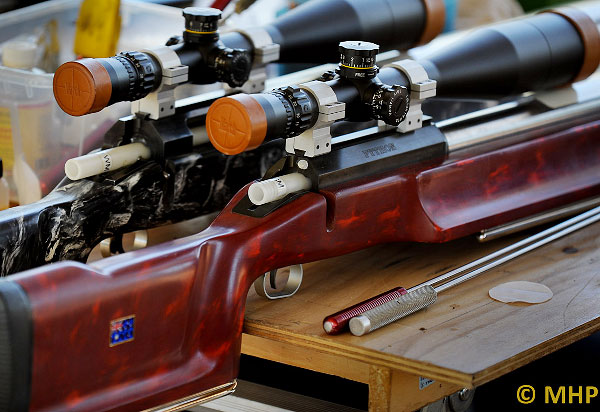
The BRT 500m Fly Shoot Nationals were shot in reasonably good conditions, with major rains and floods in the week leading up to the shoot things were looking a bit dodgy. Luckily the day before the shoot the weather started to clear and over 40 tons of gravel had to be bought in to repair the access road to the 500m target line which had been washed away. The main organiser David Groves and his willing team of helpers took this all in their stride and did a tremendous effort to keep things running smoothly.

The inaugural shoot had an international flavor with shooter Sebastian Lambang, maker of the Seb rest, making the trek from Indonesia to compete. Lambang bought along his new switch-barrel rifle. With wide front “wings” attached and his .284 barrel, Seb finished 14th overall and 7th in Light Gun.

| Top Competitors at 500m BRT Fly Shoot Championships |
|
Name – Score – Class + Placing
1. Stuart Elliott: 261.03 — HG 1
2. Murray Hicks: 260.05 — HG 2
3. Anthony Hall: 257.03 — LG 1
4. Jason Trotter: 249.02 — HG 3
5. Annie Elliott: 247.03 — HG 4
6. Michael Farr: 242.04 — HG 5
7. Les Fraser: 242.01 — HG 6
8. Les Fraser: 241.01 — LG 2
9. Tyson Trotter: 238.01 — LG 3
10. Roy Gow: 237.02 — LG 4
11. Mick Easton: 235.02 — LG 5
12. Dave Groves: 228.02 — HG 7
13. Michael Bell: 228.01 — LG 6 |
Other Important Results
Small Group Paul Read: HG 1.382″
Best target Jason Trotter: HG 58.01
Best Junior Roy Gow: LG 237.02
Note on Rankings: The ranking list (the “Dirty Dozen”) includes 13 rankings of 12 shooters. Les Fraser shot both classes, finishing 7th overall with his HG and 8th overall with his LG. A second entry is included in the “Dirty Dozen” list for Les to allow recognition of his second highest score in Light Gun Class. However, each shooter normally only gets one overall ranking in the “Dirty Dozen” top 12. |

All photos are copyright Murray Hicks, used with permission.
March 29th, 2012
Three-gun match competitor Zak Smith employs a simple, handy means to store his elevation and wind dift data — a laminated data card. To make one, first generate a come-up table, using one of the free online ballistics programs such as JBM Ballistics. You can also put the information in an Excel spreadsheet or MS Word table and print it out. You want to keep it pretty small.
Below is a sample of a data card. For each distance, the card includes drop in inches, drop in MOA, drop in mils. It also shows drift for a 10-mph cross wind, expressed three ways–inches, MOA, and mils. Zak explained that “to save space… I printed data every 50 yards. For an actual data-card, I recommend printing data every 20 or 25 yards.” But Zak also advised that you’ll want to customize the card format to keep things simple: “The sample card has multiple sets of data to be more universal. But if you make your own data card, you can reduce the chance of a mistake by keeping it simple. Because I use scopes with MILS, my own card (photo below left) just has three items: range, wind, drop in MILS only.”
 
Once you have the card you can fold it in half and then have it laminated at a local office store or Kinko’s. You can keep this in your pocket, tape it to your stock, or tie the laminated card to your rifle. If you regularly shoot at both low and high elevations, you may want to create multiple cards (since your ballistics change with altitude). To learn more about ballistic tables and data cards, check out the excellent “Practical Long-Range Rifle Shooting–Part 1″ article on Zak’s website. This article offers many other insights as well–including valuable tips on caliber and rifle selection.
Scope-Cover Mounted Ballistics Table
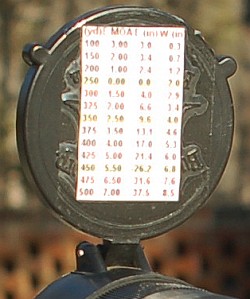 Another option is to place your ballistics card on the back of the front flip-up scope cover. This set-up is used by Forum member Greg C. (aka “Rem40X”). With your ‘come-up’ table on the flip-up cover you can check your windage and elevation drops easily without having to move out of shooting position. Greg tells us: “Placing my trajectory table on the front scope cover has worked well for me for a couple of years and thought I’d share. It’s in plain view and not under my armpit. And the table is far enough away that my aging eyes can read it easily. To apply, just use clear tape on the front objective cover.” Another option is to place your ballistics card on the back of the front flip-up scope cover. This set-up is used by Forum member Greg C. (aka “Rem40X”). With your ‘come-up’ table on the flip-up cover you can check your windage and elevation drops easily without having to move out of shooting position. Greg tells us: “Placing my trajectory table on the front scope cover has worked well for me for a couple of years and thought I’d share. It’s in plain view and not under my armpit. And the table is far enough away that my aging eyes can read it easily. To apply, just use clear tape on the front objective cover.”
Updated Links for JBM Ballistics Program
With the release of version 5.1 of the JBM program, some URLs for the calculations pages have changed. You may want to update your bookmarks with the following web addresses:
March 27th, 2012

Mark you calendars for April 13-15, 2012. Those are the dates for the 141st NRA Annual Meetings and Exhibits, to be held this year in St. Louis, Missouri. As ever, there will be plenty to see and do at the NRA National Meetings/Exibits. There will be seminars, celebrity appearances, and priceless collections of firearms. Virtually all the major gunmakers in the country should have their latest products on display. In fact, there will be more than 500 exhibitors, whose displays will cover 340,000 square feet of exhibit hall space. In addition to fireams, you can see knives, wildlife art, shooting accessories, hunting gear, ATVs, and much more. You’ll even find an airgun range on site where you can shoot air rifles provided by Pyramyd Air.
To learn more about the NRA Annual Meetings and Exhibits, visit www.NRAM.org, the NRA’s Meetings/ Exhibits website. There you’ll find floorplans, seminar schedules, lists of exhibitors, plus information on hotels and travel. Look for the latest updates on the NRA’s Facebook Page.
|