Tim Claunch (aka tclaunch) recently put on an amazing display of precision shooting. At an MSSA 600-yard Benchrest Score match in Memphis, TN, Forum member Tim shot six targets in a row, with an average 5-shot group size of 1.677″. Tim’s stellar performance began with a two-target shoot-off for club Shooter of the Year honors (he won). Then Tim shot four more targets as part of the club’s regular 4-target score match. NOTE: this is NOT an official six-target match result. The actual match that day was four (4) targets only, and Tim’s Agg for those four was about 1.8″, still darn impressive. No one is claiming any records here. Still give credit where credit is due — Tim put together six targets in a row, in competition, averaging 0.267 MOA for all six. Tim’s small group (of the six) was 1.351″ and his large group was 2.088″. That shows amazing consistency. This is spectacular shooting by any measure*.
Tim tells us: “I can check off one of the items on my ‘bucket list’ now — shooting a sub-two-inch Agg. We shot our monthly match here in Memphis at our awesome MSSA range. Though this was a score match, and the first two targets were part of a club shoot-off, I wondered about the average group size of all six. We measured all six targets I shot in sequence on Sunday. I was some kind of happy when I saw it was a 1.677″ 6-target average. That Bartlein and the .140″ FB BRX reamer are a good match. I used Varget with Berger 105gr VLDs and CCI 450 primers. I had never Agged under two inches before in my life (the 4-target Agg was 1.8″). Sure was nice to do it at home the first time.”
Tim shoots a 6mm BRX Light Gun with Shehane ST1000 Tracker stock, Borden Rimrock BR action, and Bartlein 6mm cut-rifled barrel. He uses a Leupold 45X scope in Burris Signature Zee rings sitting on a +20 MOA rail. Tim jokes: “People might laugh at my cheapo Burris rings. Well I guess those Signatures hold zero just fine.” Tim tried a power-booster lens on his Leupold for a while, but this altered eye relief, producing the occasional smack in the forehead. Not surprisingly, Tim removed the booster.
Borden Action with Dwight Scott Bolt and Firing Pin Upgrade
The action is a Borden Rimrock BR dual-port. “This action is smooth, and it allows me to rip ‘em when the conditions are good. For these six targets I shot fast.” The Borden action has some interesting mods: “The firing pin and bolt body were re-worked by Dwight Scott. He has a weight of pin to power of spring he worked out with Tony Boyer. I could tell a significant difference in performance.”
For better target resolution, click the gear-shaped icon and select 480p playback.
The stock is a Shehane fiberglass ST1000 Tracker bedded by TM Stockworks (Tom Meredith). The metalwork was done by Stephen Hall of Dyersburg, Tennessee. Tim reports: “I can’t say enough about this highly-talented guy. He’s a great smith and a great point-blank benchrest shooter himself. I’ve had four chambers cut by him and couldn’t be happier”. The barrel is a 1.250″ straight contour, finished at 26″. That’s a bit shorter than you’ll find on most 600-yard rigs these days, but Tim wanted some weight off the nose so he could add weight to the butt to balance the gun better (and still make weight). Tim raves about this Bartlein barrel: “Readers should not give up on maybe that next barrel being the one barrel a guy gets in a lifetime. I have tried all the cut-rifling barrel-makers, but I’ve recently gone to Bartlein. Based on my ratio of great-shooting barrels to average barrels I am there to stay.”
Tim’s Accurate Reloading Methods Tim’s reloading procedures could rightly be described as the “relentless pursuit of perfection”. After two firings, once “the brass has settled down and conformed to the chamber”, Tim anneals his cases. He then re-anneals after EVERY subsequent firing. The brass he shot at the MSSA match had eight firings, so it had been annealed many times. Tim uses current-generation (blue box) Lapua 6mmBR brass, and he lightly turns his necks for an 0.269″-necked chamber. Tim points his bullets, but does not trim them: “These were pointed, no trimming, just point and shoot. I have shot a few of the new Berger hybrids, but I keep going back to the Berger VLDs.”
Superior accuracy, Tim believes, requires ultra-consistent neck tension. Tim uses a K&M arbor press with a force gauge. If the needle shows any notable variance in seating force, Tim will pull the round apart, run a mandrel in the neck, resize the neck, and re-seat the bullet. If the bullet still doesn’t seat smoothly, he won’t shoot the round for record. Tim is also particular about seating depth: “I measure every loaded round base to ogive using a comparator. All my match ammo is held to plus/minus .0005″ (i.e. one thousandth total spread) in base to ogive length. Yes, this is possible if you anneal regularly and monitor bullet-seating force carefully. If you can’t hold .001″ [base-to-ogive] tolerances with good bullets, that’s probably because of inconsistent neck tension.”
Secret of Success — Improved ‘Bench Manners’ and Gun Handling
Tim had a personal break-through not so long ago that improved his accuracy dramatically. Previously he got down on the gun, and would use some cheek pressure. But he noticed some erratic horizontal in his groups. Tim changed his shooting position, getting his head completely off the stock. The change worked: “After cleaning up my ‘bench manners’ and getting my head off the gun, my groups started shrinking. It was a real eye-opener.” Tim shoots with minimal hand contact (“just touching”) on the stock, and he doesn’t pin the gun to the stop. Tim explained: “I run the gun up to touch the stop before each shot, but I don’t use any shoulder pressure. I don’t push on the gun at all.”
You can learn more about Tim’s amazing six-target display of accuracy in this Forum thread. Registered Forum members can post questions about Tim’s rifle and the shooting conditions, and Tim will answer them when he has the opportunity.
* Just for comparison sake, the NBRSA official Light Gun 600-yard, 6-Target (30-shot) Agg record is 2.092″ (Robert Hoppe, 2006). The IBS official Light Gun 600-yard, 4-Target (20-shot) record is 1.6068″ (Sam Hall, 2011). The IBS does not list a LG 6-target Agg record for 600 yards.
Creedmoor Sports has knocked ten bucks off the price of the Windtronic 2 Windmeter. For three days only (Feb. 17-19), the Windtronic 2 is ON SALE at Creedmoor Sports, for $89.00. Most every other source sells the Windtronic 2 for $99.00 or more.
Windtronic 2 Reads Wind from Any Angle
This unique product reads wind speed from any angle, because the impeller spins on a vertical axis (like a helicopter’s main rotor). By contrast, with most other windmeters you need to manually align the device in the correct direction. Those devices may deliver mis-reads unless you can manually turn the meter. However, with the Windtronic 2 you can “set and forget” — mount the device on a pole or tripod near your shooting station with the screen in view, and it’s good to go, no matter which way the wind blows. The Windtronic’s LCD display shows current wind speed, average wind speed, maximum wind speed and a Beaufort bar graph. A standard lithium battery should supply YEARS of service. Made in Germany by Kaindl Electronics, the Windtronic 2 comes with a two-year manufacturer’s warranty.
The Windtronic 2 features rotating cups mounted on a vertical axis. With this design you don’t have to align the unit with the wind, unlike the Kestrel WindMeter or SpeedTech WindMate™ devices. Many users feel the Windtronic’s unique design allows it to read wind speeds more accurately; it certainly can respond to shifting winds more easily. The omni-directional functionality of the Windtronic 2 allows it to be mounted on a stand or tripod and continuously display current wind speed, max wind speed, and average velocity. The Windtronic 2 does NOT gauge temperature, barometric pressure, humidity, or density altitude. The Windtronic only records wind speeds, but it does that task exceptionally well.
Report by German Salazar
The 2012 Berger Bullets Southwest Long Range Nationals fired last week at Phoenix’s Ben Avery Shooting Facility left competitors from all over the US and Canada smiling and ready to return for next year’s event. With over 200 competitors from 40 states and several Canadian provinces, this was truly a national level event and the scores reflected that intensity. However, it wasn’t just about the shooting; as at any large rifle match, renewing old friendships, seeing friends from the AccurateShooter Forum and enjoying time and a few meals with them are just as important.
The week began on Tuesday with a wind reading clinic by Mid Tompkins who knows more about how air moves across a rifle range than just about anyone. Next in line was Wednesday’s 600-yard match, a nice warm-up for the long-range shooting to come. Thursday we got down to business with a Palma team match. The sling winners were the US National Team composed of Trudie Fay, Bryan Litz, Justin Skaret and Peter Church. In F-Open, the winning team was Team Norma/Berger composed of Larry Bartholome, John Brewer, Danny Biggs, and Jim Murphy. The winning F-TR team was the Arizona State Rifle & Pistol Assn. squad, with Warren Dean, John Chilton, Steve Lockwood and German Salazar.
Individual shooting resumed on Friday, Saturday and Sunday as well as one more team match at 1000 yards. Conditions throughout the week were picture perfect as cool mornings gave way to afternoons in the mid 70’s. One of the Canadian shooters mentioned that it was 35 below at home on Saturday while we were in shirt sleeves! The wind was challenging without ever being as vicious as it can be on certain days in Phoenix. More than one Eastern shooter was heard to comment that they had never seen wind as switchy as this. Overall, it tested one’s ability without reaching a level of frustration — just perfect. Trudie Fay was the overall winner in the sling category, Jim Murphy in F-Open and James Croft in F-TR, but many other shooters won cash and bullets from our generous sponsor Berger Bullets as well as many door prizes at the barbeque from Nightforce, Krieger, Leupold, Sierra and many others.
Put this match on your list for next year, it’s well worth the effort. We have 100 firing points (check out the photo below) and we’re ready to put them all to use!
All-Star Instructors Lead Clinic A training clinic was held on Feb. 7th (Day 1), with a true all-star cadre of instructors. The clinic started with Nancy Tompkins instructing sling shooters on proper position/shooting style, while Darrell Buell and Larry Bartholome did the same for F-TR and F-Open shooters. Mid Tompkins then conducted a lengthy wind clinic which featured a series of drills at 1000 yards to observe specific wind trends. Many shooters commented on the benefits of the exercise as well as the opportunity to get some ‘trigger time’ before the main event. Finally, Bryan Litz (photo right) gave a class on long-range ballistics.
Rodrigo Rosa is a rising star in the world of High Power shooting. Though he’s been shooting competitively for only four years, he is already a top contender at the national level. In 2011, the young marksman, who now lives and works in New Hampshire, was right up with the leaders at the NRA National High Power Championships. At Perry, Rodrigo finished second in the Across-the-Course phase and finished third in the Long Range National Championship. He was also on the winning 2d Amendment match team with Norm Houle. Over the last couple of years, Rodrigo has lead the field at New England High Power events. He was New Hampshire State Champ in 2010 and 2011, Massachusetts State Champ in 2011, and Mid-Range (and Across-The-Course) Vermont State Champion in 2009. Rosa is also a two-time NE Regional Across-the-Course Champion, winning titles in 2008 and 2011. That’s an impressive shooting resume for a young man who shot his first High Power match in 2008, and had to borrow money to get his first real match rifle.
Rodrigo tells us: “I had a good year in Camp Perry in 2011. My goal was only to perform well in the across-the-course event, so taking second place after Carl Bernosky by only 3 points and taking third place in the Long Range event was a real treat.”
What was the “secret” of Rosa’s meteoric rise from rookie shooter to podium performer at Camp Perry? Rodrigo replied: “Key factors? I would have to say dry-fire practice, and working on consistency and the ‘mental game’. I spent many hours dry-firing last winter, particularly working on my off-hand position. Despite such training my technique was still flawed at the beginning of the year. I could dry-fire very well but the results did not show on target. I believe that my ability to finally build a mental sequence that allows me to perform the same movements time-and-time again, on demand, made the greatest difference on my results.”
Interview with Rodrigo Rosa — Born to Shoot
We had the opportunity to chat with Rodrigo. He told us how he got started in competitive shooting. He then discussed his shooting techniques and his reloading methods. At our request, Rodrigo offers some tips for new sling-shooters. Rosa also revealed his preferences in hardware and shooting gear.
AccurateShooter: Rodrigo, tell us about your background. How did you get involved in shooting?
Rosa: I grew up on a farm in Brazil. When I was about 11 years old my mom bought me an air rifle, and I later inherited my grandpa’s Winchester .22LR. I hunted many rabbits and ducks with that rifle until I was 17 years old when my studies became more important. I traveled to the USA in late 2004 to finish my Veterinary clinical training at Cornell University, where I met my wife-to-be. We got married in 2005 and moved to California for internships. It wasn’t until early 2007 when I decided to buy a rifle and join a gun club. All I could afford was a simple .308 hunting rifle. With the .308, I tried (with limited success) to hit small metal silhouettes at 600 yards. Despite my limited success I decided to educate myself about the shooting sports, predominantly by reading books by David Tubb and Nancy Tompkins, as well as foreign publications.
My wife Kate and I moved to New Hampshire in 2007, when I decided to take a personal loan to buy a better rifle, suited for High Power competition. I joined the Nashua NH Fish and Game Association and started to work on my skills. In late 2010 I met Norm Houle who became a good friend and gave me extra motivation to stay in the game.
AccurateShooter: What are your strengths and what are the areas where you need improvement. What training methods do you use to improve those weak points?
Rosa: My strengths are my ability to concentrate, attention to detail and perseverance. The areas I tend to work on the most are my mental systems. I know I am able to shoot a perfect score in any yard line and shooting position, so I spend most of my time coming up with ways to make my shooting sequence as meticulous and repetitive as possible. I believe I still have a lot of work to do….
AccurateShooter: What are the best and worst things about competing at Perry?
Rosa: 2011 was my second year competing in Perry (I also started the match in 2009 but had to leave early for a family issue). I had one of the best weeks of my life! Perry is a wonderfully beautiful and challenging range, and the friends I had the pleasure to share my time with were the highlight of the trip. From previous experience, I would say that the heat and humidity are the worst things
about Perry, but 2011 gifted the competitors with amazingly pleasant weather.
AccurateShooter: Rodrigo, do you have any tips for novice High Power shooters?
Rosa: Start by investing in good equipment — buy quality and you will buy it only once. Seek the advice of successful shooters. All truly good shooters will be glad to share their “secrets”, for it is only worth winning when all competitors can shoot their best. Develop a safe, reasonably good load for your cartridge and quit messing with it! If you already have an accurate rifle your time is much better spent working on your hold than on developing loads. Be ready! Develop checklists, plans, mental sequences. The less you can worry about, and the more prepared you are for adverse situations at the firing line, the better your chances will be.
AccurateShooter: Speaking of load development, tell us what load you shoot, and what methods you use to create accurate ammo.
Rosa: I shoot the 6mmXC cartridge Across-the-Course and Long-Range (except for Palma, of course). I use Federal 210M primers, Norma brass, Hodgdon 4350 powder, Sierra 70gr bullets for 200 yards and DTAC 115gr bullets from 300 to 1000 yards. My loads are: 39.5 grains H4350 with the Sierra 70gr; 37.5 grains H4350 with DTAC 115gr for 300 yards; and lastly, for Mid-Range and Long-Range, I use a stout H4350 load with the DTAC 115s. (Editor: Start at 37.0 grains H4350 and work up with the 115s; Rodrigo’s long-range load is near max).
The most important steps of my reloading are accurate load weighing (I weigh ALL loads) and bullet selection. I select all the bullets I shoot from 600 to 1000 yards by bearing surface and length. I do not spend any time doing elaborate load testing (and re-testing). All I care about is having a reasonably accurate load that functions smoothly in my rifle.
AccurateShooter: Tell us about your shooting coat and sling. Do you have any advice concerning coat fit and sling adjustment?
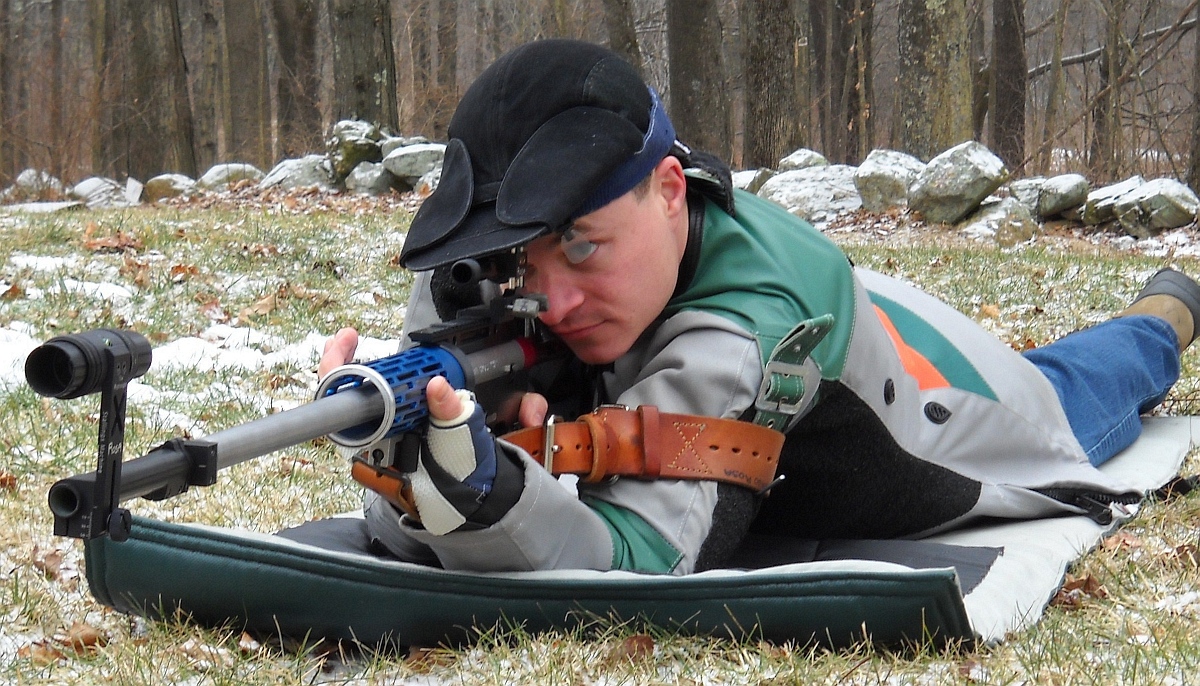
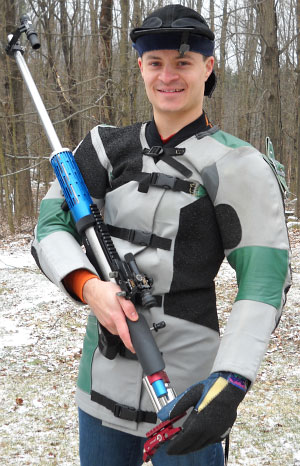
Rosa: I currently wear a Monard shooting coat. Proper fit is fundamental for anyone who wishes to be competitive in any category of position rifle shooting, and the folks at Monard certainly have got that down. My advice to anyone who is going to invest hard-earned money in a coat is to make sure that the maker uses at least 15 different measurements of his/her body. Anything less than that is not acceptable in my opinion. I also prefer the stiffness and coolness of canvas over leather. Leather tends to mold better to ones body but softens and shrinks when wet. Since High Power shooters must often shoot in the rain I believe that canvas is a more durable and stable material. For a sling I always used the Superior Shooting Systems Heart Breaker Sling. This is an extremely well-made sling crafted to last many decades. It is important to cut the new sling to fit one’s arm diameter so that the “hinge” is located between the arm and the hand. I did not know this important “trick” for the longest time until David Tubb called my attention to it at Perry last year.
AccurateShooter: You shoot a Tubb 2000 match rifle. Tell us the features of the T2K you really like, and explain how you set up the sights and buttstock for different positions.
Rosa: The Tubb 2000 rifle is the only rifle I have ever shot Across-the-Course. It is an extremely user-friendly gun that truly allows the shooter to extract all that a competitive target rifle can offer. I used to have only one buttstock and was therefore forced to make adjustments between shooting positions. Now I have three buttstocks individually set up for each position — a major asset in my opinion. My off-hand buttstock is probably the least orthodox of the three. It has a good deal of added weight to help balance the gun and a very narrow buttplate. I like the narrow buttplate because it fits my small shoulder better. This plate is, however, kept mostly flat (very shallow curvature) in order to comply with NRA rules (less than 1/2 inch depth).
Canting — I truly enjoy the ability to cant the T2K rifle to fit my body. Anyone who watches me shooting seated will notice that I use a great amount of canting in that seated position. Canting is a major asset and can greatly improve most shooter’s position by increasing comfort. The key thing with canting is you must be consistent with the amount of cant you use (hint: learn how to use a bubble level).
Forearm — I have shortened the tubular handguard/fore-end of my rifle in order to improve balance as well. People occasionally ask me: Didn’t you get nervous about cutting such an expensive rifle? (I had taken a loan to buy the rifle and it wasn’t even paid for yet). My answer was “Not at all!” My philosophy is that if something does not fit you or does not do the job for which it was intended, then you MUST act on it. It is pointless to have a rather costly piece of machinery if it does not lead to 10s and Xs.
Sights — I use a Warner #1 rear sight and a “Right Sight” in the front. I currently use the “Houle Tube” sight extension tube (bloop tube) made by Norm Houle. This bloop tube has been a major improvement. It lets me have a short, balanced gun for off-hand and a long gun for sling-supported positions. I must admit that I did not believe these extension devices would repeat zero until I tried one. The Houle Tubes are incredible. These extensions come in 2″, 4″ and 6″ lengths and repeat zero flawlessly every time.
Gunsmithing — Dick Beaudoin from Derry, NH has done most of the customization work on my rifle. I want to give him credit. His patience and attention to detail has made all the difference.
Editor’s Comment: We thank Forum member Rodrigo Rosa for taking the time to share his knowledge with our readers. He is a very talented, yet humble young shooter who works diligently on his game. We have no doubt that one day we will see Rodrigo standing on top of the podium at Camp Perry. Boa sorte Rodrigo, we wish you 10s and Xs and continued success…
Forum member Darrel Evans from the UK pulled off a remarkable feat recently. He set multiple 600-yard UK benchrest records shooting a true, military-type tactical rifle, an Accuracy International AW chambered in 6.5×47 Lapua. The gun had a custom 24″ fluted Border barrel, and bag-riding accessories, but other than that, Darrel’s gun was very much “as-issued” by the factory. Darrel pulled off this fine display of precision shooting at the December 27th 600-yard benchrest comp at England’s Diggle Ranges. (The Diggle, as you may know, is notorious for difficult conditions.)
Report by Darrel Evans
Just thought that you all might like to know how I have been getting on with my Accuracy International AW chambered in 6.5×47 Lapua. To make a long story short, I broke three UK records: smallest group of the day — 1.8″ at 600; smallest Agg for the day — 2.8″; and smallest Agg for the Light Gun class — 2.8″. All these records can be viewed on the UKBRA and TargetShooter websites.
To say that I was ‘over the moon’ would be an understatement. I was happy that all of my hard work had paid off. I was delighted to set records on the rifle’s first outing since [adding bag riders]. The 600-yard benchrest comps over here are run as a winter competition and the winds at the Diggle are not very forgiving. I knew that the group was small as the markers were over lapping each other when the target board came back up. But when they told me that it was 1.823″ I knew that I had got a record, as the last record of 2.225″ was set by myself in 2009 on the first Comp with the 6.5×47 barrel on, this was then broken with a 2.18″ on a calm day later that year. Later I received an email from Vince Bottomley telling me that I also had the best factory Agg record and the Agg record for Light Gun class.
About Darrel’s 6.5×47 Accuracy International
My Accuracy International AW (AI-AW), a military rifle system, started life as a .308 Winchester when I first bought it. But after a lot of reading I decided to buy a 6.5×47 Lapua barrel for it. As you know the AI-AW rifle system is a very good switch-barrel design, so after a phone call to Graeham Clark at Sporting Services I bought a Border Barrels 24″ fluted barrel in 6.5×47 Lapua. My .308 barrel is now in my gun safe. After seeing how the 6.5×47 barrel shoots, I doubt the .308 tube will ever go on again.
The rifle falls in the Factory Class for our 600-yard BR comps. This also qualifies in the Light Gun class. Most folks say that a factory rifle will never beat the custom lads in the Light Gun class…. Well, sometimes it’s nice to see this happen. To help the rifle’s bench manners, I made a plate for the front so that it would sit on my compact front rest with a Farley joystick top. I also made a bar to fit on the bottom of the buttstock for the rear sandbag.
Load Development and Accuracy Testing After a lot of testing with different powder and bullet combos, I settled on 38.2 grains of Hodgdon Varget, with 130gr JLK bullets and CCI 450m primers. Velocity is 2914 fps. Seems that this is where it likes to be. In the photo below, you can see the results of a few different powders, but all with the fantastic JLK 130gr bullets. The 38.3 Varget load had all four rounds in nearly one hole and I pulled the fifth, so this was pretty much the load that I went with for my 600-yard Comp. The JLKs are really good, consistent bullets, and I think that the next barrel that I buy will be set up for these bullets and no other — they are that good. I seat the bullets at 2.157″ OAL, just kissing the lands. I could not go any further out as the bearing surface is short.
Wrapping up his success story, Darrel added: “I hope that this is of some help to people who have a 6.5×47 or are thinking of building one. All the best for 2012.”
Past F-Open Class National Champion (and Forum Member) Larry Bartholome, has authored an authoritative article on the 2011 F-Class National Championship held last fall in Lodi, Wisconsin. Larry writes: “With a wind tunnel for a range, and rain that canceled the final team match, only the strongest stood on the winners’ podium when the Championships ended”. Larry provides a day-by-day guide to the match, with complete results for both F-Open and F-TR classes. You’ll find Larry’s article in the February 2012 edition of Shooting Sports USA.
You can read, for FREE, the digital version of Shooting Sports USA. CLICK HERE to read Larry’s article (pp. 20-22). Along with the report on the F-Class Nationals, there are many other items of interest in the February edition of Shooting Sports USA. You’ll find a 14-page 2012 Event Calendar that covers NRA competitions all across the country.
In addition, this month’s edition features a well-written, 4-page Guide to Field Target Competition by Jock Elliot. Field Target is a form of outdoor silhouette shooting using high-tech PCP Air Rifles with high-magnification scope. Check out the special Marauder Hybrid bullpup used by Team Crosman member Ray Apelles in the photo below. These high-end rigs are not cheap. A “full-race” Open Class Field Target rifle can cost up to $3000.00 with another $1000.00-$3000.00 for optics.
Gary Eliseo of Competition Shooting Stuff (CSS) is about to release his new Heavy-Duty (HD) bipod for his CSS tubegun chassis systems. In development for over a year, this unit is very innovative. To place the bipod’s rotational (swivel) axis as close as possible to the bore axis, the bipod actually attaches with a cylindrical bushing fitted to the front tube (handguard). This keeps the center of gravity low and significantly reduces perceived torque, particularly with .308 and larger calibers.
You’ll also notice the large half-spherical leg bases. These have been called “golf-ball” feet or, alternatively, “mushroom heads”. Extensive testing showed that this design works really well, particularly for shooting off an uneven or inclined surface. Because the half-spheres contact the ground in just one point, you can easily adjust your rifle’s angle to the target. By contrast, some of the popular sled-type and ski-type bipod feet will dig one end into the ground if the rifle is angled up or down significantly relative to the ground plane. With the golf-ball feet you can shoot on a steep down-angle hill with no problems.
Gary also found that the spherical “mushroom head”-style feet work real well on a shooting mat, sliding back smoothly on recoil without hopping too much. This is good for those guys who like to allow their rifle to slide back a bit to smooth out the recoil and follow-through. If you prefer to hold hard and brace firmly against the backward push of the rifle, you can screw down pointed spikes from the bottom of the ball feet. These spikes can be planted in the ground to anchor the gun against rearward movement. So, the spherical bases offer a choice of two shooting styles.
Gary explains: “The new CSS HD Bipod is designed specifically for my chassis systems. As you can see, the bipod mounts in the end of the hand guard so the rifle rotates on its central axis. Our testing shows that this mounting system works really well at controlling torque effects. The spherical feet are made of delrin so they slide easy if you want to let the recoil move back on recoil. But the round leg bases are drilled and tapped to accept track shoe spikes so you pre-load the bipod and hold hard if you prefer.”
Both bipod legs are individually adjustable for height with an inner rod sliding in an outer tube on each side. Adjustment is continuous, with height fixed by way of a tensioning knob. It’s fast and easy to adjust height. One or both legs can also be retracted upwards in an arc, so they can be stowed parallel to the barrel (with tips facing either to the front or to the rear). The new Eliseo HD Bipod weighs 1 pound, 10 ounces — reasonably light considering how sturdy these units are. Pricing has not yet been set, but Gary says they should retail for under $200.00. For info, visit CompetitionShootingStuff.com.
Our sharp-eyed researcher EdLongrange spied something very interesting in the 2012 HS Precision Catalog. Among HS Precision’s complete rifle offerings are two competition rifles — an F-Class gun, and (believe it or not) a short-range Benchrest rig chambered in either 6 PPC or 22 PPC. It’s been a long time since a major gun builder came up with a turn-key rifle for the short-range (100/200) benchrest discipline. The HS Precision BCR™ Rifle complies with all NBRSA short-range rules and is even set up with a tight-neck 6 PPC or 22 PPC chamber. The BCR Rifle features a single-shot action, competition trigger and an aluminum trigger guard. And get this — with each BCR Rifle, HS Precision supplies a 5-shot test target measuring .250″ or less. For guys who don’t compete, but would like to use this rifle for varminting, other short-action calibers are available with a ½”, 3-shot 100-yard accuracy guarantee.
Will we see this BCR 6 PPC rifle on the firing line at registered benchrest matches? Probably not, as the $3375.00 price is comparable to what you’d spend for a full custom gun. On the other hand, we’re pleased that HS Precision is building something for the accuracy market. If the gun is a commercial success, perhaps other large gun-makers will follow suit.
New HS Precision F-Class Rifle
In addition to the surprising “point-blank” BCR rig, HS Precision is introducing a new F-Class competition gun, the FCR™, designed to compete straight out of the box. The rifle is available in short or long actions, and in chamberings such as 6.5×284. With multiple barrel lengths, stocks, and accessories available, this rifle “can be made as individual as its user” according to HS Precision. We don’t have a price on the HS Precision FCR, but it looks like a well-thought-out F-Open rig. The listed barrel length is 26″, but we imagine many F-Classers will prefer a longer tube. Hopefully HS Precision will offer a .284 Win or 7mm WSM version with a 28-30″ barrel. For more information, visit HSPrecision.com, or call (605) 341-3006. HS Precision is based in Rapid City, South Dakota.
Editor’s NOTE: Though the product has some shortcomings, we wanted to show you guys the Hyskore Bench Beast Coaxial Competition Rest because it has some interesting engineering features (such as the scissors-jack primary elevator). The front bag holder won’t accept very wide fore-ends, and the high sides of the rear rest compromise your ability to get in close to the gun and work the rear controls while aiming. Still, there are few integrated front/rear rests on the market, so we thought you’d want to see this new offering from Hyskore.
At SHOT Show 2012, Hyskore unveiled an combined front/rear mechanical rest system appropriately named the Bench Beast. The front rest has a coaxial-type control activated by a long, angled joystick. Hyskore claims the joystick control provides 110 MOA adjustment for both windage and elevation.
For gross elevation changes, this contraption uses a scissors-jack type lift in the front that is definitely industrial in origin. In fact, the Bench Beast looks like something made in a Latvian tractor factory. But this may be useful for someone who wants a linked front and rear mechanical rest that can support a very heavy rifle (50 lbs. or more). It looks like the max width in the front is limited to 3″ so this would not work with a super-wide stock without modification. Too bad. Moreover, the front bag supplied with the Bench Beast is designed for narrow, hunter-style fore-ends. Even to run a 3″-wide gun, you’ll need to purchase an aftermarket bag. While Hyskore calls this a “competition rest”, the Bench Beast is not really set up for competition rifles.
About $500.00 for Combined Front and Rear Rests
The front and rear units can be purchased separately. Exact pricing is not yet set, but the front section should cost about $300, with the rear priced about $200.00. People should note, however, that, if you have full windage and elevation adjustment in the rear, you really only need gross height control in the front (to get on target). With a good rear rest, all the fine windage and elevation adjustment can be done from the rear, and, because of the geometry, a little bit goes a long way. It would be interesting to combine the Bench Beast’s rear unit with a simple (non-joystick) front pedestal rest.
Design Concerns
We’re intrigued with the Bench Beast’s rear unit, since there are few mass-produced, mechanical rear rests on the market. However, we have some concerns about the footprint, height, and overall size of the rear unit (SEE video 1:00-1:10). Ideally, a rear mechanical rest should allow the shooter to tuck in comfortably beside the gun. The Bench Beast has fat control knobs and tall support shafts placed far out from the centerline, on the extreme edges of the rear base.
While the wide rear base provides a solid platform, the outboard support columns and control knobs, we believe, make it difficult for the shooter to position his upper body close to the gun.
The main rear rest control knobs are also not conveniently placed. Look at the video carefully. Better rear rests have the controls further forward and closer to the centerline where they can be easily reached by the shooter’s non-trigger-pulling hand, in a comfortable shooting position. That way a right-handed shooter can easily use his left hand to work the controls while viewing the target through the scope, and holding the rifle grip with his right hand. We like the idea of an affordable rear mechanical rest, but we think the rear section of the Bench Beast would benefit from a major redesign.
Before the largest crowd ever to watch a 3-gun match, and with the largest payday in the history of the sport on the line, on the evening of January 18th, eight of the country’s top 3-gunners stepped to the firing line at the Clark County Range outside Las Vegas. With the famous Las Vegas strip illuminating the desert sky as the backdrop, the sport of 3-Gun formally announced its arrival to the shooting industry, major media outlets and a national television audience.
Photo by Tim Walsh www.seanchaicom.com
Team FNH USA’s Tommy Thacker defeated teammate Mark Hanish in the final round of the 3-Gun Nation Championship Finale, sponsored by Brownells, to become the 2012 3-Gun Nation Champion, winning an unprecedented $50,000 from Leupold Tactical Optics and NBC Sports Network.
“Unbelievable,” Thacker said, trying to put the enormity of the moment into words. “The only thing I could think is I am so blessed and everything happens for a reason. The only thing I could think is to thank God. When you think about everything that happened, I don’t know how else to describe it. Coming into this, I knew everything was right. I was in the zone more than I’ve ever been, and after the first run, I knew I was going to win this thing.”
For finishing second, Hanish was awarded a Barrett MRAD rifle fitted with a Leupold scope and BORS system, along with a check for $2,500 from Brownells.
Counting prizes awarded to other finals competitors, the Las Vegas payouts totaled $67,500, with an additional $15,000 in product value. In all, 3-Gun Nation paid out more than $150,000 in cash prizes on the 2011-2012 3GN Tour.
Champion’s Profile: Tommy Thacker is Director of Product Management for Law Enforcement & Commercial Sales with FNH USA. He is also a nationally-ranked competitive shooter, certified firearms instructor, and small business owner. He served as the inaugural Captain of FNH USA’s award winning shooting team.
The 3GN Championship Finale, sponsored by Brownells and sanctioned by NRA Sports, was the culminating event of the 2011-2012 FNH USA 3-Gun Nation Tour, Presented by SureFire. Spanning ten major 3-gun events all across the country, more than 1,500 competitors earned scores toward the 3GN Standings. From there, the top 50 competitors qualified to the 3-Gun Nation Championship in November, a one-day Tactical Optics-only match that comprised the deepest field of 3-gun talent ever assembled. The top 16 shooters then battled in an elimination Shoot-Off, with the Final 8 advancing to the Las Vegas Rumble On the Range.


 Tim’s reloading procedures could rightly be described as the “relentless pursuit of perfection”. After two firings, once “the brass has settled down and conformed to the chamber”, Tim anneals his cases. He then re-anneals after EVERY subsequent firing. The brass he shot at the MSSA match had eight firings, so it had been annealed many times. Tim uses current-generation (blue box) Lapua 6mmBR brass, and he lightly turns his necks for an 0.269″-necked chamber. Tim points his bullets, but does not trim them: “These were pointed, no trimming, just point and shoot. I have shot a few of the new Berger hybrids, but I keep going back to the Berger VLDs.”

 The Windtronic 2 features rotating cups mounted on a vertical axis. With this design you don’t have to align the unit with the wind, unlike the


 A training clinic was held on Feb. 7th (Day 1), with a true all-star cadre of instructors. The clinic started with Nancy Tompkins instructing sling shooters on proper position/shooting style, while Darrell Buell and Larry Bartholome did the same for F-TR and F-Open shooters. Mid Tompkins then conducted a lengthy wind clinic which featured a series of drills at 1000 yards to observe specific wind trends. Many shooters commented on the benefits of the exercise as well as the opportunity to get some ‘trigger time’ before the main event. Finally, Bryan Litz (photo right) gave a class on long-range ballistics.
 Rodrigo Rosa is a rising star in the world of High Power shooting. Though he’s been shooting competitively for only four years, he is already a top contender at the national level. In 2011, the young marksman, who now lives and works in New Hampshire, was right up with the leaders at the NRA National High Power Championships. At Perry, Rodrigo finished second in the Across-the-Course phase and finished third in the Long Range National Championship. He was also on the winning 2d Amendment match team with Norm Houle. Over the last couple of years, Rodrigo has lead the field at New England High Power events. He was New Hampshire State Champ in 2010 and 2011, Massachusetts State Champ in 2011, and Mid-Range (and Across-The-Course) Vermont State Champion in 2009. Rosa is also a two-time NE Regional Across-the-Course Champion, winning titles in 2008 and 2011. That’s an impressive shooting resume for a young man who shot his first High Power match in 2008, and had to borrow money to get his first real match rifle.


 AccurateShooter: Tell us about your shooting coat and sling. Do you have any advice concerning coat fit and sling adjustment?


 After a lot of testing with different powder and bullet combos, I settled on 38.2 grains of Hodgdon Varget, with 130gr JLK bullets and CCI 450m primers. Velocity is 2914 fps. Seems that this is where it likes to be. In the photo below, you can see the results of a few different powders, but all with the fantastic JLK 130gr bullets. The 38.3 Varget load had all four rounds in nearly one hole and I pulled the fifth, so this was pretty much the load that I went with for my 600-yard Comp. The JLKs are really good, consistent bullets, and I think that the next barrel that I buy will be set up for these bullets and no other — they are that good. I seat the bullets at 2.157″ OAL, just kissing the lands. I could not go any further out as the bearing surface is short.

 Past F-Open Class National Champion (and Forum Member) Larry Bartholome, has authored an authoritative article on the 2011 F-Class National Championship held last fall in Lodi, Wisconsin. Larry writes: “With a wind tunnel for a range, and rain that canceled the final team match, only the strongest stood on the winners’ podium when the Championships ended”. Larry provides a day-by-day guide to the match, with complete results for both F-Open and F-TR classes. You’ll find Larry’s article in the
 In addition, this month’s edition features a well-written, 4-page


 Both bipod legs are individually adjustable for height with an inner rod sliding in an outer tube on each side. Adjustment is continuous, with height fixed by way of a tensioning knob. It’s fast and easy to adjust height. One or both legs can also be retracted upwards in an arc, so they can be stowed parallel to the barrel (with tips facing either to the front or to the rear). The new Eliseo HD Bipod weighs 1 pound, 10 ounces — reasonably light considering how sturdy these units are. Pricing has not yet been set, but Gary says they should retail for under $200.00. For info, visit


 Design Concerns


