John Wilson wins Tompkins Trophy, Leech Cup, and NRA High Power Long-Range title at Camp Atterbury
This story is based on Shooting Sports USA Report by John Parker
We congratulate the newly-crowned 2024 NRA National High Power Rifle Long-Range Champion, John Wilson. With a very strong performance at Camp Atterbury, Indiana, John won the Long Range rifle title along with other honors. He was shooting an Eliseo tubegun that could be converted between two chamberings — .308 Win and 6.5 EL/MO.
Gary Eliseo posted: “Congratulations to John Wilson, 2024 NRA Long Range National Champion! John used his Competition Machine UMRS rifle chambered in 6.5 EL/MO to fire the winning score of 1241-73X, in addition to winning the championship John also won the Leech Cup, the oldest target shooting trophy in the United States! Well done John!”
Wilson captured this year’s NRA High Power Long-Range title and the Tompkins Trophy with a score of 1241-73X. Wilson also won the Leech Cup Match with a score of 199-14X, claiming victory in the shoot-off with a score of 100-5X. Wilson noted: “The best shooters in the country showed up to Camp Atterbury this year, and it was an honor to shoot with them”. This year there were 49 total entries in the 2024 NRA High Power Rifle Long-Range Aggregate.
Wilson was shooting an Eliseo Universal Match Rifle (UMRS) chambered in 6.5 EL/MO.
Coming in second place in the 2024 NRA High Power Rifle Long-Range Aggregate was Amanda L. Elsenboss a past NRA High Power Champion and Long Range Champion. Amanda, a former USAMU team members, finished 1240-62X score, and she won the Remington Trophy Match with a 199-12X score, after a shoot-off.
Ranking third in the Aggregate was John Friguglietti, with 1240-60X. Friguglietti secured the High Palma Rifle title, along with the Bert Rollins Trophy. John also won the Edward D. Andrus Memorial Trophy Match with a score of 199-9X, the Palma Individual title with 449-25X, and the Sierra Trophy Match with 796-41X.
USAMU Dominates Team Matches
In the team matches, the U.S. Army Marksmanship Unit (USAMU) team took the Roumanian Trophy with a score of 784-38X and the Herrick Trophy with a score of 792-28X. Team members included SSG Lee Bahten, SSG Shane Butler, SSG Benjamin Cleland, SSG Jarrod McGaffic, Team captain SPC Adam Fitzpatrick, and Team coach SFC Alexander Deal.
Get Full Camp Atterbury National Match Results on NRA Website
Full results of the 2024 NRA National Matches at Camp Atterbury are available on the NRA Competitive Shooting website. There will also be a comprehensive Summer 2024 NRA Championship Report in an upcoming issue of the Shooting Sports USA digital magazine.
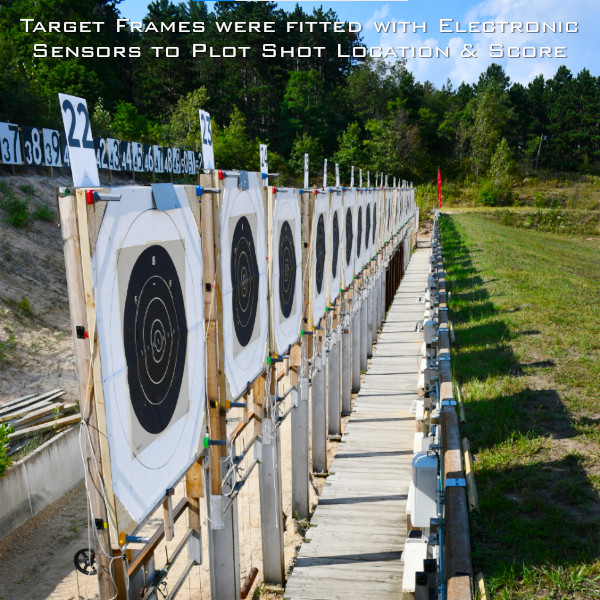
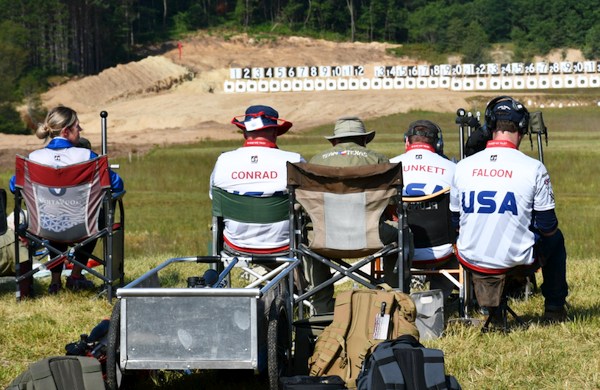
The 2024 F-Class Mid-Range and Long Range National Championships were held August 10-17 at the Winnequah Gun Club in Lodi, Wisconsin. The match was a success, drawing 145 competitors in F-Open and 67 shooters in F-TR. Shooters tell us the Long-Range match was tough, with challenging weather conditions. The entire competition — Mid-Range and Long Range — was shot using a ShotMarker Electronic Target System. Each target frame had sensors that locate shot placement (and score) with great precision. This system provides instant score access, and eliminates the burdens of pit duty.
We congratulate the new 2024 Long Range National Champions: Alan Kulcak (F-Open) and Randy Littleton (F-TR). These men both showed great shooting skills and impressive wind-reading abilities — there were some tough conditions in Lodi this year.
F-Open champ Alan Kulcak shot a great match to win with 1390-71X, four points ahead of second-place Peter Johns (1386-72X) and third-place Robert Sebold (1386-60X). F-TR Long Range National Champion Randy Littleton fought a tight battle to the very end. The F-TR LR match went down to the final target with Littleton (1376-54X) edging runner-up Mike Plunkett (1375-56X) by a single point. Now that’s close competition!
Credit AccurateShooter Forum member Turbulent Turtle for all the images in this story. You can see over 340 photos from the match, thanks to Turbulent Turtle and his camera. CLICK HERE to see 2024 F-Class Nationals Photo Archive.
Here are the Long Range Top 10 for F-Open and F-TR:
F-Open LR Top 10
1 Kulcak, Alan (HM) 1390-71X
2 Johns, Peter (HM) 1386-72X
3 Sebold, Robert (HM) 1386-60X
4 Dileva, Dan (HM) 1384-73X
5 Skogman, Doug (HM) 1384-72X
6 Fairley, Joseph (HM) 1383-67X
7 Nettesheim, Brian (HM) 1382-73X
8 Basalla, Matthew (HM) 1382-67X
9 Kolodziej, William (HM) 1382-63X
10 Mitchell, Ryan (HM) 1382-62X
F-TR LR Top 10
1 Littleton, Randy (HM) 1376-54X
2 Plunkett, Mike (MA) 1375-56X
3 Trapp, Keith (HM) 1373-57X
4 Hubbard, Tom (HM) 1373-50X
5 Hogg, Tracy (HM) 1370-51X
6 Strasovich, Todd (MA) 1367-44X
7 Lucy, Dale (MA) 1363-41X
8 Klemm, Ian (HM) 1362-55X
9 Casale, Lou (MA) 1362-53X
10 Faloon, Christopher (HM) 1360-46X
Long Range F-Class Nationals Team Competition
In F-Open Long-Range team competition, Team Bayou Boyz won the F-Open Team title followed by Team Lapua-Brux-Borden (Second) and Team Vihtavuori (Third). It was a close match, with the Bayou Boyz (1590-83X) edging Team Lapua-Brux-Borden by a slim 2-point margin (1588-83X) with the same X-count. Congrats to Team Bayou Boyz members: Joseph Fairley, Johnny Ingram, Peter Johns, and Alan Kulcak.
Team Bayou Boyz won both the Long Range and Mid-Range F-Open Team events.
In F-TR LR Team competition, Team Vortex (1583-80X) finished first, followed by Team USA White and Team USA Red. Team Vortex recorded an impressive victory, winning by 20 points over runner-up squad Team USA White (1563-54X). Congrats to Team Vortex members: Tracy Hogg, Ian Klemm, Brad Sauve, and Keith Trapp.
Team Vortex recorded an impressive 20-point win in the F-TR Long Range Team Match.
The Mid-Range F-Open event saw tight competition. We congratulate new Mid-Range Champ Johnny Ingram who edged second-place Jim Fowler by two points. The top five F-Open finishers were separated by just five points and third-place finisher Matt Basalla had the highest X-Count with an impressive 99X. In the F-TR division, 2024 Mid-Range Champion Tom Hubbard put on a dominant performance, winning by ten points with the highest X-Count (87X) among all F-TR competitors.
Here are the Mid-Range Top 10 for F-Open and F-TR:
F-Open Mid-Range Top 10
1 Ingram, Johnny (HM) 1783-95X
2 Fowler, Jim (HM) 1781-82X
3 Basalla, Matthew (HM) 1779-99X
4 Waite, Boe (HM) 1779-92X
5 Brooks, David (HM) 1778-88X
6 Kulcak, Alan (HM) 1777-78X
7 Thomas, Jamie (MA) 1777-71X
8 Stob, James (HM) 1776-86X
9 Basalla, Gwen (HM) 1776-70X
10 Zwahr, Brandon (HM) 1775-86X
F-TR Mid-Range Top 10
1 Hubbard, Tom (HM) 1770-87X
2 Gavrock, Gabriel (HM) 1760-68X
3 Crofts, James (HM) 1759-78X
4 Conrad, Keith (HM) 1756-73X
5 Retzloff, Robin (EX) 1755-62X
6 Faloon, Christopher (HM) 1749-63X
7 Brindle, Jerry (HM) 1749-55X
8 Wiens, Gerry (HM) 1746-62X
9 Sowa, Mike (EX) 1743-58X
10 Dixon, Richard (HM) 1739-59X
Mid-Range F-Class Nationals Team Competition
In Mid-Range Team Competition, Team Bayou Boyz (1598-115X) won the F-Open Division while Team USA White (1585-87X) won the F-TR Division. Congrats to the Mid-Range Bayou Boyz (Johnny Ingram, Peter Johns, Alan Kulkak, and Pat Wood) and to USA White (Keith Conrad, Christopher Faloon, Dale Lucy, Mike Plunkett). There were 17 teams competing in F-Open, and 10 Teams competing in F-TR.
CLICK HERE for 2024 F-Class Nationals Program and Match Rules. NOTE: This official program incorrectly states that Silver Mountain electronic targets are used. Instead the ShotMarker system was used.
Competition Note:This past week the 2024 F-Class National Championships have been running in Lodi, Wisconsin with competition in both F-Open and F-TR divisions. F-TR is shot with a bipod and cartridge types are limited to .223 Rem (5.56 NATO) and .308 Win (7.62×51). The 2024 Mid-Range Championship ran August 10-13 while the 2024 Long-Range Championship ran August 14-17, concluding late yesterday. CLICK HERE for 2024 Championship Results.* We will soon have a full report on the 2024 event, but for today’s Sunday GunDay story, we look back at a Mid-Range winning F-TR rifle from a few years back.
Story based on Report by Bryan Blake, Blake Machine Company
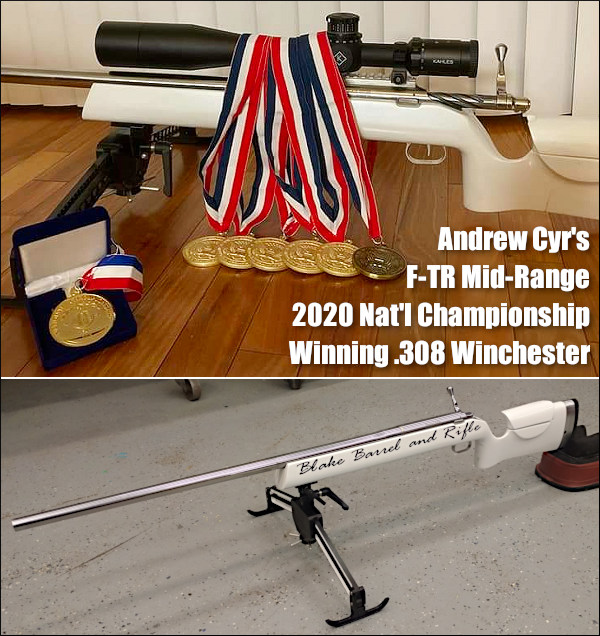
Here’s the gold medal-winning .308 Win rifle of the 2020 F-TR National Mid-Range Champion, Andy Cyr. Arizona native Cyr won the F-TR Mid-Range Championship with an impressive score of 1761-72X out of a possible 1800 points. At this three-day Mid-Range event at Ben Avery in Phoenix, all 180 rounds were shot at 600 yards. Andrew delivered a convincing victory, winning by NINE points over runner-up James Crofts, a past national champion himself. We congratulate Andrew on his impressive win. And today’s Sunday GunDay feature examines the details of Andrew’s impressive .308 Win F-TR rifle.
Cyr Overcame Incredibly Tough Conditions at Ben Avery
After Day One of the Mid-Range Nationals, Andy was in 5th place. Andy made up some serious ground on the next two days despite winds that were well into the 20 MPH+ range. In fact, many experienced shooters took misses (not hitting the scoring ring) because the winds were so fierce. Interestingly, Andy’s 1761-72X score beat all but eight F-Open shooters.
Andrew Cyr’s .308 Win F-TR rifle during load development and accuracy testing.
F-TR Mid-Range Championship-Winning .308 Win Rifle Specifications:
Blake Barrel and Rifle 32″ .30 Caliber, 1:11″-twist barrel with custom specs
McMillan XIT Stock (lightened with ports on butt area)
Borden BRM Action
Kahles K1050 10-50x56mm Scope
Phoenix Bipod with F-Class Products lowering kit and skeleton legs
Andrew Cyr’s Championship-winning F-TR rifle was built by Phoenix-based Blake Barrel and Rifle (BBR) in 2018. Interestingly, this rifle was originally built for Andy’s daughter Jessica. The rifle was used by Andy a few months later. The rifle features a severely-lightened XIT stock with the grip smoothed out. Andy was actually the first customer of Blake Barrel and Rifle back in 2018. He has always been willing to try out new rifling profiles, twist rates, and barrel configurations as recommended by BBR.
Bryan Blake tells us: “Many customers demand exact specs and there is no way of changing their mind, even if it is factual-based. With Andy he was always willing to try new things, some things didn’t work well, but some things worked very well, just like the barrel used to win the Nationals.” Andy preferred a heavier barrel in the chamber area than most TR shooters. The shank diameter is 1.350″ rather than 1.250″. What this does is keep as much material around the chamber, which is the hottest area of the barrel. That way the barrel is less affected by heat over a string of fire, since the heat can be dissipated into a larger area.
Andy used a 32″ barrel, a length not commonly used in F-TR anymore. Most are running 30″ or even 28″ now. Many folks think a shorter barrel is more accurate so these competitors do not use a 32″ barrel. Well as you can see by his results, Andrew’s 32″ tube shot great. The extra length was NOT a handicap. We should remember that longer barrels can normally produce higher velocities than shorter barrels or deliver equivalent speeds with less pressure.
Many people also believe that a 1:9-10″ twist is needed to shoot 200-grain class bullets out of a .308 Win accurately. However, Andy took the advice of Blake Barrel and Rifle, and went with a 1:11″-twist Blake cut-rifled barrel. Many would say this twist is too slow, and some online calculators say a 1:11″-twist won’t fully stabilize 200-grain bullets. Obviously this is also not the case. Andy’s 11-twist and Berger 200-grain Hybrid bullets (NOT 200.20X bullets) work very well with this combination. NOTE: Andy uses an F-Class Products barrel tuner to tune his load. He will sometimes even alter tune between relays to compensate for changing barometric conditions.
Winning .308 Win Load — Lapua Palma Brass, VV N550, CCI 450s, Berger 200gr Hybrids
Andy Cyr took the Mid-Range title loading Vihtavuori N150 powder, CCI 450 primers, Berger 200gr Hybrids, and Lapua .308 Win Palma brass. Andy does not push his bullets very fast and finds a big accuracy node at the mid-2600 FPS range. He jumps his bullets .015″ off the lands. One thing Andy consistently does is test, test, test. He will test different powders, charge weights, seating depths nearly every time he is at the range. He will shoot a different load for each string to see what works best.
Profile of 2020 F-TR Mid-Range National Champion — Andrew Cyr
Father and Daughter Compete Together
Andy started shooting F-Class in 2012 to help him shoot better in the PRS series. He hoped to learn to read the wind better and get more experience in long-range shooting in general. After shooting F-Class he was hooked and found he enjoyed it more than PRS. Andy and his daughter Jessica have shot many state matches together, with both of them shooting F-TR. Jessica owned the Mid-Range 20-shot woman’s Aggregate record for years with a score of 200-11X. Interestingly Andy shot his very first clean at 1000 yards at the Nationals in Raton, NM in 2018 with a score of 200-11X also. This year Andy started using a spotting scope to help read mirage and it has helped him tremendously he reports.
The “Master” Beat the “High Masters”
Andy is currently classified in Mid-Range as a Master for F-Class, not yet High Master. Even after winning the F-Class Mid-Range Nationals, the most prestigious F-Class match of the year, he is still classified as a Master. Andy’s 1761-72X score works out to 97.8% of a perfect 1800. But the requirement for F-Class High Master is 98%. That just shows you how tough the conditions were at Ben Avery this year. But still the Master beat ALL the High Masters — if you look at the score sheet above, all the other Top 10 F-TR competitors were High Masters. Impressive. And we believe Andy is the first Arizona resident to ever win a national F-Class Championship in either F-Open or F-TR.
About Blake Barrel and Rifle Blake Barrel and Rifle (BBR) has been in business since 2018. BBR built the rifle that Brian Bowling used to win the 2019 F-Open National Championship. And now another ultra-accurate BBR-built rifle has won the 2020 F-TR Mid-Range Championship. Bryan Blake tells us that Blake Barrel and Rifle has recently upgraded BBR’s rifle barrel building equipment. There are advanced CNC lapping machines, CNC bore-honing machines, and all-new, proprietary rifling cutter designs that no one else in the barrel business uses.
Blake Barrel and Rifle produces cut-rifled, 6-groove barrels with a unique rifling profile no other barrel manufacturer is using. Blake barrels have an impressive winning record in recent major competitions — earning National Championships, plus many match wins and podium performances. Bryan Blake tells us that “The time and quality control spend on Blake barrels is second to none and the proof in the results.” For more information, visit Blakebarrel.com.
* We believe that Alan Kulcak won 2024 Long-Range F-Open while Randy Littleton won 2024 Long-Range F-TR Division. We believe Johnny Ingram is the 2024 Mid-Range Champ in F-Open and Tom Hubbard won the 2024 Mid-Range F-TR title.
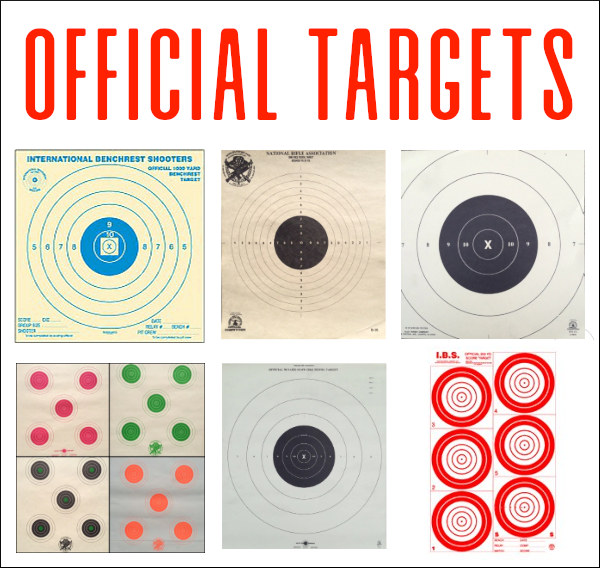
While some shooting disciplines have moved to electronic targets, most shooting matches still use paper targets, which must have precise dimensions for the particular distance and discipline. If you need correctly-sized targets for specific shooting disciplines (such as NRA Smallbore, F-Class, and 1K Benchrest) check out the links in this article. Precise, dimensionally-correct competition targets are produced by a half-dozen specialty printers. In this article we provide links to the leading target sellers, with a chart showing “who’s got what”. Look for your particular discipline and the vendors will be specified.
Sources for Official Shooting Competition Targets:
AccurateShooter.com offers dozens of FREE, printable targets for target practice, load development, and fun shooting. We also offer a few of the most popular NRA Bullseye targets. One or more of these printable targets should work for most training purposes. However, some readers have asked: “Where can we get the real targets… exactly like the ones used in NRA, IBS, and NBRSA shooting matches?”
All these vendors carry nearly all the NRA High Power and Smallbore targets, including the smaller F-Class targets. National Target has the F-Class and High Power targets, including 100-yard reductions of the 200, 300, and 600-yard military targets.
Here are some of the air rifle, smallbore, and High Power targets at Creedmoor Sports:
Orrville Printing currently sells IBS targets for rimfire (50 yard) benchrest, short-range centerfire Benchrest (100, 200, 300 yards), Hunter BR Rifle (100, 200, 300 yards), plus the official 600-yard and 1000-yard IBS targets. National Target Company also has most of the IBS targets. NBRSA short-range, 600-yard, and 1000-yard benchrest targets are available directly from the NBRSA Business Office. Send an email to nbrsa@icloud.com or call (434) 993-9201.
Good Source for Specialty Targets and Target Stands
Need Steel, Cardboard Silhouettes or specialty targets? ALCO Target Company in Duarte, California is the USA’s leading producer of the full spectrum of shooting targets including paper targets, cardboard targets, steel targets, and target stands.
Vertical stringing is a common problem that all precision shooters will face sooner or later. In addition to ammo inconsistencies, many other factors can cause vertical stringing. Accordingly, it’s important that you analyze your gun handling and bench set-up systematically.
EDITOR: Folks, READ THIS ARTICLE! You WILL benefit. There are some VERY important insights here. You’ll learn ways to set up your gun better, and check for various technical issues. That can save you time at the range and save you money spent on expensive bullets and powder.
In this article, Hall of Fame benchrest Shooter Speedy Gonzalez explains how to eliminate mechanical and gun-handling problems that cause vertical spread in your groups. Speedy’s article addresses the many human and the hardware factors that can cause vertical.
Speedy Gonzalez, noted shooter, gunsmith and member of the Benchrest Hall of Fame, offers these pearls of wisdom to help you eliminate vertical in your shot strings. Remember that vertical can result from myriad gear issues and gun-handling mistakes. Try to isolate one item at a time as you work to improve your groups.
BAGS and REST–VERY IMPORTANT
• Front Rest Wobble — You will get vertical if the top section of the front rest is loose. Unfortunately, a lot of rests have movement even when you tighten them as much as you can. This can cause unexplained shots.
• Rifle Angle — If the gun is not level, but rather angles down at muzzle end, the rifle will recoil up at butt-end, causing vertical. You may need to try different rear bags to get the set-up right.
• Front Bag Tension–Vertical can happen if the front sand bag grips the fore-arm too tightly. If, when you pull the rifle back by hand, the fore-arm feels like it is stuck in the bag, then the front bag’s grip is too tight. Your rifle should move in evenly and smoothly in the sand bags, not jerk or chatter when you pull the gun back by hand.
• Sandbag Fill — A front sandbag that is too hard can induce vertical. Personally, I’ve have never had a rifle that will shoot consistently with a rock-hard front sandbag. It always causes vertical or other unexplained shots.
• Bag Ears — If the channel between the Rear Bag’s ears is not in line with the barrel, but is twisted left or right, this can affect recoil and vertical consistency. And take note — if the bag is off-axis quite a bit, you can also get horizontal stringing.
• Reliability — ALL your bench equipment must work flawlessly. If it doesn’t, get it fixed or get rid of it. We need all our attention on wind flags.
GUN HANDLING and BENCH TECHNIQUE
• Be Consistent — You can get vertical if your bench technique is not the same every shot. One common problem is putting your shoulder against the stock for one shot and not the next.
• Free Recoil — Free recoil shooters should be sure their rifle hits their shoulder squarely on recoil, not on the edge of their shoulder or the side of their arm.
• Head Position — Learn to keep your head down and follow-through after each shot. Stay relaxed and hold your position after breaking the shot.
• Eyes — Learn to shoot with both eyes open so you can see more of the conditions.
• Last Shot Laziness — If the 5th shot is a regular problem, you may be guilty of what I call “wishing the last shot in”. This is a very common mistake. We just aim, pull the trigger, and do not worry about the wind flags. Note that in the photo above, the 5th shot was the highest in the group–probably because of fatigue or lack of concentration.
• Last Shot Low — I hear a lot of discussion about low shots in a group and apparently this occurs a lot on the 5th shot. If your 5th shot that goes out most of the time, you can bet you are doing something at the bench.
• Seating — When possible, bring your own stool so that you can sit comfortably, at a consistent height, every time you shoot.
LOAD TUNING
• Find the Sweet Spot — A load that is too light or too heavy can cause vertical problems. When you’ve tuned the load right, you should see a reduction in vertical. Even 0.1 grain may make a difference, as will small changes in seating depth.
• Primers — If you’re getting vertical, and everything else looks fine, try another brand of primers. And remove the carbon from the primer pockets so the primers seat uniformly every time.
• Case Prep — When you chamfer the inside of your case necks make sure they are smooth enough that they don’t peel jacket material off when you seat the bullet. Bullets with J4 Jackets (like Bergers) and Lapua Scenar bullets seem more prone to jacket scratching or tearing than Sierra bullets.
• Shell Holders — Keep shell holders clean, in both your press and priming tool. I have seen so much dirt/crud in shell holders that the cases end up get sized crooked because the rim is not square to the die.
• Water in Cases — I see people walking around with case necks turned up in the loading block. A lot of the time there is condensation dropping from the roof of your loading area. If one drop of water gets in a case you are in trouble. How many times have you had a bad low shot when it has been raining and you have been walking around with your cases turned up in your block?
MECHANICAL and HARDWARE ISSUES
• Barrel Weight — A lot of rifles are muzzle-heavy. Some rifles have too heavy a barrel and this causes vertical, especially when shooting free recoil. Basically the gun wants to tip forward. The remedy is to trim or flute the barrel, or add weight in the rear (if you can stay within weight limits).
• Unbalanced Rifle — If the rifle is not balanced, it does not recoil straight, and it will jump in the bags. If the rifle is built properly this will not happen. Clay Spencer calls this “recoil balancing”, and he uses dual scales (front and rear) to ensure the rifle recoils properly.
• Firing Pin — A number of firing-pin issues can cause vertical. First, a firing pin spring that is either too weak or too strong will induce vertical problems. If you think this is the problem change springs and see what happens. Second, a firing pin that is not seated correctly in the bolt (in the cocked position) will cause poor ignition. Take the bolt out of rifle and look in the firing pin hole. If you cannot see the entire end of firing pin it has come out of the hole. Lastly, a firing pin dragging in bolt or shroud can cause vertical. Listen to the sound when you dry fire. If you don’t hear the same sound each shot, something is wrong.
• Trigger — A trigger sear with excessive spring load can cause problems. To diagnose, with an UNLOADED gun, hold the trigger in firing position and push down on sear with your thumb. If it is hard to push down, this will cause vertical problems.
• Stock Flex — Some stocks are very flexible. This can cause vertical. There are ways to stiffen stocks, but sometimes replacement is the best answer.
SCOPE ISSUES
• Lock Rings — This year alone I have seen nine lock rings on scopes that are not tight. Guess what that does to your group? Make sure yours are tight.
• Big Tubes Need Tension — We’ve observed that some 30mm scope rings are not getting tight enough, and scopes are slipping in the rings under recoil. This will cause point of aim movement.
• Windage Bases — If you’re using a conventional-style single dovetail with rear windage adjustment, make sure both sides of the windage screws are tight. This can induce both windage AND vertical issues since the rear ring is held down by the windage tension.
AWARENESS of CONDITIONS and READING WIND
• Basic Wind-Reading Rule–If you do not know how to read wind flags or are very inexperienced, try to shoot your group with the flags all going in one direction.
• Rate of Fire — The longer you wait between shots when a condition is changing, the more the condition change will affect your shots.
• Look Far and Wide — Learn to look at the whole field of flags, not just the row in front of you. Many times a change quite a ways out will cause shot to go out of your group well before that change shows up in front of your bench.
• Don’t Fear the Wind — When you realize that the wind is your friend you will become a much better benchrest shooter. By this I mean that wind skills can separate you from other shooters who have equally good equipment. To learn how to read the wind, you must practice in challenging winds, not only in good conditions.
• Watch Wind Direction AND Velocity — Pay attention to angle changes on flags. Even though you see the same windspeed indicators, angle changes make a big difference in your groups.
• Watch While You Wait — Between courses of fire, whenever possible, watch conditions on the range. That way you will be aware of any changes in conditions since your last group and you will be mentally prepared for the new condition.
SPECIAL ADVICE for HUNTING RIFLES
• Clean That Barrel — Most hunting rifle barrels do not get cleaned enough. If you keep barrel clean it will shoot better for you. You should clean your barrel well after every 10 to 12 shots. If you’re lazy, just use Wipe-Out.
• First Shot Inconsistency — Most hunting rifles will not put the first shot (after cleaning) with the subsequent shots. So, after cleaning, if you have a rifle that tosses that first shot high or wide, then shoot one fouling shot before going hunting or before you shoot for group.
• Barrel Heat — Thin-contour “sporter” barrels WILL change point of impact as they heat up. When testing loads for your hunting rifle, take your time and don’t let the barrel get hot on you.
At the CMP’s 2024 National Trophy Pistol Matches, John Bickar of Menlo Park, CA, became only the third competitor in history to earn back-to-back wins in the President’s Pistol Match. John captured his second straight title shooting a 1911 pistol used by his mother, who passed in 2003. After a two-decade long hiatus, Bickar returned to the National Matches in 2023, using his mom’s cherished 1911 pistol. He won the President’s Match in 2023 and now has won a second year in a row with his 2024 victory.
John Bickar won his second consecutive President’s Pistol Match at the 2024 National Matches.
As Bickar packed his gear and waited for others to finish the President’s Match, the USAMU’s SSG Christopher Hudock told John, “That’s the highest score I’ve seen so far.” Bickar then thought: “I might’ve won this again.” Indeed he had won again, and was proud to do it with his mother’s 1911 pistol. “Glad to carry on the tradition,” Bickar said.
The President’s Pistol Match, a staple of the century-old National Matches since 1981, had 414 competitors this year. Bickar fired an overall score of 384-17X over the day — just one point above the second and third place finishers. John noted that the conditions on the day of the President’s Match were nearly ideal.
John Learned Pistol Marksmanship from his Mother and Father
Originally from Canton, Ohio, John competed at the National Matches as a junior. He comes from a line of pistol enthusiasts – with his mom, Judy, a competitor until her passing in 2003, and his dad, John, the president of the Canton McKinley Rifle and Pistol Club for 17 years before his passing in 1994.
John, with his parents’ guidance, earned his Distinguished Pistol Badge in 1993 at the age of 16 — the youngest at the time – and went on to compete in college as well as internationally attending World Championships and Pan American Games. He also trained at the Olympic Training Center in Colorado. He earned his Distinguished International Badge in 2001 and his Distinguished Rifleman Badge in 2018.
Other Notable Performances at the National Trophy Pistol Matches
Finding second behind Bickar was 1LT Lisa Emmert Traciak of Colorado Springs, who claimed the High Woman honor in the President’s Pistol event. She went on to also earn the National Woman’s Trophy as the top scoring woman in the National Trophy Individual Match (NTI), garnering a score of 280-14X, and the Rose Krelstein Trophy as the highest scoring woman in the President’s/NTI Aggregate.
Jonathan Shue of Liberty, NC, was the top overall competitor of the National Trophy Individual (NTI) event with a score of 293-15X. It was Shue’s second time earning his name on the General Custer Trophy, having previously won back in 2019. He also claimed the High Civilian title with his win and took the Anheuser Busch Trophy as the leading competitor in the NTI/NTT Individual Aggregate, with a score of 584-24X. Shue is the current national record holder in the Aggregate event.
What’s a “Wallet Group”? It’s a singularly spectacular proof target that entitles its bearer to bragging rights. The wallet group may or may not have been shot in competition, and, by definition, it may not be repeatable. But it exists as incontrovertible proof that, at least once, the stars aligned, and the wind gods smiled on the shooter.
Five Shots in 0.178 MOA at 1000 Yards
A few years ago, Forum member and F-Class shooter Gary Wood was testing his 6.5-284 rifle at the 1000-yard range in Coalinga, California, getting ready for an upcoming long range match. In practice, Gary nailed a witnessed 1.859″ five-shot group, with four of the five shots well under an inch. Use this as proof to win those club-house arguments about whether it is possible to shoot “in the ones” at 1000 yards. Gary’s group worked out to 0.178 MOA!
Gary reports: “I was load testing with 5-shot groups. Each group was shot on a new F-Class center and pulled by Ret. Master Chief Jerry Pullens and spotted by an other long-range shooter. The second 5-shot load group looked really small … by our reckoning four out of five shots measured under an inch. I was amazed. What’s more, when I shot the group, the 4th shot blew the spindle out of the 3rd shot. My spotter saw that in his scope and Jerry Pullens told me about it afterwards”.
As measured with the OnTarget Software, using a scan of the target, Gary plotted the group size at 1.859″ total for five shots, or 0.178 MOA. Gary noted: “I had everyone sign the target which I saved and photographed.” Yes, Gary, this may be the wallet group to end all wallet groups. You should have that target framed.
Gary’s Load and 6.5-284 Rifle Specs
Gary was running a stout load of Hodgdon H4350 and CCI BR-2 primers, pushing moly-coated 142gr Sierra MKs, in Lapua 6.5-284 brass. The rifle features an F-Class, single-shot Surgeon action with a Bartlein 5R barrel chambered with a no-turn neck. Gary says “The barrel only has 70 rounds through it… yep, I think it will shoot.” Gary did all of the gunsmithing and barrel work himself.
Did Gary have any special reloading tricks? Apparently not: “Other than weighing the cases and the powder very carefully, there really were no magical reloading secrets used. The Sierra 142s were moly-coated straight from the box of 500, but they were not weighed or checked for bearing surface. The powder was dropped with a RCBS ChargeMaster then checked with an Acculab scale (to under a tenth). The Lapua cases were not neck-turned, but I did weight-sort them. The five cases for the small group weighed: 195.05, 195.03, 195.03, 195.03, 195.01.”
The USA F-Class National Championships are underway right now in Lodi, Wisconsin. The Mid-Range Championships run August 10-13, 2024, while the Long Range F-Class Championships start on the 14th and run through August 17, 2024. With the Mid-Range event underway today, as you read this, top F-Open and F-TR shooters are aiming their rifles at 600-yard targets. VIEW Nationals Match Program HERE.
2024 NRA F-CLASS NATIONAL CHAMPIONSHIPS
NRA F-CLASS MID-RANGE NATIONAL CHAMPIONSHIP AUGUST 10-13, 2024
NRA F-CLASS LONG RANGE NATIONAL CHAMPIONSHIP AUGUST 14-17, 2024
Event hosted by Winnequah Gun Club and sponsored by Brux Barrels, Criterion Barrels, Krieger Barrels, and Silver Mountain Target.
There will be two divisions at The F-Class National Championships: F-Open and F-TR. In F-Open the rifles can shoot any cartridge type (up to .35 caliber) and have a 22-lb (10kg) weight limit. A front rest is allowed, and most shooters favor a rest with a joystick control.
In F-TR, two cartridge types are allowed: .223 Remington (5.56×45) or .308 Winchester (7.62×51 NATO), with no restrictions on bullet weight. F-TR rifles are fired off a bipod attached to the rifle’s fore-end. The F-TR weight limit is 8.25 kilograms, or about 18 pounds. This includes the weight of the rifle, scope, and bipod. A sandbag can be used under the rear of the stock. Because of the lower weight limit, which includes the bipod, F-TR stocks tend to be much slimmer and lighter than F-Open stocks which have wide fore-arms to work with the front rests.
F-Open Cartridge Options — Modern Magnum Options
For Today’s Sunday Gunday Story we feature an article about F-Open chamberings by respected rifle builder and past F-Open National Champion Emil Kovan. In this article, Emil reviews some of the new magnum cartridge options that are being employed by F-Open competitors. Many shooters are still using the .284 Winchester (or variants), but an increasing number are shooting 7mm and .30-caliber cartridges based on magnum cartridge types. The 7mm is probably still the favored caliber for F-Open because 7mm bullets offer great ballistics with less recoil than heavier .30-caliber projectiles.
Cartridges for F-Class Part II — Rise of the Magnums
A few seasons back, I wrote an article on cartridge choices for F-Class shooters. CLICK HERE to READ ARTICLE. Since the first article I wrote, F-Class has continued to grow, and push the limits of precision and accuracy. While the .284 Win and its variants are still the most common F-Open cartridges, more and more top F-Open shooters are using magnum cartridge types to win competitions and set new records. In this article, I will list some of the advantages and disadvantages of the most commonly used magnums, and will cover the strengths and weaknesses of each one of them.
Performance factors we will consider for magnum F-Open cartridges include:
1. Equal or better accuracy than standard chambers
2. Better ballistic performance
3. Enhanced case life
4. Barrel life
Accuracy Potential of Magnum Cartridges for F-0pen Competition
John Meyrs has won four National Mid-Range Championships using the .300 WSM. Tim Vought used the same cartridge to win two Mid-Range Nationals and used a 7-6.5 PRC to win the long range Nationals. Standard .437″ case head (.308 Win head size) cartridges still have more Nationals wins overall, but the magnums are quickly catching up, and my prediction is that magnums will dominate soon.
The accuracy and precision potential of magnums used in F-Class (.300 WSM, 7-270 WSM, 7mm RSAUM or “7 SAUM”, 7-6.5 PRC) is better than non-magnum cartridges because their shapes are closer to the ideal “fat/short” body associated with wider nodes and extreme precision. For example a .300 WSM is proportionally much closer to the 6 PPC, 6 Dasher, and 6 BRA than is the .284 Winchester.
Stunning F-Open rifle with SEB Mini front rest with Blake Machine accessories.
The first thing that comes to mind when magnums are discussed is power and speed. In my humble opinion most shooters are missing out on accuracy because they push their magnums right past the most stable and accurate nodes. Recently I met my good friend from the Army Marksmanship Unit, SFC Brandon Green, at a shooting competition. We discussed the latest and greatest in long-range shooting. I knew that the USAMU had switched from 6.5-284 Norma to 7mm RSAUM several years back, but didn’t know what load they are currently using. Brandon told me that the load featured Berger 180gr hybrids in Nosler cases at 2820 fps. We all know that the 7 SAUM is capable of much higher speeds, “but at around 2820 fps the load/rifle combo will hammer the X-Ring anywhere under any conditions” SFC Green said.
F-Open rifles on the firing line at the Ben Avery Shooting Facility in Phoenix, Arizona.
Most shooters jump right into magnum territory velocities when testing, missing out on better precision at standard chamber speeds. For example, my 30 KMR can easily reach 2880 fps with 230gr Hybrids, and it actually shoots pretty good. But the same rifle at around 2770 fps will absolutely hammer the X-Ring in any condition anywhere. When it’s all said and done, F-Class is a long-range shooting competition at a known distance which requires extreme precision and accuracy. It is not a speed race.
IMPORTANT — Case-Head Dimensions Do Make a Difference
Magnums, when shot within reasonable velocities, on average will give better case life due to the bigger case + lower pressure and “more meat” in the case-head area. For example a 7 SAUM case will outlast a .284 Win case when both are loaded to around 2900 fps.
Disadvantages of Magnum F-Open Cartridges
Perhaps the biggest disadvantage linked to magnums is recoil. Some people complain about developing the “gun shy” syndrome after shooting a magnum for a while. Muzzle blast and recoil are significantly more pronounced in magnums, but that can be easily managed with a properly-built rifle equipped with appropriate recoil mitigation hardware such as RAD and the various butt plates.
F-Open rifle equipped with recoil reduction buttpad system.
Barrel Life — “Barrels are Expendable Components”
It is true that certain magnums can torch a barrel in just a few hundred rounds. But the same is true when improving a 6BR to 6 Dasher for example — barrel life might be reduced significantly. More powder = more heat = diminished accuracy after a certain round count. In my experience, a F-Open magnum’s barrel life is very close to high-performance standard cartridges such as the .284 Shehane or .284 KMR. I “retire” my barrels around 1200 rounds regardless of the cartridge being a magnum or not. After that many rounds most barrels will still shoot OK but will copper up, and you will start seeing those unexplained vertical 9s. The bottom line is this, barrels are expendable components very much like brass. You can’t get the performance of .300 WSM and the barrel life of the .308 Win at the same time. If you want to race in NASCAR, fuel mileage should not be the top priority!
Top Magnum Cartridge Types Used in F-Class Open Division
.300 Winchester Short Magnum
The .300 WSM (Winchester Short Magnum) tops the popularity chart in F-Class Open division. It has been used to win numerous National championships and has set many National records. The .300 WSM’s short/fat case shape, with minimal body taper and 35-degree shoulder, contribute greatly to its outstanding performance at long range. Components are readily available as well. Best brass remains to be Norma, although ADG is just as good and some would even say better, but it is more expensive and harder to get at this time.
The .300 WSM has been described as a “super-sized Dasher”.
For the .30-cal magnums, in my opinion, the best bullets by far are made by Berger. If your rifle does not shoot 215gr, 230gr hybrids, or 210gr VLDs well, you likely have a rifle problem, NOT a bullet issue. My “go to” bullet is the Berger 230gr Hybrid. The 215-grainer is a close second, followed by Berger’s accurate but ballistically inferior 210gr VLD, which I use in calm and steady conditions.
Top powders for the .300 WSM are Hodgdon H4831SC and H4350. I know there are many more powders suitable for the .300 WSM cartridge, but none I have used can match Hodgdon’s consistency when shot in different geographical locations and weather conditions.
7mm Remington Short Action Ultra Magnum
The 7mm RSAUM (aka 7 SAUM) used to be the darling of F-Open. Its case capacity and shape are about perfect for launching 180gr pills with great ballistics and precision. Its popularity faded a little, due to the lack of good brass, and the rise of the improved versions of the .284 Win which can almost match the RSAUM performance. Norma still makes 7 RSAUM brass which is pretty good but little on the soft side and hard to find. ADG is arguably producing the best RSAUM brass right now. It is very uniform, reasonably priced, and seems to hold up very well even when pushed hard. The best bullets are again made by Berger, and those are the 180gr hybrid, 184gr hybrid, and 180gr VLD. Best powders are H4831sc, H4350, and Alliant Reloder 16 and Reloder 23.
7-270 WSM, 7-300 WSM, and 7 WSM
The first two are pretty much identical, the only difference being that the 7-270 WSM is necked up .270 WSM while the 7-300 WSM is a .300 WSM necked down to 7mm. I personally prefer the first one since necking-up is easier than necking-down (with fewer doughnut issues).
The WSM case-based 7mms will give you great velocity flexibility as well as superb precision when tuned well. In the 2013 world championship in Raton NM, I was scoring for a gentleman from Canada who was shooting 7-270 WSM. The wind was blowing pretty hard that day. On one of his shots, just before he pulled the trigger the wind gusted. I remember thinking that’s going to be an 8 for sure. The target came up a line 10! I asked him after the match what he was shooting, and he replied 180s at 3100fps. Although capable of such speeds, I think that potentially better and more consistent accuracy can be achieved at much slower speeds. The best powders and bullets are again Hodgdon and Berger respectively. Best cases are made by Norma and ADG, with Winchester being a third option.
7-6.5 PRC — Popular Wildcat
Last but not least on our chart is the 7-6.5 PRC. This particular cartridge is actually a wildcat. It is a 6.5 PRC necked up to 7mm. It is pretty much identical to the 7 RSAUM with the only differences being a shorter neck and .01″-narrower body. Currently the 7-6.5 PRC is the most requested cartridge that I offer when building new rifles. It seems to fill the gap between the .284 Win and the larger magnums very nicely. It is capable of reaching 3000fps but most shooters are getting their best results around 2920-2950 fps. The biggest advantage of this wildcat is brass. Lapua makes super high-quality, readily-available 6.5 PRC brass. Best powders are H4831sc, H4350, Reloder 16, and Vihtavuori VV 555. The best bullet in my opinion is the 180gr Berger. I am yet to hear about a better-performing bullet in this chamber.
Conclusion In conclusion, magnums are not perfect but their performance advantages should be very seriously considered when building a rifle for long-range F-Class. In part three, I will list the most common wildcat magnums, and present the KMR magnums which will make you (if you haven’t already) buy a magnum action and get a magnum build for sure!
– 2014 F-Class Open National Champion
– 2015 F-Class Open National Championship, Silver Medal
– F-Class Open National Championship Teams, 2015, 2014, 2013, Shooting Team Member
– Over 15 wins in Regional and State Championships in Palma, F-TR, F-Open
– 2013 U.S. National Team Member
– 2023 F-Open Gold Medal Team USA Member, 2023 World Championship in South Africa
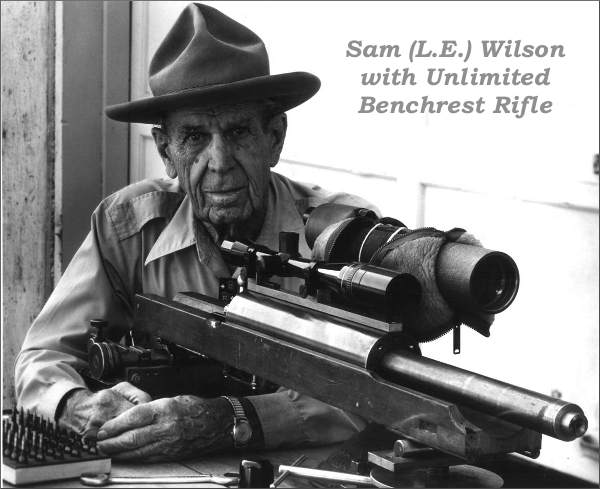
Sam (L.E.) Wilson actively competed in benchrest matches until he passed. He’s shown here with an Unlimited benchrest rifle of his own design.
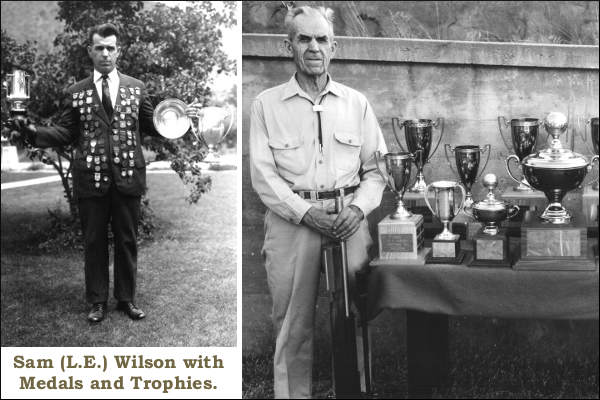
If you’ve used hand dies with an arbor press, chances are you’ve seen the L.E. Wilson company name. You may not know that the founder of L.E. Wilson Inc. was an avid benchrest competitor who pioneered many of the precision reloading methods we used today. Known as “Sam” to his friends, L.E. Wilson was one of the great accuracy pioneers who collected many trophies for match victories during his long shooting career. His company continues to innovate — bringing out new products such as the Case Gage Depth Micrometer tool.
The photo above shows Sam (foreground) with all of his children at a shoot. Behind Sam are Jim, Jack and Mary, shooting in the Unlimited Class. What do they say — “the family that plays together stays together”? Note the long, externally-adjusted scopes being used. Learn more about Sam (L.E.) Wilson and his company on the L.E. Wilson website.
Unlimited Class was Sam’s favorite discipline, because in the “good old days” top competitors normally would craft both the rifle and the front/rear rests. This rewarded Sam’s ingenuity and machining/fabrication skills. In the “build-it-yourself” era, one couldn’t just order up an unlimited rail gun on the internet. How times have changed…
Need a top-notch Ballistics App for your iPhone, iPad, or iPod? Start with Ballistic: Advanced Edition (AE), the number 1 (i.e. most installed) App for iOS systems (iPhones and iPads). Ballistics AE (Advanced Edition) is the most popular iOS ballistics program for many good reasons. It offers a full feature set with Ballistic Solver, Ballistic Comparison (with up to 8 projectiles), Target Log (records group sizes), Advanced WindKit, and more. The Ballistic: Advanced Edition software is easy to use, with nice controls. Underneath it all is the proven JBM Ballistics calculator. And here’s the kicker — this excellent mobile App software is now FREE to download and install on iPhones and iPads!
This Video Explains How to Set Up and Use Ballistic: Advanced Edition
Full-featured and easy to use, Ballistics AE has been refined over many years, and it supplies rock-solid solutions derived from JBM Ballistics solver (created by James B. Millard). Unlike some other Apps, Ballistics AE is STABLE on iPhones (with various OS levels). What’s cool is that Ballistics AE is now available for FREE for both iPhones and iPads. This software is now provided by Federal Premium Ammunition, with in-App purchase functionality.
We’ve used the Ballistic: Advanced Edition program on an iPhone 5S, iPhone 6, and iPad, and it performed well. Here are some of the features we liked:
1. Mirrors output from online version of JBM Ballistics we often use for initial calculations.
2. Controls are simple to use and (mostly) intuitive.
3. Handy comparison feature lets you compare ballistics for different projectiles side by side.
4. Advanced Wind Kit allows you to account for complex wind situations.
5. Projectile and BC Databases are very comprehensive.
6. Software is regularly updated to match Apple OS changes.
This article is Copyright 2023 AccurateShooter.com. No republication is authorized. Any appearance of this story on another site obliges that site to pay liquidated damages and/or licensing fees.








 In this article, Hall of Fame benchrest Shooter Speedy Gonzalez explains how to eliminate mechanical and gun-handling problems that cause vertical spread in your groups. Speedy’s article addresses the many human and the hardware factors that can cause vertical.
  • Front Bag Tension–Vertical can happen if the front sand bag grips the fore-arm too tightly. If, when you pull the rifle back by hand, the fore-arm feels like it is stuck in the bag, then the front bag’s grip is too tight. Your rifle should move in evenly and smoothly in the sand bags, not jerk or chatter when you pull the gun back by hand.


 Five Shots in 0.178 MOA at 1000 Yards


 There will be two divisions at The F-Class National Championships: F-Open and F-TR. In F-Open the rifles can shoot any cartridge type (up to .35 caliber) and have a 22-lb (10kg) weight limit. A front rest is allowed, and most shooters favor a rest with a joystick control.


 In conclusion, magnums are not perfect but their performance advantages should be very seriously considered when building a rifle for long-range F-Class. In part three, I will list the most common wildcat magnums, and present the KMR magnums which will make you (if you haven’t already) buy a magnum action and get a magnum build for sure!