August is National Shooting Sports Month. And one of the nation’s best shooting centers, the Ben Avery Shooting Facility, invites shooters to visit. Ben Avery has excellent rifle, pistol, and shotgun ranges.
The Arizona Game and Fish Dept. (AZGFD) invites recreational shooters to celebrate National Shooting Sports Month in August. The world-class Ben Avery Shooting Facility, one of America’s largest publicly operated shooting facilities, drew almost 200,000 recreational shooters in 2023. Ben Avery’s 1000-yard rifle range is home to the Southwest Nationals, the hugely popular long-range annual event that attracts shooters from around the country.
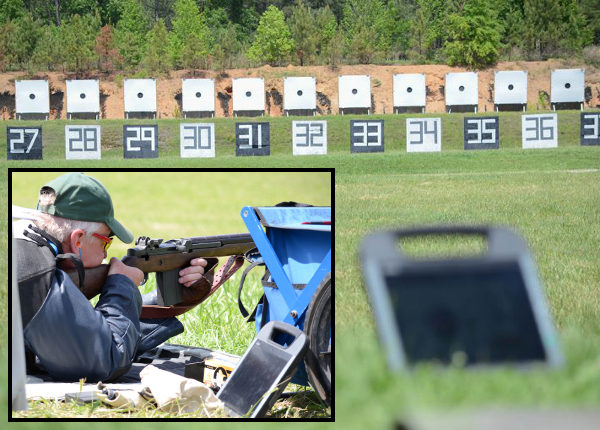
Ben Avery has a good covered facility for benchrest competition with a regular match schedule.
Looking downrange at the 1000-yard target line at Ben Avery.
“Recreational shooting is a safe, fun activity enjoyed by millions of Americans,” said Mike Raum, AZGFD Shooting Sports Chief. “Whether you’re new to recreational shooting, someone who shoots regularly or enjoys competing in tournaments, or just sighting in your firearm for a hunt, join us in celebrating the month by visiting a local shooting range.
Ben Avery Operation Hours
Below are Ben Avery’s hours of operation for rifle and pistol ranges, archery ranges, and Clay Target Center. Ben Avery is normally closed on Mondays but is open from Tuesday through Sunday. The range even opens at 7:00 am, so you can have some shooting fun before work!
Monday: CLOSED
Tuesday: 7 a.m.-3 p.m.
Wednesday: 7 a.m.-3 p.m.
Thursday: 7 a.m.-7 p.m.
Friday: 7 a.m.-7 p.m.
Saturday: 7 a.m.-7 p.m.
Sunday: 7 a.m.-5 p.m.
Customers can reserve shooting times on weekend days at Bookben.azgfd.com.
There are nine other public shooting facilities owned by the Arizona Game and Fish Commission. There also are dozens of independently owned and operated ranges in Arizona, which can be found at WheretoShoot.org.
Register for CMP New England Games, High Power Rifle and Pistol Matches
On September 23-29, the CMP 2024 New England Games will take place in Jericho, Vermont. Hosted jointly by Camp Ethan Allen National Guard Training Site and the Vermont State Rifle and Pistol Association (VSRPA), the New England Games will be conducted at the Camp Ethan Allen Training Site, a beautiful facility. The New England Games features a full lineup of mathces including recreational-style rifle and pistol CMP Games events as well as High Power Rifle matches.
New England Games Registration is currently open. Competitors are encouraged to register right away, though interested shooters will also be able to register for additional matches while attending the event. The CMP expects over 150 competitors this year. The New England Games have become extremely popular for the serene, scenic environment and fun competition.
Popular Rifle Events
Popular events like the Garand/Springfield/Vintage and Modern Military (GSMM), Rimfire Sporter, Carbine and Vintage Sniper matches combine classic and contemporary rifle competitions that are suitable for those just beginning as well as those seasoned in the sport. Additionally, High Power rifle matches like the 80 Shot Aggregate series, a 4-Man Team event and a Service Rifle Excellence-In-Competition (EIC) match offer even more exciting challenges on the range, fired on CMP electronic targets.
Rifle Training Programs at New England Games
A basic Rifle Training Class will be held at New England Games. Also, an M1 Maintenance Clinic will show M1 owners how to maintain and preserve the historic M1 Garand rifle. And a GSMM New Shooter Clinic will be offered for novice GSMM competitors.
Electronic Targets Speed Up Matches and Eliminate Pit Duties
The 202e New England Games will feature the CMP’s electronic High Power targets. The electronic target system is now well-sorted and provides accurate scoring. Shooters have monitors right at their shooting stations, providing instant scoring info — no more waiting for the targets to be marked manually. And with the elimination of pit duty allowed by the target system, matches are completed more quickly.
Pistol Matches and Handgun Training Courses The CEATS Pistol Range hosts centerfire and rimfire matches in a lovely, tree-lined setting.
The CMP New England Games will include Service Pistol, .45 Cal, and .22 Rimfire Pistol EIC events, along with As-Issued 1911 Pistol and Military & Police Service Pistol matches. the CMP will host a Pistol Marksmanship 101 course with hands-on training on the firing line covering gun safety, target shooting skills, positioning, mechanics and more. All firearms and equipment will be provided.
Accommodations and Meals
Competitors may stay at Camp Ethan Allen in the Barracks for $20.00 per night (advance application required). Meals are also available and must be requested in advance. There will also be Camp Transient Quarters available to former and current military personal. Competitors interested in Transient Quarters will contact the Billeting Office at (802) 899-7028.
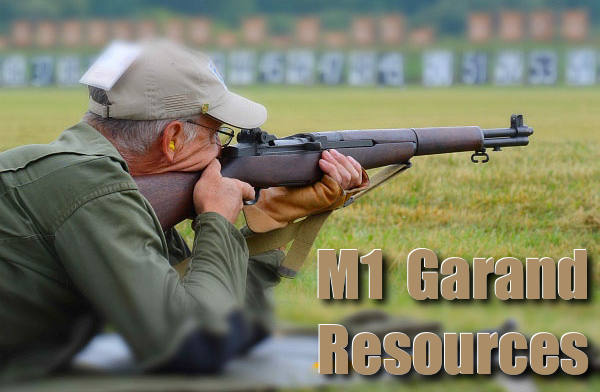
Today, .30-06 M1 Garands and classic military rifles will fill the firing lines at Camp Perry. The National John C. Garand, Springfield, Vintage and Modern Military Match (GSMM) concludes today, Sunday, August 4, 2024. (See CMP Camp Perry 2024 Calendar.) Some participants will shoot just one rifle type, but there is also a combined GSMM 4-Gun Aggregate. This GSSM Agg encompasses a series of position shooting matches on NRA SR targets at the CMP Nationals. Match scores will be posted on the CMP National Matches Results Page.
This video shows the Garand Match at Camp Perry. The rifles are still the same a decade later…
The annual GSMM event is one of the most popular events at Camp Perry, drawing participants from around the nation. One of America’s top GSSM shooters is Brian Williams, who was profiled in our Daily Bulletin. The 4-gun Aggregate includes Garand, 1903 Springfield/1917 Enfield (or similar bolt rifle), M1 Carbine, and AR-type rifle for “Modern Military”. Remarkably, Brian won the GSMM 4-Gun at the CMP National Matches in Camp Perry three years in a row — the inaugural 2017 4-Gun Agg, plus 2018 and 2019. Below, Brian offers some thoughts on the classic wood-stocked rifles used in GSMM competition: M1 Garand, 1903 Springfield, and M1 Carbine.
M1 Garand Service and Maintenance
Shooting Sports USA (SSUSA) published an excellent article on Service and Maintenance of M1 Garand Rifles. This offers some smart tricks, such as using smoke from burning masking tape to darken the front sight post. There is also an older SSUSA article that covers basic cleaning and servicing and also explains how to upgrade the performance of your Garands. READ Article HERE.
M1 Garand Disassembly, Cleaning, and Lubrication
This Brownells video shows how to disassemble your M1 Garand.
This TekMat video explains how to clean and lubricate your M1 Garand.
Recommended M1 Garand Service Manuals
Among the many M1 Garand manuals available, we recommend the CMP’s U.S. Rifle, Caliber .30, M1: ‘Read This First’ Manual. This booklet covers take-down, reassembly, cleaning, lubrication, and operation. The manual comes with CMP rifles or can be purchased for $3.25 from the CMP eStore. The author of Garand Tips & Tricks says: “It’s one of the best firearms manuals I’ve seen and I highly recommend it.”
The Classic Wood Guns of CMP 4-Gun Competition
Perspectives on M1 Garand, M1903A3, M1917, and M1 Carbine
CMP 4-Gun ace Brian Williams provides perspectives on the “Wood Gun” game, with suggestions on how to improve your performance with the M1 Garand, M1903 Springfield, M1917 Enfield, M1 Carbine, and other 20th Century military rifles. Brian explains what to look for…
Q: What should one look for when acquiring older rifles for CMP 4-Gun Games — M1 Garand, M1903/1903A3, M1917, M1 Carbine? What are realistic budgets for these firearms? What kind of accuracy can one expect? What upgrades are important?
Brian: All of these military surplus rifles are out there, but they are getting harder to get your hands on. And, just like everything else, the prices continue to rise. Not that long ago you could get your hands on a M1 Garand for four or five hundred dollars. In today’s market they are usually about double that price. But understand that these rifles are all unique and all have a story to tell. No two are alike, or have the same story. Just like the guns themselves, there are fewer and fewer dedicated gunsmiths for these vintage rifles. But I promise if you look for a good smith, they are out there and they are some of the most interesting people you will ever meet.
M1 Garand — Of the four (4) centerfire guns I shoot in the CMP games, my favorite has to be the M1 Garand. There were over 6 million of them produced in a very short time period, and every single one has its own unique story, and that is just cool. M1 Garands are capable of good accuracy. I believe that a well-maintained M1 with at least a replacement barrel is capable of shooting between 1 and 1.5 MOA.
M1903A3 Springfield — I find that the sights on a M1903A3 are a little easier to see than the sights of the M1903, but both are very accurate rifles. Like most military rifles in the current climate the prices have risen dramatically, but there are some gems out there that can be had for far less than $1000. The nice thing about the Springfield rifle is that almost all of the accuracy than you would want can come from just replacing a worn out 80-year-old barrel. In terms of accuracy, I think a good M1903A3 can shoot 1 MOA most of the time.
M1917 Enfield — This rifle is the newest of my collection and it shoots very well, with just a new Criterion barrel — again about 1 MOA with iron sights. These rifles are very close in price to the M1903 Springfield. But if you do your homework and keep your eyes open, there are always great deals to be found. I actually prefer shooting the M1917 to my M1903A3, due primarily to the M1917’s cock-on-close bolt which allows smoother cycling.
Public domain photo from Armémuseum (The Swedish Army Museum).
M1 Carbine — By 1945 there had been more M1 Carbines built than Garands. Today the Carbine can be harder to find, and due to the scarcity the price has shot up and most military M1 Carbines are going for more than $1000 at this point. The great thing about the M1 Carbine is that as long as you have a good ammo supply this rifle can shoot. Honest. I have had countless numbers of people that tell me that there is not an M1 carbine that will shoot. I can tell you from experience that they will, but you are going to have to put in some time with one to learn how to get it to shoot where you want it.
The M1 Carbine shoots the .30 Carbine round, with 110gr bullet going about 1990 FPS. In comparison, the .30-06 Springfield round used in the M1 Garand is almost three times more powerful than the .30 Carbine.
Today is the final day of competition at the 2024 NRA National Smallbore Prone Championships at Camp Atterbury. Many of the nation’s top rimfire prone position shooters are on the firing line competition for the national title. In addition there is a division for .22 LR rimfire F-Class shooters (see bottom photo). For regular update on NRA events, check out the NRA Facebook Page. In today’s story we’ve also included the calendar for NRA Camp Atterbury events this summer.
Along with the classic rimfire prone competition with competitors using slings and shooting coats, there is a division for .22 LR rimfire F-Class shooters. These rimfire F-Class rifles resemble their centerfire cousins, with 3″ wide forearms and high-magnification riflescopes. Shooters can use font rests (such as the Mini-X) or stable, wide-base bipods, typically with ski-type feet.
2024 NRA National Matches Schedule
Smallbore Rifle Prone and F-Class (July 28 – August 1)
July 28 – Squadded practice, Metallic Sights Day One
July 29 – Metallic Sights Day Two
July 30 – Randle, Dewar, Team Matches
July 31 – Any Sights Day One
August 1 – Any Sights Day Two, Awards Ceremony
Smallbore Rifle Three-Position (August 2 – 4)
August 2 – Metallic Sights
August 3 – Drew Cup Team Match, Team Matches
August 4 – Any Sights, Awards Ceremony
High Power Rifle OTC (August 5 – 10)
August 6 – Member’s Trophy, Scott Trophy, Coast Artillery Trophy Matches
August 7 – Navy Cup, Army Cup, Coast Guard Trophy Matches
August 8 – Appreciation Cup, Marine Corps Cup, Air Force Cup Matches
August 9 – Crescent Cup, Cavalry Cup, Crowell Trophy Matches, Awards Ceremony
August 10 – EIC Leg Match
High Power Rifle Mid-Range (August 11 – 14)
August 11 – 300, 500, 600 yards, 600-yard Teams
August 12 – 3×600 yards, 600-yard Teams
August 13 – 300, 500, 600 yards, 600-yard Teams
August 14 – 3×600 yards, Awards Ceremony
High Power Rifle Long-Range (August 16 – 19)
August 16 – Wimbledon Cup, Rem Trophy, Porter Trophy, Andrus Trophy, Herrick Trophy Team Matches
August 17 – Leech Cup, Mustin Trophy, Farr Trophy, Aitken Trophy, Roumanian Team Trophy Matches
August 18 – Palma Individual Match, Awards Ceremony
August 19 – Palma Team Matches, Awards Ceremony
2024 NRA National Matches at Camp Atterbury Calendar
USAMU SGT Alison Weisz was the overall winner in both 3-position smallbore and 60-shot air rifle at the 2024 National Matches.
Weisz Wins in CMP’s National 3-Position Smallbore and Air Rifle Championships
U.S. Army Marksmanship Unit (USAMU) shooter SGT Alison Weisz, 29, shot great at the 2024 National Smallbore and Air Rifle Championships at the CMP National Matches. SGT Weisz posted overall wins in both the 3-position smallbore and 60-shot air rifle competitions. Weisz has already had a busy year, competing in the Olympic Trials and securing a place as an alternate on the USA women’s Olympic air rifle team.
The National Smallbore and Air Rifle Championships were held July 11-20, facilitated by the Civilian Marksmanship Program (CMP). The event, shot with electronic targets for the second year, featured three-position and prone smallbore matches along with 60-shot air rifle and air pistol competitions. Events included two days of qualifying matches as well as a culminating elimination final to determine overall winners.
The smallbore match started off smoothly for Weisz, with little wind. Conditions on Day 2 of competition proved to be more of a challenge. “There was a lot more wind, and I struggled with that a little bit more,” Weisz confessed. But Weisz finished well to win the smallbore event.
The quick turnaround on the match schedule left Alison little time to celebrate before heading over to the CMP Gary Anderson indoor air gun range to compete in the air rifle final. “We had the smallbore final right before it, and my positions are a little bit different, so I was kind of intrigued”, she said. “I approached it with curiosity, wondering how it would work to have only five minutes of sighters to settle in and find the air gun position and see what happens from there.” She shot well, leading through most of the air rifle match, and made it a double-victory day.
The 60-Shot Air Rifle Match was held within the Gary Anderson CMP Competition Center.
The combination of air rifle and smallbore matches running simultaneously suited an array of athletes searching for more international-style or collegiate competition, which typically feature both types of rifles. The National Three-Position Smallbore and Air Rifle Championships also included three-person team elimination matches. An aggregate award based on qualification scores from the three-position smallbore and air rifle competitions was also presented at the conclusion of both events, with Peter Fiori, 24, earning the overall title by a margin of four points.
Do you have an Eliseo Tubegun that you use for sling-shooting competitions, but would like to try your hand at F-Class Open matches? Well here is a low-cost, yet very effective add-on that can transform your TubeGun into a serious F-Open rifle. The bolt-on rails also work great for load development if you want to use a front rest with 3″-wide front bag for greater stability and repeatability.
Competition Machine’s Gary Eliseo is a very smart designer as well as a talented shooter. The inventor/builder of the popular Competition Machine Tubegun chassis systems, Gary offers a bolt-on bag-rider accessory. Gary call this his PickleFork fore-end extension. The Pickleforks are rails that fit to the sides of the tubular fore-end/handguard on his chassis systems. This allows you to use a pedestal-style front rest for F-Class competition.
Pickleforks also provide a much more stable platform for load testing, varmint hunting, or any kind of rest-assisted precision shooting. These PickleForks transform a Tubegun into an ultra-stable, straight-tracking rig when used with a competition-style front rest.
Gary explains: “Now you can have the same super low-boreline, long ‘wheelbase’ and vertical sides of our innovative F1 F-Class chassis system for your tube chassis. The new PickleForks attach directly to the sides of the F-Class/Tactical fore-ends, no modifications are required. They are very rigid with no flex or twist and make the rifle track like it’s on rails.” The new Eliseo Competition Machine PickleForks are offered for a very reasonable $70.00 per pair, with Cerakote finish. (You get two metal units, one for each side of the fore-arm). For more information, visit www.GotXRing.com or call (928) 649-0742.
Product Tip from EdLongrange. We welcome reader submissions.
Want to learn the basics of position shooting? Then you should check out an article by Gary Anderson, DCM Emeritus, in On the Mark digital magazine (Summer 2014, pp. 6-13). This article covers all the key elements: body position (prone, sitting, standing), sling use/adjustment, sight picture, aiming process, and trigger control. While this 8-page article was specifically written for Rimfire Sporter shooters, the techniques described by Anderson apply to all types of position shooting, whether you shoot air rifles, smallbore rifles, or centerfire rifles.
Here’s what Anderson says about aiming — how to keep your sights steady and get them centered on the middle of the target:
Trigger Contact and Center As soon as aiming at the target begins, the index finger must move from the trigger-guard to contact the trigger. It is important to get initial pressure on the trigger as soon as aiming begins. Then the shooter must focus on the sight picture and centering the sight picture movements over the aiming point. No one, not even champion shooters, can hold the aligned sights perfectly still. The sights are going to move a little bit or a lot, depending on the shooter’s skill level. The secret is to center those sight picture movements over the aiming point on the target (see trace illustration) before pulling the trigger.
When the sight picture movements on the target are centered, the last step in firing the shot is to add… smooth pressure on the trigger until the shot breaks.
Anderson also discusses the 5 Basics of Shot Technique:
BONUS: Olympic Gold Medalist Jamie Gray
Here’s an interesting video about three-position shooting. Produced by GOnra Media, this video demonstrates rifle hold and body alignment for prone, standing, sitting, and kneeling positions. Olympic Gold Medalist Jamie Gray demonstrates the proper stance and position of arms and legs for each of the positions. Ideally, in all of the shooting positions, the shooter takes advantage of skeletal support. The shooter should align the bones of his/her arms and legs to provide a solid foundation. A shooter’s legs and arms form vertical planes helping the body remain stable in the shooting position.
Think you can shoot fast with a bolt gun? Bet you can’t beat these Norwegian speed-demons. In 2019, Inge Hvitås set a Mad Minute World Record, putting 39 rounds inside a 16″ circle at 200 meters, all in a single minute. At the same match, another Norwegian ace fired 48 rounds in a minute, with 38 in the bullseye. Now that’s spectacular speed and accuracy. We first ran this story in 2019 when the record was set. Wikipedia reports this is still the current record. So we believe no one has ever put more rounds on a 16″ target at 200m (with a bolt-action rifle) than Inge Hvitås. We include videos showing Inge’s amazing sequence.
Watch Inge Hvitås Set New Mad Minute World Record:
NOTE: This video, hosted by Facebook, may be slow to load. But be patient — it’s amazing to watch! CLICK HERE to run this story all by itself, speeding up the video load.
Mad Minute World Record — 39 Hits in One Minute (60 seconds)
At the Haga shooting range in Norway, spectators witnessed spectacular speed shooting in 2019. Norwegian shooter Inge Hvitås set a Mad Minute Challenge World Record with 39 hits in ONE MINUTE at 200m. The target was a 40cm (15.75″) bullseye placed at 200m (218 yards). Fellow Norwegian Jesper Nilsstua also shot brilliantly, sending 48 rounds down-range in one minute. Jesper had 38 hits, missing the record by just one. Both shooters were using iron-sighted Sauer 200 STR target rifles, which are normally chambered for the 6.5×55 cartridge. For this event, magazines are limited to 5 rounds and shooters may use slings but no bipods or other support.
Amazing Bolt-Gun Cycling Speed — 48 Rounds in One Minute
Another Norwegian ace, Jesper Nilsstua, missed the Mad Minute Challenge record (by one hit), but boy was he fast. Dennis Santiago (who has done his own Mad Minute drill), was dazzled: “This dude didn’t get the new world’s record of 39 hits in 60 seconds. He ‘only’ got 38 hits after getting off an amazing 48 shots in 60 seconds. Watch the smoothness of his shooting. It’s amazing.”
NOTE to Readers: This video is hosted by Facebook. It may be slow to load. But it is worth watching.
For the Mad Minute Challenge in Norway, a standard 200m DFS target was used, with 1 point per hit within the black area which is 40cm (15.75″, or 6.9 MOA) in diameter.
Norwegian Mad Minute Challenge — Event Rules
The organizers of the event posted: “The Mad Minute Challenge [is] a modern edition of a old military drill. This is a place for sport shooters to … share experiences on the subject of speed shooting with bolt-action rifles. The Mad Minute Challenge is all about the sport! To make a attempt for the record everyone must follow these five simple rules:”
Rapid-Fire Shooting Comparison Video
To illustrate the remarkable speed of Norwegian champion Inge Hvitås, this video shows Inge (top of frame) compared with other skilled competitors shooting the same 1-minute course of fire in Lesja, Norway.
About the Original MAD MINUTE
“Mad Minute” was a pre-World War I term used by British Army riflemen during training at the Hythe School of Musketry to describe scoring a minimum of 15 hits on a target at 300 yards within one minute using a bolt-action rifle (usually a Lee-Enfield or Lee-Metford rifle). It was not uncommon during the First World War for riflemen to greatly exceed this score. The record, set in 1914 by Sergeant Instructor Alfred Snoxall, was 38 hits.
Listed as “Practice number 22, Rapid Fire” of The Musketry Regulations, Part I, 1909, this drill required at least 15 shots on the Second Class target at 300 yards. The exercise was just one of several annual tests to classify a soldier as a sharpshooter, first or second class shooter depending on the points achieved.
Research indicates the Second Class target was a 48″ x 48″ square with 24″ inner circle and 36″ outer circle. The sight mark was a central 12″ x 12″ shape representing a soldier. ALL hits scored points (3 for center circle, 2 for outer circle, 1 for outer square). NOTE: Though some sources say the Mad Minute drill used a 12″-diameter round target, this appears to be a mistake from Ian Hogg’s book “The Encyclopedia of Weaponry”. No other source mentions a 12″ circle, which would be a mere 3.82 MOA. In reality the true drill target was a 48″ x 48″ square, roughly 15 times larger. (From No.WikiPedia.)
Team SIG Sauer pro shooter Lena Miculek had a great performance at the 2024 USPSA Multi-Gun Nationals held July 19-21 in Minnesota. While defending her Ladies Division title, Lena posted a record-breaking, highest-ever finish by a female in National Multi-Gun competition. She shot a red dot SIG pistol this year with a SIG M400 prototype semi-auto rifle. Watch Lena shooting rifle, pistol, and shotgun at the USPSA Nationals in the video below right.
On her Facebook Page Lena stated: “This was one of the most challenging and technical Multi-Gun Nationals yet! This year, I switched to a new division called Modified. Compared to years past, I now got to run a red dot on my pistol. My shotgun started loaded with 13 shells instead of just 9, AND bipods were legal for rifle. I was nervous about the switch but quickly realized it was the best choice[.] My two months of shooting boot camp earned me my highest Nationals placement ever. Hard work and dedication always pays off. Big thanks to everyone that worked the match and made it possible. Definitely a wonderful experience and competition I am thankful to have attended!”
“Lena crushed Multi-Gun Nationals, there’s just no other way to say it”, said Robby Johnson, SIG Sauer’s Chief Marketing Officer. “She is a force to be reckoned with, not just in the female divisions, but amongst all competitors. To achieve this level of success, it is a life commitment. Lena lives this day in and day out and all her glory is the result of preparation, training, and the absolute hardest work[.]”
At the 2024 USPSA Multi-Gun National Championship, Miculek defended her High Lady title through eight field courses and four speed shoots using a SIG M400 rifle with ROSE features and a TANGO6T riflescope, a P320-DH3 pistol with ROSE features, and a ROMEO1 Pro optic. She used SIG Sauer Match Elite competition ammunition. NOTE: The M400 prototype ROSE rifle Miculek used at the 2024 Multi-Gun Nationals is currently in development and is a variant of the SIG SAUER M400 series.
The 2024 USPSA Multi-Gun Championship was held at the Forest Lake Sportsmen’s Club in Minnesota, July 19-21, 2024. Next month, Lena Miculek will compete at the International Practical Shooting Competition (IPSC) Rifle World Shoot beginning August 4, 2024 at Ruutikangas Shooting Center in Liminka, Finland.
The 2024 NRA National Matches at Camp Atterbury commenced Monday, July 22, with the First Shot Ceremony and the start of the NRA National Precision Pistol Championships. Now in its fourth year at Camp Atterbury, the 2024 NRA National Matches will continue until the close of the NRA High Power Long-Range National Championships on Monday, August 19. Camp Atterbury is a National Guard training facility in Indiana located about 37 miles south of Indianapolis.
2023 NRA National Matches First Shot. (Photo by Cole McCulloch).
During the opening ceremony at Camp Atterbury, Indiana Congressman Greg Pence gave the keynote address. NRA Board Member and Indiana State Representative Craig Haggard (shown above) also spoke and then fired the ceremonial First Shot to commence the event.
Greg Pence is the U.S. representative for Indiana’s sixth congressional district and lives in Columbus, Indiana, located about 14 miles from Camp Atterbury. “Camp Atterbury is in my district,” Pence said. “[As a representative in Congress], I plan to maintain the support and advocacy for the Second Amendment, as well as for the NRA.”
Precision Pistol shooters on the firing line at Camp Atterbury during the practice session for the 2024 NRA Precision Pistol Nationals on the first day of the 2024 NRA National Matches. (Photo by Cole McCulloch)
NRA National Matches at Camp Atterbury, Indiana
The NRA first moved its National High Power Rifle Championships to Camp Atterbury in 2017, with the National Precision Pistol Championships and National Smallbore Rifle Championships making their home at the National Guard base two years later. Now the NRA National matches represent one of the two biggest summer shooting events of the year, along with along with the CMP National Matches at Camp Perry. For more information, click the links below.
The 2024 NRA National Matches at Camp Atterbury — including the Precision Pistol, Smallbore Rifle, and High Power Rifle National Championships — begin Monday, July 22, and conclude Monday, August 19. The 2024 NRA National Matches at Camp Atterbury will begin with the Precision Pistol Nationals, followed by the Smallbore Rifle Nationals, and then the High Power Rifle Nationals.
2024 NRA National Matches Schedule
Precision Pistol (July 22 – 25)
July 22 – Opening Ceremony, Practice, Prelim Match, Harry Reeves Match
July 23 – .22 Championship, .22 EIC
July 24 – Centerfire Championship, Service Pistol EIC
July 25 – .45 Championship, Distinguished Revolver, Awards Ceremony
Smallbore Rifle Prone and F-Class (July 28 – August 1)
July 28 – Squadded practice, Metallic Sights Day One
July 29 – Metallic Sights Day Two
July 30 – Randle, Dewar, Team Matches
July 31 – Any Sights Day One
August 1 – Any Sights Day Two, Awards Ceremony
Smallbore Rifle Three-Position (August 2 – 4)
August 2 – Metallic Sights
August 3 – Drew Cup Team Match, Team Matches
August 4 – Any Sights, Awards Ceremony
High Power Rifle OTC (August 5 – 10)
August 6 – Member’s Trophy, Scott Trophy, Coast Artillery Trophy Matches
August 7 – Navy Cup, Army Cup, Coast Guard Trophy Matches
August 8 – Appreciation Cup, Marine Corps Cup, Air Force Cup Matches
August 9 – Crescent Cup, Cavalry Cup, Crowell Trophy Matches, Awards Ceremony
August 10 – EIC Leg Match
High Power Rifle Mid-Range (August 11 – 14)
August 11 – 300, 500, 600 yards, 600-yard Teams
August 12 – 3×600 yards, 600-yard Teams
August 13 – 300, 500, 600 yards, 600-yard Teams
August 14 – 3×600 yards, Awards Ceremony
High Power Rifle Long-Range (August 16 – 19)
August 16 – Wimbledon Cup, Rem Trophy, Porter Trophy, Andrus Trophy, Herrick Trophy Team Matches
August 17 – Leech Cup, Mustin Trophy, Farr Trophy, Aitken Trophy, Roumanian Team Trophy Matches
August 18 – Palma Individual Match, Awards Ceremony
August 19 – Palma Team Matches, Awards Ceremony
2024 NRA National Matches at Camp Atterbury Calendar
View the full program for this year’s National Precision Pistol, High Power Rifle, and Smallbore Rifle championships at Camp Atterbury via the NRA National Matches website. There are links to the 2024 NRA National Matches calendar and downloadable Match Program (PDF). You can also keep track of all the competitive shooting action at Camp Atterbury by subscribing to the Shooting Sports USA Newsletter.


 August is National Shooting Sports Month. And one of the nation’s best shooting centers, the Ben Avery Shooting Facility, invites shooters to visit. Ben Avery has excellent rifle, pistol, and shotgun ranges.




 Today, .30-06 M1 Garands and classic military rifles will fill the firing lines at Camp Perry. The National John C. Garand, Springfield, Vintage and Modern Military Match (GSMM) concludes today, Sunday, August 4, 2024. (See



 The smallbore match started off smoothly for Weisz, with little wind. Conditions on Day 2 of competition proved to be more of a challenge. “There was a lot more wind, and I struggled with that a little bit more,” Weisz confessed. But Weisz finished well to win the smallbore event.


 As soon as aiming at the target begins, the index finger must move from the trigger-guard to contact the trigger. It is important to get initial pressure on the trigger as soon as aiming begins. Then the shooter must focus on the sight picture and centering the sight picture movements over the aiming point. No one, not even champion shooters, can hold the aligned sights perfectly still. The sights are going to move a little bit or a lot, depending on the shooter’s skill level. The secret is to center those sight picture movements over the aiming point on the target (see trace illustration) before pulling the trigger.


 Research indicates the Second Class target was a 48″ x 48″ square with 24″ inner circle and 36″ outer circle. The sight mark was a central 12″ x 12″ shape representing a soldier. ALL hits scored points (3 for center circle, 2 for outer circle, 1 for outer square). NOTE: Though some sources say the Mad Minute drill used a 12″-diameter round target, this appears to be a mistake from Ian Hogg’s book “The Encyclopedia of Weaponry”. No other source mentions a 12″ circle, which would be a mere 3.82 MOA. In reality the true drill target was a 48″ x 48″ square, roughly 15 times larger. (From


