|
|
February 23rd, 2008

The current issue of The First Shot, the CMP’s online magazine, features a well-written article on Prone Shooting Technique by SPC Matthew Sigrist of the U.S. Army Marksmanship Unit (USAMU). The article covers all the major points of gun hold and body position: hand position, elbow position, stock weld, buttstock placement, and sling position/tension.

SPC Sigrist breaks down the prone position into “fundamentals” and explains how you put each element together to create a stable body position: “The fundamentals are the building blocks of a position. Much like the framework of a house, a correct application of the fundamentals ensures a solid and stable structure. Since each person’s position will depend on their particular body build and shape, there is no ‘perfect position’ that applies to everyone. Experience, practice and knowledge of the correct fundamentals will dictate the best position for you.”
SPC Sigrist also demonstrates the two basic variations of the leg position when shooting prone: open/spread legged, and bent-legged.
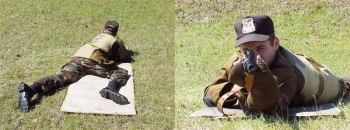

For any service rifle, highpower, cross-course, or prone shooter, this helpful article can improve your performance in the prone position.
February 21st, 2008
“March Madness” returns to the Sacramento Valley Shooting Center, in Sloughhouse, CA, next month according to match director Ed Eckhoff. Sac Valley will host three major, long-range matches in three successive weekends. The Shooting Center is located approximately 15 miles Southeast of the city of Sacramento.
On March 4-9, the 17th Annual American-Canadian Long Range Rifle Matches take place at Sacramento. The course of fire is 300 yards (MR-63 target), 500 yards (new 500-yard Target), 600 yards (MR-1 target), and 800/900/1000 yards. This match is primarily for Palma shooters (.308 Win, 155gr bullet), but F-Class competitors are welcome (there will be a F-Target Rifle and F-Open class, provided there are at least four of each). Both team and individual matches will be held. CLICK HERE for firing schedule and general Match INFO. The NRA Long Range Classification system will be used in all matches. Canadian (or other visitors) will compete in the higher of classifications earned at National or Provincial meets. Canadian Masters in the upper half of the Master Class will compete in the High Master Class.

March 12-16, 2008, the Steve Zinsmaster Memorial Highpower Rifle Long Range Regional Championship will be held at Sacramento, under the direction of the Folsom Shooting Club. Wednesday is a squadded practice day, followed by the Folsom Club Match (Palma course of fire) on Thursday. Friday is a 4-man Team Match (Palma Course of Fire). Saturdy and Sunday comprise the two-day Regional Championship with Palma match and 1K match on Saturday and a Palma-format match on Sunday. CLICK HERE for more information and rules.
The following week, from March 19 through 23, the 2008 Folsom 1000-Yard Championship will be held on the Sac Valley Shooting Center 1000-yard Range. This is a 1K prone match open to both iron sights Palma Rifles and “any sights” rifles. F-Class competitors are welcome also. Thursday is a Folsom Club Match, Friday is the 4-man Team Match and the individual championship runs on Saturday and Sunday.

If that’s not enough for you long-range competitors, Following “March Madness”, in April, the Sac Valley Shooting Center will host the NBRSA 600-Yard National Championship. Dates for this 600-yard registered BR match are April 25-27, 2008.
February 17th, 2008
Many of the top short-range benchrest shooters in the country will trek to Phoenix, AZ to compete in the Cactus Classic on March 1-2, 2008. Hosted at the Ben Avery Shooting Facility, the event will draw nearly 150 shooters. Event organizer Gary Ocock notes: “The Cactus is the largest 2-day, short-range Benchrest match of the year, and always draws top competitors from around the country. This is one of the most important events west of the Rockies and kicks off the season for many shooters.”
The Cactus is limited to two classes, 10.5-lb Light Varmint and 13.5-lb Heavy Varmint. Participants will shoot at 100 yards on Saturday and at 200 yards on Sunday. Ocock explains: “Bench rotation will be 30 benches to the right after the 100-yard stage. We anticipate three (3) relays. We will squad three shooters per bench.” The full 2-day Match Fee is $90, while the 1-day fee is $50. The Ben Avery Range will be open for practice February 26-29 (Tuesday through Friday). Camping is available at the Ben Avery facility for $10/day.
CLICK HERE for 2008 Cactus Classic Registration Form
CLICK HERE for Ben Avery Shooting Facility Map

February 11th, 2008
Air rifles are ideal trainers for young shooters. They can be used indoors (with appropriate pellet traps). And, because they are not firearms as defined by state and federal law, there is no problem (in most jurisdictions) with the use of air rifles by teen shooters. Junior Air Rifles can be purchased through the Civilian Marksmanship Program (CMP).

High School Air Rifle Competition on TV
This week, the ShootingUSA television show features Air Rifle Competition at the high school level. ShootingUSA reports the shooting sports are expanding in high schools across the country: “Air rifle competition is a growing sport in high schools. The proof is the largest invitational high school team match in the country.” The tournament hosted by Mongomery Bell Academy in Nashville, TN draws over 400 competitors from 72 high schools in 16 heartland states.

The format is Olympic-style 10-meter competition. The match requires 20 shots from each of three positions — standing, kneeling and prone. 600 is a perfect score, but with the very tiny Ten-Ring, perfect scores are very unusual. There are three classes of competition. Sporter Pneumatic Class (pump rifle, no special gear); Open Sporter Class (compressed air rifle, glove allowed); and Precision Class (Shooting Suits, Shoes and Gloves allowed).
ShootingUSA runs every Wednesday on the Outdoor Channel at the following times:
Eastern Time 4:30 PM, 8:30 PM, 2:00 AM (Thursday)
Central Time 3:30 PM, 7:30 PM, 1:00 AM (Thursday)
Mountain Time 2:30 PM, 6:30 PM, Midnight
Pacific Time 1:30 PM, 5:30 PM, 11:00 PM
Camp Perry Junior Open
In related news, the Second Annual CMP Camp Perry Junior Open was held successfully on Jan. 18-19. For the second year in a row CMP’s newest three-position air rifle event, the Camp Perry Junior Open, was filled to capacity with 57 junior shooters. Travelers from as far away as Auburn, Alabama and Waukegan, Illinois made the trek to Camp Perry, Ohio, for the sanctioned precision and sporter air rifle match.

The event was held on a temporary range in Camp Perry’s Bataan Armory, which the CMP acquired from the Ohio National Guard. Next year the Camp Perry Junior Open will take place at the new CMP Camp Perry Competition Center which will house an 80-point air gun range with electronic targets. The Competition Center will open in June, 2008.
February 4th, 2008
Ace California shooter Jerry Tierney added a few more feathers to his cap this past weekend. Shooting a “spacegun” chambered in 6mmAR by Robert Whitley, Jerry, a retired computer engineer, set no less than six (6) new records in a reduced High Power course match on Saturday, February 2nd. Note, while distances are shorter, the targets are reduced proportionately in size so the course of fire remains very challenging. Half in jest, Jerry reported: “High Power is more fun than full-bore!”
Based on his recorded scores, it’s believed Jerry set all these records on Saturday: 3 Grand Senior records; 1 Senior record; 1 Civilian Record; and 1 Open Record (best regardless of age group or military/civilian status).
The 6mmAR is a wildcat based on the 6.5 Grendel case necked down to 6mm. It provides performance very similar to that of the 6mmBR Norma with a cartridge that will mag-feed in an AR style rifle. Robert Whitley has done extensive development for this round, developing optimal loads he’s posted on www.6mmAR.com. Robert also sells “space gun” accessories, and complete 6mmAR upper assemblies.
Jerry has enjoyed considerable success in other disciplines–as you can see from the photo below, Jerry did pretty well when he tried his hand at the 1000-yard Benchrest game. He won the 2005 NBRSA 1K BR championship with a dominant performance. Now the High Power crowd has to worry about Jerry as well…

February 1st, 2008
 Fifty-two competitors, many clad in historic military uniforms, shot period-correct rifles and pistols in the So. Michigan Gun Club’s 8th Annual CMP “Snow Shoot” Vintage Rifle Match. Cold, snowy weather on January 26th didn’t stop the diehard shooters from enjoying friendly competition and supporting the M1 for Vets Program, which provides M1 Garand Rifles to disabled American veterans of the Iraq and Afghanistan conflicts. Over $1000 dollars was raised for the M1 for Vets Program.
The overall match winner was Caleb Hughes. Hughes shot a 289-3X with a K-31 Swiss 7.5×55 and received the First Place Trophy, a plaque and a gold Military CMP pin. The second place winner was Phil Randall who shot a 283-6X and received the Second Place Trophy, a plaque and a gold M1903 CMP pin. Alexandra Verburg was the top female shooter of the match. Competing in her very first Snow Shoot, Verburg shot an impressive 214-1X with an M1 Carbine to win the First Place Women’s Trophy. CLICK HERE to learn more about the Michigan Snow Shoot.

January 29th, 2008
 Turning necks is widely, if not universally, done by short-range benchresters shooting 6 PPC and 22 PPC cartridges. On the other hand, many long-range shooters, using bigger cases with longer bullets, have had great success with sorted, but non-neck-turned Lapua brass. For example, Richard Schatz has set multiple world records, and won many major matches shooting his no-turn Dashers.
Turned necks still completely dominate the short-range benchrest game. But, do we have any hard evidence of how much of an advantage turned necks offer? And, is it fair to say that turning necks is less advantageous with longer, heavier bullets typically used for 600- and 1000-yard benchrest?
Lou Murdica is a very skilled benchrest shooter in California. This editor has personally seen Lou finish first in a short-range BR match competing against some of the best shooters on the West Coast. Lou does a lot of serious comparison testing of components, and he has access to an indoor tunnel. The tunnel allows Lou to eliminate (or at least minimize) wind effects when testing ammo. Over the past few months Lou has been testing turned vs. unturned necks, and he recently posted some interesting conclusions.

Lou writes: “I don’t want to say that what some people have done is wrong for them, but I have been testing for nine months, shooting three to four times a week. I have found that there IS a difference between turned brass and unturned brass. Turned brass has shot better every single time in my tests. However, I have also come to the conclusion that if you shoot with very, very light neck tension it is hard to tell the difference between turned brass or unturned brass. If you shoot with any neck tension, though, turning does make a difference and you can get flyers with unturned brass.
The benefits of neck-turning showed up more in the 22 calibers than the 6mm. Moreover, I shot thick necks in the 6mm better than the 22. I found that the 22 wanted more release that the 6mm. I could get the 6mm to shoot tight necks easier than the 22.
For what it’s worth, I think that everyone should at least clean up their brass with a turner. All these years people have tried to find short cuts in shooting benchrest and every time we always come back to the same steps and care in making brass as before. I think it’s a given that if you want to compete at the top you cannot take short cuts. You may get by once or twice, but in the long run it will hurt you.
Since 1991 when I was on the winning team at the 1st World Shoot in France, I started to experiment and shoot every weird thing I could find or build. I tried more crap, bought and built more guns and while doing this I tried to shoot every shoot I could across the country. I took Tony Boyer’s class three years back, and the first thing he told me was pick a couple of guns out of all of them and shoot 6 PPC and nothing else for the next couple years. He told me to spend my money on barrels for those guns. Well, I did as he suggested and boy, it made a difference in my shooting.
What I’m trying to say to all the guys that have been shooting benchrest for a while and are starting to travel to the bigger matches is, stick with proven goods that have dominated for years, like the 6 PPC, with turned necks. You can try the weird stuff in practice.”
Neck-Turning, Neck Tension, and Longer Bullets
–Does a Different Rule Apply?
Keep in mind that Lou is primarily talking about short-range PPC loads with short, flat-base bullets. Those who are shooting beyond 400 yards typically use longer boat-tail, high-BC bullets. These have a smaller, less pronounced pressure ring, a much longer bearing surface, and weigh two to three times as much as a 6mm PPC match bullet. The longer bullets are also propelled by slower powders, operating in a somewhat lower pressure range than is common for a competitive 6 PPC load. Notably, top 600-yard shooters like Terry Brady and Richard Schatz have found that these long bullets prefer relatively light neck tension, meaning the neck is sized to just .001-.002 under a loaded round.
 This takes us back to one of Lou Murdica’s observations. Lou said: “I have also come to the conclusion that if you shoot with very, very light neck tension it is hard to tell the difference between turned brass or unturned brass.” Though Lou was mostly working with the lighter bullets, perhaps his observations explain why unturned brass has worked surprisingly well with the heavier bullets with long bearing surfaces. Since those long bullets typically work best with relatively light tension, maybe the benefits of turning necks are not so great, and that’s why someone like Richard Schatz can win with no-turn Dasher brass. Richard was the 2007 IBS 600-yard Shooter of the Year.
This is not to say that turned necks can’t benefit the 600-yard shooter. Murdica also shoots 600 yards, and he believes neck-turning helps long-range accuracy. Don Nielson absolutely dominated the NBRSA 600-yard Nationals using brass that was carefully neck-turned with his Pumpkin neck turning tool. Don strongly believes that his turned necks helped with accuracy and shot-to-shot consistency. So the jury is still out on the merits of neck-turning with longer bullets in bigger cases, but we applaud Lou Murdica for doing some serious research and putting in the “tunnel time” to confirm the benefits of turned necks for the short-range PPC shooters.
January 23rd, 2008
 Sgt. 1st Class Grant L. Singley, a service rifle shooter with the U.S. Army Marksmanship Unit (USAMU), has been selected as the Military Marksmanship Association (MMA) Soldier of the Year for 2007. This is the second such award for SFC Singley. He was also named MMA Soldier of the Year in 1996. In recognition of his 2007 achievement, Singley received a Smith & Wesson .45 acp pistol from retired MMA president Col. Robert I. Hoidahl.
Singley expressed gratitude to the MMA for the award and thanked his teammates and coaches from the USAMU Service Rifle Team and the gunsmiths of the USAMU Custom Firearms Shop. Singley has been with the USAMU Team for nearly two decades. After completing Basic Training and Infantry Training at Fort Benning, he was assigned to the Army Marksmanship Unit in December 1989.
In 2007, SFC Singley was a member of the Winning Interservice Championship 10-Man Team, the winning National Infantry Trophy Team, and the winning National Trophy Team. At the National Rifle Matches at Camp Perry, Ohio, in August, he was the individual winner of the Mountain Man, Forces Command, Association of the U.S. Army, 25th Infantry Division, Rattlesnake and Porter Trophies. In previous years he has won numerous major matches, including the 2000 National Trophy Individual Rifle Match, where his 497-21x score broke the existing record.

You can learn about the Military Marksmanship Association at MilitaryMarksmanship.org. Visit USAMU.com for more info on the U.S. Army Marksmanship Unit.
January 17th, 2008
Each summer the Civilian Marksmanship Program sponsors a popular series of Three-Position Air Rifle Camps to teach rifle marksmanship skills to junior shooters and their adult leaders. For 2008, these 5-day camps are offered in Fort Benning, GA; Camp Perry, OH; Rapid City, SD; and Kerrville, TX. The CMP is now accepting 2008 Camp Applications. Camps fill-up quickly, so early registration is recommended.
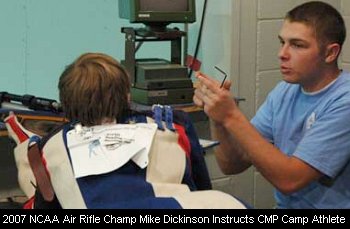
CMP Junior Three-Position Air Rifle Camps are for junior shooters with a basic knowledge of the sport. Athletes should have completed basic rifle marksmanship training and one season of three-position competition. CMP camps are designed for students who will be in grades 9 through 12 during the coming school year. The Junior Shooters must bring their own shooting equipment — either precision or sporter class rifles, prone mat, and a spotting scope (except at Fort Benning where electronic targets will be used).
The 2008 Summer Camp Fees are:
$350 (jr. athlete), $150 (adult) for Residential Camps
$225 (jr. athlete), $30 (adult) for Commuter Camps
$265 (jr. athlete) $70 (adult) for Camp Perry Camp
Dr. Dan Durben will again serve as Camp Director and chief instructor. Dan shot for the USA in the 1988 Olympics and served as the National Rifle Coach from 1997 through the 2000 Olympic Games. Dr. Durben will be assisted by Camp Coordinator, Sommer Wood, and by James Hall, who earned All-American honors in both air rifle and smallbore in collegiate competition.

CLICK HERE for CMP SUMMER CAMP INFO PAGE
January 15th, 2008
After 10 years of hosting the Int’l Defensive Pistol Assn. (IDPA) Winter Championships, Smith & Wesson will now hold the first IDPA Indoor National Championships February 21-23, 2008 (Thurs-Saturday). This year’s prestigious event will be held at the Smith & Wesson Shooting Sports Center in Springfield, Massachusetts.
The 2008 IDPA Indoor National Championships will feature over 300 competitors in five IDPA divisions. Each participant will face nine courses of fire involving low-light conditions, moving targets, and defensive shooting scenarios. Along with the match itself (a half-day of shooting for each class), competitors can participate in Smith & Wesson factory tours, training seminars with Champions such as Jerry Miculek, and shooting demonstrations.

Robert Ray, IDPA’s Marketing Manager observed: “We are very excited to be holding the first IDPA Indoor National Championships at the Smith & Wesson Shooting Sports Center, one of the most advanced training facilities in the United States.” Ray added, “The Smith & Wesson Winter Championships have grown into the second largest IDPA event in the world and we expect that momentum to extend into this year’s Indoor National Match.”
For more info on this year’s IDPA Indoor National Championships including match details and important updates, visit www.matches.smith-wesson.com.
MATCH ENTRY Form ($150.00 Entry Fee)
MATCH INFO Form (With Stage Formats)
|


