|
|
December 2nd, 2007
Over 200 rifle and pistol airgun shooters from the United States as well as Canada, Czech Republic, France, and Puerto Rico competed at the U.S. Olympic Shooting Center in Colorado Springs, CO at the 2007 USA Shooting 3XAir Match. The 3-day event served as a qualifier for the Bavarian Airgun Match, to be held in January.

Americans with Olympic experience performed well in the first two days of competition. Olympic gold medalist Matt Emmons won the Men’s Air Rifle title for the second day in a row, finishing the competition with a total score of 703.1. (On Day 1, Matt shot a perfect 600 score, tying a national record set by Matt Rawlings.) Rawlings competed in the 3XAir Rifle match as well, and finished second with 697.2. Two-time Olympian Jason Parker, a member of the U.S. Army Marksmanship Unit (USAMU), finished third with 697.0.
Jason Turner, a 2004 USA Olympian, took first place for Men’s Air Pistol with a score of 679.0. Two-time Olympian and USAMU shooter Daryl Szarenski took second with 675.3.
In other results, Katy Emmons of the Czech Republic captured first place in Women’s Air Rifle for the second day in a row after shooting a perfect score of 400, then firing a 103.3 in the finals for a total of 503.3. Emily Caruso, a 2004 USA Olympian, took second place with 500.1.

November 29th, 2007
The American Rimfire Assn. (ARA) Indoor Winter Nationals will be held this weekend, December 1st and 2nd in North Carolina. The event is hosted at the Rocky River Bench Rest Barn, located near Aquadale, NC (about 60 miles east of Charlotte). Cost is $50 for both days, or $25 for juniors.

In ARA rimfire competition, competitors shot a 25-bull target (one shot per bull) with “worst edge” scoring. Most ARA benchresters shoot in the “Unlimited” class, which has no weight or rest restrictions. You’ll typically see rifles with barrel tuners and 30-40X scopes, shot from high-tech rests. Shown below, on a Roger von Ahrens one-piece rest, is an ARA unlimited 22LR rifle belonging to Joe Friedrich . CLICK HERE to download the ARA Winter Nationals registration form.

November 19th, 2007
Visitors to this site often ask, “Just what is F-Class, and how are the matches run?” Monte Milanuk, a regular on our Forum, has provided a practical explanation that is far more illuminating than the technical definition of F-Class found in the RuleBooks.

Monte explained: “Since ‘TR’ may not mean much to you if you’ve never shot iron sights competitively, specifically in a Commonwealth country… lets try it like this. F-Class matches are all shot prone. No benches, no sitting, no standing, nothing but prone, as in laying on the ground.
The matches are shot in a manner referred to as ‘slow fire’ (as opposed to ‘rapid fire’). Basically only one round in the gun at a time. Got a 30 round magazine? Fine, but you can only load one round at a time.
The general idea is you shoot at a target on a fairly large frame, suspended in a sliding carrier, sticking up from behind a protective berm. After the shot goes thru the target, someone in the ‘pits’ pulls the target down, puts a shot spotter (plastic or cardboard disk w/ a spindle) in the hole, puts a paster over any previous shot holes, marks the value of the shot, and runs it back up.
The reason for the value marker is because at distances of 600-1000yds, it’s very difficult, even with the best of optics, to tell if a shot is on one side of a scoring line or another. The spotter disk tells you where the shot went, the value marker tells you what the actual score for that shot was.

At this point is where we run into the difference between ‘pair fire’, which is what they do in Canada, Britain, and other countries, and ‘string fire’, which is what we predominately shoot here in the U.S.A. In pair fire, you have two (or more) shooters to a firing point, alternately shooting and scoring for one another. This makes it functionally almost impossible to ‘machine gun’ a string and get off a large number of shots in one wind condition — you simply have to learn to read the wind, take your best calculated guess, and let fly. In string fire, you can shoot again as soon as the target comes back up, over and over and over. You have a ‘block’ of time, say 22 minutes for 2 sighters and 20 record shots, and you can use 3 minutes, or you can use 21 minutes 59 seconds.
At any rate, you shoot usually three or four ‘strings’ of 15-20 shots. They might all be at one distance (say, 600yds), or you may have to change yard lines between each string (800, 900, 1000yds).
The targets are fairly challenging. The X-ring is 1/2 minute across, and the 10-Ring is 1 minute across. It’s just a little over a 1/4 minute from the edge of the X ring to the 9 ring… not a lot of room for error. [Editor’s Note: There are four specific targets, for distances 300, 500, 600, and 800/900/1000 yards. Exact Target dimensions (plus distance-specific courses of fire) are found at F-ClassInfo.com.]
There are two basic classes or categories in F-Class. There is ‘Open’ class, which is fairly wide-open still. 10kg (22 lbs.) weight limit, max .35 caliber, 3″ wide fore-end, and no one-piece rests or rear mechanical rests. And then there is ‘Target Rifle’ class, aka F/TR. A slightly lower weight limit (8.25kg, roughly 18.15 lbs.), caliber restricted to .223 Rem or .308 Winchester, and you have to use either a bipod or a sling, both of which are included in the overall weight limit! The majority of shooters seem to be migrating initially to F/Open (about 75-80%), and the remainder are in F/TR. Unfortunately, this means that at a lot of smaller local matches a lone F/TR shooter will likely get lumped in w/ the F/Open shooters.
Long-range.com is probably the de-facto place to go for F-Class info, but there is a fair amount of [cross-over] in terms of accuracy, loading techniques, etc. from 600/1000yd BR. The U.S. F-Class team has a website, USFClass.com, that covers most of the basics, and there are a number of other websites with introductory articles on the sport.”
Here are Web Resources with useful info on F-Class Gear, Competition, and Rules:
F-ClassInfo.com
F-Class FAQ
F-Class Shooting Basics
F-Class Nationals Report
November 17th, 2007
 In the current edition of The First Shot (the CMP’s Online Magazine), Sgt. Walter E. Craig of the USAMU discusses physical conditioning for competitive shooters, particularly Highpower competitors. In the article, Craig advocates: 1) weight training to strengthen the Skeletal Muscle System; 2) exercises to build endurance and stamina; and 3) cardiovascular conditioning programs to allow the shooter to remain relaxed with a controlled heart beat. Sgt. Craig explains: “An individual would not enter a long distance race without first spending many hours conditioning his/her body. One should apply the same conditioning philosophy to the sport of shooting. Physical conditioning to improve shooting skills will result in better shooting performance…. The objective of an individual physical training program is to condition the muscles, heart, and lungs thereby increasing the shooter’s capability of controlling the body and rifle for sustained periods without experiencing fatigue.”
CLICK HERE to READ FULL ARTICLE
November 14th, 2007
The question is often asked “what’s the best cartridge for 1000-yard Benchrest”. This immediately stirs a debate between fans of the “Big Thirties”, 6.5mm and 7mm advocates, and a few staunch 6mm defenders. In truth, a wide variety of cartridges, from the 6mmBR all the way up to .338 Lapua magnum, can do well at 1000 yards. However, there is clear statistical evidence that magnum-class 30s are still the top dogs in the 1000-yard game.
 Steve Shelp, who shoots with the Hawks Ridge Gun Club in North Carolina, has amassed statistics from years 2000 through 2006, recording all the calibers and chamberings used in the matches of the North Carolina 1000-yard Shooters Association. The data is further sorted by Light Gun (LG) and Heavy Gun (HG) classes. Steve has even been able to filter the data to include Relay Winners and Shootoff Participants. Steve has also created tables that show the Top 30 Groups and Scores in both LG and HG classes.
Below is a table showing the Top 15 Chamberings among shootoff participants, for combined LG and HG Classes from 2000-2006. We have totaled the Big 30s in this group of 15, and the large 30 Calibers (red dots) represent 66% of the total. There are 2064 entries in this set of Top 15, and 1355 are 30 Calibers.

The next chart includes ALL LG and HG Relay Winners from years 2000-2006. Steve has sorted the data by bore diameter. The two dominant calibers among Relay Winners are: 30 Caliber (.308) at 60%, and 6.5mm (.264) at 27%. Presumably most of the 6.5mms are 6.5-284s, but there are some larger 6.5mm wildcats as well. NOTE: When you look at Light Gun Relay Winners only, the percentage of 6.5mms rises while the percentage of 30 Cals falls. Overall however, the big bore 30-Caliber rifles are still “King of the Hill” in 1000-yard competition.

Steve Shelp’s data is contained in three Microsoft Excel spreadsheets. Click the links below to download the collected 2000-2006 data.
Top 30 IBS Scores and Groups
1000yd Chambering Statistics (LG, HG, and combined)
1000yd Participants by Bore Size (Includes Relay Winners)
October 30th, 2007
Here is a photo of Bob Hoppe’s 0.579″ five-shot group shot recently in Sacramento. This is truly an impressive achievement. Bob shot the group with a 6mm Dasher (Light Gun), Varget powder, and Hornady 105-grain Amax bullets. The group isn’t officially certified as a record yet, but I spoke to Don Nielson, an NBRSA Officer, and he believes the group will eventually certify well under 0.6″. “I measured it myself,” Don said, “and Robert deserves to be proud. That’s one heck of a group, and we’re pleased it was shot in an NBRSA match.” Robert’s group represents the smallest 5-shot group ever shot in registered benchrest competition at 600 yards.
CLICK HERE FOR LARGE PHOTO


To give you a reference, the true size of the inner, white X-Ring is 1.2 inches in diameter. Note: This photo was taken at a inclined angle with a slightly wide-angle lens. That’s why the target circles are slightly distorted. For record purposes the group size is determined by measuring centerpoint to centerpoint of the most distant bullet holes.
October 29th, 2007
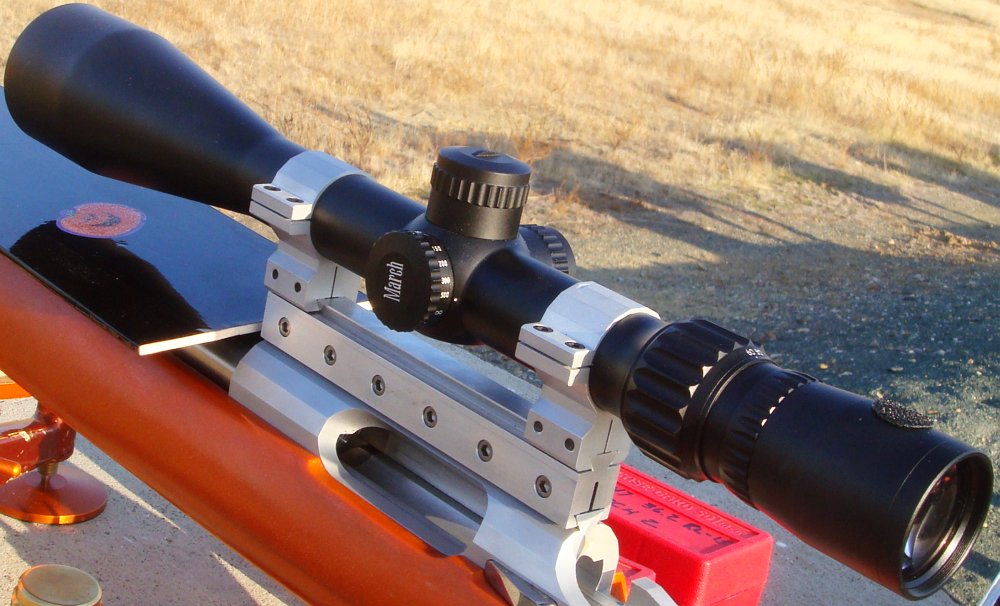
Here it is folks, the March 10-60x52mm, the most powerful premium zoom rifle-scope ever offered to the public. There are three prototypes now in the United States. One is on Don Nielson’s 6.5×47 Lapua Bench gun. He shot that rifle this weekend in Sacramento at a 600-yard match in Heavy Gun class (though the rifle is light enough to shoot in Light Class). Don’s results speak for themselves–Don finished first in HG Agg., LG Agg., HG Score (283-3X), 2-Gun Score (421-3X), and 2-Gun Aggregate (3.0xx”). The HG score, 2-Gun score, and 2-Gun Agg are all new NBRSA records for the new target with its tiny 1.2″ X-Ring.
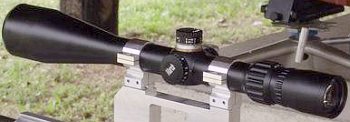
Yep, that’s a pretty good showing for a scope in its first-ever match (and yes, you have to credit Don’s great shooting as well). The March showed itself to be very reliable and repeatable. The big question we had “can it resolve 6mm bullet holes at 600 yards?” was answered with a resounding “Yes!”. Don tells us that, with the 10-60x March “he could see bullet holes very well in the white.” In the light blue section of the target, holes were harder to see but Don could still clearly see where his group was forming up.
We’re pleased to see that the zoom March offers 60 MOA of elevation–good enough for 1000 yards. The scope has a 52mm objective, 30mm main tube, 40 MOA of windage, and weighs 24.8 ounces (704 grams). It has a side-focus parallax control, 1/8-MOA clicks, and focuses from 50 yards to infinity. Currently, the only reticle choice is a 1/16-MOA dot, but that could change with production models. Apart from its anticipated $2500-$2600 price, the only negative concern we have with the new March scope is the exit pupil. Even with a generous 52mm front objective, the exit pupil is under 1mm at 60-power. That’s very small and will make head/eye position very critical when using the March at full magnification. The top photo below shows the March on Don’s trademark orange rifle.
CLICK HERE FOR LARGE PHOTO.


October 28th, 2007
Records continue to fall. Robert Hoppe of Reno, NV just smashed the NBRSA 600-yard record with a 0.579″ five-shot group at 600 yards. Don Nielson just called with the news from this weekend’s 600-yard NBRSA match at the Sacramento Valley Shooting Center.
Robert was shooting a 6mm Dasher with Varget powder and 105gr Hornady Amax bullets. His gun has a 28″ Hart Barrel, Panda Action with Jewell trigger, Dierks carbon fiber stock (photo below), and Nightforce 8-32X scope.

At the match, Don Nielson was using one of the new 10-60X52 March zoom scopes. Don has one of three prototypes now in the USA. Don reports: “The scope is outstanding. I could see bullet holes very well at 600 yards in the white. In the light blue area of the target they were harder to pick out, but still visible in good conditions.” Don promised to provide some photos of the new March 10-60 when he returns from Sacramento. Rumored price on the new scope, if it goes into production, will be $2500-$2600.
October 28th, 2007
Results for the 2007 Western CMP Games and Creedmoor Cup Matches are now availalble online at the Civilian Marksmanship Website, Odcmp.com. To navigate directly to the results page, CLICK HERE. The CMP Games ran Oct. 20-23. The Creedmoor Cup started on Oct. 24 and will conclude this sunday, the 28th.

The CMP’s “First Shot” Online Magazine features a full match report on the Western CMP Games. Author Gary Anderson writes: “Wind was a dominating factor in the 2007 Western CMP Games that took place at the Ben Avery Shooting Facility north of Phoenix, AZ on 20-23 October. The matches began with a clinic attended by over 70 new shooters on 20 October. When the 126 competitors who checked in for the first Garand, Springfield and Vintage Military Rifle Matches returned on Sunday morning, the overnight arrival of a strong high pressure system with sustained winds of 30 mph and gusts up to 60 mph forced the cancellation of the day’s matches. Two 30-shot events were fired on Monday when strong winds of 15-30 mph prevailed. Then on Tuesday, the final day of the Western Games Matches, the weather was absolutely gorgeous and the winds were dead calm.”
October 22nd, 2007
The St. Thomas Sportsman’s Club in Pennsylvannia recently held its season-ending big GroundHog shoot. 104 shooters attended the event and $2000.00 worth of prizes (and cash) was awarded. The event encompassed three stages, at 200, 300, and 400 yards, with scores totaled for the three distances. Roy Hunter posted the best score, an impressive 144.01 (out of a possible 150) to win the Custom Class. Roy shot a 30BR, demonstrating the accuracy of this cartridge on distances out to 400 yards.
Ranked below are the Top 15 shooters in the Custom and Factory Classes. Ed Harshman won the Factory Class shooting a .223 Rem. A 22/250 and a .223 Rem finished 2nd and 3rd, respectively, while two .308s rounded out the Top Five.

The two most successful chamberings in Custom Class were the 6BR and 30BR, but a couple 6.5s and 6PPCs did well also.

These results demonstrated that among factory guns, the little .223 Remington remains a great choice, with low recoil and excellent accuracy. Among customs, we’d have to say the 6BR is still the cartridge to beat, though the 30BR is definitely capable of winning it all.

|