USAMU SGT Alison Weisz was the overall winner in both 3-position smallbore and 60-shot air rifle at the 2024 National Matches.
Weisz Wins in CMP’s National 3-Position Smallbore and Air Rifle Championships
U.S. Army Marksmanship Unit (USAMU) shooter SGT Alison Weisz, 29, shot great at the 2024 National Smallbore and Air Rifle Championships at the CMP National Matches. SGT Weisz posted overall wins in both the 3-position smallbore and 60-shot air rifle competitions. Weisz has already had a busy year, competing in the Olympic Trials and securing a place as an alternate on the USA women’s Olympic air rifle team.
The National Smallbore and Air Rifle Championships were held July 11-20, facilitated by the Civilian Marksmanship Program (CMP). The event, shot with electronic targets for the second year, featured three-position and prone smallbore matches along with 60-shot air rifle and air pistol competitions. Events included two days of qualifying matches as well as a culminating elimination final to determine overall winners.
The smallbore match started off smoothly for Weisz, with little wind. Conditions on Day 2 of competition proved to be more of a challenge. “There was a lot more wind, and I struggled with that a little bit more,” Weisz confessed. But Weisz finished well to win the smallbore event.
The quick turnaround on the match schedule left Alison little time to celebrate before heading over to the CMP Gary Anderson indoor air gun range to compete in the air rifle final. “We had the smallbore final right before it, and my positions are a little bit different, so I was kind of intrigued”, she said. “I approached it with curiosity, wondering how it would work to have only five minutes of sighters to settle in and find the air gun position and see what happens from there.” She shot well, leading through most of the air rifle match, and made it a double-victory day.
The 60-Shot Air Rifle Match was held within the Gary Anderson CMP Competition Center.
The combination of air rifle and smallbore matches running simultaneously suited an array of athletes searching for more international-style or collegiate competition, which typically feature both types of rifles. The National Three-Position Smallbore and Air Rifle Championships also included three-person team elimination matches. An aggregate award based on qualification scores from the three-position smallbore and air rifle competitions was also presented at the conclusion of both events, with Peter Fiori, 24, earning the overall title by a margin of four points.
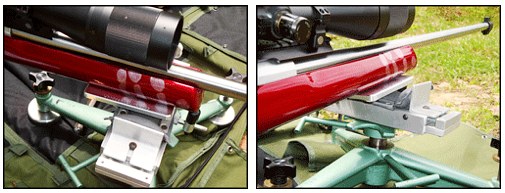
Do you have an Eliseo Tubegun that you use for sling-shooting competitions, but would like to try your hand at F-Class Open matches? Well here is a low-cost, yet very effective add-on that can transform your TubeGun into a serious F-Open rifle. The bolt-on rails also work great for load development if you want to use a front rest with 3″-wide front bag for greater stability and repeatability.
Competition Machine’s Gary Eliseo is a very smart designer as well as a talented shooter. The inventor/builder of the popular Competition Machine Tubegun chassis systems, Gary offers a bolt-on bag-rider accessory. Gary call this his PickleFork fore-end extension. The Pickleforks are rails that fit to the sides of the tubular fore-end/handguard on his chassis systems. This allows you to use a pedestal-style front rest for F-Class competition.
Pickleforks also provide a much more stable platform for load testing, varmint hunting, or any kind of rest-assisted precision shooting. These PickleForks transform a Tubegun into an ultra-stable, straight-tracking rig when used with a competition-style front rest.
Gary explains: “Now you can have the same super low-boreline, long ‘wheelbase’ and vertical sides of our innovative F1 F-Class chassis system for your tube chassis. The new PickleForks attach directly to the sides of the F-Class/Tactical fore-ends, no modifications are required. They are very rigid with no flex or twist and make the rifle track like it’s on rails.” The new Eliseo Competition Machine PickleForks are offered for a very reasonable $70.00 per pair, with Cerakote finish. (You get two metal units, one for each side of the fore-arm). For more information, visit www.GotXRing.com or call (928) 649-0742.
Product Tip from EdLongrange. We welcome reader submissions.
Want to learn the basics of position shooting? Then you should check out an article by Gary Anderson, DCM Emeritus, in On the Mark digital magazine (Summer 2014, pp. 6-13). This article covers all the key elements: body position (prone, sitting, standing), sling use/adjustment, sight picture, aiming process, and trigger control. While this 8-page article was specifically written for Rimfire Sporter shooters, the techniques described by Anderson apply to all types of position shooting, whether you shoot air rifles, smallbore rifles, or centerfire rifles.
Here’s what Anderson says about aiming — how to keep your sights steady and get them centered on the middle of the target:
Trigger Contact and Center As soon as aiming at the target begins, the index finger must move from the trigger-guard to contact the trigger. It is important to get initial pressure on the trigger as soon as aiming begins. Then the shooter must focus on the sight picture and centering the sight picture movements over the aiming point. No one, not even champion shooters, can hold the aligned sights perfectly still. The sights are going to move a little bit or a lot, depending on the shooter’s skill level. The secret is to center those sight picture movements over the aiming point on the target (see trace illustration) before pulling the trigger.
When the sight picture movements on the target are centered, the last step in firing the shot is to add… smooth pressure on the trigger until the shot breaks.
Anderson also discusses the 5 Basics of Shot Technique:
BONUS: Olympic Gold Medalist Jamie Gray
Here’s an interesting video about three-position shooting. Produced by GOnra Media, this video demonstrates rifle hold and body alignment for prone, standing, sitting, and kneeling positions. Olympic Gold Medalist Jamie Gray demonstrates the proper stance and position of arms and legs for each of the positions. Ideally, in all of the shooting positions, the shooter takes advantage of skeletal support. The shooter should align the bones of his/her arms and legs to provide a solid foundation. A shooter’s legs and arms form vertical planes helping the body remain stable in the shooting position.
Think you can shoot fast with a bolt gun? Bet you can’t beat these Norwegian speed-demons. In 2019, Inge Hvitås set a Mad Minute World Record, putting 39 rounds inside a 16″ circle at 200 meters, all in a single minute. At the same match, another Norwegian ace fired 48 rounds in a minute, with 38 in the bullseye. Now that’s spectacular speed and accuracy. We first ran this story in 2019 when the record was set. Wikipedia reports this is still the current record. So we believe no one has ever put more rounds on a 16″ target at 200m (with a bolt-action rifle) than Inge Hvitås. We include videos showing Inge’s amazing sequence.
Watch Inge Hvitås Set New Mad Minute World Record:
NOTE: This video, hosted by Facebook, may be slow to load. But be patient — it’s amazing to watch! CLICK HERE to run this story all by itself, speeding up the video load.
Mad Minute World Record — 39 Hits in One Minute (60 seconds)
At the Haga shooting range in Norway, spectators witnessed spectacular speed shooting in 2019. Norwegian shooter Inge Hvitås set a Mad Minute Challenge World Record with 39 hits in ONE MINUTE at 200m. The target was a 40cm (15.75″) bullseye placed at 200m (218 yards). Fellow Norwegian Jesper Nilsstua also shot brilliantly, sending 48 rounds down-range in one minute. Jesper had 38 hits, missing the record by just one. Both shooters were using iron-sighted Sauer 200 STR target rifles, which are normally chambered for the 6.5×55 cartridge. For this event, magazines are limited to 5 rounds and shooters may use slings but no bipods or other support.
Amazing Bolt-Gun Cycling Speed — 48 Rounds in One Minute
Another Norwegian ace, Jesper Nilsstua, missed the Mad Minute Challenge record (by one hit), but boy was he fast. Dennis Santiago (who has done his own Mad Minute drill), was dazzled: “This dude didn’t get the new world’s record of 39 hits in 60 seconds. He ‘only’ got 38 hits after getting off an amazing 48 shots in 60 seconds. Watch the smoothness of his shooting. It’s amazing.”
NOTE to Readers: This video is hosted by Facebook. It may be slow to load. But it is worth watching.
For the Mad Minute Challenge in Norway, a standard 200m DFS target was used, with 1 point per hit within the black area which is 40cm (15.75″, or 6.9 MOA) in diameter.
Norwegian Mad Minute Challenge — Event Rules
The organizers of the event posted: “The Mad Minute Challenge [is] a modern edition of a old military drill. This is a place for sport shooters to … share experiences on the subject of speed shooting with bolt-action rifles. The Mad Minute Challenge is all about the sport! To make a attempt for the record everyone must follow these five simple rules:”
Rapid-Fire Shooting Comparison Video
To illustrate the remarkable speed of Norwegian champion Inge Hvitås, this video shows Inge (top of frame) compared with other skilled competitors shooting the same 1-minute course of fire in Lesja, Norway.
About the Original MAD MINUTE
“Mad Minute” was a pre-World War I term used by British Army riflemen during training at the Hythe School of Musketry to describe scoring a minimum of 15 hits on a target at 300 yards within one minute using a bolt-action rifle (usually a Lee-Enfield or Lee-Metford rifle). It was not uncommon during the First World War for riflemen to greatly exceed this score. The record, set in 1914 by Sergeant Instructor Alfred Snoxall, was 38 hits.
Listed as “Practice number 22, Rapid Fire” of The Musketry Regulations, Part I, 1909, this drill required at least 15 shots on the Second Class target at 300 yards. The exercise was just one of several annual tests to classify a soldier as a sharpshooter, first or second class shooter depending on the points achieved.
Research indicates the Second Class target was a 48″ x 48″ square with 24″ inner circle and 36″ outer circle. The sight mark was a central 12″ x 12″ shape representing a soldier. ALL hits scored points (3 for center circle, 2 for outer circle, 1 for outer square). NOTE: Though some sources say the Mad Minute drill used a 12″-diameter round target, this appears to be a mistake from Ian Hogg’s book “The Encyclopedia of Weaponry”. No other source mentions a 12″ circle, which would be a mere 3.82 MOA. In reality the true drill target was a 48″ x 48″ square, roughly 15 times larger. (From No.WikiPedia.)
Team SIG Sauer pro shooter Lena Miculek had a great performance at the 2024 USPSA Multi-Gun Nationals held July 19-21 in Minnesota. While defending her Ladies Division title, Lena posted a record-breaking, highest-ever finish by a female in National Multi-Gun competition. She shot a red dot SIG pistol this year with a SIG M400 prototype semi-auto rifle. Watch Lena shooting rifle, pistol, and shotgun at the USPSA Nationals in the video below right.
On her Facebook Page Lena stated: “This was one of the most challenging and technical Multi-Gun Nationals yet! This year, I switched to a new division called Modified. Compared to years past, I now got to run a red dot on my pistol. My shotgun started loaded with 13 shells instead of just 9, AND bipods were legal for rifle. I was nervous about the switch but quickly realized it was the best choice[.] My two months of shooting boot camp earned me my highest Nationals placement ever. Hard work and dedication always pays off. Big thanks to everyone that worked the match and made it possible. Definitely a wonderful experience and competition I am thankful to have attended!”
“Lena crushed Multi-Gun Nationals, there’s just no other way to say it”, said Robby Johnson, SIG Sauer’s Chief Marketing Officer. “She is a force to be reckoned with, not just in the female divisions, but amongst all competitors. To achieve this level of success, it is a life commitment. Lena lives this day in and day out and all her glory is the result of preparation, training, and the absolute hardest work[.]”
At the 2024 USPSA Multi-Gun National Championship, Miculek defended her High Lady title through eight field courses and four speed shoots using a SIG M400 rifle with ROSE features and a TANGO6T riflescope, a P320-DH3 pistol with ROSE features, and a ROMEO1 Pro optic. She used SIG Sauer Match Elite competition ammunition. NOTE: The M400 prototype ROSE rifle Miculek used at the 2024 Multi-Gun Nationals is currently in development and is a variant of the SIG SAUER M400 series.
The 2024 USPSA Multi-Gun Championship was held at the Forest Lake Sportsmen’s Club in Minnesota, July 19-21, 2024. Next month, Lena Miculek will compete at the International Practical Shooting Competition (IPSC) Rifle World Shoot beginning August 4, 2024 at Ruutikangas Shooting Center in Liminka, Finland.
The 2024 NRA National Matches at Camp Atterbury commenced Monday, July 22, with the First Shot Ceremony and the start of the NRA National Precision Pistol Championships. Now in its fourth year at Camp Atterbury, the 2024 NRA National Matches will continue until the close of the NRA High Power Long-Range National Championships on Monday, August 19. Camp Atterbury is a National Guard training facility in Indiana located about 37 miles south of Indianapolis.
2023 NRA National Matches First Shot. (Photo by Cole McCulloch).
During the opening ceremony at Camp Atterbury, Indiana Congressman Greg Pence gave the keynote address. NRA Board Member and Indiana State Representative Craig Haggard (shown above) also spoke and then fired the ceremonial First Shot to commence the event.
Greg Pence is the U.S. representative for Indiana’s sixth congressional district and lives in Columbus, Indiana, located about 14 miles from Camp Atterbury. “Camp Atterbury is in my district,” Pence said. “[As a representative in Congress], I plan to maintain the support and advocacy for the Second Amendment, as well as for the NRA.”
Precision Pistol shooters on the firing line at Camp Atterbury during the practice session for the 2024 NRA Precision Pistol Nationals on the first day of the 2024 NRA National Matches. (Photo by Cole McCulloch)
NRA National Matches at Camp Atterbury, Indiana
The NRA first moved its National High Power Rifle Championships to Camp Atterbury in 2017, with the National Precision Pistol Championships and National Smallbore Rifle Championships making their home at the National Guard base two years later. Now the NRA National matches represent one of the two biggest summer shooting events of the year, along with along with the CMP National Matches at Camp Perry. For more information, click the links below.
The 2024 NRA National Matches at Camp Atterbury — including the Precision Pistol, Smallbore Rifle, and High Power Rifle National Championships — begin Monday, July 22, and conclude Monday, August 19. The 2024 NRA National Matches at Camp Atterbury will begin with the Precision Pistol Nationals, followed by the Smallbore Rifle Nationals, and then the High Power Rifle Nationals.
2024 NRA National Matches Schedule
Precision Pistol (July 22 – 25)
July 22 – Opening Ceremony, Practice, Prelim Match, Harry Reeves Match
July 23 – .22 Championship, .22 EIC
July 24 – Centerfire Championship, Service Pistol EIC
July 25 – .45 Championship, Distinguished Revolver, Awards Ceremony
Smallbore Rifle Prone and F-Class (July 28 – August 1)
July 28 – Squadded practice, Metallic Sights Day One
July 29 – Metallic Sights Day Two
July 30 – Randle, Dewar, Team Matches
July 31 – Any Sights Day One
August 1 – Any Sights Day Two, Awards Ceremony
Smallbore Rifle Three-Position (August 2 – 4)
August 2 – Metallic Sights
August 3 – Drew Cup Team Match, Team Matches
August 4 – Any Sights, Awards Ceremony
High Power Rifle OTC (August 5 – 10)
August 6 – Member’s Trophy, Scott Trophy, Coast Artillery Trophy Matches
August 7 – Navy Cup, Army Cup, Coast Guard Trophy Matches
August 8 – Appreciation Cup, Marine Corps Cup, Air Force Cup Matches
August 9 – Crescent Cup, Cavalry Cup, Crowell Trophy Matches, Awards Ceremony
August 10 – EIC Leg Match
High Power Rifle Mid-Range (August 11 – 14)
August 11 – 300, 500, 600 yards, 600-yard Teams
August 12 – 3×600 yards, 600-yard Teams
August 13 – 300, 500, 600 yards, 600-yard Teams
August 14 – 3×600 yards, Awards Ceremony
High Power Rifle Long-Range (August 16 – 19)
August 16 – Wimbledon Cup, Rem Trophy, Porter Trophy, Andrus Trophy, Herrick Trophy Team Matches
August 17 – Leech Cup, Mustin Trophy, Farr Trophy, Aitken Trophy, Roumanian Team Trophy Matches
August 18 – Palma Individual Match, Awards Ceremony
August 19 – Palma Team Matches, Awards Ceremony
2024 NRA National Matches at Camp Atterbury Calendar
View the full program for this year’s National Precision Pistol, High Power Rifle, and Smallbore Rifle championships at Camp Atterbury via the NRA National Matches website. There are links to the 2024 NRA National Matches calendar and downloadable Match Program (PDF). You can also keep track of all the competitive shooting action at Camp Atterbury by subscribing to the Shooting Sports USA Newsletter.
Slee Claims Seventh Open Sight-Class Win During 2024 National Rimfire Sporter Match
60-year-old Steven Slee from Michigan scored 580-21X to win the Open Sight O-Class for the second consecutive year at the 2024 National Rimfire Sporter Match at Camp Perry, Ohio. Slee’s 2024 victory is his Seventh O-Class title, starting back in 2009. Slee is also the current record holder in the class and has previously won O-Class at Camp Perry in 2009, 2010, 2016, 2018, 2021 and 2023. Last year, Slee also shot in T-Class and won T-Class by one point over current record holder, Samuel Payne.
The CMP’s 2024 National Rimfire Sporter Match was a big success with over 280 shooters competing on a hot July 13th day. The competition was one of the first events at the annual National Matches, which have been held at the Camp Perry National Guard Training Site since 1907. The National Rimfire Sporter Match is open to both adults and juniors with targets at 25 and 50 yards. There are three classes for .22 LR rifles: Open Sight (O), Telescope Sight (T), and Tactical Unlimited (TU).
Along with the major annual Camp Perry event, other Rimfire Sporter matches are held throughout the country in connection with the CMP’s Travel Games.
The CMP Rimfire Sporter discipline is for .22 LR smallbore (rimfire) rifles that weigh 7 1/2 pounds or less. Firing is done at 25 and 50 yards in prone, sitting, and standing positions, in slow and rapid-fire modes. Even with the vast number of competitors, the Rimfire Sport match proceeds efficiently. The CMP now has a special smart-phone App that helps speed up scoring. SEE 2024 Results.
Other leading competitors of the 2024 National Rimfire Sporter Match were John Hawes, 40, of Waynesboro, PA, who won the T-Class with a score of 594-34X, and William Dunbar, 17, of Riverside, Iowa, who was the top scorer of the TU Class with 594-35X. Dunbar was just one point shy of the current TU Class record score of 595-37X, set nearly a decade ago, in 2015.
As one of the most popular rifle events offered by the CMP throughout the year, the National Rimfire Sporter Match is a great intro to competitive marksmanship. The match format and convivial atmosphere works for shooters of all ages and all experience.
Learn more about the CMP Rimfire Sporter Rifle competition on the CMP website at thecmp.org/competitions/matches/rimfire-sporter-2. To find an upcoming Rimfire Sporter Match near you CLICK HERE then select Rimfire from the list of upcoming match types.
At the request of our Shooters’s Forum members, we’re repeating an excellent article by Steven Blair on wind reading. Steven, a top F-Class shooter, talks about mirage, topography effects, tail winds, and other subtle factors that can cause frustration for shooters. Steve explains that wind effects can be complex — there’s more going on than just velocity and angle. You need to notice things like berm locations and effects of temp changes over the course of the day.
Wind Reading Tips for Competitive Shooters by Steven Blair, Past California State Long Range F-Open Champion
Assess the Terrain and How the Wind Will Interact with It
Before you begin a match, take a few minutes to look around the range at the terrain, any obstructions, range topography (berms and backstop), and trees, buildings or structures that could affect wind flow over the range. Imagine what might happen if the wind was from the left or right, headwind or tailwind. Depending upon the direction, significant effects may be seen on range. A head or tail wind may ripple across the berms, causing elevation changes, both high and low. A tall side berm, like the east side berm at Ben Avery, may cause turbulence when the wind comes from that direction. Blocking features might shield most of the wind but a break along the range can funnel strong gusts through the gap with no other indications. Take a few notes about the effects of different wind directions and refer to them if the prevailing direction changes. (Tip courtesy Tony Robertson.)
Use a Spotting Scope, Even When Shooting a Scoped Rifle
A good spotting scope can “see” mirage much more clearly than even an expensive rifle scope. Take your spotting scope to the line and position it as sling shooters do, close enough to use without much movement. Focus the scope approximately 1/3 of the way down range or where the most significant wind effects are likely to occur. Take a quick look while waiting for pit service, glance at the flags and compare to your scope sight picture. I often see ambiguous indications at the target through the rifle scope, but see a clear indication of wind direction and speed through the spotting scope at the shorter distance. When shooting the Arizona Palma Championship at Ben Avery last weekend, I was scoring while the wind was coming from the east. Shooters up and down the line were out to the left, losing points. Mirage at the target looked moderate and the flags weren’t indicating strong wind. As I focused the spotting scope back, the mirage suddenly looked like it was flowing twice as fast around 500 yards than it was closer or farther. It wasn’t until I realized that the access road cut through the berm there that I understood what was happening. (Tip courtesy Gary Eliseo.)
Don’t Over-React to Something That May Be an Anomaly
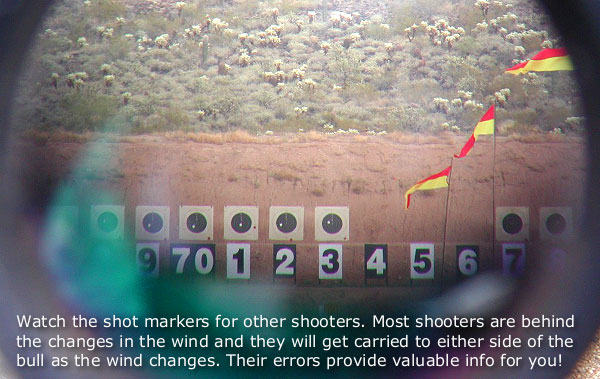
On ranges with sizable berms, a headwind or tailwind can cause significant elevation problems. It is generally not possible to see or predict when this will occur. When the conditions exist that cause elevation changes and other competitors are experiencing the same problem, the best strategy is to ignore it. Certainly, avoid shooting when the head or tail wind is gusting, the same as you would in a crosswind. But, if you react to random, range-induced elevation changes, the only likely result is to make it worse. Whether the problem is caused by range or ammunition, maintain your waterline hold until you have evidence that something has fundamentally changed.
My .284 Shehane will usually require a click or two down during a string as the barrel warms. That is normal and manageable. But, if your shots are just bouncing up and down in the 10 ring, leave it alone. The same is also true of an occasional gust pushing a shot into the 9 ring. If the conditions have not changed and one shot just went out, it may be the result of a random occurrence that was not predictable. (Tip courtesy “School of Hard Knocks”.)
Adjust Spotting Scope Focus and Magnification as Needed to View Mirage vs. Target Details
In F-Class we only need to see mirage, spotters, and scoring disks. That does not take a lot of magnification. My scope is a Nikon 25-75x82mm ED. It is a superb scope for the money and makes it trivial to see minor variations in mirage. It is good to have the high magnification available, and it can always be reduced if necessary. I use different power settings for different situations.
Setting Magnification Levels
During a match, in very good viewing conditions, I set my spotting scope at 75X, full power. The mirage is more subtle in the morning and greater magnification is needed.
During a match with heavy mirage I set my spotting scope at about 40X. I have no problem seeing mirage, even at this magnification.
When practicing at 300 yards or closer I set my spotting scope at max power (75X) so I can see the little 6mm holes from my 6BR rifle. I usually need to focus back and forth between shots to see both bullet holes and mirage.
Steven Blair, 2012 California State Long Range F-Open Champion, has been shooting since childhood and competing for over 30 years. Before retiring, Steve spent 16 years in Engineering and IT with General Atomics. He has held Engineering and Marketing positions with several firearms companies and worked on projects from pistols to 155mm howitzers.
Good news for shooters — electronic targets will be used at the CMP National Matches at Camp Perry this year. The Civilian Marksmanship Program (CMP) has announced that, for the first time, ALL the National Mid-Range and Long Range events will be fired on outdoor electronic targets! The Mid-Range and Long Range matches, scheduled for August 5-10, 2024, are part of the annual National Matches at Camp Perry, situated near Port Clinton, Ohio.
The electronic target system provides monitors at each firing point that instantly display accurate shot scores — this helps competitors quickly assess their shot placement and wind corrections. The use of the targets also eliminates the need for pit duty. That significantly lessens the duration of each match, so shooters can spend less time in the hot summer sun.
In this video, CMP Highpower Manager, Brian Williams demonstrates the accuracy of the KTS electronic targets and explains how the system works.
The Long Range series features 10 individual and team events on Camp Perry’s 1,000-yard Viale Range as well as a Mid-Range Match, fired at 600 yards. Only 50 targets will be assembled, meaning the Mid-Range Match will likely sell out — so competitors should sign up as soon as possible. CMP’s National Long Range matches include Match Rifle, Service Rifle, Palma, F-Open, F T/R or AR Tactical categories. The events are open to adult and junior competitors, regardless of experience level. CLICK HERE to learn more the National Mid-Range and Long Range Matches.
After successfully field testing the electronic target line for Long Range matches at two spring events, the CMP made the decision to utilize the technology at this year’s Nationals. Sara Rozanski, CMP’s Highpower Rifle Coordinator, reports: “Using the targets for Long Range at our Eastern Games in North Carolina in May and again at Camp Perry for a test match in June really encouraged us to make them available for competitors at the National Matches. We received a lot of positive feedback, and we hope bringing the technology to Camp Perry will … enhance the experience of the National Matches for those who attend our Long Range events.”
The CMP 2024 National Matches (for all divisions — pistol, rimfire, centerfire) run July 11 through August 10, 2024. Find registration links and other info on the CMP website at Thecmp.org/cmp-national-matches.
ARs and Narrow-Forearm Sporters Benefit from Front Bag-Rider Blocks
Whidden Gunworks offers a smart product that will enhance the bench-rested accuracy of any rifle with an accessory rail on the forearm. The Whidden Track Plate fits securely in the forearm accessory rail on prone, cross-the-course, tactical, and Palma rifles. These guns typically have a narrow and/or rounded fore-end so they rock and wobble when used with a front pedestal rest. The TrackPlate cures that. Once installed it provides a rock-solid, 2.9″-wide platform that mates perfectly with a benchrest-type front sandbag. This gives sling-shooters maximum stability when testing loads or zeroing their sights or scope. Plus you can now shoot F-Class competitively with a prone gun. (The 2.9″ width is 100% legal for F-Open).
The Track Plate is light-weight, has catamaran-style runners to aid tracking and prevent rocking, and can be easily stowed in a range bag. The Track Plate fits BOTH Anschutz and American style forends and is made in the USA of machined aluminum. The Track Plate is available from Whidden Gunworks for $58.50.
Plate designer (and 5-Time Nat’l LR Rifle Champion) John Whidden says: “The Plate is great for any rifle with a rail whether it ís smallbore, centerfire, or an air gun. Now you can try F-Class with your favorite prone rifle: the Plate has a perfect low-drag finish for riding a rest or sandbags and is competition legal.”
Bag-Riders for AR-Platform Rifles from EGW
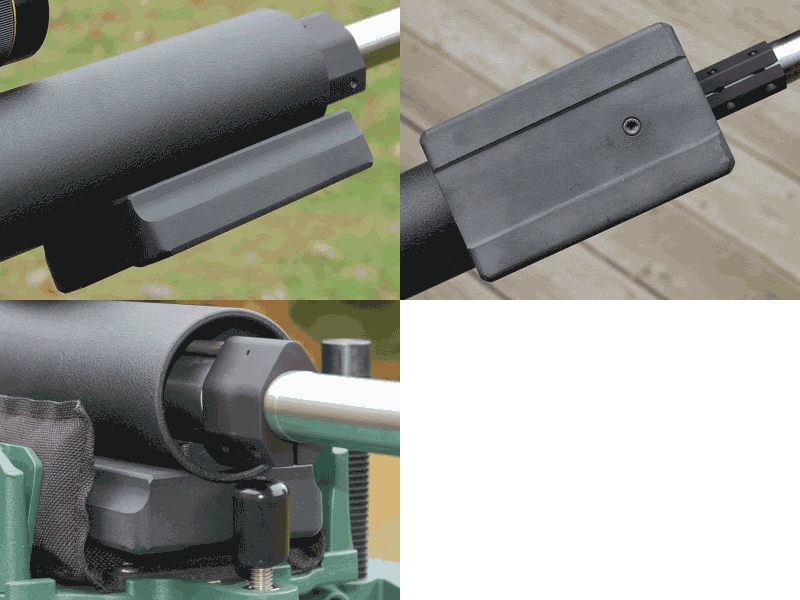
AR owners should check out the 3″-wide Delrin bag-rider from Evolution Gun Works (EGW). There are two versions, one for front Picatinny Rails, and another that mounts via sling swivel studs. These EGW Bag-Riders were developed expressly to fit the fore-ends of ARs. The front bag-riders are contoured to match the handguard profile so they fits securely with no wobble.
The $49.99 EGW Picatinny Rail front Bag-Rider simply slides on your under-forearm rail and there is a a tension bolt. Attachment is quick and easy. Or, if your AR has no rail get the original $39.99 EGW front Bag-Rider that attaches to a front sling swivel stud anchor. That allows it to mount as easily as a Harris bipod — no rail needed! Just unscrew the swivel stud, put the front bag-rider in place and attach one hex-head machine screw.
Also with the two front Bag-Riders, EGW offers a Rear Bag-Rider for ARs that attaches via the sling swivel anchor. Overall, it is a slick system. Front and rear bag-riders can be attached in a couple of minutes. The Delrin blocks slide easily in the bags and make the gun ultra-stable. The gun tracks straight back.


 The smallbore match started off smoothly for Weisz, with little wind. Conditions on Day 2 of competition proved to be more of a challenge. “There was a lot more wind, and I struggled with that a little bit more,” Weisz confessed. But Weisz finished well to win the smallbore event.


 As soon as aiming at the target begins, the index finger must move from the trigger-guard to contact the trigger. It is important to get initial pressure on the trigger as soon as aiming begins. Then the shooter must focus on the sight picture and centering the sight picture movements over the aiming point. No one, not even champion shooters, can hold the aligned sights perfectly still. The sights are going to move a little bit or a lot, depending on the shooter’s skill level. The secret is to center those sight picture movements over the aiming point on the target (see trace illustration) before pulling the trigger.


 Research indicates the Second Class target was a 48″ x 48″ square with 24″ inner circle and 36″ outer circle. The sight mark was a central 12″ x 12″ shape representing a soldier. ALL hits scored points (3 for center circle, 2 for outer circle, 1 for outer square). NOTE: Though some sources say the Mad Minute drill used a 12″-diameter round target, this appears to be a mistake from Ian Hogg’s book “The Encyclopedia of Weaponry”. No other source mentions a 12″ circle, which would be a mere 3.82 MOA. In reality the true drill target was a 48″ x 48″ square, roughly 15 times larger. (From




 Setting Magnification Levels