To understand the heart and mind of a champion, watch this video profiling Jessie Harrison. This talented lady is arguably the best female action pistol shooter in history. No other woman has amassed as many championships or set so many speed-shooting records. Over the past two decades Jessie Harrison (who has also competed with with married names Jessie Duff and Jessie Abbate) has earned dozens of major titles including twenty-two U.S. Practical Shooting Association (USPSA) Ladies Championships. Jessie won her 22nd USPSA title at the 2021 USPSA Race Gun Nationals in Alabama.
Jessie is one of the hardest-working athletes in the shooting game. Jessie is America’s “leading lady” — perhaps the winningest female pistol shooter in the game today. The drive and dedication that has made Jessie a success are revealed in this video from Weatherby.
Jessie Harrison’s Will to Win
Jessie explains how hard work brings titles: “To prepare for a championship, I’m on the range constantly.
My office is the gun range — that’s where I do my work.
I travel the country pullin’ the trigger, makin’ brass, smelling gunsmoke. I have to make sure that I’m in control because… there is no other person on the line with me, helping pull the trigger.
I have to pay attention to my foot placements, my set-ups, my positions, gettin’ the gun clean out of the holster, my reloads. I can’t think about it when I’m shooting. I can’t think about these small things. I have to focus on the sights and pulling the trigger. It’s just me and the gun.
[When] I step out on to the range, I simply have to be perfect — I have to be the best… I won’t settle for anything less.”
First-Ever Female Grand Master
Jessie Duff is the first woman in history to earn the title of USPSA Grand Master (GM), the highest rating conferred by the U.S. Practical Shooting Association (USPSA). To earn this prestigious ranking, Duff had to maintain an average above 95% in shooting classification courses, something never before achieved by a lady shooter. Jessie finished 2013 with a 95.39% average.
Photo by Forum member GAT. Chambered in 6-6.5×47 Lapua, this rifle features a Stiller TAC30 action, Krieger barrel, Harrells brake, Konohawk Stock, and Sightron SIII 6-24x50mm scope.
Ryan Cleckner has created many good shooting videos for the NSSF, such as his excellent Understanding MOA Video. Ryan is noted for his ability to explain complex topics in an easy-to-comprehend manner. This video, covering the fundamentals of shooting, has been viewed over 3 million times! It’s worth watching, particularly for guys getting started in PRS/practical competitions.
In this video, Ryan Cleckner reviews proper technique for rifle shooters. A stable platform, sight alignment, sight picture, and trigger control are key fundamentals to shooting properly. This is basic stuff, but Cleckner presents it in a clear, logical fashion. This is a good video for novice shooters.
Tip on Viewing Your Reticle:
Cleckner: “Sometimes it can be difficult to focus between the target and the reticle, even with the parallax adjusted properly. I recommend you focus only on the reticle. Just like the front sight on a rifle or a handgun, that reticle is what you can control, and it’s what matters. Focus on a crisp, clear reticle, in a stable platform, and all that’s left is trigger control.”
Tip on Trigger Control:
Cleckner: “Trigger control is pretty straightforward, as long as you think about it as a continuous process, and not just one thing that happens. I like to think about it as drawing a line in the dirt. I like to think about this constant pressure that I’m adding as I draw this line straight back, and then… continuing to draw that line even as the rifle goes off. That’s the good follow-through you’ll need.”
Long Range Shooting Handbook — A Good Resource
Cleckner has authored a book, the Long Range Shooting Handbook, which expands on the topics covered in the above video. You can view Sample Chapters from Ryan’s Book on Amazon.com.
Ryan Cleckner’s new book is designed as an intro to important fundamental concepts such as MOA vs. Mils, External Ballistics, and Environmental Effects. Included are personal tips and advice based on Cleckner’s years of experience as a sniper instructor and special operations sniper.
The Long Range Shooting Handbook is divided into three main categories: What It Is/How It Works, Fundamentals, and How to Use It. “What It Is/How It Works” covers equipment, terminology, and basic principles. “Fundamentals” covers the theory of long range shooting. “How to Use It” gives practical advice on implementing what you’ve learned, so you can progress as a skilled, long range shooter.
As a long-range shooting expert, Ryan Cleckner has impressive credentials. Cleckner was a special operations sniper (1/75 RGR) with multiple combat deployments, and he has served a U.S. Army sniper instructor. Currently he works as a firearms industry executive and attorney.
Congratulations to Team Lapua-Brux-Borden (“Team Lapua”) winning the F-Open Grand Aggregate Team Award at the 2023 F-Class Long-Range Championships with a superb score of 1593-95X. Team Lapua members are Tod Hendricks, Ted Wedell, Jeremy Smith, David Christian, and Jay Christopherson, with Bob Sebold as coach and Erik Cortina as Team Captain.
In Match 1 of the F-Open Team Championship, Team Lapua also set a new National record of 800-53X, breaking the previous record by 11 Xs (set by Team Long Shots in 2014). In the 2023 Match 1 four Team Lapua members fired 20 rounds for record at 1000 yards, not dropping a single point.
“We noticed in the forecast that the wind conditions were going to be mild, and there was a chance to set a new National record”, commented Team Captain Erik Cortina. “The previous record was an 800-42X, so we knew we all had to shoot perfect scores to claim the record. It felt great when the 80th shot came up an X! We managed to score 800-53X, beating the old record by 11 Xs.”
Additionally, team members Jay Christopherson, David Christian, and Erik Cortina finished in the top 10 of the individual F-Open LR championship. Along with its record-breaking Long Range 2023 win, Team Lapua finished 3rd place overall in the Mid-Range F-Open team championships, adding an exclamation point to Lapua’s dominating results.
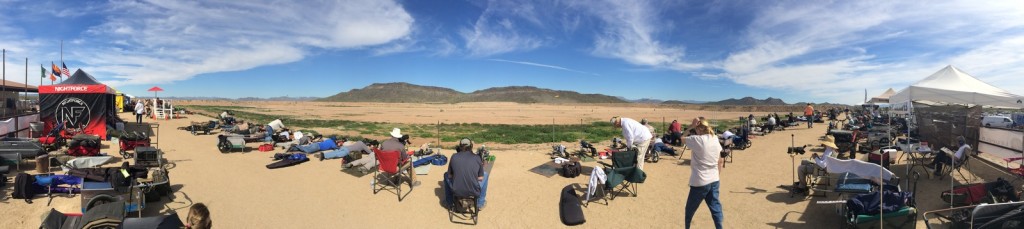
The 2023 United States F-Class Long Range National Championships were hosted by the Desert Sharpshooters and held November 1-5, 2023 at the Ben Avery Shooting Facility in Phoenix, Arizona. The Long Range National Team Championship consists of eight (8) 20-shot strings fired at 1000 yards. There are 160 shots total with a max score of 10-1X per shot.
About Lapua
For 100 years, Lapua has been producing superb small caliber cartridges and components for civilian and professional use. Lapua is a part of the Capstone Precision Group, exclusive U.S. distributor for Berger, Lapua, Vihtavuori and SK-Rimfire products. For more information, visit Lapua.com
On the heals of the USA NRA F-Class Nationals held earlier this month in Phoeniz, we’ll take a look at the gear used by F-Class competitors who shoot in F-TR and F-Open divisions. On the firing line you’ll see the latest and greatest stocks, actions, optics, bipods (for F-TR), and Front Rests (for F-Open). This article looks at the two F-Class divisions.
A while back, our friend Vince Bottomley in the UK wrote an excellent article for Target Shooter Magazine. Vince offers “solid-gold” advice for new F-TR and F-Open shooters. Vince reviews the cartridge options, and offers suggestions for a shooter’s first (and hopefully affordable) F-Class rifle. Vince also reviews various bipod choices for F-TR and discusses optics options (from $300 to $3000).
Getting Started in F-Class by Vince Bottomley
As membership secretary of a large club, one of the questions I’m frequently asked – “What’s the best way to get started in F-Class?” My club has an F-Class shoot every couple of weeks at ranges from 300 to 1000 yards and, not surprisingly, it’s very popular.
F-TR or Open Class?
From a shaky start way back in 2004, the F-TR Class is now proving as popular as Open Class and, at GBFCA League shoots and club shoots, many shooters choose to start with a 308, shooting off a bi-pod – in other words F-TR. In Open Class, the 7mm WSM soon established itself as the “must have” cartridge – if you wanted to win but, the WSM’s appetite for barrels eventually brought another 7mm cartridge into play – the 284 Winchester. This 50-year-old stalwart was revived a decade or so ago as the 6.5-284 and indeed this cartridge found some favor with F-Class pioneers – before the potency of the WSM was discovered. If you don’t mind shelling out for a couple of barrels per year (barrel life is about 750 rounds with the WSM) go for the 7mm WSM but, if you require a decent round-count, then opt for the .284 Win and learn to read the wind a bit better!
[Editor: In the last couple of years, another option has emerged — the 6.5 PRC necked up to 7mm. This wildcat 7-6.5 PRC offers a bit more velocity than a .284 Win or its “improved” cousin the .284 Shehane.]
F-Open rifles on the firing line at the Ben Avery Shooting Facility in Phoenix, Arizona.
Scopes for F-Class
If you will be shooting 1000 yards then I would recommend at least 32 power and preferably a variable – like the 8-32. The cheapest “usable” scope in this range is the Sightron. It’s a great scope for the money and at under $900 (in the USA) it’s half the price of its nearest competitor. It’s also light – at 1.5 lbs – and there are some great reticles for the F-Class shooter – like the LRMOA.
We created this custom target in 5 minutes using PrintTargets.net. If you like it, DOWNLOAD HERE.
AccurateShooter.com has a HUGE collection of FREE downloadable PDF targets. We offer a very wide range of target designs: Load Development Grids, NRA Bullseye targets, Official-Size BR targets, Realistic Varmint Targets, Silhouette Shapes, Fun Plinking Targets, and even specialized tactical training targets. If our collection of free targets isn’t enough, or if you want to create a new kind of target — you’re in luck. The Australian-based interactive website, PrintTargets.net, allows you to create your own customized, printable PDF targets. Shown below are just a few of the target designs you can create in minutes:
CLICK Graphic to Create Your Own Targets.
Just follow the step-by-step instructions to set paper size, layout, bullseye color, line thickness, number of rings and diameter. You can even add Score Numbers to your target rings. PrintTargets.net is easy and fun to use. It’s much faster to create targets this way than to try to draw a series of circles with PowerPoint or MS Paint.
Power-User Tip: PrintTargets.net even offers a handy diamond-grid calibration diagram that you can add to your custom target designs. You’ll find the calibration grid as option #15 when you design your target — just scroll all the way down the PrintTargets.com home page.
A while back our Aussie friend Stuart Elliot of BRT Shooters Supply recently filmed some interesting videos at the QTS range in Brisbane, Australia. Stuart told us: “I was shooting in an Air Gun Benchrest match here in Brisbane, Australia. I finished my target early and was awaiting the cease fire and took a short, slow-motion video of windflag behavior.” You may be surprised by the velocity changes and angle swings that occur, even over a relatively short distance (just 25 meters from bench to target).
Here are windflags in slow motion:
The flags show in the videos are Aussie Wind Flags, developed by Stuart Elliot. These are sold through the Bench Rest Tactical (BRT) Precision Shooting Products website, along with many other fine products.
Here is a video in real time:
Stuart says this video may surprise some shooters who don’t use windflags: “Many people say the wind doesn’t matter. Well it sure does — whether for an airgun at 25 meters or a long range centerfire at 1,000.” This video illustrates how much the wind can change direction and velocity even in a small area.
We congratulate Ian Klemm (F-TR, left below) and Matthew Basalla (F-Open, right below) — the 2023 NRA F-Class Long Range National Champions! The NRA F-Class championships were held at the Ben Avery Shooting Facility outside Phoenix, Arizona. The 2023 Long Range F-Class Nationals ran November 2-5, following the Mid-Range F-Class Nationals held October 29 through November 1st.
F-Open Long Range Championship
Matt Basalla (1594-101X) earned an impressive victory in F-Open, followed by Peter Johns (Second) and Norm Harrold (Third). Matt only dropped just 6 points across the three days, while Peter dropped 7 and Norm 8. Impressively Matt recorded 101 Xs during the match. Mid-Range winner John Masek told us that this was “Crazy good shooting in some tricky conditions”.
Team Lapua/Brux/Borden Wins F-Open Team Event
It went down to the wire in the F-Open Team Competition. Team Lapua/Brux/Borden finished first with 1593-95X. Team Long Shots was tied on total points with 1593 but took second on X-Count with 93X. Both those teams had shooters with superb 400-24X scores. Team Lapua also set a Nationals one-phase team record of 800-53X, breaking the previous record of 800-42X set in 2014 by the Long Shots. The top individual performance in the Team match was a 400-29X by Johnny Ingram of Team Bayou Boyz.
Conditions at the Long Range Championships
John Masek, 2023 F-Open Mid-Range Nat’l Champion, told us about the conditions during the Long Range phase of the F-Class Nationals: “Conditions for the Long Range F-Class Nationals were oddly deceiving. We started out Thursday with some mild cross winds that would switch quickly, but if you were patient you could shoot in steady conditions. It was clear that those at the top of the leaderboard had figured that out as there were quite a few shooters who dropped from zero to a just a couple points.
Friday was a pretty close repeat of the previous day and if you had figured out the previous day’s conditions you were in the top half, but there were plenty of people who struggled and dropped quite a few points. The final individual day on Sunday started in totally different conditions with a pretty decent head wind that was quickly moving the flags left to right. If you weren’t paying attention, you could easily get blown out to the left or right in the blink of an eye. The final relay was back to a crosswind with some tricky angle changes. Over the three days there was plenty of wind to help push the top shooters up, leaving no doubt that Matt Basalla was top F-Open shooter, and earned his victory.”
F-TR Long Range Championship — Ian Klemm Wins Again
In the F-TR division, Ian Klemm put in a great performance to secure his fifth National F-TR LR Championship finishing with both high score and top X-Count (1580-82X). Ian has previously won in 2021, 2020, 2018, and 2017. To secure FIVE titles in 7 years is mighty impressive. Certainly it can be argued that his FIVE F-TR Long Range Championships earn Ian the “F-TR GOAT” title (greatest of all time). Keith Trapp finished second (1578-74X) while Oleg Savelyev took third place (1575-72X).
Team Vortex Wins F-TR Team Event
As captain of Team Vortex, Ian Klemm also was part of the winning F-TR squad which scored 1588-76X. Team Vortex member Keith Trapp finished with a 400-19X, not dropping a point. He was the only F-TR shooter to have a 400 in team competition. The Bridgeville Long Range F-TR squad took second place with a 1580-61X score.
To succeed in long-range shooting matches, given the high level of competition these days, you’ll need solid wind-reading abilities. We’ve found an article by SFC Emil Praslick III, retired USAMU Service Rifle coach and U.S. Palma Team Coach, that can help you make better wind calls in competition.
Emil Praslick, now retired from the U.S. Army, is considered one of the best wind gurus in the United States, if not the world. During his service with the USAMU he authored an excellent two-part article on wind reading that is available on the CMP (Civilian Marksmanship Program) website. Both articles contain helpful illustrations, and are “must-read” resources for any long-range shooter–not just Service Rifle and Highpower competitors.
Part One covers basic principles, tactics, and strategies, with a focus on the 200-yard stages. Emil writes: “There are as many dimensions to ‘wind reading’ as there are stages to High Power competition. Your tactical mindset, or philosophy, must be different for the 200 and 300 yard rapid-fire stages than it would be for the 600 yard slow-fire. In the slow-fire stages you have the ability to adjust windage from shot to shot, utilizing the location of the previous shot as an indicator. Additionally, a change to the existing conditions can be identified and adjusted for prior to shooting the next shot.”
In Part Two, Praslick provides more detailed explanations of the key principles of wind zeros, wind reading, and the Clock System for determining wind values: “The Value of the wind is as important as its speed when deciding the proper windage to place on the rifle. A 10 MPH wind from ’12 o-clock’ has No Value, hence it will not effect the flight of the bullet. A 10 MPH wind from ‘3 o’clock’, however, would be classified as Full Value. Failure to correct for a Full Value wind will surely result in a less than desirable result.”
Praslick also explains how to identify and evaluate MIRAGE:
Determine the accuracy of the mirage. Mirage is the reflection of light through layers of air that have different temperatures than the ground. These layers are blown by the wind and can be monitored to detect wind direction and speed.
Focus your scope midway between yourself and the target, this will make mirage appear more prominent. I must emphasize the importance of experience when using mirage as a wind-reading tool. The best way to become proficient in the use of mirage is to correlate its appearance to a known condition. Using this as a baseline, changes in mirage can be equated to changes in the value of the wind. Above all, you must practice this skill!
Click HERE for more excellent instructional articles by Emil Praslick and other USAMU Coaches and shooters.
November 5th is the final day of the 2023 NRA F-Class National Championships at the Ben Avery shooting facility in Phoenix, Arizona. Along with America’s ace F-Open and F-TR shooters, there are many top foreign shooters at the Nationals, including Sebastian (“Seb”) Lambang, creator of the outstanding SEB Rests and SEB Joystick bipods. For this Fall 2023 event, Seb commissioned a handsome new, state-of-the-art F-Open rifle built by Blake Barrel and Rifle. Above is Seb’s F-Open rifle on the firing line this week at Ben Avery. For full results from the F-Class Nationals, click the link below:
Seb Lambang’s impressive new 7 FCP rig was crafted by Blake Barrel and Rifle using a 7mm, 1:8.5″-twist Blake barrel chambered in 7 FCP fitted to a Borden Accuracy BRMXD action. Mated to the Borden action is a Bix’N Andy Competition Benchrest trigger. On top is a March 10-60x56mm HM scope.
The handsome laminated wood XR stock is made by Cerus Rifleworks. The XR stock boasts a R.A.D. recoil reduction system in the rear, and a metal bag-rider system at the forward end of the stock. The rig employs an adjustable F-Class Products F-Open Barrel Tuner.
Seb Lambang is a talented shooter as well as a great craftsman. On the side of his March X scope it states: “Sebastian Lambang, QRA Queens 2022, F-Open Winner”.
Sebastian Lambang — Founder and Chief Designer of SEB Rests
When he is not competing, Seb works hard producing SEB Front Rests, SEB Neo-X Rests, SEB Mini-X tripod rests, and the class-leading SEB JoyPod-X joystick bipod, favored by F-TR shooters worldwide. Here are products at Seb’s warehouse, getting ready to be shipped out.
About the 7 FCP — New 7mm Cartridge Derived from 6.5 PRC
The 7 FCP was a cartridge designed from the ground up by F-Class Products out of Phoenix, Arizona in the fall of 2022. The developers believe it is the “ultimate cartridge” for the F-Class Open Division competition. F-Class Products notes: “We wanted a cartridge that [had] an efficient case capacity [matching] the 7mm Remington Short Action Ultra Magnum. The 7 RSAUM has proven to be the most winning cartridge in world F-Class competitions and many nationals and finale events. The problem with the RSAUM is brass availability. Remington stopped making brass for the RSAUM years ago and recently Norma has also stopped producing brass for it. The only option now is ADG. While the ADG brand of brass is good, it is quite expensive and also is only run in short runs and is hardly ever available.”
So the 7 FCP was developed from the 6.5 PRC, which has high-quality Lapua brass available. The 7 FCP was designed to shoot the 180 grain Berger Hybrid bullet at 2960 FPS out of a 30″ barrel without excessive pressure. SEE: 7 FCP Cartridge INFO FAQ Page.
7 FCP Cartridge — Wildcat Based on 6.5 PRC Necked up to 7mm
How Does the 7 FCP’s Case Capacity Compare?
F-Class Products states: “The parent case of the 7 FCP is a 6.5 PRC. The 6.5 PRC is a magnum case that has a head diameter of 0.532″ and has a overall length of 2.020″. It is the same overall length as the 7 RSAUM but with a smaller diameter body. Hence, without improving it, you will get not get the case capacity of a 7 RSAUM case, and therefore you will not get the velocities that the 7 RSAUM produces either.” F-Class Products has compared the capacity of cases commonly used in F-Open competition:
.284 Winchester = 63 grains of water capacity
.284 Shehane = 66.5 grains of water capacity
6.5 PRC = 65 grains of water capacity
7-6.5 PRC = 66.5 grains of water capacity
As you can see by the data above, the 6.5 PRC that is simply necked up to a 7mm does not provide more case capacity than the .284 Shehane. That is why the PRC has the shoulder moved forward.
What Powders Work Well in the 7mm FCP?
F-Class Products has tested many powders with the 7 FCP: “Any powders that work well in a .284 Win, a .284 variant or a 7 RSAUM and/or variant, can work well in the 7 FCP. We have tested many different powders and many show to work excellent. Here is a list of the powders we have tested that work well in our testing and in our customers’ testing:
Hodgdon H4350
Hodgdon H4831
Hodgdon H4831 SC
Alliant Reloder 16
Alliant Reloder 23
Vihtavuori N160
Vihtavuori N550
Vihtavuori N555
This is just a short list of what we believe are the core powders that will burn and work efficiently in the 7 FCP. There are plenty of other powders that also can work, yet they may be temperature sensitive and or not burn efficiently in the case.”
What Velocities Are Optimal?
F-Class products observes: “With the 180 grain Berger bullet we see accuracy from 2920-2980 FPS muzzle velocity. With the 190 grain Hornady A-Tip bullet we see accuracy from 2860-2900 FPS.”
What Twist Rates Do You Recommmend?
F-Class Products recommends a 1:8.5″-twist barrel. An 8-twist can work, yet the accuracy nodes may be narrower than the 8.5 twist. A 9-twist barrel can also work if you are shooting a 184 grain bullet or less. These twist rates are recommended for lead cored bullets. If you are planning on shooting a solid copper bullet, consult the bullet manufacture for recommended twist rates for that particular bullet.
What Is the Parent Case?
The parent case of the 7 FCP is a 6.5 PRC. The 6.5 PRC is a magnum case that has a head diameter of 0.532″ and has a overall length of 2.020″. It is the same overall length as the 7 RSAUM but with a smaller diameter body, hence without improving it, you will get not get the case capacity of a 7 RSAUM case, and therefore you will not get the velocities that the 7 RSAUM produces either.
The 2023 NRA F-Class National Championships are underway right now at the Ben Avery Range outside Phoenix, Arizona. There are two divisions: F-Open and F-TR. The F-Class Championships have two segments, Mid-Range and Long Range. The Mid-Range Championships ran from October 29 through November 1st, while the Long Range Championships commenced on November 2, and conclude on Sunday, November 5. See details of the 2023 F-Class Championships, including the course of fire, on the Desert Sharpshooters 2023 F-Class Nationals Program page.
For this Saturday Video Showcase, we feature five F-Class videos. These segments cover F-Class equipment, reloading, load testing, marksmanship, wind-reading and competition.
F-Class Competition — On the Firing Line at 2020 Nationals
This 12-minute video by F-Open ace Erik Cortina shows the action at the 2020 F-Class Nationals held at the Ben Avery Range outside Phoenix. Erik, who shoots with F-0pen Team Lapua, explains how team competition differs from the individual matches. Wind calls are made by the team’s wind coach. The shooter focuses on the trigger pulling.
Reloading for F-Class — Tools and Techniques
In this video, Erik Cortina, the 2023 SW Nationals F-Open Champion, and member of Team Lapua, provides a break down of the process he goes through to reload his match ammo for competition. Eric covers all phases of reloading: bullet sorting, case prep, priming, powder measuring, and bullet seating.
Load Development Procedures for F-Class — Seating Depth
In this video, 2023 NRA Mid-Range National Champion John Masek (aka “F-Class John”) explains how he does load development in an efficient and reliable manner. He specifically focuses on testing for optimal seating depth. With 229,000 views, this is the most-watched video on F-Class John’s popular YouTube channel. Viewers have praised this video: “This was a great video, really appreciate the explanation about how you bracketed the jump and why you chose the closest.”
F-Class Competition at Bisley Range in the UK
Every wondered what F-Class competition is like in England? There are different staging rules and different targets with “V” for a center hit vs. “X” at USA F-Class matches. This video covers the 2015 F-Class Championship held at the famed Bisley Range in England, UK. To learn more about F-Class in the UK, For more on F-Class, visit NRA.org.uk.
Wind-Reading for Long-Range Competition
In this excellent video Keith Glasscock explains how to read the wind and even predict wind changes in cycling conditions. Keith notes that you should look at environmental features and mirage, not just wind flags. Keith is one of America’s best wind gurus — he was a team wind coach and he has finished second three times in F-Open division at the F-Class National Championships.
Here is the sleek, carbon-stocked .308 Win rifle Bryan Litz used to win both the 2015 Mid-Range AND
Long-Range F-TR Championship at the Ben Avery Range in Phoenix, Arizona.


 Jessie Harrison’s Will to Win




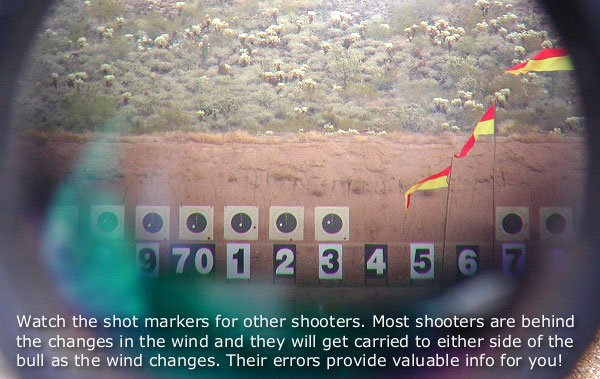
 To succeed in long-range shooting matches, given the high level of competition these days, you’ll need solid wind-reading abilities. We’ve found an article by SFC Emil Praslick III, retired USAMU Service Rifle coach and U.S. Palma Team Coach, that can help you make better wind calls in competition.
 Part One covers basic principles, tactics, and strategies, with a focus on the 200-yard stages. Emil writes: “There are as many dimensions to ‘wind reading’ as there are stages to High Power competition. Your tactical mindset, or philosophy, must be different for the 200 and 300 yard rapid-fire stages than it would be for the 600 yard slow-fire. In the slow-fire stages you have the ability to adjust windage from shot to shot, utilizing the location of the previous shot as an indicator. Additionally, a change to the existing conditions can be identified and adjusted for prior to shooting the next shot.”


 How Does the 7 FCP’s Case Capacity Compare?


