The 2023 NRA Long Range F-Class Nationals event is underway right now at Ben Avery range in Phoenix. That’s an extremely tough competition — the targets are at 1000 yards and your need a rifle with ultra-high accuracy potential. To win in competitive shooting you need an accurate rifle, excellent ammo, good sights/optics, and good physical fitness.
But in addition, there is the “mental game”. You need to be mentally prepared for the match. You should be focused yet relaxed, and be able to deal with stresses from a bad shot or rapid wind change. Experts say you also want to visualize the perfect shot.
One great Shooting Sports USA article, Shooting is 90% Mental, was penned by Chip Lohman (SSUSA’s former Editor). With the help of two very smart Ph.D types, Judy Tant and Mike Keyes, Lohman examines the mental processes involved in the shooting sports. Chip’s co-authors have impressive credentials. Dr. Judy Tant is a Clinical Psychologist and National Bullseye Pistol Champion. Dr. Michael J. Keyes, is a licensed Psychiatrist and former physician for the U.S. Shooting Team. CLICK HERE to read article.
Recommended Books to Focus Your Mental Game and Improve Your Shooting
Along with the article above, there are a number of good books than can help you improve your mental game and perform better in competition. Here are seven recommended books that can help your mental game and shooting skills. These are available from Creedmoor Sports and Amazon.com.
The Bullseye Mind
Bullseye Mind is the first mental training book written specifically for sport shooters.
Mental Training in Shooting
Mental training in Shooting” is a practical book packed with good, straightforward advice about techniques and mental preparation.
Mental Game and Marksmanship Books on Amazon
Mental Preparation for Shooting Matches
Advice from Emil Praslick
Along with these books we offer some smart advice from Emil Praslick III, former USAMU coach. Considered one of the best wind readers on the planet, Praslick also was known for his ability to help his shooters master the “mental game”. Here is an article from the CMP Archives in which Praslick explains how to focus your mind to achieve greater success.
Thinking Your Way to Success by Emil Praslick
Why does it seem that the same small group of shooters wins the majority of the matches? What is the difference among shooters who are technically equal? Confidence. A confident shooter is free to execute his shots without the fear of failure, i.e. shooting a poor shot.
Negative thoughts (can’t, won’t be able to, etc.) will destroy a skilled performance. The mind’s focus will not be on executing the task, but on projecting fear and self-doubt. Fear is the enemy, confidence is the cure. How does a shooter on the eve of an important match … attain the confidence needed to perform up to his potential? A pre-competition mental plan can assist in acquiring that positive mental state. The plan can be broken down into a few phases.
Build a feeling of preparedness. Developing and executing a plan to organize your equipment and pre-match routine will aid you in feeling prepared on match day.
Avoid negative and stressful thoughts. Focusing on “winning” the match or shooting for a specific score (like making the “cut” or making the President’s 100) can cause undue stress. Good shooters focus on aspects that are within their control: their sight picture, their sight alignment, their position. Each shot should be treated as an individual event.
Train stage-specific tasks during your practice sessions. Instead of shooting matches or practice matches only, include some drills that focus on your problem areas. Training in this manner will assist your level of confidence.
As part of your pre-match routine, imagine yourself shooting perfect shots. Visualize getting into the perfect position, acquiring a perfect sight picture, and perfect trigger control.
We congratulate John Masek (F-Open) and Keith Trapp (F-TR), the 2023 NRA F-Class Mid-Range National Champions. The Mid-Range Nationals were held at the Ben Avery Range outside Phoenix, Arizona, and the F-Class Long Range Nationals continue November 2 through November 5, 2023. Keith’s 2023 Mid-Range title was his second big win in a row — Keith won the Long-Range F-TR Championship in 2022.
2023 F-Class Mid-Range National Champions Keith Trapp (L) and John Masek (R).
We were particularly pleased to see our colleague John Masek earn this major victory. John helps AccurateShooter.com with product tests/reviews, and John works on our Deals of the Week features. John also has a popular F-Class John YouTube Channel with videos we frequently feature. And you can see John’s content on his new website FClassJohn.com. CLICK HERE to access John’s videos and product tests.
John Masek Wins His First Nationals
John finished with a very impressive 1774-95X score, followed by Jason Simes (1772-84X) and Norm Harrold (1768-99X). John shot very well in difficult, windy conditions, finishing with not just the highest Grand Aggregate score, but the second highest X-Count (after Norm Harrold). This is a big win for John, his first-ever National title. No one has worked harder to raise his game through advanced reloading processes and lots of practice both with centerfire and rimfire rifles.
Forum member and fellow F-Class competitor David Joe praised John’s performance: “Hey John, great wind calling this week, congratulations! Who needs Long-Range with wind like that. What a close and hard won contest! Great scores today!”
In the F-TR Division, Keith Trapp took top honors with a 1776-87X score, followed by Tracy Hogg (1767-70X), and James Crofts (1762-67X). Keith, a proven F-TR superstar, also won the F-TR 1000-yard Nationals at Ben Avery in 2022.
Here’s an insightful interview with John Masek and fellow F-Open ace and YouTube host Erik Cortina:
And here is a video F-Class John produced at last year’s Long-Range (1000-yard) F-Class Championship. This was also held at the Ben Avery Range in Arizona.
Destiny Fulfilled: Before John left his Oregon home for the 2023 F-Class Nationals, this Editor spoke to John on the telephone. I said “Good luck John, I think you’re due to stand on the podium and hold a trophy.” That prediction proved prophetic. We are glad to see our friend and colleague John Masek now hold the title of NRA F-Class Open Mid-Range National Champion!
Shown above is John’s 7 PRCW F-Open Rifle. This features a Borden BRMXD action, X-Ring stock, and Flavio Fare trigger. On top is the 8-80x56mm March Majesta scope, a very advanced new optic. The rifle is chambered for the 7mm PRCW cartridge. John loads with Lapua brass, Vihtavuori N555 powder, and Berger 180gr Hybrid bullets.
Precision rifle shooters don’t have to hit a big-league fastball, or launch a top-fuel dragster in the blink of an eye. Nonetheless, reaction times are important in our sport — both for competitive shooters and hunters. Want to catch that prairie dog before he slips down his hole? You’ll need to be quick. Want to win at short-range benchrest? Then you’ll need to watch your windflags and respond quickly to a change. Miss a major wind-shift and you could ruin your whole weekend.
Here’s a fun test of reaction times from HumanBenchmark.com. The way it works is that, after clicking “Start”, you wait until the background color changes from red to green. The instant you see green, immediately click your mouse. The average (median) reaction time is 215 milliseconds. Hint: If you keep your finger “preloaded” in contact with your mouse button you can shave some milliseconds — but don’t “jump the gun”.
Tips for Faster Times
Here are three tips to speed up your reaction times:
1) Respond to the color change (by itself), rather than wait to read the word “CLICK!” after the box shifts to green.
2) Try focusing at the corner of the box, rather than the center. This may help you react “without thinking”.
3) Have your index finger “poised and ready” over the left button–you can shave milliseconds by very slightly depressing the button before you actually click.
The 2023 F-Class National Championships commence Sunday, October 29, 2023 at the Ben Avery Shooting Facility (BASF) in Phoenix. For 2023, the Nationals combine both Mid-Range and Long-Range competitions in one extended mega-match. The Mid-Range U.S. F-Class Nationals start on Sunday, October 29, 2023 and run through Wednesday, November 1, 2023. All Mid-Range shooting will be at 600-yard targets.
The Long Range U.S. F-Class National Championships then run Thursday, November 2, 2023 through Sunday, November 5, 2023. All Long Range matches are at 1000 yards. The competitions will have two different divisions: F-Open and F-TR (Target Rifle). Registration LINKs for both Mid-Range and Long-Range Championships are below. CLICK HERE for 2023 Nationals Official Program.
2023 U.S. NRA Long Range F-Class Nationals
Thursday, November 2 through Sunday, November 5
Located on 1,650 acres in north Phoenix, Ben Avery is one of the nation’s largest publicly-operated shooting facilities. A City of Phoenix “Point of Pride,” the facility has received a five-star rating from the National Association of Shooting Ranges. A camping area is available for competitors. Contact Ben Avery Shooting Range Camping to reserve a camping spot.
Firing line at 2015 F-Class Nationals at Ben Avery Shooting Facility.
You’ll see some serious hardware on the firing line at Ben Avery. Here’s a modern F-Open rig with a handsome maple stock. The gun, belonging to David Mann of Texas, shoots as good as it looks.
RULES: Current NRA F-Class Rules shall apply. TARGETS: MR-1FC at 600 yards and LRFC at 1000 yards. TARGET SERVICE: Competitors will pull their own targets. SCORING: Competitors will score. Any competitor failing to perform his scoring duties may be disqualified. CLASSIFICATION: NRA F-Class Classifications will be used. Those competitors unclassified or without proof of a lower classification, will be required to compete in the Master class. Please indicate classification on the registration and entry form. EMPTY CHAMBER INDICATOR (ECI): Approved NRA empty chamber indicators are required to be used at all times except during the preparation period time and firing.
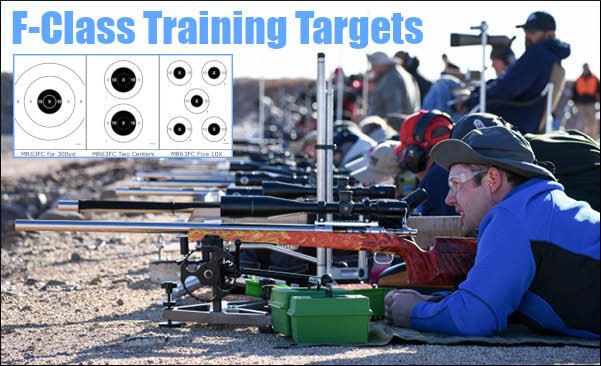
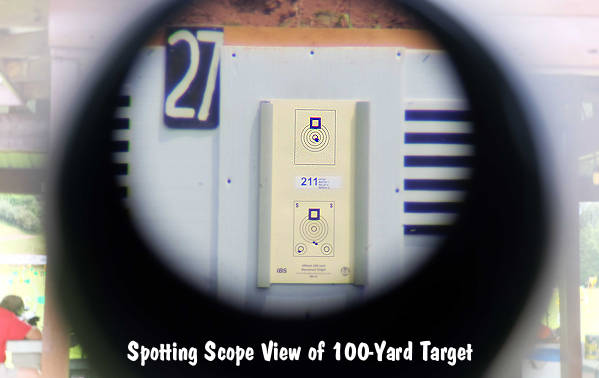
The 2023 F-Class National Championships commences October 29th at the Ben Avery Range outside Phoenix, Arizona. With economic inflation and the high price of gas in particular we know some F-Class shooters couldn’t make it to Nationals this year. For them, and other folks who are getting started in the sport, here are some special targets that let you train at your home range, even if it does not have target bays at 600 and 1000 yards. These special 300-yard target centers let you duplicate the exact MOA size of the official F-Class targets, but at closer range.
Here is the sleek, carbon-stocked .308 Win rifle Bryan Litz used to win both the 2015 Mid-Range AND Long-Range F-TR Championship at the Ben Avery Range in Phoenix, Arizona.
These reduced-size target centers were created by Forum member SleepyGator, an F-Class competitor who needed practice targets he could use at 300 yards. There is an official reduced-distanced standard for 300-yard F-Class matches. This utilizes the NRA No. MR-63FC – F-Class Target Center which is pasted over the MR-63 target. It provides a 1.42″ X-Ring, 2.85″ 10-Ring, and 5.85″ Nine-Ring. (The dimensions of F-Class targets are found in the NRA High Power Rules, Sec. 22, part 4, page 70-71 — see sample below.)
To duplicate the 300-yard target, SleepyGator has prepared a printable version of the MR-63FC Target Center, along with a pair of training targets with two bulls and five bulls. The two-bull and five-bull targets mirror the scoring rings on the MR-63FC, but they display only the innermost three rings and two rings respectively. All three targets are Adobe Acrobat (PDF) files that can be easily printed. You may need to adjust the scale (sizing) on your printer to get the dimensions exactly correct. As noted above, when printed, the 10-Ring on all three targets should measure 2.85″. This should provide some handy practice targets you can use between matches. Thanks to SleepyGator for providing these targets. You can download all three as a .Zip archive. After downloading the .Zip file, just click on the .Zip archive to extract the individual targets.
Hardware Choices: Actions, Stocks, Barrels, Optics and More Tech Talk by Jeff Stover
This article was prepared by past IBS President Jeff Stover based on results from the 2019 IBS 100/200 Group Nationals held August 12-17, 2019 at the Holton Gun & Bow Club in western Michigan.
Let’s examine the Top Ten rifles from the IBS Group Nationals in the 10.5-lb Light Varmint Class. We’ll focus on the most popular rifle components — the choices for Actions, Stocks, Barrels, and Scopes.
Hall of Famer Jeff Gaidos taking aim at the 2018 IBS Group Nationals. He has a low-profile carbon-fiber stock with a Leupold fixed-power scope.
For some years now, BAT has been the predominant action. This year BAT actions held nearly 100% of the Top Ten places in all the Bag Gun equipment lists. Bruce Thom’s Idaho-crafted actions, except for a couple stray actions in Heavy Bench, swept the top rankings.
Next, look at barrels. Bartlein or Krieger seem to rule with upstate New York’s venerable Hart barrels as competitive. Shooters tend to go with winners, so Wayne Campbell and Jeff Peinhardt dominate as gunsmiths for the top benchrest shooters.
In stocks there seems to be variety, but there is some commonality. The Scoville and Scarbrough stocks, both Michigan-made, are laminated wood (balsa and other wood) with carbon fiber and wrapped in carbon fiber. The Scoville stock on my 10.5-lb rifle weighs 18 ounces but is full size with a nice long fore-end. Bob Scarbrough makes a very similar product. Both are winners — it’s a choice of Ferrari or Lamborghini. The Roy Hunter and Terry Leonard stocks among these top rifles take a different route to winner’s circle. Both are wood (cedar or other), but super high-tech as they are laminated with carbon fiber. They are beautiful to boot. High-magnification Leupold, March, and Nightforce scopes rule the roost among benchrest optics.
Bullets and Powder
Bullets are important. Really important. A hot bullet gives you “Teen Aggs” and lots of trophies. An average bullet does not. Most of these are 68 grain 6mm boattails. The Peinhardt (StaMoly Precision) bullet is well represented on this list, but some top shooters make their own as you can see. Bullet jackets are likely StaMoly or J4. For powder, nearly everyone shoots Vihtavouri N133 except a few guys running LT30/32 or surplus 8208.
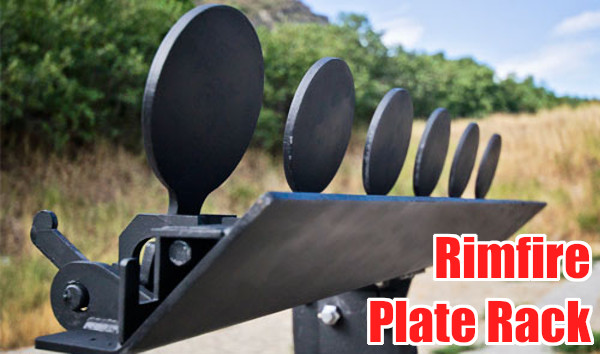
The Action Target Sport Plate Rack is specifically designed for .22 LR Rimfire shooting. This rack features six 4″-diameter plates that reset with a provided cable.
Shooting plates is fun. You get immediate feedback — “instant gratification” when you make a hit. When shooting steel inside 100 yards, we like to use .22 LR rimfire guns. The ammo is inexpensive, noise levels are lower (though you still need ear protection), and at close ranges there are fewer issue with ricochets and bullet splash-back. Additionally, for busy folks who don’t have time to reload, you can pick up a .22 LR rifle or pistol, grab a couple $5 boxes of ammo, and get to the range in a few minutes. The convenience means it is easier to shoot every week if you like.
SFC Joel Turner from the USAMU’s Action Shooting Team offers a few pointers on how to shoot plates quickly and accurately. He’s using a centerfire pistol, but the same principles apply for rimfire handguns. Click speaker icon to activate audio.
New .22 LR CP33 Pistol is Great for Plates
If you like shooting plates with rimfire guns, one of the better new pistols for the job is Kel-Tec’s CP33. We tested this interesting handgun at the 2019 SHOT Show Media Day at the Range, and were impressed. The pistol is big, but balances well. The sights are easy to see, and the full-length rail lets you easily mount a variety of optics. The trigger is surprisingly good — better than 90% of rimfire handguns out there. For the plates game, this “quad-stack” gun can handle long stages without mag changes. The standard clear-sided CP33 magazine holds 33 rounds of .22 LR ammo.
If you are interested in an affordable, but very accurate, high-capacity semi-auto rimfire pistol you should consider Kel-Tec’s new CP33. Shooting Sports USA (SSUSA) notes: “The rapid growth of rimfire competition in Steel Challenge has prompted some gun makers to enter the fray. Kel-Tec is one, and their new CP33 .22 LR pistol has a lot of potential.” Popular YouTube host 22 Plinkster tested the gun and reports: “This handgun has been 100% reliable IF I load the magazine the right way… and it’s pretty dog-gone accurate.” The video below shows the best way to load the 33-round magazine:
SSUSA’s testers tried the pistol with a variety of ammo and it consistently shot about one-half-inch for five shots “from a 25-yard sandbag bench rest using the iron sights.” SSUSA noted that the gun disassembles quickly and easily by removing one central pin. That’s a nice feature.
Overall SSUSA’s tester, Chris Christian, was impressed with the gun, saying it balanced well and the sights aligned naturally: “…the neutral-balance-point grip produced an almost instinctive sight alignment.”
Christian used the CP33 in a 6-stage Steel Challenge Match, and did well: “I decided to shoot Rimfire Pistol Iron (RFPI) and used the CCI Mini-Mag. The high-speed ammo ran perfectly. [T]he bright sights and handling qualities let me finish top among iron-sight shooters and even hold my own with C and B class rimfire pistol shooters using optical sights. It would be interesting to put a reflex sight on the gun, and maybe even shoot some Bullseye with it.”
Intro: Ron Dague wanted a new gun that was similar to his trusty .223 Rem rifle, but which fired 6mm bullets. There is a superb choice of bullets in this caliber, and Ron found that the 95gr Berger VLD could be driven to a healthy 2604 FPS by the small .223 Rem case. This 6mm wildcat based on the common .223 Remington offers excellent accuracy and very low recoil — something very important in the cross-the-course discipline. In addition, Ron’s 95gr load with Alliant Reloder 15 delivered an ES of just 4 fps over ten shots. That exceptionally low ES helps achieve minimal vertical dispersion at 600 yards.
I have watched a change in thinking for NRA High Power across the course in match rifles and calibers. There are several [popular chamberings]: 6mm AR, 6.5 Grendel, 6XC, and 6.5 Creedmoor. I have seen these rifles perform and all have done very well.
When I started this project I was looking for a cartridge that shoots and feeds well from a magazine[.] I had shot the .223 Rem in my 722 Remington and knew it had fed well so I chose the .223 Remington necked up to 6mm.
The 6mm-223 gives me what I have in the standard .223 only with a better selection of bullets. I wanted a better 600-yard bullet with a higher BC than provided by the 80 and 82 grain bullets. I also wanted a 600-yard line bullet with a .500 or better B.C. for those shots that should be 10 ring or better but seem to find the 9 ring no matter how well I held and broke the shot.
Putting the 6mm-233 Project Together
My project started with ordering a 6mm barrel from Bartlein with a 1-8″ twist. I called Pacific Tool and ordered the 6mm-223 reamer. I found a used Remington 700 action at a local gun shop and already had a Remington 40X stock. I then started putting the gun together.
I already had a .223 Remington match rifle, and I wanted the 6mm-223 to be as close to the same as I could make it. I installed the barreled action in a wood 40X stock to work up load data and work out any magazine feeding issues. While I was working on that, I looked for a McMillan Baker Special stock and finally found one to finish this project. I bedded the action and stock, then took the rifle to the range to check zeros on the sights and scope. I was surprised that I didn’t have to change anything on the sights. I thought changing the stock would cause sight changes. The thought went through my head, “Maybe the 40X stock isn’t all that bad”.
Here’s line-up of 6mm bullets. The Berger 95gr VLD is in the middle.
I took the new rifle to the first match of the year, a National Match Course match, and my off-hand score was 83, rapid sitting 95, rapid prone 95, and slow fire prone 197 — for total aggregate 470. This may not be my best work, but on match day the wind was blowing about 15 mph and the temp was around 40° F, with rain threatening. This was a reduced course of fire — we shot at 200 and 300 yards on reduced targets.
I used 70gr Berger bullets for this match, loaded in Remington brass with 25 grains of VihtaVuori N540 and Federal 205M primers. When I worked up loads for this rifle, N540 gave the best accuracy with the best extreme spread — 2,950 fps with an extreme spread of 20 fps on a 10-shot string. The load for 600 yards was with a 95gr Berger VLD bullet, with 23.0 grains of Reloder 15, Lapua cases, and the same Federal 205M primers. This load is 2,604 fps, with an extreme spread of 4 fps over a 10-shot string. I’ve shot this load at several 3×600 yard matches, and the accuracy has proven to be very good. At the last 3×600 match, my scores were as follows: 199-10x and 198-11X with scope, and 193-10X with iron sights. Best 600-yard score so far with iron sights was 198-12X.
6mm-223 Rem Rifle Specifications: 700 BDL action and floor plate, Bartlein 6mm 1:8″ twist, McMillan Baker Special stock in Desert Camo, Centra front and rear sights, Ken Farrell bases with stripper clip guide, Sinclair hand stop, and Jewell trigger. Gunsmith Neil Keller helped me with the metal work and instructed me on the action work and rebarreling.
Philip Hemphill, Pistol Champion, Has Left the Range
We are sad to announce that champion pistol shooter and Team Lapua member, Philip Wayne Hemphill, has passed away at age 71 at his home in Meridian, Mississippi. Hemphill was one of the greatest-ever American pistol shooters. Hemphill was a 10-time National Police Pistol Combat Champion and two-time NRA Precision Pistol Champion. Above is Hemphill after winning the .22 LR Rimfire pistol championships at Camp Perry in 2019.
Philip Hemphill served 30+ years with the Mississippi Highway Patrol before retiring as a Captain in 2011. The Shooting Wire recounted his remarkable history with the National Police Pistol Combat (PPC) series: “Hemphill shot his first PPC in 1985 in Des Moines, Iowa. He competed every year [except 2005] until he served as a referee in 2008. In 2008, he returned to the range in Albuquerque as a shooter to compete one final time, and captured his tenth title. [In his competition career] Hemphill represented Lapua, Team Zero, Rock River Arms, and AimPoint. He remained one of the few people who drew the attention of competitors, fellow vendors, and spectators at shooting events.”
Funeral services for Mr. Philip Wayne Hemphill will begin at 11:00 am Monday, October 16, 2023 at Cross Mountain Ministries in Porterville, Mississippi. Online condolences may be expressed at robertbarhamffh.com which hosts the Philip Hemphill obituary and photo collection.
Philip enjoyed squirrel hunting and turkey hunting. He enjoyed traveling and spending time with his grandsons, who lovingly referred to him as Papaw. He was a friend to all who knew him, with friendships spanning all over the world.
Here is an NRA-TV interview with Philip Hemphill from 2016. Hemphill has been a 10-Time NRA National Police Pistol Champion, and has won multiple National Pistol Championships:
While there are many very, very talented women shooters, it’s still a bit unusual to see many ladies on a long-range firing line. It’s even more unusual to find a women shooter who regularly beats all the “good ol’ boys”. This week we feature Katy from California, who has competed in Varmint Silhouette matches with a very stylish and accurate Stolle 6BR. Along with husband/spotter Don (who shoots a 6mm Dasher), she has been one of “Top Guns” at the popular Pala Shooting Range in North San Diego County. Here’s a view of the Pala facility, looking down-range at the rows of silhouette targets:
Pala — A Mecca for Southern California Shooters
Near the Indian Casino and Resort in Pala, California is one of the longest rifle ranges in the state. Pala hosts a wide variety of shooting matches — cowboy action, lever action silhouette, black powder silhouette, hi-power silhouette, tactical pistol and rifle matches, to name a few. The black powder buffalo and tactical rifle matches use the longest range with 900-meter targets. Katy and her husband Don have competed in Varmint Rifle Silhouette matches, which were held monthly in years past. Range Info: Range.palatribe.com.
Katy tell us: “These Varmint Silhouette matches are a lot of fun! It’s very satisfying to see the little critters fly off the rail. A good spotter will note how the target flies when hit–‘Did it turn right or left? Did it lift up or fall back?’ Steel targets reveal more about real world ballistics than just a hole in a piece of paper. And nothing beats reactive targets for fun shooting.”
For Katy and Don, shooting is a family affair: “I started shooting the varmint rifle silhouette at the encouragement of husband Don. He bought/built himself a 6mmBR to shoot the varmint rifle match and re-barreled an old Hart-sleeved Remington 700 to fast-twist .223 for me to use. I did pretty well for a beginner, winning a match after just a few months of competition. Winning with that .223 had competitors scratching their heads. Frankly, it was just a fortuitous combination of great spotter, steady hold, and a good rifle. That .223 was certainly a very accurate piece. I always expected the bullet would hit right where the rifle was aimed, if we called the wind right. But like all good things, with time the .223’s accuracy began to fade. As the barrel finally gave up the ghost, a replacement was ready–a bright red Panda bear chambered in 6mm BR.
Beating the Guys at their Own Game
With my old .223, I won five varmint matches between December 2000 and April 2002. I also won my class (Master) in June, 2001. However, with the 6BR Panda, I shoot higher scores and have now had four match wins between May, 2003 and August 2004. And I won my class twice in 2003. Over time, as our competitors’ skills and firearms have improved, the criteria for shooter classification has been upgraded. Originally, one could miss 10% of the animals and qualify as a “Master” shooter. A few years ago, the criteria was tightened to 5% misses to earn “Master” status. This 6mmBR has kept me up in Master class.
I’ve done well enough with my little Red Panda that folks have been asking me about my shooting technique. Both Don and I shoot free recoil. We keep everything off the rifle except the trigger finger and thumb. Keep your shoulder back from the butt, and make sure your cheek doesn’t contact the stock and that your shooting cap doesn’t hit the scope. Fine-tune your elevation by squeezing on the rear bag. I use a front rest forearm stop to keep the rifle in the same place on the front rest. After firing, pushing the rifle back against the front stop usually verifies rifle tracking and allows a quick check of how far off the sighter shot’s impact was from point of aim.”
The Female Perspective — Katy’s Views on Shooting
We all know women can be crack shots. The little lady in the picture proved that more than a century ago. Competitive shooting is one of the few sports where women can and do compete head-to-head with men — and often win. [Amanda Elsenboss recently won the National High Power Championship and the National Long Range Championship. And Nancy Tompkins and her daughter Sherri Gallagher have won National shooting titles.] But the fact remains shooting is still very much a male-dominated sport. Here are some of my thoughts on how that might change.
Beneficial Aspects of Shooting
The first and most important benefit of competitive shooting is learning to handle a rifle/firearm safely. We’re well past the time when women should have conquered their fears of guns. An added benefit would be increasing a woman’s ability to respond to any threats. I remember when I was in college and we took my anti-gun roommate out to the range for a shooting lesson. She had a great time shooting away. She learned that firearms are not just “scary”, but also an enjoyable tool.
How to Get More Women Involved
Since we aren’t going to get the silencer legislation changed to improve women’s enjoyment of the sport, we will have to promote other aspects of shooting. I think shooting sports can increase self-confidence, giving women a sense of accomplishment and inner strength to remain calm under stress. It is very satisfying to see a positive result (at very long distance) of your focused efforts. Developing skill at any sport can improve one’s self-image and coordination. Encourage the women in your life to join you at the range. Believe it or not fellows, your wives and girl friends like to spend time with you. At Pala, some of the wives make the best spotters, even though they don’t shoot.
I find these varmint silhouette matches ideal from the standpoint of a woman’s participation. First, you get to lay down and shoot–that’s much more relaxed than classic position-shooting. Second, the really heavy rifle is supported on front and rear rests so that all you need to do is carefully guide the rifle, concentrate on the sight picture and pull the trigger when everything lines up. And, by the way, I clean house and prepare the meals, while my husband Don cleans the rifles and prepares the ammunition.
Dealing with Noise Pollution
The first thing a women notices at the range is how much noise these rifles make. How can anyone carry on a decent conversation, much less think with all the racket? Practice days are the worst–there is just constant gunfire with very few ceasefires. Matches are fine, because there is only gunfire during warm-up and then for 8 minutes during each relay. On the firing line, I wear both fitted earplugs and ear muffs to tolerate the decibels. Being heard and understood is always a problem during the match.
Shooters’ Techno-Babble–I Guess It Really Is a “Guy Thing”
One of my fellow female shooters commented that, at the range, the guys never seem to talk about anything but firearms and their accouterments at the range. Although I am familiar with the term “minutes of angle” I have gotten sloppy in my speech and generally just report how many clicks one needs to adjust for the wind or the sighter shot. Reading Don’s equipment discussion confused me when he kept referring to MOA. I have been with non-shooting friends several times when knowledgeable shooters start talking firearms. It is as if they are speaking a different language, and my friends look to me with a puzzlement on their faces. Well, in fact it has its own language and I think I’m getting finally getting able to speak it.
Katy’s 6BR — Technical Primer by Hubby and “Loadmaster” Don
Way back in 1990 a Precision Shooting magazine “Trading Post” advertisement offered a low-mileage, Panda-actioned .262″ neck, 6mm BR rifle and all the reloading accouterments. This light-varmint class rifle was built in the mid-1980’s around an unusual round Panda action with straight-fluted bolt. As configured, the gun had performed very well indeed–shooting many groups in the zeros. The action is glued into a Lee Six thumbhole BR stock and uses externally accessible pins to hang the 3 oz. trigger. The scope is an older 36X Leupold BR model, held by Kelbly rings on a Davidson base. The original barrel was a 4-groove, 14-twist, apparently made by Pat McMillan. A hand-written information tag taped to the underside of the barrel was discovered upon its removal, and indicates the barrel was fitted by JACO, April 1986. Anyone know who that is?
The 14-twist barrel could not stabilize any bullets greater than about 80 grains. It would keep an 80-grain Starke inside 0.4″ at 200m with a velocity of 3120 fps using 31.8 grains of Varget. However, the 80-grain bullets were blown all over by the winds out to 500 meters.
Past success with Pac-Nor pre-fit barrels inspired me to order a 28″, 4-groove, 8.6″-twist barrel chambered with their .262” neck 6mm BR reamer. Pac-Nor crowned and chambered the barrel; and, in this case, threaded it to fit a Panda action. After we installed the barrel on the action, we found that the bolt nose touched the conical barrel breech face. 0.010” needed to be removed from the cone face so that the bolt closed with a perfect fit. Headspace is now just right at 1.167″.
Load Development
My experience with a couple of other fast-twist 6BRs, one also chambered with Pac-Nor’s .262″ reamer, suggested that the 95gr Berger VLDs would work well the estimated 0.060″ freebore in Katy’s rifle. The goal was to get 2800-2900 fps velocity with inherent accuracy no worse than half the smallest silhouette size. That meant we needed a load that delivered repeatable 0.4 MOA accuracy or better.
A new batch of Lapua 6mm Norma BR brass was neck-turned to 0.0083″ wall thickness to fit the chamber and fire-formed during barrel break-in, following Pac-Nor’s guidelines. We tried a bunch of different moly-coated bullets at 200 meters, most with moderate charges of H322. The results of the bullet-testing ranged from poor (over an inch) to astonishing (68-grain, flat-base Eubers over 29.7 grains of H322 went into about .25″ at 200 meters!) But these flat-based bullets lacked the high ballistic coefficient we wanted for the varmint silhouette match. So we tried the 95-grain VLD Bergers (0.5+ BC) and produced several good loads, all sparked by Federal 205m primers. The best load seemed to be 28.2 grains H322 at 2860 fps, followed by 30.4 grains N135 at 2920fps, and 31.0 grains of Varget at 2890 fps.
All loads shot better than 0.4 MOA, but the H322 seemed a little more accurate, and about twice as much H322 was on hand. So, after about 120 shots the barrel was conditioned, brass formed and a match load selected for the 95 VLD Bergers. Bullets are seated about 0.010″ into the rifling for a typical cartridge LOA of 2.325”, which puts the heel of the 95 VLD boat-tail just below the case neck-shoulder line. Cases are sized with a Wilson neck bushing die that works only the upper 2/3 of the case neck to support the bearing surface of the seated bullet.
Don’s Handy Guide to Varmint Silhouette Shooting
Varmint Silhouette–Origins and Basics
Over a decade ago, a metallic silhouette match was devised for typical varmint rifles at the North County Shootist Association range near the hamlet of Pala, in north San Diego County, California. The course of fire used the conventional rifle silhouette range with banks of 10 special varmint targets sized 0.8 to 1.0 MOA (Minute of Angle) in width. At five different yardages, ten steel “critter” targets are set as follows: 200 Meters – Field Mice (“pikas”); 300 meters – Crows; 385 meters – Ground Squirrels; 500 meters – Jack Rabbits; 600 yards – Prairie Dogs. The folks at Pala run a tight ship, cycling multiple relays efficiently, so everybody gets to shoot 50 targets (10 each at five different yardages), and the show is usually completed by 1:00 pm. There’s a one-hour sight-in period starting at 8:00 am, and the match starts at 9:00 am sharp. Newcomers should definitely arrive no later than 7:45 am, because you may need that full sight-in period to acquire solid zeros at all five yardages.
Firearms are limited to field-portable, varmint-caliber rifles in either custom or factory class, and having a maximum 6.5mm bore, but bullets must weigh no more than 107 grains. You can shoot prone or from a bench using a front rest and bag rear. For more information, visit Range.palatribe.com.
Match Rules and Shooting Procedures
Matches are fired as a team — shooter and spotter. The course of fire typically consists of 10 steel, knock-down varmint animal targets at each of the five distances. After firing a sighter, targets are taken from left to right, one shot per target. Missed targets remain standing. Any target struck out of sequence is also a “miss”. The shooter’s objective is to sequentially knock-off (clean) all 10 targets. The spotter’s duties are to support the shooter in all aspects of shot preparation. First and foremost, the spotter tries to see each shot impact and call appropriate windage and elevation adjustments for the shooter. In shifty conditions, a good spotter is vital.
Let’s start at the beginning. Before the match there is usually an opportunity to fire a few fouling shots and check sight settings for load and distance. An initial read on conditions–mostly wind direction, strength and consistency–is also made. The spotter should checklist the shooter to make sure they are set up for the relay distance and have adjusted their sights to the correct elevation and windage.
It could be argued that for the shooter, the first shot at a given distance, the sighter shot, is the most important shot fired. Since the sighter targets are fixed (don’t fall over) and freshly painted, bullet impact is obvious to both shooter and spotter. If the bullet hits where expected–point of aim–the spotter then tracks and calls observed changes (mostly wind) relative to the shooter’s initial scope settings. If point of impact shifts on subsequent record targets or the shooter misses, appropriate sight adjustments are recommended to the shooter. Admittedly, it is sometimes difficult or impossible to see the point of impact on these small, reactive targets. However, an estimate of bullet strike can be made from target behavior such as rotation and/or impact trajectory.
The Guacamole Connection
Katy and Don are avocado farmers. From time to time they’d bring a few avocados to the range to give to the other shooters. In addition, on some months, Katy would bring some home-made Guacamole made from the avocados on their ranch. Katy says “Fellow shooters appreciate a batch of guacamole so much they bring their own chips to go with the dip. I keep getting suggestions that I go into the business of making and selling guacamole. Guess I could start by selling it at the range.”
Katy’s Guacamole Recipe
4 ripe avocados, peeled and pitted
1/2 lemon squeezed (I use Meyer lemons, lime juice is also good)
1/2 cup fresh salsa — your favorite variety
1 tsp garlic salt or fresh garlic chopped
All of the above quantities can be adjusted for taste. Mash the ingredients with a potato masher. Serve with chips, fresh vegetables (carrot sticks, celery, broccoli), or as garnish for tacos, burritos, taquitos, etc., and as special treat – spread on warm buttered toast for breakfast.
Good Shooting and Bon Appetit! — Don & Katy
No reproduction of any content is allowed without advanced permission in writing.


 John Masek Wins His First Nationals






 By Ron Dague, Sinclair Reloading Tech
 Putting the 6mm-233 Project Together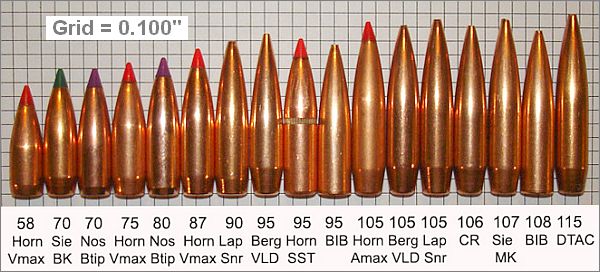

 Philip Hemphill served 30+ years with the Mississippi Highway Patrol before retiring as a Captain in 2011. The

 Beating the Guys at their Own Game
 Beneficial Aspects of Shooting
 Load Development

 Firearms are limited to field-portable, varmint-caliber rifles in either custom or factory class, and having a maximum 6.5mm bore, but bullets must weigh no more than 107 grains. You can shoot prone or from a bench using a front rest and bag rear. For more information, visit
 Let’s start at the beginning. Before the match there is usually an opportunity to fire a few fouling shots and check sight settings for load and distance. An initial read on conditions–mostly wind direction, strength and consistency–is also made. The spotter should checklist the shooter to make sure they are set up for the relay distance and have adjusted their sights to the correct elevation and windage.
 Katy and Don are avocado farmers. From time to time they’d bring a few avocados to the range to give to the other shooters. In addition, on some months, Katy would bring some home-made Guacamole made from the avocados on their ranch. Katy says “Fellow shooters appreciate a batch of guacamole so much they bring their own chips to go with the dip. I keep getting suggestions that I go into the business of making and selling guacamole. Guess I could start by selling it at the range.”


