This winter there has been very cold weather throughout much of the USA. For many marksmen winter indoor training is needed if they want to maintain their shooting skills. Even if you can shoot outdoors all year long in your location, it makes sense for position shooters to work on their rifle holds. The Mantis systems help with that. These advanced smart devices record and plot the movement of your firearm as you aim and then break the shot. There are systems for both dry-fire and live-fire training, starting at $99.99. Considering the cost of bullets these days, and the difficulty of finding primers, it makes sense to increase your dry-fire training.
Mantis X2 for Dry-Fire, $99.99
Built for dry-fire use only, the Mantis X2 ($99.99) provides real-time, shot-by-shot feedback for both pistol and rifle users. You can track multiple training sessions with data-driven insights, and monitor your progress. This unit has earned high user reviews such as: “As a new gun owner the Mantis X is a game changer for me. I have not been able to get to the range during the lockdowns and being able to practice at home [is great].” And another: “Easy to install[.] The App is free and easy to use.”
The Mantis X2 is a good value. The manufacturer states: “There is nothing at this price point that will give you this level of feedback for dry fire.” There are actually four Mantis models: X2 ($99.99), X3 ($169.99), X7 Shotgun ($199.99) and X10 Elite ($249.99). The X3 adds live fire functionality. MORE INFO HERE.
Mantis X10 Elite– Advanced Training System
The advanced Mantis X10 Elite ($249.99) is 50% lighter and 40% smaller than the original Mantis, with three times the battery life and four times the data transfer rate. This new quick-detach X10 system offers all X2 and X3 functions PLUS recoil analysis and software support for all shooting sports (pistol, rifle, shotgun, archery). Collecting thousands of data points per second, the X10 works with dry fire, live fire, airsoft/CO2, and simulated firearm systems.
Mantis Blackbeard Trigger Reset System for AR-Platform Rifles
AR service rifle shooters can definitely benefit from the Mantis Blackbeard system, a Bolt Carrier + Magazine replacement that works with your existing trigger.
Using electromechanical wizardry, the $199.00 Blackbeard quickly resets the hammer between each shot, so you can stay in position through multiple practice shots. Installation takes less than a minute — remove the bolt carrier group, drop in the red upper unit, place the red Mantis magazine and you’re good to go. All Blackbeards now support both direct impingement and piston-driven ARs. Guys we know say that a few sessions with this system delivered marked improvement in their service rifle scores.
Mantis X3 for Live-Fire or Dry-Fire, Rifle and Pistol
The Mantis X3 collects thousands of data points per second and analyzes your shooting in real-time. For both pistols and rifles, the X3 works with dry fire and live fire. It will also work with airsoft/CO2/compressed air, and simulated firearm systems. Priced at $169.99, the Mantis X3 mounts to standard universal accessory rails. (No Picatinny rail? Creedmoor Sports sells adapters). The X3 is part of the second generation of Mantis Shooting Performance Systems.
NRA Media has announced the winners of the 2026 NRA Golden Bullseye Awards. Now in their 24th year, the Golden Bullseye Awards recognize outstanding innovative firearms, optics, shooting products, and ammunition. And there are also Golden Bullseye Awards for top shooters and for individuals who support the gun industry and Second Amendment rights.
Every year the NRA announces Golden Bullseye Award winners for various product categories (rifle, shotgun, handgun, optics, accessories, gear etc.). These awards are like the Oscars for the shooting industry. There are separate Golden Bullseye prizes awarded by different NRA Magazines — including American Rifleman, Shooting Sports USA, and American Hunter. The 2026 Golden Bullseye Awards will be officially awarded during the April NRA Annual Meetings & Exhibits in Houston, Texas.
Golden Bullseye product awards are selected by the staff of the NRA’s American Rifleman and American Hunter magazines, with multiple categories recognized by each magazine. The selections are then reviewed by NRA Media management. To qualify for consideration for a Golden Bullseye Award, the product must have been: 1) Recently introduced; 2) Innovative in design/function; 3) Tested by a NRA Magazine/media staffer; 4) Reliable in the field; 5) Recognized as good value; and 6) Styled in a manner “befitting the shooting and hunting industry”.
American Rifleman 2026 Golden Bullseye Product Awards
The Tikka T3x Ace Target rifle is an affordable tactical rig capable of winning PRS and NRL matches right out of the box. It is offered in three chamberings: .223 Rem, 6.5 Creedmoor, and .308 Win. Two barrel lengths are available: 23.6″ and 26.0″. Standard features include two-stage trigger, adjustable cheekpiece, and forearm rails. The Tikka T3x Ace is available for $1799.00 – $1959.00 at EuroOptic.com.
In this video (above), our friend Erik Cortina tests the Tikka T3x Ace Target rifle, shooting from 100 to 1000 yards. The 6.5 Creedmoor T3x showed superb accuracy with Sako TRG Precision factory ammo. Erik stated he was “very impressed” (2:30 time-mark).
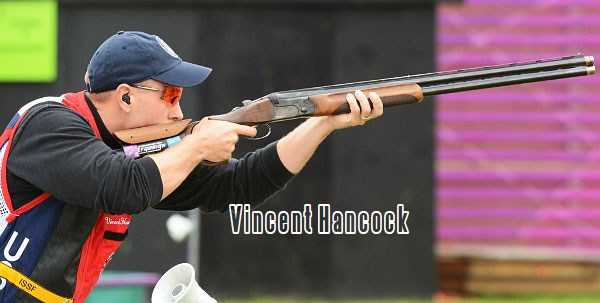
The 2026 Shooting Sports USA Golden Bullseye Competitor Award goes to four-time Olympic Gold Medalist Vincent Hancock. He has been one of the greatest skeet shooter in history. He is also recognized for coaching and mentoring Team USA shooters.
The NRA Media 2026 Golden Bullseye Freedom Award goes to noted attorney, scholar, and author Stephen P. Halbrook. In his legal practice Halbrook has won cases before the U.S. Supreme Court, and his scholarship has contributed to Second Amendment historical knowledge.
The NRA Publications 2026 Golden Bullseye Pioneer Award recipient is Anthony Imperato, the founder and President of Henry Repeating Arms. Imperato has been a strong supporter of the NRA and the Second Amendment rights.
The 2026 Golden Bullseye Woman of the Year winner, nominated by the editors of NRA Women.com, is Tanisha Moner. As a dedicated instruction, Tanisha brought firearms training to thousands of women through the Legally Armed in Detroit (L.A.I.D.) organization.
The following article by Tom Alves describes a very practical approach to physical training for those of us who are not as young and spry as we once were. Tom shows us how to give our bodies at least some of the maintenance we give our rifles. While we all realize that our rifles will outlive us, let’s see if we can’t narrow the margin a bit with some personal maintenance that just might help the shooting too!
This article originally appeared in German Salazar’s Rifleman’s Journal, and appears with permission. Sadly, German passed away in 2022. This was a very sad loss of a distinguished-class marksman and a great shooting sports writer. This Editor counted German as a close friend, who helped this site in many ways.
A Suggested Training Approach for Older Shooters
By Tom Alves Most articles and discussions regarding competitive shooting center around equipment. Now and then one will come across an article about physical training such as the USAMU piece on Physical Conditioning for Highpower Shooting. If you break the articles down they often discuss “core strength” and durability. The purpose of this paper is to elaborate on those points with a bit different perspective. Many of the articles you will read in books about position shooting and the one mentioned before are directed more toward the younger generation of shooters in their 20s. If you look down the line at a typical high power match these days you are likely to see quite a few folks who are in their middle 30’s and up. Many people in that age range have had broken bones and wear and tear on their joints so a training program needs to take that into account. For instance, while jogging for an extended period for heart and lung conditioning — often called cardio exercises — may be the recommended approach for younger folks, it may be totally inappropriate for older people. The procedure to repair meniscus tears in knees is one of the most frequently performed operations in this country. Another approach one often sees in training to improve core strength is the use of weight machines which isolate certain muscle groups in their operation. I would like to suggest an alternative approach that not only does not require special equipment but uses the body’s muscles in a coordinated fashion in the same way they are used in our natural movements. So, let’s set down some criteria:
1. The approach has to be low impact to conserve joints.
2. One goal is to improve the strength of the core muscles which are the muscles of our trunk that keep us erect and from where all movements initiate.
3. Along with core strength we need flexibility and full range of motion.
4. We want to improve our lung and heart function so we can have a good flow of oxygen going to our organs and muscles to reduce the rate at which we become fatigued during a competitive event.
Before I continue I believe it is appropriate for the reader to understand that I am a fellow shooter and this is a program I have designed for myself based on considerable reading and experience over a number of years. I am not a medical doctor, a formally trained exercise professional or any other type of specialist in the field. Consequently, this information is offered with the advice that you consult your medical advisor or similar authority before you embark on this or any similar regimen.
I will start with core strength and flexibility. Pilates exercises are resistance exercises that can incorporate the use of resistance bands, light weights and the weight of your body parts in order to strengthen the muscles in the abdomen, back, hips, chest and shoulders. The exercises can be performed alone but I recommend attending classes put on by a certified instructor who will ensure that you perform a balanced routine meaning you work on the front and back and both sides of your trunk. As to flexibility, yoga complements Pilates exercises and they are often taught together. In practical terms yoga strengthens through resistance using the weight of the body and increases flexibility by stretching the various muscle groups in a coordinated fashion. Some yoga exercises also work on balance which is helpful in position shooting and life in general. Again, I suggest attending formal yoga classes since an instructor can help you address such things as a joint misalignment. As an example, my right leg healed improperly after the femur was broken and my right foot splays out putting undue load on my left knee. There are a number of books available on Pilates and yoga and some of them get pretty involved; I leave that to the reader to explore. I will list some reference material at the end of the article that I have found useful.
Finally, heart and lung improvement. In order to exercise the heart and lungs while not abusing the joints, particularly the knees and hips, one has to resort to something other than jogging. Walking, bicycling, elliptical machines and swimming may be alternative methods you’d like to consider. Based on my reading, in order to get the most benefit it is important to exercise so that the pulse rate becomes elevated for periods of time rather than kept at a constant rate. The process I use, called PACE, is promoted by Al Sears, MD, http://www.alsearsmd.com/. It is interval training for the non-athlete. In simple terms one exercises, using whatever equipment one desires, to achieve a heart rate in which you are slightly above your ability to bring enough oxygen into your body to sustain the activity for an extended period. This is similar to wind sprints for a sprinter or a football player. After each episode you must rest until you have achieved recovery, meaning you can catch your breath easily. A series of three sets is recommended which covers a total time of about 20 minutes.
Report from the Author — Yes, Training Helps
As a result of this training program I have experienced increased strength in my legs and trunk, less joint stiffness, lower blood pressure, and lower resting pulse rate. The Pilates/yoga classes are usually attended 2 to 3 times a week and the interval training performed twice a week. [The author was 64 when this was first published. He is now 75, and still shooting Palma and Smallbore prone.]
Before I close I would like to touch briefly on two other related subjects: hydration and visual training. When one is exerting oneself, the body produces perspiration to keep the body’s temperature at an acceptable level. As one perspires the blood gets thicker and the ocular fluid in one’s eyes thickens as well. The heart has to work harder to supply oxygen and nutrients to the body so visual and cognitive functions degrade and fatigue sets in rapidly. Essential chemicals called electrolytes are also carried out of the body with the perspiration. As a result, it is necessary to replace moisture and electrolytes to maintain basic health and a competitive level of performance. If one goes on the Internet there is a multitude of articles on hydration. Due to the kindness of my lead Pilates/yoga instructor, Ms. Annette Garrison, I have a pretty comprehensive article on various aspects of hydration that I have included, http://www.ideafit.com/fitness-library/hyponatremia-other-side-hydration-story , for your information.
Last I want to mention visual performance training. The New Position Rifle Shooting, A How-To Guide for Shooters and Coaches by Bill Pullum and Frank Hanenkrat mentions sports vision training amongst other aspects of vision in competitive shooting. [Used book under $40.00 on Amazon]. If one goes on the Internet you will find training programs directed at golfers, baseball and football players. There is one site that has a demo which, if one looks at it for long, it is obviously very similar to a shooting gallery video game. The training involves rapid recognition and hand-eye coordination. Another source of visual training exercises, along with a wealth of other information, is the book Prone And Long Range Rifle Shooting by Nancy Tompkins.
Hopefully, I have provided some information which will be helpful in improving shooting performance and extending the time you can participate at a competitive level. It is important that you proceed at your own pace. I have pushed myself too hard in the interval training and now have to back off a bit. In closing I would like to thank Annette Garrison and German Salazar for their help, patience and encouragement.
Additional Reference Material
1. Framework by Nicholas A. DiNubile, MD This is required reading for anybody who has suffered an injury like a torn meniscus or has muscular skeletal issues. This is the book that led me to Pilates/yoga
2 P.A.C.E., The Twelve Minute Fitness Revolution by Al Sears, MD The approach I use to interval training. I am sure there are other sources.
The type of targets you use can make a difference during load development and training — helping you align your crosshairs, estimate group size visually, and also record load data/gun type. Here we provide selection of FREE printable precision and training targets. This selection includes popular load development targets AccurateShooter created as well as other useful grid targets. You can download ALL these targets as PDF files and then print them out on 8.5×11″ heavy paper.
AccurateShooter.com offers a cool page with over 50 FREE downloadable targets. You’ll find all types or FREE targets — sight-in targets, varmint targets, rimfire targets, bullseye targets, tactical targets, load development targets and more. CLICK HERE for all our free targets, including our LOAD DEV target.
We created the above target a decade ago. Since then it has been used by tens of thousands of shooters. It has proven very popular as a load development target, since all your load data fits neatly in the boxes under each target. In fact this target is being employed by both rifle-makers and barrel-makers (including Criterion) to test their products. The target was designed for aiming efficiency. The diamonds have 1/2″ sides and you can align your cross-hairs on the horizontal and vertical lines. It is a clean design that is easy to see even at 200 yards with a 20X scope. When we test, we usually crank in a little elevation, setting the point-of-impact higher, so that our shots fall in the gray circles. That way you leave the squares intact for precise aiming.
Versatile Targets with Multiple Aiming Points
We use the two targets below for load development and precision practice. For the left target, use the corners of the diamonds to align your cross-hairs precisely. The circle dot target (on the right) can also be used for informal rimfire competition at 50 yards. Right-Click Each Target to Download Printable PDFs.
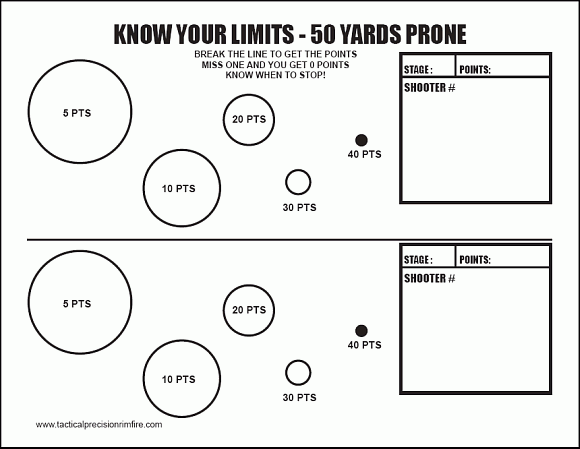
Know-Your-Limits Target for Rimfire Training & Fun Matches
Here’s a rimfire training target with “big to small” target circles. Start with the largest circles, then move to the smaller ones in sequence. This systematic drill provides increasing challenge shot-by-shot. Novices often are quite surprised to see their accuracy improve as they move from bigger to smaller aiming points. That provides positive feedback — always a good thing.
Right Click and “Save as” to download printable PDF versions of target.
Five Diamond Grid Targets
Here’s a popular grid target with multiple red diamond aiming points. The background includes a grid pattern with 1″ squares — that helps to quickly estimate group size through your scope. We recommend using a color printer for this target so the diamonds and grid lines are bright red.
Here’s a NRA-type target for pistol shooting. The bright red center helps when shooting indoors because well-placed bullet holes are much more visible. This target includes data entry boxes to record gun type, score, and load data. This is one of many good free targets available at Targets4free.com.
Kirsten Joy Weiss has created a useful video about Dry-Fire practice. Dry-Fire is a method of training without a live round in the chamber. Dry-Firing is effective, Kirsten explains, because “it eliminates all the extra noise and messages that you get when you fire a live round. Without recoil, without the sound of a shot going off etc., all you hear is the click of the trigger. This allows you to focus on your sight picture and your trigger press.” This the lastest installment in Kirsten’s ‘How to Shoot Awesomely’ series. Kisten says: “I hope it helps you, and keep on aiming true!”
The Benefits of Dry-Fire Training
If you are not doing Dry-Fire practice yet, then it’s time to start. Dry-Fire training is essential to the sling disciplines, and very useful for F-Class. Dennis DeMille, a national Service Rifle Champion, told us that, for every minute he spent in actual competition, he would spend hours practicing without ammunition. While in the USMC, Dennis would practice in the barracks, working on his hold and dry-firing:
“The most important thing is to spend time off the range practicing. Most of what I learned as a High Power shooter I learned without ammunition — just spending time dry firing and doing holding exercises. Holding exercises will really identify the weak parts of your position. The primary purpose of dry firing is to get you used to shooting an empty rifle. If you can shoot a loaded rifle the same way you shoot an empty rifle then eventually you will become a High Master.”
Dry-Fire Training Can Benefit Benchrest Shooters
What about benchrest? Well, we’ve found that Dry-Fire sessions can even benefit benchresters — it can help reveal flaws in your trigger technique, or inconsistencies in the way you address the rifle from shot to shot. With the gun set up with your front rest and rear bag, if you see the scope’s cross-hairs wiggle a lot when you pull the trigger, you need to work on your technique. Also, dry-fire practice can help you learn to work the bolt more smoothly so you don’t disturb the gun on the bags.
NOTE: The contest is OVER, so ignore information on the PDF about submitting targets — that’s from back in 2013.
Here’s a target for the holidays that can provide some fun at the range. This Christmas Tree Target was created by Sierra Bullets for a 2013 contest. This contest is now over, but you can still have fun with the target. This tree target is designed to be shot at 15 yards with pistol, or at 100 yards with rifle.
Santa’s Extra Accuracy Challenge
Start with the big circles, and then work your way down to the small circles (7,8,9,10) as you build your confidence. Shoot the gifts for bonus points.
For an extra challenge (with an accurate rifle), try working your way back up to the top, aiming for the X-Marks in the circles and finishing with the small, inset star at the top. Try to hit each X-Mark and then put your final shot in the inner star. Have fun!
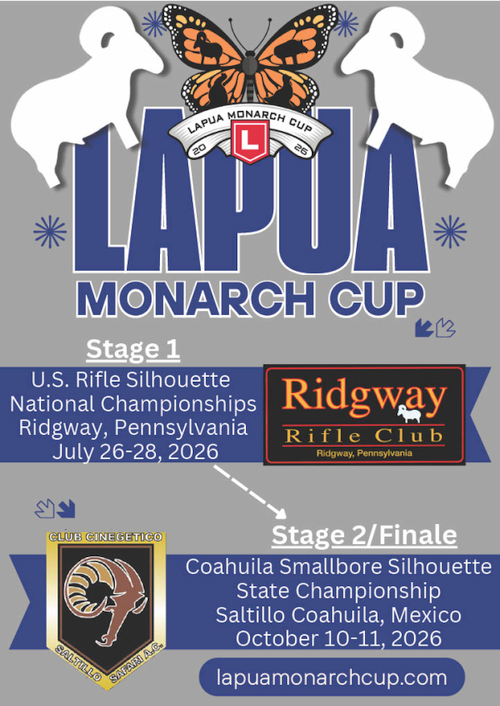
Lapua Monarch Cup Announces Official 2026 Schedule
The Lapua Monarch Cup, North America’s premier smallbore rifle silhouette competition, has announced its official 2026 schedule. Now entering its fifth year, the Cup features a two-part series of smallbore standard rifle silhouette matches hosted in the United States and Mexico. The Lapua Monarch Cup is built around the annual U.S. Smallbore Rifle Silhouette National Championships, with an additional host country (either Canada or Mexico) selected through a proposal process. CLICK HERE for registration details and complete information on the Lapua Monarch Cup.
2026 Lapua Monarch Cup Competition Schedule:
1st Match – NRA National Smallbore Silhouette Championships
Ridgway Rifle Club, Ridgway, PA, USA | July 26-28, 2026 2nd Match – NRA National Smallbore Silhouette Championships
Saltillo Coahuila, Mexico | October 10 & 11, 2026
About the Monach Cup — “The Lapua Monarch Cup is more than a competition — it’s a premier showcase of precision and passion”, said Adam Braverman, Vice President of Sales and Marketing at Lapua and advisor to the Cup. “With $25,000 in cash prizes on the line, this event delivers an unmatched experience for shooters while fostering camaraderie and celebrating world-class marksmanship across North America.”
Competitors earn scores from each match within their respective classifications (Master, AAA, AA, & A), allowing all participants the opportunity to compete for a share of $25,000 in cash prizes distributed across the two events.
The Lapua Monarch Cup Board is pleased to welcome new members: Dustin Flint (USA), Gabriel Villareal (Mexico), Jose Corral (Mexico). These three new Board Members join existing members Erich Mietenkorte, Daniel Salazar, Jason Marsh, Jose (Pepe) Valdes, and Chris Cawthorne — with Adam Braverman serving as an advisor. To learn more about the North American Silhouette Shooting Association (NASSA), visit www.nassasilhouette.org.
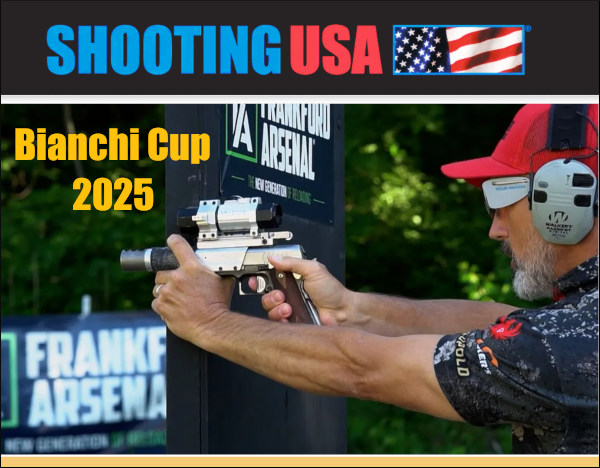
The famed Bianchi Cup pistol match is featured today on Shooting USA television. This event, the top action pistol match on the planet, celebrates its 45th year in 2025. The CMP Bianchi Cup attracts the world’s leading pistol shooters, and this year the Cup added a new .22 LR rimfire pistol division. Adding rimfire competition is a big, positive update to this venerable competition.
Shooting USA TV Broadcast Times on the Outdoor Channel
Wednesday 12/3/25 at 9:00 PM Eastern and Pacific, 8:00 PM Central on Outdoor Channel. If you miss the broadcast you can view the episode at any time for $0.99 on Vimeo. Or, subscribe to see all Shooting USA shows on Vimeo as often as you wish for $2.99 per month.
Bruce Piatt Wins 2025 Bianchi Cup
At the 2025 Bianchi Cup competition, Legendary competitive shooter and Team Vihtavuori member Bruce Piatt claimed his eighth Bianchi Cup title, securing victory at the 2025 Bianchi Cup with the only perfect score of 1920 in the match.
The Civilian Marksmanship Program (CMP) now oversees the Bianchi Cup competition, previously run by the National Rifle Association. The 2025 Civilian Marksmanship Program (CMP) Bianchi Cup, known as the gold standard in action pistol shooting, was hosted once again at the Green Valley Rifle and Pistol Club in Hallsville, Missouri, May 20-23, 2025. Participants from all over the world competed in the Falling Plates, Moving Target, Barricade, and Practical events.
This video features the 2025 CMP Bianchi Cup at the Green Valley Rifle and Pistol Club in Hallsville, Missouri. This video showcases the new class for .22 LR pistols. Watch talented rimfire pistol competitors firing .22-caliber pistols at steel plates. The new rimfire class allows much more affordable competition. High quality .22 LR match ammo is available for $11.50 for 50 rounds (just 23 cents/round). By contrast, a good box of .38 SPL match ammo can cost $0.60 to $1.10 per round (or more).
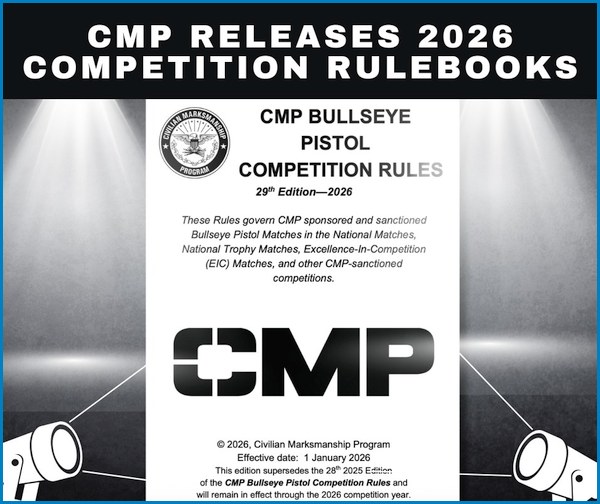
CMP Announces the Early Release of Four 2026 Competition Rulebooks
Four rulebooks that govern CMP Highpower Rifle, CMP Games, Bullseye Pistol and Action Pistol competitions in 2026 have been updated and approved by the CMP Rules Sub-Committee. These four rulebooks were published on 12/1/2025, one month before they will take effect on January 1, 2026. This early release will give competitors and match sponsors a head start on preparing for their next competition year. Download these Four New Rulebooks at https://thecmp.org/competitions/cmp-competitions-rulebooks/.
The following 2026 rulebooks are now posted on the CMP website:
Copies of these new rulebooks can be downloaded from the CMP Competition Rulebooks Webpage. On that CMP webpage, the listings of downloadable documents will include the 2026 rulebooks, lists of changes in each 2026 rulebook, and the Range Officer scripts that are to be followed.
Notable CHANGES IN 2026 CMP RULEBOOKS
The four CMP rulebooks that are being released now contain some important changes that may impact your 2026 competition plans. Here are some of the most significant 2026 rule changes.
New F-Practical F-Class Category (HIGHPOWER RIFLE). The 2026 CMP Highpower Rifle rulebook introduces a new F-Practical F-Class Category that is limited to factory production rifles and equipment. Cartridges cannot exceed .308 in bullet diameter; “magnums” will not be allowed. Rifles may not weigh more than 14.0 pounds and must have a minimum trigger pull of 2.0 pounds. Optics are limited to 16X. Total retail cost of a competitor’s rifle and equipment is limited to $3,000. This new category will be offered in all CMP Mid- and Long-Range Matches. Clubs are encouraged to include it in their sanctioned matches.
Suppressors and Silencers (HIGHPOWER RIFLE). The use of silencers or suppressors is already widespread in some shooting sports disciplines. Their use is promoted as a means of reducing range noise levels and mitigating the possibility of hearing loss. The CMP has taken its initial steps in approving suppressors for use in CMP Matches. In 2026, competitors in most F-Class categories (F-TR, F-O, AR Tactical) will be allowed to shoot with suppressors.
Highpower Rifle Scoring (HIGHPOWER RIFLE). Several years ago, the CMP adopted the highpower rifle scoring protocol used by the NRA. This calls for scoring highpower rifle targets according to the size of the competitor’s bullet. This meant that competitors with AR-Type rifles had their shots scored with a .223″ gauge while competitors firing M14-Type rifles had their shots scores with a larger .308″ gauge. Starting in 2026, electronic targets used in CMP Highpower Rifle events will have the same sized scoring rings. Electronic targets, of course, score to the center of the shot hole, not the outside edge, so those targets will now assume that all shots were fired with a 7.62mm/.308 bullet to determine precise scoring ring sizes. All shots fired on paper targets will be scored with a uniform .308 inch scoring gauge.
Nat’l Trophy Match New Shooter Rule (HIGHPOWER RIFLE & BULLSEYE PISTOL). National Trophy teams will get a break if they have two or more new shooters on their National Trophy Teams. They must designate one of them as their new shooters. Any other new shooters retain their new shooter eligibility.
At-Large Teams (HIGHPOWER RIFLE, BULLSEYE PISTOL). The new rules for both Highpower Rifle and Bullseye Pistol changed “Out-of-Competition” teams to “At-Large” teams. This rule is used extensively in the National Trophy Rifle and Pistol Team Matches to allow teams that could not comply with eligibility requirements to still shoot in the match even when they could not win awards. To give status to these teams, the name was changed to “At-Large” and the possibility of giving awards has been added.
Smallbore Rifle and Air Gun Rulebooks Delayed. The completion of two 2026 CMP rulebooks is being delayed while the shooting world awaits final decisions from the International Shooting Sport Federation (ISSF) regarding major proposals to change rifle clothing and rifle 3-position finals.
Shown above is David Tubb, the legendary 11-time National High Power Champion, posing with a very serious rifle used in the Extreme Long Range (ELR) game. David has jumped into the Extreme Long Range discipline in a very big way, producing a .375-caliber, long-barreled ELR version of his famous Tubb rifle, called the Adaptive Target Rifle (ATR). A version of this rifle, piloted by David’s son-in-law Nate Stallter, set an ELR World Record in January 2018. See video below for a full report.
This video shows Team TUBB setting a new ELR World Record of 2011 Yards using the Tubb Adaptive Target Rifle in .375 CheyTac. Nate Stallter nailed three shots at over one mile — 1768 yards. Then Nate broke his own record, going 3 for 3 at 2011 yards. ELR Central hosted this match, held at the Front Sight gun range, Pahrump, Nevada on January 21, 2018.
David Tubb Shoots ELR Adaptive Target Rifle at KO2M
For the Extreme Long Range (ELR) discipline, David Tubb developed a .375-caliber, long-barreled ELR version of his famous Tubb rifle, called the Adaptive Target Rifle (ATR). A version of this rifle, piloted by David’s son-in-law Nate Stallter, set an ELR World Record in January 2018.
David Tubb Talks about KO2M and Extreme Long Range Shooting
David Tubb’s long-range rifles have performed well in Extreme Long Range shooting. AT the 2019 NRA Extreme Long Range Championship, David Tubb won the Heavy Gun Division. In this video, created during the King of 2 Miles (K02M) competition at the Whittington Center in New Mexico, David talks about the challenges of ELR shooting, and cartridge selection. Big, heavy, large-caliber bullets with ultra-high BCs are favored for the ELR game, but recoil and cost must also be considered.
About the .375 CheyTac Cartridge
Some of the most successful ELR cartridges are based on the CheyTac family, including the .375 CheyTac (9.5×77) and .408 CheyTac (10.36 x 77). This .375 Cheytac cartridge has proven to be tough and accurate. And it is capable of winning — our friend Derek Rodgers won the 2017 King of 2 Miles (K02M) event shooting a .375 CheyTac (9.5×77).
Derek Rodgers was the 2017 King of 2 Miles. Derek is also the first-ever human to ever hit the maximum distance target target at 3368 yards (1.91 miles). His cartridge choice? The .375 CheyTac. Derek ran Cutting Edge Bullets in Peterson brass with Hodgdon H50BMG powder.
Q: Why did you choose the .375 CheyTac cartridge?
Derek: When I was asked to join the Applied Ballistics Team, I needed to get an ELR rifle built in a short period of time. I was under a very tight time schedule to get the project complete. In an effort to eliminate variables, I decided to keep things standard and as simple as possible. I chose the .375 CheyTac for the ease of getting components. The larger rifles are more difficult to get components quickly and I felt like the .375 CheyTac had enough attributes to be competitive at ELR distances.


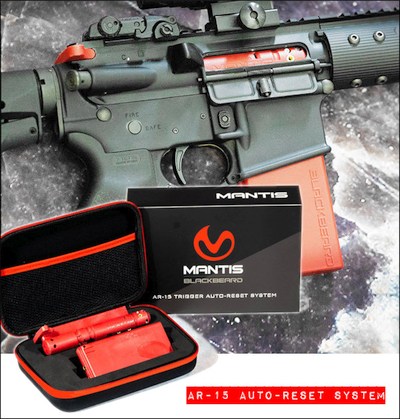 AR service rifle shooters can definitely benefit from the Mantis Blackbeard system, a Bolt Carrier + Magazine replacement that works with your existing trigger.





 Most articles and discussions regarding competitive shooting center around equipment. Now and then one will come across an article about physical training such as the USAMU piece on
 Last I want to mention visual performance training. The




 The Benefits of Dry-Fire Training
 Santa’s Extra Accuracy Challenge
 Bruce Piatt Wins 2025 Bianchi Cup