Ace tactical shooter and gunsmith Jim See of Elite Accuracy LLC has tested a Frankford Arsenal rotary brass tumbler. Like the older Thumbler’s Tumblers, this can tumble your cases in a liquid solution. The wet-tumbling process worked very well Jim reports. Posting on Facebook, Jim noted: “I was super impressed with the Frankford Arsenal rotary tumbler and cleaning packs they sent me. I ran 350 pieces of brass for one hour. They now look great.” Jim appreciated not having to deal with dry tumbling media, such as crushed walnut shells. Dry media produces dust and can leave residues or clog flash-holes.
Interestingly, Jim recommends you try wet-tumbling WITHOUT using stainless media. At least give it a try. Tumbling without media simplifies the process and you don’t have to worry about pins stuck in flash-holes or case-necks*. Jim reports: “Stainless steel pins come with the Frankford kit, but mine hit the trash right out of the box. There is no need to clean the inside of your cases 100% and that’s all the pins add to the equation. The brass bumping brass with hot water and Frankford’s liquid cleaner works great all by itself.” One wag stated: “That’s great to hear. Stainless steel pins are a PITA.”
Other Facebook posters concurred with Jim’s evaluation of the Frankford Arsenal Rotary Tumbler:
“I’ve had one for a couple years, and it works well. I usually run about 250-300 Dasher cases at once in it. But I use the pins because I’m OCD about clean brass.” — David W.
“I’ve had one for a year and a half and it definitely works with or without pins.” — Luke C.
“I got one about six months ago and have yet to use any stainless steel media [pins]. I just use some dawn, distilled water, and Lemi Shine®. Turns nasty 5.56 range brass bright and shiny.” — Brian D.
“I don’t use the pins either and use a combination of Dawn soap and Lemi Shine.” — Jon N.G.
This video shows how to assemble and operate the Frankford rotary tumbler. But note, Jim See does NOT feel that it is necessary to use stainless media.
How to Dry Your Brass — Hair Dryer Vs. Machine
The downside of wet tumbling is that you end up with a pile of wet brass at the end of the cleaning cycle. There are many ways to dry brass, from drying in the sun to using a kitchen oven (be careful not to “overcook” your brass). One Facebook poster asked Jim: “What is your drying method for wet brass, and how long does it take?”
Jim See replied: “To start I just drain off the dirty water, and rinse the brass with clean hot water. Then I roll the brass on a towel for 30 seconds and put the brass in a one-gallon bucket. Next I insert a hair dryer in the bucket (with the brass) and let it run for about 5 minutes. With this procedure, the drying process for me is done in less than 10 minutes.”
Jack Lanhart has another method: “I use a food dehydrator. It takes 30 to 45 minutes.”
For those who don’t want to mess with towels and hair dryers, Frankford Arsenal offers a matching Platinum Series Case Dryer that simplifies the process of drying brass. Lyman also makes an excellent Cyclone Case Dryer. These drying machines each cost about $65.00 and both have multiple levels so you can separate different types of cartridge brass. Lyman states that “The forced heated air circulation of the Cyclone will dry your brass inside and out within an hour or two, with no unsightly water spots.” The Lyman dryer can also be used for ultrasonically-cleaned gun parts.
*The Frankford Rotary tumbler does include media separators if you choose to use the provided pins or other media. CLICK HERE for diagram showing how to use media separators.
Lyman makes a very handy product for reloaders that can save space on your reloading bench and give you more efficient powder flow into your cases. With common plastic “one size fits all” type powder funnels, the powder sometimes sticks to the sides of the funnel. Or, the fit to the case mouth is less than ideal so some of the kernels end up on the bench.
Precision powder funnels solve those problems. But what if you shoot a wide range of calibers with big and small case mouths? Lyman has the answer: the Brass-Smith Precision Funnel set, now $28.79 at Midsouth. This handy product combines a static-free cast aluminum funnel with a set of SIX (6) CNC-machined inserts that fit cartridges from .22 caliber all the way up to .338 caliber. It is easy to swap the inserts to match the particular cartridge you are loading. In this Ultimate Reloader video, our friend Gavin Gear shows how to use the Lyman Precision Pro Powder Funnel Set with multiple neck-diameter inserts:
Product Description: “The Brass-Smith Precision Funnel set is made to be completely static-free, no more powder clinging to surfaces which can happen with lightweight plastic Funnel. This is no ‘one size fits all’ funnel — the Brass Smith Precision Funnel set uses precision-machined, caliber-specific inserts to properly fit the case neck. CNC-turned aluminum inserts to fit specific cartridge families for calibers 22 to 338. Inserts are laser-marked for caliber identification. The inserts can be quickly and easily installed by simply pushing them into place and then pulling them out when changing calibers. The Funnel comes with inserts for .22, .243/6mm, .25/6.5mm, .270/7mm, .30 and .338 caliber rifle cartridges. A padded storage case neatly stores the funnel and inserts when not in use.”
Forum Member Likes the Lyman Precision Powder Funnel Set
One of our Accurate Shooter Forum members, Garandman, purchased the Lyman Precision Funnel System. He has used it now for multiple cartridge types and is very pleased with the results. Here is his report:
“I wanted to share my good experience with the Lyman powder funnel. First off, with the funnels being aluminum / pot metal, no static charge forms and the powder kernels go right down the funnel into the case with no hang-up.
Also the funnel comes with interchangeable case neck dimension inserts so you get no powder loss outside the case neck. And the funnel is also is less likely to stick to the case neck and pull it out of your loading block. That could spill powder all over the place.”
Overall, the Lyman Precison Funnel Set with case neck inserts has done a great job for Garandman and he suggests you may want to add this tool to your reloading tool collection. Below is a Lyman Precision Funnel Set review from Johnny’s Reloading Bench. This video review has nice close-ups of the six precision inserts from .22 to .338 calibers.
Wilson Combat has introduced a New Ultralight Arms (NULA™) line of bolt-action rifles. These hunting rigs are accurate and very light weight, ranging from 4 lb. 15 oz. to 5 lb. 4 oz., depending on caliber and barrel length. Currently, five chamberings/calibers are offered: .243 Winchester, 6.5 Creedmoor, 7mm-08 Remington, .308 Winchester, and .358 Winchester. Other chamberings will be offered in the future.
With a $3295.00 MSRP, the NULA rifles are expensive. But this modern ultra-light bolt-action rifle seems like a good choice for an avid hunter. NULA rifles have a sub-1″ MOA accuracy guarantee. Weighing about 5 pounds without scope, the NULA is also one of the lightest hunting rifles on the market. On extended hunts, light weight is a huge advantage. No one wants to carry a 10-lb rifle for many miles in the field.
The NULA rifle is a good choice for hunters, given its lightweight design. And the guaranteed sub-MOA accuracy should give hunters confidence. The NULA’s lightweight construction makes it easy to carry and maneuver in the field. Wilson Combat states: “Whether you’re hunting big game or small varmints, this bolt action rifle provides the accuracy and dependability needed to get your trophy quickly and cleanly.”
This top-of-the-line rifle boasts many premium components: Timney Elite Hunter trigger (with 2.75- to 3.25-lb trigger pull), Wilson Combat 416R stainless honed stress-relieved button-rifled barrel, and EDM Cut and machined action made from 4140 bar stock. The barrele action is fitted to an ultra-lightweight carbon fiber stock with reinforced receiver walls for added strength without adding weight.
For its NULA rifle series, Wilson Combat started with a proven Melvin Forbes rifle design and then made several major improvements. The NULA rifles are now produced with advanced manufacturing methods and modern materials including carbon fiber.
Bill Wilson stated: “I feel so fortunate to know Melvin and to have been entrusted with the opportunity to continue his legacy of building the finest and lightest bolt rifles on the market. I’m also deeply humbled and honored that Melvin has put his trust in me and my team at Wilson Combat to continue his life’s work. He is basically turning his ‘baby’ over to us and I assure him and all the past and future customers we won’t let any of you down.”
The digital archives of Shooting Sports USA magazine (SSUSA) features an Expert Forum on Wind Reading. This outstanding article on wind reading starts off with a section by ballistics guru Bryan Litz, author of Applied Ballistics for Long-Range Shooting. Then four of the greatest American shooters in history share their personal wind wisdom. Lanny Basham (Olympic Gold Medalist, author, Winning in the Wind), Nancy Tompkins (Past National HP Champion, author, Prone and Long-Range Rifle Shooting), David Tubb (11-Time Camp Perry National Champion), and Lones Wigger (Olympic Hall of Fame) all offer practical wind-reading lessons learned during their shooting careers.
Whether you shoot paper at Perry or prairie dogs in the Dakotas, this is a certified “must-read” resource on reading the wind. Here is a sample selection from the article:
Shooting Sports USA magazine (SSUSA) has a modern, mobile-friendly website with tons of great content. Log on to www.ssusa.org. There you’ll find current news stories as well as popular articles from the SSUSA archives. The SSUSA website also includes match reports, gear reviews, reloading advice, plus expert marksmanship tips from the USAMU.
Here is beautiful F-Open rig crafted by Forum member CigarCop of KW Precision LLC. It features a laminated wood stock with stunning figured walnut on the outside.
One of the most popular items in our Shooters’ Forum is the ongoing “Pride and Joy” thread. Since 2009, Forum members have posted photos and descriptions of their most prized rifles. Here are some of the most popule “Pride and Joy” rifles showcased in our Forum. Do you have a gun you’d like to see featured there? Just Register for the Forum and you can add your favorite gun to the list. You’ll enjoy the Forum, which recently hit the 70,000-member mark!
600/1000 Benchrest Light Gun for Richard Schatz in 6 BRA
This blue benchrest rig was crafted by Alex Wheeler for ace benchrest competitor Richard Schatz, a past 600-yard IBS Shooter of the Year. Richard’s new 600/1000-yard Light Gun features a Krieger barrel chambered in 6 BRA (40° Ackley version of 6mmBR Norma). That Krieger is mated to a 1.550″ BAT B action, ignition-timed for smooth bolt close and increased accuracy. The trigger is the sophisticated Bix’n Andy. Schatz’s BAT is glued and screwed into a Wheeler LRB stock, with aluminum rails and adjustable metal “tracking rudder” on the toe of the stock. The rudder can be adjusted side to side to ensure optimal tracking, while the rudder’s vertical angle can be adjusted slightly with shims.
Hand-Crafted Thumbhole-Stocked Rifle Chambered in 6 PPC
Forum Member Grimstod offered this handsome 6 PPC custom with a beautiful, hand-made thumbhole stock: “This was fully accurized with Premier Accuracy recoil lug installed. Really makes these shoot a lot better. It features a Kelbly Panda action with Hart barrel and glass bedding. Trigger fall was perfect to start and we have to give Ian Kelbly big thumbs up for making every action perfectly timed.” On top is a March competition scope. See more photos at www.premieraccuracy.com.
A Wicked Accurate Big Dawg in 28 Nosler
This 28 Nosler Benchrest rifle looks good and shoots even better — check out that 20-shot target shot at 200 yards! You can’t argue with that…
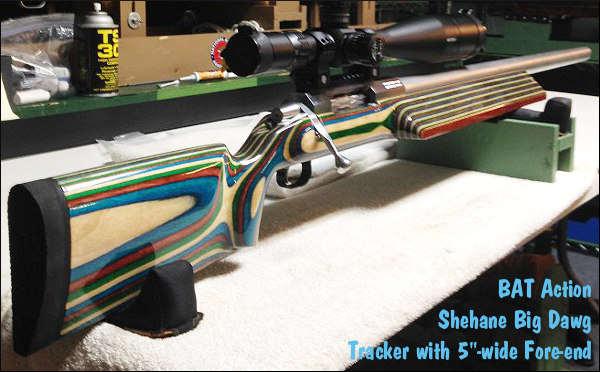
Belonging to Forum member LA50Shooter, this rig is chambered in 28 Nosler, with metal work by Gre-Tan Rifles. The action is a BAT Model “L” 1.650 Octagon with a 30 MOA scope rail, running a Jewell BR Trigger. The stock, from D&B Supply, is a Shehane Big Dawg Tracker with 5″ fore-end. Color scheme is “Field & Stream” Rutland laminate. This big rig boasts FOUR 34″ Benchmark barrels (1.5″ for seven inches tapering to 1.225″ at muzzle).
A Pair of Score Benchrest Beauties
Forum member JimPag showcased two new Benchrest-for-Score rifles. The rig on the left, smithed by Dwight Scott, features a Farley Black Widow RBLPRE (with Bix’n Andy trigger). It features Pistachio and Carbon Terry Leonard stock glued and screwed by Sid Goodling. The barrel is a Krieger 23.5″ chambered in 30BR with a Mike Ezell tuner. It’s topped with a Goodling-built 1-piece Davidson base and a Nightforce 42X Comp scope. The rifle on the right, smithed by Sid Goodling, features a Marsh Saguaro RBLPRE Action with Bix’n Andy trigger, and March 36-55X scope. This rifle boasts a rare Screwbean Mesquite and carbon stock by Terry Leonard. The 23″ Lilja bbl is chambered in 30 Thrasher with a Goodling tuner. (30 Thrasher is longer 30 BR case developed by Joe Entrekin). Jim also has two other barrels for this action in 30 BR and 6 BRAI. On top is a Sid Goodling-built one-piece Davidson base with a March 36-55X scope.
6BRA with BAT Action, Brux Barrel — The Blue Beauty
Next is a blue 6BRA beauty from Forum Member RiflePainter: “This is my brand new 6BRA Light Gun built by Jason Danley at Danley Precision! Jason did all of the work including paint. Brass was done by Darrel Jones at DJ’s brass service.” This features a Johnny Byers stock painted in HOK Custom Oriental Blue Candy mix. The action is a BAT DS Left-load, Right-eject, Right bolt fitted to a 1.5 oz. Jewell trigger. The barrel is a 28″ Brux HV 1:8″-twist chambered for the 6BRA (6mmBR Ackley) and fitted with a Harrell’s radial muzzle brake. On top is a Sightron SIII 10-50x60mm optic riding in BAT 1-piece scope rings.
Rem 700 in Manners Stock — .284 Winchester for Hunting
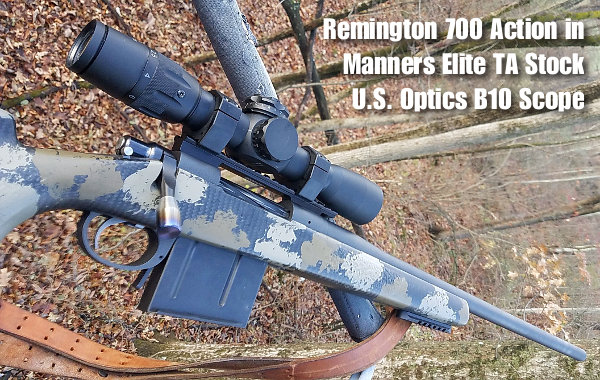
Here’s a Rem 700 enhanced with a Manners Elite TA stock and other upgrades. Forum Member NickB1075 says: “Here is a rifle I finished for hunting this year. It’s a bit heavy for New York woods carry but it just shoots great. Maybe I will have to get one of those fancy Proof Research barrels to lighten it up a bit.” Nick is running a Benchmark 1:8.5″-twist barrel chambered in .284 Win with 0.315 neck for shooting 150gr Barnes bullets. Nick added a Jewell trigger and on top is a U.S. Optics B10 Scope.
When Only the Biggest and Boldest Will Do — .50 BMG
No “Pride and Joy” feature would be complete without a Big Boomer. This impressive .50 BMG, “61 inches of big bore goodness”, weighs a whopping 49 pounds (95 lbs. complete with case and accessories). This rifle’s proud owner, forum member 6MT, says everything on this black beast is jumbo-sized: “Yes, I can stick my finger clear through the ports in the muzzle brake!” The rifle boasts a U.S. Ordnance 31″ heavy-contour barrel fitted to Barnard GP action. The stock is a “Big Mac” from McMillan. No optics yet — 6MT says he is “looking at an ATACR 7-35x56mm with a Spuhr mount… As soon as my wallet recovers!”
Hunting season is starting soon around the country. For hunters that means many hours may be spent searching for animals through spotting scopes and binoculars — “glassing” for game. And when the hunter does find a good buck or doe, he’ll need to know the animal’s precise distance, so that demands a good laser rangefinder. Being carried in the field, the scopes on hunting rifles need to be tough and durable, and every hunting scope should have good low-light performance. And when the hunter finally takes his shot, his scope better be properly zeroed. Today’s Saturday at the Movies showcase is all about Hunting Optics. We offer nine great videos that help you select the right riflescope, spotting scope, rangefinder, and binoculars for your next hunt.
Comparison of Seven Popular Deer Hunting Scopes
This is summary review of seven (7) popular hunting scopes, as available in 2020 (there may be newer variants). This video consist mostly of manufacturer-created marketing content with a few minutes of independent reviews. Consider this video a place to start when shopping for a new hunting optic. You’ll want to check independent reviews when you select a particular model. The seven riflescopes featured in the video are: Athlon Optics Argos BTR, Leupold VX-3i 3.5-10x50mm, Leupold VX-R 4-12x40mm, NightForce SHV 5-20x56mm, Nikon Buckmasters II, Vortex Crossfire II, Vortex Viper HS SFP.
Optics Selections for Mountain Hunts
Here’s a good video by an avid hunter who treks in remote, mountainous zones. The host has learned what works… and what’s worth the weight to carry: “I’ve found that the combination of 10×42 binoculars and a 27–60x80mm spotting scope is the sweet spot for mountain hunting. This pairing balances weight with reach, allowing me to keep moving but also reach out and see well-hidden animals. In some cases, I will make use of an 18×56 binocular, but this is reserved for non-backpack hunts. With 25 years of mountain hunting experience, I can whole-heartedly recommend my preferred binocular pair as a fantastic and versatile set-up for northern mountain hunts at the very least.”
Ultimate Spotter Test — 19 Spotting Scopes Reviewed
The producers of this remarkable 19-product spotting scope comparison state: “If you are looking at choosing the best spotting scope for hunting… you are in the right place! We tested these 19 spotting scopes to find the best compact spotting scope, best 65mm spotting scope, and best 85mm spotting scope out there. We also wanted to find the best values on the market, and I think we definitely did that. While we certainly couldn’t test them ALL, we were able to put together this incredible lineup of some of the best spotting scopes out there to help you find what is going to work for your specific needs.”
First Focal Plane vs. Second Focal Plane Scopes
For the last century, Second Focal Plane (SFP) scopes have been most common on hunting rifles. Now there are an increasing number of First Focal Plane (FFP) optics favored by hunters. The main reason is that the reticle mark values (in Mils or MOA) are constant relative to the target size at all magnification levels. That is handy for hold-offs and hold-overs. On the other hand, a SFP scope maintains a constant reticle size and line thickness at all zoom values. For most hunting shots, taken inside 300 yards, that really should be fine. Many hunters feel they can spot their prey more easily without a busy reticle that obscures small details at higher magnification. This video explains the pros and cons of both reticle types. The final decision is up to you — much will depend on the terrain you hunt and the distances you shoot.
Field Evaluation of Nine Binoculars under $500
Here is another multi-product optics comparison test. Backwoods Pursuit tested nine binoculars under $500. The testers evaluated each of the nine binoculars performed, considering optics (glass) quality, sharpness, low-light performance, focus control, weight, and ergonomics. Listed in the order they appear in the video, here are the nine binocular types tested:
1:27 Maven C.1
2:16 Athlon Midas
3:15 Zeiss Terra ED
4:30 Kowa BD II XD
5:34 Bushnell Forge
7:29 Vortex Viper HD
The Complete Optics Selection for For Deer Hunting
In this video, Vortex optics techs explain the optics package deer hunters will want to take into the field. Along with a good medium-power zoom riflescope, you’ll want binoculars and (probably) a spotting scope. You’ll also want a Laser Rangefinder (LRF) or laser-equipped binoculars. As the team points out, the LRF is not just to range your prey right before you take a shot. A top-quality LRF can range a reflective object as far as 1500 yards away. That helps you decide whether you want to hike a mile to reach that buck you see way out on the next ridge.
Comparison of Eight Laser Rangefinders
The Backfire team purchased eight rangefinders and tested them in the field. Most of the products are under $500. This is a good review if you are looking for a compact LRF at a moderate price. Looking at performance for the price, for the hunting market, the reviewers favored the Leupold RX-1600 and the waterproof Vortex Ranger 1800. COMMENTARY: If you can afford it, we recommend that serious hunters consider top-end laser rangefinder-equipped binoculars such as the ZEISS Victory RF and Leica Geovid.
MOA vs. MIL — What you Need to Know
These days, scope manufacturers offer a wide selection of both MIL (Milliradian) and MOA (Minute-of-Angle) based optics. We do think that MOA is still predominant in the lighter-weight, lower-cost (sub-$500) scopes marketed for hunters. There are pros and cons for both angular measurement systems. One MIL is 3.6″ at 100 yards, while one MOA is 1.047″ at 100 yards. If you grew up thinking in inches, a 1/4-MOA click-value hunting scope might work best. If you shoot PRS or have other MIL scopes you may prefer a MIL-value optic for your hunting rifle. Both choices will do the job.
How to Zero Your Hunting Rifle Efficiently
Last but not least, here’s a great video from Vortex that shows you how to quickly and efficiently sight-in and zero your hunting rifle before heading out into the field. This video explains a simple procedure that lets you get a solid zero in just three shots. Of course you probably want to fire a few more rounds to confirm your zero before you head off to your hunting grounds, but this will let you get on-target with a minimum amount of time and ammo expended. This helpful video has over 3 million views on YouTube!
Fouling Shots and Cold Bore Condition
If you recently cleaned your rifle, you may want to fire two or three fouling shots before you start this procedure. But keep in mind that you want to duplicate the typical cold bore conditions that you’ll experience during the hunt. If you set your zero after three fouling shots, then make sure the bore is in a similar condition when you actually go out hunting.
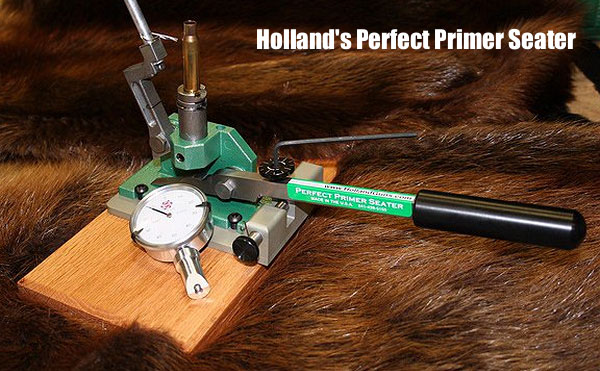
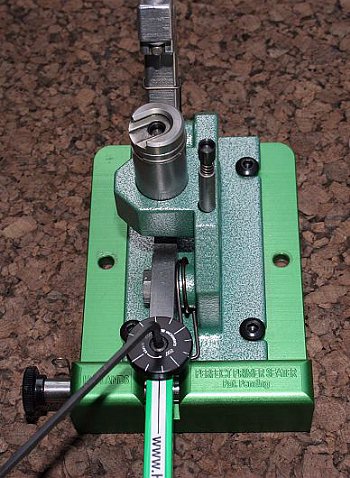
Gunsmith Darrell Holland sells a Priming Tool Adapter that upgrades the RCBS Auto Bench Priming Tool with key features — including primer seating depth control. If your hand starts to hurt after priming dozens of cases with a hand-held, squeeze-type priming tool, you may want to consider Holland’s invention, which he calls the “Perfect Primer Seater” (PPS).
Holland basically has modified the RCBS lever, adding a precise crush control and a means of measuring depth with a gauge. He claims this gives “an EXACT primer seating depth based on primer pocket depth and primer thickness”. With Holland’s PPS, primer seating depth is controlled with a rotating wheel that limits lever travel in precise gradations. You can buy the complete priming system for $340.00, or, if you already own the RCBS Auto Prime tool, you can purchase an adapter kit (with base, arm, adjuster, and gauge etc.) for $190.00. To order, visit Hollandguns.com Reloading Equipment Page. Look for the Perfect Primer Seater Adapter for $190.00 or order the Complete Unit for $340.00.
User Review by Tommy Todd
Sierra Bullets’ Chief Ballistician Tommy Todd acquired the Holland Perfect Primer Seater, and gave it a positive review. Todd writes: “This cartridge case priming system allows you to measure the primer pocket depth and adjust the seating tool to match the primer seating depth for a contact fit with a measured lot of primers to the cases you are working with. Mr. Darrell Holland has taken a standard RCBS automatic bench-mounted priming tool and modified it to a new level of precision. The modifications allow you to measure the primer pocket depth, primer height, and with the addition of an adjustable stop on the priming tool achieve precision primer seating, rather than how the primer ‘feels'[.]
If you are already utilizing the RCBS priming tool, Mr. Holland offers an adapter kit to upgrade your equipment. If you are looking for a new priming unit, I suggest giving this product a try. Increasing consistency when seating primers should result in smaller groups[.]”
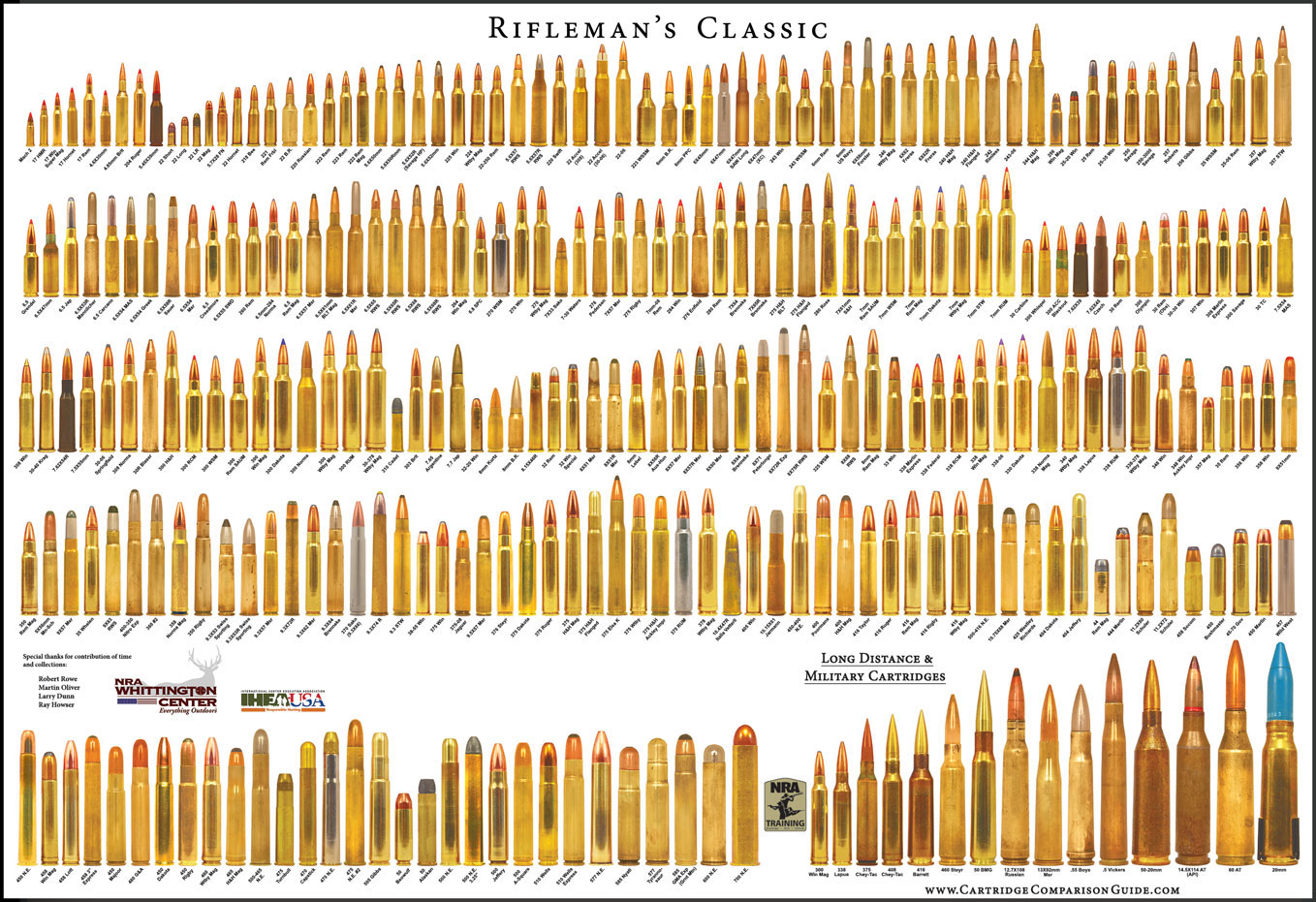
Need something for the walls of your “man cave” or reloading room? Looking for a great birthday gift for one of your shooting buddies? The creators of the Cartridge Comparison Guide offer a collection of wall posters showing ammunition types from 17 caliber rimfire cartridges all the way up to giant 35mm military rounds. ChamberIt.com currently offers 12 different large wall posters that display a huge variety of cartridge types. For example, the American Standard Poster (shown above) contains every standardized cartridge mass produced in the USA as of 2021. The cartridges are 100% to scale (life size). These posters feature full color images on high gloss / high quality 100-lb poster paper.
For example, the Rifleman’s Classic Poster (below), a full 38 inches wide and 27 inches tall, is the most comprehensive. This $17.76 poster displays over 300 rifle cartridge types at true size (within 4/1000 of an inch). Cartridges shown range from .17 caliber all the way up to the big boomers (including some cannon shells). The Rifleman’s Classic Poster includes nearly all American Standardized Rifle Cartridges and many European rifle cartridges.
Rifleman’s Classic Poster Click to view large size poster.
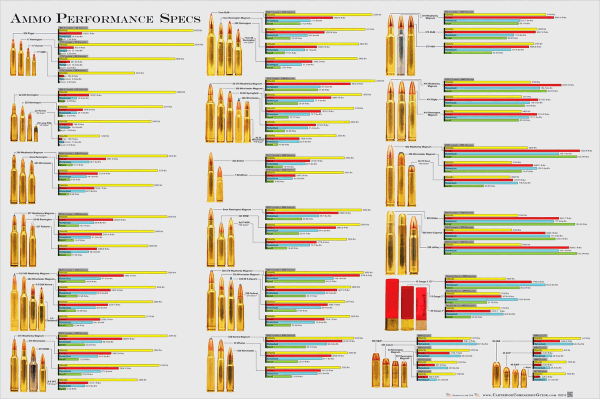
Ammunition Performance Specifications Poster
There is also an interesting Ammo Performance Specs poster. This shows dozens of popular hunting cartridges with the velocity, energy, momentum and recoil for each cartridge displayed in a bar graph.
This shows the actual size of the Ammo Performance Poster as displayed on a wall.
Small patches are not very efficient at distributing bore cleaning liquids inside your bore. The problem with a tight-fitting patch is that the solvent gets squeezed off in the first few inches. You can switch to a smaller jag, or a bore mop, but there is an even better way to get an ample amount of solvent in your bore. Just spray directly into the bore with a wash bottle, an inexpensive plastic bottle with an L-shaped dispensing neck, tapered at the end.
When using the wash bottle, you can either just plug the breech and spray from the muzzle end (where most copper fouling is), or, alternately, put the wash bottle neck directly in the chamber and spray forward. When spraying from the chamber forward, you may need to use a rubber O-Ring to seal off the action… depending on the bore size and the particular wash bottle’s neck spout diameter. We prefer to plug the breech and squirt from the muzzle.
Bottle Solvent Application Great for Smaller Bores
Using wet patches or wet brushes is an inefficient way to really saturate the tight bores of 17s, 20s, and 22s. Even with a cotton bore mop, most of the solvent will be squeezed out before it gets to the end of the bore, where most copper fouling occurs. For these smaller 17, 20, and 22-caliber bores, you can just take the wash bottle and stick the tapered nozzle right in the chamber. The tapered end will press fit in the throat, sealing off the chamber. With the barrel slightly nose-down, give the bottle a couple good squirts until the solvent mists out the muzzle. In just a few seconds, this will put more solvent in the bore than a half-dozen wet patches.
A solvent-filled wash bottle is also handy for wetting your brushes. It’s much easier to saturate a bore brush (without spilling solvent on your stock), by using the wash bottle. You can get wash bottles from USPlastic.com, Amazon.com, or lab supply stores.
Product innovation is all about “building a better mousetrap”, or in this case, building a better bore-cleaning patch. A real smart guy, Shane Smith, has invented a triangular patch that earned a patent. The U.S. Patent Office has awarded a utility patent for BoreSmith’s Triangle Patch™. This unique cleaning patch was designed by Shane Smith, a mathematician/physicist who employed his scientific and firearms knowledge to create innovative bore-cleaning products.
BoreSmith’s clever Triangle Patch™ (aka Pyramid Patch) presents more cleaning surface area to the bore wall than does a conventional square or round patch (of equivalent size). At the same time, the unique geometry makes Triangle Patches much less likely to jam in the barrel. This is because the notches in the sides of the triangle allow the patch to sit more uniformly on the jag (without bunching up). In addition, the Pyramid patch is must less likely to jam due to pleating. One reason conventional patches get stuck is unwanted 5-layer pleating. The special notches in the Pyramid patch remove all or most 5-layer pleating. As a result the patch does not bunch up and this also reduces rod bowing. SEE Triangle Patches HERE on Amazon.
Triangle Patch Function and Geometry Explained (See 1:18 time-mark):
NOTE: Despite what you may see in this video, you should ALWAYS insert brushes and patches from the chamber end first, using a fitted cleaning rod bore guide. With bolt-action rifles, NEVER insert a cleaning rod (with brush or jag) in through the muzzle. This may damage the delicate crown of your barrel.
The Triangle Patches work great with Boresmith’s patented dual-diameter bore brushes:







 User Review by Tommy Todd