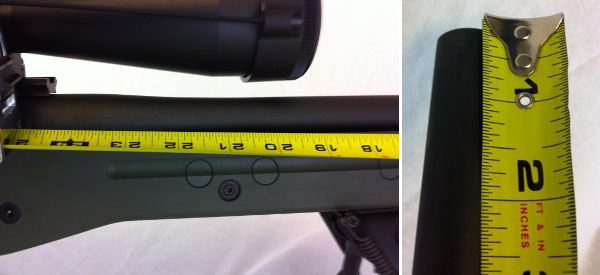
Here is one of Bill Reid’s 6mmBR (6BR) rigs. Like his Sako 6 PPC, this is exceptionally accurate.
AccurateShooter Forum member Bill White (aka “CT10Ring”) is a New Yorker who relocated to Idaho in his senior years. From his Idaho home, Bill enjoys long-range target shooting. But his favorite gun pastime is varmint hunting in nearby states — the Dakotas, Montana, and Wyoming. Every year he loads up his truck and hits the road, often doing a grand circle route, visiting prairie dog havens in multiple states.
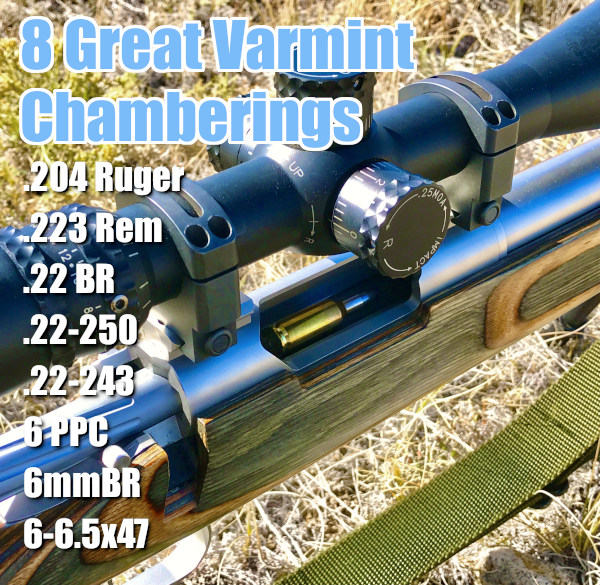
Bill has a large rifle collection, most of which see duty in the varmint fields of Montana, North Dakota, South Dakota, and Wyoming. Here are his key “take-aways” for his eight favorite varmint chamberings: .204 Ruger, .223 Rem, .22-250, .22 BR, .22-243, 6 PPC, 6mmBR, and 6-6.5×47 Lapua (aka 6×47).
Eight Great Varmint Cartridge Types — .204, .224, .243 Calibers
.204 Ruger — This delivers great velocity with the little .20-caliber bullets, with mild recoil. The .204 Ruger easily reaches out to 400 yards, but heavier winds do move the tiny bullet around. Tremendous splat factor under 250 yards. I use Sierra 39gr bullets with IMR 8208 XBR in a Sako 75. Even now, .204 Ruger ammo is relatively easy to find.
.223 Remington — Probably the most popular centerfire rifle round in the USA, the .223 Rem offers inexpensive brass, and is a great choice for AR-15 owners. If you run short on ammo, you can find it nearly everywhere. I often bring one AR-15 and one .223 Rem bolt gun on varmint safaris. My Rem 700 5R 1:9″-twist barrel likes 53gr V-Max bullets.
.22 BR — My .22 BR is my first choice for most prairie dog missions. Accuracy is superb with necked-down 6mmBR Lapua brass — quarter-MOA and blazing fast. With the right twist rate, this chambering can shoot anything from 40gr FB bullets to 80gr VLDs. Load development is easy. Below is my .22 BR ammo for another varmint trip. I use 55gr Sierra BlitzKings with Varget in my 1:12″-twist Shilen-barreled rifle. 60gr Bergers are very accurate with a fairly flat trajectory for useful distances.
.22-250 Rem — A classic varmint cartridge, the .22-250 with 50gr V-Maxs delivers spectacular hits. If three P-Dogs happen to be lined up, I’ve witnessed one .22-250 shot take ‘em all out with a triple hit. I currently have five .22-250-chambered rifles: 3 Sako 75s, one Rem 700, and a single shot Nesika that shoots tiny groups. I favor the very deadly Berger 52gr Varmint HP. Making a custom .22-250? With a 1:8″-twist barrel you can use the full weight range of .22-cal bullets, while spinning the lighter bullets fast for “red mist” effect. Remember this cartridge can be a barrel burner. Don’t shoot too many rounds too quickly.
.22-243 Win — This wildcat is even more potent than the .22-250, delivering devastating results on P-Dogs. Run a .243 Win case slowly through a full-length .22-243 die, with plenty of lube to form the brass. I start with Lapua .243 Win brass. There can be some issues necking-down the brass. Watch for donuts forming at the neck-shoulder junction. I bought my .22-243 rifle not sure how it would perform. But now I love shooting it. My .22-243 delivers half-MOA groups with 41.0 grains RL-22 and Hornady 75gr Amax bullets. With those 75-grainers, it’s great in the wind and good to 600 yards easily.
6 PPC — You may consider the 6 PPC a benchrest competition cartridge only, requiring fire-forming. However I have an original Sako 75 single-shot 6 PPC rifle that I load with Sako-headstamp 6 PPC brass (see below) so no fire-forming is required. This Sako 75 came with a test target that measured 0.113″! With my 6 PPC Sako, I found that 58gr V-Maxs, pushed by Vihtavuori N133, are potent out to 300 yards. [Editor’s NOTE: As the Sako brass is no longer available, new 6 PPC shooters will need to fire-form their brass, or try to find Norma 6 PPC brass.]
6mmBR — The 6mmBR Norma (6BR) offers a nearly unbeatable combination of accuracy, efficiency, and tunability. With the 6BR and a fast twist barrel, you can shoot everything from 40gr flat-base bullets to the latest 105-110gr match bullets. I load Lapua brass, Vihtavuori N135, and Hornady 58, 65, and 75gr bullets for my Krieger 1:14″-twist HV barrel. While this cartridge is capable of long-range accuracy, I usually limit my 6BR shots to 350-400 yards.
6-6.5×47 Lapua — I have a nice 6-6.5×47 Lapua varmint rifle, with Surgeon action and Manners stock. I Cerakoted the barreled action and then bedded the action. Shown below is 6-6.5×47 ammo I loaded for testing. Note how I separated different bullets and powder loads into multiple, labeled bags. Hodgdon H4350 is a great choice for this cartridge — 39 grains H4350 with 105gr Amax was the winner here, but 88gr Bergers also shot well. This cartridge has tremendous “critter dismantling” abilities out to 600-700 yards.
Six Tips for Novice Long Range Varmint Hunters
1. Take twice as much ammo you think you may need. The fields could be particularly rich, or, because of wind or other variables, you may have far more misses than expected.
2. When possible, set up with the wind at your back (or, alternatively, directly ahead). This will minimize the effect of cross-winds. Set up a stake with a ribbon to show wind direction.
3. Bring at least two rifles. Ideally one would be a low-recoil rifle with cheaper components for the closer shots. Then bring a rifle with higher-BC bullets for longer shots where wind is a bigger factor.
4. Check the weather before you head out. Prairie dogs like sunshine and calm conditions. If a cloudy, very blustery day is predicted, considering staying in town and cleaning the rifles.
5. Bring plenty of water on a trip. An adult male should be drinking at least 64 ounces of water (or other liquid) every day — more if it’s very hot or you are sweating a lot.
6. Preferably always hunt with a companion. If you do go out solo, have a Garmin inReach SatComm/GPS for emergencies if there is no cell coverage in your location.
The 43rd Edition of the Blue Book of Gun Values was released last month. Purchase this popular price guide through Blue Book Publications for $54.95. Or order from order from Amazon for $61.17. The Blue Book of Gun Values by S.P. Fjestad is the leading gun valuation resource. There are now over 1.8 million copies in circulation worldwide. This book continues to be the “Bible” for buyers, sellers, collectors, and connoisseurs in the firearms industry.
Blue Book of Gun Values, 43rd Edition, April 2022
The 43rd Edition contains 2,528 pages covering over 1,900 manufacturers/trademarks, with almost 30,000 gun model descriptions, and over 180,000 values, with new-for-2022 data!
This 2022 43rd edition includes a new dedicated section on AR-15 manufacturers, making it easier to find these popular models. In addition there is an updated 64-page color Photo Percentage Grading System (PPGS) which makes firearms grading even easier and more accurate. The 2022 Blue Book also features a Serialization Index to make finding serial number information even easier!
Review by Tom Gresham, Gun Talk Radio Host
“At some point, every gun owner asks the question, ‘What’s it worth?’ The leading reference for decades has been the Blue Book of Gun Values. Whether you are a seller, a buyer, a shopper, or just curious, this constantly-updated gold mine of research is your friend.”
Features of the new Blue Book of Gun Values:
· Includes the new 2022 makes and models, with many new handguns and rifles, and important pricing updates.
· 2,528 Pages covering over 1,900 manufacturers and trademarks, with almost 30,000 gun model descriptions, with new section on AR-15 manufacturers.
· 180,000+ up-to-date values are provided — most complete resource in print.
· Important pricing updates on major trademark current, antique, and discontinued models, including Colt, Winchester, Smith & Wesson, and Ruger.
· An 64-page color Photo Percentage Grading System (PPGS) which makes firearms grading even easier and more accurate.
· More information, more values, more illustrations, and more history than any other gun price guide on the market.
If you are looking to compete in NRL22 or PRS rimfire tactical matches, there is a new, turnkey solution that combines the legendary Anschutz 54 rimfire action with the excellent MDT ACC chassis. Called the Anschutz Model 1710, this new competition-ready rifle is capable of winning matches right out of the box. Creedmoor Sports recently received the first set of model 1710s in the USA. At our request, Creedmoor’s Brent Books and Wayne Dayberry field-tested a new model 1710. After confirming the elevation click values for various yardages, Brent put the Anschutz through its paces, showing its superb accuracy. FYI, this 1710 came with an impressive factory test target — 10 shots at 50 meters, all in a dime-sized circle.
Shooting at the CMP Talladega Marksmanship range, Brent ran a sequence of shots, hitting steel at 100, 150, 200, 250 and 300 yards without a miss. You can see this 5-shot sequence, all in one continuous take (no edits), in the video below. As Brent observed, “it definitely shoots”. Then, later, Brent cranked in more elevation (21.1 MILs) and hit steel at 435 yards. Watch this all in the video — it’s impressive!
Anschutz 1710 at Talladega, Drilling Steel from 100 to 435 Yards
Watch Hits at 100, 150, 200, 250, 300, and 435 Yards
With RWS 100 .22 LR ammo, Brent drills hit after hit with no misses out to 300 yards.
“This video shows a run after we confirmed our dope. Brent Books and I are shooting an NRL22 match in two weeks. Although he has extensive smallbore and airgun experience, this will be his first match of this type. I thought it would be a good/fun exercise for him to run the plates fairly quickly and also showcase the performance of this rifle system at the same time on the video.” — Wayne Dayberry
Anschutz Model 1710 — Great Accuracy Right from the Start
Report by Wayne Dayberry
The Anschutz 1710 MDT ACC rifle system is purpose-built for smallbore tactical precision rifle competition. With its capabilities we went from from bore-sight to 300 yards in just 12 shots. We started with a factory-fresh .22 LR Anschutz 1710 in an MDT ACC Ghost Gray chassis. This rifle incorporates a 20-inch heavy profile threaded stainless barrel and the 5119 two-stage trigger. After a clean, lube, and inspection, we mounted up an Element 5-25x56mm First Focal Plane optic we already had in a set of rings and headed out to the CMP Talladega Marksmanship Park. In addition to traditional target ranges, the CMP range has an unknown distance steel range with targets out to 600 yards. Due to a compressed schedule, we did not have time to follow the traditional zeroing and velocity-gathering processes, so we headed straight to the unknown distance steel range. This range has steel from 75 yards to 600 yards much like you would see in PRS and NRL type competitions.
Given the compressed timeframe, we didn’t follow the traditional steps one would normally take to do a break-in process, zero, collect data, and build out rifle dope. We were essentially doing all of that on a steel target range as we were putting the first rounds down the barrel while shooting this piece. At the same time, with a quality rifle system, and following a process, it worked out well as we were able to stretch out the capability of this rifle to 435 yards very quickly.
Anschutz 1710 Components and Specifications:
The new Anschutz model 1710 is built with premium components top to bottom. It features an Anschutz Match 54 repeater action with blued receiver, Anschutz 5119 two-stage trigger, 20″ stainless steel barrel, and MDT ACC alloy chassis with built-in rails. The chassis is adjustable for LOP and cheek height.
Receiver: Scope mount attachment with 11mm rail and drilled and tapped
Barrel Length: 20″ stainless steel heavy barrel, no iron sights
Chamber: Optimized Match Chamber
Crown: Recessed Target Crown
Muzzle Diameter: 0.90″
Trigger: New 5119 Two-Stage Trigger
Trigger Weight Range: 4 oz. to 7.5 oz. (110 to 215g)
Trigger Weight: Adjusted to 6.35 oz. (180g)
Magazine Capacity: 10
Magazine Release: Extended
Rifle Weight without scope: 10 lbs., 10 oz.
This photo shows the Anschutz 1710 fitted with bipod and suppressor. The tripod clamps via the integral forearm ARCA rail.
Testing the Anschutz 1710 on Steel — Expedited Procedure
The closest steel on the Talladega range that day was 75 yards so we started from scratch at that distance. Brent was on the rifle, so I spotted and ran ballistics. After bore-sighting at 75 yards, and confirming zero on steel with a few rounds, we went to the ballistic solver to start a profile. For the RWS R100 ammunition we were running, I entered a G1 BC of .14 and a guess at the muzzle velocity of 1080 FPS. The call of 1.1 MILs for the 100-yard steel resulted in Brent’s shot landing .2 MILs high of center on the first round; we “confirmed” 0.9 MILs. We noted the impact and moved on to 150 yards.
As I mentioned we were very short on time so the “confirmations” of our dope for our first pass were with a single shot and measuring in the reticle. That’s obviously not the normal process, but for us, it was good enough for this exercise, given the time we had. We were shooting on freshly-painted targets and getting excellent feedback to see POA / POI deviations and could easily measure this in the reticle, which helped. And we were shooting a top-of-the-line Anschutz which came with a confirmation test target showing a 10-shot group at 50 meters with all shots touching and within a circle the size of a dime. With a former NCAA All-American smallbore shooter running the gun, and this test target in hand, confidence was high.
Moving to the 150-yard target, a call of 3.7 MILs hit 0.6 high on our first round so we measured and confirmed 3.1. We trued the muzzle velocity in the solver as we went. At 200 yards I called 6.0 MILs and the first round hit was .3 high. We measured and confirmed 5.7 MILs. 9.0 mils was the call at 250 yards and we hit just a bit high. After measuring, we confirmed 8.6 MILs. At 300 yards, Brent was holding about 1 mil wind as a storm started rolling in. I called 12.5 MILs elevation and the first round impact was near the top of the plate, and after measuring we confirmed a come up of 11.7 MILs.
The net result was this — we went from mounting the optic and bore-sighting, to making solid first-round impacts from 100 yards out to 300 yards, at each 50-yard increment, in just 12 rounds! That’s efficiency!
Stretching it out to 435 Yards on Steel
Later, we went on to make solid hits at 350 yards and 435 yards. I got on the gun and put two on top of each other at 350 yards — pretty cool. This just proved this gun is an absolute hammer. The 435-yard target was a bear target, which was quite a bit larger than the 12″ steel we were shooting in the video. Not a small target by any means, but we were shooting 435 yards with a rimfire rifle as a storm rolled in. I think between us, Brent and I hit 5 of 6 (at 435 yards) which was pretty good given the sporty conditions. Next stop… the 600-yard plates at the end of this range. That’s a come-up of about 36 Mils.
Rimfire Maintenance — Tips from a Top Competitor
An NCAA All-American smallbore shooter, Brent Books knows a thing or two about rimfire rifles, and how to maintain optimal accuracy. Brent told us: “I shot on the rifle team at Jacksonville State University so 500 rounds a week was common through my Anschutz 2013. I’d clean my rifle at the end of each week before we travelled to a competition with a wet patch through the barrel, a few passes of the nylon brush (unscrewing the brush before pulling it back through), one more wet patch, and then dry patches until they came out clean. A bore guide was always used to protect my action from debris and to align the cleaning rod. After cleaning the barrel, I’d completely disassemble the bolt to clean and lube it, making sure the bolt would glide effortlessly in the action. After cleaning, I’d shoot a minimum of 50 rounds to foul the barrel with ammo I was using to compete.”
Anschutz Model 54 Action with 5119 Trigger
The Anschutz 1710 features the competition-proven Model 54 action, running a 10-round magazine. In the 1710, the safety-equipped action is fitted with an outstanding 5119 two-stage trigger that adjusts from 4 to 7.5 ounces. First released in 1954, Anschutz Match 54 action still represents a benchmark for smallbore rifles. Match rifles fitted with Model 54 actions have captured numerous World Championships and Olympic medals. These actions are smooth, consistent, and ultra-reliable, making them a great choice for multiple smallbore rifle disciplines. Anschutz boasts that this action has: “solid, extremely reliable construction [with] a functional safety that does not fail even under the most adverse conditions.”
MDT Adjustable Core Competition (ACC) Chassis
What’s so cool about the MDT ACC Chassis? MDT’s ACC chassis is optimized for NRL and PRS shooting formats, although it can be used in other disciplines. The ACC chassis design has been optimized with input from top PRS and NRL shooters. Key features include: full 17″ ARCA/RRS fore-end, flared magazine well, extended barricade stop, widened thumb shelf, adjustable cheek riser, adjustable length-of-pull, and adjustable MDT Vertical Grip Elite.
The ACC boasts an integrated weight management system, allowing shooters to fine tune chassis weight and balance. Weights can be added to the buttstock, the fore-end interior or fore-end exterior. This allows the shooter to increase the chassis-only weight from 4.5 lbs up to 12.3 lbs. Complete with barreled action, scope, rings, bipod, and accessories, shooters can run 20+ lbs for the full rig.
The weight can be tuned without taking the barreled action out of the chassis. Internal fore-end weights can be inserted from the front of the fore-end and screwed in place, while external M-LOK-compatible weights can be easily attached on either side of the fore-end. This ACC weight-management system allows shooters to rapidly adjust the feel and recoil characteristics of their system.
Recommended Accessories
Creedmoor Sports stocks a large variety of products that can be used with the Anschutz 1710. Below you’ll find the Element Titan 5-25x56mm FFP MRAD scope, Soup Can Sandbag, and RWS R100 Ammunition used for the Anschutz 1710 testing featured here. Click each item below for more product information:
Product Review By James Mock
There is an old adage when it comes to buying rifle scopes — one should “buy the best and cry once”. Generally it is true that we get what we pay for. However, we all like to get full value for our hard-earned dollars and it seems that we have several top-flight rifle scopes available to shooters today. Many of these top-tier scopes carry a premium price of $3000 or more. If one has champagne tastes and beer budget, must he/she settle for a second-tier scope?
The answer to the above is “not any more”. Check out the new Delta Stryker 5-50x56mm at under $1600.00 retail. A well known gunsmith told me that if someone made a scope with the quality of glass found in a Nightforce Competition and the reliable tracking plus ability to hold point of aim of the Kahles, they would have a winner. I have shot both of the above-mentioned scopes and they are great scopes. If one could get the best traits of both of these in one package and could get that optic at a good price (relative term), it would be great.
I may have found such a scope with the Delta Stryker 5-50x56mm long range scope, currently $1590.00 at SW Optics. Since I shoot mostly 600-yard matches, I requested the 5X-50X Stryker model with second focal plane (SFP) MOA reticle and 1/8-MOA adjustments. Here are the key features and specifications:
Delta Stryker 5-50x56mm Scope Specifications
Magnification: 5X-50X
Objective Lens Diameter: 56mm
Tube Diameter: 34mm
Reticle: DLS 3 MOA, Second Focal Plane
Maximum Elevation: 100 MOA
Maximum Windage: 50 MOA
Eye Relief: 89mm – 100mm
Diopter Range: -2D/+3D
Field of View: 16m @ 5X and 9.5m @ 50X
Parallax Adjustment: 10m to Infinity
Eye Relief: 89mm (3.5″) to 100mm (3.9″)
Length: 333mm (13.1″)
Weight: 1042g (2.3 lbs)
All Reticle Options: DLS-1, DLS-2, DLS-3
Warranty: 10 Years
Other features: Locking turrets, Zero Stop, Illumination Dot, Rotation Indicator for both windage and elevation
Gen 3 Delta Stryker Long Range Optic
Note: Shown above is Delta Stryker’s new Generation 3 offering. This incorporates features wanted by purchasers of earlier generation scopes. Delta has made some great improvements to this scope. Key Gen 3 upgrades are: 1) Indicator added to show the number of revolutions the turrets have been turned; 2) Locking turrets for both windage and elevation knobs; 3) Unique Zero Stop made of brass rather than plastic; 4) MILRAD models now have .05 mils per adjustment clicks; and 5) Parallax adjustment wheel was given much longer travel which benefits getting the fine adjustments needed.
Other features of this second focal plane (SFP) scope include Japanese ED glass, illuminated 1/10 MOA dot with 11 brightness settings, zero lock turrets, 1/8 MOA click values, and a 10 year warranty. There are three reticles offered in this 5X-50X model. The DLS-1 and DLS-2 reticles are MILRAD types, while the third DLS-3 reticle, the one I tested, is a MOA reticle with each hash mark subtending 1 MOA at 40 power.
Turrets Run Smoothly with Easy to Read Markings
The markings on the turrets are large and easy to read with 10 MOA per revolution. The center dot subtends 1/10th MOA. The illumination on this model illuminates only the dot. The Gen 3 comes with sunshade, hex wrench for adjustments of zero stop, scope caps, a tab for the power ring, an optional large parallax wheel, and glass lens cover. It has a 10-year warranty. When one turns the windage, elevation, parallax, or power change knobs, he or she realizes what a quality scope this is. All of the above adjustments could not be smoother if they were on ball bearings.
The objective lens is 56mm. The image produced by the ED glass in this scope is spectacular — equal to or better than many scopes costing twice as much. There is little of the dreaded “black ring” surrounding the image. The adjustments are very, very smooth and the clicks are positive and without the backlash evident in many scopes. This is very well thought-out scope and represents one of the great values available today.
DEVA Institute Tests Confirm High Light Transmission
Delta enlisted the services of the prestigious DEVA Institute in Germany for an independent evaluation. The Deva Institute gave the scope a thorough “going over”, determining that that the individual lens layer allowed 98% light transmission while the total system allowed 92%. The scope is also very tough and withstood 6500 Joules (~5054 ft-lbs) of recoil energy.
Field Test Results of Delta Stryker 5-50x56mm
My testing began on a cold January 29th, 2022. I designed a tall target with a vertical line drawn with a level and marked that line up 25 MOA in 5 MOA hash marks. I set up my rifle (Stiller Cobra) on the bench and leveled both the rifle and the scope’s crosshairs. The model that I am shooting has 1 MOA hash marks with a 1/10th MOA floating dot. This reticle is ideal for 600 and 1000 yard competition. The rifle is currently chambered in 6mm PPC and I tested with N133 and Bart’s Avenger BT bullets. I will change the barrel to a 6mm Dasher before the next 600-yard match.
Photo below shows the setup with tall target at a measured 100 yards. I measured 100 yards with a steel tape to make certain that I did not skew my results but shooting at a greater or less distance. I will do some more testing at this distance when the weather warms a bit.
Tall Target Test — 25 MOA Up and Back Down
For this test I created a target with two sighting points placed a measured 25 MOA apart. I shot a few rounds of old ammo to get a rough zero and then fired an initial sighter. After an adjustment, I fired the first test shot and it hit in the proper location (inside the lower circle). Then I adjusted the elevation up 25 MOA. I fired again and the bullet impact was VERY close to my measured +25 MOA hash mark. Then I cranked 25 MOA back down and fired. That drilled the third test shot in the original circle at virtually the exact original elevation. This confirmed the accuracy of the click values.
Below is a picture showing the impact with the 25 minutes dialed in the scope. Although it is not perfect, it is VERY good. This scope tracks very well. The picture below shows the great tracking at 25 minutes up.
Point-of-Aim Test with Power Change
The final test done today was one in which I tested for shift in point of aim with power change. The first two rounds were fired at 40X, then I moved followed by one at 30X, another at 25X, then the final two rounds at 15X.
For each of the test magnification levels I had an aiming box on a vertical line. I started with 40X, then moved my point-of-aim down to the next box in sequence as I reduced the magnification level: 30X, 25X, and finally 15X. As you can see, the impact was very good at all the tested magnification levels.
Excellent Quality Image Viewed through the Lenses
Delta Optical is located in Poland. The company’s devotion to excellence is very evident. The brightness and clarity of the Delta lenses is amazing and the scope has large internal lenses as demonstrated by the sight picture. The tunnel effect with the black ring surrounding the image is absent in this fine scope.
Let me add that on two occasions, I have tested with extreme mirage and this scope handles the mirage as well as any I have tested. After all of my shooting, I can say that this scope has passed the tests with flying colors.
SUMMARY — Excellent High-Magnification Optic and Great Value
I have previously named other scopes as being the best value in long range scopes, but I may have to reconsider that statement. For a scope as versatile as the Delta Stryker 5-50x56mm, the price is very reasonable ($1590.00 at SW Optics). There are scopes that cost $1000 more without the features of this offering. My testing will continue and there will be updates. I want to thank Mr. Grzegorz Matosek of Delta Optical. He made it possible for me to have this scope for testing.
My shooting partner, Kent Bennett, remarked recently when we were testing several guns at his range, that this scope is as clear as any [high-magnification optic] he has looked through.
I predict that this Delta 5-50x56mm scope will sell very well in the USA. When the word gets out about the features and overall quality of this instrument, I believe that long range shooters will want to try it. There are two USA importers with which I am familiar: SW Optics & Equipment (Arizona) and EDgun West (California). My prediction is that those who try this scope will not be disappointed with quality or price. — GOOD SHOOTING! — James Mock
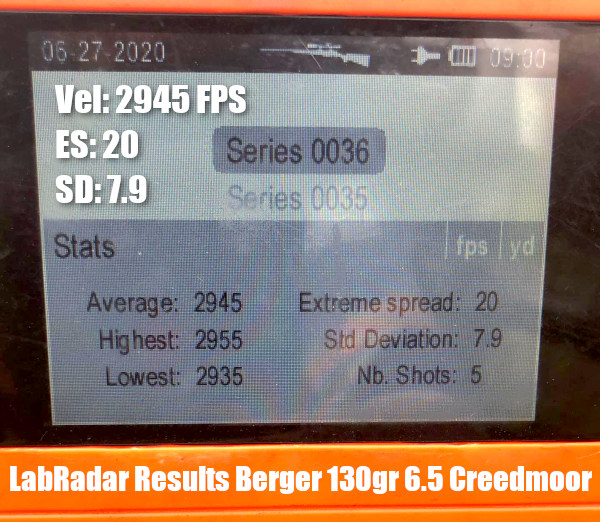
Is factory 6.5 Creedmoor ammunition good enough to win a PRS or NRL competition? The answer is a resounding “YES” if we’re talking about Berger ammunition. Produced with Berger match bullets and premium Lapua brass, this Berger 6.5 ammunition demonstrated excellent accuracy, impressive velocity, and very good ES/SD numbers. When tested at 1000 yards with an MPA-stocked PRS rig with Rem 700 action, this ammo showed just half-MOA of vertical, and produced a group that would have been a 50-1X in F-Class competition. That’s quite impressive for a PRS rig.
This ammo test was performed by our friend Erik Cortina from Texas. Erik is a top F-Class competitor who also shoots tactical matches (for fun and glory). Erik recently built a new 6.5 Creedmoor with a Remington 700 action. Though this rifle sports a top-shelf MPA chassis and premium Kahles scope, Erik calls this his “budget build” because it has a plain Rem 700 factory action rather than the elite Borden actions he normally runs. Erik’s actions of choice are the Borden Mountaineer for PRS and Borden BRM-XD for F-Class.
Erik posted: “Shot my budget 6.5 Creedmoor today with Berger Bullets factory ammo. I shot five rounds over the chrono to get speed. I used BC info from the box and it all lined up properly. I adjusted my ECTuner to tune load and it took just 15 shots to get it shooting well. It’s simple with good components.”
This Berger factory ammo features Berger 130gr Hybrid OTM Tactical bullets. The Lapua 6.5 Creedmoor cases have a large rifle primer. You can see this ammo displays good velocity with Extreme Spread and Standard Deviation rivaling good hand-loads.
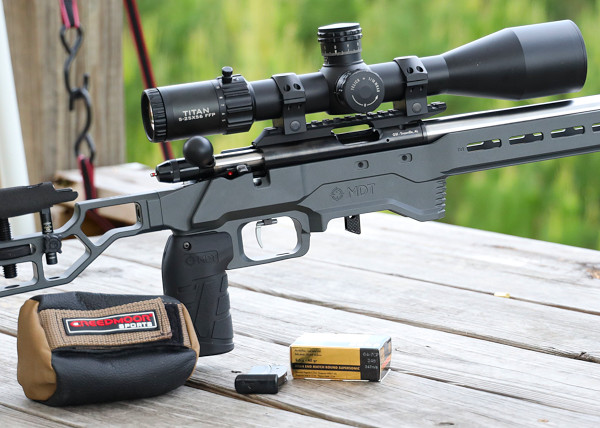
Cortina says the very accurate Brux barrel and razor-sharp 6-24x56mm Kahles scope help achieve this kind of outstanding performance at 1000 yards. Here are the key components for Erik’s latest PRS rig:
Barrel Tuner by Erik Cortina — Fits Behind Muzzle Brake
This rifle features a barrel tuner designed and crafted by Erik Cortina. You can the ECTuner alone, or, as you can see, the ECTuner can be fitted BEHIND a muzzle brake. Erik tells us: “The ECTuner allowed me to tune the barrel to my ammo rather than tuning the ammo for barrel as is done when reloading. With the tuner, there is no need to try different brands of ammo as they can all be tuned to shoot as good as possible in my rifle.”
MPA Chassis Configuration Guide
Erik’s “budget” PRS rifle employs a MasterPiece Arms (MPA) BA Competition Chassis with Rapid Adjustment Technology (RAT). This MPA Arms Video shows how to set up an MPA Chassis to suit the owner:
Story by Paula Crenshaw
We like air rifles both for fun shooting and for competition. However, so many options are now available that is easy to get overwhelmed with the choices. Thankfully, there is a good book that helps air rifle shooters make informed decisions about air guns and accessories. Steve Markwith’s comprehensive resource, Air Rifles: A Buyer’s and Shooter’s Guide offers a wealth of useful information. This 154-page book is now available for $12.95 (paperback) or $9.95 (Kindle).
“This is a very informative book explaining the ins and outs of air rifles, their capabilities and limitations. I highly recommend this book to anyone considering purchasing an air rifle for marksmanship practice or small game hunting.” – L. Stanek, Verified Amazon Reviewer
Read Free Sample Chapters Online
If you go to Amazon.com and click on the cover of this book, you can view a FREE preview with extensive samples from many chapters. The book covers all the most important types of air rifle systems, both pre-charged pneumatics and other self-charging guns. Markwith reviews the wide variety of pellets available, offering suggestions for particular applications. You’ll also find a useful discussion of Airgun Power, Range, and Accuracy. This will help you pick the right air rifle.
Markwith explains the many attractions of airguns. They are not considered firearms (in most jurisdictions) so they can be purchased at local shops or mail-order outlets without FFL fees or background checks. You’ll find a huge online selection of airguns at PyramydAir.com that can ship direct to you — no FFL required. Air rifles are also quiet and very inexpensive to shoot. While .177 and .22 caliber air rifles are most common, there are also larger-caliber airguns offered for hunting or special applications.
Pyramyd Air has dozens of helpful videos about air rifles and air pistols.
Rimfire Varmint Adventure
Can you shoot prairie dogs with a .22 LR Rifle? The answer is yes, if you have an accurate rifle, know your drops, and keep your targets within a reasonable distance (inside 240 yards). While the .17 HMR and .17 WSM are much more potent, flat-shooting, and effective P-dog slayers, a talented marksman CAN get good results with a .22 LR rimfire rifle, as ace PRS shooter and gunsmith Jim See recently proved.
Posting on his Facebook Page on 7/9/2020, Jim wrote: “Took out the .22 LR for some LR prairie poodles, there were not many in this town, but it gave me a chance to get some impressive hits. Norma TAC-22 ammo put the smack down on a first-round hit, called head shots at 189 yards. The body-shot dog was a first-round kill at 240 yards. I had one more head shot with a second round hit at 163. The nice part about using the .22 Long Rifle ammo is the [critters] don’t spook too bad, so a follow-up shot with a correction is usually available to get a better wind hold.” Even unsuppressed, a .22 LR rimfire shot makes much less noise than a centerfire round.
NOTE: The Norma TAC-22 .22 LR ammo used by Jim See offers great bang for the buck. It is quite affordable — a 50rd box is just $4.50 at Palmetto State Armory. Some lots have show outstanding accuracy. These target photos (below) come from Champion Shooters Supply which may have gotten an exceptional lot. This vendor tells us: “We have found this to run very well in Ruger rifles, handguns, and target pistols. These are 5-shot groups at 50 yards with an Anschutz 1913 rifle. This is an incredible value.” Jim says the TAC-22 ammo delivers 1″ groups at 100 yards in his rifle.
Sierra Bullets has introduced a new line of loaded centerfire varmint ammunition, the Prairie Enemy series of cartridges. Sierra currently offers Prairie Enemy ammo for six cartridge types: .204 Ruger, .223 Rem, .224 Valkyrie, .22-250 Rem, .243 Win, and 6.5 Creedmoor. To celebrate this new ammo line, Sierra created a colorful Prairie Enemy P-Dog target. Click the image below to download the PDF target.
Want to shoot better scores at your next match? Here’s a smart, inexpensive do-it-yourself project from the good folks at Criterion Barrels. For less than a dollar or two in materials, in just a few minutes you can create a handy, effective mirage shield, custom-fitted to your favorite rifle.
All precision shooters should be familiar with mirage, a form of optical distortion caused primarily by variations in air temperature. Savvy shooters will use mirage as a valuable tool when gauging wind speed and direction. Natural mirage is unavoidable, but there are many techniques designed to limit its influence in long-range marksmanship.
A form of mirage can be produced by the barrel itself. Heat rising from the barrel may distort sight picture through your optics, leading to erratic results. Mirage caused by barrel heat can be reduced dramatically by a simple, light-weight mirage shield.
How to Make a Mirage Shield
A mirage shield is an extremely cost-effective way to eliminate a commonly-encountered problem. Making your own mirage shield is easy. Using old venetian blind strips and common household materials and tools, you can construct your own mirage shield for under one dollar.
Materials Required:
1. Vertical PVC Venetian blind panel
2. Three 1”x1” pieces adhesive-backed Velcro
3. Ruler or tape measure
4. Scissors or box cutter
5. Pencil or marker
1. Measure the distance from the end of the receiver or rail to the crown of the barrel.
2. Using a pencil and ruler, measure the same distance and mark an even line across the blind.
3. Cut across the line using scissors or a box cutter, shortening the blind to the required length. (Remember, measure twice, cut once!)
4. Expose the adhesive backing on the loop side of the Velcro. Center and apply the Velcro strips on the barrel at regular intervals.
5. Expose the adhesive backing of the fuzzy side of the Velcro.
6. Place the blind on the upper side of the barrel. Apply downward pressure. Once the Velcro has secured itself to the barrel, separate the two sides. Proceed to mold both sides of the Velcro to fit the contour of their respective surfaces.
7. Reaffix the blind. Barrel related mirage is now a thing of the past!
NOTE: You can attach the Velcro on the opposite side of the blind if you want the blind to curve upwards. Some folks thinks that aids barrel cooling — it’s worth a try.
How to Remove and Re-Attach the Mirage Shield
Removal of your mirage shield is accomplished by simply removing the blind. You can un-install the Velcro by pulling off the strips and then gently removing any adhesive residue left behind using an appropriate solvent. (Simple cooking oil may do the job.) Caution: With fine, high-polish blued barrels, test any solvent on a non-visible section of the barrel. Before storing the gun, re-oil the barrel to remove active solvents and residual fingerprints.
We are coming into peak Prairie Dog season. For long shots you’ll definitely want a centerfire. We like the 20 Practical in an AR and a 22 BR/BRA in a bolt-action. That will have you covered out to 700 yards. But for shorter shots on small critters — say inside 150 yards — it makes sense to have an accurate 17 HMR rimfire rig. Today’s 17 HMRs are capable of surprising accuracy, rivaling a good centerfire rig, but with way less recoil and much lower cost per shot. And the 17 HMR offers more than double the velocity of a .22 LR — up to 2650 fps with a 17-grain bullet.
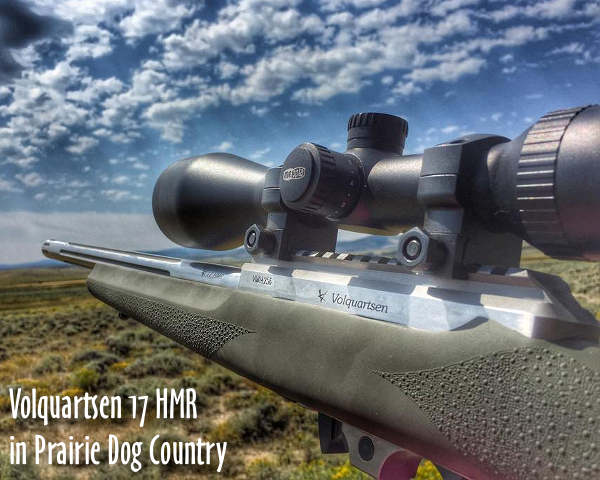
Top Shot former Champion Dustin Ellerman likes his Volquartsens, and we can see why. With one of his favorite 17 HMR rimfire varmint rigs, he’s seen some outstanding accuracy with CCI ammo. A few seasons back, on his Facebook page, Dustin reported: “Prepping for prairie dogs and I’m floored by this cold, sub-half-inch group shot with the Volquartsen Custom 17 HMR at 100 yards.” This thumbhole-stock rifle features a Bowers Group USS suppressor, and 3-12x56mm Meopta Scope. Dustin tried different types of CCI 17 HMR ammo. This small group was shot with CCI A17 ammo.
What’s the effective range of a 17 HMR on prairie dogs? You might be surprised. in 2015, Dustin took another Volquartsen 17 HMR on a Prairie Dog hunt in Wyoming. He was impressed with the rifle (shown below) and the little rimfire cartridge. Dustin says the effective range of the 17 HMR is farther than one might expect: “I made hits out to 300 yards. 200 yards was easy as long as the wind wasn’t too bad.”
Here’s the Volquartsen 17 HMR Dustin used in Wyoming in 2015:
After that 2015 P-Dog expedition, Dustin became a fan of the 17 HMR cartridge: “Never paid it much attention before now because the ammo is five times more expensive than .22 LR and I mostly target shoot. However, for prairie dogs, the 17 HMR is amazing!” Consider this — Hornady’s 17 HMR ammo pushes a 17gr V-Max bullet at 2550 fps, twice as fast as typical .22 LR rounds.
Prairie Dog Adventure with Savage A17
This video shows a successful Prairie Dog hunt. Watch and you’ll see hits out to 160 yards (00:50), proving the effective range of the 17 HMR cartridge. The host is shooting a Savage A17 semi-auto 17 HMR rifle in a Boyds laminated stock.
Sightron is now offering big discounts on popular scopes with its Summer Instant Savings Promotion. You can save up to $200.00 on select premium riflescopes: the S-TAC, SIII PLR, and S30 RDS. With Father’s Day and graduation just around the corner, now is a great time to save hundreds on some of Sightron’s most popular models. This instant rebate promotion kicked off May 1st and runs through June 30, 2022.
You can get these Sightron deals through an an authorized Sightron retailer, such as Creedmoor Sports, or you can order direct from Sightron, via the Summer Instant Savings Page.
SIGHTRON is offering up to $200 in savings on select premium riflescopes:
Save $200 on SIII PLR (Precision Long Range) — Designed for long-range target and competition shooting, the PLR series offers 6-24x50mm, 8-32x56mm, and 10-50x60mm models (shown below). All models employ a new optical design, Zact-7 Plus Revcoat multicoating technology, internal zero-stop, and illuminated reticles. Sightron SIII PLR scopes offer premium performance at an unbeatable price.
Save up to $120 on S-TAC — Excellent choice for hunting or competitive shooting, the S-TAC 3-16×42 and 4-12×50 riflescopes have the features you need to get on target and stay there. Available in SFP and FFP models, the S-TAC series features Zact-7 Revcoat multicoating technology applied to high-quality Japanese precision-ground glass for excellent, crisp, and clear color-corrected images.
Lifetime Warranty on All Sightron Scopes
All Sightron riflescopes are backed by a Lifetime Performance Guarantee that protects buyers. If you ever have an issue, Sightron’s skilled technicians will fix your scope or Sightron will replace it.









 Cortina says the very accurate Brux barrel and razor-sharp 6-24x56mm Kahles scope help achieve this kind of outstanding performance at 1000 yards. Here are the key components for Erik’s latest PRS rig:



 Rimfire Varmint Adventure