Effective hearing protection is a must whenever you are shooting firearms or when you are in the vicinity of gun-shots. For ultimate protection, we recommend a good set of tapered foam earplugs, topped by muffs. However, there are situations when you may prefer lighter-weight hearing protection that can be quickly removed. For example, if you are standing well behind the firing line as an observer, or if you are working as a rangemaster or waddie some distance away from the shooters. In addition, game hunters may only need hearing protection for a few moments when they take their shot, so something light-weight that can be deployed in seconds is ideal.
In addition to traditional ear plugs and ear-muffs, band-style protectors provide a third sound-blocking option. Howard Leight, a top name in the sound-protection business, offers the popular “Quiet Band”, a device with soft foam plugs attached to a plastic band worn around the neck. This “Quiet Band” product is comfortable, easy-to-deploy, and surprisingly effective.
NOTE: We do NOT recommend these for normal, sustained use when shooting firearms, as when shooting a match. Use muffs over plugs for that. However, Quiet Bands work very well if you are spotting for a fellow shooter, or are near the firing line. These also work great when running noisy machinery such as leaf-blowers.
Three Quiet Band Models
There are three (3) types of Leight Quiet Band® sound protectors. We prefer the QB2 Supra-aural model (item QB2HYG, NRR 25).
The recommended QB2 Quiet Band positions cone-shaped foam pads next to the ear openings and holds them there with light pressure from the orange-colored band. There is also an Inner-aural version (item QB1HYG, yellow band, NRR 27), and a Semi-aural model (item QB3HYG, red band, NRR 21).
Our preferred QB2 Supra-aural (orange band) model is just as comfortable as the QB3 (red band) version, and offers much better protection. The QB1 Inner-aural (yellow band) model requires that you place the ear buds in the ear canal, so it’s not really any easier to use than conventional earplugs. That’s why we like the QB2 Supra-aural model best of all. Other users agree. Here’s what two QB2 owners had to say:
“I first saw these used by Hickok45 on YouTube and he talked positively about them. I got two and gave them a try. At first, I didn’t think they were going to work very well. After some fiddling, I found they work pretty darn good. With my ears, they fit the best if the band starts on top of my head, I insert the plugs then rotate the band behind my head. PRESTO, perfect fit. Shooting the 9mm and 12 gauge out back was comfortable with no ringing afterward. [They are] small and easy to transport — just throw in the range bag. Yet, they are big enough to keep around your neck out of the way[.] I highly recommend them to anybody needing banded hearing protection.” — Tom W.
“Great for woodworkers — These are lightweight AND very effective at reducing noise. When not in use the band hangs loosely around your neck, out of your way completely. Very cost effective for a great product!” — Sheri D.
Quiet Bands Are Much Less Expensive Than Earmuffs
Quiet Band® sound protectors can be purchased online for under $6.00 per set. We like the QB2 Version which comfortable and easy to put in place. These currently cost $5.99 for one set or $11.48 for three QB2 bands with 3 extra sets of plugs. Alternatively, you can get the Leight QB3 Supra-Aural for $5.00 or the Leight QB1 Inner-Aural for $4.96. The QB3 features a flatter ear pad while the QB1 is designed the insert in the ear canal like conventional plugs. We think the QB2 is the best choice for most users.
For QB1, QB2, and QB3 ear bands, replacement ear buds are available and sold by the pair. You can also buy a Ten-Unit Bulk Pack of QB2 Quiet Bands for $45.50 with free shipping. If you run shooting matches or training programs, you can buy these in bulk for your Range Officers and pit workers. And there is a similar Sellstrom Banded unit with blue plugs for just $3.46 on Amazon.
The U.S. Army Marksmanship Unit regularly publishes reloading “how-to” articles on the USAMU Facebook page. One very good article, part 5 of a 6-part series, focused on Progressive Presses. This article explains proper procedures for Auto-Indexing Progressives, which advance the shell-plate with every pull of the handle. Auto Progressives are very efficient, but they also require special attention and focus, because so many things are happening at once. You need to train yourself to watch every station. If you run a progressive press now, or are considering getting a progressive, we recommend you read this article. Visit the USAMU Facebook page for other helpful handloading guidance.
Progressive Loading Presses — Self-Advancing Shellplate Type
Recently, we addressed manually-operated progressive presses for the beginning handloader. This type press requires one to manually advance the shellplate after each handle stroke. An advantage for beginners is that nothing happens at any station until the loader wants it to. This helps users avoid problems from clearing malfunctions without noticing that the shellplate has advanced itself. (Read Previous USAMU Article on Manual Progressives.)
The next, more luxurious type progressive press advances the shellplate automatically whenever the handle is cycled. [Editor: This is also called an “Auto-Indexing” Progressive Press.] Typically, each stroke automatically sizes and primes a case, operates the powder measure (if used) and seats a bullet. Some also have case feeders that automatically put a new case in the shellplate with every cycle. Others require the loader to insert a case each cycle. With both types, the loader usually puts a bullet on each sized/primed/charged case.
[CAVEAT: While our Handloading Shop has several progressive presses, ALL of our powder charges are thrown/weighed by hand. We do not use powder measures on our presses. Our progressives are used for brass preparation, priming, seating, etc., but not for fully-progressive loading.]
The manually-advanced press can be a boon to beginners, but as one gains experience it can be a mixed blessing, depending on one’s style. If one pays close attention to every operation and loads without distractions, the manual press is very reliable and allows full scrutiny of each round as it is loaded. However, if one easily drifts into day-dreaming, or isn’t focused on paying careful attention at all times, the manual progressive can be a bit of a liability. The opportunity for forgetting a powder charge, leading to a squib load, is ever-present. [Editor: A lock-out die can help reduce the risk of a squib load, or a double-charge. See below.]
The automatically-advancing progressives help prevent this by ensuring a powder charge will be dropped each time the handle is operated. Experienced handloaders often appreciate this feature due to the savings of time and effort. Individual preferences between the two press styles are influenced by several factors. These include one’s comfort with more- vs. less-complicated mechanisms, how often one changes calibers (case feeders often must be converted, in addition to dies and shellplates), how many rounds one loads annually, relative ease of changing primer mechanisms from small to large, etc. Automatic progressives and their caliber conversion kits tend to be significantly more expensive than manual progressives and caliber conversions from the same maker.
One USAMU handloader, who likes simple, bullet-proof machines and maximum efficiency when converting presses, owns two manually-advanced progressives. One is set up for large primers, and the other for small primers. He can change calibers in the twinkling of an eye. As he loads for many different calibers, this fits his style. Another handloader here is just the opposite. He loads for a few calibers, but in larger quantities. He much prefers his self-advancing press with case-feeder for its speed. He makes large lots of ammo in a given caliber before switching, to improve overall efficiency. His caliber conversion kits are more expensive than those for the manually-advanced progressive, but he uses fewer of them.
Whichever type one chooses, it is VERY important to buy quality gear from a manufacturer with a long, well-established track record for quality, durability and good customer support. Avoid jumping on the “latest, greatest” model until it has a proven track record. For example, this writer knows a loader who got a brand-new, expensive, self-advancing model press some years back, shortly after its introduction. As is too often the case these days, the manufacturer released it before all the “bugs” were worked out.
Better Safe Than Sorry — the RCBS Lock-Out Die
RCBS Makes a “Lock-Out Die” that senses the powder charge. This will halt the Progressive press if you have a double charge, or an undercharge. Your Editor has the Lock-Out Die on his RCBS Pro 2000. It has “saved his bacon” a half-dozen times over the years. It can be used on Dillon and Hornady progressives as well as RCBS machines.
It would not fully seat primers to the correct depth. No amount of adjustment, extra force, or fiddling would do better than to seat primers barely flush with the case head. Any inattention could result in a slightly “high” primer, protruding above the case head. It created a risk for slam-fires, particularly in semi-autos without spring-retracted firing pins, such as the M1 or M1A. In desperation, he had a machinist buddy study the problem and machine a new part to correct it. No dice. Its engineering didn’t permit full primer seating, even with extended parts. He now wishes he’d heeded his shooting buddies’ advice to stick with the “tried and true,” reliable performer they all used.
Whichever press one selects, see if the maker has a kit or list of commonly-replaced parts. Having needed springs, pins, etc. on hand in the rare event that one breaks or “goes missing” can save the day when one is busy loading for a match! Another tip for improving one’s overall loading efficiency (rounds loaded with minimal set-up/tear-down time) is to plan one’s handloading by primer size. For example, if your machine is set to use small primers, load all the calibers that you intend to that take small primers, before converting the press to load large-primer calibers.
In our next chapter, we’ll discuss peculiarities of progressive loading for rifle cartridges, with remedies for problems such as excessive cartridge-case headspace variation when sizing, tips for ensuring best powder charge consistency, and so on. Until then, be safe, and good shooting!
At the request of our readers, we provide select “Deals of the Week”. Every Sunday afternoon or Monday morning we offer our Best Bargain selections. Here are some of the best deals on firearms, hardware, reloading components, optics, and shooting accessories. Be aware that sale prices are subject to change, and once clearance inventory is sold, it’s gone for good. You snooze you lose.
1. Graf’s — Peterson Catridge Brass In Stock
⏺ Peterson brass is strong and consistent, good selection of cartridge types
Peterson makes great brass for a wide variety of popular cartridges. Peterson has earned a great reputation for its consistent, long-lasting match-grade brass. Right now Graf’s has Peterson brass IN STOCK for a wide range of cartridge types — from small varmint rounds to F-Class cartridges all the way up to big magnums for ELR. Whether you shoot a .22-cal or even a .408 CheyTac round, you should find in-stock Peterson brass that suits your needs.
2. EuroOptic — Vortex Optics Closeout Sale (Save Hundred$)
⏺ Huge discounts on excellent scopes with superb warranty
Need a scope for your next rifle project, but have a limited budget? You can save hundreds of dollars with EuroOptic’s Vortex Optics Close-Out Sale. EuroOptic has FFP and SFP Vortex scopes with a variety of feature sets and magnification ranges — all at crazy low prices. All Vortex scopes on sale are brand new, with full factory warranty.
3. Creedmoor Sports — American Practice Bullets
⏺ Major discounts on big-name factory bullets; great for practice
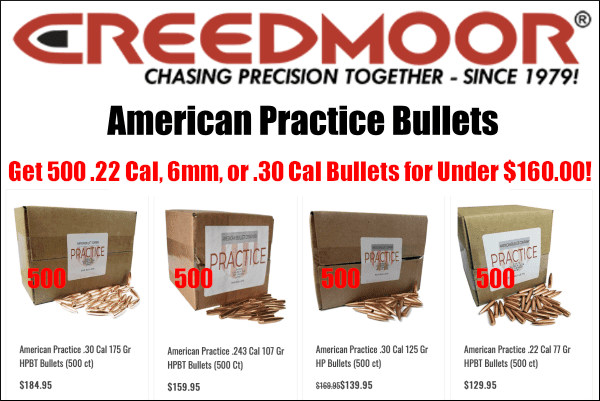
We can all use more live fire practice. To shoot more without breaking your budget, we recommend these American Practice bullets. These are good quality “big name” bullets in a wide range of calibers. You can get 500 bullets for a fraction of their normal costs. CLICK HERE for the full selection. We recommend: 77gr .224 bullets; 107gr 6mm bullets; and 168gr .308 bullets. With these deals you can practice more often.
4. Powder Valley — Accurate Powders IN STOCK, Low Prices
⏺ Good selection of Accurate-brand powders at VERY favorable prices
For a long time, Powder Valley Inc. has been one of the best resources for reloading supplies. Powder Valley is a highly ethical company, run by honorable folks who have worked hard to hold down prices on powder and primers. Powder Valley has also been a staunch supporter of AccurateShooter since the beginning. Right now Powder Valley has a good selection of Accurate-brand powders in stock at very fair prices — from $27.25/lb (Accurate #2) to $34.50/lb (Accurate 4064). If you could use one of the available Accurate-brand powders, head over to Powder Valley today.
5. Midsouth — Hornady V-Max Bullet Sale
⏺ Get high-quality, first-rate tipped hunting bullets at bargain prices
V-Max bullets are favored by game hunters and varmint shooters. Right now Hornady V-Max bullets, in a wide assortment of calibers/weights, are on sale at Midsouth. The Hornady V-MAX polymer tip increases the ballistic coefficient and also initiates dramatic expansion upon impact — even at velocities as low as 1600 fps. For varmint hunting in .20, .224, and 6mm calibers, the V-Max bullets are a great choice, and now you can save big. 22-Caliber shooters can select 40gr, 50gr, 53gr, and 55gr bullets all for just $21.59 for 100 bullets.
6. Palmetto SA — S&W M&P15-22 Sport Rimfire Package, $449.99
⏺ Good, reliable rimfire AR clone for NRL22 and cross-training
This Smith & Wesson AR-style M&P15-22 provides the fun of an AR15 with the low cost of rimfire ammo. This can work well for cross-training or NRL22 matches. The S&W M&P15-22 SPORT features a slim M-LOK handguard that easily accepts a variety of accessories without removing the handguard. The M&P15-22 SPORT comes standard with removable Magpul MBUS front and rear folding sights. This $449.99 package includes 3 magazines and a nice gun case.
7. Midsouth — Bulldog Rifle Case 54″, $69.99
⏺ Good deal on excellent case for long rifles up to 52.5″
Highly rated by purchasers, the Bulldog Long Range Rifle Case fits rifles up to 52.5″ long. This premium 54″ soft case is on Sale Now for $69.99 at Midsouth, 18% off the regular $84.99 price. The Bulldog LR works great for long-barreled match rifles. This versatile case boasts a tough 600-dernier water-resistant outer shell, plus quilted inner lining with Velcro tie downs. There are two zippered center pockets plus an external zippered pocket at front. The main compartment zippers are lockable. Choose either Dark Tan (shown), or Matte Black for the same $69.99 price.
8. Amazon — Lyman Brass Smith Case Trim Xpress, $119.99
⏺ Efficient, well-designed power trimmer that indexes off shoulder
Trimming brass is critical to precision reloading. However, with most case trimmers it’s a pain to adjust trim length, plus the hand-cranking becomes tiresome. A better, more efficient case trimming solution is offered by the Lyman Brass Smith Case Trim Xpress. We like this case trimmer for good reason. The smart design allows for .001″ trim length adjustments with the click of a dial. The tool ships with 10 bushings that cover the most popular neck sizes on the market. To see a video of the Case Trim Xpress in action, check out our Lyman Case Trim Xpress Review.
9. Amazon — Caldwell The Rock Jr. Front Shooting Rest, $35.19
⏺ Low-cost rest works for young shooters and as back-up varminting rest
Simple and light can be good. When teaching youngsters to shoot or when sighting in a hunting rig, this Caldwell Rock Jr. Rest may be all you need. Weighing under 5.5 pounds, this compact rest is easy to set up. It offers 7.75″ vertical adjustment. One verified buyer states: “After lugging [a heavy front rest] to and from the range a few times I realized it was just too big and heavy for what I really needed. This little rest is inexpensive, yet it’s ideal for sighting-in firearms and airguns, and for informal shooting. A hint: Lubricate the elevation screw and the thrust washer that sits under the elevation wheel with a dab of lithium grease, and your adjustments will be smoother and easier.”
10. Brownells — Wipe-Out Foam Cleaner, $10.99
⏺ Wipe-Out Foam is effective, particularly when used right after shooting
Walking the firing line at the Berger SW Nationals, one cleaning product was mentioned over and over again and for good reason. Sharp Shoot R Wipe-Out foaming bore cleaner is a no-nonsense, easy-to-use bore cleaner that does a great job. We get best results with two applications of Wipe-Out after some wet patches. If you’re tired of long brushing sessions, give Wipe-Out a try — it really reduces brushing required. This is a good deal. The same 5 oz. can is $23.87 on Amazon!
Look and be amazed! In competition, a rifle drilled FIVE perfectly-overlapped bullet holes — the last virtually indistinguishable from the first — at a target a football field (100 yards) away.
Today we feature a benchrest rifle that earned its place in history by setting a small-group record in 2013 that may never be broken. This .30-caliber benchrest rig shot a 0.0077″ five-shot group at 100 yards. That’s the smallest 100-yard group ever shot in competition by ANY gun at 100 yards in history. And we may never see anything smaller in our lifetimes.
In setting that .0077″ (seventy-seven ten-thousandths of an inch) record, the shooter, Mike Stinnett, broke a record that stood for four decades — the 0.009″ five-shot group credited to Mac McMillan. The previous NBRSA Light Varmint Record of .009″ for five shots (at 100 yards) was set on 9/23/1973, 49 years ago. Experts considered that record “untouchable”, “unassailable” — in other words “unbreakable.” But Mike broke Mac’s record 40 years after it was set.
The Record-Setting Rifle and Cartridge
The gun that produced the historic .0077″ group was a Light Varmint-class Benchrest rifle chambered as a .30-caliber wildcat, the 30 Stewart. That cartridge is based on the 6.5 Grendel case necked up. The load had Hodgdon H4198 powder behind BIB 114gr, 10-ogive bullets. Notably, the record-setting ammo was pre-loaded before the match.
The Smallest 100-yard Group in History
All target shooters strive for perfect shot placement. Well one man has come closer to perfection than any other shooter who ever lived. You are looking at Michael Stinnett’s .0077″ NBRSA world-record group, the smallest 100-yard 5-shot group ever shot in the history of rifle competition. The group was certified at .0077″ (though labeled .008″ on the range-signed target below). A moving backer verified that this was FIVE shots — no question about that. You may be surprised but this was NOT shot by a 6 PPC, but rather a .30-caliber wildcat, based on the 6.5 Grendel.
Group Is Smaller than ANY 100-yard Group Shot in ANY Class
Mike’s amazing group stands as a NBRSA Light Varmint Class record. But it is also smaller than the current NBRSA 5-shot, 100-yard records for ALL other classes, even Unlimited (Rail Gun). Likewise Stinnett’s .0077″ group is smaller than the IBS records for ALL classes:
Better than any Rail Gun too — Mike Stinnett’s .0077″ group was smaller that ANY group shot in ANY class — event Unlimited Rail Guns, as shown below:
Below is a larger-than-life-size view. Using this photo we measured the group with target-calculating software, and it came out .006″ (the software only goes to three digits). We recognize that it would be much better to work from the real target rather than a photo, so we are not challenging the official measurement in the least. But this does confirm that this is a phenomenally small five-shot group.
Stinnett Sets .0077″ Record with a .30-Caliber Modified Grendel Cartridge, Pre-Loaded
Many folks have asked about the gun and ammo that produced the .0077″ group. The rifle was chambered as a .30-caliber wildcat, the 30 Stewart, which is based on the 6.5 Grendel case necked up. Mike was using Hodgdon H4198 powder behind BIB 114gr, 10-ogive bullets. Notably, the record-setting ammo was pre-loaded before the match. Unfortunately, we don’t have a photo of the target yet — it is still in the hands of the official NBRSA certification committee. However, Mike has been kind enough to tell us about his rifle and his load.
Mike Stinnett .0077″ Record Group Equipment Report
Mike reports: “Several guys have asked so here is my equipment listing. The hardware build actually started in 2008 with the goal of building two identical Benchrest rifles which could be used for both group and score. The idea was to shoot 6PPC and a .30 Cal without a base rifle change.”
Record-Setting Rifle Equipment and Components
Action: Kelbly Panda “Speedy Shorty” with solid bolt and PPC-diameter bolt face. Kelbly was asked to build several actions which were identical with the intent to eliminate any variance in head space between the two new rifles. This helped me use a single set-up on sizing dies for both rifles and ammo is interchangeable. Both actions were sent to Thomas ‘Speedy’ Gonzalez to be blue-printed and have Jewell triggers installed.
Reamer: 30 STEWART (I just call it a 30 PPC as that is what everyone expects, but it is in fact a custom design and Ralph deserves about 99% of the credit).
Barrels: Krieger was selected for the barrels. After discussions with Randy Robinett of BIB Bullets, a 1:17″ twist was identified as the correct, safe solution. Ralph Stewart has cut all my chambers using a custom-designed reamer. [Our goal] was consistent headspace and Ralph has been able to keep my barrels within .0002 variance. The barrel tuner also comes from Ralph Stewart.
Stock: Larson (including action bedding)
Scope: Leupold 45X Competition in Kelby Single Screw Tall Rings
Brass: Lapua (Base case is 6.5 Grendel)
Bullets: Randy Robinett (BIB) 30 Cal. 114gr, 10 Ogive (secondary bullet; primary is 112gr BIB)
Powder: H4198 – Stout Load with 2980 FPS Velocity
Front Rest: Farley Coaxial
Bags: Micro Fiber
Flags: Graham Wind Flags (large)
About the Cartridge — 30 Stewart (Based on Lapua 6.5 Grendel Parent Brass)
Mike explains: “Our goal was to shoot H4198 as the optimal powder for stability. There were several versions of the reamer before we settled on the current configuration. I am optimized for the 10 Ogive BIB bullet, powder to the base of the bullet. I found in testing the small 30-cal case did not like compression at all. The bullet is seated only 0.12″ into the case with zero freebore.
Cases were initially created with the .220 Russian (like a PPC) but I later decided it was better to build from the 6.5 Grendel. I size the brass and bump the shoulder back until it will fit into the chamber, fill to shoulder with International Clays, cotton wad packed on top. I have a fire-forming barrel. (I would not recommend this Clays and cotton wad method in a good barrel.) After initial fire-forming, I then mandrel the neck up the rest of the way to .30 caliber, turn the necks and trim.
It takes at least 8 firings to fully form a case! If you fire only three loads I find the brass does not have a sharp shoulder or any pressure on the bolt so any die selection is incorrect. Brass continues to harden well past 25 firings. I have match brass with well over 500 rounds fired, and I have never blown a case or neck yet (using my forming method).
For loading I use a Hornady Custom Shop Sizing Die and a Ralph Stewart Custom Seating Die. For those who are curious, yes the small group was fired with pre-loaded rounds. I do this now and then with local matches or may load 50 in a batch for one match.”
Mike wanted to thank his smiths, Randy Robinett, and all the folks involved in running the matches: “A big THANKS — as these are the guys that make our matches possible and without question maintain the integrity of the targets and record system. I was very fortunate to have all the right people in the right places for this match and my record. As for measurement – I only saw the target for about 10 seconds up close and can say I’m very happy I did not have to measure that group! Thanks again to everyone!” — Mike Stinnett
For this Saturday-at-the-Movies session we offer a selection of videos featuring interesting tools and products for handloaders. If you spend much time in your reloading room, these tools can save you time and help you load better ammo in less time. Today’s feature products range from sophisticated, premium tools such as 21st Century powered neck-turning lathe, to basic add-ons such as Lee Breech Lock Bushings, which are very handy if you load a variety of cartridge types.
21st Century Powered Neck-Turning Lathe
Power is activated by the red button on the end of the blue, horizontal feed handle:
Do you neck-turn hundreds of cases annually? Then you deserve this outstanding tool. The 21st Century Innovation Powered Neck-Turning Lathe may well be quite simply the best system ever created for quickly and precisely uniforming (and reducing) the neckwall thickness of cartridge brass. We have the original manual 21st Century neck-turning lathe, and can attest that it works great. With this powered system you can turn necks faster and more efficiently, with less effort. This is like going from a stick shift to an automatic transmission. The cases feed very smoothly and the results are beautiful. Note: The videos show the version as first marketed by 21st Century Shooting, which now operates as 21st Century Innovation.
The Powered Neck-Turning lathe is a modular system. Swing the bar from right to left to feed the case. The power head (with case holder) glides on stainless steel rails for smooth movement. This allows very precise feed rate. Power is supplied via a button that is built into the end of the feed handle. Push the red button to make the case spin. It’s as simple as that.
Hornady OAL Tool and Hornady Bullet Comparator
Gun Tech Steve Ostrem explains how to properly use Hornady’s Overall Length Gauge to determine length-to-land precisely. The OAL Gauge uses a “Modified Case” that threads onto the tool and holds a bullet. Push on the back of the gauge until you feel the bullet just touch the rifling. (We do this gently at first, tapping the rod a couple time to ensure the bullet is aligned correctly). Once you’ve got the length, then use the tool with a comparator on your calipers to get the length-to-lands. NOTE: We recommend taking the measurement 3-4 times in a row to get a reliable number. With a little practice your should be able to get repeatable measurements within .0015″.
Henderson Power Case Trimming/Chamfering Machine Test
F-Class John tests some of the finest reloading and shooting equipment you can buy. Recently he added the impressive Henderson Gen 3 Powered Trimmer to his inventory of tools. John is now a Henderson fan. He likes the speed, precision, and repeatability of the $779.00 Henderson machine, which trims-to-length and chamfers the case mouth all in one pass. Unlike some other trimming tools, the Henderson indexes off the overall case length NOT the shoulder. John found this worked just fine for his .284 Winchester brass, which has all been full-length sized prior to trimming.
Watch the video to see the Henderson trimmer in action. The dual, parallel horizontal support shafts provide precise alignment of the case as it moves inward toward the cutter blade. The Taper-Lock cutter provides a 14-degree inside chamfer and 30-degree outside chamfer. The trimming process is very consistent case after case, and the Henderson’s design captures brass shavings effectively.
This related video shows a comparison with the popular Giraud Powder Trimer
As noted in this comparison, John liked the precision of the Henderson trimmer and the overall design of the machine, which offers good ergonomics and very precise alignment of the cases. Cycling is smooth and positive, as you can see from the videos. The Giraud is also an excellent machine for bulk trimming/chamfering but the Henderson has some advantages.
Concentricity Checking with Accuracy One Gauge
Every serious hand-loader needs a quality concentricity gauge. The Accuracy One Concentricity Gauge boasts a smart design that delivers precise, repeatable results. We like the unit’s easy adjustability and its ability to work in a variety of configurations. The Accuracy One Gauge measures internal and external neck runout of cartridge cases as well as seated bullet runout. It can also measure the runout of the ogive, bearing surface, and boat-tail of individual bullets. And it can even measure your primer pocket runout.
Lee Die Lock Rings and Spline Drive Breech Lock Bushings
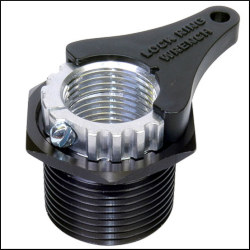
In this recent video Gavin Gear reviews three types of die accessories from LEE. These work for virtually all standard dies, not just LEE-brand reloading dies. The new LEE basic silver-finish die lock rings now feature splines for enhanced grip and compatibility with LEE’s new die lock ring wrench (photo right). They still boast a rubber 0-Ring that helps “float” the die for improved concentricity. Gavin also reviews Lee’s Spline Drive Breech Lock Bushings for use with presses fitted with LEE’s Breech Lock system. These Breech Lock bushings allow rapid change-out of dies without modifying the setting. The colorful new bushings feature splines on top that work with the new Lee Lock ring wrench shown above. In addition, the Breech Lock Bushings have a clamp to preserve die depth setting.
Tools Galore — Affordable Tools and Accessories for Reloaders
This detailed 15-minute video from the Bolt Action Reloading YouTube Channels, features a variety of lower-cost products/tool that help with key reloading tasks. The video looks at hand priming tools, case prep tools, Lyman stepped loading blocks, powder tricklers, expander mandrels, powder trickler, long-tube funnels and more! If you are getting started in hand-loading, this is a very helpful video to watch. It covers a lot of ground, illustrating options for tool types.
This Lyman case prep tool is one of many products reviewed in this 15-minute video.
Here’s a product that should please handloaders who wet-tumble their brass with stainless media, or use ultrasonic cleaning machines to clean cartridge brass (and gun parts). Employing forced hot air circulation, the new Lyman Cyclone Case Dryer will dry a large quantity of brass in under two hours. Internal racks provide five drying levels. Now available for under $60.00 on Amazon, the Cyclone Case Dryer is a very affordable and effective addition to an ultrasonic or rotary-tumbler cleaning system.
The Lyman Cyclone Case Dryer works fast. No need to wait overnight (or longer) to air-dry your brass. Lyman states that “The forced heated air circulation of the Cyclone will dry your brass inside and out within an hour or two, with no unsightly water spots.” The handy individual trays keep different types of brass separate. The dryer can also be used for gun parts that have been ultrasonically cleaned.
Lyman Cyclone Case Dryer Features:
• Holds up to 1000 .223 Rem cases or 2000 9x19mm Luger cases
• Works with cartridge brass cases or gun parts
• Fast drying time — Typically 1 to 2 hours
• Timer control can be set up to 3 hours
• Durable ABS trays with recessed handles
Watch How Cyclone Case Dryer Functions with both Cartridge Brass and Gun Parts
Cyclone Case Dryer 115V (Part #7631560) MSRP: $86.25
Cyclone Case Dryer 220V (Part #7631561) MSRP: $86.25
At the request of our readers, we provide select “Deals of the Week”. Every Sunday afternoon or Monday morning we offer our Best Bargain selections. Here are some of the best deals on firearms, hardware, reloading components, optics, and shooting accessories. Be aware that sale prices are subject to change, and once clearance inventory is sold, it’s gone for good. You snooze you lose.
1. Midsouth — Multiple Popular Powders in Stock
⏺ Good powders — Accurate, Hodgdon, Ramshot, IMR, & Vihtavuori in stock
Good news for handloaders — Midsouth has received significant quantities of popular reloading powders, including LT30, LT32, H322, H390, H50BMG, Ramshot TAC, VV N133, VV N320, and more. CLICK HERE to all propellants in stock. N133 is a top powder for the 6 PPC, LT30 and LT32 are top choices for short-range score cartridges, VV N320 is our favorite powder for .45 ACP, and Ramshot TAC is a great choice for .223 Rem and varmint loads. Head over to Midsouth today to see if there’s something you need.
⏺ Nice versatile rifle for hunting, target shooting, and tactical matches
Sportsman’s Warehouse is running a President’s Day Sale with significant savings on guns, optics, and ammo. Among the best gun deals are Bergara B-14 HMR rifles. Get a Bergara B-14 HMR in 6.5 Creedmoor, .308 Win, or .300 Win Mag for $799.99. That’s $150.00 off the regular price. Other Bergara Models are on sale as well, including the B-14 HMR Wilderness HMR in .300 PRC (26″ bbl) for $949.99. Act soon, this sale ends at 11:59 pm on 2/21/2022.
⏺ Cool ported pistol for rimfire games — accurate with great ergonomics
For .22 LR gun games, such as Rimfire Challenge matches, this Walther P22 is a good choice. The ported P22 combines low recoil/minimal muzzle flip with best-in-class ergonomics. This P22 pistol offers interchangeable backstraps, plus ambidextrous magazine release and slide safety. With its compensated (ported) barrel this gun delivers fast follow-up shots. A rare feature for a rimfire, the P22 is covered by the Walther Lifetime Limited Warranty. The P22 has a 5″ barrel and weighs 16 ounces with empty magazine. NOTE: Supply is limited.
4. Palmetto SA — Vortex 1-8x24mm Scope + Mount, $299.99
⏺ Smart cantilever set-up for AR rifles, save $200.00 with Code “STRIKE”
If you are looking for an affordable turn-key scope solution for your AR-platform rifle, check out this Vortex 1-8x24mm Strike Eagle GEN2 Scope + Mount Combo System. This combo includes a riflescope PLUS a Vortex cantilevered scope mount that positions the optic in the right position on a AR15 or AR10 rifle. You can see how the system works on an AR15 above. AR owners have been very happy with this combination. The Strike Eagle offers a true 8X zoom ratio with an illuminated AR-BDC3 Reticle optimized for ARs. Listed retail price is $499.99 but you save $200.00 with CODE “STRIKE”. That lowers your net cost to $299.99 for scope and mount.
5. MidwayUSA — Hoppes Gun Vise and Cleaning Kit, $24.86
⏺ Good basic gun vise at great price with bonus cleaning kit
The Hoppe’s Gun Vise is a good basic support for working on your firearms. And right now its offered for a crazy-low $25.86 sale price. Clamping brackets in the front and rear hold your rifle or shotgun securely without scratching. The vise is made out of a durable, chemical resistant polymer and has multiple compartments for cleaning chemicals, tools, and accessories. Included with this vise is a 12-piece Cleaning Kit for rifles, pistols, and shotguns. This gun vise has multiple compartments for tools and adjustable feet.
6. Amazon — BOG Deathgrip Aluminum Tripod, $159.00
⏺ Versatile tripod mounts quickly, securely — use for PRS/NRL or hunting.
This is a great tripod for long-range hunters and PRS/NRL competitors. The clamp-type head quickly secures to your rifle’s forearm for a secure shooting solution. The BOG Deathgrip Aluminum Tripod is on sale now on Amazon for $159.00. If weight is critical, there is also a lighter BOG carbon fiber tripod for $223.96 at Grafs.com. For the extra $65 (Graf’s price) you save a pound in total weight (7.5 lbs for carbon vs. 8.5 lbs for aluminum). This aluminum version is the top-rated hunting tripod on Amazon.
7. Natchez — CCI Blazer 9mm Ammo, $16.99/50 or $17.49/50
⏺ Quality 9mm pistol ammo at ultra-attractive prices
Do you carry a 9mm or use one for IDPA matches? Then check out this deal. Right now Natchez has CCI Blazer 9mm Luger (9x19mm) ammo on sale — both brass-cased and aluminum-cased. If you reload, pay a few bucks more for the brass-cased Blazer 9mm ammo ($17.49/50). If you don’t reload for 9mm, then shoot the aluminum-cased Blazer variety at just $14.99 for 50 rounds. Both Blazer types work fine — we’ve shot hundreds of rounds of the stuff in Glocks, SIGS, Rugers, and HKs with no issues whatsoever. Grab this bargain — the same ammo was selling for $28+ a few months ago.
⏺ Reliable, affordable, compact scale for reloaders
Right now this Frankford Arsenal DS-750 digital scale is 36% off at Amazon. This is a handy, precise little scale that is good for loading at the range, or for weight-sorting components. The DS-750 offer +/- 0.1 grain accuracy and weighs up to 750 grains. One nice feature is auto-shutoff after 60 seconds of inactivity. That saves on battery life. This won’t replace a premium scale, but it can serve many duties for reloaders. The scale measures in grains, grams, carats, and ounces and runs on 2 AAA batteries.
⏺ Handsome wood chest is great for holding small tools
This Wood Tool Chest makes a great addition to your reloading room. The eight (8) drawers can hold the many small tools and accessories used for hand-loading, such as bushings, shims, uniforming tools, mandrels, neck-turners and more. A deeper top compartment (under the lid) holds wrenches and other larger tools. The price is just $84.99 at Harbor Freight. A lockable sliding wood panel fits in place to cover the drawers when not in use. This locking panel also secures the drawers during transport.
10. Amazon — Jialitte Scope Bubble Level, $10.99
⏺ Great price for handy product every rifle shooter can use
All serious rifle shooters need a scope level. This nicely designed Jialitte Scope Bubble Level features a 30mm milled inside diameter, plus an inner insert ring so it will also fit 1″-diameter main tubes — that dual-diameter versatility is a nice feature. We also like the way the unit is nicely radiused, and has a low profile in the middle. Price is just $10.99 with free shipping. User reviews have been very positive. You could easily pay $35.00 or more for a 30mm scope level.
BONUS — RCBS Reloading Sweepstakes
Now through February 28, 2022 (2/28/22), you’ll have a chance to RCBS Reloading gear prizes worth $1918.97 (combined total). The various RCBS prizes include: RCBS MatchMaster Digital Powder Scale & Dispenser, RCBS Rebel Master Single Stage Press Kit, RCBS Case Prep Kit, RCBS Rotary Case Tumbler. CLICK HERE for entry info. No purchase necessary to enter contest.
Are you a High Power or F-Class marksman looking for official bullseye paper targets? Here are bulk sets of 25, 50 and 100 targets from Creedmoor Sports. All these can can be used for general practice, fun matches, or official sanctioned events. Choose the official 200-yard SR target with all scoring rings (X,10,9,8,7,6,5), priced at $49.95 for 50. For long-range practice, try the NRA Official 600-yard High Power Target ($58.95 for 25ct), or the Official “Full Face” MR-65 500-Yard F-Class Target ($31.95 for 50ct). Creedmoor also offers a variety of Repair Centers, including the 300-Yard SR-3C Target Repair Center ($34.95), or the 600-yard MR-1 Target Repair Center ($32.95). These target centers can be used on top of full targets, or by themselves for practice on smaller target frames.
Creedmoor Sports also offers match-grade spotter discs. These are used to mark shot locations. They are offered in three diameters: 1.5″, 3.0″, and 5.0″. In addition, you can purchase the spindles used with spotter discs along with orange Golf Tees also employed to mark shots. These are placed in the shot holes by pit workers.
Tipton Cleaning Rod Racks on Sale
Looking to better organize your reloading room (aka “man cave”)? Here’s a handy, affordable product that will help you organize gear in your reloading room or “man cave”. Tipton’s Cleaning Rod Rack (Tipton #100335) can accommodate up to six rods with various size handles. The wall-mounted Rod Rack also has horizontal studs on either end for additional accessories. These are useful for hanging the Tico Tool shotgun cleaning wands that stow in a tube with a plastic hook on the top.
Tipton Cleaning Rod Racks come complete with mounting screws (and screw slots are molded-in). You can find Tipton Cleaning Rod racks for under $7.00 right now. They are $6.95 at MidwayUSA. And Amazon currently offers the racks for $6.95 with free shipping for Amazon Prime Members.
A while back, we featured a portable reloading bench built on a Black & Decker Workmate. That proved a VERY popular do-it-yourself project so we’re showing it again, in case you missed it the first time.
Texan Robert Lewis made himself a great portable reloading bench from plywood mounted to a Black & Decker Workmate. The bench, roughly 22″ x 19″ on top, folds up to fit easily in your car’s trunk or behind the seats in a pick-up truck cab. Four recessed bolts hold the wood top section to the collapsible B&D Workmate. The sides and back of the unit are attached to the base with small nails. There is a small shelf (also nailed in place) which can be used to clamp a powder measure or hold a scale. Shown in the photo is a Harrell’s Benchrest measure and Harrell’s single-stage “C” press.
The whole unit can be built for about $65.00 with pine, or $80.00 with oak (as shown). Robert explained: “The Workmate was $40. If someone bought a 2’x4′ sheet of 3/4″ oak plywood, I think it is around $30. Using pine plywood would be about half that. Fasteners were $3. Spar Urethane would be $5.”
Robert told us: “I used a couple ideas I found on the web. The Larry Willis website gave me the idea to use the Black and Decker Workmate as a base. I found the Workmate on sale for $40 and the top is made from oak plywood I had in my shop. I sealed the wood with three coats of Spar Urethane. The whole thing folds into a nice package for transportation to and from the range.”
NOTE: Since we first ran this story, the price of a Black & Decker Workmate WM225 has increased. However you can still pick a WM225 Workmate for under $75.00. Amazon is currently selling WM225 Workmates for $70.34. The next best price we found was $72.96 at Home Depot, still a good price (Lowe’s is charging $94.98).


 Effective hearing protection is a must whenever you are shooting firearms or when you are in the vicinity of gun-shots. For ultimate protection, we recommend a good set of tapered foam earplugs, topped by muffs. However, there are situations when you may prefer lighter-weight hearing protection that can be quickly removed. For example, if you are standing well behind the firing line as an observer, or if you are working as a rangemaster or waddie some distance away from the shooters. In addition, game hunters may only need hearing protection for a few moments when they take their shot, so something light-weight that can be deployed in seconds is ideal.
 Three Quiet Band Models
“I first saw these used by Hickok45 on YouTube and he talked positively about them. I got two and gave them a try. At first, I didn’t think they were going to work very well. After some fiddling, I found they work pretty darn good. With my ears, they fit the best if the band starts on top of my head, I insert the plugs then rotate the band behind my head. PRESTO, perfect fit. Shooting the 9mm and 12 gauge out back was comfortable with no ringing afterward. [They are] small and easy to transport — just throw in the range bag. Yet, they are big enough to keep around your neck out of the way[.] I highly recommend them to anybody needing banded hearing protection.” — Tom W.







 In this recent video Gavin Gear reviews three types of die accessories from LEE. These work for virtually all standard dies, not just LEE-brand reloading dies. The new LEE basic silver-finish die lock rings now feature splines for enhanced grip and compatibility with LEE’s new die lock ring wrench (photo right). They still boast a rubber 0-Ring that helps “float” the die for improved concentricity. Gavin also reviews Lee’s


 A while back, we featured a portable reloading bench built on a Black & Decker Workmate. That proved a VERY popular do-it-yourself project so we’re showing it again, in case you missed it the first time.


