SIG Sauer has introduced a new .22 LR rimfire pistol that should be popular with SIG’s centerfire handgun owners (and anyone who wants a quality, polymer-framed .22 LR pistol). This new P322 pistol offers excellent ergonomics and 20+1 capacity, making it good for cross-training and fun rimfire shooting.
This VIDEO explains the features of the new P322 (Loud Volume — turn down at work):
The new P322 was designed and built by SIG Sauer in the USA. It has many premium features, including an optics-ready removable rear sight plate allowing installation of a red dot optic without adapter plates. The P322 offers ambidextrous controls, interchangeable flat and curved triggers, and fiber optic front and rear sights. The P322 even comes with a threaded barrel adapter making it suppressor-ready right out of the box. And with a 20-rd magazine for 20+1 total capacity, the new P322 is the highest-capacity .22 LR pistol in its class. (And a mag extension is offered for 25-rd capacity).
Though it may look like a striker-fired pistol, the SIG P322 is a hammer-fired, single-action-only design (the hammer is enclosed by the rear of the slide). The P322 is blow-back operated with a fixed (non-tilting) 4″ barrel. This helps contribute to excellent accuracy and reliability.
Hands-On P322 Testing by Ammoland.com Staffer
Jim Grant of Ammoland.com recently posted a very thorough review of SIG’s new P322 rimfire pistol. Grant shot hundreds of rounds both with and without a suppressor. He concluded that the P322 was extremely reliable and fun to shoot: “SIG P322 Verdict –Is the SIG P322 worth a buy? Abso-freaking-lutely yes. The P322 ships with two mags, a threaded barrel, two triggers, and an optic cut. That is an already impressive package but add… that the gun is literally peerless in terms of reliability and you have a recipe for total market dominance. What’s even better is that the gun has a MAP of $399.” WATCH Grant’s video review:
SIG Sauer P322 Pistol Features:
Ambidextrous Controls With Reversible Magazine Catch
Optics-Ready Removable Rear Sight Plate
Fiber Optic Front and Rear Sights
Hammer-fired, Single-Action-Only, Fixed 4″ Barrel
Suppressor-Ready With Included Threaded Barrel Adapter
Interchangeable Trigger Shoes (flat and curved included)
20 Round Magazine Capacity (with +5 optional mag extension) SEE PRODUCT PAGE
Running out of space in your gun safe? Here’s a clever product that will allow you to store more long guns in your current vault. The plastic Rifle Rods from Gun Storage Solutions slip in long-gun barrels and then grip the shelf above using Velcro pads. This allows you to nestle your rifles and shotguns much closer together than with the conventional racks provided with most gunsafes.
The handy Rifle Rods are offered in bright orange or basic black. We prefer the orange rods (shown above with the Velcro “receiver” shelf liner provided with the Rod Kit).
Rifles with narrow furniture (such as lever guns) can be placed very close together, saving lots of space. For benchrest or varmint rifles with wider fore-ends, you won’t benefit as much. Note that, in the photo above, all of the guns are fairly slim — none have wide fore-ends. Still we think these Rifle Rods could open up 12″ or more horizontal clearance in a medium-sized safe — that could easily allow you to store six (6) more guns in two rows, as shown.
Rifle Rod Kits Starting at $21.95
A kit with 5 Rifle Rods and loop fabric shelf liner costs $21.95 on Amazon.com, while the 10-Rod Kit with liner costs around $34.95. That’s a lot cheaper than buying a new safe. A six-pack of additional Rifle Rods costs $17.95 on Amazon. You can also purchases rods and fabric directly from Gun Storage Solutions.
WARNING: Always REMOVE Rod from barrel before taking gun to the range. Never place live ammunition in a gun with storage Rod in the barrel!
Product tip from EdLongrange. We welcome reader submissions.
Here’s a helpful, time-saving tool for handgun owners. MidwayUSA’s online Holster Finder lets you quickly find the right holsters for virtually all popular makes and models of pistols and revolvers. The wide variety of carry styles, materials, and features can make finding the right holster difficult or confusing. Drawing on a database of over 125,000 gun/holster combinations, the MidwayUSA Holster Finder turns that complex task into an easy three-step process.
The selection process is simple: 1. Choose Pistol or Revolver; 2. Select Make and Model of Handgun (and barrel type/length); 3. Click to view results. Just choose your gun type, select your make, model and barrel, then view the results. All major holster types are included: Ankle, Belly Band, Belt (outside waistband), Chest, Competition, Drop Leg, Inside Waistband (IWB), Paddle, Pocket, and Shoulder. Check out the MidwayUSA Holster Finder at MidwayUSA.com/holster-finder.
MidwayUSA’s Marketing VP Jeff Larkin says: “Our team built the Holster Finder so our customers could find all holsters we offer for their specific firearm without sorting through thousands of search results. Finding the perfect holster is now easier than ever — just a few clicks, and we’ll show you everything that fits!”
Take a good look at this black-stocked, rimfire benchrest rifle. This just might be the most sophisticated (and accurate) Ruger 10/22 on the planet. This 10/22 was originally acquired as a used “donor gun” for just $98.00. Then its owner Les (aka “Scasa” in our Forum) completely upgraded the rifle from stem to stern. He added a rear lug to the receiver, threaded the receiver, installed a new barrel, and upgraded the trigger. Then he crafted the handsome benchrest stock from wood. He even designed and crafted the barrel tuner AND built the sophisticated shooting rest himself.
Overall, Les imagines he has over 1000 hours of design, fabrication, and fitting in this project. But the hard work paid off — this one-of-a-kind Ruger 10/22 shoots tiny groups. Is this the most accurate 10/22 on the planet? Possibly. But without question, it is the most sophisticated, do-it-yourself Ruger 10/22 project gun ever created.
$98 Ruger 10/22 Transformed into Tack-Driving Bench Gun
Report from Les E. (aka “Scasa” in our Forum)
I long thought I’d someday put an upgraded Ruger 10/22 together but the big hold-up was the receiver. I really wanted a threaded barrel/receiver and a rear lug for two-point mounting. They do make a rear lug that attaches to the rear of some aftermarket receivers but it’s just a little tab that attaches to the back, not what I would call really solid. So one day while hanging out at the local gun store I saw a Ruger 10/22 on the used gun rack for just $98.00. I latched onto it and I had my donor gun. This was an early gun that had the two guide rails for the bolt, walnut stock, and metal (not plastic) furniture.
Finished 10/22 rifle with rifle stock, tuner, and aluminum shooting rest all built by Les.
I then began a complete transformation of the rifle. Little did I know that, by the end of the project, I would put in about 1000 hours of labor. There were several things I wanted to make quite different than Ruger’s original design. First was to add the rear lug. Then get rid of the trigger pins. I also threaded the barrel hole in the receiver to get rid of the wedge. I also wanted to fix the bolt release. Of course that all required a new stock too.
In this video, Les explains the major upgrades he did to the Ruger 10/22:
Interested in this rifle build? Talk about it in our Shooter’s Forum. Rifle owner/builder Les can answer your questions about this Ruger 10/22 in this Forum Thread.
The Ruger 10/22 receiver was threaded to accept a more traditional barrel installation. Below is a conventional 10/22 drop-in barrel. Note that normal barrel is NOT threaded at receiver end, but slides in and then is held in place with a “wedge” locking block.
I made a rear lug that attaches to the back of the Ruger receiver with four, 6-32 screws and glued with JB Weld and filed to match the receiver contour.
Shown above is the completed gun before stock painting. The stock is made from nine pieces of Poplar 1x2s, with lots of sanding and black satin paint. Above is a photo of the stock before painting. As you can see, the laminations were stacked vertically. The rifle sits on a one-piece shooting rest I also built.
Editor: Les designed and crafted this sophisticated shooting rest himself. That’s right — this is a DIY rest! Les told us: “I built the rest from scrap aluminum. The design came from looking at rimfire rests online. Probably the Pappas Rest was the greatest influence. That Pappas rest cost about $1100.00 at the time for a polished one. I have less than a hundred dollars in mine now, but I’ve got a couple WEEKS of work in it. I’ve made two of them, one for my rifles and one for my benchrest pistol. It’s a lot of work to sand and polish, but in the end you have a solid shooting platform. Keep it waxed to preserve the shine.”
Watch Les shoot his fully-transformed and upgraded Ruger 10/22 with rest he built:
Editor: In the above video Les shoots his fully-upgraded Ruger 10/22 from a sophisticated one-piece rest he built himself. You can see how well the rest handles his upgraded Ruger 10/22. Below are the two 5-shot groups shot at 25 yards with this rig in the video. Very impressive! The ammo used was Wolf Match Extra.
More Upgrades — Trigger Pins, Bolt Release and More…
The trigger pins were replaced with 10-32 socket head screws which required threaded bushings to be put in the left side of the receiver and access holes in the right side of the stock. Now the trigger group and bolt can be removed without taking the action out of the stock. This also pulls the receiver sides together reducing bolt clearance. The trigger is shimmed with a piece of shim stock so it can’t be too tight.
There are several “How-Tos” which cover conversion of the manual bolt release to an auto bolt release, but it still requires a little fiddling with the darn thing. So instead of having it pivot on a slot, I welded up the slot and now it’s just a hole. I also welded on some more length and put a little knurled knob on it. With those modifications, it now works perfect.
The trigger housing is factory Ruger acquired at a gun show 25 years ago with Volquartsen hammer and sear. The barrel is a Green Mountain blank turned, threaded, and with a Bentz chamber. I made the barrel tuner. The rifle is fitted with a BSA 36-power scope I bought for $125.00 from the AccurateShooter Forum classifieds. There may be another $250.00 or so in parts and accessories I bought.
Editor’s Commentary — This project started with an old, used $98.00 Ruger 10/22 rifle. Now the transformation is complete. It took Les countless hours, and lots of effort, but he is deservedly proud of the end result. The excellence of the upgraded 10/22 is matched by the sophisticated, unitized aluminum shooting rest Les built. Very impressive design and execution.
So How Does it Shoot? Very Nicely Indeed!
Les reports: “Above is a target with some 3-shot groups while playing with the tuner. Those groups were shot at 25 yards. I figure at that distance I’m testing what the gun will do, not how well I can read the wind, not well and its been really windy. If I can get one clean hole 5 shots I’m pretty happy.”
Les electro-etched the caliber on the barrel. Les told us: “The machine was easy to make and works really well. It’s just a pain getting stencils.”
Good news for owners of 1903/1903A3 Springfields, M1917 Enfields, and M1 Carbines. The CMP eStore sells brand new chambered, Criterion chrome-moly barrels for these M1903/M1903AC rifles for under $200.00. In addition there are M1 Carbine barrels for $229.50. These authentic-profile barrels are made by Criterion Barrels in Richfield, WI, using the button-rifling process. They are “semi-finished” meaning they come chambered and headspaced within .010″ of finished size, with final fitting to be done by a competent gunsmith. The barrels are also externally Parkerized to match the finish of your vintage ’03, Garand, or M1 Carbine. To order, go to the CMP eStore and click the Barrels Link in the upper left.
NOTE: Final assembly and headspacing by a qualified gunsmith is required!
New 1903 barrels by Criterion Barrels, Inc., 4140 chrome moly steel, button rifled, contoured, and finish lapped after contouring. These comply with CMP competition rules and are legal for the 1903 Matches. Parkerized like the original 1903 and chambered .010″ from finish size to be fitted and headspaced when assembled to fit your receiver and bolt dimensions.
New 1903A3 barrels by Criterion Barrels, Inc., 4140 chrome moly steel, button rifled, contoured, and finish lapped after contouring. These comply with CMP competition rules and are legal for the 1903A3 Matches. Parkerized like the original 1903A3 and chambered .010″ from finish size to be fitted and headspaced when assembled to fit your receiver and bolt dimensions.
New M1917 barrels by Criterion Barrels, Inc., 4140 chrome moly steel, button rifled, contoured, and finish lapped after contouring. These comply with CMP competition rules and are legal for the 1903A3 Matches. Parkerized like the original M1917 Parkerized like the original M1917 and chambered .010″ from finish size to be fitted and headspaced when assembled to fit your receiver and bolt dimensions.
New Carbine barrels by Criterion Barrels, 4140 chrome moly Steel, button rifled, contoured, and finish lapped after contouring. Comply with CMP Competition Rules and are legal for the CMP M1 Carbine Matches. Parkerized like the original M1 Carbine and chambered .010 away from finish size to be fitted and head-spaced when assembled to fit your receiver and bolt dimensions. Barrel is .30 Carbine.
ZEISS has introduced a new LRP S5 series of First Focal Plane (FFP) optics. There are two new FFP scopes with high zoom ratios, the LRP S5 318-50 and LRP S5 525-56. These are impressive scopes, with excellent glass, precise controls, and a ton of elevation. Both models boast a 34mm main tube, European-style fast-focus eyepiece, Ballistic Stop elevation turret (with 40.7 MRAD or 140 MOA of total elevation travel), and an external locking windage turret.
Gunsmith Jim See of Elite Accuracy LLC has been testing the LRP S5 525-56 which offers 25X max power. Jim had the Milrad version with the ZF-MRi Reticle and 40.7 Mils of elevation. Jim, an active PRS/NRL competitor, knows what features are important in tactical competitions. He understands that a good PRS/NRL scope must be tough, precise, and repeatable. Jim was impressed with the new 5-25x56mm ZEISS scope. Jim really liked the bright, clear markings on the turrets, and the positive clicks. He also praised the lever-equipped zoom control, the positive zero-stop on the elevation knob, and he believed the lockable windage turret can have definite benefits in the field.
Jim told us: “The scope operates well, it tracks well, and the turrets are accurate in their movements. All the functions work well — elevation, windage, parallax. This LRP scope has a quality feel — similar to other ZEISS products I have used.” Overall, Jim believed this ZEISS 5-25x56mm optic “will fit well in its intended market”, namely PRS/NRL and long range hunting.
I recently reviewed ZEISS’s latest scope offering for the precision rifle shooter. ZEISS is a very recognizable name in the optics industry, and the LRP S5 line of optics is there first big attempt to attract the attention of PRS/tactical/competition enthusiasts.
ZEISS LRP S5 accessories include a power throw lever, a sunshade, and a set of precision rings with integral bubble level, which I found to be very well-made. I fitted my test scope with these items.
For the review I was sent the 5-25x56mm version in MRAD configuration. This optic has a 34mm main tube and is a first focal plane scope. My initial impressions of the optic when I first handled it were favorable. It had the typical look and finish of other ZEISS optics I was familiar with, the robust and solid feeling construction, and well thought-out turrets clearly numbered and easy to read.
Jim had high praise for the highly visible numbers on the dials: “With my (older) eyes, I can’t read the numbers on most scopes, but with this ZEISS LRP S5 scope I CAN read the numbers.”
I mounted the ZEISS to a very accurate 6mmBR rifle and headed out to the range to zero the optic and set the zero stop. This operation only took minutes. I fired a shot, dialed the scope to the bullet impact and sent another round, with a little fine-tuning over the next three shots I had my zero. I consulted the Owner’s Manual, and quickly reviewed the procedure for zeroing out the elevation turret and setting the zero stop. Simply loosen the two turret set screws, push the turret down and spin it to the zero indication mark on the turret until it stops, then retighten the two set screws. It’s a very easy process which I appreciated.
The turrets on this scope have clearly identifiable clicks with a slightly deeper detent at the full One Mil indicator marks. So as you rotate the turret and hit the full mill values, you can clearly feel the resistance of the heavier detent.
My next objective was to test the accuracy of the turret and the reticle sub-tensions. In any long range matches we compensate for bullet drop and wind deflection by accurately calculating our corrections via a ballistic calculator or collected data. It is very important that an elevation turret tracks true. I set up a tall target test with marks at 36″ and an exact range of 100 yards. I shot a 3-shot group at my aim point and then dialed up 10 Mils. I then repeated the 3-shot group using the same Point of Aim. The results were near perfect with a 36″ spread between the two groups. All groups were at or under .25 MOA which is representative of this rifle. The scope repeated on aim impacts, fresh off a +10 Mil “up” dial. I then dialed the turret back to zero and repeated the test with a +10 Mil aim-point change using the reticle subtensions only. There was a small variance on impact height using the subtension lines, without clicking up 10 Mils, but using the reticle hold lines only.*
Note that the view through the scope is bright and clear all the way to the very edge of the viewable image. Lesser scopes may show shadowing or distortion at the periphery.
A few days later I was able to get to a range with some steel targets out to distance, on this day I was looking at optical performance and the “feel” of the optic. It just so happens that the sun was low in the sky and I thought what a great time to check for optical flare. No good comparison happens without something to compare against. So with me was another rifle with a flagship optic [another brand] I was very familiar with. I fitted both optics with their sun shades, and looked at a picnic table on a pond dike, directly in line with the sun. The ZEISS in this test showed considerably less optical flare, to the point that flare was almost nonexistent. The ZEISS offered a clear and usable image with no eye strain. The other brand scope did not perform nearly as well in this comparison.
I proceeded with some longer distant shooting with the main purpose of seeing exactly what I could see. In the game of precision-style rifle matches one of the keys to success is managing recoil through the application of solid fundamentals. The goal here is to identify independently where each bullet goes. We accomplish that by staying in the scope and watching down range. Bullet trace, dirt impacts, target reaction, target impacts, and occasionally seeing the actual bullet in flight, are feedbacks we look for. With the sun low and sitting at about 1:30 from my line to the target, it turned out to be a great day for actually seeing the bullet in flight. The reflection of the light off the side/rear of the 105 grain Berger bullet was clearly visible to me. This is not something everyone sees because you have to know how to look for it, it is best to run in a midrange power of 10-15x to pick up these subtleties. In this case I knew I was holding about one Mil of right wind and 4.3 Mils of dialed elevation. So as I broke the shot I let my eye look up and right of the target. Each time I could catch the arching streak of the bullet as it headed to and impacted the target. The lighting in combination with the wind, on this day, was not very conducive to seeing bullet trace, again something we look for but do not always see depending on conditions.
After beating up the already shot-up plate, I was able to turn up the magnification on the ZEISS and identify both old impacts and the newer impacts that were shinier on the steel plate, typically seen as brighter smears before the lead and steel has a chance to oxidize. I then ranged and dialed plates at different distances, then shot, dialed, and shot some more. Everything in the ZEISS worked well and tracked well, causing no concerns whatsoever.
I concluded the session with some side-by-side comparisons with my control optic. I studied impacts on the same steel plate, and then did a side by side on farm buildings about 2400 yards away. Both of these optics clearly resolved the images studied. What I took away from this was that the ZEISS had a more sensitive eye box when your eye placement shifted from left to right. Not substantial but something I only noticed with a constant evaluation [in direct comparison]. Your eye placement behind the ZEISS optic front to back was forgiving and pretty normal for scopes of similar design. I noted to myself that this was worth another assessment day to better judge the optic.
In this video, on a snowy day, Jim shows how easy it is to set the Zero Stops on the turrets of the ZEISS LRP S5 5-25x56mm scope.
I was able to look through the optics again on a day with pretty flat light. We were now snow-covered and cloudy in north east Iowa. The goal today was to set up the optics in my BOG Deathgrip tripod and study the town I lived in. I set up and focused the optic onto a multi-story brick building at 1500 yards. With some fine tuning, both optics allowed me to clearly see the mortar lines between the bricks at this distance, with the flat lighting brightness and contrast were very similar in these scopes. I then looked for some color. I found my local Casey’s gas station at about 800 yards and started my comparison. My color perception in both optics seemed very similar to the point of being uneventful in even trying to compare the two, now I wished I had a bright sunny day to look over these optics again.
I spent a third evening behind glass, the goal was to get an idea of how the ZEISS performed as light was fading, again we had another cloudy evening in Iowa. I added another high-end tactical optic of similar power rating and dimensions to the evaluation, that model being a few years old but still in the manufacturer’s line-up. What I took away from this three-optic evaluation was that, on similar power settings, the ZEISS low light performance was exceptional. The white snow was still nice and white, resolution was very good and the images were easily identifiable. The first competitive comparison optic also performed very well, the second optic added to the mix showed a tint of yellowing in the image, something that I had not noticed with that optic in previous daylight use.
Overall I think ZEISS has developed an optic that will fit in with the market it was intended for. It is a solid optic that feels very robust and repeatable. The ZEISS LRP S5 525-56’s functions and repeatability performed as they should in my testing. The optical quality is very good and offers a bright, clear image. Those shooters looking for a new top-level optic should give the ZEISS LRP S5 525-56 an honest look.
Installation in Zeiss Rings
Jim placed the scope in high-quality ZEISS rings with integral bubble level. He then took the rig out into the field and completed an initial Tall Target test. That test confirmed the precision and repeatability of the 0.1 MRAD elevation and windage click values.
Jim also liked how positive the clicks felt with both elevation and windage knobs. Jim told us: “The scope operates well, it tracks well, and the turrets are accurate in their movements. All the functions work well — elevation, windage, parallax. This LRP scope has a quality feel — similar to other ZEISS products I have used.” Jim also noted that the ZEISS LRP S5 scope resisted solar flare very well: “This is important in PRS matches where we get that low sun in the afternoons”.
Scope mounted in ZEISS rings with bubble level. Optional sunshade is attached in front.
To test ruggedness and weatherproofing, Jim is putting the ZEISS LRP through its paces in harsh winter conditions. He’s using a tripod here to keep off the snowy ground. The tripod mount also allows smooth traversing to view a wide selection of terrain and objects near and far.
Advanced Optical Technology — ZEISS LRP S5 Features
The ZEISS LRP S5 525-56 has many notable features, including a lockable windage turret, adjustable reticle illumination, and a HUGE amount of elevation travel — 40.7 Mils in the MIL model and 140 MOA in the MOA version. That gives this optic the ability to shoot at extreme range without requiring holdovers.
* In this test I could see immediately that the reticle showed a measured gap between my previous two groups of 9.8 Mils (not 10), though those groups were actually a true 36″ apart (ten Mils is 36″ at 100). The shooting results, using the reticle lines only, confirmed what I saw, and I now had two groups that measured 36.6″ apart. The “take-away” is that if I have to hold with the reticle only, I can calculate the error at a minimal 0.1 mil for every 5 mils held in the reticle. Will this error cause problems? Some may think so, but in competitions we rarely hold over 5 mils while shooting stages. At 100 yards, a 0.1 Mil click is 0.36 inch, a full Mil is 3.6 inches, and ten Mils is 36″.
“The press is the heart of the handloading operation, also traditionally the most expensive single tool employed…” — Laurie Holland
British competitive shooter Laurie Holland has reviewed three popular, single-stage reloading presses for Target Shooter Magazine (targetshooter.co.uk). Laurie bolted up a Forster Co-Ax, RCBS Rock Chucker Supreme, and RCBS Summit to his reloading bench and put the three presses through their paces. These three machines are very different in design and operation. The venerable Rock Chucker is a classic heavy, cast-iron “O”- type press that offers lots of leverage for tough jobs. The smaller RCBS Summit press is an innovative “upside-down” design with a large center column and open front. It offers a small footprint and easy case access from the front. The Co-Ax is unique in many respects — dies slide in and out of the upper section which allows them to “float”. The cartridge case is held in the lower section by spring-loaded jaws rather than a conventional shell-holder.
If you are considering purchasing any one of these three presses, you should read Laurie’s article start to finish. He reviews the pros and cons of each press, after processing three different brands of brass on each machine. He discusses ergonomics, easy of use, press leverage, smoothness, priming function, and (most importantly), the ability to produce straight ammo with low run-out. The review includes interesting data on case-neck run-out (TIR) for RWS, Federal, and Norma 7x57mm brass.
Review Quick Highlights:
RCBS Rock Chucker Supreme
“My expectations of the antediluvian RCBS Rock Chucker Supreme’s performance weren’t over high to be honest as I mounted it in the place of the Summit. As soon as I sized the first of the stretched RWS cases though, I saw why this press has been such a long-running favorite. The workload was considerably reduced compared to the other two presses and doing 40-odd cases took no time at all with little sweat — it just eats hard-to-size brass.”
RCBS Summit Press
“Despite its massive build and long-stroke operating handle, [the Summit] took more sweat than I’d expected, even if it was somewhat less work than with the Co-Ax. Although the Summit is apparently massive, I noticed that the die platform would tilt fractionally under the heaviest strains[.] It is nevertheless a very pleasant press in use and bullet seating was a doddle — the few examples tried proving very concentric on checking them afterwards. The optional short handle would be valuable for this task.”
Forster Co-Ax
“[On the Forster Co-Ax], the operating handle is above the machine, located centrally here [with] twin steel links at the top end of the press dropping down to the moving parts. The Co-Ax incorporates a number of novel features, principally its automatic and multi-case compatible shell-holder assembly with spring-loaded sliding jaws, very neat spent primer arrangements that allow hardly any gritty residues to escape and foul the moving parts and, the snap-in/out die fitment that allows rapid changes and also sees the die ‘float’ in relation to the case giving very concentric results. I own this press and it meets my handloading needs very well.”
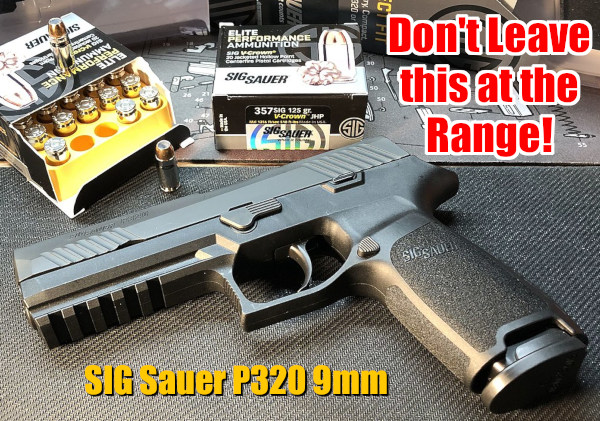
Here’s a story about a $1500 screw-up. Last year a fellow was shooting pistols at a range in Colorado. After his range session, the shooter left behind a specialty back-pack containing two nice 9mm handguns, plus ammo, hearing protection, and other gear. The smaller pistol appears to be a Smith & Wesson M&P M2.0 compact, while the larger handgun looks like a SIG Sauer P320 Nitron full size. Combined current value of those two handguns (with mags) was over $1200.00.
What was the total value of the forgotten items? To the handguns’ value, you must add the cost of the ammo ($150+), hearing protection ($50+) and the price of the range backpack and other accessories ($150). All totaled, this unfortunate shooter left over $1500.00 worth of guns, ammo, and gear on the bench.
The poor fellow was fortunate however. His backpack filled with guns and ammo was found by an HONEST member of our Shooters’ Forum. That Forum member put up a notice about the lost items on the shooting club’s website. The objective was to safely return the guns and gear to their absent-minded rightful owner.
“I was at my club range in Colorado this morning right at sun up. I wanted to fire a box of 7mm-08 before the heat set in. I found this backpack left behind from the day before on a bench. The backpack had two pistols and was packed to the gills with ammo, magazines, and ear protection.
But there was NO OWNER ID inside!
I left a big note there at the range saying that I found the pack, and listing my phone number. I will have a ‘found gear’ notice posted on our shooting club website very soon.
Guys, this isn’t the first time. Last fall I found a Ruger 77 .30-06 rifle left in a rifle rack. The owner got it back a few days later.”
Guys — Slow down!
Look around before leaving the range!
Be sure to gather ALL your guns and gear!
HAPPY ENDING — Guns and Gear Returned to Owner
“The very happy owner was reunited with his pack after coming to my house. He drove out to the range at 1:00 PM and saw my note held down with a rock on that bench. He called and ID’d the contents. I love a happy ending!” READ Forum Thread.
Paul Phillips is a past King of 2 Miles, and one of the world’s top Extreme Long Range (ELR) Shooters. He recently showcased one of his ELR rifles that shoots the .416 Barrett cartridge with huge, 550gr Cutting Edge bullets seated in CNC-machined RCC (Robertson Cartridge Company) brass that costs $10 per case.
Even with these giant-sized cartridges, Paul Phillips is getting remarkable accuracy. He recently went out to a snow-covered rifle range to do some testing. We include some test results in this article. Paul’s rig delivered 1.056″ to 1.748″ 3-shot groups at 500 yards. That’s .202 to .335 MOA for three shots. (1 MOA = 1.047″ at 100 yards, or 5.235″ at 500 yards). That’s very impressive accuracy for such a big cartridge with serious recoil.
Confidence is Gained from Consistent Accuracy
Report by Paul Phillips
After being retired from my 30 years of service in military and law enforcement, I started my own company, Global Precision Group LLC. We specialize in Long range shooting. I am currently doing some R&D for a new ammunition company, Ultimate Ammunition, (UA) out of Las Vegas. UA specializes in Military, Law Enforcement, and Custom ammunition.
On this particular day, it was a very cool 15 degrees F. I was testing ammunition for the .416 Barrett. Since winning the King of 2 Miles in 2019, my team has been looking at ways to make everything better. The competition is fierce and everyone is getting better and better. Finding single-digit Standard Deviations (SDs) is a must. Holding SDs under 5 FPS can be what it takes to win.
After several weeks of testing, I think I found the perfect combination for the .416 Barrett in my rifle. My optimal load runs about 3000 FPS using the following components:
Cutting Edge 550 Grain Solid Bullets with Tips
RCC Brass (CNC-machined)
Vihtavuori 20N29 Powder
RWS primers
Loaded for ~3000 FPS load velocity goal
I figure if I can keep my 3-round groups under two inches consistently, I have a chance to win on any Sunday. The average group size of these groups was 1.47 inches at 500 yards. With big bore rifles it gets very costly to test. That is why I am limiting my test groups to 3 rounds. See below:
Note the single-digit Extreme Spread and SD for all of these three-shot groups, as recorded by the LabRadar (see below). The average SD for these three groups at 500 yards was about three.
NOTE: This is an animated GIF with THREE images, alternating every 4.5 seconds.
Not just the ammunition deserves credit. I also have to give credit to the quality Manson reamer, BAT action, Bartlein Barrel, Bix’N Andy trigger, Manners ELR stock, Nightforce Optic, and Accu-Tac bipod with my new P skis. All these gear/hardware items, combined with quality ammunition, allow these kind of groups.
Products featured in this article include:
Accu-Tac Bipods
Bartlein Barrel
BAT Machine Action
Bix’N Andy Trigger
CROSSTAC Shooting Mat
Cutting Edge Bullets
Edgewood Shooting Bag
Kestrel with Ballistics
LabRadar
LongShot Cameras
Manners Composite Stock
Manson Precision Reamer
Nightforce Optics
RCBS Press and Tools
RCC (CNC-machined) Brass
Vihtavuori Powder
For 2022, Hornady has introduced a new CX™ (Copper alloy eXpanding) hunting projectile. This monolithic CX bullet is designed to provide outstanding performance when hunting in areas where solid lead or lead-core bullets are prohibited. Hornady states: “The new CX™ bullet from Hornady represents the most advanced monolithic hunting bullet on the market. Its optimized design offers extended range performance, greater accuracy, high weight retention, and deep penetration.” The Heat Shield tip is made of a heat-resistant polymer that … provides a consistently high BC for the bullet’s entire flight path. The grooves on the CX bullet are claimed to “maximize aerodynamic performance while effectively reducing bearing surface and fouling”. Fully California-compatible and appropriate for use in other areas that prohibit lead in bullets, CX bullets are a good option for hunting medium-size to large game. The CX will be available in a number of calibers/bullet weights: 6mm, .25 Cal, 6.5mm, .270 Cal, 7mm, .308, .338, and .375.
Along with the CX bullets by themselves, Hornady will offer factory ammunition loaded with these monolithic copper alloy bullets. CX bullets are offered in Hornady’s Outfitter, Superformance, and Custom ammunition product lines.


 Installation in Zeiss Rings


 Review Quick Highlights:

 What was the total value of the forgotten items? To the handguns’ value, you must add the cost of the ammo ($150+), hearing protection ($50+) and the price of the range backpack and other accessories ($150). All totaled, this unfortunate shooter left over $1500.00 worth of guns, ammo, and gear on the bench.


 After several weeks of testing, I think I found the perfect combination for the .416 Barrett in my rifle. My optimal load runs about 3000 FPS using the following components:


