A while back, our friend Vince Bottomley in the UK wrote an excellent article for Target Shooter Magazine. Vince offers “solid-gold” advice for new F-TR and F-Open shooters. Vince reviews the cartridge options, and offers suggestions for a shooter’s first (and hopefully affordable) F-Class rifle. Vince also reviews various bipod choices for F-TR and discusses optics options (from $300 to $3000).
Getting Started in F-Class by Vince Bottomley
As membership secretary of a large club, one of the questions I’m frequently asked – “What’s the best way to get started in F-Class?” My club has an F-Class shoot every couple of weeks at ranges from 300 to 1000 yards and, not surprisingly, it’s very popular.
F-TR or Open Class?
From a shaky start way back in 2004, the F-TR Class is now proving as popular as Open Class and, at GBFCA League shoots and club shoots, many shooters choose to start with a 308, shooting off a bi-pod – in other words F-TR. In Open Class, the 7mm WSM soon established itself as the “must have” cartridge – if you wanted to win but, the WSM’s appetite for barrels eventually brought another 7mm cartridge into play – the 284 Winchester. This 50-year-old stalwart was revived a decade or so ago as the 6.5-284 and indeed this cartridge found some favor with F-Class pioneers – before the potency of the WSM was discovered. If you don’t mind shelling out for a couple of barrels per year (barrel life is about 750 rounds with the WSM) go for the 7mm WSM but, if you require a decent round-count, then opt for the .284 Win and learn to read the wind a bit better!
Scopes for F-Class
If you will be shooting 1000 yards then I would recommend at least 32 power and preferably a variable – like the 8-32. The cheapest “usable” scope in this range is the Sightron. It’s a great scope for the money and at under $900 (in the USA) it’s half the price of its nearest competitor. It’s also light – at 1.5 lbs – and there are some great reticles for the F-Class shooter – like the LRMOA.
While Varget and Reloder 15 remain in short supply, you can often find IMR 4320 powder back in the shelves of local gun stores. IMR describes IMR 4320 as follows: “Short granulation, easy metering, and perfect for the 223 Remington, 22-250 Remington, 250 Savage and other medium burn rate cartridges.” This older-generation powder isconsiderably more temp sensitive than the Hodgdon Extreme propellants, but in the right application, it looks to be a viable alternative for folks who can’t source Varget, Reloder 15, and even H4895.
IMR 4320 Shoots Well in the .308 Winchester
A while back, GS Arizona wrote an excellent Riflemans Journal article, IMR 4320 — the Forgotten Powder. GS developed IMR 4320 loads for his .308 Win Palma rifle and competed with IMR 4320-powered ammo at long range matches. He concluded that: “[IMR 4320] appears to be a very useful alternative to some of the harder-to-get powders. The load is working extremely well at 1000 yards. In the [2009] Arizona Palma State Championship, several high-placing competitors were using the 4320 load. We got sub X-Ring elevation at 1000 yards from several rifles, and that’s all I’m looking for in a Palma load.”
IMR 4320 Works for Dasher Shooter
Forum member FalconPilot shoots a 6mm Dasher with Berger 105gr Hybrids. Looking for an alternative to Varget, he decided to give IMR 4320 a try. The results were good. FalconPilot reports: “I’ve been looking for other options (besides Reloder 15, which I love, but it’s really dirty). While at a gun shop in Ohio, I ran across 8 pounds of IMR 4320. I had never even heard of it, much less tried it. Getting ready for upcoming mid-range shoots, I loaded five rounds with IMR 4320 to the exact same specs as my winning Varget loads for the 6mm Dasher. This recipe was 32.7 grains of powder, Wolf SMR primer, Berger Hybrid 105 jumped fifty thousandths.” Falcon pilot tested his IMR 4320 load at 600 yards:
As you can see from the photo at the top of this article, FalconPilot had good results — a 1.5″ group at 600 yards. He reports: “This group was shoot during the middle of the day, mirage bad, scope set to 25X. It looks like IMR 4320 is a [very close] replacement for Varget… with a tad bit slower burn rate.” FalconPilot tell us the accuracy with IMR 4320 rivals the best he has gotten with Varget: “This gun has always shot under 2 inches [for 5 shots] at 600 yards, and most of time shoots 1.5 to 1.7 inches.”
For comparison purposes, here are Heat of Explosion and Burn Rate values from QuickLOAD for IMR 4320, and for the popular Reloder 15 and Varget powders. You can see that these powders have similar characteristics “by the numbers”:
Manufacturer
Powder Brand
Heat of Explosion
Burning Rate Factor
IMR
4320
3890
0.5920
Alliant
Reloder 15
3990
0.5200
Hodgdon (ADI)
Varget
4050
0.6150
WARNING — When changing from one powder to another, always start with manufacturer’s stated load data. Start low and work up incrementally. Never assume that loads will be equivalent from one powder to another, even powders with similar burn rates.
What Other Forum Members Say:
I was using IMR 4320 in the mid 70s in my .222 Rem. Darned great powder and I never had a load that was not accurate from the .222 to .30-06 with that powder. — 5Spd
A fine powder overshadowed by the nouveau wave of “gotta have the newest — make me a better shot” powders. Try 4320 in a 22-250 — what a well-kept secret! IMR 4320 meters very well and is a flexible alternative to many of the hard-to-find powders so much in demand. — AreaOne
IMR 4320 was my “go to” powder in my .223 for many many years. This powder and Winchester 55gr soft point bulk bullets (the cheapest bullet I could buy at the time) accounted for thousands of prairie dogs, coyotes, and anything else that needed shooting. I still use IMR 4320 in some .223 loads and am very happy with it still. — pdog2062
I’ve been using it in a .308 Win for several years. I think it is very sensitive to temperature and always waited till the last minute to load my ammo with a close eye on the weekend forecast at the range. IMR 4320 Works pretty good for 155gr Palma and 168gr Hybrid [bullets] in my .308. — JayC
IMR 8208 XBR is also good — if you can find it
Another good substitute for Varget powder in a .223 Rem or .308 Winchester is IMR 8208 XBR. In our own .308 Win tests, this generated slightly more velocity than Varget, with good ES/SD. However, this very good IMR 8208 XBR powder is out-of-stock at many vendors.
This story, from our Gun of the Week Archives, offers a good intro to the 30 BR cartridge, which is still the leading chambering for short-range Score Benchrest.
What’s better than one custom-built 30 BR with gorgeous wood and top-shelf components? A matching pair of course. Just ask Australian shooter Greg Roche (“Caduceus” in our Forum). A decade ago, Greg spent two years living and working in the USA. While in America, he commissioned two matched custom rifles to bring back to Australia for Hunter Class BR matches. Though the look-alike rigs are both chambered in 30 BR, one is designed for the Australian “Traditional” centerfire Hunter Class (10-lb limit), while the other is purpose-built for the “Custom” centerfire Hunter Class (14-lb limit). The 10-lb Traditional rifle features a fully-functioning two-round magazine and a 6-power scope. In contrast the Custom Class rifle is a single-shot action, with a 45X Leupold scope. The Custom weighs 13.5 pounds so it can also be used in traditional Heavy Varmint Benchrest matches if desired.
Tale of Two Rifles Story and Photos by Greg Roche (“Caduceus”)
The USA boasts some of the finest precision rifle-builders and Benchrest parts suppliers in the world. Before returning to Australia after two years in the States, I decided to have two special BR rifles built using American components and skilled labor. I wanted a matched pair — twin guns that would be as handsome as they were accurate. The heavier gun of the pair, the 13.5-lb Custom Class rifle, features top-of-the-line (but well-proven) technologies and components. With the 10.5-lb Traditional Class rifle, we had to develop new solutions to allow the 30 BR cartridge to feed from a functional two-round magazine. Here is my saga of how my twin 30 BRs were conceived and built, and how they have performed in competition.
BACKGROUND — The 30 BR for Score Competition
The 30 BR is a wildcat cartridge based on a necked-up version of the 6mmBR Norma case. It originated in U.S. Benchrest circles where it found its niche in Varmint For Score (VFS) matches. Unlike traditional Benchrest, where group size determines the winner, VFS matches are shot on a target with multiple, concentric-ringed bullseyes. Point total is based on “best edge” shot location (one shot per bull). In score competition, the 30 BR’s “supersized” .308-diameter hole offers an advantage over the 6mm hole created by a 6 PPC, the dominant group BR chambering.
The starting point for loading the 30 BR wildcat is Lapua 6mmBR brass. These are necked up as a single-step operation using a .30 caliber tapered expander ball (or dedicated expander mandrel). This will leave a bulge in the neck, so the expanded case neck is normally turned to bring the thickness down to the correct dimension for the chamber. I turned these necks down to .010″ wall thickness using a Stiller neck-turning tool. It features an eccentric mandrel similar to the Nielson “Pumpkin”. Loaded rounds measure .328″ neck diameter. This gives minimum clearance in my .330″ neck chamber, so very little neck resizing is needed after firing. Cases are trimmed to 1.500″ prior to turning to ensure consistency since the Stiller tool indexes the length of cut off the case mouth. Other than that, cases are just chamfered, loaded and made ready to shoot. No special fire-forming is required.
17-Twist Barrels for Both Rifles
Texan gunsmith Mike Bryant chambered both barrels. Mike also polished both barrels to a high-gloss to match the receivers. In this game, barrels are consumables, much like powder and primers, so most owners wouldn’t bother to polish their barrels. However a 30 BR barrel can provide up to 5000 rounds of accurate life (unlike a 6PPC barrel which might be tossed after 800-1000 rounds.) So, these barrels are likely to be on the rifles for many seasons. Given the high-gloss finish of the Grizzly actions and the beauty of the Red Cedar stocks, it would have been an injustice to leave a dull finish on the barrels.
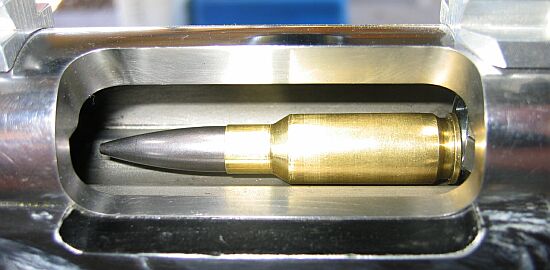
The chambers were both cut with the same reamer supplied by Dave Kiff of Pacific Tool and Gauge. Randy Robinett, one of the originators of the 30 BR wildcat, specified the reamer dimensions. Randy’s 118gr, 10-ogive custom BIB bullets and the 30 BR cartridge enjoy a winning track record in the USA. The 30 BR Robinette reamer has zero free-bore and a .330″ neck, and is optimized for the BIB 118s. The bullets perform best when seated far enough out to jam firmly into the rifling as the bolt is closed. The long ogive means the bullet’s bearing surface is very short.
Slow Twists for Maximum Accuracy
You may note the unusually slow twist rate of both barrels. In most .30-caliber chamberings, the barrel twist rate is 1:11 or 1:12 to stabilize 150gr to 200gr bullets. The 30 BR is optimized for 115gr to 118gr flat-base bullets and 1:17 provides sufficient stability at muzzle velocities around 2900-3000 fps. In competitive Benchrest, where every thousandth of an inch counts, over-stabilization of projectiles can hurt accuracy, so “just stable enough” is the goal; hence the 1:17 twist.
Case Forming, Case Prep, and Reloading Methods
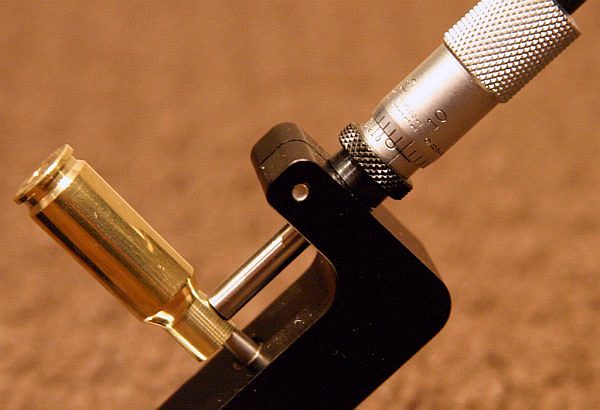
A Sinclair case neck micrometer indicates neck thickness of 0.010″ after neck turning.
30 BR dies are readily available from a number of manufacturers. I personally use Wilson neck and seating dies with a Sinclair Arbor press, but Redding and Forster both supply high-quality threaded dies for use in a conventional press. For under $100.00 US, custom full-length dies can be obtained from Hornady and CH Tool & Die by sending them reamer prints or a couple of fired cases. Harrell’s Precision offers “semi-custom” dies. Just send them some fired cases and they select a pre-made CNC-cut die that ideally fits your chamber. You can ask the Harrell brothers for a die that’s tighter at the shoulder or base, or otherwise customized to your preferences.
Load Development and Accuracy Testing
With cases formed and bullets selected, load development is simply a matter of choosing the right primer, powder and charge weight, and loading the most consistent ammunition possible. The Lapua BR cases use a small rifle primer. The choice here was Federal 205 Match primers vs. CCI BR4 Benchrest primers. Some shooters have also had success using CCI 450 Magnum primers but it is very unlikely the small case needs this much spark to light off regular extruded powders. In my case, I selected Federal primers because availability tends to be better in Australia.
The relatively large bore-to-capacity ratio of the 30 BR case means that fast burning powders are the order of the day. Once again, US experience suggests H4198 (the Hodgdon equivalent of ADI AR2207) is the choice of match winners. The fact that H4198/AR2207 is an Australian-made product is an added bonus. So, I loaded up test rounds with AR2207 from 32.5 grains to 35.0 grains in approximately 0.3 grain increments. All bullets were seated to jam +0.010″ into the lands. This places the bullet base about two-thirds of the way down the neck and well short of the neck-shoulder junction.
Tired of spending $15-$25 for a can of spray lube that doesn’t last that long? For about the same price as a single 10 oz. can you can make your own effective spray lube that should last for multiple seasons and lube thousands of cases quickly and easily.
In the YouTube video embedded below, our friend Gavin Gear of UltimateReloader.com shows how to make your own case lube using simple, inexpensive ingredients. As recommended by the 6.5 Guys, this Liquid Lanolin + Isopropyl Alchohol mix works well and is very cost-effective. You can make a pint of this home-brew Lanolin case lube that will lube thousands of cases — many more than a typical commercial aerosol spray can (that’s mostly compressed air).
Gavin describes the exact mixing process on his Ultimate Reloader website. Gavin says this lube mix is a good complement to the Hornady One-Shot (pistol) and Dillon DCL (rifle) lubes he has used for pistol and rifle reloading sessions. CLICK HERE to read more.
Today, AR-platform rifles are hugely popular. Dozens of manufacturers sell AR-type rifles, in a wide variety of configurations and calibers. But before there were M16s and AR-15s, ArmaLite produced a 7.62×51 caliber rifle, the AR-10. Yes before there were millions of 5.56 black rifles, there was a .30-caliber big brother with reddish-brown furniture. Invented by Eugene (‘Gene’) Stoner for the Armalite company in the late 1950s, this is the father of all of today’s AR-platform rifles. Way ahead of its time, this remarkable, select-fire battle rifle weighed just 7.25 pounds as first developed.
If you’re curious about the AR-10, in this video, Jerry Miculek puts an original 1957-vintage AR-10 through its paces on the range. This extremely rare, early-production rifle was provided by Mr. Reed Knight and the Institute of Military Technology. (The gun in the video was actually produced in the Netherlands under license, see video at 4:40.) This AR-10 is the direct ancestor of the AR-15, M16, and many of the modern sporting rifles that we use today.
The AR-10 was slim and light, weighing around 7 pounds. Some folks might argue that the original “old-school” AR-10 is actually better than some of today’s heavy, gadget-laden ARs. The AR-10’s charging “lever” was under the carry handle — that made it easier to manipulate with the gun raised in a firing position.
You’ll notice there is no “forward assist”. Inventor Gene Stoner did not believe a separate “bolt-pusher” was necessary. The forward assist was added to solve problems encountered in Viet Nam. Some critics say the forward assist “only takes a small problem and makes it a big problem.” For today’s competition ARs (that are never dragged through the mud) the forward assist probably is superfluous. It is rarely if ever needed.
Note also that the handguards are fairly slim and tapered. Today, six decades after the first AR-10 prototypes, we are now seeing these kind of slim handguards (made from aluminum or lightweight composites) used on “full race” ARs campaigned in 3-gun competition.
History of the AR-10
The AR-10 is a 7.62 mm battle rifle developed by Eugene Stoner in the late 1950s at ArmaLite, then a division of the Fairchild Aircraft Corporation. When first introduced in 1956, the AR-10 used an innovative straight-line barrel/stock design with phenolic composite and forged alloy parts resulting in a small arm significantly easier to control in automatic fire and over one pound lighter than other infantry rifles of the day. Over its production life, the original AR-10 was built in relatively small numbers, with fewer than 9,900 rifles assembled.
In 1957, the basic AR-10 design was substantially modified by ArmaLite to accommodate the .223 Remington cartridge, and given the designation AR-15. ArmaLite licensed the AR-10 and AR-15 designs to Colt Firearms. The AR-15 eventually became the M16 rifle.
AR-10 3D Model Shows Internal Parts
If you want to see more close-up details of the AR-10, computer artist Stefan Engdahl has created a very detailed 3D model of the AR-10 for use in computer simulations. This computer model features 18 separate objects so you can look at details of frame, barrel, trigger, sights and more.
Here are some additional images of early AR-10 models, with various configurations. Multiple handguard and muzzle options were employed during early development.
Color AR-10 photos from Arms Izarra, a Spanish company specializing in de-militarized, collectible firearms. Interestingly, this particular AR-10 was produced in the Netherlands under license.
Need a new barrel for your Rem-actioned hunting or tactical rifle? Here’s a great DIY option for riflemen. McRee’s Precision offers complete, no-gunsmithing re-barreling kits for Remington and Rem-clone actions. These feature a high-quality, pre-chambered “PRE-FIT” stainless barrel from Criterion, a Savage-style barrel nut, a recoil lug, and a special barrel-nut wrench. Most of the Pre-Fit barrels are 24″ long and threaded at the muzzle. CLICK Here for all Pre-Fit barrel specs.
With this system you can easily re-barrel your favorite Remington rifle yourself in less than an hour. You don’t need to pay gunsmithing fees, or wait weeks (or months) for a busy smith to do the job. And the price is under $500.00. Kits are currently available for these chamberings: 6.5 Creedmoor, 6mm Creedmoor, .243 Win, .308 Win, .308 Winchester Magnum. You can buy with confidence — McRee’s Precision offers a Half-MOA Accuracy Guarantee with its pre-fitted barrel kits.
The stainless steel Barrel Nut is set up for 1 1/16 x 16 barrel threads, while the stainless steel recoil lug has a 1/8 inch removable locator pin and is set up for 1.0625 dia barrel threads.
McRee’s Precision sells Rem-action Pre-Fit barrel packages (complete with barrel nut, recoil lug, and wrench) starting at $489.52. Choose from five chamberings: 6.5 Creedmoor, 6mm Creedmoor, .243 Win, .308 Win, and .300 Win Mag. These Pre-Fit barrel kits come ready-to-install. All you need to do is remove your current barrel, place the recoil lug, spin on the new tube, follow the instructions for setting head-space with standard go/no-go gauges, then torque the barrel nut against the lug. NOTE: You may require a barrel vise and action wrench to remove the original barrel. Chambering-specific headspace gauges required. Minor inletting changes may be needed forward of the action.
The folks at McRee’s Precision say their Pre-Fit system offers many advantages: “Remington Pre-Fitted Barrel Kits have become popular over the years. If Savage can do it, why not for our Remingtons? Our [Criterion-supplied] barrels are spec’d to the McRee standard of performance. There are several places to get the tools required to remove your factory barrel correctly. Once you have your barrel removed all you have to do is follow the normal Savage procedure to install your new barrel. We recommend that you contact your local gunsmith for the install. Feel free to call us with any questions.”
Product Tip from Ed LongRange. We welcome readers’ submissions.
SHOT Show 2020 Special Episode
This week, Shooting USA features a full hour of SHOT Show coverage. If you watch just one episode of Shooting USA this year, it should be the SHOT Show 2020 Special which runs today, March 5th at 3:00 pm ET on the Outdoor Channel. Jim Scoutten’s team works hard every January, bringing you highlights from the gun industry’s largest trade show. Jim, son John Scoutten, and other staffers prowled the 12 miles of aisles in the Sands Convention Center in Las Vegas, visiting many of the 1,600+ exhibitors. This episode provides a “first look” at the new guns, optics, and gear introduced for 2020. Click HERE to learn more about this week’s 2020 SHOT Show episode.
2020 SHOT Show Highlights: Colt Python, Hornady A-Tip bullets, Volquartsen Summit .17 WSM, Ruger-57 Pistol, Pinnacle Precision Rifle, HK SP5, Impact Sport Muffs, Laugo Arms Alien Pistol, Vortex 1-10X Scope, Glock 44 Pistol, and much more.
Shooting USA’s SHOT Show 2020 will air today, Thursday, March 5 at 3:00 pm ET on the Outdoor Channel. Look for Shooting USA on the Outdoor Channel. In addition, you can watch all episodes of Shooting USA on the VIMEO channel by subscription. The SHOT Show 2020 edition is jsut $0.99.
Here are some of the 50+ new products featured on the SHOT Show Special. Click Images for detailed product information.
Kestros ZR Stock — Impressive Design for Competition
Review by F-Class John
Walk the line at just about any rifle competition and you’ll see your share of McMillan stocks. Known for crafting high-quality fiberglass/composite stocks, McMillan has long been at top choice for competitive shooters, hunters, and tactical marksmen. Now McMillan is out to dominate F-Open with the Kestros ZR stock. The Kestros line features several models, but the ZR represents the pinnacle of craftmanship. Each one is finished off by a single craftsman and takes roughly four times longer to create than any other Kestros. So when McMillan offered me a chance to test one out, I jumped at the opportunity.
The aluminum Z-Rail extends nicely from the front of the stock and has a nice contrast of metal against the matte finish of the stock. I inspected the rails and noticed that they are very cleanly machined — all the corners and rails were precise and sharp. As a result, I grabbed some 1000-grit sandpaper and just lightly knocked the edges and corners down just to keep from accidentally scratching myself or my gear.
Lead time for a ZR is currently 6-9 months. I was like a kid on Christmas when mine arrived after seven months. Holding a Kestros ZR is definitely a unique experience compared to a traditional wood stock and you can’t help but feel like you’re holding something special. I chose three shades of blue that transitioned dark from the butt stock to lighter on the fore-end in a spectacular flame pattern. With McMillan, there are thousands of possible color and pattern combinations. These color/pattern options are outlined on McMillan’s Gallery Page.
The Kestros ZR comes fully inletted with pillars. I was able to bolt my Defiance action right into the stock “as is” without a bedding job. (McMillan states bedding is not required, though this is certainly something most Kestros owners will do). I threw in my action, fit a couple action screws and tightened it all down. I was amazed at how nicely it all fit together with even the little details like the port cutout being perfectly smooth with my action port. I loaded up some .284 Win rounds and headed to the range to test the new stock at 100 yards.
Here are examples of targets shot with the Kestros ZR at 100 yards.
During initial range testing (see above) I shot nine groups for vertical and all of them were under 0.40″ with the smallest being .08″ of vertical. I topped off the testing by shooting a 200-11X the next week at my club match. The thing that really stood out was how smoothly the stock tracked with its lower center of gravity while shooting free recoil and ultimately this translated to success on target.
Low-Rider — You may find that because of how low the Kestros rides as well as its additional length due to the Z rail, you may require an extension for your front rest.
CONCLUSION — Great Modern Low-Profile F-Class Stock
Overall the Kestros ZR exceeded my expectations. After a small learning curve, it was a joy to shoot and it performed great. As someone who believes in the power of muscle memory, I found each time I transitioned between the Kestros and my traditional wood stocks there was a slight adjustment period but not enough to impair accuracy in any way. Something to consider is that because every Kestros is made to the same dimensions, it makes owning multiples an easy process of switching between guns without any need for readjustment.
For those willing to put in the practice, your patience will be rewarded, and I think most shooters will find the Kestros ZR could become their new favorite stock. If you’re in the market for a new F-Open stock, the Kestros ZR is definitely one to consider.
Tips for Ordering a Kestros ZR
Ordering the Kestros ZR is a simple process thanks to McMillan’s online order form. While there are a number of options available, McMillan has a helpful guide that walks you through each one to ensure you get exactly what you need. While filling out my form I realized that because I have a custom-designed action, I needed some help, so I gave McMillan a call. The staffers were incredibly helpful and their knowledge of all the major actions out there made answering my questions a snap. I liked the fact that there is no set, fixed price on any of the stocks. The pricing system allows customers to get just what they want (within limits) and not have to pay for anything they do not want or need.
Many readers may not know this, but the Ruger Precision Rimfire rifle is now available in two additional rimfire chamberings: .17 HMR and .22 WMR. While .22 LR ammo is considerably cheaper, .17 HMR and .22 WMR shoot flatter and deliver much more energy. This makes the Ruger rig way more suitable for varminting. In fact we think this .17 HMR transforms the Ruger Precision Rimfire into a very good “carry-around” varmint rifle. We really like the .17 HMR — it’s our favorite rimfire cartridge for small varmints out to 160 yards.
Both cartridge types, .17 HMR and .22 WMR, also offer higher velocities, less wind drift, and flatter trajectory than the .22 LR. This is a benefit when cross-training. You can shoot at more distant targets with considerably less elevation dialed in your scope. And the windage corrections will be less extreme.
Ruger says: “Faster, flatter and with high-performing bullets, .17 HMR and .22 WMR cartridges expand the capabilities of the Ruger Precision Rimfire platform. Like its .22 LR predecessor, these new magnum offerings maintain the same ergonomics, trigger and manual of arms as the larger centerfire Ruger Precision Rifle.”
Here’s an excellent video review of the .17 HMR Ruger Precision Rimfire rifle by YouTuber 22 Plinkster. The reviewer was impressed with the rifle’s accuracy with 17gr ammo.
Both Ruger Precision Rimfire rifles feature 18″ hammer-forged barrels threaded for muzzle devices, including the Ruger® Silent-SR®. The 15″ free-float handguard with Magpul M-LOK slots provides generous scope clearance and easy mounting of M-LOK-compatible rails and accessories.
Like its .22 LR version, the magnum Ruger Precision Rimfire models featured an adjustable bolt throw (that can emulate a centerfire action if desired), along with trigger that adjusts from 2.25 to 5 pounds. The .17 HMR and .22 WMR models ship with a 0 MOA Picatinny rail and one, 15-round BX-15 Magnum magazine or one, 9-round JMX-1 rotary magazine. The BX-15 Magnum is a natural pairing for the new Ruger Precision Rimfire in magnum calibers. It is also compatible with Ruger 77/17®, Ruger 77/22® and Ruger American® Rimfire rifles chambered in .17 HMR and .22 WMR.
A few seasons back, our Editor and his friend Joe Friedrich flew to Texas to visit Gene Beggs and test rifles in Gene’s 100-yard indoor tunnel. That was a once-in-a-lifetime opportunity to shoot centerfire rifles in such a test facility. Here’s our report…
The South Texas Tunnel
Gene Beggs operates his own 100-yard indoor tunnel and rifle testing facility just outside of Odessa, Texas. Surrounded by tall fencing, this place really looks like a “Area 51″ secret military facility.
In his South Texas tunnel, Gene provides instruction and “tunnel time” for serious benchresters looking to improve their skills and optimize the accuracy of their rifles. Along with teaching the fine points of short-range benchrest, Gene employed his tunnel to develop a pair of radical rifles, one chambered in 220 Beggs, a slightly modified 220 Russian, and a second chambered in 6mm Beggs, a necked-up version of the 220 Russian that retains the original body taper and shoulder angle.
Radical Skeleton Stocks with Aluminum Sled mounted to Barrel
Both rifles shared a skeleton design which uses the Stiller Cobra or Viper action as a central load-bearing member. Remarkably, there is no conventional fore-arm at all. Gene has bolted, directly to the barrel, a 3″-wide bag-riding aluminum sled. The sled was not designed as a mid-barrel tuner, but it might have some beneficial effects in that regard. However, the tuning functions are handled by two concentric rings threaded to the muzzle. Gene believes that with minor rotations of his front tuning rings, he can dial the gun into tune and the tune can be easily adjusted as conditions warrant.
Do Mr. Beggs’ guns shoot? Absolutely. We had the chance to visit Gene in Odessa. We shot both the 220 Beggs-chambered rifle, and its 6mm Beggs-chambered cousin. Both rifles are nearly identical, though the Heavy Varmint-weight 220 has a longer, 27″ barrel compared to 22″ for the Light Varmint 6mm.
In the tunnel, the 220 HV, with a no-turn-neck 220 Beggs chamber, produced three-shot groups in the low ones and zeros right out of the gate, even before the tuner was optimized. With a barrel with over 1000 rounds through it, after firing 40 rounds without cleaning, Gene produced a tiny 5-shot group in the low ones. The first shot was slightly high (a common occurrence in the tunnel according to Beggs). The last 4 shots, rounds 42-45 since the barrel had been cleaned, went into 0.084″. This rig, though radical in the extreme, certainly appears fully competitive with more conventional BR rigs, and it tracked superbly, with no hopping or rocking on the bags.
220 Beggs — Simple, Accurate, Efficient
We were also very impressed with the 220 Beggs cartridge. It’s basically a plain 220 Russian with a sharper radius at the neck-shoulder junction. Gene has commissioned a 220 Beggs reamer with matching seating and full-length sizing dies. The little cartridge achieves 3600+ fps with a 52gr bullet, pushed by Benchmark powder.
Less Recoil Than 6PPC — From what we could tell during our short visit, the 220 Beggs is easy to load for, and performs exceptionally well with either turned (.250″) or no-turn necks. The recoil was noticeably less than a 6mm PPC, making the gun a joy to shoot. This round, we felt, could also be an outstanding varmint cartridge. The velocity is there, and we don’t think any other 22-caliber varmint cartridge is going to beat it for inherent accuracy.
As for the 6mm version, Gene told us: “The 6mm version of the cartridge performs best with Hodgdon’s H4198 Extreme, but the 220 has proven it will shoot well with just about anything you put in it including N133, H322, Benchmark, 8208, Norma 200 etc. It is the most trouble-free, user friendly cartridge I have ever worked with and will compete heads-up with anything. It’s also very easy on the shoulder.”
Gene Beggs sells components (reamers, dies etc.) for the 220 and 6mm Beggs, and also, under special circumstances, offers training/testing sessions in his West Texas Tunnel on an appointment basis.


 While Varget and Reloder 15 remain in short supply, you can often find IMR 4320 powder back in the shelves of local gun stores. IMR describes IMR 4320 as follows: “Short granulation, easy metering, and perfect for the 223 Remington, 22-250 Remington, 250 Savage and other medium burn rate cartridges.” This older-generation powder is considerably more temp sensitive than the Hodgdon Extreme propellants, but in the right application, it looks to be a viable alternative for folks who can’t source Varget, Reloder 15, and even H4895.


 30 BR dies are readily available from a number of manufacturers. I personally use Wilson neck and seating dies with a Sinclair Arbor press, but Redding and Forster both supply high-quality threaded dies for use in a conventional press. For under $100.00 US, custom full-length dies can be obtained from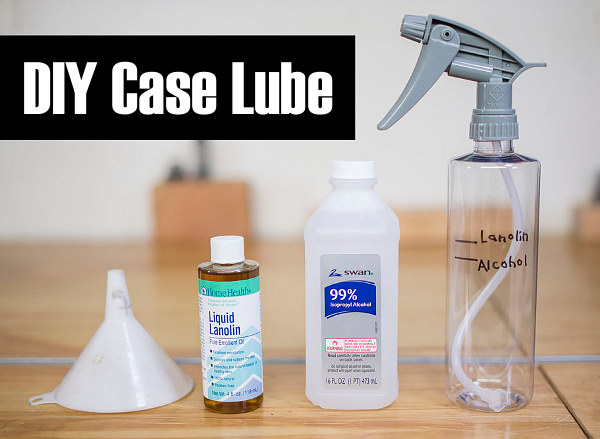




 Many readers may not know this, but the Ruger Precision Rimfire rifle is now available in two additional rimfire chamberings: .17 HMR and .22 WMR. While .22 LR ammo is considerably cheaper, .17 HMR and .22 WMR shoot flatter and deliver much more energy. This makes the Ruger rig way more suitable for varminting. In fact we think this .17 HMR transforms the Ruger Precision Rimfire into a very good “carry-around” varmint rifle. We really like the .17 HMR — it’s our favorite rimfire cartridge for small varmints out to 160 yards.


 Gene Beggs operates his own 100-yard indoor tunnel and rifle testing facility just outside of Odessa, Texas. Surrounded by tall fencing, this place really looks like a “Area 51″ secret military facility.

 Do Mr. Beggs’ guns shoot? Absolutely. We had the chance to visit Gene in Odessa. We shot both the 220 Beggs-chambered rifle, and its 6mm Beggs-chambered cousin. Both rifles are nearly identical, though the Heavy Varmint-weight 220 has a longer, 27″ barrel compared to 22″ for the Light Varmint 6mm.


