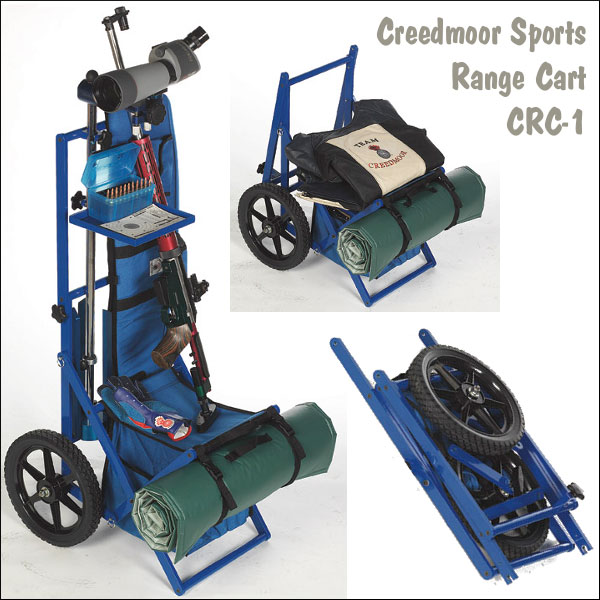
The Berger Southwest Nationals is coming up next month. That means you want to upgrade your hauling capabilities. SWN F-Class and High Power shooters have a ton of gear they need to carry out to the firing lines. To do the hauling, you can certainly purchase a factory-made, purpose-built cart that folds up and has all the bells and whistles. The Creedmoor Sports CRC-1 (photo right) is a proven, quality product that works great. You’ll find these used by top shooters at Camp Perry. But the Creedmoor CRC-1 cart costs $475.00, even on sale.
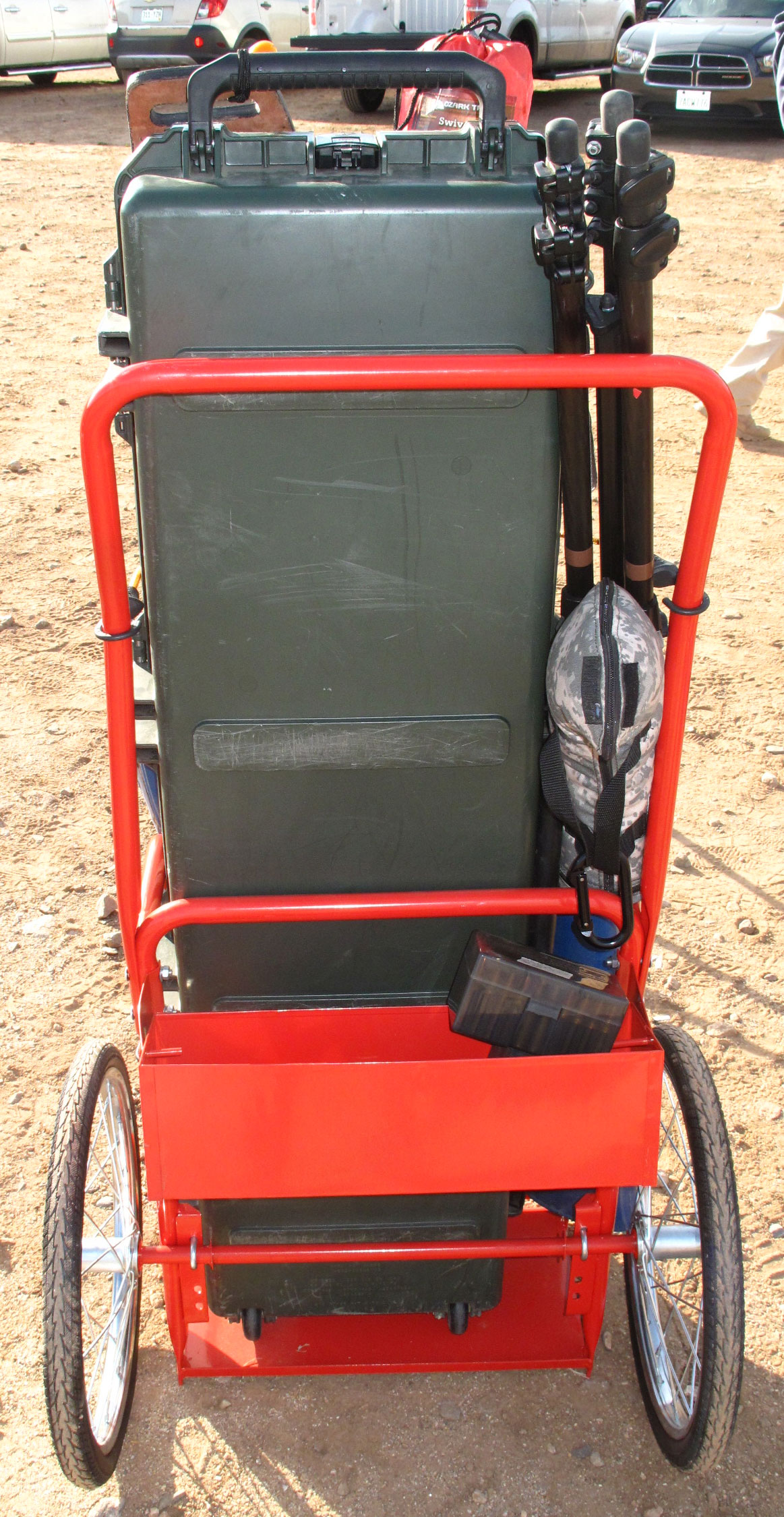
For a fraction of that price ($59.99), plus a few dollars more for do-it-yourself enhancements, you can have a heavy-duty cart that will haul all your gear just fine, though it doesn’t fold up. In the top photo is a Harbor Freight Welding Cart we saw at the Berger Southwest Nationals. This rig is carrying a rifle in hard gun case, bipod, folding chair, shooting mat, tripod, spotting scope, rear sand-bag, and ammo box — that’s a lot of gear!
Check out the Harbor Freight Welding Cart, item #65939. This cart is ON SALE right now for just $59.99. Overall size is 29-1/2″ L x 20″ W x 49″ H, and width between side rails is 18″. The wheels (with tires) are 20 3/4″ in diameter for smooth rolling. Consider that, if you made your own cart from scratch you could easily pay $30.00 or more just for the large-diameter wheels and axle. Do note — this cart has air-filled tires. Be sure to inflate before you go to the Range!
As sold, the Harbor Freight Welding Cart can benefit from upgrades for range use. But with a few bungee cords (and some creativity), the cart can be adapted pretty easily to hauling your gun gear. If you want to enhance the basic cart, it’s easy to add plastic side-panels on the bottom unit, and fit a barrel-holding system on the cross-tube. This ensures rifles and gear won’t flop forward. (A small piece of wood under the bottom panel provides a bit of extra lift that will keep the bottom plate out of the dirt and gravel.)
The Snake is back baby! For 2020, Colt’s Manufacturing Co. LLC will offer a refined and upgraded Colt Python with a hefty $1499.00 MSRP. The legendary double-action revolver, which originally debuted in 1955, returns in stainless steel in 4.25″ and 6″ barrel lengths. It is designed to be stronger than before. Numerous improvements were made to reinforce the revolver, including the use of stronger stainless steel alloys and a re-designed rear sight which allows for a 30% increase in the cross-sectional area of the top strap — meaning more steel for a stronger revolver.
Important Colt Python Enhancements:
— More Steel in Top-Strap for Enhanced Strength
— Recessed Muzzle Crown (protects rifling during cleaning)
— Reduced Number of Parts in Trigger Mechanism for Greater Durability
Colt doesn’t want these to be safe queens, they’re meant to be shot. Along with the stronger frame, these Colt Pythons have recessed target crowns for improved accuracy[.] Chambered for .357 Magnum they can withstand a lifetime of full-power loads[.] — Max Slowick, GunsAmerica.com.
GunsAmerica Review of New Colt Python
The new Colt Python is offered with a high-polish stainless steel finish and either a 4.25-inch or 6-inch barrel. Both come with walnut grips that bear the Colt medallion. These updated versions of the Colt Python have a few changes to differentiate them from the old snake guns but they maintain the classic looks and operation of the originals.
The classic grip pattern, boxy frame, generous trigger, ribbed topstrap, and full-length underlug are all just as they should be. Both models are double- and single-action with a spurred hammer.
Colt modified the sights. The rear sight is still a fully adjustable target sight, which is standard for full-size revolvers, and the front sight can be changed by the user like on the new Colt Cobras.
The classic grip pattern, boxy frame, generous trigger, ribbed topstrap, and full-length underlug are all just as they should be. Both models are double- and single-action with a spurred hammer.
The 4.25″ barrel Python is 9.75″ long and 42 ounces. The 6″ model is 11.5″ long and 46 ounces.
Factory Video Shows New Python’s Features
This Colt-produced video explains features of the new Colt Pythons (4″ and 6″) in detail. If you are interested in this wheelgun, definitely watch this video — it will answer most technical questions. Double action pull-weight is 7 to 9.5 pounds while the single action pull is 3 to 4 pounds out of the box. The new Colt Python .357 Magnum is available now through Colt stocking dealers for $1499.00 MSRP.
This is a tougher, stronger Python — durability tests included over 40,000 trigger pulls on a single Python. Trigger pull scans show lighter trigger pull weights, less friction, and increased consistency.
“We know the Colt Python is one of the most beloved and collected firearms in American history, and its re-release has long been demanded by enthusiasts,” said Justin Baldini, Product Director at Colt. “We took our time on R&D – we needed to be sure the look and performance of this redesign lived up to its legendary name and kept its impeccable reputation for quality and accuracy. This new Python lives up to the legend in every way.”
It’s 2020! Welcome the new year and a new decade. We know many of our readers will be spending the winter day indoors. If you need a break from the bowl games on TV, here are eight interesting and informative videos that are worth watching. The subject matter runs the gamut from benchrest gunsmithing to long-range varmint silhouette competition. There are also reviews of some of the best precision rifle options for PRS and NRL22 disciplines. Enjoy our New Year 2020 Video Fest.
Epic Reloading Hardware Test — 14 Single-Stage Presses. In this remarkable video, Gavin Gear of UltimateReloader.com reviews fourteen (14) single-stage reloading presses. This is the most comprehensive reloading press comparison test ever done by anyone, anywhere. The presses range from compact units to large-frame exotics from Europe. If you are in the market for a single-stage press in 2020 this is a MUST-watch video. Brands include Forster, Hornady, Lyman, MEC, RCBS, Redding, Turban (Prazipress).
2. Precision Riflesmith — Profile of Benchrest Smith Mike Bryant
Texas gunsmith Mike Bryant is a talented benchrest shooter and a highly respected builder of competition and hunting rifles. In this wide-ranging interview, Mike talks about benchrest competition, the key factors that contribute to rifle accuracy, and about his career as a gunsmith.
3. Erik Cortina — Mag-Feed Testing Borden Action with 6BR
Click the Speaker Icon (lower right) to HEAR AUDIO
Our friend Erik Cortina has built a new PRS/NRL rifle based on the new Borden Super Short 6 Action. This video show Erik’s first mag-feeding test with ten 6BR loaded rounds. You’ll see there is NO problem speed-feeding the short 6BR case. Erik tells us: “I removed the firing pin from bolt for safety. The magazine has not been modified in any way. I would say there is no need to do anything to it, she’s ready to run!” Impressive indeed.
4. Shooting USA — Texas Varmint Benchrest Match
This episode of Shooting USA TV features long-range varmint silhouette competition in Texas. This discipline combine the pure accuracy of benchrest competition with the fun of knocking down critter targets. These are smaller than standard silhouettes, so it’s quite a challenge to hit them at 300 yards and beyond.
In this episode, host John Scoutten competes with his 6.5 Creedmoor PRS rifle. Most shooters use benchrest-grade rifles with premium front rests. NOTE: This video shows some top-flight benchrest rifles, and also covers the origins of benchrest varmint silhouette in Pennsylvania. There are even some AccurateShooter Forum members on screen.
5. Vickers Tactical — .308 Win Bolt Gun Vs. .308 Win Gas Gun
This interesting video from Vickers tactical compares and contrasts two tactical style rifles both chambered for the .308 Winchester. The test team compares functionality, accuracy, ergonomics, and versatility. Each platform has its advantages, as the video reveals.
6. Outdoor Life — The Best New Affordable Precision Rifles
This video showcases three modern tactical-style rifles suitable for the PRS Production (Factory) Class which is limited to $2000 for rifle alone, not counting optics (Rule 2.3.1). Outdoor Life Shooting Editor John Snow puts three capable rifles through their paces: Patriot Valley Arms John Hancock, BadRock Precision SouthFork, and Seekins Precision Havoc Bravo.
7. Aerial View of Deep Creek Shooting Range in Montana
The Deep Creek Range near Missoula, Montana, is one of the best 1000-yard ranges in the country. Many long-range benchrest records have been set in this scenic, tree-lined facility. Now, thanks to Forum member David Gosnell (aka “Zilla”), you can see Deep Creek from the air. David flew a camera drone over the Deep Creek Range, soaring from firing line to the target bay and back again. This video gives you a “birds-eye view” of one of America’s elite ranges.
8. Nat’l Rifle League — Intro to NRL22 Rimfire Tactical Matches
NRL22 is a great way to get into competition shooting with minimal expense. There are Five (5) classes: Open, Base, Ladies, Young Guns (8-16), and Air Rifle. Base Class is for the budget-minded shooter — the combined MSRP of Rifle and Optic may not exceed $1050.00 (so you could spend $550 on a rifle and $500 on a scope for example). That keeps the sport affordable. Open, Youth, and Ladies Classes have no price limits on Rifle and Optic. Visit NRL22.org to find an NRL22 match near you.
Folks who load at the range need to bring a lot of gear — reloading presses, powder dispensers, scales, funnels, sizing/seating dies, brass prep tools and more. And there may be other important items to transport — such as ammo caddies, LabRadar mounts, over-size rest feet, and even barrel fans.
A rifle case works fine for carrying your scoped rifle, but you still need to organize all your reloading tools and other gear, and transport them safely from home to range and back again. Some guys have built their own loading tool-boxes from wood. Other may stuff gear in a couple of plastic range boxes. But clever Chris Covell came up with an even better solution.
Chris sourced a handsome, sturdy metal Horse Grooming Box from eBay. Chris reports the multi-feature metal box “works perfectly for reloading. My ChargeMaster is now out of the wind.”
Bullets, Trickler, and Priming Tool on Top
On top, below the hinged metal lid, is a large compartment that holds Covell’s funnels, scales, priming tool, trickler and other vital gear (photo on right). This top compartment is deep enough to handle wide-mouth funnels with no problem.
Slide-Out Drawer with Dividers
Below the top level is a handy sliding drawer with multiple dividers. This is perfect for holding Covell’s inline seating dies, case-neck deburring and chamfering tools, among many other smaller bits and pieces.
In the bottom of the Horse Grooming box is a large compartment that holds bigger gear. In the bottom section, Covell places his RCBS Chargemaster Lite, along with a case-trimming tool, an arbor press, and various other bulky tools. Check it out:
Chris Covell’s Range Box was featured on the Benchrest Shooting and Gunsmithing Private Group Facebook Page. You may want to sign up for this Group — with membership you can access a wealth of information for accuracy-oriented shooters.
There’s a nice article in the Western Powders Blog that any varminter will enjoy. In this hare-raising tale, gunwriter Jim Waddell explains how he used a self-loading Savage A17 rifle to take care of a serious jack-rabbit problem on a rancho in California. “[My friends] purchased a huge amount of acreage that had some existing alfalfa fields and [surrounding sagebrush]. Sagebrush is home to jack rabbits. Lots of jack rabbits. The previous owner of this property didn’t do any varmint or predator control[.] The ink wasn’t dry on the escrow papers before [my friends] started asking for help shooting rabbits. A problem in taking these critters is it has to be done at night when they come out to feed as they lay low in the bush during the daylight hours.”
Savage A17 Comes to the Rescue
Initially Waddell and some friends took on the jack-rabbit hordes using Ruger 10/22s and a .44 Magnum Marlin lever gun. Neither option was ideal. The .44 Magnum just couldn’t keep up the desired shooting pace (it took too long to reload) ant the .22 LRs were too anemic. So Waddell decided to give the more potent 17 HMR a try. He acquired a Savage A17 and went back for a second bunny-busting session. He came away convinced that the 17 HMR cartridge in the modern semi-auto Savage works great for small varmint control.
Waddell writes: “I wanted more than a .22 after seeing the problems my pals had with their [10/22] bullets not anchoring the rabbits. Armed with my new Savage A17 it was time to head back to the alfalfa fields. This time my hunting partner was Dan, my son-in-law from Seattle. We hunted for four nights. Each night was either raining, windy or both. My question about whether or not rabbits would be out in the weather was answered immediately. They were everywhere. As miserable as the weather was, we got all the shooting we wanted and that Savage rifle was up to the task. We got so many rabbits it was impossible to count.” CLICK HERE for the full account of Waddell’s jack-rabbit adventures on the California rancho. It’s worth a read. Here is a sample:
Wabbits, Wabbits Everywhere — Even Running Right at You
I couldn’t believe my eyes when I saw a sea of rabbits as far as the lights would shine and when the light beams hit the bunnies, they became confused and as often as not, would run right at the lights so a good percentage of our shots were literally in spitting distance. It was also a new experience shooting at targets that are running TOWARD you. Most of us who’ve done much hunting for game or varmints have experienced moving targets but how many of those targets are coming at you?
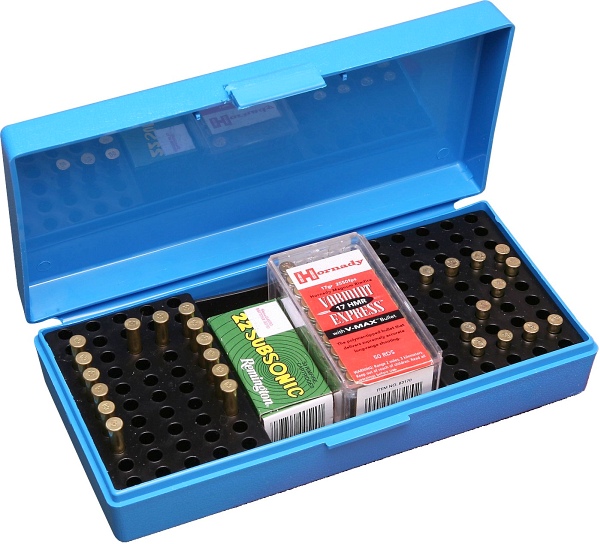
For centerfire ammo, you can choose from dozens of flip-top boxes, storage bins, or milsurp-style ammo cans. For rimfire ammo, there are not so many good choices. Our preferred rimfire ammo carrier is the MTM SB-200 Small-Bore Fitted Ammo Box. This flip-top plastic box holds 100 rimfire rounds in 10×5 black grids on the left and right. In the center is a storage area that will hold another 100 rounds in factory boxes.
Versatility for ALL Types of Rimfire Ammo
MTM’s SB-200 box is not just for .22 LR ammunition. This handy carrier will hold 17 HMR rounds, as well as 17 Mach 2, 22 short, 22 Win Mag Rimfire, and of course 22 Long Rifle (.22 LR). This box is a winner — it’s low profile, holds rounds securely, and the center storage feature is smart.
MTM Case-Gard 200 Round Smallbore Box
This is really the only product of its kind on the market. It allows you to conveniently and securely hold 200 rimfire rounds, and also segregate your ammo by brand or bullet type. These boxes fit all types of popular rimfire ammunition. The vertical clearance of the lid is sufficient to hold the longer .22 WMR Rounds, and 17 HMR (as well as .22 LR naturally). The lid fits securely so you don’t have to worry about your rimfire ammo spilling out on the way to the range.
If you don’t have one of these boxes yet, we recommend you order one or two. They cost less than $15.00 and are available in Blue or “Rust” (a brick color).
Shown is the Redding Model 15-P Competition Piloted Inside Chamfering Tool with pilot rod that centers in the case flash hole. Also shown is a Forster 45° Rocket Tool.
There are a wide variety of reloading tools designed to cut a slight chamfer in case necks and deburr the edge of the case mouth. You don’t need to spend a lot of money for an effective tool. A basic “rocket-style” 45° chamfering tool, such as the Forster, actually does a pretty good job taking the sharp edge off case mouths, particularly if you use a little scotch-pad (or steel wool) to smooth the edge of the cut. The Forster chamfer tool, shown below, is a nicely-made product, with sharper cutting blades than you’ll find on most other 45° chamferers. It costs $20.99 at Brownells.com.
Redding sells a handy piloted chamfering tool with a 15° inside cutting angle and removable accessory handle. This Redding Model 15-P chamferer works really well, so long as you have consistent case OALs. The pilot rod (which indexes in the flash hole) is adjustable for different cartridge types (from very short to very long). This ensures the concentricity of the inside neck chamfer to the case mouth. This quality tool ($35.99 at Brownells) works with cases from .22 to .45 Caliber.
Sinclair International offers a 28° carbide chamferer with many handy features (and sharp blades). The $29.99 Sinclair Carbide VLD Case Mouth Chamfering Tool will chamfer cases from .14 through .45 caliber. This tool features a removable 28° carbide cutter mounted in the green plastic Sinclair handle. It is on sale right now for $24.99 at Brownells. NOTE: A hex-shaft cutter head power adapter can be purchased separately for $14.99 (Sinclair item 749-002-488WS). This can be chucked in a power screwdriver or used with the Sinclair Case Prep Power Center.
Many folks feel they can get smoother bullet seating by using a tool that cuts at a steeper angle. We like the 22° cutter sold by Lyman. It has a comfortable handle, and costs just $11.54 at Midsouth Shooters. The Lyman tool is an excellent value, though we’ve seen examples that needed sharpening even when new. Blade-sharpening is easily done, however.
K&M makes a depth-adjustable, inside-neck chamferer (“Controlled Depth Tapered Reaper”) with ultra-sharp cutting flutes. The latest version, which costs $51.70 at KMShooting.com, features a central pin that indexes via the flash hole to keep the cutter centered. In addition, the tool has a newly-designed handle, improved depth-stop fingers, plus a new set-screw adjustment for precise cutter depth control. We caution, even with all the depth-control features, if you are not careful, it is easy to over-cut, slicing away too much brass and basically ruining your neck. We think that most reloaders will get better results using a more conventional chamfer tool, such as the Forster or Redding 15-P.
One last thing to note — tools like the K&M and the Sinclair chamferer are often described as VLD chamferers. That is really a misnomer, as bullets with long boat-tails actually seat easily with very minimal chamfering. In reality, these high-angle chamferers may be most valuable when preparing brass for flat-base bullets and bullets with pressure rings. Using a 22° or 28° chamferer can reduce the risk of cutting a jacket when using VLD bullets though — so long as you make a smooth cut.
Here’s a new safety device that should prove useful for firearms, particularly pistols. The patented ShotBlock is a hi-viz orange foam chamber plug mated to an orange brush extension that goes in the barrel. This serves the same purpose as a Chamber Flag or Empty Chamber Indicator (ECI), but is more compact (and multi-purpose). With the Shot Block in place a round cannot be chambered. That should, with most firearms, render the gun safe, and unable to fire.*
Currently, the bright orange ShotBlock safety plugs are available for .380 ACP, 9mm Luger, .40 SW, and .223 Remington. Soon versions will be offered for .45 ACP and .308 Winchester as well. Watch the Video to see how this works:
The ShotBlock works by blocking the ability to chamber a round. The ShotBlock is attached to an “extended protection indicator” (i.e. an orange nylon brush). The plug and brush are placed into the barrel with the wide end of the plug on the breech lip. The extended protection indicator (orange brush) can be trimmed to fit the barrel length. Having the tip of brush visible at the end of the gun barrel confirms the Shot Block is in the chamber. As an added benefit, you can spray an anti-corrosion product on the brush for long-term storage.
The inventors state: “Once the ShotBlock is in the barrel of the gun you can easily manipulate the weapon safely, and any attempt to load the firearm will cause the bullet to be wedged inside the Shot Block, and prevent the [cartridge] from going inside the breach.”
Shot Block is Patented
The inventor of the ShotBlock, Bill Masters, has been awarded two U.S. Patents for this product: Nos. 9,448,024 and 9,310,149, both for “Firearm Safety and Chamber Block Indicator”. Bill explains why he invented the ShotBlock: “I had the idea for the ShotBlock after visiting a shooting range with my wife. The owner brought it out of the case and held it facing my wife without clearing it. He finally handed it to me and I cleared it. I left there telling myself there should be an easy way to let the customer know it was safe … to prevent someone quickly loading the weapon and doing bad things with it.”
Bill Masters is an engineer, inventor, designer, entrepreneur, and business advisor. He holds the first 3D printing patent, along with patents for other 3D printing technologies and CAD. He founded Perception Kayaks, which revolutionized the industry through by using molded plastics instead of fiberglass.
Alternative Product Available Soon from Chamber-View
Chamber-View will soon offer a chamber plug for pistols. Like the ShotBlock, Chamber-View’s Universal Empty Chamber Indicator (ECI) prevents a round from chambering. Unlike the ShotBlock, there is no barrel brush, but a large bright orange extension wing serves as an Empty Chamber Indicator:
* We are concerned however, that with some type of floating firing pins in semi-auto systems, it still might be possible to get a primer strike. This might happen if a round is stripped from the magazine and the firing pin moves forward from inertia as the pistol slide or bolt carrier moves forward rapidly and then stops. It’s unlikely a light strike could cause a round to fire, but check your firearm with dummy rounds before assuming it is 100% safe.
“Ultimate PPC” by Speedy with engraved Stiller Viper action. Titanium Rest by John Loh (R.I.P.).
Just in time for Christmas, today we feature a beautiful red rifle built by West Texas gunsmith Thomas “Speedy” Gonzalez many seasons back. With an eye-catching, one-of-a-kind engraved Stiller Viper action, and gorgeous red/black gelcoat finish, we think this rifle is one of the prettiest benchrest rigs ever made — and the color scheme fits the holiday season.
When Speedy set out to build the “ultimate PPC” for his own use, he wanted it to be as handsome as it was accurate. This stunning 6 PPC combines some very trick components with old-world detailing. When was the last time you saw an engraved receiver on a “race gun”? This rig combines modern high-tech components with classic good looks — the best of both worlds.
This competition benchrest rig features an engraved Stiller Viper action, with integral scope rail, SAKO Extractor and non-fluted bolt. The action sits in a new Millenium BR-X carbon-fiber stock built by Robertson Composites (now closed). The bold red-on-black marbled finish is how the gelcoat came from Ian Robertson’s factory — the stock has not been painted. The slick front rest is a titanium Ultra-Rest machined by the late, great John Loh with design input by Speedy. John built only two of these in titanium, one for himself and one for Speedy. We’re sad to say John recently passed. R.I.P. John. The Leupold Competition scope sits in quad-screw bedded rings from S.G.& Y. Precision Rifles.
Speedy picked a very special barrel for this project–a 1:14 twist, 20.5″, 6-groove barrel, the last original Pat McMillan-crafted barrel in Speedy’s inventory. Speedy runs a .263″ neck. Bushing size depends on the load and the condition of his brass. Speedy’s match load is about 29.2 grains of the IMR 8208 “ThunderBird” powder (he stockpiled this great propellant years ago). Speedy feels that T-Bird may be the most user-friendly BR powder ever made: “Once you have a good load worked up with T-Bird, you can shoot it at most any location in the country, and in almost any conditions. It’s not fussy about temperatures or humidity.”
A Very Unique Viper Action, Two Years in the Making
This is no ordinary Viper action. The full engraving attracts your attention, but there are some slick “performance mods” Jerry Stiller added at Speedy’s request.
First, the action features a plain-Jane unfluted bolt, with a slight taper in the middle, a bit of a wasp-waist. Speedy prefers an unfluted design because it has superior wear characteristics. He’s found, when working with an aluminum action such as the Viper, the sharp flutes on the bolt will wear the inside of the action faster. In the interest of reduced wear, Speedy also requested a smaller-sized loading/ejection port. This provides for a larger front and rear receiver ring, which enhances bolt bearing surface. More bearing surface reduces point loading for less internal wear.
We were surprised that Speedy did not order a drop port for his Viper. He explained: “I’m a bag squeezer, so I keep my forearm right where the cases would exit the drop port. I’ve used the drop ports, but given my shooting style, I prefer a conventional port.” Speedy did decide to fit the bolt with a SAKO-style extractor. He believes this is easier to tune and can contribute to accuracy. Speedy told us: “With a conventional sliding plate extractor, like you find on the Stolle actions, there can be a bit of a side push as you chamber the round. I think this can affect the way the bullet enters the chamber. With the SAKO extractor there is no side-push so I can reduce the possibility of bullet misalignment.”
BR-X Stock — American Design, Canadian Craftsmanship
The BR-X carbon fiber stock represents a third-generation design. The original Millenium, built by Lee Six, was a hollow shell. This modern BR-X is carbon fiber over a foam core. In Light Varmint trim, it weighs just 1.5 pounds. Speedy tells us: “this BR-X has a low center of gravity, slight pistol grip, and the angles are really straight and true. It tracks well in the bags, and won’t lift out of the rear bag during recoil. That’s one of the purposes of the wedge-shaped rear section.”
Speedy looked at the various benchrest stocks, and, with input from Tony Boyer, he worked out a design that mirrored many of the better features of existing designs with some significant enhancements. The first thing you’ll notice is that the geometry is very uniform. The flats on the side of the fore-arm are perfectly parallel. The underside of the fore-arm is seamless and completely flat. Speedy explained “one problem we’ve seen with stocks that have a mold seam in the middle is that sometimes the two halves of the mold don’t mate perfectly. Sometimes the mold is mismatched so one side is on a different plane. That creates all kinds of handling issues. If the bottom of the stock is convex, even a little bit, you lose a lot of stability.”
Much thought went into the rear section of the stock. Speedy and Tony found that many stocks would start off tracking well, but by the end of the string they were pulling themselves out of alignment. Speedy noted that with some more conventional designs, they tended to ride up out of the rear bag after two or three shots. The BR-X works differently. It uses a wedge design, rather than a radius, so it tends to drive itself down into the bag on recoil. The BR-X is not the only stock to use a wedge in the rear, but it is different than other wedge designs. According to Speedy: “On most other wedge stocks, the wedge tapers towards the pistol grip, making the ‘V’ wider towards the end of the buttstock. This will change point of aim as the stock moves. The BR-X has a wedge that is a constant ‘V’, with no taper from the end to the pistol grip. This does make the gun track better and stay on target better.”
Competition Benchrest Terminology
Bughole: Very small group.
Mothball: The 10-ring on the standard Benchrest Target.
Tomato Stake: A worn out or otherwise inaccurate rifle barrel.
Screamer: A group measuring less than 0.100″ at 100 yards or less than 0.250” at 200 yards.
Weather Report: A Group “scattered” as a result of poor wind doping.
Wailing Wall: Place where targets that have been scored can be viewed by competitors.
Dope the Wind: Ccompensate for the effects of wind by shifting aiming points on the target.
Barrels–The Hunt for a ‘Hummer’
Top 6 PPC competitors often run through a number of barrels in the quest for a “hummer” that performs optimally. In addition to the Pat McMillen tube on this gun, Speedy uses barrels from Hart, Krieger, and Shilen. He’s tried a few from some other boutique barrel makers and they shot well, but he wasn’t satisfied with the barrel life. Some of them lost their competitive edge after just 500-600 rounds. He won’t name names in print, but you can call and ask. When choosing a barrel, Speedy recommends that you invest the time and call a few well-known smiths who regularly compete in high-level BR matches. Find out what’s working real well currently.
Speedy says, “you can read the equipment lists from the big shoots, but the printed results can be deceiving. That winning barrel might have been produced a couple of years ago. Barrel-makers do have good runs and not-so-good runs. Do your homework and find out what’s working best right now.” Speedy prefers 6-groove barrels: “I’ve shot em all one time or another. It seems that the 6-groove barrels are easier to get to shoot. It seems at 200 yards bullets from a 4-groove barrel move more than from a 6-groove barrel. Both windage and elevation. I think Tony Boyer feels the same way.” [Editor’s Note: Speedy’s groove observations were made many seasons ago. Today, many top shooters are using 4-groove and 5-groove barrels, and 3-grooves have been successful in score competition.]
We asked about Speedy’s signature “SpiderWeb finish”. While the web design has esthetic appeal, there is a functional side as well: “Tests have shown that a bead-blasted barrel will shed heat faster than a highly polished barrel. With the SpiderWeb, we leave most of the bead-blast finish on the barrel, but the web effect gives the tube some visual appeal.”
Speedy Speaks — How to Succeed in Benchrest Competition
Let me begin by saying that benchrest competition is the most difficult sport I’ve ever tried. For the newcomer, it can be daunting. From the very word “go” you are thrown to the wolves. Most new competitors have about a two and a half or three-year window. After that, if they are not meeting their expectations, they get fed up and leave the sport. Considering the time, effort, and money they may have expended in that time, that’s an unfortunate outcome.
So, how does one improve as a shooter and get to the point where you are meeting your goals? First you need to break down the shooting process into its parts–gun handling, loading technique, wind awareness, time management, bag set-up, and what I call ‘bench management’. Then you need a mentor. Benchrest is like golf–you can have the best equipment (best action, best stock, best rest) but you won’t get far without a knowledgeable veteran to monitor your progress and observe your technique. Without a mentor, benchrest is a rough game to play and you can reach a frustration point after a couple of years.
If you don’t have somebody who can sit and evaluate your loading style, bolt-working, follow-through, and wind-reading etc., you can develop bad habits that are hard to break. If there’s no one to monitor your shooting and see what you’re doing wrong, you’ll keep making the same mistakes. So how does one find a mentor? Well it’s not a bad idea to attend one of the shooting schools. But one-on-one training is best. Look for someone with a strong record in competition, but a person who is also patient. And when you find that person, show some loyalty. With most people who have been involved in the sport a while, if you show them allegiance, they will return that allegiance.
6mm PPC Basics — About the Cartridge
Developed by Louis Palmisano and Ferris Pindell (left and right in photo), the 6 PPC is the “King of the Hill” in short-range benchrest competition, the most accurate cartridge ever invented. It still completely dominates 100- and 200-yard Group BR Shooting. If you want to win in that game, you pretty much have to shoot a 6 PPC, or some close variant of the 6 PPC cartridge design.
Easily made from Lapua 220 Russian brass, the 6mm PPC has a small primer and small flash hole. The small flash hole/primer accounts for much of the 6 PPC’s superior accuracy, though nobody really knows precisely how or why. The “short, fat” shape and nearly straight body contribute to efficient, consistent combustion and good “chamber behavior”.
While SAKO has created an official SAAMI 6mm PPC round, called the 6PPC USA, most American 6 PPC shooters run tight match chambers cut with custom reamers. There will be variations from one reamer to another, enough so that custom dies are generally recommended for match guns. Here is a PT&G reamer spec’d by Speedy a while back. He prefers a .263″ neck because that works better than .262″ when he needs to use his tightest bushings to get more neck tension.
The 6 PPC’s case capacity, case size to bore ratio, and combustion properties seem to be just about ideal for the short 6mm match bullets. A 6BR can come close, but when the goal is shooting “zero” groups at 100 and 200 yards, the 6 PPC is the clear winner. Currently most 6 PPC shooters form their cases from Lapua 220 Russian brass. Norma also makes factory-formed 6 PPC cases, but Norma brass is not commonly used as most shooters believe it is less “tough” than Lapua brass and accordingly won’t last as long with very stout match loads.
Field Test by Colton Reid, AccurateShooter Hunting Editor
As a solo backcountry hunter, I try to carry as little weight as possible. Each step is a reminder to bring only the most essential/effective equipment. Each item in my pack must earn its precious backpack real estate. That’s why I favor gear that serves multiple purposes — and binoculars are no exception. In a previous optics review, I field-tested Zeiss Victory RF 10×42 ranging binoculars and the results were beyond expectation — they are outstanding. However, such superior, upper-eschelon ranging optics from Zeiss cost over $3000.00. And Leica Geovid HD-B 3000 ranging binoculars cost around $2500.00.
For those looking for a more affordable option, there are several mid-range binoculars with integrated ranging capability. One popular choice is the Vortex Fury HD 5000 10×42 LRF Binoculars. Priced at around $1200 on Amazon, the Fury HD 5000 is half the price of some European LRF Binoculars. Yet the Fury HD 5000 LRF Binos still combine two optical systems (magnification and laser ranging) into one that is more valuable than the sum of the parts.
Vortex Fury HD 5000 Look and Feel
The Fury binoculars are compact and relatively light — a modest 2 pounds. They are covered by a rubber armor exterior that feels sturdy enough to survive some hard falls, but is also comfortable to hold. The compact size did offer a challenge in determining how best to place my thumbs (see top photo). The rangefinder controls (Measure, Menu) are easy to access and are distinguishable by the braille-like bumps that cover them. Considering that these buttons are going to be located and pressed without looking at the top of the binoculars each time, it was perhaps a poor design choice to place the raised Vortex logo adjacent to the controls. But after a little practice I was able to quickly locate the measure button when ranging in the field.
The eye cups are comfortable and offer four discrete eye relief positions. The focus and diopter knobs are large and easy to turn but also provide resistance to rotation. Resistance is useful for maintaining the previous positional setting.
Vortex Fury 5000 — Rangefinding Performance
The Vortex Fury’s rangefinder function, along with its menu, is simple and intuitive. In my humble opinion, simple is better. The display is a red LED projection in the right optic. As noted in another review, the red display can be difficult to distinguish against a tan/brown image, so I used max brightness at all times to ensure display visibility. The display menu covers the core items: distance (line of sight or angle compensated), measurement units (yards/meters), brightness, and the ability to display either the strongest “Best” signal or the “Last Result” to help range objects behind trees or brush. The rangefinder also enables scan mode (continuous ranging) that updates displayed distance every three-quarters of a second as you sweep over the terrain.
In the field, rangefinder performance was good. I could consistently range objects at distances out to around 1500 yards. Beyond that, the rangefinder struggled with hills, trees, and brush. Ranging Longer distances required a rock or something more reflective. I will likely never shoot targets at or beyond 1500 yards, but the ability to range objects at those distances is extremely useful when scouting in the field. I routinely use my rangefinder to measure the distance to my next vantage point or staging area for a stalk, which can be over a mile away.
Optics — How Good is the Glass?
I should first note that it is difficult to quantitatively compare optical systems without objective data from sophisticated scientific measurement systems used in optics labs. Consequently, I must rely on a qualitative comparison with a known reference. In this case I compared the Fury HD against my tried and true Swarovski Habicht porro-prism binoculars.
With that disclaimer, I would rate the Vortex Fury optics as good to very good. In ample daylight, the Fury and Habicht binoculars were comparable. The main difference being that the Fury required a more precise adjustment of the focus knob in order to capture a crisp image. In low light, the Habichts had the advantage. The Fury images appeared slightly darker than the Habichts and the image sharpness in the Fury seemed to degrade more quickly with the fading light.
That may be partially linked to lower light transmission but also to the more sensitive focus knob of the Fury. With that sensitivity it could be difficult to tell which knob position yielded the best image. That being said, I was still able to spot deer with the Furys in low light (see image). What is more, I didn’t have to switch between my binoculars and a rangefinder to determine distance or suffer the reorientation of a different magnification and field of view. That is a huge benefit!
The Verdict
Overall, I was happy with the Vortex Fury’s performance. Both the optics and rangefinder were what I would consider mid-range in terms of performance. But for a street price of about $1200.00, that is a good value. Yes you can do better, but you’ll have to pay more than twice as much. Considering my recommendation is always to buy the best optics you can afford, the Vortex Fury HD 5000 would be a good choice for serious hunters on a budget. These are solidly made. Vortex states the aluminum alloy body is nitrogen-purged, and O-ring sealed to provide a waterproof, fogproof and shockproof product.


 The Berger Southwest Nationals is coming up next month. That means you want to upgrade your hauling capabilities. SWN F-Class and High Power shooters have a ton of gear they need to carry out to the firing lines. To do the hauling, you can certainly purchase a factory-made, purpose-built cart that folds up and has all the bells and whistles. The Creedmoor Sports CRC-1 (photo right) is a proven, quality product that works great. You’ll find these used by top shooters at Camp Perry. But the Creedmoor CRC-1 cart costs $475.00, even on sale.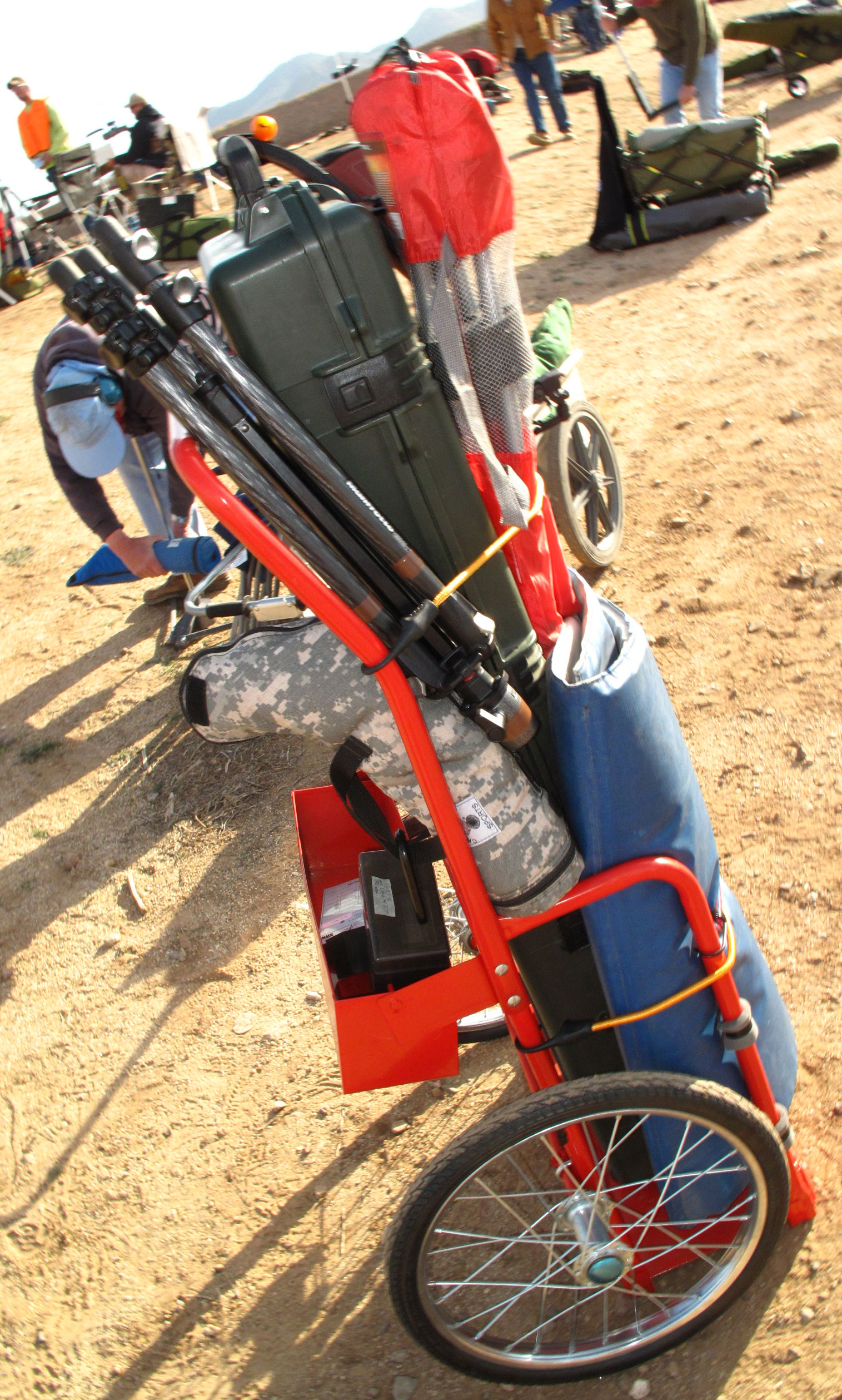


 This episode of Shooting USA TV features long-range varmint silhouette competition in Texas. This discipline combine the pure accuracy of benchrest competition with the fun of knocking down critter targets. These are smaller than standard silhouettes, so it’s quite a challenge to hit them at 300 yards and beyond.

 Bullets, Trickler, and Priming Tool on Top




 Just in time for Christmas, today we feature a beautiful red rifle built by West Texas gunsmith Thomas “Speedy” Gonzalez many seasons back. With an eye-catching, one-of-a-kind engraved Stiller Viper action, and gorgeous red/black gelcoat finish, we think this rifle is one of the prettiest benchrest rigs ever made — and the color scheme fits the holiday season.
 First, the action features a plain-Jane unfluted bolt, with a slight taper in the middle, a bit of a wasp-waist. Speedy prefers an unfluted design because it has superior wear characteristics. He’s found, when working with an aluminum action such as the Viper, the sharp flutes on the bolt will wear the inside of the action faster. In the interest of reduced wear, Speedy also requested a smaller-sized loading/ejection port. This provides for a larger front and rear receiver ring, which enhances bolt bearing surface. More bearing surface reduces point loading for less internal wear.
 Much thought went into the rear section of the stock. Speedy and Tony found that many stocks would start off tracking well, but by the end of the string they were pulling themselves out of alignment. Speedy noted that with some more conventional designs, they tended to ride up out of the rear bag after two or three shots. The BR-X works differently. It uses a wedge design, rather than a radius, so it tends to drive itself down into the bag on recoil. The BR-X is not the only stock to use a wedge in the rear, but it is different than other wedge designs. According to Speedy: “On most other wedge stocks, the wedge tapers towards the pistol grip, making the ‘V’ wider towards the end of the buttstock. This will change point of aim as the stock moves. The BR-X has a wedge that is a constant ‘V’, with no taper from the end to the pistol grip. This does make the gun track better and stay on target better.”
 Speedy says, “you can read the equipment lists from the big shoots, but the printed results can be deceiving. That winning barrel might have been produced a couple of years ago. Barrel-makers do have good runs and not-so-good runs. Do your homework and find out what’s working best right now.” Speedy prefers 6-groove barrels: “I’ve shot em all one time or another. It seems that the 6-groove barrels are easier to get to shoot. It seems at 200 yards bullets from a 4-groove barrel move more than from a 6-groove barrel. Both windage and elevation. I think Tony Boyer feels the same way.” [Editor’s Note: Speedy’s groove observations were made many seasons ago. Today, many top shooters are using 4-groove and 5-groove barrels, and 3-grooves have been successful in score competition.]
 So, how does one improve as a shooter and get to the point where you are meeting your goals? First you need to break down the shooting process into its parts–gun handling, loading technique, wind awareness, time management, bag set-up, and what I call ‘bench management’. Then you need a mentor. Benchrest is like golf–you can have the best equipment (best action, best stock, best rest) but you won’t get far without a knowledgeable veteran to monitor your progress and observe your technique. Without a mentor, benchrest is a rough game to play and you can reach a frustration point after a couple of years.
 Developed by Louis Palmisano and Ferris Pindell (left and right in photo), the 6 PPC is the “King of the Hill” in short-range benchrest competition, the most accurate cartridge ever invented. It still completely dominates 100- and 200-yard Group BR Shooting. If you want to win in that game, you pretty much have to shoot a 6 PPC, or some close variant of the 6 PPC cartridge design.


