The Bertalotto 17 HMR Cleaning Rod Bore Guide is actually made from aluminum arrow shafts.
When Hornady (and CCI) developed the 17 HMR cartridge, they really hit a home-run. And the rifle manufacturers quickly marketed some nice rifles to chamber this 17-cal rimfire round. But unlike .22 LR rifles which, typically, require very little cleaning, 17 HMRs demand frequent bore cleaning to maintain good accuracy. That’s because 17 HMRs shoot copper-jacketed bullets at 2550 fps velocities.
17-Cal Bore Guides — The Challenge
The problem is, it’s hard to find a well-designed, quality bore guide for 17-caliber rimfire rifles. With many 17 HMR (and 17 Mach 2) rifles, you encounter mechanical interference when you try to use a standard bore guide to protect the delicate chamber edge and the bottle neck area of the chamber. A fixed ejector is in the way. On many 17 HMR rifles, this little “shark fin” ejector is right in line with the chamber and is fixed — it doesn’t retract. Therefore the kind of bore guide you might use for centerfire rifles won’t work in 17 HMRs — it will hang up on the ejector.
Polymer bore guides exist for this type of action, but they are typically open-bottom designs that do not enter and seal the chamber. These open-bottom designs don’t protect the delicate chamber edge or the bottleneck area of the chamber, and they also allow some seepage of solvents out of the chamber. That’s why Roy Bertalotto created his RVB Precision Bore Guide for 17 HMR rifles. The 7075 aluminum tube on his Bore Guide is thin enough to pass by the ejector, yet it is extremely rigid. (Photos below.)
Roy explains: “My bore guide is made of 7075 anodized aluminum tubing, which is totally unaffected by any type of cleaning solution. One end is swagged down to fit completely into the chamber of a 17 HMR rifle. This guides your cleaning rod perfectly to the bore without touching the chamber walls or front edge of the chamber. The tight fit of the bore guide in the chamber also stops cleaning solvents from getting into the action, magazine, and trigger housing.” (Editor: Solvent seepage can do damage. We had a 17 Mach 2 rifle that rusted internally because solvents leaked past an open-bottom bore guide.)
Using the RVB 17 HMR Guide – Once the bore guide is in place, slide the supplied aluminum bushing over the tube, and gently push the bushing into the rear of the action. This centers the guide rod in the action to keep the guide rod tube aligned. Once the guide rod and bushing are in place, you can use a 17-caliber cleaning rod* with patches and/or brushes to clean the barrel. Use the rod normally, but make sure your patches are quite small and don’t apply too much pressure as these small-diameter rods can kink if you try to force over-size patches down the bore.
The RVB Precision 17 HMR Bore Guide costs $19.95 plus $5.00 shipping. To order, email Roy Bertalotto via rvb100 [at] comcast.net. Roy will then send you shipping/payment details.
Roy tells us: “Yes, I make the bore guides out of 1616 aluminum arrow shafts. The only material on earth that fits EXACTLY what is needed. I buy the shaft material as simple tubing from Easton. It is hard anodized, the perfect wall thickness and doesn’t look too bad either.”
* NOTE: You really do need a dedicated .17-cal cleaning rod for this job. Most other rods are too fat to pass through the barrel. Dewey Mfg. makes a decent 17-caliber cleaning rod that is reasonably stiff and doesn’t kink too readily. It is available in 7″, 11″, 18″, 26″, and 36″ lengths, either bare stainless steel or with a nylon coating. For use with the Bertalotto Bore Guide, we prefer the nylon-coated version, in either 26″ or 36″ lengths, depending on barrel length.
If you have a high comb on your rifle, you may need extra length to avoid interference with the rod handle. Use this formula to determine correct rod length: Length of barrel + action or breech rod guide length + 2-3″ clearance + high comb if applicable = total rod length needed.
There are other quality 17-cal cleaning rods, but we’ve used the Dewey and it functioned well. The nylon coating cleaned easily and was gentle on the throat and crown. You should clean the coating before and after each use to ensure it does not embed grit or other contaminants.
We see comparison tests of cars, cameras, and other hardware. But how about chronographs? What could we learn by setting up three different chronographs, and running a 20-shot string over all three at the same time. One of our Forum members, Randy S. (aka AAA) did that very test with three of the best chronographs you can buy: LabRadar, MagnetoSpeed, and an Oehler model 35P. The MagnetoSpeed was attached to the barrel of an F-Class rig, with the LabRadar placed on the left side of the shooting bench. The Oehler 35P was positioned about 23 feet downrange. The photo above shows the set-up. A 20-shot string was recorded with the results in a spreadsheet.
AAA talks about this interesting experiment in a Shooters’ Forum Thread. Here is his report:
Comparison Testing Three Chronographs
We all have our favorite chronograph. Each gives a number, but how would that number compare to the same round fired with another chronograph? I wanted to know so a friend and I set up the following test with three chronographs: LabRadar, MagnetoSpeed V3, and Oehler Model 35P.
For the test we fired Berger 105gr VLDs over the three chronographs simultaneously. The test rifle was my 6mm BR Ackley (BRA) F-class rig with fire-formed brass and 200 rounds on the new barrel.
Chronogaphs Tested
LabRadar
MagnetoSpeed V3
Oehler Model 35P
Temperature: 86 deg. F
Elevation: 854 feet
Cartridge: 6mm BRA (105gr Berger VLD)
Time between shots: 45 seconds
To start off, five rounds were fired to make sure all systems were recording and to warm the barrel. Then the test was 20 shots fired across all three instruments with 45 seconds between shots. The Oehler was set 7.5 yards from the muzzle so 12 FPS was added to the recorded value.
We were using the internal trigger on the LabRadar. The manual says the Vo indicated is the actual muzzle velocity when using the internal trigger, but not if using the Doppler. The 12 FPS Oehler adjustment (back to MV) was based on the Berger Ballistics Calculator.
Results of the Triple Chronograph Shoot-Out:
LR-M is FPS variance between LabRadar and MagnetoSpeed V3. LR-O is FPS variance between LabRadar and distance-adjusted Oehler 35P. You can see all three chronos were very consistent. SD was identical with the LabRadar and MagnetoSpeed.CLICK HERE for spreadsheet.
The tester, Randy S. (aka AAA) says: “Judge for yourself, but I was impressed by all.”
Comments by Forum Members
Our Forum members expressed interest in this Triple Chronograph test. Some confirmed that the LabRadar and Magnetospeed give very similar FPS numbers, based on their own tests:
“Great test and thanks for sharing. I’ve tested my MagnetoSpeed and LabRadar together and results are always within 2-4 FPS of one another.” — Big D
“Very happy to see your numbers support my decision to buy a MagnetoSpeed. Had read reports comparing it to the Oehler and the numbers I get seem to be supported by my long range shooting results. Many thanks for taking the time and effort [to perform] this comparative test. Always good to get actual test results.” — Texas10
“I did a 4-shot test with my MagnetoSpeed and another shooter’s LabRadar a couple of days ago. The results were within 4 fps with the LabRadar being optimistic.” — Pat Miles
Forum Member Powderbreak studied AAA’s original spreadsheet from the chronograph trio test, then figured out the shot-by-shot FPS variance between the machines. He concluded that all the machines performed very well. Powderbreak posted:
Analyzing the Triple Chronograph Test — What Can We Conclude?
AAA did a great job of comparing the 3 chronos. What conclusions can be drawn?
1) I have not checked the manufacturer’s claims of accuracy, but the three chronos are very close to one another. There is no way for us to determine the actual true velocities, but we do not need to do so. Any of the chronos would be more than adequate for an accurate shooter.
2) The resolution of the three chronographs is actually pretty astounding. One foot per second (FPS) is a resolution of 0.033%.
3) AAA did a great job of reloading a very consistent round. With an extreme spread of 33 fps out of 3014 for 20 rounds, that is only 1.09% total spread of velocities.
4) There is a closer velocity match between the MagnetoSpeed and the LabRadar, but that does not mean the Oehler is less accurate. There is simply an offset between the Oehler and the other two. This could be due to the greater distance, the location, or the internal working of the Oehler.
5) Believe your chronograph, it is probably the most accurate reloading tool that you own.
Brian Litz of Applied Ballistics carefully explained the operation, set-up, accuracy and comparison of AB’s chronographs in his books. [Those books] are well worth the money, and give great insight into the workings of chronographs.” — Powderbreak
Here’s a great gift for Father’s Day that any dad with a truck should appreciate. Forum member John Niemi crafts custom hitch covers that look like the end of a cartridge case, complete with head-stamp. Costing $75.00 (delivered), they are made out of solid brass with a stainless steel “primer”. The diameter of the brass is 4 inches and the engraved letters are about half an inch tall. The section that slides over the trailer hitch is aluminum, so you don’t have to worry about rust.
The “headstamp” can include your favorite cartridge-maker and caliber (wildcats too!), or you can include the name of your business. John tells us: “I can engrave any text on one as long as there is enough room for it. Turn around time is usually less then a week after payment. I have sold many of these and everyone has been extremely happy with the quality and workmanship that I put into my product. These make great one-of-a-kind gifts.”
$75.00 Delivered in the USA
The current price for brass bullet hitch covers from John Niemi is $75.00 shipped anywhere in the USA. To order, send email to JohnNiemi [at] charter.net or call (503) 440-1954. John said he should be able to offer pretty quick turn-around, unless he just gets swamped this week.
Forum member Wayne (aka WAMBO) ordered a custom hitch cover from John, featuring the 30/338 Lapua Improved wildcat he calls the 300 WAMBOMAG. Wayne reports: “The hitch cover is very well made. I’m impressed with the quality. Buy with confidence.”
How will it look on your truck? Check out this Niemi hitch cover on a vehicle belonging to Forum member ELR Researcher. The brass cover is sturdy, distinctive, and handsome:
We’ve seen John’s craftsmanship on many of these hitches, and we can confirm that the hitches are beautifully made, and make a handsome addition to any vehicle. If you order one (or more), be sure to mention you learned about the hitch covers on AccurateShooter.com.
Looking for an affordable PRS Factory Class rifle? Savage has released an updated version of its model 110 that may fit the bill. The new Savage 110 Tactical comes in Grey or Desert Tan in three popular chamberings: 6mm Creedmoor, 6.5 Creedmoor, and .308 Win. Street price is under $630.00. The 110 Tactical features a user-configurable stock with internal sub-chassis. It also features a suppressor-ready threaded barrel, a one-piece +20 MOA scope rail, and 10-round detachable box magazine. The Savage Accutrigger is adjustable.
Competitors will want to know about barrel configurations. All 110 Tacticals have medium-heavy contour barrels with threaded muzzles (and thread cap). 6.5mm Creedmoor versions sport a 24″ barrel. The 6mm Creedmoor version has a 26″ barrel, while the .308 Win is offered with either 20″ or 24″.
This video tests the 6.5 Creedmoor Model 110 Tactical with multiple ammo types:
Four types of factory ammo were tested in above video: Hornady American Whitetail 129gr, American Eagle 140gr, Hornady Match 140gr ELD, S&B Tactical 140gr FMJ. Three sets of handloads were also tested. These used 130gr Hornady ELD, 130gr Nosler RDF, and 122 Lehigh CC bullets in Hornady brass. All handloads used H4350 powder and Federal primers. Accuracy was not bad with handloads.
Savage AccuFit System for Comb and LOP Adjustments
The 110 Tactical’s AccuFit system lets you customize comb height and length-of-pull with different comb risers and stock spacers that install easily. The AccuStock sub-chassis secures the action three-dimensionally along its entire length. This aids accuracy and shot-to-shot consistency.
Key Features
• AccuFit system for comb height and length-of-pull
• Detachable 10-round Magpul AICS magazine
• Threaded heavy barrel with end cap
• 20 MOA EGW rail
• Gray or Desert Tan synthetic stock
• Tactical oversized bolt handle
Left-Hand Version in .308 Win Only
Savage will offer a left-hand .308 Win version of the 110 Tactical. Sorry southpaw 6mm and 6.5 Creedmoor shooters — for now, only right-hand options are offered for those chamberings.
Father’s Day is Sunday, June 17, 2018, three days away. If your father enjoys the shooting sports, here are some recommended items that our staff owns or uses. All selections cost less than $100.00. It’s not too late to order for many of these items. If you have an Amazon Prime membership, you can get two-day shipping in most areas of the country. That’s enough time to get the gift to “Pops” by Sunday. But we bet Dad would appreciate any of these gift items, even if they arrived a few days later.
TEN Great Father’s Day Gifts for Dad Under $100.00
This Columbia Bahama II guide shirt is durable and comfortable. More importantly it provides UPF 30 protection from the sun’s damaging rays. The added cape over the shoulder area provides extra protection for shooters in the prone position. This is offered in 17 colors in breathable nylon. This is popular for fishing, sailing, hiking and other outdoors sports.
These Howard Leight Electronic Muffs are Amazon’s #1 Seller in the Safety Ear Muffs category. These offer 22 dB sound protection with the ability to still hear conversations and range commands. For regular use, we do recommend running plugs under these muffs for higher effective NRR.
This is an excellent shooting mat — it is very well made with good padding/insulation. On gravel, concrete, or hard-packed ground this is way more comfortable than typical mats. It is wide enough and easy to fold. Any Dad who shoots would love this.
Lyman’s new Ideal compact press works great as a second, lighter-duty press. It also is a good choice for loading at the range. It can easily be mounted to a bench with C-Clamps. This cast-iron press is stronger than other presses in its price class. The Lyman Ideal costs just $77.51 at Midsouth Shooters Supply.
The Fospower Battery Pack can charge your smartphone, tablet, and other USB-compatible devices. This is a great as a backup power source for a LabRadar chrono, or if you are using a tablet to monitor a TargetCam. Waterproof and shockproof, the rugged Fospower unit is built for outdoor use. On sale at Amazon.com for $26.99, this 10200 mAh Power Bank has been popular with our Forum members.
We’ve used Bog-Pod shooting supports on varmint hunts. They’re great for down-angle shots from a ridge or kneeling shots to get above terrain obstacles. Bog-Pods adjust from 17″ to 39″.
Walkie-Talkies are “must-have” items for long-range shooting. The 50-CH Midland GXT1000VP4 Two-Way Radio set is Amazon’s #1 Best Seller in FRS/GMRS Handheld Radios. Priced under $65.00, this kit includes earbuds plus both 12V and 120V chargers. Quick Weather Scan Feature.
Plano’s AirGlide case is a unique, top-loading rifle case. Ideal for benchrest guns with wide forearms, the AirGlide case puts no side-pressure on scopes. We like the ease of loading. This fits rifles up to about 27-28″ barrels.
The versatile MTM Range Box includes cradles so you can do gun maintenance while at the range. A lift-out tray holds small items such as patches and jags. This is a durable product that can hold ammo and other gear.
This cleverly-designed Shotshell thermos will make Dad smile. Styled just like a 12ga shotgun shell, the Stansport thermal bottle holds 25 oz. of hot or cold liquids.
This is the MOTHER LODE of GUN INFO. If you’d like to have instant access to 6,800 gun schematics and descriptions of 67,000 types of guns and ammo from 1,000 manufacturers, then check this out. The Firearms Guide is a humongous online database that is regularly updated. You can access all this info for pennies a day. The annual subscription is on sale right now for just $29.95. If you only need the info for a month or two, get a monthly membership at $6.50 per month, and cancel any time.
You can also get a DVD or Flash Drive add-on that lets you access the database even without a web connection. A 1-year Online Edition PLUS Firearms Guide 8th Ed. DVD for Mac & Windows is $34.95, including shipping. Alternatively, the 1-year Online Edition PLUS Firearms Guide 8th Ed. Flash Drive for Mac & Windows is $44.95. This lets you access the data from laptops and most tablets with a USB port.
You may be familiar with the Firearms Guide when it was distributed as a DVD. Now the 7th Edition is a fully interactive, subscription-based online database of firearms and ammo, which is also the most complete guide to global gun values on the web. The amount of imagery is amazing — there are tens of thousands of photos and over 6300 schematics, which help you work on a firearm or identify key components/parts. Published since 2009, the Firearms Guide permits detailed searches of antique and modern guns and side by side comparisons of search results. Guns are cross-referenced with the ammunition database.
Guns and ammo are presented with prices, specifications, features, ballistics, and up to 12 high-rez zoom-able color pictures. GUN VALUES are provided for dealers and gun collectors. You can access thousands of printable and zoom-able GUN SCHEMATICS (diagrams or exploded views) with parts lists and blueprints for professional gunsmiths.
If you are a gun collector, or just an information junkie, you’ll find the Firearms Guide to be an invaluable resource. The scope is truly worldwide, with coverage of gun makers in Western Europe, Eastern Europe, South America, South Africa, and Asia as well as North America. The online database’s search capability lets you search by gun caliber, manufacturer, and key features (e.g. “.223 Rem, Colt, folding stock”). There are 14 different search criteria — this allows you to “drill down” precisely to find the gun you want in seconds. Shown below are typical profiles of listed products:
About the Firearms Guide Database Firearms Guide has been published from 2009 to 2015 on DVDs and sold through Cabelas, Bass Pro Shop, the NRA and other vendors. In 2016 Firearms Guide was transformed into a subscription-based, online searchable guns and ammo reference and gun value guide for industry professionals and enthusiasts. Along with the web subscription, you can purchase a supplemental DVD or Flash Drive which contains the same information for off-line access. Firearms Guide is a proud sponsor of the NRA.
Report by Craig Arnzen, Area419.com
It’s easy to think about shooting your first precision rifle match and worry about all of the gear and trinkets that you may need to make it through. In reality, the old rules apply — keep it simple.
We wanted to put together for you a no-nonsense list of the Top Five Gear Items you need for your first match. This list focuses on the “must-have” items you’ll need for PRS-Style competitions.
1. A Rifle (That is Reliable and Sub-MOA Accurate)
Your rifle is the most obvious piece of kit, but we can give you a little more information. Most of the guys you’ll find out there are shooting 6.5 Creedmoor. Yeah, there are guys using .308 Wins and 6mm Dashers, but the 6.5 Creedmoor makes up more than half of the rounds shot in PRS competition, when looking at both national and club matches. Your comp rig needs to be mag-fed and shoot better than 1 MOA. It DOESN’T need to be better than 0.5 MOA (half-MOA). With most targets being 2-3 MOA in size, a half-MOA gun will do just fine. More accuracy is better of course, but you don’t need an exotic quarter-MOA rig to win.
[Editor’s NOTE: PRS does offer a Gas Gun division, but most guys start out with a bolt-action rifle, which will be less maintenance-intensive than an AR-platform rig.]
Muzzle brakes, like our Area 419 Hellfire, are also very popular as much of the PRS game is recoil management. If you can’t see your misses, you’re sure to have more of them.
The rifle also needs an optic with repeatable clicks and a reticle with Mil- or MOA-based hashmarks. The clicks can be either Mil system or MOA system (Mil is more common), so long as the click values match the reticle (i.e. you don’t want 1/4-moa clicks with a Mil-marked reticle). How much power do you need? Anything that zooms in the mid-teens will suffice. I could shoot a match with a fixed 12X scope and not feel disadvantaged. We love the Kahles K624i, if you’re looking for a suggestion.
Oh, and you’ll want a bipod — but the choice in bipod deserves a whole separate article by itself. Nothing wrong with starting out with a Harris swivel. Then you might look at different bipods on other competitors’ rifles for comparison.
2. Ammunition — Factory Ammo and Hand-loads
Good ammo is important, but as we discuss above, 0.5 MOA is good enough. Also, speed is great but it matters FAR less than you’d think. Drop can be calculated with precision, and distances are normally known, so a slightly flatter trajectory doesn’t really matter. Wind matters, but the difference you’ll find when eeking out that last 50 fps is very, very small.
Federal, Hornady, and Prime all make quality ammo that is widely used by shooters from local to national matches. Facebook photo by CReece.
Precision Handloads
If you want to run down the rabbit hole of finding that perfect ammo that shoots in the “twos” (0.2 MOA), get yourself an AutoTrickler and some of our billet aluminum accessories — you’ll love the setup.
3. A Versatile Support Bag
There are countless bag options. But there is ONE bag you’ll see everywhere, and for good reason. The Game-Changer from Armageddon Gear is aptly named. Many shooters use it as a barricade bag as well as a rear bag, meaning a guy could get away with using only this bag for an entire match. If you need another bag when you get there, ask someone in your squad, they’ll share. I promise.
4. DOPE (Reliable Ballistics Info)
We’re not talking the kind of Dope you may find in a match outside Denver — we are talking about the kind that feeds you ballistic solutions. The software-enabled Kestrel is a very common item on the range, but you’ll also see lots of guys using mobile Apps such as Shooter or Applied Ballistics Mobile, and they have great results.
It’s also handy to have an armband or an item like the Hawk Hill data card holder for stages with various targets at differing ranges. Once the RO says “engage” and your mind stops working, you’ll appreciate having it written down.
5. Hearing Protection
PRS Competitors shoot with brakes and sometimes in enclosed spaces. That’s why you need serious hearing protection. We recommend NRR 33 earplugs, doubled up with Electronic Muffs to hear range commands. I have used the 33 dB NRR Mack’s foamies at matches for most of the last year, and the Howard Leight NRR 33 Max-1s are also very effective. The budget-priced (under $50) Howard Leight Impact Sport Electronic muffs work well, but premium electronic muffs may be more comfortable.
Growing in popularity are high-tech, in-ear digital units like the ESP Stealth. I have a set of linked ESP Steaths on the way and hope to evaluate them soon. These are supposed to be very good, but the ESP Stealths cost $2100.00 per pair!
Think we missed something? Have more questions? Let us know.
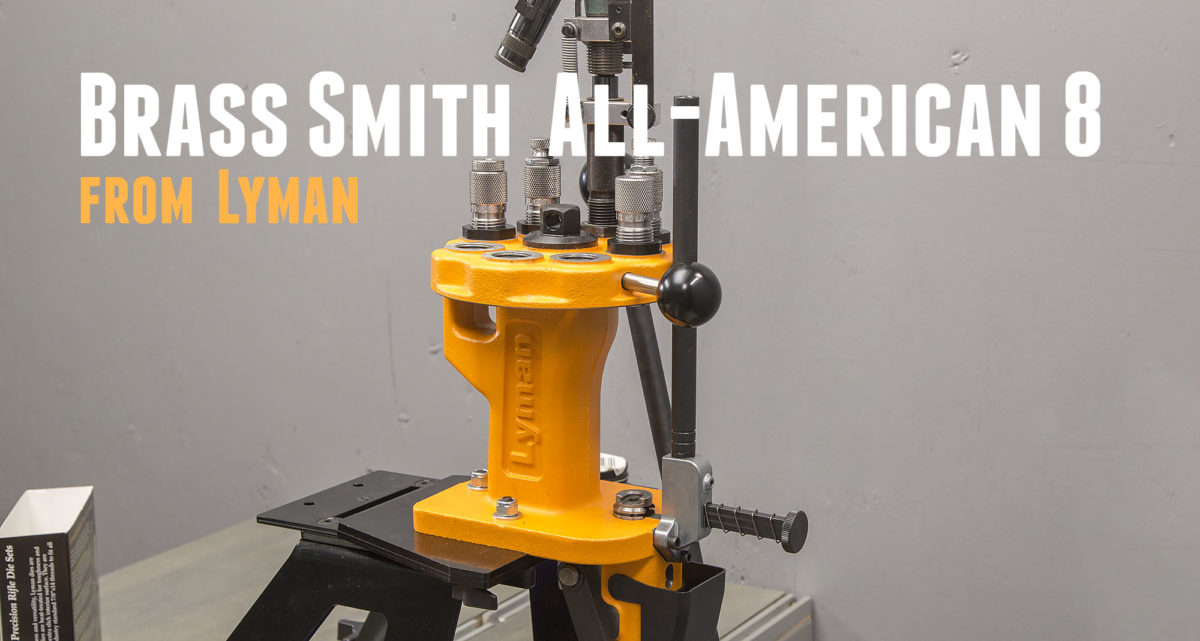
For 2018, Lyman has introduced a new 8-station turret press, the All American 8. There are two other new Brass Smith presses from Lyman — a compact C-Frame Ideal Press and a sturdy O-Frame Victory single-stage press that competes with the RCBS Rock Chucker. With its eight-station capacity, strong cast iron construction, we think the All American 8 will become popular. With a $195 street price, the 8-station Lyman is $100 cheaper than the 7-station Redding T-7. No question, that’s a significant price advantage, and we believe Lyman will take sales from Redding.
Our friend Gavin Gear of UltimateReloader.com got his hands on one of the new All American 8 presses, and he’s created an informative video showing press set-up and loading function. Gavin was excited to work with this beefy new turret press: “Why has this Lyman press been anticipated so highly since its announcement? A few reasons are: the 8-station capacity, cast iron construction, on-press priming system, ambidextrous design, and turret rear support for repeatable sizing and bullet seating. Plus, it’s made right here in the USA!” To learn more about the All American 8 turret press, watch Gavin’s video:
More Stations = More Reloading Options
Gavin said the press works well — he liked having 8 stations, because this offers more flexibility. With eight stations, you can have four two-die sets, or three two-die sets plus a dedicated decapping die and a powder measure. Gavin notes: “I’ve owned many reloading presses, including 3-station, 4-station, 5-station, and 7-station variants, but I’ve never owned an 8-station press until the Brass Smith All-American 8 came to the shop. I’ll have to say… you can’t get too many stations, especially on a manually-indexed turret. I love the idea that you can leave dies on the press, and load multiple calibers/chamberings using the same turret setup.”
Primer Function Works Well
Gaving also seated small and large primers using the on-press priming system. The Lyman All-American 8 turret press comes complete with all of the parts needed to seat both large primers and small primers. Gavin observed: “The All-American 8 loads quite well! Once I cleaned out the primer tube (always do that on a new press) the priming system worked perfectly, and I had no issues getting up to ‘full turret speed’ after getting into the groove.”
Why Use a Turret Press
This Editor has used a six-station RCBS Turret press for many years. I keep a dedicated decapping die on that press, as well as sizing and seating dies for pistol cartridges. My high-volume 9mm and .38 SPL reloading is done on a progressive press, but the RCBS turret allows me to have dies for two larger pistol chamberings — .44 Magnum and .45 ACP — at the ready. While we recommend single-stage presses for precision rifle reloading, the turret press offers great flexibility for handgun hand-loaders who shoot numerous cartridge types. And if having six die stations is good — having eight is even better. Advantage Lyman.
Forum member Evan K. (aka “Katokoch”) has crafted a nice rimfire benchrest rig using a Suhl action fitted into a handsome home-built cedar and carbon fiber stock. This shows what a skilled hobbyist wood-worker can create in his garage. Evan tells us: “Here is my Suhl 150-1 with a factory 1:19″ twist barrel, Leupold 36X scope, Harrell tuner, and my handmade cedar/carbon fiber stock. I started working on the laminate blank a couple years ago and finally finished it earlier this year. I’ve been using it in my IR 50/50 matches this summer. I haven’t shot a 250 with it yet but I know the rifle is very capable — as usual, I am the weak link!”
We think Evan did a great job on his stock, though he has limited stock-building experience. Evan explained: “The stock is my first attempt at making a very lightweight laminate and also gluing both vertical and horizontal seams in a blank. The wood is Spanish and Red Cedar and I made the trigger guard and buttplate with carbon fiber too (great use for small scrap pieces). The finish is hand-rubbed spar urethane and the action is semi-glued-in with Devcon 10110 and stainless pillars.”
USRA-IR50/50 is a popular .22 rimfire benchrest discipline with three (3) classes: 13.5 lb., 10.5 lb., and 7.5 lb. (Sporter). The matches are shot at 50 yards and 50 meters.
GunsAmerica just released a detailed review of the recently-upgraded Kestrel 5700 Elite with LiNK, a software-enabled weather meter. If you compete in practical/tactical events (with targets at multiple distances), or campaign a wide selection of rifles, or shoot at Extreme Long Range, you may want to get this device. It offers unrivaled capabilities in a small package. This impressive handheld device combines weather-monitoring capabilities with a full-featured, very sophisticated ballistics solver that now calculates out to 5,500 yards. Using Bluetooth and LiNK technology it communicates with your mobile device as well as LiNK-enabled laser rangefinders.
Why You May Want to Buy the Kestrel 5700 Elite with LiNK:
— The Device can hold up to 30 different rifle/cartridge profiles, each with its own BC and muzzle velocity for ballistic calculations.
— The Device registers current windspeed, wind direction, air temp and pressure, and other variables, and then sends that info via Bluetooth to your smart-phone, updating the ballistic solution. It essentially updates your drop chart in real time.
— The Device “talks” to your smart-phone, providing a large, convenient display that can show both elevation clicks and wind corrections. The display essentially replaces your data card. The Smartphone integration also makes it easy to modify your different rifle/ammo profiles.
— The Device gives you come-ups and wind corrections for multiple targets (at various ranges). These can be displayed in a list, ordered by distance. This is a great feature, check it out:
Quick and Accurate Solutions for all Cartridge Types — Big and Small
The Kestrel 5700 Elite can work for everything from a .22 LR to a .50 BMG. In fact, GunsAmerica’s tester used the Kestrel 5700 for a 6.5 Creedmoor shooting out to 1070 yards, and then used the solver for a .22 LR match out to 300 yards. The data for the 6.5 CM was spot on, but even more remarkably, the holdover for the .22 LR was precise to 0.2 mils at 300 yards. The GunsAmerica Reviewer, Ian Kenney, was impressed:
“I think the best testament to the capabilities of the Kestrel 5700 Elite were on display at a recent range trip where I was getting my modified Ruger 10/22 ready for an upcoming precision rimfire match. I started out with a sort of hodgepodge of information, using an unconfirmed BC [for Eley Force ammo] that I’d heard from a friend along with a muzzle velocity that another friend had gotten with the same ammo. I created a new profile using this assortment of data and entered in target distances for 200 and 300 yards. Imagine the smile on my face then when I got hits at both distances with the elevation setting only being 0.2 mils off at the farthest target.
It’s impressive that the technology allowed me to only be 0.2 mils off with .22 LR ammunition at 300 yards, which is only about two inches, all the while starting out with imperfect data. If that’s not an exquisite demonstration of the versatility of this technology, to be able to toggle between such diverse calibers and get accurate data to long distances, I don’t know what is.”
Kestrel 5700 Elite Special Capabilities
The LiNK Ballistics App lets you set up multiple targets for single-screen viewing. The Kestrel 5700 Elite can also be wirelessly paired with LiNK-compatible laser rangefinders. Being able to instantly accees exact target range data allows a more rapid and and more precise ballistic solution.
In addition to the ballistics solver capabilities, the Kestrel 5700 Elite is a comprehensive weather meter that monitors all key variables including: wind speed and direction, temperature, humidity, heat index, pressure, and altitude. Your data log can be transferred to a iOS/Android device wirelessly with the LiNK wireless communication option and Kestrel LiNK app. The 5700 Elite now uses a single AA Battery housed separately from the circuit board.
More Features of the Kestrel 5700 Elite
The Kestrel 5700 elite has almost too many features to list. One notable capability allows you to quickly “tune” a profile by entering field-confirmed data. Kenney explains: “You can go into the gun profile and calibrate the muzzle velocity by telling it how much elevation you used to get a hit, effectively truing your dope in short order. This is ten times faster than logging it in your data book, going back to an online solver, and making adjustments[.]”
Ian Kenney’s Kestrel 5700 Elite Review is very thorough, and contains many more details and insights than we can cover here. For anyone considering purchase of a high-end Kestrel, we strongly recommend you read Kenney’s review. Ian concludes: “I’m not going to lie… with an MSRP of $699, I recognize [the Kestrel 5700 Elite] may not be for everyone. Considering how often I shoot long range and the number of rifles that I have, it makes sense for me[.] The Applied Ballistics solver also gives me the confidence that my dope is going to be accurate no matter what conditions I might find myself in. So for me… this Kestrel delivers the goods.”
Kestrel 5700 Elite Advanced Features (Partial List)
Kestrel LiNK Apps for iOS and Android
Wireless Bluetooth for Mobile Devices
Connects with LiNK Compatible Range Finders
Temperature Sensor (Patented External Isolated)
Integrated Applied Ballistics Calculator
Applied Ballistics G1/G7 Drag Model Profiles
Applied Ballistics Custom Drag Models
Average and Peak Wind Correction
Muzzle Velocity Calibration
Supports Mil, MOA Click Values
Create and store up to 30 Gun/Bullet Profiles
Create and store up to 10 Targets
Moving Target Lead Correction
Aerodynamic Jump Correction
High Angle Shot Correction
Target Range Estimator
Spin Drift Correction
MV-Temp Table
Digital Compass
Range Card


 17-Cal Bore Guides — The Challenge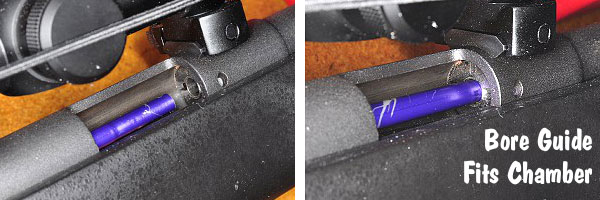

 Using the RVB 17 HMR Guide – Once the bore guide is in place, slide the supplied aluminum bushing over the tube, and gently push the bushing into the rear of the action. This centers the guide rod in the action to keep the guide rod tube aligned. Once the guide rod and bushing are in place, you can use a 17-caliber cleaning rod* with patches and/or brushes to clean the barrel. Use the rod normally, but make sure your patches are quite small and don’t apply too much pressure as these small-diameter rods can kink if you try to force over-size patches down the bore.


 The “headstamp” can include your favorite cartridge-maker and caliber (wildcats too!), or you can include the name of your business. John tells us: “I can engrave any text on one as long as there is enough room for it. Turn around time is usually less then a week after payment. I have sold many of these and everyone has been extremely happy with the quality and workmanship that I put into my product. These make great one-of-a-kind gifts.”