Need a top-notch Ballistics App for your iPhone, iPad, or iPod? Start with Ballistic AE, the number 1 (i.e. most installed) App for iOS systems. Ballistics AE (Advanced Edition) is the most popular iOS ballistics program for many good reasons. Full-featured and easy to use, Ballistics AE has been refined over many years, and it supplies rock-solid solutions derived from JBM Ballistics solver (created by James B. Millard). Unlike some other Apps, Ballistics AE is STABLE on iPhones (with various OS levels). What’s cool is that Ballistics AE is now on sale for $12.99.
We’ve used the Ballistic AE program on an iPhone 5S, iPhone 6, and iPad, and it performed well. Here are some of the features we liked:
1. Mirrors output from online version of JBM Ballistics we often use for initial calculations.
2. Controls are simple to use and (mostly) intuitive.
3. Handy comparison feature lets you compare ballistics for different projectiles side by side.
4. Advanced Wind Kit allows you to account for complex wind situations.
5. Projectile and BC Database is very comprehensive.
6. Software is regularly updated to match Apple OS changes.
Comprehensive Projectile Info and BCs
Ballistics AE has very complete data libraries. The program includes 5,000 projectiles, factory loads, military loads, and performance data points from leading manufacturers, military testing, and performance testing.
Ballistic Coefficient libraries include the latest commercial BC data, plus Applied Ballistics’ (Bryan Litz) custom G7 BCs, plus G7 military coefficients from Aberdeen Proving Grounds.
These Videos Explain How to Set Up and Use Ballistic AE:
BAT .50 BMG Model EX– Now That’s an Action!, by GAS
A while back, I stopped into Bruno Shooters Supply for a jug of powder and looked into the display case where the new actions are kept. Amid the usual array of BAT Machine, Kelbly and other actions, there was something unlike any action I’d seen before — all I can call it is the BIG BAT (It’s officially the BAT Model EX 2.5). I wasn’t too surprised at the weight (a beefy 13.7 lbs.), but until you lift it it’s hard to appreciate how solid, chunky, hefty, massive (pick your favorite adjective) this thing really is. The action is a 2.5″-diameter, 12″-long BAT for the .50 BMG cartridge. It is simply the biggest, slickest custom action on the planet. In order to give you some sense of scale, I photographed the action alongside a conventional BAT action for short-range Benchrest shooting and I put a .220 Russian case and a .30-06 case into the picture. I’ve handled and fired other .50 BMG actions/rifles before, but this BAT puts them all to shame, as far as fit and finish go.
The action is actually quite conventional in design and execution. The bolt is fluted and has two front lugs with a conventional, although super-sized, firing pin assembly. Any Remington-style trigger will mount by way of a normal trigger hanger, allowing for simplified maintenance or replacement in the field. The loading port is 5.5″ long and the barrel threads are 1.5″ x 16 tpi — nothing about this beast is small! There is a conventional rocker-type bolt release on the left side of the receiver body and a recoil lug is built into the bottom of the receiver. In reality, the action is very similar to any other BAT except for the size and it adheres to all of BAT’s high standards for quality of design, manufacture, fit, finish and just plain good looks. Slide that bolt back and it feels as tight as a small Benchrest action!
Given the BIG BAT’s $3,125.00 sticker price (before options), not many of us will ever have the opportunity to own or shoot one of these beauties (I certainly won’t). However, it is nice to know they exist and can be bought and enjoyed in many places. CLICK HERE for BAT EX configuration options.
The special laminated fancy wood stock was crafted by Will McCloskey of Cerus Rifleworks. Cerus mills its stocks with a super-precise, computer-controlled CNC machine. This provides ultra-exact dimensions/geometry for superior tracking. This stock features carbon upgrades — a carbon fiber bedding block and carbon fiber forearm tunnel. Speedy tells us: “The Borden action is conventionally bedded, then glued-in as per our benchrest rifles in order for the stock and barreled action to function as one unit. This feature also eliminates the possiblity of moisture entering into the receiver’s bedding area in a rain or high moisture event.”
The stock is made from multiple layers of exotic and fancy woods. On the outside is Bocote, a super-dense (extra heavy) exotic from Central America. Next comes Birds-eye Maple, while the core (centerline) layer is Wenge wood. Strengthening the laminate are carbon fiber stringers. A stock like this can be purchased for $799.00 plus $100 for the exotic wood upgrades.
Speedy F-Open Rifle Specifications:
Cerus Rifleworks stock with R.A.D. Borden Accuracy BRMXD action
Flavio Farè trigger
Brux barrel with Erik Cortina Tuner
Nightforce Competition scope
SEB Mini Coaxial front Rest with F-Class Feet
The handsome, CNC-milled laminated Cerus stock features a R.A.D. Recoil Reduction System.
Even seen an integrally suppressed rifle? Ruger offers this technology with its new Silent-SR ISB, a multi-baffle integrally suppressed barrel (ISB) for Ruger 10/22 takedown models. This system reduces sound levels to an average of 113.2 dB with standard velocity ammunition. That’s very impressive — consider that an unsuppressed .22 LR firearm can produce noise levels as high as 140 dB with standard velocity ammunition. That’s well above the threshold where irreversible hearing damage begins. (Source: NC Silencers).
Even if you are not interested in a suppressed rimfire rifle (or live in a state where suppressors are forbidden) we think you’ll be interested in Ruger’s technology. The Silent-SR employs a long, multi-element “baffle stack” that can be easily removed for cleaning.
Watch Integrally Suppressed Barrel in Action. CLICK HERE to View Video on Ruger Site. Scroll to bottom of Ruger page after jump!
Here’s what Ruger says about its new ISB (Integrally Suppressed Barrel) for the 10/22 Take-down:
The Silent-SR ISB quickly and easily assembles to any Ruger 10/22 Takedown or 22 Charger Takedown, and features an induction-hardened breech with cold hammer-forged barrel that provide easy takedown and accurate return-to-zero.
Reducing sound pressure levels of .22 LR to an average of 113.2 dB with standard velocity ammunition, a 10/22 Takedown rifle equipped with the Silent-SR ISB is as quiet as a bolt-action rifle with a thread-on silencer. The relatively long barrel of the Silent-SR ISB (compared to other integral suppressors) means the bullet generates energy near that of a 16″ gun for consistent, accurate and effective performance on target. The pushed-cone baffle geometry has been stretched to utilize the volume under the barrel maximizing suppression of the gunshot without disturbing the travel of the bullet.
Disassembly for cleaning is as simple as separating the barrel from your firearm and loosening the Silent-SR ISB’s single assembly screw using the included 5/32″ hex key tool. Once loose, pull the screw to remove all six 17-4 stainless steel baffles, spacer and front cap free of the sleeve for cleaning. The sealed baffles keep the fouling away from the serialized sleeve, yet easily come apart even after thousands of rounds. Finished with Cerakote, the Silent-SR ISB is engineered and built for a lifetime of hard use without clogged ports, seized components or loss of suppression that often plague other integrally suppressed rimfire barrels.
Mother of All LR Primer Tests
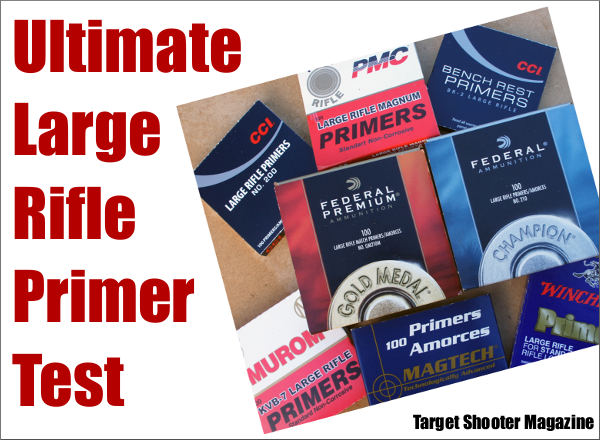
If you shoot a .308 Win, or any cartridge that uses a Large Rifle (LR) primer, you should read an important article by Laurie Holland in Target Shooter Magazine. Holland, a talented shooter from the UK, tested no less than sixteen (16) different large primer types using a custom F-TR target rifle shot from the bench. Laurie loaded .308 Win ammo* with 16 LR primer varieties and then tested for average velocity, ES/SD, and group size. This may be the most comprehensive and thorough LR primer test ever done. Here are the primer types tested:
1. CBC Magtech 9½
2. CCI 200 LR
3. CCI BR2 Match
4. CCI 250 Magnum
5. Federal 210
6. Federal 210M Match
7. Federal 215M Magnum Match
8. Fiocchi Large Rifle
9. Kynoch Large Rifle
10. Murom KVB-7 (PMC LR)
11. Norma Superflash LR
12. PMC LR Magnum
13. Remington 9½ LR
14. Remington 9½ M Magnum
15. Sellier & Bellot LR
16. Winchester WLR
Test Rig: Osprey Rifles-built F-TR rifle with Savage PTA action, 32″ Bartlein 1:12″-twist ‘Heavy Palma’ barrel, and Dolphin Gun Company modular stock with an F-Open/Benchrest fore-end.
Some of Laurie’s results may surprise you. For example, would you guess that Sellier & Bellot primers had the lowest ES, by a significant margin? And get this, among ALL the primers tested, Rem 9½M Magnum primers produced the lowest velocity, while Rem 9½ LR (non-magnum) primers yielded the highest velocity. (The total velocity spread for all primers was 35 fps). That’s counter-intuitive and it’s odd that Rems were at opposite ends of the speed spectrum among ALL primers tested.
“The rationale for doing side-by-side tests is to see what effect primer choice has on ballistics, i.e. average velocities and MV consistency. There are a great many views on the subject, a few based on tests (including primer flame photography) but most apparently hearsay.” — Laurie Holland
Every serious hand-loader should definitely read the full test results to understand Laurie’s methodology and get all the details. This is an important test, with significant findings. But if you can’t spare the time right now, here are some highlights below:
Primer with Lowest Velocity: Remington 9½ M Magnum (2780 fps)
Primer with Highest Velocity: Remington 9½ LR (2815 fps)
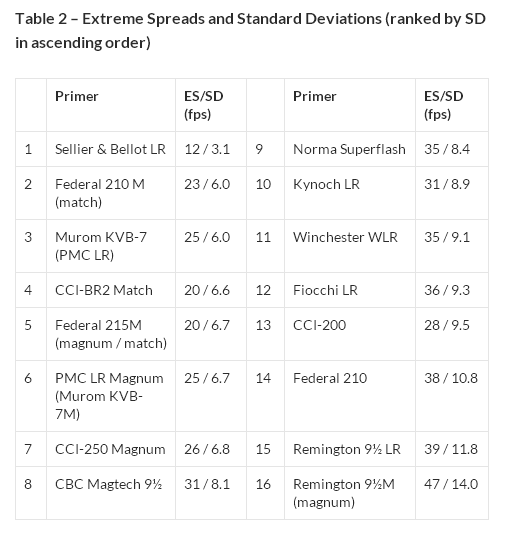
Primer with Lowest ES/SD: Sellier & Bellot LR (12/3.1 fps)
Primer with Highest ES/SD: Remington 9½ M Magnum (47/14.0 fps)
Primer with Smallest Group Size: Remington 9½ LR (0.43″ average, three 5-shot groups)
Primer with Biggest Group Size: CBC Magtech 9½ (0.7″ average, three 5-shot groups)
Editor’s Comment: Laurie shot three, 5-shot groups at 100 yards with each primer type. The average group size for the top six primers varied by only 0.10″ (0.43″ to 0.53″), so one can’t conclude that one type is much better than another. Total group size variance (from best to worst) was 0.27″.
“The biggest surprise to me … came from an elderly (at least 10 years) lot of Czech Sellier & Bellot standard caps with an ES of 12 and SD of 3.1 fps, way below those of the nearest competitor. By contrast to the Fiocchis, they were an almost slack fit in the cases and this may have contributed to their consistent performance.” — Laurie Holland
NOTE: Values in chart are based on 15-Shot strings. The ES/SD numbers will therefore be higher than is typical with five-shot strings.
All ES/SD Values from 15-Shot Strings
Testing 16 primer types was a huge task — we commend Laurie for his hard work and thoroughness. This extensive test is an important contribution to the “knowledge base” of precision shooting. Laurie’s findings will doubtless influence many hand-loaders who hope to produce more consistent ammunition, or achieve better accuracy. Credit should also be given to Target Shooter Magazine for publishing the results. Well done gentlemen…
*Reloading method for Test Ammo: “Test batches consisted of 16 or 17 rounds for each primer, charges thrown by an RCBS ChargeMaster and checked on lab-quality electronic scales, adjusted if necessary to within ± 0.04gn, so any charge weight variation would be under 0.1 grain which equates here to 5 fps.”
An accurate, self-loading .22 LR rifle, such as this Volquartsen, is our gun of choice for speed shooting with rimfire reactive targets.
Reactive targets offer “instant gratification” — with every hit your target moves, spins, or falls. Shooting reactive targets with a rimfire rifle is fun AND affordable. Times are a-changin’ — rimfire ammo prices have dropped dramatically, so you can now get very good rimfire ammunition for just four bucks a box, such as Norma Tac-22. That works out to a mere eight cents a round. At that price, you can afford to shoot every weekend.
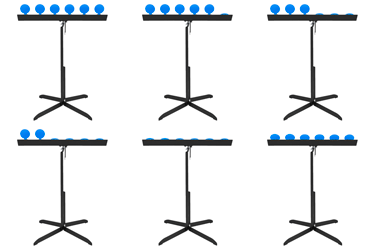
Rimfire Biathlon Target — Tons of Fun RimfireSteel.com offers the unique Rimfire Steel Biathlon Target, a scaled-down Biathlon target designed for use at 50 feet for training and recreational shooting. This is one of our favorite rimfire targets. You can increase the level of challenge by moving it to 25 yards! Watch the video — it shows how to reset the five plates remotely with a lanyard.
Make Your Own Shooting Gallery with Reactive Rimfire Targets
For .22 LR fans, the folks at Action Target have created a whole series of steel rimfire targets. Much lighter than their centerfire counterparts, these rimfire targets are easier to transport and easier to set up. With this wide selection of reactive targets, you can create your own shooting gallery.
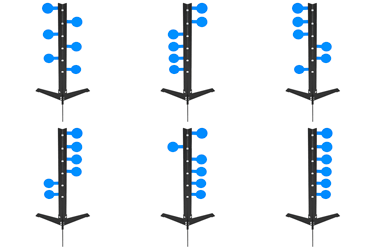
Rimfire Dueling Tree
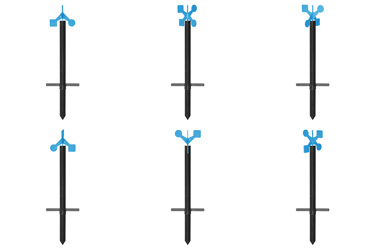
Rimfire Spinning Jack
Rimfire Plate Rack
Rimfire Buffalo
In this video, Michael Bane reviews Action Target’s line of rimfire targets, which includes plate racks, spinners, dueling trees, and more. As Michael explains: “This line of targets is very well thought out. For example — dueling trees are a lot of fun. But a centerfire dueling tree weighs a lot, it’s hard to cart it around. A rimfire dueling tree is easy to set up, easy to carry around.”
New PT Target “Walks” When Hit
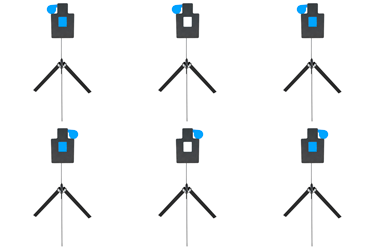
Action Target has just released a new reactive target that doesn’t even need a stand or base. The patent-pending PT Twist rests on the ground, and flops over or “walks” when hit. Constructed from a single piece of 3/16″-thick A514B steel, the PT Twist has no welds or bolts to break or ricochet. Watch the PT Twist in action:
This stunning flame-painted PPC belongs to Chris from Australia. This rifle features a Stiller Viper action, Speedy (Robertson) BRX stock, and Maddco (Australian) 14-twist barrel chambered in 6PPC.
In our Shooters’ Forum you’ll find a thread in which readers can post photos of their “pride and joy” — their favorite rifle. You’ll find a wide range of guns, from “big boomers” to .17-caliber varminters. Here are some of our favorite entries in the “Pride and Joy” Gallery.
The Bear’s Barbed-Wire Barnard
BarryO, aka ‘the Blue-eyed Bear’, posted his beautiful 6mm Dasher, with its unique barbed wire 3D finish. (There’s a story behind that design.) This rifle was smithed by John King in Montana, with stock bedding work by Leo Anderson. The gun features a Barnard ‘P’ action (with trigger), and 28″ Broughton 5C fluted barrel with VAIS muzzle brake. The Barnard sits in a Tom Manners carbon fiber BR stock decorated with amazing graphics by Mad Shadow Custom Paint.
Sebastian’s Radical Swallowtail 6PPC
Sebastian Lambang is the designer and builder of SEB Coaxial Rests. He’s a smart, creative guy, so you knew when he designed a short-range benchrest stock it would be something special. It needed to be lightweight, yet very rigid. Using “out of the box” thinking, Seb employs a truss-style structure to provide great strength with minimal weight. The rear section is equally radical. There are two splayed “keels” in the rear, forming what this Editor calls a “swallowtail” rear design. Others have called it a “catamaran buttstock.” Below is a side-view of the prototype SEB stock before painting.
Brad’s 6CM Long-Range Match Rifle
Chambered in the 6mm Competition match cartridge, this handsome rig features a Surgeon RSR Action, Bartlein Barrel, and LRB stock. Barrel work was done by Chad Dixon at LongRifles, Inc. and paint by AT Custom Painting.
Varmint Special with Figured Walnut Stock
Here’s a handsome varminter with a beautifully-figured walnut stock. This is one of three rifles Forum Member Dan Hall posted in the Pride and Joy thread.
A Trio of Pealescent Bench Guns
DixiePPC served up not one but THREE pretty bench rigs, all with pearlescent paint jobs. We’d be proud to own three eye-catching rifles like that. Click the image to see a full-screen version.
Zebra-Skinned Match Rifle
And here is Mark Walker’s amazing Zebra-skin BR rifle. With that wild-looking paint job, this rifle turns heads whenever Mark brings it to the range…
We have used NO-LEAD Cleaner in rimfire benchrest rifles similar to this modified Suhl 150-1. It helped restore accuracy with minimal brushing.
Made by the same folks that created Wipe-Out™, and Carb-Out™, the NO-LEAD Brushless Lead Remover™ really works. Honest. If you are an active rimfire shooter, or if you shoot cast lead-alloy bullets in centerfire rifles and pistols, you should try this product. We now use NO-LEAD in our rimfire benchrest rifles, and in some centerfire guns that receive a steady diet of soft-alloy cast bullets (90%+ lead). (With rimfire guns, you don’t need to use NO-LEAD very often — maybe every 300-400 rounds unless you have a real fouler of a barrel.)
If you’ve got stubborn lead fouling in a rimfire barrel, or on a pistol’s muzzle brake/compensator, you should definitely give this stuff a try. We don’t know how but it does soften lead deposits. The manufacturer says you don’t need brushes, but we found that a bit of brushing (after NO-LEAD application) can help remove more serious lead build-up.
Frankly we were surprised to find a lead solvent that really works. We have tried a half-dozen or more other lead “cleaners” that promise to dissolve lead and most of them, we discovered, are nearly useless. There’s a reason for that, as the lead alloys used in bullets don’t react to typical petrochemical-based solvents. It took the Wipe-Out chemists over five years to perfect a new water-based solution that really does dissolve lead.
NO-LEAD Cleaning Procedure — Read Carefully
NO-LEAD Lead Remover is a clear, red gel that is easy to apply. Just swab it in your bore (or on muzzle brakes) with wet patches or bore mop and let it sit for a few minutes. (The manufacturer says you can leave the NO-LEAD for up to 20 minutes, but that long of a dwell time does not seem necessary with our rimfire barrels.) When it contacts lead it will start to foam and you’ll see that the NO-LEAD solvent turns a pastel pink when it dissolves lead. The pink comes from the formation of lead oxide. After the recommended dwell time, simply patch out the dissolved lead deposits (you can also use a nylon brush for stubborn lead build-up).
NOTE: After cleaning, it is very important that you get all the NO-LEAD out of your barrel, and neutralize it. We recommend following the application of NO-Lead with Wipe-out or Patch-Out to neutralize the NO-LEAD, clear the bore, and remove residual carbon and copper fouling. If you don’t have Wipe-Out or Patch-out, flush the barrel thoroughly with Rubbing Alcohol or even a solution of Dawn dish detergent — then re-oil the bore.
Be Sure to Neutralize NO-LEAD After Use
Remember that N0-LEAD is a strong, slightly acidic chemical that needs to be neutralized after use. If you leave it on a nice, blued barrel for too long, it can harm the bluing. NO-LEAD will remove all the surface oils from the barrel bore. For this reason it is recommended that you neutralize NO-LEAD with Wipe-Out, or Patch-Out, which both contain effective corrosion inhibitors. If you don’t have those products, once you’ve flushed the NO-LEAD with something like rubbing alcohol, then follow with a gun oil. Caution: A petroleum-based gun oil will NOT, by itself, neutralize NO-LEAD. You need to neutralize first, then apply the corrosion inhibitor (or do it all in one step with Wipe-Out or Patch-Out).
Where to Buy NO-LEAD Lead Remover
NO-LEAD Lead Remover costs $15.99 for an 8 oz. squeeze bottle with a flip-top spout. This product is sold directly by Sharp Shoot R Precision Products, www.Sharpshootr.com, or you can purchase NO-LEAD through many other online vendors. For more information, send an email via the Sharp Shoot-R Contact Form or or contact Sharp Shoot-R at (785) 883-4444. You can ask for Terry Paul, Sharp Shoot-R’s owner and the master chemist who developed the NO-LEAD formula.
Here are five Peterson .308 Win casings after 32 loading/firing cycles (31 at SAAMI max). The brass remained intact, with no cracks. The circles below the shoulders are markings from pressure testing.
Recently Peterson’s ballistician had some extra time in his schedule, and asked what he should work on next. He was told, “Just for the heck of it, see how many times you can fire our .308s before you experience failure.” So that’s what he set out to do.
He took five casings out of inventory and loaded them at SAAMI max pressure, which is the pressure we use for all of our longevity testing. It is a hot load, and he did the firing out of Peterson’s Universal Receiver. This way he could measure pressures and velocities each shot. He shot all five, 20 times. (It takes a long time to do that. Load five casings. Shoot five times. Back into the lab to reload, back into the indoor range to shoot, back into the lab, and so forth.)
After 20 firings with no sign of case deterioration, Peterson’s tester asked if he should keep going. “Sure, let’s see how long these can go”, was the reply. So he shot them five more times. Same result. All casings still in good shape. We told him to keep going. He shot each of them six more times. At this point each of the five casings had been fired 31 times. After several days of this the casings were still in good shape but “ballistician fatigue” was setting in. Finally he said, “Let me take these cases to an outdoor range and see how they do for accuracy.” The Peterson team agreed.
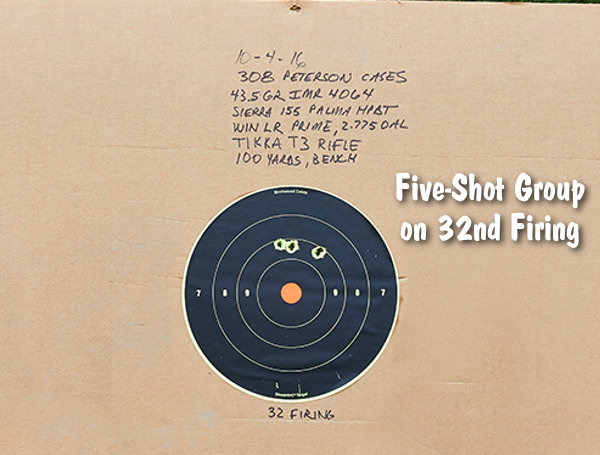
Five Shots at 100 Yards after 32 Load Cycles:
For the 32nd firing, the cases were loaded with a somewhat lighter load, and then tested for accuracy. The test rifle was a Tikka T-3 bolt action, with a 20 inch, 1:11″-twist barrel. After 32 firings the primer pockets had opened about 0.002″ (two-thousandths) but were still tight enough for further use. There were no cracks or signs of head separation. The tester put five shots in three holes at 100 yards. The group was 1.5 inches for the five shots, on a somewhat windy day.
Story Tip by EdLongrange. We welcome reader submissions.
Forum member Rick from Louisiana (aka RMulhern) has rigged up a fantastic target for long-range shooting. Rick, a long-time competitive Palma shooter, had a large 72″x72″ steel target fabricated with two separate center rings that are equivalent to the official paper Palma/Creedmoor target. He says he’s “shot a lot of Palma on that target, as well as lots of Black Powder Cartridge (BPCR) rounds”. The big steel target works great when Rick shoots his Sharps 45/110 BPCR at 800 to 1000 yards. The large steel background (painted white) helps Rick see and hear his hits. If you understand the high-arching trajectory of 500+ grain projectiles shot from a 45/110, you know it can take a few rounds to get Point of Impact dialed in.
Rick reports: “These are two of my favorite rifles to shoot: a M1874 Shiloh Sharps in caliber 45/110 (2 7/8) made in Big Timber, Montana by Kirk Bryan and family. The other is a 6.5×47 Lapua on a blue-printed M700 action with 1:8.5″-twist Krieger barrel and F5 McMillan Tactical stock. Many of the shooters that take up BPCR have a tendency to get away from their smokeless powder rifles in favor of the blackpowder game. Frankly I have the best of both worlds as I enjoy shooting both (smokeless and BPCR), although I must admit that I probably spend the majority of my time on the range with the Sharps rifles these days.” (Rick’s pretty good with his Sharps by the way — he recently shot a 95, 96, and 100 (clean) for 3×10 shots at 800 yards.)
Gongzilla: $1000 Worth of Steel with Three Plate Layers
Rick tells us: “Here’s the deal — everything is steel! The large plate is 72″x72″ and the black bull is 44″ diameter. The 20″-diameter central white bull is made from 1/2″-thick AR400 bull-dozer plating. That’s the same size as the regulation Palma/Creedmoor paper target. The white square and black bull are 3/8″-thick mild steel. Plates are off-set 2″ from each other. I welded a 2″ length of square tubing to the back of both plates and the bolt slides through and is attached to the large plate. I used 2 3/8″ upset tubing (oil field pipe) for the holder framing.” Rick says he invested about $1000.00 in metal for the target, but that was 15 years ago. Today the steel would be much more expensive.
Rick says the AR400 armor plate in the center bull is very strong: “You can shoot a .338 Lapua Magnum at 200 yards and it won’t damage the center bull”. The mild steel works well for the cast bullets Rick uses with his Sharps 45/110. Also, Rick says the mild steel is rugged enough for 6.5mm and .308 hollowpoint match bullets, if you’re at least 500 yards away. However, Rick told us, “If I would make [the target] again, I would make the black bull AR400 as well. [That way] you would never have to worry about big dents or beating the plate up at any distance. The AR400 is very tough steel. You can shoot a Sierra or Lapua HP bullet and they will just splatter.”
Rick told us: “I built this target with off-set clanger plates. The white clanger is AR400. Bullets just splatter!” Does he worry about hitting the bolt head? Not at all. Rick says: “When I hit the bolt head, I break my arm patting myself on the back!”.


 Need a top-notch Ballistics App for your iPhone, iPad, or iPod? Start with Ballistic AE, the number 1 (i.e. most installed) App for iOS systems. Ballistics AE (Advanced Edition) is the most popular iOS ballistics program for many good reasons. Full-featured and easy to use, Ballistics AE has been refined over many years, and it supplies rock-solid solutions derived from JBM Ballistics solver (created by James B. Millard). Unlike some other Apps, Ballistics AE is STABLE on iPhones (with various OS levels). What’s cool is that Ballistics AE is now on sale for $12.99.










 Made by the same folks that created Wipe-Out™, and Carb-Out™, the
  Where to Buy NO-LEAD Lead Remover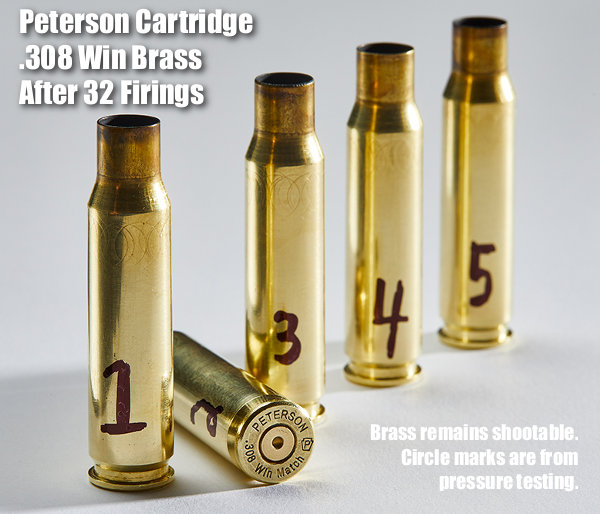

 Forum member Rick from Louisiana (aka RMulhern) has rigged up a fantastic target for long-range shooting. Rick, a long-time competitive Palma shooter, had a large 72″x72″ steel target fabricated with two separate center rings that are equivalent to the official paper Palma/Creedmoor target. He says he’s “shot a lot of Palma on that target, as well as lots of Black Powder Cartridge (BPCR) rounds”. The big steel target works great when Rick shoots his Sharps 45/110 BPCR at 800 to 1000 yards. The large steel background (painted white) helps Rick see and hear his hits. If you understand the high-arching trajectory of 500+ grain projectiles shot from a 45/110, you know it can take a few rounds to get Point of Impact dialed in.


