A few years back our friend Danny Reever acquired the PMA Action Cleaning tool. He’s now used it for many seasons and it’s still working great. If you shoot a precision rifle, it deserves to have a clean action and lug recess area. This handy tool speeds up the cleaning process, letting you do a more thorough job in less time.
PMA Action Cleaning Tool Kit Review by Danny Reever
I’ve been using the PMA Action Cleaning Tool Kit for quite some time. Previously, I used one of the old style (round knob) Sinclair action-cleaning tools with cylindrical cotton rolls. With the Sinclair tool, I was pretty satisfied that I was getting my actions reasonably clean. But, as I explain below, I think the newer PMA Action Cleaning Tool Kit is easier to use, and possibly achieves better results.
PMA Tool Kit Extensively Tested with Many Action Types
PMA tried a variety of options before finalizing the PMA Action Cleaning Tool Kit. PMA explains that several shooters did a lot of testing “with various sizes of die-cut foam, patches, felts and cotton rolls with various bolt action types (BAT two- and three-Lug, Kelblys, Halls, Remingtons, Winchesters and Savages). [Testers all agreed] that the foam disc is far superior to felts and cotton rolls [and] we decided to include two different sizes of foam discs.”
The PMA Action-Cleaning Tool uses round foam discs in two included sizes: 1″ diameter and 1.25″ diameter. Both size discs can be used alone, or with a 3″ patch wrapped around them. The handles of the tools are CNC-machined blue-anodized aluminum with a silicone sleeve for grip. The PMA tool handles are a bit longer than those of my old Sinclair action-cleaning tool. I like the added handle length, and I find the design of the handle easier to use compared to the old-style round knobs.
The PMA tools are quality items. They are an improvement over my older Sinclair action-cleaning set-up. But do the PMA tools they actually clean the action better or easier than the old style cotton rolls? Well, based on my experience, the answer is a definite “maybe”.
Comparison Testing — Cotton Rolls vs. PMA Foam Discs (with and without patches)
Starting with the old-style cotton roll system, I cleaned my actions to a level I considered “clean” in the past. I then tried the included PMA foam discs. I found that, for my Remington-style actions, the larger 1.25″-diameter disc seemed to work better than the smaller 1″-diameter disc. Wrapping the larger disc with a 3″ patch definitely brought out more crud from my previously cleaned actions than the old style cotton rolls. Well, you might ask, what if you wrap the old-style cotton roll with a patch? Yes that will remove more crud too, but perhaps not as much as the PMA system. Moreover you would have to buy both cotton rolls AND 3″ patches. Not many places sell the cotton rolls.
Is it worth plunking down the $49.95 for the complete PMA system? Well, if you want to upgrade to a quality-made tool with better handles the answer is yes. Is getting that last bit of crud out of your action every time you clean it that important to you? You have to decide that for yourself. From my own perspective, I was due for an upgrade so the answer was easy. I like the PMA system, especially the new improved handles. Also, with the PMA system I don’t have to fool around with a tiny Allen screw to secure the cotton rolls — that was annoying. So my final take on the PMA Action Cleaning Tool Kit is that it is a good product with some real advantages over other action-cleaning systems.
PMA Tool charges $49.95 for the complete Action Cleaning Tool Kit that includes a chamber cleaning handle and cotton swab. PMA offers the lug recess action cleaning tool by itself with four foam cleaning discs and five 3″ patches. Cleaning discs are also available separately in your choice of 1″- and 1.25″-diameter in a five pack.
Here’s a cool product that can help you level your front rest and rear bag, level your scope, align your target frame, and perform a myriad of tasks around the house. The Digital AngleCube (aka Electronic Level and Protractor Gauge) is basically a high-tech level that gives you exact angular read-outs to within 0.2 degrees. That’s a lot more precise than any bubble level.
Numerous Shooting-Related Applications
For you position shooters who like to run angled sights, this tool will help you set the rear sight and front tower to exactly the same angle. For High Power guys with 3-way and 4-way adjustable buttstocks, this digital angle gauge can help you quickly and precisely set buttstock angle and cast-off. Even tactical shooters and long-range hunters can use this device to confirm exact shot angle, with greater precision than a plastic protractor or even an expensive Angle Degree Indicator (ADI). Heck you can even use the thing as an anti-cant device (if you don’t mind the extra weight). We’re sure that our clever readers can find even more uses for a digital angle read-out tool.
The AngleCube Digital Level sells on Amazon.com for $29.95. It comes with magnets on the sides so you can attach the tool to any ferrous metal surface for a “hands-free” reading. You can find similar devices in hardware and home improvement stores. One of these square, magnet-equipped electronic protractor/levels is made by INSIZE. The illustration below shows how the INSIZE gauge can be used in the field.
We liked (and used) Lyman’s Digital Trigger Pull Gauge before, and now it’s even better. Lyman has updated its pull gauge to be faster and more precise. The new gauge measures trigger pull weights from 1 ounce to 12 pounds with resolution of 0.1 ounces (2.8 grams). We think that anyone running match triggers below 2.5 pounds pull weight should have a gauge like this. Among the pull gauges on the market, we think the new Lyman unit now offers the best performance for the price — this gauge has a $59.95 MSRP, and expect to see it for under $50.00 when it is available. We like the new adjustable, 4-position rod which retracts into the gauge body.
Upgrades: More Precise Strain Gauge | Improved Grip Shape | Adjustable Rod Lengths
Lyman’s new, improved Electronic Digital Trigger Pull Gauge is designed to be the fastest and most accurate trigger pull gauge available. State-of-the-art strain gauge technology allows for repeatable accuracy of 1/10 ounce (2.8 grams). The gauge features a large, easy-to-read LCD display and you can switch from ounces to grams with the push of a button. The gauge can also deliver a pull weight average of the last 10 readings. That’s very helpful, particularly when working with factory triggers that may not be very consistent.
The new model Trigger Pull Gauge features a solid, collapsible rod with four locking positions. Being able to adjust length makes it easier to use the gauge with a wide variety of firearms. The locking feature prevents the rod from flexing when applying pressure to the trigger. When not in use, the rod conveniently collapses into the gauge body, making the whole unit more compact. The new Trigger Pull Gauge comes in an internally-padded plastic case that can be easily stored in a drawer or on your work bench. The old-style Lyman gauge (shown below) had a limited rod-length adjustment range, and the rod needed to be removed to store the gauge in its soft case.
Wouldn’t it be great if you could quickly and easily adjust shoulder bump during the full-length sizing process, without struggling to move die lock-rings by trial and error (or fiddle with shims). Well you can. The PMA Micro Die Adjuster is a brilliant little device that replaces the lock ring on your FL sizing die. It allows you to move the die up and down in precise, tiny increments. The tool has .001″ index marks, but you can easily set your die between the marks to achieve .0005″ (half-thousandth) adjustments.
To see how the PMA Micro-Die Adjuster works, watch this video by our friend Boyd Allen:
Many of our Forum members now use the PMA Micro Die Adjuster, and they give this specialty tool high praise. Here are actual reviews by Forum members and other verified tool buyers. Read more comments in this AccurateShooter Forum Thread.
PMA Micro Die Adjuster User Reviews
“No more ‘close enough’ for headspace[.] With this tool set-up it’s easy to put headspace exactly where you want it, then repeat it exactly for subsequent batches for the same cartridge.” — JohnF
“I have four of these Micro Adjuster rings and all I can say is that it works and it is repeatable. I bump my brass .0005″-.001″ and this die lock ring will do it without issue.” — TrapperT
“I size brass for four different 6.5×47 rifles (chambered with three different reamers) using a single die, set in the PMA Adjuster. I have to say… I should have bought one sooner. Adjusting it is very quick and repeatable to well under .001.” — /VH
“I’ve been using PMA’s lock ring for some time now and find it to be very easy to adjust to within .0005″ on a single piece of brass. Very quick to do as well. One thing I have found is that if you still need that half-thou adjustment I will run the brass once more at the same setting before I make that .0005″ adjustment and 50 percent of the time that does the trick. The marked increments are in .001″ scale so if you go half way in between there’s your half-thousandth.
PMA Micro-Adjuster vs. Shims
Many hand-loaders have abandoned shims after trying the PMA Micro Die Adjuster:
“Shims [require] you to completely remove the die. That gets old rather quickly after having used the PMA adjustable lock ring.” — Patch 700
“Great product. Shims used to drive me crazy, put a .002 in and get .0035 of change. With this if you want .0015 set it and that’s what you get.” — John B
“I like mine — adjustments are easy and it will adjust very fine. I used to use .001″ shims. Now can adjust my bump as fine as I want.” — Joe139
Product Description from PMA Tool
The PMA Tool Micro Die Adjuster (MDA) replaces your existing lock ring and can be used with nearly any 7/8-14 full length sizing die. We successfully used this tool with sizing dies from Redding, RCBS, Hornady, Lee, Harrells Precision and those made from Newlon Precision die blanks. It allows you to easily make adjustments to your “shoulder bump” as fine as .0005″. The engraved marks on the MDA are equal to approximately .001 inches (true adjustment .000992″) of adjustment to the shoulder bump. Splitting the engraved marks is therefore approximately equal to .0005″. The design of the MDA does not allow it to work with the Forster Co-Ax press. Some custom dies for very short cartridges may require the use of an extended shellholder. Micro Die Adjuster shown in use installed on Custom Newlon/Scott 6mm PPC Die and Harrells Precision Compact Press.
Every serious shooter should have some kind of anti-cant device fitted to his or her rifle. When you tilt your rifle to one side or the other from shot to shot, even a little bit, this can alter your point of impact. Unless the direction and angle of tilt (or cant) is exactly the same for each shot, canting your rifle will open up your groups. And the effects of inconsistent cant* become more extreme the farther you shoot. READ MORE about rifle canting.
Jackson Hole Shooting Experience Instructional Video features scope-mounted Wheeler level.
In this video, Bryce Bergen of Long Range Shooters of Utah explains the key reasons you should fit a bubble level (anti-cant device, ACI) to your rifle. Bergen explains why inconsistent canting alters impact at long range. Bergen also offers tips on mounting your anti-cant device and working with bipods.
You don’t need to spend a lot of money on your bubble level. While there are fancy levels that cost more than $130.00, you can get a functional level for a tenth that cost. This Discovery scope level is CNC-machined to close tolerances for a good fit. It is available with three diameters to fit scopes with 1″, 30mm, or 34mm main tubes. The 1″ version is just $12.99 while the 30mm model is $13.95 and the large 34mm version is $15.95. This unit will do the job, and user reviews are very positive.
Scope-Mount Vs. Rail-Mounted Levels
Some “experts” recommend a scope-mounted bubble level rather than a rail-mounted level. The reason is that you can easily orient the position of a scope-mounted level. With the scope’s vertical cross-hair aligned with a plumb line, simply rotate the bubble level mount until the bubble is centered. It’s not so easy to adjust a rail-mounted level. If your rail is slightly off, or if the rail-mounted anti-cant device doesn’t sit perfectly horizontal when clamped on the rail, the bubble may not center in the view port.
Combo Anti-Cant + Angle Degree Indicator System Flatline Ops sells a smart, scope-mounted leveling device with an optional vertical Strong Arm™ accessory for mounting an Angle-Degree-Indicator (ADI), which allows the shooter to make quick “true range” corrections for up-angle and down-angle shots.
As a combined unit, the Accu/Level™ (fitted with Strong Arm and ADI) is a great set-up for the tactical shooter or long-range hunter. The bubble level rotates inward for protection, then kicks out to the left for easy visibility. The ADI is held in plain view on the left, under the bubble level. On LongRangeHunting.com, Jim See explains how the Accu/Level works in the field and how he employed the ACI during a hunt. CLICK HERE for Accu/Level™ Field Test.
We like the combined Level + ADI system that Flatline Ops has developed. But it is very expensive: The 30mm Accu/Level™ costs $139.99 and the Strong Arm (for ADI mounting) is $58.99. So you’ve got two hundred bucks invested before adding the $110.00 ADI. That’s a significant chunk of change that could be invested in your scope instead.
* By itself, canting the rifle does not hurt accuracy as long as the angle is exactly the same for every shot. Many sling/irons shooters, including David Tubb, cant their rifles. With scoped rifles, if you do prefer a cant, you should mount the scope so that the cross-hairs are plumb with your rifle at your preferred cant angle. You want that vertical cross-hair straight up and down always. The key is to never change the cant of your rifle from shot to shot.
The new SEB Mini joystick (coaxial) pedestal rest has been a huge success. Sebastian (“Seb”) Lambang’s SEBRests.com team is shipping these out worldwide to meet demand. The great thing about the Mini is that it folds up into a small package, making it much easier to transport than a conventional coaxial front rest such as the Seb NEO or Farley. Shown above is an army of Minis getting ready to conquer the world (well at least the world of shooting).
Even though the Mini is compact and relatively light weight, it is very stable and gives up very little in performance to a full-sized joystick front rest such as the SEB NEO. At the Berger SW Nationals last month, our Systems Admin Jay Christopherson used a SEB Mini. Jay finished Second in F-Open Class just one point behind winner David Gosnell, thereby proving the SEB Mini is “competition ready”.
Jay reports: “I’m glad I had the SEB Mini — it worked great and was much easier to transport and carry from position to position.” Here’s a short video of Jay using the SEB Mini to drill a string of Xs with his .284 Winchester F-Open rifle.
New Carry Bag for SEB Mini
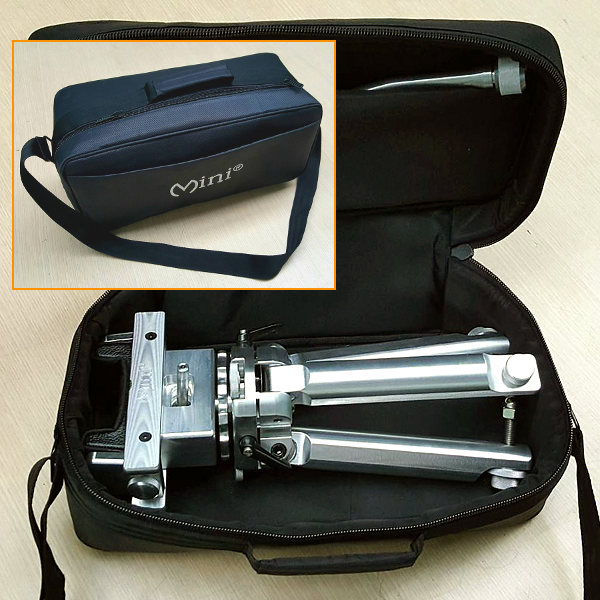
With the success of the SEB Mini, Seb Lambang has already started designing some new accessories. Here is a prototype carry package, the Mini Transporter. You can see this compact bag will hold a Mini even with big F-Class feet attached. Seb says: “I’m experimenting with soft case for Mini rest… Your thoughts?” We think Seb should certainly offer this case for sale. Post your thoughts in the comment section below.
SEB Mini with large disc feet attached still fits in bag.
Flat-bottomed stocks are great for benchrest shooting, but their geometry is not ideal for mounting conventional Harris bipods, which were originally designed for stocks with a curved underbelly. Long-time Forum member Mark S. wanted to know if there is a way to make a stud-mounted bipod more secure on a flat-bottomed stock: “I have started shooting some steel matches that require shooting from bipods. My best gun for the job is a 6BRX in a MBR benchrest stock. I have installed a stud, but the bipod is still wanting to turn sometimes. What do you use?”
Here’s a solution for Mark and others using Harris bipods on flat-bottomed stocks with studs. Get the Harris-made #9 (HB9) adapter. Costing just $22.12 (at Midsouth), the HB9 adapter provides an extended contact surface with pads, so the bipod will fit securely on your flat fore-end.The HB9 adapter also has a center cut-out for the swivel stud so the bipod adapter aligns properly on the underside of your stock:
Ed Connors placed three consecutive shots all on target at 2160 yards for a sub-3/8 MOA group. Wow.
Amazing shooting — that’s how we’d describe what Ed Connors accomplished recently with his Speedy-built .338 Lapua Magnum LR rifle. Ed nailed a 3-shot group at 2160 yards that would be great at 1000 yards. Check out the target above. Now consider that the shooter was a full mile PLUS 400 yards away. That is truly remarkable accuracy.
At this distance, 2160 yards, one MOA is 22.61″. This three-consecutive-shot group, measuring about 8 inches, works out to less than 3/8 MOA. Think about that — most guys would be elated to shoot 3/8 MOA at two hundred yards. Ed did that at over two thousand yards!
That takes a great rifle, as well as great ammo. Ed says: “I believe in loading like a benchrest shooter to achieve these ultra long-range shots”.
Gunsmith Thomas “Speedy” Gonzalez writes: “Anytime you build a customer a rifle to work out beyond the 1000-yard mark you must work hand-in-hand with your customer and explain everything you are doing to ensure performance at distances most shooters never even contemplate (except in their dreams).
Ed was involved in all aspects of the projects from the reamer print to what we needed for both single-shot work and mag-fed function in timed competition. This was Ed’s very first work-out with his reborn Surgeon-actioned .338 Lapua Magnum. He did great to say the least!”
Pretty Darn Good at One Mile as Well…
While “tuning up” for his 2160-yard session. Ed also produced some very impressive results at one mile (1760 yards). Once he got “dialed in” he delivered three shots you can cover with the palm of your hand. That’s spectacular consistency at one mile.
.22 Plinkster runs of the most popular gun-centric YouTube channels. His videos have been watched by hundreds of thousands of firearms fans. Many of .22 Plinkster’s videos involve trick shots, such as shooting a .22LR through 100 balloons, but he also does serious reviews. He’s actually a very competent marksman who has shot a vast collection of .22 LR/22 WMR pistols and rifles, making him a qualified rimfire expert (as well as a trick-shot artist and showman).
Here are Four of our Favorite .22 Plinkster Firearms Reviews:
Savage A22, 22 Magnum (WMR) Rifle Field Test
The Savage A22 is the .22 WMR “big brother” to Savage’s popular A17 17 HMR rifle. In this video, .22 Plinkster demonstrates that the A22 is a very reliable semi-auto that can deliver near-1 MOA accuracy when the barrel is clean. This rifle retails for about $390.00.
Smith & Wesson Model 41 .22 LR Pistol Review
The S&W Model 41 is a classic American rimfire target pistol. Beautifully crafted, the Model 41 boasts a superb trigger, comfortable grip, and excellent accuracy. New or used, a Model 41 would be a fine addition to any firearms collection.
Volquartsen Scorpion .22 LR Pistol Review
The Scorpion demonstrated exceptional accuracy in the hands of .22 Plinkster. It comes with a large target-style grip. With a built-in compensator, the Scorpion stays on target with almost no muzzle rise. The comp can be easily switched out with a suppressor (See video at 3:00 time-mark).
S&W Victory Vs. Ruger Mark IV Pistol Shoot-Off
.22 Plinkster liked both pistols. He favored the grips on the Ruger while preferring the S&W’s trigger. He felt the Ruger’s iron sights were best for precision work, but he noted that the green dot fiber optic sights on the S&W Victory worked better for speed work.
The CMP and NRA now allow magnified optics (up to 4.5X max power) in service rifle matches. You can spend thousands on a high-end scope for your AR, but you just might find that a much cheaper optic will do the job. Right now Amazon has a killer deal on Bushnell’s 1-4x24mm riflescope with 0.1 Mil clicks. The Drop-Zone BDC reticle features hold-over points calibrated for .223/5.56 55-62 grain ammo. That’s a bonus for 3-Gun and tactical matches. When shooting heavier, higher-BC bullets in service rifle matches, you’ll still want to click up and zero at your target yardages.
Amazing Deal Now at Amazon.com
Right now at Amazon.com, you can get this 1-4x24mm Bushnell for just $111.99 with free shipping. That’s a steal — this scope sells elsewhere for up to $155.00. And actual scope owners tell us that this very affordable 1-4x24mm Bushnell holds its own vs. competitive optics costing 3-4 times as much. Read the reviews for yourself below …
Reticle
Second Focal Plane, Drop Zone-223 BDC Ballistic Reticle calibrated for 55-62 grain, 223 REM/5.556 loads with aiming points out to 500 yards.
Specifications
Turrets: Target, 0.1 mil click value
Tube Diameter: 30mm
Weight: 16.9 oz.
Length: 9.5″
Eye Relief: 3.5″
Exit Pupil (mm): 13.1 at 1x / 5.2 at 4x
Adj. Range: +50 inches at 100 yards
Finish: Anodized Aluminium Matte
Here are reviews from actual, verified scope purchasers:
“The scope is solid and the fit and finish is excellent. The BDC reticle is very clear and the scope stays focused when changing the magnification. The glass is very clear and the light transmission is better than my Vortex Viper. The windage and elevation turrets are precise and not mushy. At a local gun store I compared this scope to a much higher-priced M223 Nikon and a Leupold. The clarity was similar and the light transmission was actually better in this [Bushnell] scope. The only noticeable advantage the higher-priced scopes had was they weighed less. The best eye relief for my setup was four inches without any noticeable parallax.” — Dave K.
“Doesn’t have the fanfare of putting a Trijicon on your rail (doesn’t have the associated price tag either) but pound-for-pound I bet this bad boy would last in a head to head against the more expensive names. I’ve used it in snowy and rainy conditions, as well as more favorable and it has proven reliable. Great view, fast acquisition, and a fair price. Highly recommended for any AR build.” — WarriorSeries
“I gave this a 5-Star rating because for the same price you will NOT find a better scope! The build quality is solid, the lens are clear, and after 200 + rounds it stayed true. I mounted mine on a Ruger AR-556 with a Burris AR PEPR 30mm mount. Zeroed in a matter of minutes at 100 yards, then was shooting 200 yards, then 300 yards, and 500 yards with no issues. And props to Bushnell for the reticle in this scope! It worked … and made shooting 500 yards a breeze! If you want a good scope for an excellent price this is the one to buy.” N. Bates




 Flat-bottomed stocks are great for benchrest shooting, but their geometry is not ideal for mounting conventional Harris bipods, which were originally designed for stocks with a curved underbelly. Long-time Forum member Mark S. wanted to know if there is a way to make a stud-mounted bipod more secure on a flat-bottomed stock: “I have started shooting some steel matches that require shooting from bipods. My best gun for the job is a 6BRX in a MBR benchrest stock. I have installed a stud, but the bipod is still wanting to turn sometimes. What do you use?”


