SHOT Show in Las Vegas is just two weeks away. Here are some of the interesting new products that will debut at SHOT Show. You can find these items and hundreds more new-for-2016 products at the SHOW Show New Product Center.
The Newcon Optik Spotter LRF is a combined spotting scope and laser rangefinder — the first of its kind. This unique piece of equipment integrates a Newcon Optik Laser Rangefinder with a 15-45X Spotting Scope with etched mil-dot reticle. Newcon Optik claims a 5500m maximum range for the LRF. The integrated scope/LRF is housed in a rugged yet light-weight MIL-SPEC housing. We like the idea of a combined Spotter/LRF. Will other companies try to copy Newcon Optik’s innovative design?
Mason Target Systems — AR500 Steel Target With Shot Sensor
The MTS Target System “Pescadero” unit combines a rugged AR500 steel target with a durable electronics and sensor package that allows shooters to view their shots on a mobile App. With on-board power and wireless communication technology, the system will display shot location to the shooter positioned hundreds of yards away. So you can hear the “ding” of steel and then see your exact shot location on your smart phone or tablet. To aid aiming, the Pescadero target can mount self-healing polymer targets to the AR500 steel plate. Visit MasonTargetSystems.com for more information.
Schweitzer Optics — First-Ever Double FOV Scope
Here is a very innovative new hunting scope that actually displays a 3.5 X view AND and 1.0 X view simultaneously. Schweitzer claims this is the first and only double Field of View (FOV) sports optic in the world. This innovative optical technology doesn’t come cheap — Schweitzer’s Eagle Eye 3.5 dual POV scope retails for $2500.00.
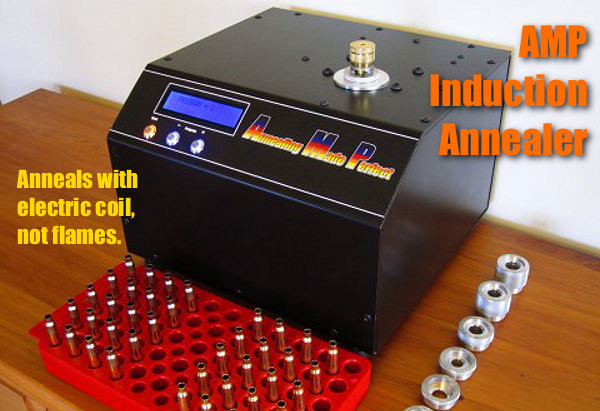
Annealing Made Perfect — Induction Annealing Machine
No more flaming torches (and burned fingers). The AMP Annealing system anneals through electrical induction. This micro-processor controlled, precision-calibrated induction annealer provides exact and repeatable neck hardness. With the various AMP-made pilot inserts, the machine will handle popular cartridge types from .17 Caliber all the way up to 460 Weatherby. Anneal times are pre-programmed for optimal results.
Accu-Tac — SR-5 Tactical Bipod
The Accu-Tac SR-5 Bipod is crafted from high-quality billet aluminum. The SR-5 mounts quickly and securely to a 1913 Picatinny rail. The bipod’s wide stance provides good stability. Ratcheted leg extensions adjust to five different heights, and then retract quickly with a one-button retraction lever. Legs can be deployed in a conventional 90-degree orientation, or at a 45-degree angle either forwards or rearwards.
Lyman Products — Cyclone Rotary (Wet) Tumbler
Lyman is introducing a new Rotary Tumbler for 2016. Designed for use with stainless (pin-type media) and liquid, this Cyclone Tumbler gets brass thoroughly clean inside and out. The large capacity drum holds up to 1000 pieces of .223 Rem brass and features a rubber lining to protect brass and greatly reduce operating noise. The included two-piece sifter pans make separating cases and pins easy.
Swiss+Tech Products — Tac20 Firearms Multi-Tool
This new multi-function gun tool contains 4 driver bits, 2 Torx drivers, 2 Allen drivers, gun pin punch, sight wrench, castle nut wrench, flat screwdriver, bottle opener, knife, and LED flashlight. It even contains a fitting with a male thread connection for attaching cleaning rods. That’s clever. All totaled, the Tac20 multi-tool offers 20 features — that’s a lot of functionality in a small, compact package from Swiss+Tech Products.
Hearing loss is a terrible thing. Protect your hearing while you can. Permanent damage can occur in a single shooting session. For maximum protection, we recommend that you “Double up”, i.e. wear ear plugs under muffs. Between shooting, riding motorcycles, and working with gas-powered yard equipment, your Editor probably has foam plugs in his ears 8-12 hours a week. I’ve tried many different varieties of ear plugs, both the foam variety and the soft plastic flange-type plugs.
I now favor the Howard Leight MAX-1 plugs. Rated at NRR33, these are, quite simply, the best ear-plugs I’ve ever tried. No BS — these things really work. Among all disposable plugs I’ve tried, the MAX-1s are definitely the most effective at blocking noise, and they are also more comfortable than most other foam plugs I’ve used. In my experience at the range, these plugs block sound way better than most muffs (when worn without plugs underneath).
The first thing I noticed about these plugs is how much more effective they were than muffs alone. With muffs in place, a rifle report is still quite audible. With the red MAX-1 plugs, the noise from a shot is much, much quieter. Proof of the “real world” effectiveness of these plugs came when talking. The plugs work so well that I had trouble hearing words spoken by a colleague from just four feet away. With conventional (non-electronic) muffs I can hear a normal speaking voice from many yards away.
These MAX-1 plugs insert easily (if you roll them first), and the wide, flared outer bell makes them very easy to remove. Subjectively, these plugs seem more comfortable than most other foam plugs I have tried. They are certainly way more comfortable than the cheap, non-tapered ear plugs. MAX-1 plugs are available in both standard configuration and corded versions. These are cheap to buy — 20 pairs of non-corded MAX-1s cost just $4.85 on Amazon.com. I just bought another 20 pairs today.
These ear plugs deserve all the raves they’ve received. They’re by far the best I’ve used and among the least expensive. They hold up very well when used repeatedly. This is the only brand I’ll buy from now on. — Joe
These things are as soft and gentle as they come and they block the noise out very well. I highly recommend them[.] — Byron
They are the best ear plugs I’ve ever used — and I’ve used many over the years. These are the only ear plugs I will ever use in the future. — Rhoda
PMA Tool now offers a unique “adjustable” Stock Weight System with variable weighting from 2 to 8 ounces (including internal sleeve). This $65.95 system allows the shooter to add or remove weight (in the buttstock) to balance the gun, or adjust the weight to meet class weight limits. Say, for example you were running at max weight but then changed your scope for a new optic that weighed 4 ounces less. With this system, you can easily get back up to the “legal limit”. You can also use the weight to adjust balance when running barrels of different lengths or contours.
The PMA Stock Weight system is made up of a sleeve, a nut and three interchangeable weights. The sleeve and nut weigh 2 ounces (combined) and weight inserts of 2, 4 and 6 ounces are included in the system. The sleeve is machined from aluminum, while the nut and weights are machined from stainless steel. All weights are roll-stamped with their weights and “coin-slotted” so they can be easily installed using a screwdriver or coin. The nut utilizes a 1/4″ hex wrench for removal from the sleeve and installation of weights.
While installation of these Stock Weight Systems is fairly simple, PMA states that: “The sleeve should be installed into the buttstock by someone with some mechanical aptitude and an understanding of stock construction, preferably a trained gunsmith or stock-fitter.”
Product tip from EdLongrange. We welcome reader submissions.
We bolt together bridges and pre-fab houses, so why not gunsafes? It fact there is a modular safe the ships in pieces and bolts together on site. Modular design allows a big, full-size safe to be transported much more easily than a conventional safe (that might weigh 1200 pounds or more). The Zanotti modular safe arrives in sections, none weighing more than 170 pounds. It is assembled in place, then can be dis-assembled when you need to move. The Zanotti is also well-suited for a gun-owner who lives in an apartment up many flights of stairs.
Zanotti Armor safes are ideal for gun owners who need to move frequently or who live in a location where it is difficult to position a conventional safe. Zanotti safes arrive in three or four discrete shipping boxes. The safe is assembled by the owner, on site, in six steps. The heaviest component is the door, weighing 110 pounds in the 16-gun ZAI safe, and 175 pounds in the largest 52-gun ZAIII model. Five safe models are offered, ranging from 350 to 925 pounds assembled weight, without interior. Zanotti safes are popular with military personnel and others whose jobs force them to re-locate often. The safe can be assembled in under 30 minutes with no tools other than a hammer, and all you need is a hand dolly to move any component.
Guns Magazine reports: “The panels are interlocked by 3/8 inch, nickel-plated steel “L” shaped pins that slip into steel tubing sections welded to the interior surfaces of the panels. The slip fit is held to a tolerance of .003 inch, and the safes are completely assembled and hand-fitted at the factory to insure the panels will align properly. The body is made from 1/8 inch and 3/16 inch steel; the door from 3/16 inch steel; the locking bolts are 3/4 inch steel.” This is heavier gauge steel than you’ll find on most conventional gun safes.
Zanotti offers many deluxe interiors including a system of roll-out sliding drawers in the bottom of the safe. We think the sliding drawers are ideal for storing handguns and expensive items such as cameras and binoculars that you want to keep out of plain view. Mark Zanotti, the innovative creator of these modular safes, can also customize any interior to suit the customer’s particular needs.
Editor’s Note: For most applications, a conventional safe is still the best choice. Bolted in place, a conventional safe with welded walls will provide the best security and a conventional safe can provide increased fire protection. Zanotti safes do not employ a separate layer of sheet-rock or ceramic fire lining. The Zanotti is a special product for gun-owners with special needs. The units are well-made and Zanotti offers many nice custom interior features that you won’t find even on much more expensive conventional safes.
To learn more about gunsafe features and fire-proofing, read our Gunsafe Buyers’ Guide.
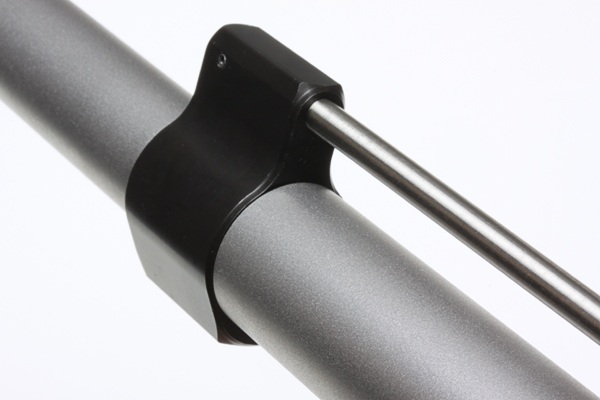
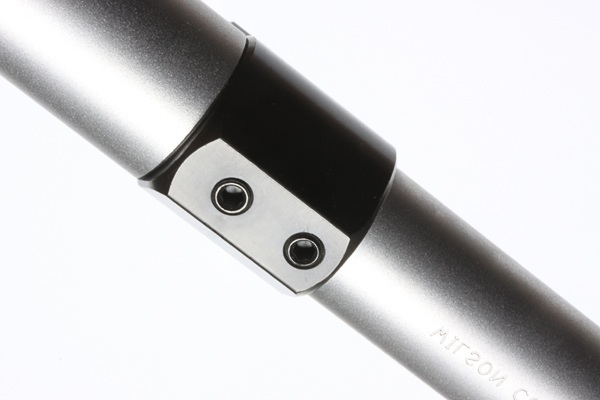
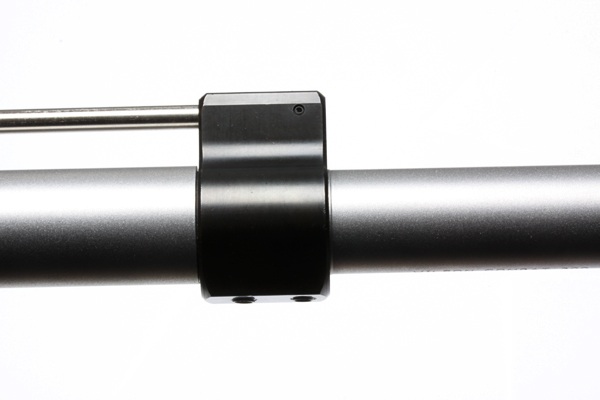
Here’s an interesting $75 product that can help you “tune” the cycling force of your AR-platform rifle. Wilson Combat offers an Adjustable Lo-Profile AR Gas Block for direct gas impingement AR-type rifles. Wilson Combat’s adjustable gas block replaces a standard AR gas block and allows you to tune your AR’s gas system for smoother cycling and enhanced reliability. Wilson Combat explains: “Adjusting your rifle’s gas port will lower or increase your bolt’s cyclic rate. This tailors your rifle’s performance to your unique needs.” When varmint hunting with an AR, we like a less-energetic ejection so the brass lands close to the gun (and doesn’t tag fellow shooters).
A simple adjustment of the hex screw at the front of the block modulates the gas volume allowing you to tune your rifle’s function to your favorite loads. This is very handy when shooting non-standard AR calibers, unusual hand-loads, or suppressed rifles. Adjustable Gas Block systems are sold as complete kits starting at $74.95. Wilson Combat offers two diameters (.750″, .937″) and three lengths (Carbine Length, Mid-Length, & Rifle Length), so you can select the right dimensions for your rifle configuration and barrel diameter. The blocks are Chromoly steel with a Melonited finish.
Package Includes:
Adjustable Gas Block (Melonite Finish)
Adjustment Set Screw (Installed)
Straight Gas Tube (Installed, Gas Tube Pin Installed)
Did you know that Shilen Rifles Inc. offers barreled actions and complete rifles? And that Shilen offers a Savage-style, barrel-nut system for its Rem-clone actions? Starting in 2010, after a hiatus of nearly twenty years, Shilen returned to the rifle manufacturing market. After several years of development, Shilen now offers custom actions ($950.00), barreled custom actions with triggers ($1500.00), and complete rifles ($3200.00 and up). Call (972) 875-5318 or email comments [@] shilen.com for more information. NOTE: An 11% Federal Excise Tax is due on complete rifles.
The new Shilen custom actions are CNC-milled from high-grade stainless steel. Two types are offered — the multi-shot DGR (Repeater) or the single-shot DGV (Varminter) action. Both actions are offered in most common bolt faces and both right-hand and left-hand actions are immediately available. The DGR and DGV actions have a 1.350″ diameter with 8-40 scope base mounting screw holes, and an 0.300″ pinned recoil lug. The spiral-fluted bolts feature a floating bolt head with an interchangeable bolt handle knob. These actions feature a footprint similar to the Remington Model 700. Both DGR and DGV actions will accept many aftermarket components crafted for Rem-700 style actions, including triggers and bottom metal.
Barreled Actions with Barrel-Nut System for Easy Barrel Exchanges
Along with the stand-alone DGR and DGV actions, Shilen is offering barreled action assemblies, chambered and ready to drop into Rem 700-inletted stocks. The actions are fitted with Shilen match-grade barrels and Shilen triggers. The barrels feature a 1-1/16″x20 barrel thread and are attached to the action by a barrel nut. This Savage-style barrel nut system simplifies headspacing, allowing easy swapping from one barrel to another. With the simple barrel-exchange procedure, you can shoot multiple chamberings with a single action/rifle. For example, shooters can change from a .223 Remington to a .204 Ruger or a .22-250 to a 6mm BR in a matter of minutes.
Complete Rifles with McMillan Stocks
With Shilen’s complete rifles, buyers can choose their chambering, and select barrel and stock configuration. Shooters can choose between a sporter weight wood stock or a variety of McMillan fiberglass stocks. With all complete rifles, the entire package is delivered in a quality gun case and Shilen even includes table mat, cleaning rod, bore guide, jag, bore brush, and cleaning patches.
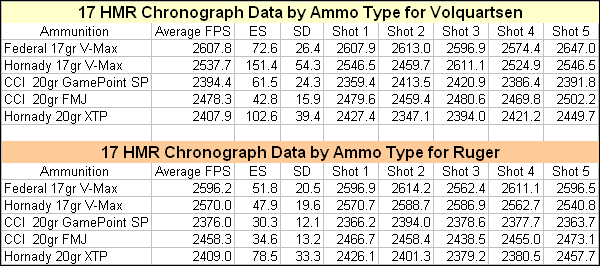
If you’re thinking about acquiring a 17 HMR rifle, you should read the 17 HMR Two-Gun Comparison in our Gun of the Week Archives. This two-gun shoot-out compares the performance of a Volquartsen 17 HMR semi-auto and a Ruger 77/17 bolt-action. Glen Robinson, the owner of both rifles, has done some serious comparison testing with both guns, trying out a half-dozen varieties of 17 HMR ammo. The overall results may surprise you. The semi-auto out-shot the bolt gun by a significant margin, with all types of ammo tested.
Comparing the Qualities of the Two 17 HMR Rifles
By Glen Robinson
While the Volquartsen proved to be the more accurate of my pair of 17 HMRs, I still enjoy owning both rifles. Each gun has its strong points and weak points.
Ruger Strong Points: From any angle, the Ruger 77/17 is a nice-looking rifle with classic lines. I like the gray-finish stainless barrel — it goes well with the gray laminated stock. With the addition of the aftermarket sear, the trigger is crisp and the bolt function is smooth. The action is strong and dependable. The conventional “open rear” action allows you to clean “normally” with a bore guide, cleaning rod, and patches/brushes. I feel I can do a better job of cleaning with the Ruger than with the boresnake on the Volquartsen.
Ruger Weak Points: Accuracy is somewhat disappointing. The best 100-yard group the Ruger has shot was about 0.82″ and the gun averages well over 1.25″ for 5 shots. In fairness, I haven’t done anything exotic in terms of bedding the action/barrel, and I would expect that an aftermarket barrel, perhaps combined with a barrel pre-load (up-pressure) pad, could improve the accuracy.
Volquartsen Strong Points: The Volquartsen is a well-made, accurate, dependable rifle. The gun cycles very reliably and requires very little maintenance. To clean it, just pull a boresnake through the bore. The gun exhibits very nice machining, and the VX-5000 stock rides steady on a front sand-bag, even though it’s only about 1.75″ wide. Even without any tweaking the trigger is very good, and the pull weight is fine for varminting.
Volquartsen Weak Points: The VX-5000 stock is not ideal for bench work — the comb is a bit too high, though I like the feel of the vertical grip. This stock profile is really more suited for silhouette shooting, but this stock seemed to be the best option offered by Volquartsen that could be used for both paper-punching and varminting. The receiver design limits your options for barrel cleaning.
Conclusion — The Volquartsen Takes the Prize
Having shot both rifles extensively, if I had to pick one gun, it would be the Volquartsen. The Volquartsen is much more accurate and it offers much faster follow-up shots. For varminting the Volquartsen would be superior, no question about it. I’m happy I bought the Volquartsen and the VX-5000 stock. It is a fun, versatile gun that lives up to the accuracy claims.
Think you need a relatively long case-neck for good accuracy? Think again. Stan Ware broke all the “rules” with his radical Wolfpup cartridge, proving that a near-no-neck design can deliver super accuracy. Read on to learn how the Wolfpup works…
Retired gunsmith Stan Ware is a talented shooter who’s not afraid to think “outside the box”. Stan competes in both Hunter Benchrest (HBR) and Varmint for Score (VFS) disciplines. In his quest to build the ultimate Hunter Benchrest cartridge, Stan created the radical “Wolfpup” wildcat, based on a 6mmBR parent case. Noting the dominance of 30 BRs in VFS matches, Stan wondered if a stretched 30 BR could work in HBR competition. The challenge was case capacity. Under HBR rules the cartridge must hold at least 45.0 grains of water, equal to the capacity of the classic 30/30 case.
To get the requisite HBR case capacity, Stan figured he needed to boost the volume of a 30 BR case significantly, so he would have to move the shoulder forward — a lot. He did this by running a 30 BR reamer deeper and deeper, test-firing brass along the way. After three reamer passes, he ended up with the capacity he needed (the Wolfpup holds 45.3 grains of water). But then he looked at the finished product — a case with almost no neck, and he wondered “how could this possibly work?”.
From Trashbin to Winner’s Circle
Ware’s prototype Wolfpup ended up so short-necked, so unlike any “normal” cartridge, that Stan figured it was “dead on arrival”. Stan told us: “I said ‘this ain’t going to work’ and I threw the brass in the trash can. Honest. But later I thought I better shoot it and see what it does.” There was one problem — Stan didn’t have a seating die. He noticed the short neck provided a bit of tension after fire-forming, so he literally seated some bullets, BIB 118s and 125s, with his fingers. For powder he used H4198 and started with 35 grains, one grain more than a 30 BR load. Stan then did a pressure work-up: “I actually went up to 41.0 grains and didn’t have a sticky bolt. I ended up at 37.9 grains of Hodgdon 4198 — that gave 3150 fps, where the sweet spot is.” (Later testing revealed a second accuracy node at about 3020 fps, using 36.4 grains of H4198).
Stan’s radical short-necked Wolfpup shot great from the get-go. Once he found the right velocity node, the gun shot in the ones and zeros with both 7-ogive and 10-ogive bullets, both 118s and 125s. The Wolfpup proved easy to tune — it’s not finicky at all. And it’s a winner. Stan began shooting the Wolfpup in 2006 in both VFS and HBR matches and the ‘Pup’ started winning matches right away. In 2007, Stan won the Wisconsin State VFS Championship shooting the Wolfpup. In June 2010 at a Webster City, Iowa VFS match, Stan won the Grand Agg and posted high X-Count for the match, while placing first at 100 yards and second at 200 yards. How’s that for a cartridge that almost ended up in the trash bin?
Does Stan deserve an award for “most innovative benchrest cartridge design”? Stan chuckles at that notion: “I’m not a hero, not a genius. I really didn’t do anything. The fun part is thinking outside the box — for me anyway. Shooting is an age-old process of experimentation. You never learn it all.”
Why Does It Work?
How can such a radical case design perform so well? “That’s a good question,” Stan admitted. He then explained: “The 30 BR is inherently accurate, so I figured something based on the 30 BR should be accurate too. My personal belief is that the short neck doesn’t hurt you. Plus if the throat in the barrel is straight, the bullet can self-align. If the chamber is good, the bullet will self-center in the throat. In a regular case there’s not much room to do that, so a bullet can start off-center, and you don’t get the same results every time. A bullet in a conventional case is stopped from self-centering by the stiffer neck, particularly in a tight-clearance BR gun.”
Reloading the .30 Wolfpup
Stan’s Wolfpup chamber has a neck dimension of 0.330″. He turns his necks for a 0.327″ loaded round. Bullets are jammed .020″ forward of first contact with the lands. When he closes the bolt it pushes the bullet back in the case — almost a soft seat. Stan notes: “To start with I normally bump the shoulder .0005-.001″ so they go in easy. Just by doing that I get a little neck tension. I also use a bushing. Right now I’m running a .322, but it’s not particularly sensitive. I’ve tried one-thousandths increments up to a .325 bushing and couldn’t tell a lot of difference.” For bullet seating, Stan uses a Wilson 30 BR seater die into which he ran the chamber reamer. This gives perfect case fit during seating operations.
About the Illustrated Gunstock
You’ll notice Stan’s stock contains scenes from Vietnam and a quotation. Here’s the story. A Vietnam combat veteran, Stan served “in-country” with the Army’s 509th Non-Divisional Combat Unit (out of Fort Riley) from 1965-1966. Shortly before he left Vietnam, Stan went to a shop to have a souvenir lighter engraved. He asked the vendor for an appropriate inscription. The shop’s metal-worker engraved: “War is a tragedy. It takes mans’ best to do mans’ worst.” That message, along with the combat scenes, were hand-painted on Stan’s rifle by his wife Susan, a talented artist. She spent more than 20 hours painting the rifle stock.
Benchrest Hall-of-Famer Thomas “Speedy” Gonzalez has teamed up with the Shurley Brothers on a new ARK series of wood laminate competition stocks. Speedy has combined the best features of various popular F-Class and Long-range Benchrest stocks into new designs to be produced by Shurley Brothers Custom in Austin, Texas. These stocks should be very straight and geometrically correct as they will be crafted on the Shurley Brothers’ new CNC mills. These stocks will be made with new-generation precision technology, not old school duplicating machines.
Initially two models will be offered: the “Hand of God” (HOG) and the “Spear of Destiny” (SOD). Both are designed for multiple shooting disciplines, so they should work well both for benchrest and for prone F-Open shooting. (FWIW, John Myers used a Speedy-crafted stock to win the 2015 Mid-Range National Championship). The forearm is 76mm (2.99″) to comply with F-Open limits. A wide variety of options will be available including adjustable Cheek Piece, adjustable length of pull, carbon fiber inserts, and exotic woods.
We like many aspects of the new stocks. First, the front of the stock is low profile, placing the barrel close to the bags for better tracking (and less hop). However, a deeper (top to bottom) section extends forward of the action — this is important. We have seen some low-profile stocks that suffer from forearm flex/hinging because they don’t leave enough wood under the action area. Speedy’s design eliminates this problem. Another nice feature of this stock is the subtle curve from the back of the action to the buttpad mount. Speedy calls this the “scooped cheek”. This allows the “driver” to shoot without face contact if he prefers, but it also allows for a higher buttpad position — which is useful when shooting heavy recoiling chamberings such as the .300 WSM.
Note how the comb area has a curve to provide clearance. For those shooters who prefer to have face contact on the gun, an adjustable Cheek Piece is offered.
Shurley Brothers Custom says these new ARK stocks are fully customizable for competition shooters with optional carbon fiber, adjustable R.A.D. systems, and many other features. The stocks, uninletted, will run $750.00. CNC-inletting (for action of your choice) is an additional $100.00. Here are some of the many available options:
— Pillar Bed and Inlet: $425.00
— Custom Wood Upgrade (Price Dependent On Wood): $100.00 – $500.00
— Full-length Carbon Fiber Stringers: $200.00
— Cheek Piece Addition: $100.00
— Cooling Ports (Buick Vents): $60.00
— R.A.D. System #2A: $335.00 (plus $100.00 to install)
— 3-Way Butt Plate: Call for Price
— Adjustable Neodymium Magnetic Cheek Piece: Call for Price
— Install Neodymium Magnetic Cheek Piece: $150.00
— Stock Finish & Clear Coat: $350.00
— Carbon Fiber Forearm Tunnel: $300.00
The underside of the forearm is relieved in the center, leaving twin outboard rails. This helps stabilize the rifle and aids tracking. (A conventional, flat forearm without rails tends to rock if there is any hump in the middle of the sandbag). Between the rails is a carbon-fiber stiffening insert.
Close-up of the Tri Way cutter with clear plastic chip guard removed.
Tired of trimming and chamfering your cartridge brass by hand? Giraud Tool may have a solution. Giraud, makers of rugged bench-mounted case prep machines, now offers a new case trimmer/chamferer that works with a power drill (or other power source). Giraud’s patent-pending Tri Way Case Trimmer is a self-contained unit powered by your drill or motor. Using a sharp carbide blade it will trim your cases to length, deburr, and cut both inside and outside chamfers — all in one pass. That’s pretty impressive for a $98.00 tool that fits in the palm of your hand.
Product Features
1. Fully adjustable for cartridge length (and depth of chamfer).
2. Tool includes carbide blade that cuts a 15° inside case mouth chamfer and 45° outside chamfer.
3. Case holder supported by sealed ball bearing raceway.
4. Tool includes removable, transparent plastic chip guard.
5. Tool can work in any orientation (vertical, horizontal, or any angle).
The Giraud Tri Way Trimmer is designed to be powered by a portable hand drill, drill press, or other dedicated rotating power source. The tool indexes off the shoulder of your cases, but the blade adjusts so that cartridge overall length (COAL) can be controlled with precision. Constructed out of 6061-T6 aluminum and 303 stainless steel, the Tri Way is rugged. Note: This tool is not universal. The Tri Way is dedicated to a single cartridge and “related” cartridges with similar body dimensions. Thus you need a specific tool for each cartridge family. For example, the .308 Win tool will also trim .243 Win, .260 Rem, and 7mm-08.
Cartridge Sizes Available for Giraud Tri Way Trimmer:
.223 Remington (Also trims .17 Rem, .204 Ruger, .222 Rem, .222 Rem Magnum)
7.62 x 39mm (Russian)
.300 Blackout (Also trims .17 Rem Fireball, .221 Fireball)
.308 Winchester (Also trims .243 Winchester, .260 Remington, 7mm-08)
.30-06 Springfield (Also trims .25-06, .270 Winchester, .280 Remington)
.300 Winchester Mag (Also trims .264 Winchester Magnum, 7mm Remington Magnum)
Product Tip from EdLongrange. We welcome reader submissions.




 Hearing loss is a terrible thing. Protect your hearing while you can. Permanent damage can occur in a single shooting session. For maximum protection, we recommend that you “Double up”, i.e. wear ear plugs under muffs. Between shooting, riding motorcycles, and working with gas-powered yard equipment, your Editor probably has foam plugs in his ears 8-12 hours a week. I’ve tried many different varieties of ear plugs, both the foam variety and the soft plastic flange-type plugs.
 These ear plugs deserve all the raves they’ve received. They’re by far the best I’ve used and among the least expensive. They hold up very well when used repeatedly. This is the only brand I’ll buy from now on. — Joe






 Retired gunsmith Stan Ware is a talented shooter who’s not afraid to think “outside the box”. Stan competes in both Hunter Benchrest (HBR) and Varmint for Score (VFS) disciplines. In his quest to build the ultimate Hunter Benchrest cartridge, Stan created the radical “Wolfpup” wildcat, based on a 6mmBR parent case. Noting the dominance of 30 BRs in VFS matches, Stan wondered if a stretched 30 BR could work in HBR competition. The challenge was case capacity. Under HBR rules the cartridge must hold at least 45.0 grains of water, equal to the capacity of the classic 30/30 case.
 From Trashbin to Winner’s Circle
 Why Does It Work?


