The new, 37th Edition of the Gun Trader’s Guide has just been released. This fully-illustrated resource features current market values for thousands of rifles, pistols, and shotguns. This 37th Edition, now with over 1000 photographs, includes dozens of new entries added since the previous edition. Along with the Blue Blue of Gun Values, the Gun Trader’s Guide is one of the two definitive resources on gun prices. If you buy or sell firearms, the Gun Traders’ Guide is a must-have item that will pay for itself. Over two million copies of the Gun Trader’s Guide have been sold to date. Order soon to be one of the first to own the new 37th Edition. Amazon’s price is $23.24.
If you don’t want to lug the big book around, a Kindle (electronic) Edition of the 2014 Gun Trader’s Guide to Rifles is available for just $16.17. This 608-page eBook edition of the 2014 Guide can be viewed on a Kindle, iPad, laptop, or your home computer. This is handy if you want to access gun values at a gunshop, estate sale, or auction.
Get Books Fast from Amazon.com
You can order the Gun Trader’s Guide, the Blue Book of Gun Values and other popular firearms and shooting books through the AccurateShooter.com Bookstore. To save you time, we’ve collected the best books on shooting, reloading, hunting, and gunsmithing all in one location. Ordering, secure billing, and shipping are all handled efficiently by Amazon.com.
If you’ve been considering the new Nightforce SHV scope for a hunting application, head over to LongRangeHunting.com. There you’ll find an in-depth field test of the 4-14x56mm SHV by Nicholas Gebhart. This is a very thorough review — Gebhardt checks every feature of the scope and comparison tests the SHV against the more costly Nightforce NXS 3.5-15x50mm. Gebhardt even put the SHV scope in his freezer for a weekend to ensure there was no fogging.
Overall, Gebhardt was very pleased with the SHV: “Optical clarity, image brightness, contrast and resolution were all extremely good.” The tester also liked the MOAR reticle in his scope. He didn’t think it was too “busy” though he thought the hold-over lines would benefit from numbers: “Nightforce’s MOAR was easy to use and provided a clear sight picture for engaging small targets. The line thickness is perfect for both precise shot placement and visibility. My personal preference however would be for the even hash marks to be numbered for the entire lower portion of the reticle.” Gebhart noted that the SHV’s side parallax knob had yardage marking numbers that proved accurate (and handy to use) — most other scopes just have lines.
Nightforce SHV vs. Nighforce NXS
How did the new SHV stack up against the NXS in a side-by-side comparison? Gebhardt was impressed with the $995.00 SHV, saying it held its own with the pricier NXS model: “I took about 30 minutes to evaluate the optics of the SHV and see how it compared to an older Nightforce NXS 3.5-15X50. Both of these scopes are made in Japan but given the price differential, I expected to see some difference in the optical quality. To my surprise, I couldn’t find any optical difference between the two except for a very slight possibility of a brighter image with the SHV.”
Nicholas Gebhardt has been an active hunter primarily pursuing mule deer, antelope, coyotes and prairie dogs since he was old enough to legally hunt. Nicholas is also a precision rifle competitor and a Captain in the Montana National Guard.
If you have been waiting to purchase a chronograph… now is a great time to buy. You can get the new-model MagnetoSpeed Sporter for under $180.00. You can set up this device in a few minutes, and you never have to go downrange to fiddle with a tripod or fuss with wires. The MagnetoSpeed Sporter is simple and effective — a no-hassle solution.
We’re impressed by the Sporter chrono (as are other shooters — this unit is selling out nationwide). Like the V3, the Sporter faithfully records shots, even in complete darkness. Shot strings are recorded digitally and can be transferred to a smart phone via MagnetoSpeed’s XFR accessory (and Apps).
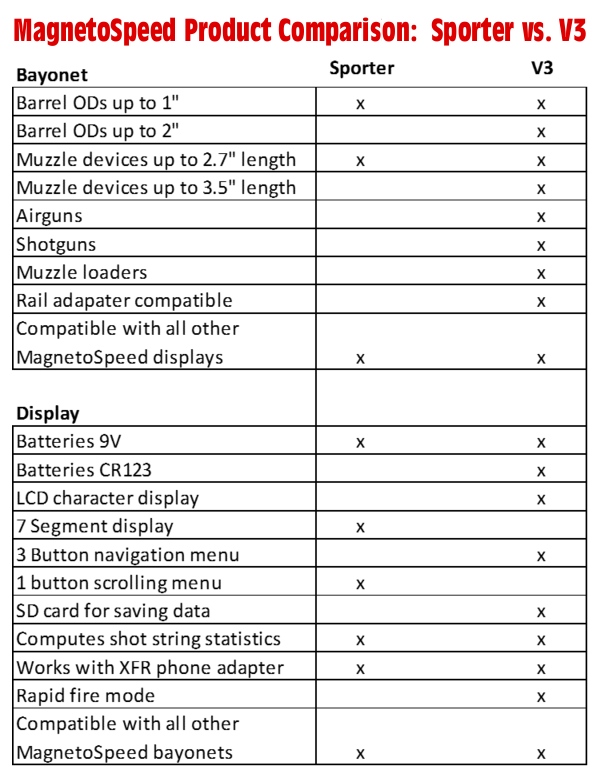
The MagnetoSpeed Sporter chrono is less than half the price of previous MagnetoSpeed models. This is big news for shooters who always wanted a MagnetoSpeed but found the $379.00 cost (for V3 model) too pricey. The new Sporter Chronograph costs just $179.99 at Sinclair Int’l and Brownells. It offers most of the features of the more expensive models (see chart below for details) and has a updated sensor. MagnetoSpeed says its new Sporter is “Ideal for contoured rifle barrels (sporter barrels) and long-barreled revolvers.” The Sporter Chronograph Kit (shown above) includes: Bayonet Sensor, 3.5 foot Data Cable, Remote Display (with Battery), Strap with thumb nut, Two V-block spacers, and compact storage box.
Is the MagnetoSpeed good enough? Well consider this, Derek Rodgers uses one of the original (full-size) MagnetoSpeed Chronos for his load development. Rodgers is the only man on the planet to have won BOTH the F-Open and the F-TR National Championship. ‘Nuff said.
See MagnetoSpeed Sporter Chronograph Features Reviewed in Video
Q: Will the Sporter Chrono work with thicker barrel (i.e. greater than 1″ diameter)?
A: The manufacturer recommends the $399.00 V3 model for thicker barrels. But, wink-wink, if you have a 1.25″ barrel you can get this to work, based on what we’ve seen.. If you have a really fat barrel (up to 2.0″ diameter), get the V3. Magnetospeed also says the V3 is needed for airguns, shotguns, and muzzleloaders.
Click Image for Full-Screen Photo
The Sporter Chrono attaches quickly and easily. It has a 3.5-foot-long cord, and will work with Muzzle Brakes and Flash-hiders up to 2.7″ long.
For pure shooting fun it’s hard to beat a semi-auto .22 LR. While Ruger’s 10/22 is the most popular semi-auto .22 LR rifle, manufacturers are now offering AR-style self-loading rimfire rifles. These rimfire versions of the AR-15 are excellent training tools for 3-Gun and service rifle shooters. You can practice with less expensive rimfire ammo, and save wear and tear on your centerfire ARs. Rimfire AR clones also work great for Rimfire Tactical Matches.
AR-Style .22 LR Rimfire Rifles
Smith & Wesson M&P 15-22
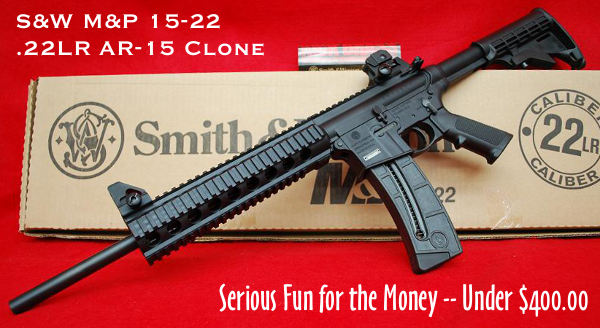
Smith & Wesson’s 15-22 is a nice little rifle. The M&P 15-22 is designed and built as a true .22 LR semi-auto from the ground up, with ergonomics (and most controls) identical to a centerfire M&P 15 rifle. These rimfire AR clones are very affordable. For example, right now BudsGunShop.com is offering the M&P 15-22 (black version) for just $358.44. (If that deal has expired by the time you read this, find other deals with the SlickGuns.com search engine.)
NRA reviewer Colon Noir tested the M&P 15-22 and was impressed: “This gun is unbelievably fun to shoot. There is virtually no recoil. The non-existent recoil makes shooting fast a breeze. Yeah, the magazine is a little quirky… but in the grand scheme of things, this gun feels like a full-out AR-15. The M&P 15-22 makes for a great training companion. I would place this gun in the ‘Fun Box’ — it’s reliable enough that you can have a fun time shooting. I’m picking one up, because it’s guns like these that make you truly realize how fun shooting is.”
Here’s a Video Review of the M&P 15-22 by the NRA’s Colin Noir
Hechler & Koch (Walther) HK 416
H&K offers the HK 416 D145RS, a dedicated .22 LR rimfire rifle. Engineered and built in Germany by Carl Walther, the HK 416 D145RS features a match-grade precision barrel, metal upper and lower receivers, retractable stock, and machined rail interface system with on-rail iron sights.
These Walther-made HK rimfire rifles (which employ a blow-back action) are accurate and reliable. They are also reasonably priced. Many vendors offer the HK 416 for under $550.00. One purchaser writes: “Great .22. I have had this gun a couple of months and have put about 500 rounds of 5 different brands of ammo through it. Not one FTE. I have shot other brands that can’t get through one 30-round mag without a failure. [The 416] is a little pricey compared to the competition but you get what you pay for.”
The Lee Classic Cast “O”-style press has always been an excellent value — it works as well as some other presses costing twice as much. And now Lee has improved on its Classic Cast Press design by adding a breech-lock fitting in the top. This allows you to swap dies in and out in seconds, once your dies are equipped with breech-lock quick-change bushings. The Lee Classic Cast Breech Lock press is available for under $120.00. That makes it a bargain compared to other heavy-duty single-stage presses. Midsouth Shooters Supply offers this press (item #006-90999) for $112.95, while Natchez Shooters Supplies sells the press (item #LEE90999) for $112.99.
Breech-Lock System Allows Fast Die Exchanges
With the Lee Breech-Lock Press system, the die drops straight in from the top. Then, with a quick 1/6th (60°) turn, the die locks firmly in place (like the breech on an artillery canon). The interrupted three-start thread assures dies return and lock into the exact same position each time. Bushings cost $7.43 each at Midsouth. If you prefer, you can leave a bushing in the press, and screw your dies in normally. But consider that it normally takes a dozen or more turns to screw in a normally threaded die. The Breech-lock system is way faster.
The Lee Classic Cast press features a strong, cast-iron frame and all-steel linkage. The large 1 1/8″-diameter ram is guided by over twelve square inches of ram bearing surface. We like the fact that you can mount the handle on either side, and adjust handle angle and length. As Lee explains: “The start and stop position is adjustable with a 48-tooth, ratchet-type handle clamp. In addition, the handle length is completely adjustable. Shorten [it] when you’re loading handgun and short rifle cases.”
Lock-Ring Eliminator Quick-Change Bushings
With Lee’s basic quick-lock bushings, you control vertical die position with the normal locking ring that seats against the top of the bushing. That works fine, but Lee also offers a handy Lock-Ring Eliminator Bushing (Lee SKU 90063). This clever design combines bushing and lock-ring into a single part. The Eliminator is turned from a solid piece of steel and the lock ring is integrated into the design of the part. With the Eliminator you’ll get the most repeatable and precise die positioning because lock ring and bushing are all one piece. Moreover, some guys say the Eliminator Bushings are easier to grab and remove than the standard Lee Breech-Lock Bushings.
Reports from Classic Cast Press Owners
Press owners have praised their Lee Classic Cast Breech-Lock units. Here are reports from two MidwayUSA customers:
Five Stars: Perfect single stage press. Loads accurately 6mm BR and 308 Win for competition. Large clearance is also great for my 460 Wby and 30-378 Wby. Pistol rounds in 44 mag and 45 ACP also load easy. The press has a lot of leverage for full-length rifle case sizing. Nice primer disposal system. Lowest price for its class. This unit beats my Lyman press by several miles…. ”
— J. Davidson, California
Five Stars: I waited until Lee would bring out their breech-lock system in classic cast design. This thing is outstanding and better than my old RCBS partner press. Once you get the sweet setting of the die, lock it in place and next time you load, you need not fumble to find the best setting. Breech lock is the key. I choose this press over Hornady, due to all-steel construction. I load a lot of .308 Win and .223 Rem for my ARs and this requires full-length sizing. Lee meets the challenge with no flex and excellent ram/die fit and alignment. [T]he spent primer disposal is perfect vs. RCBS where primers can miss the primer catcher. The handle can also be placed left or right as needed and shortened for small cases or pistol to reduce the handle travel.”
— E. Stanley, Rockford, IL
Barney M. Auston of Tulsa, OK with rifle he built to break NBRSA record and win $250 cash award from Sierra Bullets. (From cover of Precision Shooting magazine. May 1956).
Way back in 1955 Sierra Bullets offered a $1000 prize for anyone setting a new Aggregate benchrest record with a 6mm (or larger) bullet. At the time the .222 Remington ruled the roost, and Sierra wanted to promote the larger caliber. Sierra also offered a $250.00 prize for a record-breaking performance with any size caliber (including the .22s). Here is the story of how a Tulsa shooter claimed the $250.00 award with a world-record-setting Aggregate involving 10-shot groups at 100 and 200 yards.
Barney Auston’s record-setting rifle was built on an FN Mauser action with double set trigger, with a Hart stainless steel barrel, 30″ x 1 1/8″, chambered for the .222 Remington cartridge. The stock, made by Auston, has a hydraulic bedder as made by L. F. Landwehr of Jefferson City, MO. The scope is a 24X, 2″ inch Unertl. Mr. Auston shot 50gr bullets, custom made by W. M. Brown of Augusta, Ohio, with .705″ Sierra cups and soft swedged. His powder charge was 21 grains of 4198. The rifle rests, both front and rear, were also made by Auston.
Record-Setting Performance
On August 20, 1955, shooting at night in a registered shoot on the John Zink range near Tulsa, Oklahoma, Barney M. Auston of Tulsa broke the existing National Match Course aggregate record and, as the first to do that in 1955, won the Sierra Bullets $250 cash award. Here is the original Sierra Bullets prize offer from 1955:
10-Shot Groups at 100 and 200
Mr. Auston’s winning Aggregate for the National Match Course (five 10-shot groups at 100 yards and five 10-shot groups at 200 yards) was .4512 MOA. He also broke the 200-yard aggregate with an average of .4624 MOA, beating the .4801 match MAO record set by L.E. Wilson only a month earlier.
Barney Auston was a custom rifle maker in Tulsa who fabricated the rifles used by many of the leading benchrest competitors in the Mid-Continent and Guild Coast Regions. Auston was himself one of the top benchrest shooters in those regions during his shooting career.
Editor’s Note: Both of Mr. Auston’s records were broken before the end of the 1955 shooting season, but Auston was the first to win the Sierra Prize. Interestingly, in setting his record, Austin broke the existing Agg record by L.E. Wilson of Cashmere, Washington — yes, the same L.E. Wilson that now makes dies.
If you have a rifle chambered in .260 Remington, you may be wondering if the Lapua .260 Brass is worth the money compared to domestic-made brass. Well, the answer is “yes” if you demand consistent weight and dimensional uniformity (including neckwall thickness).
Mike Harpster of Dead Center Sports took the time to weigh and measure Lapua .260 Rem brass. His test show this brass to be extremely uniform. Weight variance was less than one (1) grain in a 20-case sample. And case neckwall thickness was very consistent.
Report by Mike Harpster: Lapua .260 Rem Brass Test Results (with Comparisons)
I pulled twenty (20) pieces randomly from one Lapua box to do some measurements. I weighed them on my Mettler-Toledo digital lab scale and here are the individual weights of each case. Remarkably, the Lapua brass had less than one grain total weight variance among all 20 cases!
While checking the Lapua brass I remembered I had just received some Winchester brand .308 brass, so I thought it would be interesting to do a comparison between the two brands. I again pulled 20 cases at random from a bag of 50 and repeated the same measurements. The results are shown in the right half of the table below.
Weight Variance Lapua .260 Rem Brass vs. Winchester-Brand .308 Win Brass
LAPUA .260 Rem Brass
Winchester .308 Win Brass
Average: 172.20 grains
ES: 0.94 grains
SD: 0.259
Average: 158.49 grains
ES: 2.64 grains
SD: 0.678
Winchester Brass Further Inspection
The flash holes on the majority of the Winchester brass were not round or centered and they had large burrs inside. The neck wall thickness was pretty consistent, varying only .0015″ (.0125″ – .014″). As you can see in the photo (right) many of the Winchester cases were badly dented while the Lapua brass showed very few minor dents. The annealing on the necks of the Lapua brass was clearly evident while the Winchester showed no signs of being annealed. [Editor’s note: Winchester tumble-polishes its brass before shipping — so you would not notice annealing coloration if annealing had been done.]
Lapua Brass Further Inspection
With sample Lapua .260 Rem cases, I also measured the neck wall thickness in four places with calipers, not the most accurate method but I feel confident that the thickness did not vary more than .001″ over the 20 cases (.0145-.0155). The inside diameter of the neck measured .260 which would give .004 of neck tension out of the box. I visually checked the flash holes and I did not find any flakes of brass or burrs inside, the holes were round and centered.
Summary — This Lapua Brass is Impressive
I have never done these measurements on any other brass so I don’t know how they compare, but I am very impressed with the overall quality of the Lapua .260 brass. If they prove to hold up to the repeated firings I get from my Lapua 6BR brass I believe .260 shooters will be very happy.
Mike Harpster — Dead Center Sports
105 Sunrise Drive
Spring Mills, PA 16875
phone: 814-571-4655 www.deadcentersports.com
In response to our Bulletin story about the availability of Norma powders at Midsouth Shooters Supply, one of our Forum members asked: “I’m having trouble finding Reloder 15 for my 6.5×47 Lapua — should I consider running Norma 203B instead?” As we’ve explained before, these two powders, both made by Bofors in Europe, are very, very similar. Here are some hard numbers that should demonstrate how virtually identical these powders really are.
Target Shooter Magazine writer Laurie Holland compared Norma 203B and Reloder 15 using data from QuickLOAD. Laurie also checked load manuals to see how listed charge weights varied for the two propellants. Laurie concluded there was very little difference between Norma 203B and Reloder 15.
Norma 203B vs. Alliant Reloder 15 Commentary by Laurie Holland
Running [203B and RL15] through QuickLOAD doing a ‘charge table’ run for a 130gn Berger VLD at 2.700 COAL in 6.5X47 Lapua, gives very similar positions in the table [for both powders]. The charge required to achieve 62,000 psi estimated pressure varies by a mere 0.2 grains between the pair, Norma 203B being the heavier of the two. The estimated Muzzle Velocity (MV) also varies by a mere 2 fps, RL15 estimated to produce 2,946 fps MV compared to 2,944 fps for N203B at 62,000 psi (with the parameters I used).
If they aren’t the same thing, they’re so close as to make no difference and as Forum Boss points out, they’re made by the same people (Bofors) in the same plant.
[The Berger Reloading Manual includes data for both powders] for the .308 Winchester and heavier bullets (185 to 230 grains). Maximum charges and claimed MVs are not always identical, but are so close as to be marginally different production lots of the same thing, or maybe the result of minor testing variations.
.308 Win Max Charge Weights in Grains (RL15 / N203B) (Berger Manual)
MVs [for the four bullet types] are close but not identical, the largest difference being for the 210s which shows RL15 producing 2,428 fps MV v 2,383 for Norma 203B.
Norma 203B Chemistry
According to the Norma Reloading Handbook #1, Norma 203B has the following composition:
85% Nitrocellulose
7.5% Nitroglycerin
2.0% surface coating
4.6% Various chemicals
0.9% Water
3,957 J/g specific energy
890 g/l specific density
For comparison, the 7.5% NG component compares to 15% in Viht N500 series powders and 10% in Ramshot TAC / Big Game / Hunter.
There’s a new two-stage trigger for Remington and Rem-clone actions from CADEX Defense of Canada. The new CADEX DX2 double-stage trigger adjusts from 1.5 to 5.0 lbs pull weight. Both stages can be adjusted separately through allen-head screws located on the front of the trigger body. The trigger shoe also adjusts fore and aft. The CADEX DX2 is offered in both a standard version (no safety or bolt release) and a version with integral safety and bolt release. The cost of the standard DX2 is 267.95 Canadian dollars, or $202.62 U.S. Dollars at current exchange rates. Add forty dollars (Canadian) for the version with safety and bolt release.
DX2 Dimensions: 7.21cm x 4.42cm x 1.22cm | With Safety/Bolt Release: 7.65cm x 5.23cm x 3.35cm
DX2 Weight: 37.5 grams | With Safety/Bolt Release: 52 grams
Frank Green Tries the CADEX Two-Stage
Frank Green of Bartlein Barrels recently acquired one of the CADEX two-stage triggers and he likes it. Here is his report:
“My CADEX two-stage trigger arrived[.] I installed it into my Badger M2008 action/rifle in 6 Creedmoor. Initial impression is that it’s very nice. You can adjust each stage for pull of weight. You can adjust the position of the trigger shoe and [adjust] for over-travel as well. I think the pricing on the trigger is going to be very competitive and it will be a nice option out there for another two-stage trigger.
I installed it and made no adjustments. Checked it for function and measured some pull weights while the barreled action was out of the stock. Reassembled the whole rifle and again made some pull weight measurements. I recorded the last five and they came in at 2.09, 2.15, 2.15, 2.1 and 2.12 pounds. The little variance I’m going to chalk it up to me and how I pulled on the trigger scale …but it broke clean.”
Installation Considerations
Frank Green said there may be some clearance issues with some trigger guards: “The CADEX trigger shoe assembly is a tad longer than a stock Remington. In my trigger guard it barely bottomed out/touched in the guard but functioned just fine but to give it a little room I milled .010″ off the bottom of the shoe. My trigger guard is a Defiance. I’d have to throw the trigger onto a Remington rifle/trigger guard assembly and a Badger bottom metal to see if it does the same thing but [this] is minor in my opinion.
You need a T6 Allen wrench to adjust the trigger shoe location. I had to move my shoe forward just a tad from how it came out of the package. When pulling the trigger it would just touch the back of the trigger guard.”
In recent years, Forster Co-Ax® presses have been somewhat hard to find, as demand has out-stripped supply. However, right now Grafs.com has Co-Ax presses in stock, at just $299.99 — that’s six percent off the regular price. This sale price includes a set of jaws, and includes ground shipping (in the lower 48), after a single $7.95 (per order) handling fee. If you’ve been hankering for a Co-Ax press, now is definitely a good time to buy.
If you are not yet familiar with the many unique features of the Forster Co-Ax, we recommend you watch the video embedded below. This shows how the press operates and highlights the design elements which set the Co-Ax apart from every other reloading press on the market.
Forster Co-Ax Press Video Review
This is a very thorough review of the Forster Co-Ax done by Rex Roach. This 14-minute video shows the key Co-Ax features, explaining how the floating case-holder jaws work (3:30 time-mark), how the dies are held in place (4:40 time-mark), how spent primers are captured (6:10 time-mark), and how to set the primer seating depth (10:00 time-mark). We’ve used a Co-Ax for years and we still learned a few new things by watching this detailed video. If you are considering purchasing a Co-Ax, definitely watch this video start to finish.
The Co-Ax case-holder features spring-loaded, floating jaws. These jaws have two sets of openings, small and large. This allows the system to adapt to various rim diameters. The jaw plates can simply be reversed to switch from small jaw to large jaw. In the photo above, the Co-Ax is configured with the large jaw openings in the center.


 The new, 37th Edition of the Gun Trader’s Guide has just been released. This fully-illustrated resource features current market values for thousands of rifles, pistols, and shotguns. This 37th Edition, now with over 1000 photographs, includes dozens of new entries added since the previous edition. Along with the Blue Blue of Gun Values, the Gun Trader’s Guide is one of the two definitive resources on gun prices. If you buy or sell firearms, the Gun Traders’ Guide is a must-have item that will pay for itself. Over two million copies of the Gun Trader’s Guide have been sold to date. Order soon to be one of the first to own the new 37th Edition. Amazon’s price is $23.24.
 Overall, Gebhardt was very pleased with the SHV: “Optical clarity, image brightness, contrast and resolution were all extremely good.” The tester also liked the MOAR reticle in his scope. He didn’t think it was too “busy” though he thought the hold-over lines would benefit from numbers: “Nightforce’s MOAR was easy to use and provided a clear sight picture for engaging small targets. The line thickness is perfect for both precise shot placement and visibility. My personal preference however would be for the even hash marks to be numbered for the entire lower portion of the reticle.” Gebhart noted that the SHV’s side parallax knob had yardage marking numbers that proved accurate (and handy to use) — most other scopes just have lines.




 Breech-Lock System Allows Fast Die Exchanges


 If you have a rifle chambered in .260 Remington, you may be wondering if the Lapua .260 Brass is worth the money compared to domestic-made brass. Well, the answer is “yes” if you demand consistent weight and dimensional uniformity (including neckwall thickness).

 Winchester Brass Further Inspection
 Norma 203B vs. Alliant Reloder 15


 Installation Considerations


