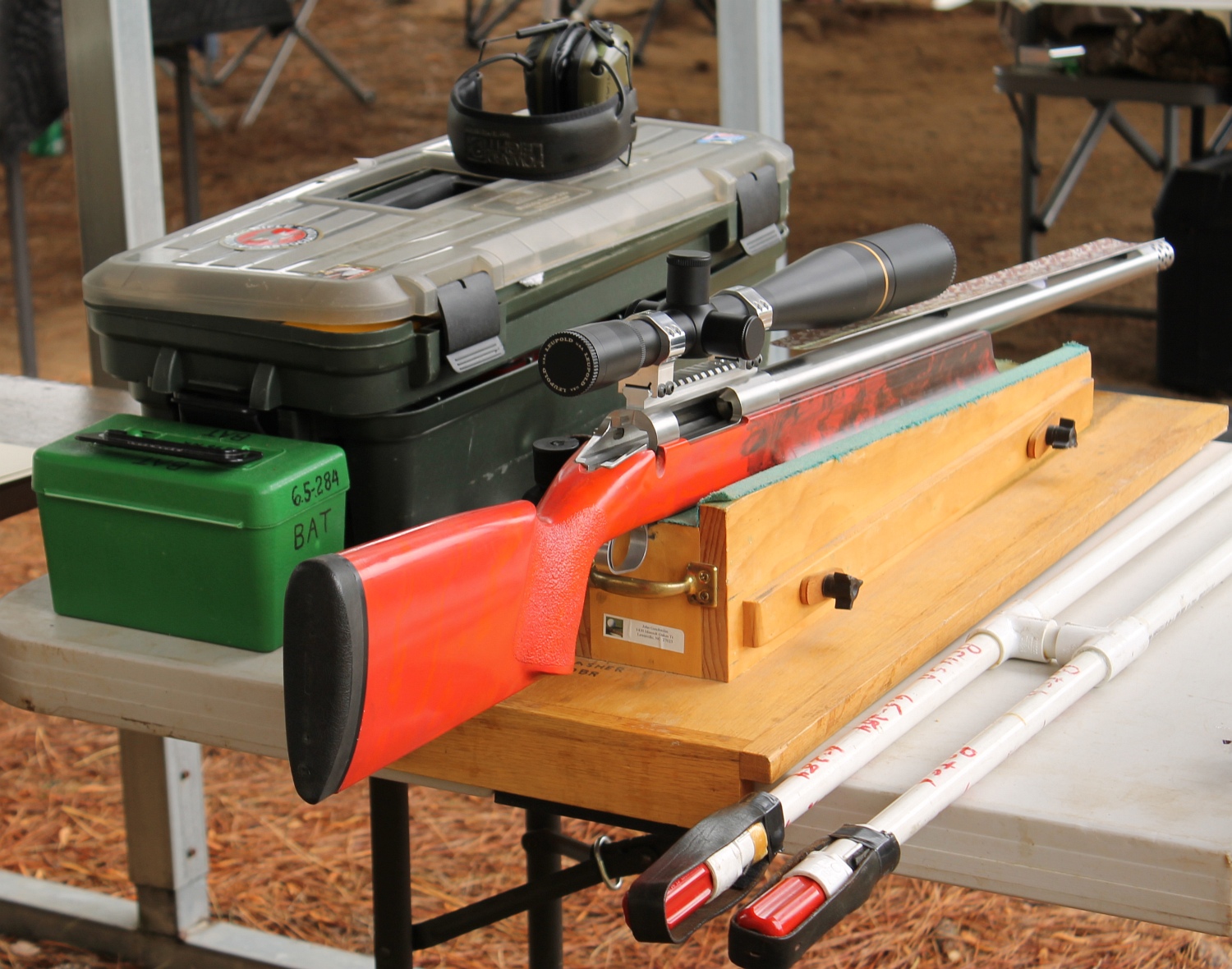
We saw some interesting gear at a 600-yard IBS match at the Piedmont Gun Club (Rutherfordton, NC). On display were a variety of hand-made wood cleaning cradles designed to fit on table tops. These typically employ a box-style design, with layer of cloth or other padding to cushion the underside of the stock. On display were both single-rifle cleaning cradle/boxes and dual-rifle rigs. This is a good do-it-yourself project that can be built with simple tools.
Click Photos to View Large Versions
Notice that these cradle-boxes feature an extended lower section in the rear. This lower “lip” butts up against the edge of the table so the whole assembly stays in place. In the photo above it appears that the lower section may actually be cut from a rubber block, but we’re not sure.
Here’s an interesting new F-Class Barrel Block Stock from True-Flite NZ Ltd. in Gisborne, New Zealand. This innovative design features a fore-arm barrel block that clamps around the barrel, allowing the action to free-float. We like the way a wood lower section (with pistol grip) is mated to the metal “spine” of the chassis. That creates a nice look and feel.
The folks at True-Flite state: “This stock has been designed by Steve Mann, and was developed in house here at True-Flite. Utilizing a 150mm barrel block, which clamps the barrel into the stock (allowing the action to free float), enables us to fit large, full-profile barrels, and still keep under the 10 kg weight restriction when running a Nightforce scope. This stock tracks like a demon, making it a very competitive rig.”
While this chassis is designed for the New Zealand-made Barnard actions, it can also work with other round actions. Target Shooter Magazine notes: “The great thing is, because the action is unstressed, you can get away with using … a Remington — rather than forking out for a custom action.”
Barnard Model P Action from New Zealand
Here’s a Barnard Model P action, which was originally developed in 1982. These three-lug actions are very smooth. They are popular with Palma rifle shooters and F-Class shooters. Designed for the Palma or long-range shooter, the Model P Single shot action is available in right-hand or true left-hand configuration (with other bolt/port configurations in the Model PC).
The bolt carries three forward locking lugs, is equipped with a Sako-style extractor and can be supplied to accept any case rim up to 0.534″(standard magnum rim). The Bolt undergoes finish machining after hardening, and is hand-lapped to its mating receiver. The receiver is 4340 chrome/moly/nickel steel, through-hardened to 38 RC and finish-machined after surface hardening to ensure concentricity.
Do you shoot an AR-platform rifle, or run a bolt gun chassis that uses AR-type grips? If so, you may want to consider the ergonomic UPG16 grip from Command Arms (CAA). This user-configurable grip includes six (6) interchangeable rubberized grip inserts (three front and three rear), allowing the user to customize the finger grooves and contoured backstraps. This can help shooters with big or small hands and also allows you to experiment with slightly different hand-holds. Sometimes a small change can improve your shot-to-shot consistency or improve comfort.
The UPG16’s interchangeable front and rear rubberized grip inserts can be swapped easily. The UPG16 pistol grip also has a capped storage area for small items or optional cleaning kit. The UPG16 modular grip weighs just 3.7 ounces and is offered in three colors: Black, Desert Tan, and OD Green. The UPG16 grip (including all inserts) costs $32.40 at Brownells.com.
Sound can be a tricky subject, but Cal Zant, the editor of PrecisionRifleBlog.com, presents everything an informed shooter should know about muzzle brake noise in a straightforward and practical way. Most sound tests are measured from the side of the muzzle, in accordance with mil-spec standards, and Cal did that. But he also measured the sound level of each brake from behind the rifle, closer to the shooter’s position. This provides a more accurate indicator of the actual sound levels firearms operators will encounter while shooting.
Muzzle brakes ARE really loud — that’s something most active shooters have observed. But this study finally gives us some hard data and makes objective comparisons. The difference between brakes was quite significant. Some brakes were ear-splitting — more than twice as loud as other brakes tested.
As a bonus, Cal also provides data on how the new Ultra series suppressors from Thunder Beast Arms Corp (TBAC) compare in terms of sound level behind the rifle.
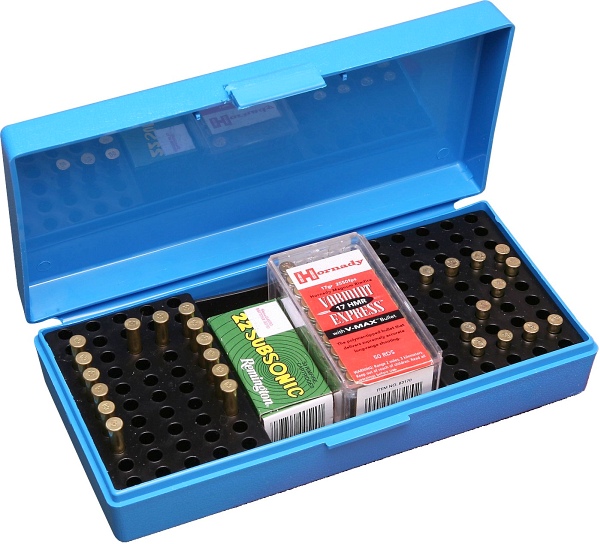
For centerfire ammo, you can choose from dozens of flip-top boxes, storage bins, or milsurp-style ammo cans. For rimfire ammo, there are not so many good choices. Our preferred rimfire ammo carrier is the MTM SB-200 Small-Bore Fitted Ammo Box. This flip-top plastic box holds 100 rimfire rounds in 10×5 black grids on the left and right. In the center is a storage area that will hold another 100 rounds in factory boxes. MTM’s SB-200 box was recently re-designed so it will now hold 17 HMR rounds, as well as 17 Mach 2, 22 short, 22 Win Mag Rimfire, and of course 22 Long Rifle (.22LR)
MTM Case-Gard 200 Round Smallbore Box
This is really the only product of its kind on the market. It allows you to conveniently and securely hold 200 rimfire rounds, and also segregate your ammo by brand or bullet type. These boxes fit all types of popular rimfire ammunition. The vertical clearance of the lid is sufficient to hold the longer .22 WMR Rounds, and 17 HMR (as well as .22 LR naturally). The lid fits securely so you don’t have to worry about your rimfire ammo spilling out on the way to the range.
If you don’t have one of these boxes yet, we recommend you order one or two. They cost less than $15.00 and are available in Blue or “Rust” (a brick color).
Harrell’s Precision sells “semi-custom” full-length bushing dies for the PPC and 6BR chamberings. While the Harrell brothers do not cut the die to spec, they carry a large selection of dies made with slightly different internal dimensions. When you send in your fired brass, the Harrells choose a die from inventory with just the right amount of sizing (diameter reduction) at the top and bottom of the case. Given the quality, and precise fit, Harrell’s full-length dies are a good value at $70.00 plus shipping.
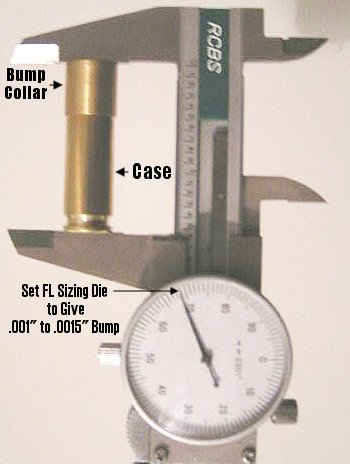
Bump Measuring Collar
The Harrell brothers provide a nice bonus item with each full-length die — a neat, little shoulder bump measuring device as shown in the photo at right. Hornady/Stoney Point sells a stand-alone tool that does the same job, but the Harrell’s bump collar is simpler and faster. To measure your shoulder bump, simply place the Harrell’s bump collar over the front of your deprimed case (before sizing) and measure the OAL with your calipers. Then size the case in your full-length die, replace the collar and repeat the measurement. You want to set your die so the shoulder moves back about .001″ to .0015″ for most applications. (With semi-auto guns you may want more bump.)
For many spotting chores, this small $260.00 Minox MD50 16-30x50mm may be all you really need.
Many readers have asked: “Can you recommend an affordable, quality, very compact spotting scope for viewing mirage or hunting?” These folks want a handy, general purpose optic — they aren’t trying to resolve 6mm bullet holes at 600 yards and beyond. For that kind of long-range viewing, you’ll need a premium ($2000+) high-magnification spotting scope (or better yet, a target cam system). However, for other tasks (such as viewing mirage, wind flags, or game animals), you can save your pennies and go with something smaller, lighter, and WAY less expensive — such as the Minox MD 50.
If you are looking for an ultra-small, medium-magnification spotting scope that is light, bright, affordable, and easy to use, we recommend the Minox MD 50 16-30x50mm spotter. To be honest, this is a steal. We don’t know of any pint-sized spotting scope that offers better performance at anywhere near the price (currently $259.00 on Amazon.com).
This small optic is easy to mount (even on very small tripods). It has a reasonably wide field of view, and is surprisingly bright and sharp considering the sub-$300.00 price. We prefer the angled model (for viewing mirage and flags while shooting prone), but there is also a straight (non-angled) version for the same price (currently $259.00 on Amazon.com).
Mind you, this little Minox MD 50 will certainly NOT replace a high-end Kowa or Swarovski spotting scope, but it may be all you need to see mirage, wind flags, and shot markers. Moreover, this little unit is ideal for use with pistols or airguns inside 50 meters. In fact this is the spotter we use when shooting pistols because it’s compact enough to fit inside a small range bag.
We’re not alone in our praise for the little Minox MD 50. The OpticsThoughts Blog reviewed five (5) different ultra-compact spotters from Leupold, Minox, Nikon, and Vortex, which ranged in price from $300 to $700.* Though the little Minox was the least expensive optic in the test, the reviewer concluded it was the best value by far:
MD50 16-30×50mm (OpticsThoughts.com Review)
This is easily the champ in the “bang for the buck” contest. Form factor-wise, it looks like a scaled-down, full-size spotter with a proper “foot” for a tripod mount. It has a very solid feel, owing to it being short and moderately heavy.
Optically, the spotter is very good for what it costs. It is a bit cheaper than the Leupold and outperforms it in most ways, while being more compact: FOV is wider, low light performance is better and overall image quality is better from 15X up to 22X or so. At higher magnifications, eye-relief gets a little short and Leupold is easier to use. However, the FOV advantage carries over across all magnifications. The focus ring is on the body of the spotter and the large diameter offers a fair amount of adjustment precision. [T]he focusing mechanism … is quite good.
McMillan Stocks has released an updated version of its .50-Cal benchrest stock. The new Super 50 BR features an extended-length “wheelbase” with machined aluminum lower surfaces for stiffness and improved tracking. In the video below, Kelly McMillan reviews the features of the new Super 50 BR:
The notable features of the new Super 50 benchrest stock are machined aluminum shoes on the bottom of the forearm and buttstock. These are machined true to each other for perfect alignment in the bags. The removable forearm shoe is available in either a 3.5” or 5” width. This is significant. Kelly McMillan explains: “You’ll be able to shoot this same stock in different classes just by changing the forearm shoe, and that’s something you can do in a match if you want.”
Engineered to be Super-Strong with Minimal Flex
With the interlocking design of the foreand (with 90° blocks that interlock with the aluminum shoe), this is a very rigid stock. In fact, Kelly says: “We’ve molded several 90° angles [into the fiberglass section] that actually increases the stiffness in addition to the stiffness that the aluminum offers. We think this is probably the stiffest fore-end on any stock that we’ve ever made.”
This Super 50 BR stock is approximately 44” long and has a forearm about 20.75” long from the front of the action. And if that’s not long enough, the forward “shoe” can be machined up to 6″ longer to extend the “wheelbase” even further. This stock has a minimum weight of about 9 pounds in Light Gun configuration and a max weight of about 18 pounds (for the stock itself) as a Heavy Gun stock. The Super 50 BR is an ambidextrous design that may be inletted and used both right and left-handed.
It’s important to use a good-fitting bore-guide whenever you clean your barrel. A good bore-guide will keep solvents out of your action and help your cleaning rods run straight and true.
Not all bore guides are created equal. Some offer a sloppy fit and/or fail to seal your chamber effectively. 21st Century Shooting has changed all that with a new generation of chamber-specific Bore Guides. These have a close fit (with O-rings) to seal your chamber completely. The design is intelligent — these bore guides are long enough to extend well past the end of your scope, while the minimal rod diameter provides sufficient clearance for most combs. Priced at $49.99, these high-tech guide rods are custom crafted to fit many popular chamberings: 220 Swift, 223 Rem, 22-250, 6PPC, 6mmBR, 6 Dasher, 6×47, 6-284, 6mm Shehane, 243 WSM, 6.5×47 Lapua, 6.5-284, 6.5 Shehane, 6.5 WSM, 25-06, 270 WSM, .284 Win, 7mm Shehane, 7mm WSM, 30 BR, 308 Win, 30-06, 300 WSM.
Email John [at] 21stcenturyshooting.com to ask about your application. These chamber-specific guide rods are designed fit actions with BAT bolts or Rem 700-style bolts (Borden, Kelblys, Ruger, Savage).
In addition to the new chamber-specific Guide Rods, 21st Century just released a clever new product for shooters who regularly swap barrels (or who need to clean dismounted barrels). If you have a switch-barrel rig, check out 21st Century’s new Barrel Off Bore Guides. Like the full-length 21st Century bore guides, these are manufactured specifically for your chamber, for a perfect fit. These chamber-specific “Barrel Off” bore guides cost $19.99.
Product Tip from EdLongrange. We welcome reader submissions.
How good are the best High Power position shooters? Pretty amazing actually. Here are some targets from the 2015 NRA High Power Championship at Camp Perry. Shown above is a 100-10X (literally a perfect score) at 200 yards. This was shot sitting, rapid-fire by 11-time National High Power Champion Carl Bernosky. That’s impressive to say the least. As one Facebook fan noted: “Not bad for an old codger with a bad back….”
File photo of Carl Bernosky from previous competition.
The target below is a 100-0X, shot rapid-fire prone by an unknown sling shooter. That may not seem that impressive at first, but this was fired from THREE HUNDRED yards. It takes a mighty solid hold to produce a nice 10-shot cluster like that without dropping a point.
To put these impressive performances in perspective, Lapua’s Kevin Thomas reports: “For those who aren’t familiar with these targets, the center X-Ring on both of these targets is 3 inches across. The 10-Ring is 7 inches across [including line], roughly the size of a small sandwich plate.”







 Bump Measuring Collar


