|
|
January 16th, 2014

Tab Gear Pollok Mats shown above with Tab Gear Bag below.
 Here is a cool product we saw at SHOT Show, the TAB Pollok Shooting Mat. This 72″x30″ mat rolls up into a compact package about 8″ long and 4.5″ in diameter. Once rolled, the mat is secured with either Snap Buckles or D-rings (buyer’s choice). The bottom of the mat has a waterproof, urethane coating. You can stuff the mat inside your pack or strap it to webbing. For comfort, there’s a 12″-wide section of closed-cell foam in the area contacted by elbows. Loops are provided so the mat can be staked down in high winds. This is a good product for hunters or varmint shooters who need to take prone shots on the ground. The mat is light and easy to stow in a day-pack. The D-ring version is $65.00, while the buckled version is $72.50. Order through the Tab Gear Webstore. For more information visit TabGear.com. Here is a cool product we saw at SHOT Show, the TAB Pollok Shooting Mat. This 72″x30″ mat rolls up into a compact package about 8″ long and 4.5″ in diameter. Once rolled, the mat is secured with either Snap Buckles or D-rings (buyer’s choice). The bottom of the mat has a waterproof, urethane coating. You can stuff the mat inside your pack or strap it to webbing. For comfort, there’s a 12″-wide section of closed-cell foam in the area contacted by elbows. Loops are provided so the mat can be staked down in high winds. This is a good product for hunters or varmint shooters who need to take prone shots on the ground. The mat is light and easy to stow in a day-pack. The D-ring version is $65.00, while the buckled version is $72.50. Order through the Tab Gear Webstore. For more information visit TabGear.com.
Size is 72″ x 30″
Rolled up size approximately 4″ x 8″
Made from 1000 Denier Cordura Nylon
Webbing is all 1″ Milspec
Padded Elbow Rest Area
Stake-down loops on each corner
Watch Video Demo with Tab Gear Roll-up Shooting Mat


December 30th, 2013
Glock will sell a small, single-stack .380 ACP pistol in 2014. The new carry gun, designated the Glock 42, was supposed to be a deep, dark secret until SHOT Show 2014, but news leaked out throughout the blogosphere, and Glock has confirmed that this is the real deal. Here’s the good news: the pistol is light (13.4 oz. empty) and slim (0.94 inches wide). Under 6″ in length, it should carry discretely in a variety of holsters. Made in the USA, the Glock 42 has a 6-round mag, and a 5.5-lb trigger pull weight.
First “Un-Boxing” of Glock 42 Carry Pistol in .380 ACP:
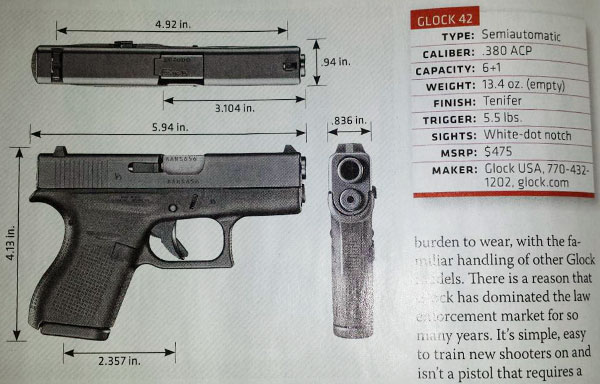
Here’s the bad news: It seems Glock fans were hoping for a slim, single stock 9mm, as the .380 ACP cartridge is considered under-powered by many self-defense “gurus”. Some would-be buyers were also hoping that Glock would finally jettison the distinctive bulged-bottom backstrap that many shooters consider uncomfortable at best, and just plain wrong at worst. For many people, that fat bulge in the lower half of the grip causes the gun to point wrong. For many of us, the “hump” on the back of the grip forces an unnatural wrist angle when firing. If you don’t understand, shoot a Glock and a classic Sig back to back and you may experience ergonomic enlightenment.

 Does the Glock 42 Does the Glock 42
Really Represent Progress?
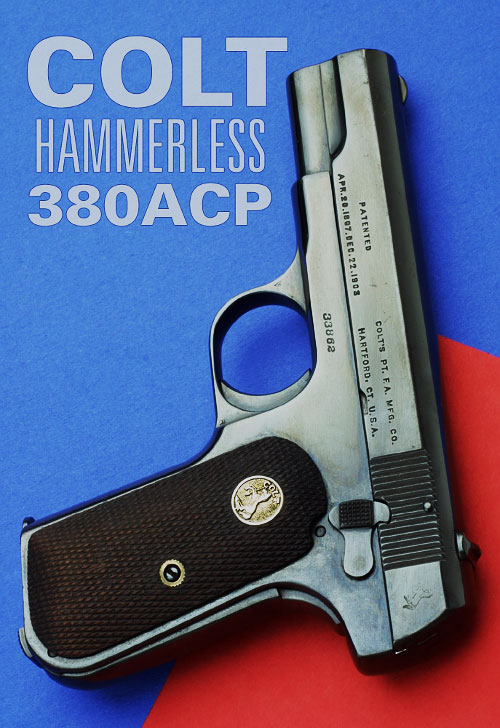
We find it interesting that, in the 105 years since Colt released its m1908 “Pocket Hammerless”, handgun design hasn’t necessarily advanced that far. Let us explain…
Compared to the Glock 42, the slim, .380 ACP Colt m1908 (derived from Colt’s .32 ACP m1903) has a smoother trigger, and boasts a 7-shot magazine (vs. a 6-shot mag for the Glock 42). The Colt also has a better-shaped grip, plus a smoother exterior (with fewer bumps, ridges, and snag-points). Remarkably, the 105-year-old Colt is actually thinner — it is 3/4″ wide compared to just under 1″ for the Glock 42.
On the other hand, at 13.4 ounces, the Glock is much lighter in weight than the 24 ounce Colt, and, yes, the Glock 42 is shorter than the m1908. For some, the Glock’s lighter weight is all-important. Others may prefer the Colt given its all-metal construction, lovely blued finish, and classic styling. Many gun aficionados feel that the m1903/m1908 pistols were the prettiest of John Moses Browning’s self-loading designs. What do you think? Is the Glock 42 really a better .380 ACP pistol than the classic Colt m1908?
December 24th, 2013
PrecisionRifleBlog.com recently published results from the most comprehensive field test of rangefinder binoculars ever conducted. It included virtually every product available in a variety of real-world scenarios, to see which had the best performance in the field in terms of both optical clarity and ranging capabilities. The results are based on over 10,000 data points collected from the field over 3 months of testing. Cal Zant, author of PrecisionRifleBlog.com, published a series of posts with exhaustive details about his optical and ranging tests and results, but we’ll hit the highlights here.

|
VOICE FILE: Click Button to Hear Cal Zant TALK about Rangefinder Binocular Test |
Six of the models tested were binoculars, and the other two were monoculars. The Leupold monocular was included for reference, because many shooters have a 1,000-yard rangefinder similar to the RX-1000. The Vectronix Terrapin model was included as the control for ranging performance, because it is known to be an extremely accurate rangefinder (spoiler alert: it is). Cal provides a very detailed side-by-side spec comparison for these models in one of his posts.
Ranging Test Results
 Each model was used to range 500+ times in a variety of scenarios from 25 to over 30,000 yards. The tests showed these models had similar performance at close and mid-range targets, but at 600 yards their performance started to diverge … so that is where most of the testing was focused. Each model was used to range 500+ times in a variety of scenarios from 25 to over 30,000 yards. The tests showed these models had similar performance at close and mid-range targets, but at 600 yards their performance started to diverge … so that is where most of the testing was focused.
The chart below summarizes the ranging performance found on the test targets in ideal conditions, which was from a sturdy tripod, at sunset, with 10+ mile visibility. The exact target shape and surroundings varied, but the targets were all approximately 2 MOA wide, highly reflective, and perpendicular to the rangefinder. Specifics on target dimensions, view from the ranging position, and target surroundings are given in the detailed ranging performance results post.

Vectronix is the leader of the rangefinder world, and that was proved once again in these tests. The new Leica Geovid HD-B wasn’t far behind them, with accurate ranging beyond 1 mile. The Zeiss Victory RF also had surgical precision off a tripod, although it had a reduced range compared to the Vectronix and Leica. The Bushnell Fusion 1 Mile also proved to be able to range targets out to their claimed max range of 1,760 yards.
PrecisionRifleBlog.com also tested the ranging performance of each model in bright lighting conditions, and offhand as well. The data from those tests also contained a few surprises. To determine how accurate each model really was, Cal Zant carefully analyzed the results from each model when aimed at precisely positioned, “known distance” targets. To see how those tests turned out, or learn more details about specific models, GO TO full results.
Optical Test Results
 For the optics tests, Cal’s goal was to find an objective, data-driven approach to testing optical performance. What he came up with was placing eye exam charts from 600 to 1,400 yards with different size letters, and then recording what two different people could accurately read with each model. The data for each unit was summed into a single score so they could be ranked relative to how much detail the testers could make out. More specifics are provided regarding how the test was conducted and how scores were calculated in the optical performance results post. Here are the results from Cal’s data-driven approach: For the optics tests, Cal’s goal was to find an objective, data-driven approach to testing optical performance. What he came up with was placing eye exam charts from 600 to 1,400 yards with different size letters, and then recording what two different people could accurately read with each model. The data for each unit was summed into a single score so they could be ranked relative to how much detail the testers could make out. More specifics are provided regarding how the test was conducted and how scores were calculated in the optical performance results post. Here are the results from Cal’s data-driven approach:

The Leica Geovid HD-B edged out the other models for the top spot, with its completely new, Perger-Porro prism design. The original Leica Geovid HD, and Zeiss Victory RF also showed great optical clarity.
The Rest of the Story
Cal’s full series of posts is very informative. He’s done tons of analysis on the data, and summarizes it in several charts that provide a lot of insight. Cal is also in the process of publishing detailed reviews on each model, including notes he and the other testers compiled for each unit. They used them all — a lot, so they have a unique perspective on what’s good or bad about each. Find out more at the link below:
CLICK HERE to Read Full Article with More Info
December 23rd, 2013
Effective hearing protection is a must whenever you are shooting firearms or when you are in the vicinity of gun-shots. For ultimate protection, we recommend a good set of tapered foam earplugs, topped by ear-muffs. However, there are situations when you may prefer lighter-weight hearing protection that can be quickly removed. For example, if you are standing well behind the firing line as an observer, or if you are working as a rangemaster or waddie some distance away from the shooters.
In addition to traditional ear plugs and ear-muffs, new band-style protectors provide a third sound-blocking option. Howard Leight, a top name in the sound-protection business, now offers the “Quiet Band”, a device with soft foam plugs attached to a plastic band worn around the neck. This “Quiet Band” product is comfortable, easy to deploy, and surprisingly effective.

 Three Quiet Band Models Three Quiet Band Models
There are three (3) types of Leight Quiet Band® sound protectors. We prefer the QB2 Supra-aural model (item QB2HYG, NRR 25). As shown in the photos, the NRR 25-rated QB2 positions cone-shaped foam pads next to the ear openings and holds them there with light pressure from the orange-colored band. There is also an Inner-aural version (item QB1HYG, yellow band, NRR 27), and a Semi-aural model (item QB3HYG, red band, NRR 21). Our preferred QB2 Supra-aural (orange band) model is just as comfortable as the QB3 (red band) version, and offers much better protection. The QB1 Inner-aural (yellow band) model requires that you place the ear buds in the ear canal, so it’s not really any easier to use than conventional earplugs. That’s why we like the QB2 Supra-aural model best of all. Other users agree. Here’s what two QB2 owners had to say:
 “I first saw these used by Hickok45 on YouTube and he talked positively about them. I got two and gave them a try. At first, I didn’t think they were going to work very well. After some fiddling, I found they work pretty darn good. With my ears, they fit the best if the band starts on top of my head, I insert the plugs then rotate the band behind my head. PRESTO, perfect fit. Shooting the 9mm and 12 gauge out back was comfortable with no ringing afterward. [They are] small and easy to transport — just throw in the range bag. Yet, they are big enough to keep around your neck out of the way[.] I can sit these Howard Leights down on the shooting bench without worrying about them getting dirty since the band is curved, placing the plugs in the air. I highly recommend them to anybody needing banded hearing protection.” — Tom W. “I first saw these used by Hickok45 on YouTube and he talked positively about them. I got two and gave them a try. At first, I didn’t think they were going to work very well. After some fiddling, I found they work pretty darn good. With my ears, they fit the best if the band starts on top of my head, I insert the plugs then rotate the band behind my head. PRESTO, perfect fit. Shooting the 9mm and 12 gauge out back was comfortable with no ringing afterward. [They are] small and easy to transport — just throw in the range bag. Yet, they are big enough to keep around your neck out of the way[.] I can sit these Howard Leights down on the shooting bench without worrying about them getting dirty since the band is curved, placing the plugs in the air. I highly recommend them to anybody needing banded hearing protection.” — Tom W.
|
“Great for woodworkers — These are lightweight AND very effective at reducing noise. When not in use the band hangs loosely around your neck, out of your way completely. Very cost effective for a great product!” — Sheri D.
Quiet Bands Are Much Less Expensive Than Earmuffs
Quiet Band® sound protectors can be purchased from many online vendors for under $6.00 per set, which includes a spare pair of ear buds. Amazon.com has the Leight QB2 Supre-Aural for just $3.57 per set, while Enviro Safety Products currently sells the QB2 for $4.20 per set. Replacement ear buds are available and sold by the pair. You can also buy a Ten-Unit Bulk Pack of QB2 Quiet Bands for $35.52 with free shipping. If you help run shooting matches (or training programs), you may want to buy these in bulk and provide them to Range Officers and pit workers. |
|
December 18th, 2013
Report based on Lars Dalseide story in NRAblog
 If you watched the position and prone shooters at the 2012 London Olympic Games, you couldn’t help but notice the exotic rifles competitors were shooting. There were wood stocks, metal stocks, off the shelf rifles and customized specials. Why are there are so many different design features and stock types? To answer this question, the NRAblog’s editors called on Jessie McClain of the NRA Competitive Shooting Division. If you watched the position and prone shooters at the 2012 London Olympic Games, you couldn’t help but notice the exotic rifles competitors were shooting. There were wood stocks, metal stocks, off the shelf rifles and customized specials. Why are there are so many different design features and stock types? To answer this question, the NRAblog’s editors called on Jessie McClain of the NRA Competitive Shooting Division.
“The customized rifles, like the Anschütz you showed me, can make a real difference in a shooter’s performance,” explained McClain. “I went from a decent shooter to making the varsity shooting team my freshman year because of the rifle.” As Jessie explained, one new feature out there is the adjustable stock, which she called the Porsche of the shooting world. Fully adjustable from the butt plate to the check piece to the hand stop and risers and bolt knobs, this component is fully customizable to the athlete … which can be a huge advantage. “Every person is different … a customizable rifle fits anyone. A rifle team can purchase four of these and field a shooting team for years.”
Not for Novices
The one warning she did have is that these are not for the novice shooter. Get a couple of years of shooting under your belt and then think about moving on to a customized rifle. That way, you can learn the basics before investing in the high dollar equipment. “You wouldn’t give your 16 year old a Ferrari for his first car, would you?”
The Modern Anschütz Position Rifle
Smallbore match rifle makers are using modern materials in response to the need for greater adjustability (and enhanced accuracy). One of the popular new designs is the Anschütz model 1913 position rifle with a “1918 ALU Precise” brushed aluminum stock. This looks like it has been crafted in an aircraft plant.


Story by Lars Dalseide, courtesy the NRA Blog.
December 17th, 2013
We’ve all seen brightly-colored chamber indicators before. But Chamber-View has come up with a better mousetrap — a solid, precisely-shaped silicone block that holds the firearm action open and prevents the charging mechanism from working. Additionally, unlike flag-type chamber indicators, Chamber-View devices block off the loading/ejector ports to help prevent dirt, moisture, or contaminants from getting inside. The Chamber-View product line includes safety devices for semi-auto/pump shotguns, AR/AK type rifle platforms, breach loading over/under and side-by-side shotguns, along with semi-auto pistols (both centerfire and rimfire). Each Chamber-View product is precisely designed and shaped for good fit and retention. The tapered design of the Shotgun device allows it to be used in a variety of scattergun action sizes and types.
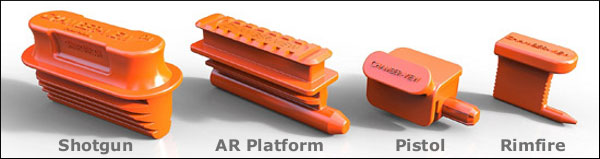

The patent-pending Chamber-View products are made of brightly-colored 100% silicone. This material has many advantages. It lasts a long time, staying flexible and resilient across a wide range of temperatures. The silicone won’t scratch fine metal surfaces. The material is not affected by most fluids and chemicals, and is heat resistant. In fact, the Chamber-View is an excellent heat sink. Chamber-View devices come standard in neon blaze orange, but a variety of bright custom colors are available.

December 10th, 2013
Looking for a gift for a young shooter in the family? Perhaps a niece or nephew, grandson or grand-daughter? Then head over to the Pyramyd Air website. Pyramyd, the nation’s largest retailer of air rifles and air pistols, has a huge selection of airguns that can provide the perfect introduction to the shooting sports for a youngster. And right now, Pyramyd is running a 12 Deals of Christmas Special, with new bargains every day through December 15th. Pyramyd also offers FREE Shipping on orders over $150.00. That all adds up to impressive savings on gift items for this holiday season.

Pyramyd offers a vast collection of air rifles, from $35.00 Red Ryder BB guns to $3700.00 Olympic-class air Rifles from Anschutz and Feinwerkbau.

December 8th, 2013
 Christmas is coming up soon, so today we’re featuring a hand-picked collection of “stocking stuffers” for precision shooters. You can order most of these items online, and if you get your orders in soon, your selections should arrive before December 25th. So as not to bust your holiday budget, all of our selections are priced under $10.00. These items are handy tools that you’ll use over and over again at the range and/or at your loading bench (so you’re allowed to buy them for yourself, even after Christmas). Christmas is coming up soon, so today we’re featuring a hand-picked collection of “stocking stuffers” for precision shooters. You can order most of these items online, and if you get your orders in soon, your selections should arrive before December 25th. So as not to bust your holiday budget, all of our selections are priced under $10.00. These items are handy tools that you’ll use over and over again at the range and/or at your loading bench (so you’re allowed to buy them for yourself, even after Christmas).
Gifts $1 to $5

Surveyors Tape
$1.99 |

Hood Kwik Estimator
$2.50 |

Bifocal 3X/6X Magnifier
$2.75 |

Barrel Mirage Shade
$4.95 |
|
Surveyors’ Tape. Always watch the wind when you shoot. Inexpensive, Day-Glo Surveyors’ Tape (aka “Flagging Tape”), attached to a stake or target frame, makes a good wind indicator. It will flutter even in mild breezes, alerting you to both angle and velocity shifts. This should be part of every range kit. Don’t leave home without it.
Hood Kwik Estimator. Here’s a very handy tool to measure your 6mm groups. Bracket the group within the diverging lines of the Kwik Estimator and you’ll instantly get a good approximation of the actual group size. No more trips to the tool box for calipers. The inexpensive Kwik Estimator fits in a shirt pocket. (Thanks to Boyd Allen for this suggestion.)
Bifocal 3X/6X magnifier. This handy, inexpensive dual-power magnifier is always close at hand on our loading bench, because it helps with so many task. We use a compact magnifier to inspect bullet tips, to check brass chamfers, and inspect the internals of triggers and other parts. Priced at just $2.75, a magnifier like this (or the folding variety) is a “must-have” item for every hand-loader.
Sinclair Barrel Mirage Shade. For high-volume varminters, and competitors who shoot fast in warm weather, a mirage shield is absolutely essential. This prevents hot air rising off the barrel from distorting the image in your scope. The aluminum Sinclair shield can be trimmed to fit, and comes with stick-on Velcro attachments. Two lengths are available: 18″ for short BR barrels, and 24″ for longer barrels.
Gifts $6 to $10

Dewey Crocogator
$6.50 |

Ballistol Aerosol Lube
$8.99 |

Sinclair Barrel Bag
$9.95 |

Sinclair Load Block
$9.99 |
|
Dewey Crocogator. The Crocogator tool, with knurled “teeth” at both ends, is simple, inexpensive, and compact. Yet nothing zips though primer-pocket gunk faster or better. Unlike some cutter-tipped primer pocket tools, the Crocogator removes the carbon quick and easy without shaving brass. One end is sized for large primer pockets, the other for small.
Ballistol Aerosol Lube. Ballistol is a versatile, non-toxic product with many uses in the reloading room. We have found it is ideal for lubricating cases for normal full-length sizing. It is clear, not gooey or chalky like other lubes. It is very, very slippery, yet is easy to apply and just as easy to wipe off. As you lube your cases, the Ballistol will also clean powder fouling off the case necks. For heavy-duty case forming and neck expansion, we’ll still use Imperial die wax, but for every-day case sizing, Ballistol is our first choice. It also helps prevent your dies from rusting and it even conditions leather. Ballistol is a favored bore cleaner for Black Powder shooters because it neutralizes acidic powder residues.
 Sinclair Barrel Bag. If you run a switch-barrel rig, or take spare barrels to a big match, this simple but effective barrel bag will protect your valuable steel. The bag is moisture-resistant vinyl on the outside with a soft, quilted interior to protect the barrel’s finish and delicate crown. There are two sizes: one for barrels up to 26 inches, the other for barrels up to 31 inches. Both sizes are priced at $9.95 per bag. That’s cheap insurance for those priceless barrels. Sinclair Barrel Bag. If you run a switch-barrel rig, or take spare barrels to a big match, this simple but effective barrel bag will protect your valuable steel. The bag is moisture-resistant vinyl on the outside with a soft, quilted interior to protect the barrel’s finish and delicate crown. There are two sizes: one for barrels up to 26 inches, the other for barrels up to 31 inches. Both sizes are priced at $9.95 per bag. That’s cheap insurance for those priceless barrels.
Sinclair ‘Poly’ Loading Block. We’ve tried wood and injection-molded loading trays, and we prefer Sinclair’s white polyethylene loading blocks. They featured chamfered holes properly sized for the particular case you reload. The blocks are heavy enough to be stable on the bench, and the “dishwasher-friendly” material is easy to clean. The standard Poly Loading Block holds 50 cases, while the Competition Loading Block holds 25 cases with a tray for empties. For a bit more money, there’s also a Heavy-Duty 50-case model with an extra-thick 1″ base.
December 4th, 2013
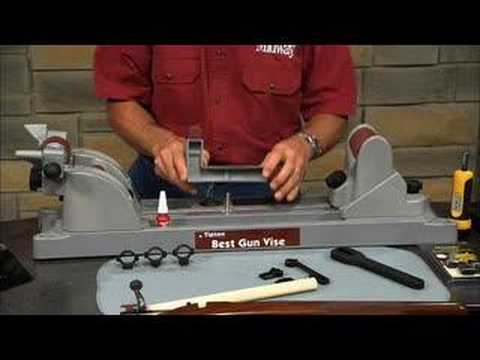
 Every shooter needs a gun vise to hold a rifle securely during cleaning, scope-fitting, and other operations. Ideally the vise should adapt to a variety of firearms and have storage for patches, jags, and solvents. The Tipton Best Gun Vise fits the bill, and right now you can get this versatile vise for just $49.99 at Cabelas.com. The Tipton Best Gun Vise is an highly-adaptable unit that can be configured in many ways. Every shooter needs a gun vise to hold a rifle securely during cleaning, scope-fitting, and other operations. Ideally the vise should adapt to a variety of firearms and have storage for patches, jags, and solvents. The Tipton Best Gun Vise fits the bill, and right now you can get this versatile vise for just $49.99 at Cabelas.com. The Tipton Best Gun Vise is an highly-adaptable unit that can be configured in many ways.
This is a very good deal — you may want to jump on it. Consider this — the lowest price we found elsewhere was $81.57 at Amazon.com. Cabela’s normally sells this unit for $99.99, so the $49.99 Sale Price is a steal.

Best Gun Vise Offers Great Adjustability
 On the “Best” Vise, the front support, center support, and rear support all slide back and forth AND adjust for height. That makes the Best Vise incredibly versatile. It has a convertible central support that works well for AR rifles, and even some handguns. One Tipton Best Vise owner explains: “I am a gunsmith and am always putting guns in awkward positions to work on them. The versatility from the adjustable parts of this vise makes those once awkward positions stable and solid. I have yet to find a position the vise would not hold my gun in. This product was very well thought out and is well worth the money.” On the “Best” Vise, the front support, center support, and rear support all slide back and forth AND adjust for height. That makes the Best Vise incredibly versatile. It has a convertible central support that works well for AR rifles, and even some handguns. One Tipton Best Vise owner explains: “I am a gunsmith and am always putting guns in awkward positions to work on them. The versatility from the adjustable parts of this vise makes those once awkward positions stable and solid. I have yet to find a position the vise would not hold my gun in. This product was very well thought out and is well worth the money.”
Another verified owner of the Tipton Best Gun Vise says: “The center post is reversible with long and short towers which makes it great for break-open guns like single shots, over/under, and my favorite, my AR. The clamps can be pre-adjusted so that you just place the buttstock between the protective clamp pads and squeeze the cam-locks on each side and you’re ready to clean, work on, or even [do a bore-sighting]. The vise has a nice assortment of different shaped storage slots (some round, some rectangular) to hold solvent, patches, brushes or other tools. It is very sturdy… and made to last.”

To really understand how the Tipton Best Gun Vise can adapt to just about any rifle, you have to see it in action. In the video below, MidwayUSA President Larry Potterfield puts a Best Gun Vise through its paces, and shows hows to adjust the various supports.
 Sale Find by EdLongrange. We welcome reader submissions.
November 14th, 2013
 Do you need a solid, yet affordable front pedestal rest for load testing or varmint shooting from a bench? Here’s very good deal from Grafs.com. Right now the Caldwell Rock BR front rest is on sale for $129.99. That’s $20-$50 cheaper than you’ll find it elsewhere. And Graf’s $129.99 price includes ground shipping (after a single $6.95 handling fee for any order). The Caldwell BR rest isn’t super high-tech, but at 15.5 pounds, it provides a solid platform, with a wishbone-style, cast-iron base. A knob on the left allows easy windage adjustments. The three-lobe bag works fine for prairie dog safaris and general use. For competition, you may want to upgrade to a higher-quality front bag from Edgewood or Protecktor (this may require some minor modification to bag cradle). Do you need a solid, yet affordable front pedestal rest for load testing or varmint shooting from a bench? Here’s very good deal from Grafs.com. Right now the Caldwell Rock BR front rest is on sale for $129.99. That’s $20-$50 cheaper than you’ll find it elsewhere. And Graf’s $129.99 price includes ground shipping (after a single $6.95 handling fee for any order). The Caldwell BR rest isn’t super high-tech, but at 15.5 pounds, it provides a solid platform, with a wishbone-style, cast-iron base. A knob on the left allows easy windage adjustments. The three-lobe bag works fine for prairie dog safaris and general use. For competition, you may want to upgrade to a higher-quality front bag from Edgewood or Protecktor (this may require some minor modification to bag cradle).
We think this $129.99 price is a stellar deal. Check out the prices for the Caldwell Rock BR rest at other vendors (prices effective November 14, 2013):


Will this Caldwell Rock rest perform as well as a Farley, John Loh, or SEB front rest? Obviously not, but not everyone needs a state-of-the-art rest costing more than a factory hunting rifle. And consider this, you can buy the complete front rest for less than the cost of some of the super-deluxe, large-footprint rear bags. If you’re looking for a general-purpose rest that may see hard use around a ranch or farm property (or on varmint hunts), keeping your investment down isn’t such a bad idea.

|


