by GS Arizona, Riflemans Journal
Neck turning isn’t a once-in-a-while operation at my reloading bench. I shoot a lot, go through a fair amount of brass and neck-turn every piece of brass I use. I like the K&M neck turner, it’s well designed, well made, affordable if you like to have more than one caliber permanently set up and so that’s what I use. The only flaw in the K&M is that the tool itself is small enough that holding it for long and frequent session of neck turning is literally a pain. If you happen to have arthritis, it’s even more so.
Pendergraft Holder for K&M Neck-Turner Joel Pendergraft makes a great tool holder for the K&M that does away with the pain as it gives a much larger and more comfortable gripping surface. The tool holder is made from aluminum, nicely machined and knurled for a good grip. I thought it was well worth the price of $48.00 delivered in the USA (Price may have gone up since this story was written). Switching the tool holder from one K&M turner to another is a matter of loosening the set screw on the side, slipping out one turner, inserting the other and re-tightening. The Pendergraft tool-holder is simple, well-made, fairly priced and a real joy to use. Who could ask for more?
If you have questions or want to order the K&M tool holder, contact Joel Pendergraft via email: joelpend@bellsouth.net .
The beautifully-made Pistol Dynamics (PD) Products Cartridge Caddy has become popular with many top shooters. USA F-Class Shooting Team members Shiraz Balolia, Kenny Adams and others rely on these caddies to access ammo and keep time. By providing a clear, unmistakable visual display of time remaining and rounds fired, these ammo caddies make life easier for shooter, scorer, and coach.
To celebrate the 2013 F-Class World Championship in Raton, New Mexico this month, PD Products, through its Formula-F Division, has introduced a limited run of sequentially-numbered World Championship Caddies with F-Class World Championship graphics and optional name engraving. Production of these 25-round caddies will be limited by the number of units sold to participants of the match and will cease after that point.
Caddies Custom-Fit Your Choice of Cartridge
Caddies are available for a variety of cartridge types from .223 Rem to 7mm Magnum. Some Caddies are multi-caliber capable. For example, the .308 block accepts .308 Win, .243 Win, 7mm08, and other .308 family variants. Limited-edition ‘World Shoot Caddies’ cost $140.00 (shipping included) with optional name engraving for $20.00 extra (at time of purchase).
Original Caddy Also Available for $110.00
PD Products’ original On-Time Caddy is still available for $110.00, including standard shipping within the continental USA. Custom name engraving is also available on this product. Both the original PD Products Caddy and the special Limited Edition World Championship Caddy come with a lifetime warranty on machined parts and one year on the timer.
To learn more about the special ‘World Shoot’ Caddy or the original On-Time Caddy visit the PD Products website, call (321) 733-1266, or send email to: info [at] pistoldynamics.com .
If you want to win shooting matches you’ll need to gauge wind speed and direction. While many shooters use the excellent Kestrel pocket Weather Trackers, many top shooters are turning to the Windtronic 2, a German-made unit that measures wind speeds from any direction.
The Windtronic features rotating cups mounted on a vertical axis. With this design you don’t have to align the unit with the wind, unlike the Kestrel WindMeter or SpeedTech WindMate™ devices. Many users feel the Windtronic’s unique design allows it to read wind speeds more accurately; it certainly can respond to shifting winds more easily. The omni-directional functionality of the Windtronic allows it to be mounted on a stand or tripod and continuously display current wind speed, max wind speed, and average velocity.
The Windtronic 2 doesn’t gauge temperature, barometric pressure, humidity, or density altitude, unlike the more advanced (and expensive) Kestrel 4000/4500 model pocket weather trackers. The Windtronic only records wind speeds, but it does that one task exceptionally well.
Made in Germany by Kaindl Electronics, the Windtronic 2 comes with a 2-year manufacturers warranty and retails for $99.00 on Amazon.com. (Amazon.com provides AccurateShooter a small commission on sales). Other vendors include Windtronic.us and Windpowersports.com.
Do you have a favorite large-caliber rifle that sits in the safe because it’s just too painful to shoot? Perhaps you’re planning a big-game safari, and you need to comparison-test some ammo, but you dread the punishment you will take firing many dozens of rounds over the course of an afternoon. Well TargetShooting Inc. has a solution. Two new accessories are offered for TargetShooting’s model 1000LP one-piece shooting rest that tame the recoil of even the hardest-recoiling rifles. Up front, a 19.85-lb weight provides extra mass for the unit, keeping the 1000LP firmly planted. In the rear, an adjustable Recoil Pad Assembly soaks up recoil energy. The key component is a very thick Sorbothane pad that adjusts to the angle of the butt on your rifle.
With the recoil reduction system in place, we have tested the 1000LP with a variety of hard-hitting calibers: 50 BMG (with brake), .458 Lott, .338 Lapua Magnum, .375 H&H. It handled all these big boomers well, and the felt impact on the shoulder was significantly reduced. We won’t say you can shoot a .50 BMG “all day long” with this rig, but this set-up is definitely a shoulder-saver. If you are testing ammo with a hard-recoiling caliber, the 1000LP with recoil reduction allows you to fire more rounds without abusing your body, or developing a bad flinch. We also tested the 1000LP with a common hunting caliber — the venerable .30-06 — and the felt recoil was really quite mild. Honestly, you could shoot many dozens of rounds of .30-06 or .308 Win with this rig without having to take multiple “time-outs” (or see a chiropractor). By itself, the 1000LP one-piece Rifle Rest costs $699.95. The adjustable Recoil Pad Assembly sells for $349.95 extra. The low-profile, forward counter-weight unit costs $139.95. The 1000LP and all its accessories are precision-crafted with very high levels of fit and finish.
The weight of the rifle and the shape of the stock/chassis will affect how the gun behaves on recoil. Light rifles with narrow fore-ends tended to jump a bit out of the front bag. Heavier rifles with a beefier chassis would recoil more in a straight line. But no matter what the caliber (or stock type), the Sorbothane recoil pad soaked up the lion’s share of the recoil, dramatically reducing the shock (or jolt) you actually feel on your shoulder. By the laws of physics, the energy of the rifle’s recoil can’t magically disappear. However, when using this system, the smack on your shoulder is much diminished and the perceived recoil “hit” (on your body) is far less extreme.
Note: The 1000LP is designed to slide a bit when used with a big-caliber gun. If the rest did not move at all, this could cause problems with stocks or optics. On a concrete bench-top the rest might slide back 1/2″ to 3/4″ after firing a big-caliber round. After a couple shots we would reposition the rest. This was easily done by sliding the rest forward on the three legs (you do not have to lift up the entire rest between shots — just push it forward, while keeping the rear “superfoot” pad aligned under the rear adjuster).
When developing loads, it is important to know the true internal capacity of your cases, both fired and “as FL-sized”. In particular, when using the QuickLOAD program, it is vital to determine true case capacity. The default case capacity values listed by QuickLOAD may be off half a grain (or more) because brass from different manufacturers can vary considerably in capacity. Case capacity is a very important variable that will affect the pressure of a load and the velocity of your bullets.
To determine the true internal capacity of your cases, first weigh an empty cartridge case, then fill the case with water (all the way to the top of the neck) and weigh the case again. The difference in weight is your H20 capacity in grains. But how do you keep the H20 from flowing out the bottom? When measuring fired, unsized cases, you can simply leave the spent primer in the pocket. However, if you want to measure new brass or “as-FL sized” cases that have been deprimed, you’d have to insert a spent primer to “stem the tide”. Until now that is… 21st Century Shooting has come up with a simple tool that plugs the bottom of the case so you can measure H20 capacity with ease.
When we saw 21st Century’s Primer Pocket Plug we thought “That’s smart — why didn’t someone think about that a long time ago?”. This handy “end-cap” lets you quickly measure multiple new brass cases or deprimed FL-sized cases so you can get an average H20 capacity. The primer pocket plugs are NOT case-specific (they feature an O-ring that fits the pocket). One version will work with all small-primer-pocket cases, while another works with all large-primer-pocket cartridge types. Price is $19.95 for either small-pocket or large-pocket version.
NOTE: If you want to measure H20 capacity on fired, sized brass, but don’t want to shell out the money for the tool (or re-insert a spent primer), here’s a simple suggestion. When you size your case, first remove the decapping rod from the die. Then you can FL-size the case without removing the primer. Of course, you will eventually have to knock the primer out, and that requires putting the decapping rod back in the die and running the case through a second time. To avoid that hassle, the Primer Pocket Plug may be worth the $19.95 over the long haul. We just ordered one of each (small and large).
Product Find by EdLongrange. We welcome reader submissions.
Made by the same folks that created Wipe-Out™, and Carb-Out™, the NO-LEAD Brushless Lead Remover™ really works. Honest. If you are an active rimfire shooter, or if you shoot cast lead bullets in centerfire rifles and pistols, you should try this product. This stuff was introduced a year ago. We now use NO-LEAD in our rimfire benchrest rifles, and in some centerfire guns that receive a steady diet of soft-alloy cast bullets (90%+ lead). (With rimfire guns, you don’t need to use NO-LEAD very often — maybe every 300-400 rounds unless you have a real fouler of a barrel.)
If you’ve got stubborn lead fouling in a rimfire barrel, or on a pistol’s muzzle brake/compensator, you should definitely give this stuff a try. We don’t know how but it does soften lead deposits. The manufacturer says you don’t need brushes, but we found that a bit of brushing (after NO-LEAD application) can help remove more serious lead build-up.
Frankly we were surprised to find a lead solvent that really works. We have tried a half-dozen or more other lead “cleaners” that promise to dissolve lead and most of them, we discovered, are nearly useless. There’s a reason for that, as the lead alloys used in bullets don’t react to typical petrochemical-based solvents. It took the Wipe-Out chemists over five years to perfect a new water-based solution that really does dissolve lead.
NO-LEAD Cleaning Procedure — Read Carefully
NO-LEAD Lead Remover is a clear, red gel that is easy to apply. Just swab it in your bore (or on muzzle brakes) with wet patches or bore mop and let it sit for a few minutes. (The manufacturer says you can leave the NO-LEAD for up to 20 minutes, but that long of a dwell time does not seem necessary with our rimfire barrels.) When it contacts lead it will start to foam and you’ll see that the NO-LEAD solvent turns a pastel pink when it dissolves lead. The pink comes from the formation of lead oxide. After the recommended dwell time, simply patch out the dissolved lead deposits (you can also use a nylon brush for stubborn lead build-up).
NOTE: After cleaning, it is very important that you get all the NO-LEAD out of your barrel, and neutralize it. We recommend following the application of NO-Lead with Wipe-out or Patch-Out to neutralize the NO-LEAD, clear the bore, and remove residual carbon and copper fouling. If you don’t have Wipe-Out or Patch-out, flush the barrel thoroughly with Rubbing Alcohol or even a solution of Dawn dish detergent — then re-oil the bore.
Be Sure to Neutralize NO-LEAD After Use
Remember that N0-LEAD is a strong, slightly acidic chemical that needs to be neutralized after use. If you leave it on a nice, blued barrel for too long, it can harm the bluing. NO-LEAD will remove all the surface oils from the barrel bore. For this reason it is recommended that you neutralize NO-LEAD with Wipe-Out, or Patch-Out, which both contain effective corrosion inhibitors. If you don’t have those products, once you’ve flushed the NO-LEAD with something like rubbing alcohol, then follow with a gun oil. Caution: A petroleum-based gun oil will NOT, by itself, neutralize NO-LEAD. You need to neutralize first, then apply the corrosion inhibitor (or do it all in one step with Wipe-Out or Patch-Out).
Where to Buy NO-LEAD Lead Remover
NO-LEAD Lead Remover costs $14.99 for an 8 oz. squeeze bottle with a flip-top spout. This product is sold directly by Sharp Shoot R Precision Products, www.Sharpshootr.com, or you can purchase NO-LEAD through many other online vendors. For more information, email gethelp@Sharpshootr.com or contact Sharp Shoot R at (785) 883-4444. You can ask for Terry Paul, Sharp Shoot R’s owner and the master chemist who developed the NO-LEAD formula.
Service Rifle shooters and varminters burn through a lot of ammunition. If you’re shooting more than 250 rounds of ammo a month, you may want to consider getting a progressive press — at least for your practice and varmint ammo. New technologies have made today’s progressives more efficient than ever. RCBS has developed a rifle-bullet feeding system that works with the RCBS Pro 2000 Progressive. The bullet-feeder can also be fitted to some Dillon units with modifications. There are four main components to the RCBS rifle-bullet feeder system: 1) base and two-piece adjustable column; 2) collator (bowl and motor); 3) drop tube and shutoff assembly; and 4) bullet feed die assembly.
Our friend Gavin Gear has tested the RCBS bulet feeder on an RCBS Pro 2000 for his UltimateReloader.com website. You can see his hands-on video review above. I’m pleased Gavin did this review because I have a Pro 2000 myself, and I can confirm that it is a very good machine. It is sturdy, the rotary-style powder measure is very precise, and the strip primer system works great. (I can change from small primer feeding to large primer feeding in a couple of minutes — honest.) I’ve also found the strip primer system virtually foolproof — so long as you insert the strips in the right direction! I haven’t used the Bullet Feeder yet, but you can see the Pro 2000 in action with the feeder in Gavin’s video above.
On UltimateReloader.com, Gavin puts the RCBS Bullet Feeder through its paces. Gavin writes: “As you can see from this picture (at left), the RCBS Rifle Bullet Feeder adds quite a bit of overall height to the progressive reloader.This is the case with all bullet feeders that use a collator (some add more than others). One of the reasons that these units are tall is to allow for a sufficient ‘buffer’ of dropped bullets so that the collator can keep up with fluctuations in loading speed and to allow enough ‘stack weight’ on the column of bullets so that they drop/feed correctly.” As fitted to the Pro 2000, Gavin says the bullet feeder system achieves “very efficient loading with excellent COL consistency and bullet concentricity.”
Runaway Technology offers a sophisticated yet easy-to-use ballistics program that runs on the Apple I-Pod Touch and Apple I-Phone platforms. The BulletFlight 4.0.0 software contains all the features you would want, including: user-selectable BC models (G1, G7, G8 etc.); output in inches, cm, MOA, Mils, and scope clicks; 360° wind drift calculation; computation of actual BC from collected data; and built-in accelerometer for angle detection.
In addition, BulletFlight 4.0.0 comes with a large database of bullet types (including weights, BCs etc.). You can also create your own custom ammo profiles (with velocity, BC, bullet type), allowing you to easily output ballistic plots for multiple firearms, without having to enter the rifle/bullet profile every time. The latest 4.0.0 version is faster than before, and 299 more projectile types have been added to the bullet database.
BulletFlight 4.0.0 is a very sophisticated program that rivals anything you can run on your home computer. A version of BulletFlight is already in use with the U.S. Military in Iraq and Afghanistan. The Apple operating system and “multi-touch” screen allows an extremely user-friendly interface. (And with the I-Pod Touch, you do NOT need a phone service contract.) “Ruggedized” Otterbox carry cases are also available for both first- and second-generation I-pods.
Software Starts at Just $3.99
There are three versions of KAC BulletFlight, all very affordable. The basic BulletFlt L1 edition (3.1.0 version) costs just $3.99. We recommend the BulltFlt L2 edition (3.1.0 version). At $11.99, the L2 software adds a full calculation screen, the ability to generate a range-card, cosine-angle calculation, and GPS functionality. Finally, the $29.99 BulletFlight Level ‘M’ 4.0.0 version further adds the ability to calculate an actual BC based on bullet drop, two velocities, or flight time. The Level ‘M’ version can also correct for subtle factors, such as the Coriolis Effects, which come into play at ultra-long ranges.
Between shooting, riding motorcycles, and working with gas-powered yard equipment, your Editor probably has foam plugs in his ears 8-12 hours a week. I’ve tried many different varieties of ear plugs, both the foam variety and the soft plastic flange-type plugs.
I’ve recently started using the Howard Leight MAX-1 plugs. Rated at NRR33, these are, quite simply, the best ear-plugs I’ve ever tried. No BS — these things really work. Among all disposable plugs I’ve tried, the MAX-1s are definitely the most effective at blocking noise, and they are also more comfortable than most other foam plugs I’ve used. In my experience at the range, these plugs block sound way better than most muffs (when worn without plugs underneath).
The first thing I noticed about these plugs is how much more effective they were than muffs alone. With muffs in place, a rifle report is still quite audible. With the red MAX-1 plugs, the noise from a shot is much, much quieter. Proof of the “real world” effectiveness of these plugs came when talking. The plugs work so well that I had trouble hearing words spoken by a colleague from just four feet away. With conventional (non-electronic) muffs I can hear a normal speaking voice from many yards away.
These MAX-1 plugs insert easily (if you roll them first), and the wide, flared outer bell makes them very easy to remove. Subjectively, these plugs seem more comfortable than most other foam plugs I have tried. They are certainly way more comfortable than the cheap, non-tapered ear plugs. MAX-1 plugs are available in both standard configuration and corded versions. These are cheap to buy — 20 pairs of non-corded MAX-1s cost just $4.25 on Amazon.com.
These ear plugs deserve all the raves they’ve received. They’re by far the best I’ve used and among the least expensive. They hold up very well when used repeatedly. This is the only brand I’ll buy from now on. — Joe
These things are as soft and gentle as they come and they block the noise out very well. I highly recommend them[.] — Byron
They are the best ear plugs I’ve ever used — and I’ve used many over the years. These are the only ear plugs I will ever use in the future. — Rhoda
My darling husband snores like the dickens. With a timid and hopeful heart, I purchased these ear plugs online. The first night I used these, I slept like a rock. The product is fantastic; the plugs stay small long enough when you pinch them so you can get them in, and they cancel out noises very well. I’m so happy I got these – they’re saving my marriage! — YC, Seattle
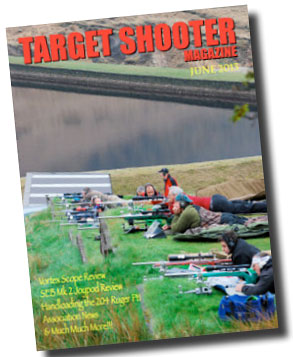
The June, 2013 Edition of Target Shooter Magazine is now available online, in PDF format. This month’s issue contains gear reviews, match reports, and a feature on handloading for the .204 Ruger cartridge. As ever, Target Shooter boasts plenty of great, large-format photos. Optics get considerable play this month with a comparison test of spotting scopes by Richard Utting, and an in-depth review of the Vortex Razor HD 5-20x50mm riflescope by Chris Parkin. There’s plenty of great reading material this month — and it’s all free to read online. (Be patient while downloading the PDF file).
Laurie Holland has authored two major articles in the June issue of Target Shooter Magazine. First, Laurie reviews the latest “Mk. 2″ version of Seb Lambang’s joy-stick bipod. Laurie found that Seb’s new “Joy-Pod” was beautifully built and performs “as advertised”. Laurie writes: “The coarse leg adjustment using the ratchet lock is excellent, allowing quick and easy set-up. The overall stability was better than on the Mk.1 — provided I loaded the butt slightly to push the bi-pod forwards and take up the small amount of slack that shows in the mechanism/joystick-head. I thought the Mk.1 prototype was a winner/game-changer. The Mk.2 is a further and noticeable improvement on that.”
Laurie has also compiled a very authoritative feature story on reloading for the .204 Ruger cartridge. Laurie discusses the available brass, powder, and projectile options for this popular cartridge. Laurie also includes Ballistics tables so you can compare performance with various loads. If you own a .204 Ruger rifle, or plan to get one, Laurie’s .204 Ruger story is definitely a “Must-Read”. This is Part One of a two-part series by Holland.


 Joel Pendergraft makes a great tool holder for the K&M that does away with the pain as it gives a much larger and more comfortable gripping surface. The tool holder is made from aluminum, nicely machined and knurled for a good grip. I thought it was well worth the price of $48.00 delivered in the USA (Price may have gone up since this story was written). Switching the tool holder from one K&M turner to another is a matter of loosening the set screw on the side, slipping out one turner, inserting the other and re-tightening. The Pendergraft tool-holder is simple, well-made, fairly priced and a real joy to use. Who could ask for more?


 If you want to win shooting matches you’ll need to gauge wind speed and direction. While many shooters use the excellent


 If you’ve got stubborn lead fouling in a rimfire barrel, or on a pistol’s muzzle brake/compensator, you should definitely give this stuff a try. We don’t know how but it does soften lead deposits. The manufacturer says you don’t need brushes, but we found that a bit of brushing (after NO-LEAD application) can help remove more serious lead build-up.
 Where to Buy NO-LEAD Lead Remover
 Our friend Gavin Gear has tested the RCBS bulet feeder on an RCBS Pro 2000 for his


 Between shooting, riding motorcycles, and working with gas-powered yard equipment, your Editor probably has foam plugs in his ears 8-12 hours a week. I’ve tried many different varieties of ear plugs, both the foam variety and the soft plastic flange-type plugs.
 These ear plugs deserve all the raves they’ve received. They’re by far the best I’ve used and among the least expensive. They hold up very well when used repeatedly. This is the only brand I’ll buy from now on. — Joe
 The June, 2013 Edition of


