How’d you like to own the most comprehensive resource on guns ever created, an interactive database with information on over 50,000 firearms? If that sounds intriguing, check out the $39.95 Firearms Guide on DVD (2d Edition) from Impressum Media.
Think of this as a digital encyclopedia of guns — the mother of all gun reference guides. The sheer amount of information is mind-boggling. The Firearms Guide covers over 50,000 models of firearms, airguns, and ammo from 425 manufacturers. Products are illustrated with 27,000 high-res color photos, plus 1,550+ schematics with parts lists for 130 gun-makers. If you’re a gunsmith or armorer, you’ll want to buy this DVD, just to have the searchable schematics with part numbers handy.
If you are a gun collector, or just an information junkie, you’ll find this DVD to be an invaluable resource. The DVD’s scope is truly worldwide, with coverage of gun makers in Western Europe, Eastern Europe, South America, South Africa and Asia as well as North America. With the DVD’s search capability you can search by gun caliber, manufacturer, and key features (e.g. “.223 Rem, Colt, folding stock”). There are 14 different search criteria — this allows you to “drill down” precisely to find the gun you want in seconds. Shown below are typical profiles of listed products:
There are some cool bonus features that significantly enhance the $39.95 DVD:
500 Printable Targets: game animals, silhouettes, crosshairs, sight-ins, fun targets.
FFL Locator – Searchable database of over 60,000 gun dealers in the USA with contact info.
US-EU Ammo Caliber Chart: Cartridge equivalency charts identify the correct domestic equivalent of European ammo.
Editors’ Comment: We were amazed with the sheer volume of data on this disk. It’s nice to be able to view the entire line of guns from major manufacturers (such as Ruger, Sako, Savage, and Sauer), along with products from “boutique” arms-makers. On the other hand, the vast majority of entries are mass production items. You won’t find many of the custom-built precision rifles that readers of this site prefer to own and shoot. Nonetheless, we enjoy being able to quickly see an entire product line, search a particular gun, and then access parts lists for repairs. I’ve got a .22LR Marlin Model 39A with a busted buckhorn rear sight, and I was able to find a replacement sight fixture in a matter of seconds. The FFL directory is handy and, as Gun Blast said in its review of this product: “The DVD is worth the price for the target images alone”.
Disclosure: Impressum Media provided a review copy of the DVD at no charge.
If you’re looking for a solid, beautifully fabricated loading press that can do double-duty at home AND at the range, consider the Combo Press from Harrell’s Precision, run by brothers Lynwood and Walter Harrell. Though it is very compact, it has plenty of leverage to full-length-size cases. The Harrell’s Combo Press works BOTH as an arbor press and as a standard press that functions with shell-holder and conventional screw-in dies. The arbor section on the left is tall enough to hold a Wilson micrometer-top seater. The threaded die section on the right has enough clearance for .308-sized cases.
One of the best features of the Combo Press from Harrell’s Precision is its sturdy clamp. This mounts solidly to a wood loading bench or table top. It also has enough vertical clearance between the jaws to work with most range benches. Forum member Boyd Allen has written a detailed review of the Harrell’s press, with additional photos by Paal Erik Jensen of Norway. The Harrell’s Precision Combo press retails for $295.00. That’s pretty pricey, but consider that it can replace BOTH an arbor press and a standard press. CLICK HERE to read full COMBO PRESS REVIEW
Combo Press Has Plenty of Power to Bump Shoulders
This Editor has loaded ammo with this press and I can say it performed well. It actually bumped shoulders on fired 6BR brass more easily than a larger cast-iron press we have in our loading area. I attribute that to the fact that the threads for the die are very precise and the shell-holder seats firmly on the ram, with no slip. Seating with a hand die (on the left side of the press) yields repeatable results, although I have to say I get better “feel” with a good Arbor press, such as those made by 21st Century, K&M, or Sinclair Int’l. I also like the availability of the seating Force Gauge on the K&M Arbor.
Some High Power shooters on the Forum asked about carts for carrying their gear to the range. You can certainly purchase a factory-made, purpose-built cart that folds up and has all the bells and whistles. The Creedmoor Sports CRC-1 (photo right) is a proven, quality product that works great. You’ll find these used by top shooters at Camp Perry. But the Creedmoor CRC-1 cart costs $499.95.
For a tenth that price ($49.99), plus a few dollars more for do-it-yourself enhancements, you can have a heavy-duty cart that will haul all your gear just fine, though it doesn’t fold up.
Check out the Harbor Freight Welding Cart, item #65939. This cart is ON SALE right now for just $49.99. Overall size is 29-1/2″ L x 20″ W x 49″ H, and width between side rails is 18″. The wheels (with tires) are 20 3/4″ in diameter for smooth rolling. Consider that, if you made your own cart from scratch you could easily pay $30.00 or more just for the large-diameter wheels and axle. Do note — this cart has air-filled tires. Be sure to inflate before you go to the Range!
As sold, the Harbor Freight Welding Cart isn’t quite ready for range use. But it’s easy to add plastic side-panels on the bottom unit, and fit a barrel-holding system on the cross-tube. I also suggest bolting/welding on extra spacers on the most forward underside edge of the bottom so that, at rest, the cart tilts slightly back. This ensures rifles and gear won’t flop forward. (A bit of extra lift also keeps the bottom plate out of the dirt and gravel.)
How to Upgrade Welding Cart for Range Use
Get a block of hard foam rubber. Cut keyhole slots in the rubber to grip the barrel and umbrella/scope stands. Mount the rubber block to the cross piece with self-tapping screws, or drill a horizontal channel in the rubber so the whole block fits over the cross-tube. On the lowest leading edge of the welding cart box (at ground level, front), fit a block of wood 2″ high (you can also fabricate metal extensions). This will make the cart lean back a little more, which helps stabilize the contents on sloping terrain.
You’ll want to enclose the sides of the bottom box area so small items don’t fall out. You can tack-weld aluminum side-plates if you want a fancy appearance. I prefer to just cut sheet plastic from a home improvement store. These plastic panels can be attached with screws or even zip-ties around tubing.
Run the plastic side panels up high enough that stuff like hats and muffs don’t fall out. After transport you can transfer ammo boxes and small items to the upper box (attached to the back side of the cross-tube).
The hardest component to find may be the hard rubber blocks for the barrel keeper, but you can also make a barrel-holding block out of wood, with some carpet to protect the barrels. The nice thing about the rubber is that it can be cut to snap over the barrels so you don’t need straps. Likewise, you can drill a hole transversely through the rubber, then slot it from the bottom and it will slide over the horizontal tubing with no fasteners needed.
Comment: This cart is heavy and it takes up a lot of space. You’ll need a station wagon, SUV or pickup truck to haul it around. But it’s cheap. The money you save on a range cart could pay for a new Krieger or Bartlein barrel, AND some new brass. Those things (new barrel and brass) will likely improve your scores more than having a fancy $500.00 range cart.
At the Pyramyd Air booth we ogled high-end competition air rifles from Feinwerkbau and Anschutz. These are Olympic-grade rigs, with prices (for the Anschutz) approaching four grand fully outfitted with all the accessories, plus premium sights. It’s obvious the Germans take accuracy very seriously when it comes to airgun engineering.
New Full-Auto Pneumatic Rifles from Evanix
We were quite surprised to see a full-auto offering among the many new products on display. Evanix of South Korea is now producing a pair of self-loading, pre-charged pneumatic air rifles that can shoot in either semi-auto or full-auto modes. When running full auto, the electronically-controlled servo breach can cycle pellets at the equivalent of 400 rounds per minute. We’re not sure why full auto capability is needed, but this certainly offers a new experience for the air gun crowd. An airgun is definitely the cheapest way to go if you have a hankering for “hosing down targets” (quoting the AirGun Reporter video below). We do like the self-loading feature for general plinking and “fun gun” use, and the 2.5-lb trigger is decent for bench use. The Evanix Conquest sells for $1699.99. Being a brand new product, the Conquest is not yet in stock but Pyramyd is taking pre-orders now. To see how the Conquest operates in full-auto mode, watch the video below.
At SHOT Show, we had the chance to meet with German software engineer Hartmut Broemel, creator of QuickLOAD software. This software program, while not a substitute for conventional load manuals, allows shooters to evaluate a wide range of powders and bullets, comparing potential loads on the basis of predicted pressures, velocities, load density and projectile in-barrel time.
We took the opportunity, in the video below, to explain some of the fine points of QuickLOAD for our members. QuickLOAD, sold by Neconos.com, helps reloaders understand how changing variables can affect pressures and velocities. It can predict the effect of changes in ambient temperature, bullet seating depth, and barrel length.
In the video below we explain how to adjust the program for true case capacity, bullet seating into the lands, and other important factors. If you are a new QuickLOAD user, or are contemplating buying the $152.95 program, you should watch the video. The program isn’t perfect, but it can accelerate the load development process, and it can save you money by narrowing down the list of appropriate powders for your cartridge.
No other product currently available to serious reloaders offers as much predictive power as QuickLOAD, and you’ll find your money well spent just for the vast collection of data on bullets and cartridges. With a couple mouse-clicks you can instantly get the specifications of hundreds of bullets and cartridges. Likewise, in a matter of seconds, you can compare load density for a half-dozen powders, or compare the projected velocities of one cartridge versus another.
Our 2012 SHOT Show Media day adventure kicked off with some serious firepower. After arriving at the Boulder City Rifle range and signing the obligatory legal release forms, Jason Baney and I made a beeline for the Colt shooting bay where an amazing Bulldog 1877 repro Gatling Gun was on display. These fully-functional, authentic replicas are crafted by the Bulldog company for Colt. You can buy one if you have a cool $50,000.00 to spend. You heard it right — fifty thousand dollars.
Jason is friends with Gatling project director John Buhay, who let both of us send some 45-70 rounds downrange. While the Bulldog Gatling can dispense a prodigious amount of lead in a few seconds (rate of fire determined by how fast the operator cranks), this firearm is not considered an NFA machine gun. Because an advancement of the crank is required for each shot to be fired, this Gatling is not subject to the severe restrictions imposed on Class III arms. You can purchase a Bulldog Gatling, so long as you would otherwise qualify to legally own a long gun.
Three things surprised me about this Gatling. First was the stunning appearance of the unit. It is beautifully machined and every polished metal component shown like gold in the morning sun. The stability of the unit was also surprising. Because the Bulldog is so big and heavy, it barely bobbles as it sends round after round through its five barrels. And surprisingly little force is required to work those barrels. The crank spins easily. I could see how a trained team of Gatling operators could, back in the 19th century, burn through thousands of rounds of ammunition in a few minutes.
UltimateReloader.com created an informative video that shows how to use the new Hornady Lock-N-Load Concentricity Gauge and Ammo Straightener. This tool can measure run-out on both the bullet and on the case-necks. Run-out is deviation from the cartridge centerline axis. Too much run-out, i.e. poor concentricity, can reduce accuracy, although when you seat bullets into the lands, a certain amount of bullet self-straightening can take place.
Hornady Tool Supports Cartridge on Both Ends
The new Hornady Concentricity Tool supports the case at two ends. As a result, the Hornady Tool will tend to yield lower run-out figures than a tool such as the Sinclair concentricity checker which supports the cartridge on the case body alone, giving the bullet unrestricted movement as the case body is rotated. As UltimateReloader explains: “Each measurement tool measures run-out differently, so you’ll need to factor that into your goals for your own match ammunition.”
Bullet ‘Straightening’ with Hornady Concentricity Tool
The Hornady Tool can be used to push seated bullets to one side or the other, reducing measured run-out. The Hornady tool has a threaded pusher that side-loads the bullet. As you screw the pusher inwards in you can see the run-out on the dial indicator decrease. That straightening process is shown in the Hornady-produced video below, at the 25-second mark. In Sinclair Intl’s Reloading Press blog, Pete Petros reports: “It can take a little bit of trial and error to get this just right, but it does work.”
Is Bullet Straightening Really That Effective?
This bullet straightening procedure, whether done with the Hornady tool or other device, is a somewhat controversial technique. Some folks say that straightening bullets simply transfers run-out back down to the case neck. Petros notes: “One concern that comes up is what are you doing to the neck of the case in terms of neck tension.”
On the other hand, many shooters claim their ammo shoots better after they straightened rounds which initially showed excessive run-out. One Hornady Concentricity Tool user writes: “The straightening feature on the Hornady tool makes bullet/case concentricity easy to correct and after using this tool, I wouldn’t be without one. Variations on [my] cast bullets have gone .020″ and when straightened, I can get down to below .001″. It takes a bit of practice, but it’s possible to make every round straight. At the 100-yard range yesterday using my straightened rounds … five-shot groups averaged .500. Before I would always have flyers and now I can see why this time I didn’t have any flyers. Straight rounds produce more consistent groups!”. Read more.
Bullet straightening with the Hornady Tool or other devices can certainly make a difference in run-out that shows up on the dial. Whether that improvement in perceived concentricity actually produces better accuracy remains an open question. Using high-quality dies with good bullets, seated in good, straight brass, you should be able to load ammo with very low run-out from the get-go. It may be better to try to achieve low run-out during your normal loading process rather than rely on the “band-aid” of bullet straightening as a last resort. On the other hand, if you are starting with factory-loaded ammo, re-aligning bullets in the case-necks may be a useful exercise. We invite our readers to comment on their experiences with bullet straightening. Has the straightening process worked for you?
Here’s something that can save you lots of time and aggravation on a varminting trip. This little $110 gizmo is great for varmint hunters and any one who needs to make a quick shot in shifty wind conditions. Instead of the traditional 1/4-MOA hash marks, the Kenton windage turret features markers corresponding to the wind drift your ammo will encounter at various distances (with 10 mph full value winds). You just dial the distance.
Custom-Calibrated Windage Knobs
Kenton Industries’ Tuned Windage Compensator (TWC) has built-in windage marks for 10 mph cross-winds at 100-1000 yards. How do they do that? Well the knobs are calibrated either for specific calibers/loads, or they can make custom knobs using your observed field data. The knobs can compensate for various wind speeds (2-20 mph) and angles (15°- 90°), by applying some simple conversion ratios. As a general rule, with a “full-value”, i.e. 90°, crosswind, the wind drift will go up or down in direct proportion to the change in windspeed. That means, for example, a 10 mph crosswind will push the bullet twice as much sideways as a 5 mph crosswind.
Two versions of Kenton’s TWC knobs are offered. The $109.95 TWC #1 features calculated ballistics for standardized factory ammo for the caliber and barrel length you specify. The $109.95 TWC #2 feature customized windage settings based on bullet BC, environmental conditions, elevation, and ballistic information you provide.
Custom Elevation Knobs
Kenton also makes a $109.95 elevation-compensating TTC knob, that can be customized to your rifle. With this elevation turret, yardages are marked in 50-yard increments, and you can literally just “dial in your distance”. However, to work effectively the TTC knob must be tailored to a particular load (velocity and bullet). Moreover, actual bullet drop will differ with changes in altitude, temperature, and shooting angle — so it’s not as simple as it sounds, and you may need multiple knobs if you shoot a variety of loads. Kenton offers it TTC #1 model calibrated for standardized factory ammo. The TTC #2 is calibrated out to the maximum effective range of your cartridge based on bullet type, muzzle velocity, altitude, and temperature. Select the type of yardage format to be used. The #2 is recommended for wildcatters or for those who want to adjust to specific conditions. Lastly, a TTC #3 elevation knob is offered that relies on the purchaser’s actual recorded drop data from the field. The TTC #3 elevation knob will be calibrated based on the click-value or MOA you provide for each 50-yard increment.
Rade Tecnologías SL, through its USA subsidiary Radetec, has developed a fired-shot counting system for pistols and long guns that offers immediate benefits for soldiers and LEO personnel. Down the road, we envision how an automatic shot-counting system could benefit Multi-Gun and High Power competitors. Firing one shot too few in a course of fire can lose a match, and firing one too many can have the same result — or worse yet, a DSQ.
Two Display Options for Pistols Radetec’s SpeedShot shot-count system employs a sensor in a special, dedicated magazine which outputs to either a digital or LED light display. Both the numeric display and color-changing LED light indicate rounds left in the magazine. For pistols, Radetec will market custom grips which incorporate the shot-counter display modules. Currently, Radetec systems are available for Beretta, Glock, Smith & Wesson M & P, and 1911-platform pistols. The digital-numeric display on these grips indicates the actual number of rounds left in the magazine. The total number of rounds fired can also be accessed.
The SpeedShot counting system is powered by a 5-year lithium battery. Pistol systems feature special Radetec grips with embedded electronics for each make/model of firearm, one magazine, and a user’s manual. MSRP is $160 for either the digital-numeric model or the LED display version.
21st Century Shooting’s all-new Concentricity Gauge looks like a winner. The cartridge case rides on four spinning rollers that allow smooth turning movement with low drag. These rollers are far superior to a set of V-Block supports, or even some ball-type supports.
The amount of eccentricity (run-out) is measured with a high-quality horizontal dial test indicator. In this application, a horizontal indicator works better than the typical vertical dial indicator with spring-loaded shaft used in most other concentricity gauges. We think that, with 21st Century’s new Concentricity Gauge, you can measure cases faster, with less effort, and greater repeatability. In addition, this device can measure the INSIDE of the case neck, not just the OUTSIDE.
Overall, this is a very impressive new tool that is unquestionably superior to many other Concentricity Gauges on the market. Given the capabilities of this device, the price is reasonable: $169.00 including Horizontal Indicator. The Gauge by itself costs $125.00, while the Indicator alone sells for $59.00.
Click Photos below to view larger Images
Why the New 21st Century Concentricity Gauge Works So Well
21st Century explains the advantages of its new design: “At 21st Century Shooting, our goal to modernize an industry that has seen little change over the years. The new concentricity gauge is a perfect example. Most conventional concentricity gauges use what is called a height indicator gauge (Dial Indicator with vertical shaft). Although economical, this type of gauge was not intended for the purpose of measuring rotating diameters. The vertical-style indicator can produce inaccuracies due to indicator rod flex and bounce.
Our new Concentricity Gauge uses a horizontal dial test indicator. This type of gauge was designed specifically for checking rotating diameters and in fact is exactly the type of gauge used in the machining industry for decades to measure run out — the very thing that we as hand loaders are striving to minimize or eliminate.
Additionally, our new gauge uses Stainless Steel turning rollers as opposed to fixed bearings or V-block style case supports. You will especially appreciate the roller supports that glide on linear guide-ways. Plus, with a simple push of a button you can adjust the case support base width. No tools are needed to move the base on the built-in guide-ways.”
Product tip from EdLongrange. We welcome reader submissions.


 How’d you like to own the most comprehensive resource on guns ever created, an interactive database with information on over 50,000 firearms? If that sounds intriguing, check out the $39.95 Firearms Guide on DVD (2d Edition) from Impressum Media.


 Combo Press Has Plenty of Power to Bump Shoulders
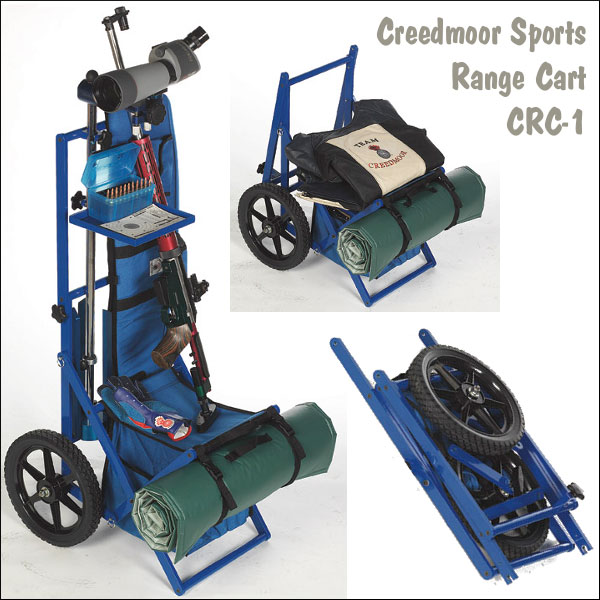 Some High Power shooters on the Forum asked about carts for carrying their gear to the range. You can certainly purchase a factory-made, purpose-built cart that folds up and has all the bells and whistles. The
  Check out the
  You’ll want to enclose the sides of the bottom box area so small items don’t fall out. You can tack-weld aluminum side-plates if you want a fancy appearance. I prefer to just cut sheet plastic from a home improvement store. These plastic panels can be attached with screws or even zip-ties around tubing.
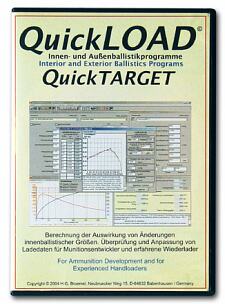 At SHOT Show, we had the chance to meet with German software engineer Hartmut Broemel, creator of QuickLOAD software. This software program, while not a substitute for conventional load manuals, allows shooters to evaluate a wide range of powders and bullets, comparing potential loads on the basis of predicted pressures, velocities, load density and projectile in-barrel time.
 Jason is friends with Gatling project director John Buhay, who let both of us send some 45-70 rounds downrange. While the Bulldog Gatling can dispense a prodigious amount of lead in a few seconds (rate of fire determined by how fast the operator cranks), this firearm is not considered an NFA machine gun. Because an advancement of the crank is required for each shot to be fired, this Gatling is not subject to the severe restrictions imposed on Class III arms. You can purchase a Bulldog Gatling, so long as you would otherwise qualify to legally own a long gun.


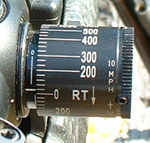 Here’s something that can save you lots of time and aggravation on a varminting trip. This little $110 gizmo is great for varmint hunters and any one who needs to make a quick shot in shifty wind conditions. Instead of the traditional 1/4-MOA hash marks, the Kenton windage turret features markers corresponding to the wind drift your ammo will encounter at various distances (with 10 mph full value winds). You just dial the distance.
 Radetec’s SpeedShot shot-count system employs a sensor in a special, dedicated magazine which outputs to either a digital or LED light display. Both the numeric display and color-changing LED light indicate rounds left in the magazine. For pistols, Radetec will market custom grips which incorporate the shot-counter display modules. Currently, Radetec systems are available for Beretta, Glock, Smith & Wesson M & P, and 1911-platform pistols. The digital-numeric display on these grips indicates the actual number of rounds left in the magazine. The total number of rounds fired can also be accessed.


