We recently had a chance to test the new Chimera Titanium Rings from TacticalRifles.net. The Chimera Rings are “ultra-premium” items designed to compete with the very best tactical rings on the market. As you’d expect, they’re expensive. The 30mm Chimera Rings retail for $224.00 per matched set, including Torx driver. Though these fat boys are beefy in size, offering 7.5 square inches of clamping area per set (way more than most rings), they are very light weight. A medium-height, 30mm Chimera ring weighs just 84 grams (2.96 ounces).
The Chimera rings are precision-machined to exacting tolerances. We had our Mark, our in-house machinist, check them out and he was very impressed: “These rings exhibit beautiful fit and finish and are extremely tough. The fit of the ring bases on a Picatinny rail is perfect. I liked the radius shapes given to most of the surfaces. The front and back faces of each ring are standard flat planes, and the ring caps have a flat disc in their centers, but the remainder of the cap and the sides of the bodies are gently curved. This design requires sophisticated machining processes to pull off, but it looks good. The larger-than-standard heads on the cap hardware, 8-32 X #25 Torx, are another departure that looks well thought out. One danger this increased head size would present if the fasteners were threading into typical 6061 aluminum bodies would be the potential to over-torque and strip the threads with the larger #25 Torx wrench. However, since the titanium bodies have approximately double the tensile strength of 6061 aluminum this is not a problem.”
Assymetrical Tensioning by Design
The Chimera Titanium Rings employ an assymetrical clamping design. This should allow the rings to provide stronger clamping force with less chance of ring distortion. Here’s how they work. After placing the scope in the lower halves of the rings, you screw down the top halves on one side only (opposite the bolt head that clamps to the Picatinny rail). After the three Torx screws are tightened fully on one side, so that the top Ring half butts firmly on the bottom half, there will still be a small gap on the opposite side of the ring (see photo). Don’t worry — that is by design. Final torque is applied to the side with the gap. With the final tensioning done on one side only, the scope is less prone to twist. Furthermore, the manufacturer claims this design puts less stress on the scope tube during mounting.
We did fit the Chimera rings to a Leupold LRT 8-25x50mm scope with 30mm tube. Fit was excellent with no high or low points. With the rings installed as instructed, with one side first clamped flush and the opposite side then torqued to spec, the scope was very secure. On removal the Chimera rings left no visible marks on the tube. I can’t say that it would be a waste of time to lap these rings, but on our Leupold scope the fit was perfect, and the “grip” was uniform over the entire clamping surface.
Tactical Precision System TSR™ Rings TSR™ rings made by Tactical Precision Systems (TPS) have a clamping design very similar to the Chimera Titanium Rings. After placing the scope in the TSR ring set, you clamp down one side (of the ring tops) until metal meets metal. This then leaves a gap of 0.020″ on the other side. The TSR Picatinny 30mm 7075 Aluminum Medium Rings cost $82 in aluminum or $94.00 in alloy steel. The TSR rings are narrower than the Chimeras, and have two Torx bolts per side, rather than the three on the Chimeras.
M3 Hinged Scope Rings from American Rifle Company
An even more radical clamping system is employed by the new, patent-pendingM3 Scope Rings from The American Rifle Company. The top section of the M3 rings is attached with a hinge on one side. After placing the scope in the bottom section of the M3 rings, you swing the upper ring half into place over the scope tube. Then the clamping is done with two inverted (head-down) machine screws that actually pull the hinged ring section downwards. This is designed to put less stress on the scope than conventional rings. The axis of the screws is tangential to the scope tube. Sophisticated finite element analysis (FEA) was used to develop the “over the top”, tangential-clamping ring design. According to the manufacturer, this design evenly distributes clamping forces over the tube and “eliminates the damaging effects of [scope] bending”. The manufacturer claims that, with its rings, “no significant stress concentrations are present on the scope tube”. American Rifle Co. backs up these claims with a series of 3D stress analyses published on its website.
Credit The Firearm Blog for reporting on the M3 ring design.
Disclosure: TacticalRifles.net loaned a pair of Chimera Titanium Rings for testing and evaluation.
Many of our readers use iPhones to run ballistics programs and to access travel maps and weather reports. We CAUTION readers who may be planning to purchase a new Apple iPhone 4 (Fourth Generation), first released on June 24th: Wait until the flaws are fixed.
You May Want to Hold Off on Purchasing a iPhone 4
We know many of you guys are anxious to get the latest iPhone 4… but we strongly advise you to wait a week or two at least. Or perhaps wait a few months until an improved version of the new iPhone is available. The reason for this advice is simple — the glass panels on the new iPhone are prone to cracking, and there is a serious reception problem on many of the latest generation of iPhones.
iPhone 4 Major Problems
We suggest readers WAIT before purchasing an iPhone 4, based on issues we observed ourselves, as well as thousands of reports that are flooding in. There are three main problems.
1. Many iPhone 4s have hardware-related reception problems causing dropped calls. This is apparently caused by hand interference with the antenna.
2. The iPhone 4’s front screen and back plate, which are composed of a new, ultra-hard Aluminosilicate glass, are very prone to cracking. We observed this first-hand.
3. Some iPhone 4 users are reporting yellow blotches and other abnormal screen discolorations. This is apparently a manufacturing defect.
Cracked Glass on Faceplate and Backplate
On June 24th, we went to the shooting range. One of our shooters, Katrina, had just acquired a brand new iPhone 4. She carried it in a protective belt holster. After a couple hours of shooting from a sitting position at the bench, she tried to make a call, only to find that the front glass screen had a full-width diagonal crack. This phone was never dropped, tossed, or abused in any way. While the screen needs to be replaced, Katrina’s iPhone is still able to make calls — the first one of which went to Apple customer support.
Many reports are surfacing about broken iPhone 4 glass. Unlike our experience with Katrina’s phone, most of the breakages appear to be on the back plate. You’ll find reports of the breakages in the Apple forums and on major tech websites.
Gizmodo.com reports: “Cases of broken iPhone 4’s backs are already appearing. This hasn’t changed from previous generations…. But the difference is that the iPhone 4 is all glass. If you drop any other phone, you have a 50% chance of breaking its screen. With the iPhone 4, the risk will always be there, no matter how it falls. It’s just more exposed to damage because of the material choice.” Another breakage report.
Reception and Dropped Call Problem
There is a widespread problem with iPhone 4s losing reception when held in the hand. The video below shows how just picking up the iPhone and holding it normally will cause loss of reception. The problem appears to be hand contact with the iPhone 4’s metal frame, which serves as the antenna.
An article in Gizmodo.com addresses the issue: “There’s no great fix for the iPhone 4 reception issues right now. We’re also pretty sure—and Apple confirms it—that touching the antenna does affect things—whether or not it has the final result of killing calls or speed of data connection.”
Rubber Bumper Partial Reception Fix?
Here is a further CNET video report confirming the reception issue with multiple iPhone 4 test units. The problem is more acute with some users than others, and CNET did suggest that installing a $30 rubber bumper may help with the problem. Tests by igear360.com show that bumper can raise iPhone 4 downloading speeds, but uploading speeds still suffer substantially. Click here for iPhone bumper tests.
Here is an interesting tool that lets shooters re-shape and uniform the tips of their .22 rimfire lead bullets. Paco Kelly’s Acu’Rzr comes in two basic versions, the “Phase III Nasti-Nose” and the “Phase IV Baby Scorp’n”. The Phase III tool produces a deep-dished hollowpoint (like an ash-tray) that opens quickly and efficiently. There is also a Phase III insert that creates a flatter, open dish HP for target shooting. The Phase IV Scorpion tool creates a deep hollow point with a central post. The internal post in the middle helps achieve deeper penetration in game. The designer claims that ammo modified with either tool is more accurate because the bullet diameter “comes out the same every time”. In addition to the Phase III & IV tools, which reform one round at a time, Paco offers a Maxi series for bulk production. These let you process either three rounds at once (Maxi 3) or four rounds at once (Maxi 4).
Why re-shape lead rimfire bullets? The first reason is accuracy. The tool’s designer, Paco Kelly, claims you can improve the accuracy of budget-priced ammo by using the dish nose rod with the Phase III tool: “The dish nose forming rod is for accuracy and paper targets. It makes very sharp and clean cut holes in paper. And the consistency of the [re-shaped] bullet diameter pulls the group together.”
The main reason to use Paco Acu’Rzr tools is to improve perfomance on small game such as squirrels, prairie dogs, and jack-rabbits. Kelly says: “Unlike most commercial 22 rimfire ammo with small holes and negligible HP expansion, the Nasti-Nose will open even with standard velocity ammo. Yet it will NOT explode on contact like the hyper-velocity ammo. For small eating game, such as squirrels, the Hyper ammo is too much and the medium-velocity, hollow-pointed commercial ammo often fails to open. But not so with the Nasti-Nose.” The idea, Kelly suggests, is that you get reliable expansion with medium-velocity ammo, without destroying the game the way hyper-velocity ammo does.
The Phase III tool costs $65.00, while the Phase IV tool costs $75.00. The Maxi 3 which does three (3) rounds at once, costs $100.00, and the four-round Maxi 4 is $128.00. All tools can be customized for target rifles or European chambers. To order, contact Paco Kelly, P.O. Box 1170, Cortaro, AZ 85652 or use this ORDER FORM.
EDITOR’s NOTE: Do NOT use this tool with premium-grade rimfire target ammo. It won’t help. Use it with the cheaper bulk-pack ammo. Also, we have not tested the reformed ammo on live targets, so you have to draw your own conclusions as to its benefits on small critters.
Sinclair International has just released its completely new Competition Shooting Rest BR. It’s a beefy unit, weighing over 30 pounds… and yes, it’s fully approved for both IBS and NBRSA benchrest competition at all distances. The new rest should start shipping in mid-May, 2010. The price is $599.00 including top bracket, but not the front sand-bag (both Edgewood and Protektor bags will fit).
Key features are: 1) Very low center of gravity for stability; 2) Smooth, precise windage control built in to the base-plate; 3) Ambi-dextrous design; and 4) Built-in carry handle on the front (target) side. The windage control, which employs twin tapered roller bearings for smoothness, is a clever design that provides nearly 48″ of windage movement at 100 yards. The oversized windage control knob is positioned near the rear (vertical) speed screw so you can easily and quickly control both the vertical and horizontal with the same hand. And you Southpaws, don’t worry… the post, center column, controls and windage adjustment disassemble and reassemble on the opposite side, for left-hand use.
The Sinclair Competition Rest’s components are “super-sized” compared to older Sinclair front pedestal designs. The new rest’s center column diameter is upsized to 1.95″ from 1.375″, the threaded post is increased to 1″ diameter from 3/4″, and the leg screws are now .5″ (up from .375″). The rear fluted speed screw is also oversized. The new Competition Rest also includes mounting holes for attachment of raised ammo caddies or a timer-holder. In addition, the Sinclair Competition Rest features a new, lockable fore-end stop assembly that adjusts for length, height, and cant (angle).
MidwayUSA recently sent us its new Compact Competition Range Bag for review. Overall, we were very impressed. The bag is made from a strong, heavy-duty PVC-coated polyester, with high-quality, large-toothed zippers. A comfortable, curved carry strap is secured by sturdy, all-metal clips. The “build quality” is visibly much better than most range bags on the market. I wish my airline carry-on bags were built as well as this. The bag is offered in black for $26.99 or olive-drab for $39.99. We tested the handsome olive-drab version which is a good match for our khaki AIM 60 Tactical Drag Bag.
Measuring 16″L x 12″W x 10″H, this Compact Range Bag is definitely smaller than MidwayUSA’s popular Large Range Bag (22″L x 15″W x 10″H). However, the “Compact” version will hold plenty of gear — pretty much all a pistol shooter will need at the range. For a rifle shooter, it will haul ammo boxes, earmuffs, magazines, and other miscellaneous gear. You CAN get a rear sandbag in the MidwayUSA range bag, but it’s probably best to use the bag for ammo boxes and the like. Overall, we really like this bag, as do most buyers. Among 43 MidwayUSA customer reviews, the average rating is 4.9 out of 5 stars. Here are two typical buyer reports:
“This bag is great. It easily holds both my S&W MP9s, hearing and eye protection, 6 magazines, magazine loader, targets and enough ammo (200-300 rds) for a good session at the range. The quality is comparable to bags costing twice as much.” — Richard B, Virginia
“I have used many different range bags over the years, but I have to say that this is by far the best…. Plenty of room for ammo, hearing and eye protection, documentation and other materials. This bag is a great buy.” — Mark C, Oklahoma
Quality Revealed in the Details
The details of this bag reveal smart design and quality construction. On the bottom, two plastic foot pads with ¼” high ribs are stitched to the fabric for grip and moisture standoff. On the inside of the bag a removable, waterproof sole further protects the contents. On both ends of the bag are full-width zippered pockets, with a handy clear identification window on one side. Metal D-rings above the end pockets provide solid attachment points for the heavy-duty shoulder strap. The shoulder strap pad has a rubberized underside that keeps the strap from sliding off your shoulder.
The main compartment is conveniently accessed through a Velcro end closure plus two long, parallel zippers whose pull-tabs are connected with a cord. The main compartment is big enough to hold two large MTM Caseguard R-100 series rifle ammo boxes, with plenty of room left over. Unfortunately, there’s no easy way to lock any compartment on the bag. That’s too bad, since some jurisdictions require handgun cases to be locked during transport.
Deceptively Large Capacity for a ‘Compact’ Bag
To test the carrying capacity of the MidwayUSA bag, we loaded it up with 100 rounds of rifle ammo, 600 rounds of centerfire pistol ammo, 500 rounds rimfire, earmuffs and FOUR pistols tucked in the padded side sleeves. All that gear fit nicely with room to spare. (We recommend putting handguns in protective sleeves if you load two per side). The padded, full-width, zippered main pocket keeps seven spare magazines organized and protected. On the reverse side of the bag, a similar, full-length padded pocket provides undivided storage space. That large outside pocket also has a zippered compartment with dividers for pens and a small notepad. The bag’s many pockets make it easy to organize miscellaneous gear such as staple gun, target stickers, small binoculars, timers, and radios.
The durable fabric, thick padding, heavy-duty zippers, and quality stitching should deliver many years of hard duty. This is a bag that holds its shape more like a luggage piece, not a thin bag that will squash flat and lay on the shelf out of the way when not in use. The black Compact Range Bag is available now. The olive drab version we tested should be in in stock on 5/28/2010.
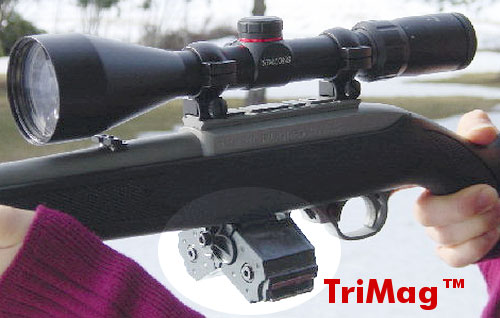
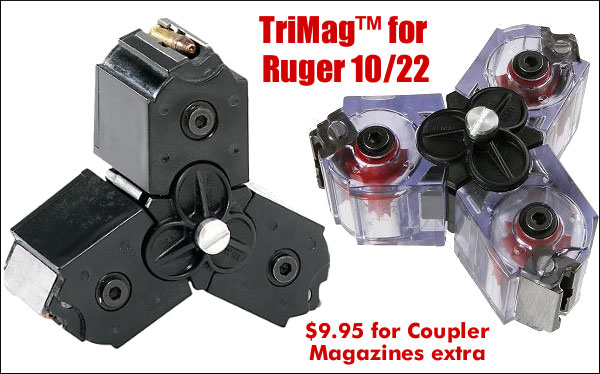
We know many of our readers have a Ruger 10/22 for varminting, fun shooting, or rimfire tactical competition. Here’s an affordable new product for the Ruger 10/22 that will fit the highly-accurate Volquartsen rimfires as well. The new TriMag™ magazine coupler secures three standard, 10-round 10/22 rotary magazines together, giving you extra ammo capacity with full factory reliability. Yes there are long, banana-style magazines for the 10/22, but a TriMag 3-mag assembly won’t interfere with prone or off-hand shooting. And when varminting, you won’t have to set your tripod super-high to provide clearance for a long single-column magazine. This is ideal for rimfire tactical matches.
Designed and crafted by Alangator of Hayden Lake, Idaho, the $9.95 patent-pending TriMag™ is a clever, U.S.-made invention that any 10/22 or Volquartsen owner can afford. Puchasers give the TriMag™ high marks. One Cabela’s customer writes: “One of the best 10/22 products ever! As everyone who owns a 10/22 knows, aftermarket or non-factory extended capacity 10/22 magazines perform terribly. This product resolves that issue because you have 30 rounds available using your perfectly-functioning factory magazines.” Another buyer adds: “IMO one of the best accessories for the 10/22… one of those things that you can’t go without. An added bonus is that when you set your gun on a bench it holds it up right.”
Where to Buy
The TriMag™ is currently offered by Cabela’s, Volquartsen, and other vendors starting at $9.95. Volquartsen says the device fits all Volquartsen .22 LR semi-auto rifles.
Congratulations to Carl Boswell, Vince Bottomley, Andy Dubreuil, Laurie Holland and all the staff at Target Shooter online magazine. Target Shooter has released its April 2010 First Anniversary issue, and it may be the best yet. The hardware photography is high quality and there is something for everyone — from Benchresters to Tactical shooters. You can view the 110-page April issue for FREE at www.targetshooter.co.uk.
Carl tells us: “Yes, this is our first anniversary issue and we have it packed with articles.” Here are some of the recommended articles in the April Anniversary Edition of Target Shooter:
Loading for the .308, Part 6 — Laurie Holland continues his informative reloading series.
SEB Neo Coaxial Rest — Vince Bottomley reviews one of the most impressive rests on the market. This is a very thorough review which compares the old SEB Coax with the SEB NEO side by side.
Rimfire and Air Rifle Benchrest — Carl Boswell looks at these rapidly evolving disciplines.
Gallery Rifle 1500 — Gwyn Roberts continues his course on Gallery Rifle Basics.
New GBR Custom Action — A New Rem 700-footprint action made in the UK.
Steyr LG110 Field Test — Tim Finley reviews the Steyr LG110 rifle for Field Target.
Definitely check out the latest edition of Target Shooter magazine. Laurie Holland is one of the best technical gun writers in the business, and when Vince Bottomley reviews a product, he delivers intelligent conclusions you can “take to the bank”. As a special bonus, this April edition includes exclusive reports from the IWA Expo in Germany — the “Euro Shot Show”.
Danny Biggs, two-time F-TR National Champion, decided to shoot Open Class at this year’s 2010 F-Class National Championships in Sacramento. Danny did very well, finishing third overall in F-Open with a score of 1324-67X. Danny’s X-count, the highest of all competitors, was 10 Xs higher than F-Open winner Derek Rogers and runner-up Ken Dickerman, who both finished with 57X.
While most F-Open shooters used a front pedestal rest, either a joystick design or a center column pedestal with remote-adjustable windage top, Danny used a wide-base bipod, as he had done at past Nationals in the F-TR class. But Danny’s bipod was very special. It is a prototype, modified Sinclair design with height adjustment via a central, vertical-axis knob. As you can see from the pictures below, the left and right bipod legs are attached to a T-shaped silver (aluminum) bracket. This bracket moves up and down as the silver knob is turned clockwise or counter-clockwise. As the knob turns, its threads pull the T-shaped bracket up and down relative to a center block of aluminum bolted to the bipod’s attachment to the rifle’s forearm accessory rail. With this system, Danny can easily reach forward and make precise adjustments in elevation. Note that the Sinclair bipod’s secure rail attachment is retained and Danny can still adjust rifle cant (tilt), using the rear push-button handle. This rear handle functions like a Pod-lock allowing the rifle to be tilted a few degrees to one side or the other to compensate for side-sloping terrain.
We watched Danny shoot with this heigh-adjustable bipod, and it worked superbly. With its wide foot-print, the bipod is ultra-stable. During recoil, the ski-type feet slide evenly straight back. Danny was able to quickly dial in a little vertical, as needed, during his string of fire. This gave him more precise control over elevation than other bipod shooters who had to slide their guns forward or backward or pinch the ears of their rear bags to make small changes in rifle elevation.
Production Plans Not Yet Certain
Wondering “Where can I get one?” Unfortunately, the Biggs Bipod adjuster is not in production yet, and we don’t know for sure if this design (or something like it) will be added to the Sinclair Int’l F-Class Bipod in the future. But Danny Biggs certainly demonstrated that the concept works superbly. We expect micro-adjusting vertical controls to appear on other F-Class bipods at future matches.
In everyone’s inventory of rifles, we think there should be at least one basic utility rifle with decent iron sights. Tech-SIGHTS, a small company in Hartsville, South Carolina, produces high-quality, yet affordable front post/rear aperture sights that fit popular rifles such as the Ruger 10/22, Marlin 60, SKS, and the CZ 452. We were particularly impressed with the new CZ200 sight set for the CZ 452, a very popular .22LR and 17HMR training and varmint rifle.
For CZ 452s sold without iron sights, the $69.00 CZ200 sight package provides both an easily-adjustable rear aperture sight and a durable, hooded front sight. The Tech-SIGHTs, designed to fit the dovetail on top of the CZ receiver, can be quickly fitted to CZ 452s. Both the rear aperture and the front post (with protective ears) can be installed easily with no drilling or tapping. For CZ 452s equipped with factory iron sights, the Tech-SIGHTs will replace the rear tangent sight with a more precise micro-adjustable aperture sight, increasing sight radius by 6.5 inches.
Ruger Sight Set Features AR-style Front Sight
The Ruger 10/22 Tech-SIGHTs mount on the rear of the receiver utilizing the existing, tapped scopebase holes. Two versions are offered, the TSR100 with dual leaf (flip-adjust) apertures, and the TSR200 with a single (non-flip) aperture with enhanced elevation adjustment. Both TSR100 ($59.00) and TSR200 ($69.00) sight sets come with a front sight tower fitted with AR15-spec detent-adjustable post. This allows the shooter to swap in a variety of front sight posts made for ARs.
For more information, close-up product photos, mounting instructions, and user testimonials, visit www.tech-sights.com. The Tech-SIGHT website has a secure shopping cart system so you can order direct from the manufacturer.
Here’s a good deal from AirGunsDaily.com if you’re looking for an inexpensive air rifle for your kids, or just a “fun gun” for plinking. Today only, AirgunsDaily.com is offering the RWS 34P (Panther) .22 Cal (pellet) Air Rifle with 4X32mm Scope and a 2-piece C-mount for just $227.99. Shipping is just $7.00.
The RWS 34 Panther is the most popular air rifle sold by RWS. It has an injection-molded synthetic stock and adjustable fiber optic sights. It is a break-barrel design with a 2-stage adjustable trigger, and 33-lb cocking weight. RWS has a good warranty and this rifle has earned excellent reviews from Pyramid Air customers, one of whom wrote: “Appearance and finish out of the box were flawless. It cocks smoothly and has a very well-balanced feel. From the very first shot I was surprised how accurate it is.”
If you miss today’s AirGunsDaily.com offer, Pyramid Air sells the RWS 34P, in either .177 (1000 fps) or .22 (800 fps) calibers, with NO scope, for $216.85. Pyramid also offers a package deal: $220.09 for the .177 version with a tin of .177 pellets and FREE Shipping.


 We recently had a chance to test the new Chimera Titanium Rings from TacticalRifles.net. The Chimera Rings are “ultra-premium” items designed to compete with the very best tactical rings on the market. As you’d expect, they’re expensive. The 30mm Chimera Rings retail for $224.00 per matched set, including Torx driver. Though these fat boys are beefy in size, offering 7.5 square inches of clamping area per set (way more than most rings), they are very light weight. A medium-height, 30mm Chimera ring weighs just 84 grams (2.96 ounces).
 Assymetrical Tensioning by Design


 Cracked Glass on Faceplate and Backplate



 MidwayUSA recently sent us its new


 Danny Biggs, two-time F-TR National Champion, decided to shoot Open Class at this year’s 2010 F-Class National Championships in Sacramento. Danny did very well, finishing third overall in F-Open with a score of 1324-67X. Danny’s X-count, the highest of all competitors, was 10 Xs higher than F-Open winner Derek Rogers and runner-up Ken Dickerman, who both finished with 57X.