Look and be amazed. What you are seeing is the smallest 5-Shot group ever shot in 1000-yard competition. And it is also perfectly centered for a 50-5X max score, yes ALL Xs. Brilliant! This amazing group was shot by Mike Wilson in July of 2018 with his 17-lb Light Gun, chambered for a 6mmBR wildcat he calls the 6 BRAW (BR Ackley Improved Wilson). This spectacular feat of accuracy demonstrates the potential of the 6BR family of cartridges even at 1000 yards. For his record group, Mike shot Vapor Trail 103-grain bullets in Lapua 6mmBR fire-formed brass. He loaded Hodgdon H4895 powder with CCI 450 primers. The action was a BAT, the barrel a Brux.
The Best 5-Shot 1000-Yard Group in History
Story based on report by Sam Hall
Look at that target by Mike Wilson. This is one of the most remarkable displays of accuracy (and precision) in the history of long range shooting. This past weekend, Mike (aka “GA. Dawg” in our Forum) drilled a truly spectacular 1.087-inch, 5-shot group at 1000 yards, all centered up in the X-Ring. Yes, you read that right, a group barely over an inch at 1000, shot in competition at an official IBS benchrest match on July 21, 2018. Note, the group was measured at the range at an even smaller 1.068″ (see target). However, as certified by the IBS as a IBS Light Gun World Record, the group is listed as 1.087″.
How small is that in angular measurement? Well 1 MOA at 1000 yards is 10.47 inches, so Mike’s 50-5X masterpiece is 0.1038 MOA! Yes that is an IBS group size AND score World Record. And it is also smaller than the current NBRSA 1000-yard 5-shot LG world record, 1.473″ by Bill Schrader in 2002. This best-ever 1K group* was shot at an IBS registered 1000-yard match at Hawks Ridge Gun Club in North Carolina. Other records have been shot at Hawks Ridge in the past, but this is the most jaw-dropping.
Sam Hall (left, green shirt) holds record target by Mike Wilson (right, white shirt).
Sam Hall, past IBS National Champion and IBS 600-Yard Shooter of the Year, was stunned by Wilson’s accomplishment: “This is a truely awesome marksmanship feat — one of the best in history. I think I would trade all 14 of my 600-yard records for that one!”. Mike’s amazing target will be submitted for approval as new Group Size and Score IBS World Records. Official approval is pretty much a certainty. The previous 5-shot, 1000-yard IBS record is 1.397″ (50 score) by Tom Sarver in 2007. (The NBRSA 1000-Yard 5-shot LG record is 1.473″ by Bill Schrader in 2002.)
Posting on our Shooters’ Forum, Mike wrote: “Thanks everyone for the kind words. As humbling as this game is, when it comes together makes it all worthwhile! A very special THANK YOU to my traveling buddy, my son, Blake, and my wife Debra for allowing me to enjoy this crazy game.” Mike also wanted to thank his smiths and component suppliers.
Mike Wilson IBS 1000-Yard Light Gun Specifications
Action: BAT ‘B’ 1.550 Melonited Action with Jewell Trigger
Barrel: Brux HV 28″ Finished Length, 1:8″ Twist Rate
Chambering: 6 BRAW (6mmBR Ackley Improved Wilson), Chambered by Darrell Jones
Chamber Specs: 0.272″ No-turn Neck with 0.135″ Freebore
Stock: Shehane ST 1000 Fiberglass Stock (with stock work by Larry “Bullet” Archer)
Optics: Nightforce 12-42x56mm Benchrest NP-2 DD
LOAD Specs: Lapua 6mmBR brass (formed to 40° Ackley Improved), Vapor Trail 103gr bullets, Hodgdon H4895 powder, CCI 450 primers.
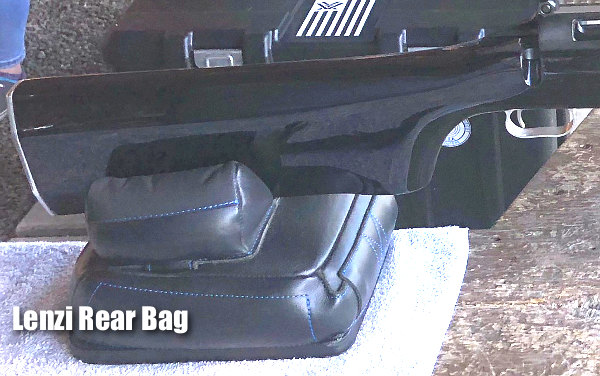
Leonard Baity front rest with Protektor Bag. Italian Lenzi bag in rear.
World Record-Setting Cartridge and Load
Mike was shooting a 40-degree Improved version of the 6mmBR Norma cartridge. Long popular with Benchrest and 300M shooters, the 6mmBR was the original inspiration for this website. Yep, we started as www.6mmBR.com. The Improved version has extra capacity, allowing about 100 FPS more velocity when chambered with a long throat. For his record group, Mike shot Vapor Trail 103-grain bullets in Lapua brass. He loaded Hodgdon H4895 powder with CCI 450 (small rifle magnum) primers.
Praise from Fellow Competitors
Here are some reactions to Mike’s amazing group by our Forum members:
“Amazing target Mike Wilson! Your group might last forever as ‘the goal’ of 1000-yard Benchrest! Heck that’s a great target even at 600 yards.” — Mike J.
“Think about this for a second. That group was barely larger than the size of your index finger’s first digit and he printed it at 1000 Yards.” — Carlos
“Unbelievable!! Doing that under chosen prime conditions is an amazing feat but to do that in competition and to have everything to come together is just unbelievable. Amazing how far skill, precision, knowledge, and the products of this sport have come. Never thought we would see a group this small and well placed especially in the hills of North Carolina where the wind always blows. Congratulations. A true lifetime achievement.” — Yote Hunter
“I think that one will stand for a while. Hard work does pay off, but it don’t hurt to be one of the givers in the sport. Mike, you are ‘The Man’!” — Bill Shehane
“Awesome, awesome. Now the goal is to shoot UNDER an inch!” — Alex Wheeler
The 6mmBR Ackley Improved
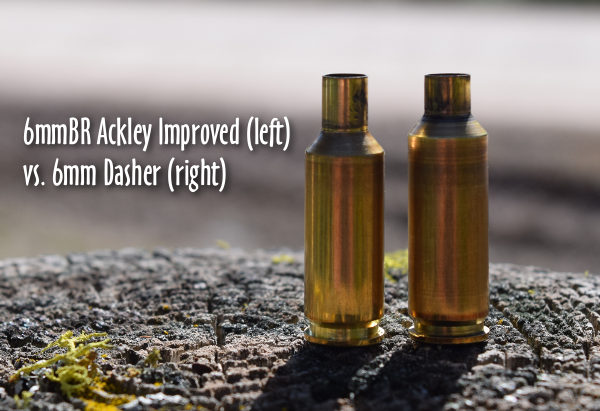
Mike Wilson shot his spectacular group with a 40° Improved version of the 6mmBR cartridge with less body taper than a standard 6BR — the design is 0.463 at the body/shoulder junction (vs. 0.460 for standard 6BR). Mike calls his version of the 6BR Ackley a 6BRAW (“W” for Wilson). Sam Hall explained: “The 6BRAW is pretty much the same as a 6BRA or 6BR-AI (Ackley Improved). I sold the reamer to Mike last year. This has a 0.272 ‘No-Turn’ chamber with a 0.135 Freebore”.
This photo shows a 40° 6mmBR Ackley Improved (6BRA), as used by Tom Mousel in Deep Creek, Montana. Mike Wilson’s 6BRAW may be very slightly different. For Mousel’s 6BRA with 28″ Krieger barrel, the accuracy node is about 2980-2990 fps, so this gives up only 30-50 fps compared to typical Dasher velocities. Mike Wilson’s load runs about 2980 fps also.
In the past couple of years, the 6BR Ackley-type cartridges have been hugely successful in 600-yard and 1000-yard Benchrest. Sam Hall notes: “This year the little 6BR-AI has shot the smallest groups ever fired in 600-yard and 1000-yard competition. Back in April 2018, bullet-maker Bart Sauter, using a 6BRA, shot a 0.311″ 50-score 5-Shot group at 600 yards.” (Read Sauter Story). Bart’s stunning 0.05 MOA group is now the 600-yard IBS HG World Record.(Note: Bart’s target was originally measured at 0.282″ but was later IBS-certified at 0.311″.)
Mike used an Italian Lenzi rear bag. Mike says the super-slick nylon on the ears of this high quality rear bag make for better tracking. The ears provide support but don’t “grab” the stock, reports Mike.
More Comments by Fellow Shooters:
“Truly an amazing feat. The 5X was the icing on the cake! Many shooters would be very happy with that group size at 200 yards.” — Mr. Zero
“Words cannot adequately express how many of us feel about your magnificent accomplishment at 1000 yards. Congratulations — that is terrific!” — Gene Beggs
“Truly amazing … well done on a great achievement… RESPECT!” — Elardus
“Bravo Mike pour ce tir incroyable. Ton exploit est sur le forum de tir longue distance en France bonne continuation.” — Frederic Riso
* There are two North American sanctioning bodies for 1000-Yard Benchrest, the IBS and the NBRSA. The previous 5-shot, 1000-yard IBS record is 1.397″ (50 score) by Tom Sarver in 2007. The existing NBRSA 1000-Yard 5-shot Light Gun record is 1.473″, shot by Bill Schrader in 2002.
A while back, RifleShooter Magazine released a list of the Ten Greatest Lever-Action Rifles of All Time. Writing for RifleShooter, Brad Fitzpatrick examined a wide selection of lever guns produced in the past 150 years, and came up with this short list of ten “all-star” lever action rifles:
Savage Model 99
Winchester Model 1873/73
Winchester Model 1888/88
Winchester Model 1892/92
Winchester Model 1894/94
As with all “Top 10″ lists, this will be controversial. Where is the Winchester model 1866 “Yellowboy”, the favorite of Native Americans? Where is the iconic Winchester model 1895, the beloved gun Teddy Roosevelt called “Big Medicine”? But other choices are hard to fault. The Henry Rifle, the first popular cartridge lever gun, surely belongs on the list. And, believe it or not, the Winchester Model 94 is the best-selling sporting rifle of all time in the USA, according to RifleShooter.
So what do you think of RifleShooter’s Top 10 list? Does it make sense, or did RifleShooter magazine get it wrong? NOTE, on the Rifleshooter Lever Gun Page, to see descriptions/photos of ALL the guns, you need to click the gray arrows that appear (barely) below each gun description (see below). That will scroll through the ten guns horizontally, back and forth.
Fitzpatrick writes: “The lever action played a very legitimate role in America’s westward expansion. It could bring meat to your table or protect your land and assets against rustlers. Nostalgia aside, the lever gun is an effective hunting tool for those willing to live within its limitations. While it can’t beat a bolt gun with a light trigger and free-floated barrel in a long-range shooting competition, a lever action in the right hands can be rather accurate, especially given new advancements in rifle design and bullet technology.”
Historic American Arms — Teddy Roosevelt’s Lever Guns
These two lever action rifles, owned by President Theodore Roosevelt, are part of the NRA Museum collection. First is a Winchester 1886 rifle known as the tennis match gun because Roosevelt used winnings from a tennis match to buy it. Below that is a suppressed Winchester model 1894 rifle. Roosevelt liked to shoot varmints around Oyster Bay (Long Island, NY) with this gun so he wouldn’t disturb his neighbors — the Tiffany and Du Pont families.
While many AccurateShooter.com readers load their own competition centerfire rifle ammunition, we all still need factory ammo for our rimfire rifles in .17 and .22 calibers. And most of the 65+ million American handgun owners rely on factory-made ammunition for their pistols and revolvers.
Today’s video collection showcases state-of-the-art ammunition factories in Europe and the United States. You can see the extremely accurate Lapua .22 LR ammo being produced, as well as excellent centerfire ammunition being made by Norma, Remington, Sellier & Bellot and other makers.
From the creation of lead bullet cores to the final packing of ammunition, you can see it all in these videos. Watch primers being made, brass being annealed, bullets being jacketed, tips being inserted, and every phase of production. Weighing and testing procedures are also revealed.
Modern Ammo Production in Multiple Facilities
This 11.5-minute video shows highly automated bullet and ammunition production in multiple facilities in Europe and the USA. You can see bullets produced from start to finish beginning with lead smelting. Then watch pistol and rifle cartridges being made on modern, computer-controlled assembly lines. Watch from start to finish. Here are some notable highlights:
00:10 — Lead Melting Pots and Billet Caster
01:20 — Lead made into strings and then formed into bullets
01:50 — Brass alloy sheets fed into machine and then punched (2:10-2:35).
03:35 — Lead pistol cores being produced
04:15 — Pistol ammo being packaged
06:15 — Ammo loaded into belts
07:15 — Completed primers being shuttled then loaded into brass (Second factory)
07:20 — Bullets being seating into rifle ammunition
07:32 — Cartridge case-neck treatment
07:42 — Robot arm loads finishes cartridges into boxes
08:04 — Cups being pressed (Third Factory S&B)
08:45 — Cartridge case draw
09:06 — Priming pistol cases
09:20 — Bullet production and weight control (10:02)
10:08 — Cartridge assembly and cartridge sealing (10:38)
11:00 — Pistol ammo packaging
Lapua Rimfire Ammunition Production in Germany
This video shows Lapua rimfire ammo production in Schönebeck, Germany. The video shows quantities of the excellent X-ACT .22 LR ammunition being produced and packaged. Starting at the one-minute mark, you can see the ammo being inspected with advanced scanning machines. Then at 1:16 time-mark you can see the ammo accuracy-tested in a tunnel, with results displayed on a computer screen (1:27).
Norma Ammunition Production in Sweden
In this video, the RecoilTV team lead by EIC Iain Harrison ventures to Sweden to visit the Norma ammunition production plant in Huvudentré, Sweden. Demand for Norma ammo has risen dramatically. A Norma marketing manager notes that production has doubled in the last three years.
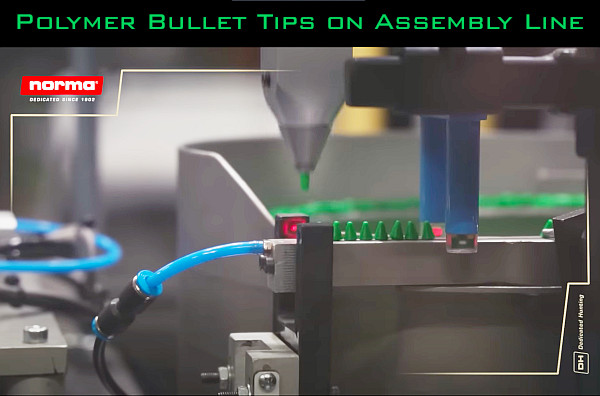
This second Norma ammunition video shows close-ups of the production process and the machinery used for centerfire ammo. This was filmed at the Norma factory in Åmotfors, Sweden, which has operated continuously for over 120 years. Among the many interesting highlight is a sequence showing how polymer bullet tips are inserted. See 6:50 time-mark.
Sellier & Bellot Ammunition Factory in Czech Republic
In this video, Larry Vickers of Vickers Tactical tours a Sellier & Bellot ammunition plant in the Czech Republic. This video shows details of primer production as well as bullet-making, brass-making, and production-line cartridge manufacturing.
Remington Ammunition Plant Re-Opened by Vista Outdoors
This video shows ammo production at the re-opened Remington ammunition plant in Lonoke, Arkansas. “This is one of the largest ammunition manufacturing plants in the world” said Mark Keefe, NRA Publications editorial director. “It was set up in 1969 by DuPont, who owned Remington at the time. They do it all here. Cases, bullets, centerfire rifle, centerfire pistol, rimfire and shotshell.” It’s great to see this plant back in production after Remington Ammunition filed for bankruptcy in 2020 and the assets of the Remington conglomerate were auctioned off. Ultimately, Vista Outdoor, owner of Federal, CCI and Speer, purchased the assets of Remington Ammunition and got the Lonoke plant running again, better than ever.
This article is Copyright 2024 AccurateShooter.com. Republication on any other site gives rise to statutory penalties and compensatory damages.
Dennis DeMille shows a young competitor at the CMP Western Games how to adjust his leather sling.
If you want to learn more about setting up your sling properly for position shooting, here are some tips from Dennis DeMille, a past Service Rifle Champion. Dennis explains how to choose a sling, and how to adjust it to fit properly.
The Benefits of Dry-Fire Training
Once you know how to set up your sling properly, you’ll want to practice. Dennis DeMille stresses the importance of dry-fire practice with sling and shooting coat. Dry-Fire training is essential to the sling disciplines. Dennis DeMille, a national Service Rifle Champion, told us that, for every minute he spent in actual competition, he would spend hours practicing without ammunition. While in the USMC, Dennis would practice in the barracks, working on his hold and dry-firing:
“The most important thing is to spend time off the range practicing. Most of what I learned as a High Power shooter I learned without ammunition — just spending time dry firing and doing holding exercises. Holding exercises will really identify the weak parts of your position. The primary purpose of dry firing is to get you used to shooting an empty rifle. If you can shoot a loaded rifle the same way you shoot an empty rifle then eventually you will become a High Master.”
SFC Brandon Green, 3-Time Nat’l High Power Champion. Brandon, one of the nation’s best “hard-holders”, demonstrates proper use of sling in prone position.
Setting-Up a Leather Service Rifle Sling for Competition
So you made the mistake of disassembling your leather service rifle sling, or are intimidated about how to use one? In this Creedmoor Sports InfoZone video, former Creedmoor G.M. Dennis DeMille explains how to set up and use a sling. The covers the basics — Dennis starts with a totally disassembled leather service rifle sling and shows you how to set it up properly.
Tip: “Many shooters shy away from using a leather sling because they have never been taught how to use one. That’s unfortunate. In my opinion a leather sling offers more support than a web sling, which is important when competing with the heavier than normal rifles.”
Configuring the Sling for the Standing (Offhand) Position
In this second in a series of Creedmoor InfoZone videos on the setup and use of the leather service rifle sling, Dennis DeMille details how to configure and best utilize the leather service rifle sling while shooting from the standing position.
Tip: “Putting the Frogs in different hole will change the amount of added elevation a sling provides.”
Looking at Sling Types — Comparing the Features
In this video Dennis showcases a large variety of shooting slings. He explains the strong points of each type so you can choose the sling best suited to your discipline and shooting style.
Looking for a match-worthy PRS/NRL rig for under $2050.00? Check out Savage’s Model 110 Elite Precision, now with a $200 rebate, lowering your net cost to $1849.99 (some calibers higher price). With the purchase of a Savage m110 Elite Precision, m110 Precision, or Impulse Elite Precision rifle you qualify for a $200 mail-in rebate from Savage. CLICK HERE for rebate info.
GunsAmerica Digest completed a very thorough test of the 110 Elite Precision, declaring that this modern Savage is “Competition-Ready Out of the Box.”
The 110 Elite Precision has many notable features:
1. Modular Driven Technologies (MDT) Adjustable Core Competition (ACC) Chassis
2. Trigger adjusts from 1.5-4.0 pounds
3. Barrel comes with timed muzzle brake from factory
4. MDT Stocks easily accepts Weights and Accessories
5. Takes AICS-compatible Magazines
6. Titanium Nitride coated bolt body
This rifle boasts an excellent MDT ACC modular chassis. GunsAmerica stated: “Combined with the excellent trigger, an AR-compatible vertical grip, flared magazine well, and AICS mag system (along with a host of additional features), the 110 Elite Precision comes with everything you need [for PRS/NRL matches].” The stock has ARCA rails on the fore-end and M-LOK mounting points for accessories and/or weights. You can add an additional 9 pounds of steel to customize the balance/mass of the rifle to improve stability and minimize recoil.
The Cheekpiece and Buttpad are adjustable, along with Length of Pull (LOP).
Another reviewer noted that the 110 Elite Precision has important accurizing tweaks from the factory: “Key upgrades include a blueprinted action … Savage squared the receiver face and cleaned up the receiver threads to ensure they’re concentric with the barrel’s bore. This combination goes a long way in eliminating the occasional flyer that can ruin a good group or cause a miss in a match.” Source: GunsandAmmo.com.
Decent Accuracy with Factory Ammo
What kind of accuracy can you expect? Decent for a factory barrel and factory ammo. With Hornady 6.5 Creedmoor ammo, shooting off a sled, the test rifle delivered 1.1-MOA average groups. We would expect considerably better accuracy using a proper front rest with a bag-rider fitted to the fore-end. Likewise, the gun would almost certainly shoot better with handloads with Lapua brass and Berger bullets. Handling was good: “The Elite Precision is about as shootable as it gets. The 12.6-pound rifle produces very little recoil with the 6.5 Creedmoor cartridge, and … the ACC chassis can be weighted to control recoil even further.”
Actual owners have been impressed with the 110 Elite Precision. One buyer posted: “You couldn’t build a complete PRS rifle that is this good of a platform for even close to the price!” GunsAmerica tester Jordan Michaels concurred that this rig is a great choice for PRS/NRL factory-class: “If you’re in the market for a rifle to compete in a long-range competition, the Savage 110 Elite Precision is an excellent choice.”
You’d like to protect your hearing, and maybe you’re a little curious about how your rifle might shoot suppressed. So you’re thinking of buying a suppressor (aka “can”, “moderator”, “silencer”). You can’t just get one off the shelf at Walmart. Acquiring a suppressor requires filling out paperwork and paying a Federal $200 Tax Stamp. Plus there is typically a pretty long wait. However, the good news is that suppressor ownership is now legal in 42 of the 50 American states — that’s 84%! For most American adults, getting a suppressor is legal, provided pass the required background checks.
States Where Suppressor Ownership is Allowed
Currently, the following 42 states allow private ownership of suppressors: AL, AK, AZ, AR, CO, CT, FL, GA, ID, IN, IA, KS, KY, LA, ME, MD, MI, MN, MS, MO, MT, NE, NV, NH, NM, NC, ND, OH, OK, OR, PA, SC, SD, TN, TX, UT, VT, VA, WA, WV, WI, WY.
Note: Even if you live in one of the states listed, you should still verify that owning a suppressor is legal in your area. Some states may have municipal- or county-based restrictions.
States Where Suppressor Ownership is Prohibited
Unfortunately, there are still eight (8) States that forbid private ownership of suppressors. The eight No-Go States are: California, Delaware, Hawaii, Illinois, Massachusetts, New Jersey, New York, Rhode Island. In these eight states, private ownership of suppressors (aka “silencers”) is forbidden. Hopefully that a few of those eight hold-out states will change their laws in the months ahead.
Looking Inside a Suppressor in Action
Popular YouTube Channel Smarter Every Day recently released a cool video featuring rifle suppressors with see-through acrylic sleeves. The team filmed shots through the suppressors using ultra-high-speed (110,000 frame per second) cameras. When played back in super-slow-motion, you can see the flame propagate through the suppressor and the bullet move through each baffle before it exists the muzzle. Watch the results in the video below — it’s mesmerizing:
See Through Suppressor in Super Slow Motion (110,000 fps) — Click Arrow to Watch:
Suppressors, On Average, Reduce Noise Levels about 30 Decibels
In an article for Ammoland, gunwriter Sam Hoober says that you can expect about 30 decibels (dB) of noise reduction from the average suppressor: “Looking at a few different products, SilencerCo attests their suppressors reduce the sound pressure of a 9mm gunshot to anywhere from 125.7 dB to 131.5 dB, depending on the model. Advanced Armament Co, another popular supplier, attests a 23 dB to 33 dB reduction or down to 127 dB. Liberty Suppressors, another manufacturer, attests a reduction of 24 dB to 38 dB, depending on model and other factors. In short, we can presume something on the order of 30 dB of attenuation as an average.”
Using that 30 dB number you can quickly discern that you’ll still need hearing protection — good hearing protection — when shooting any suppressed firearm (even a .22 LR). “Spikes of 130 dB and more can result in permanent hearing damage instantly”. Source: NRA Blog.
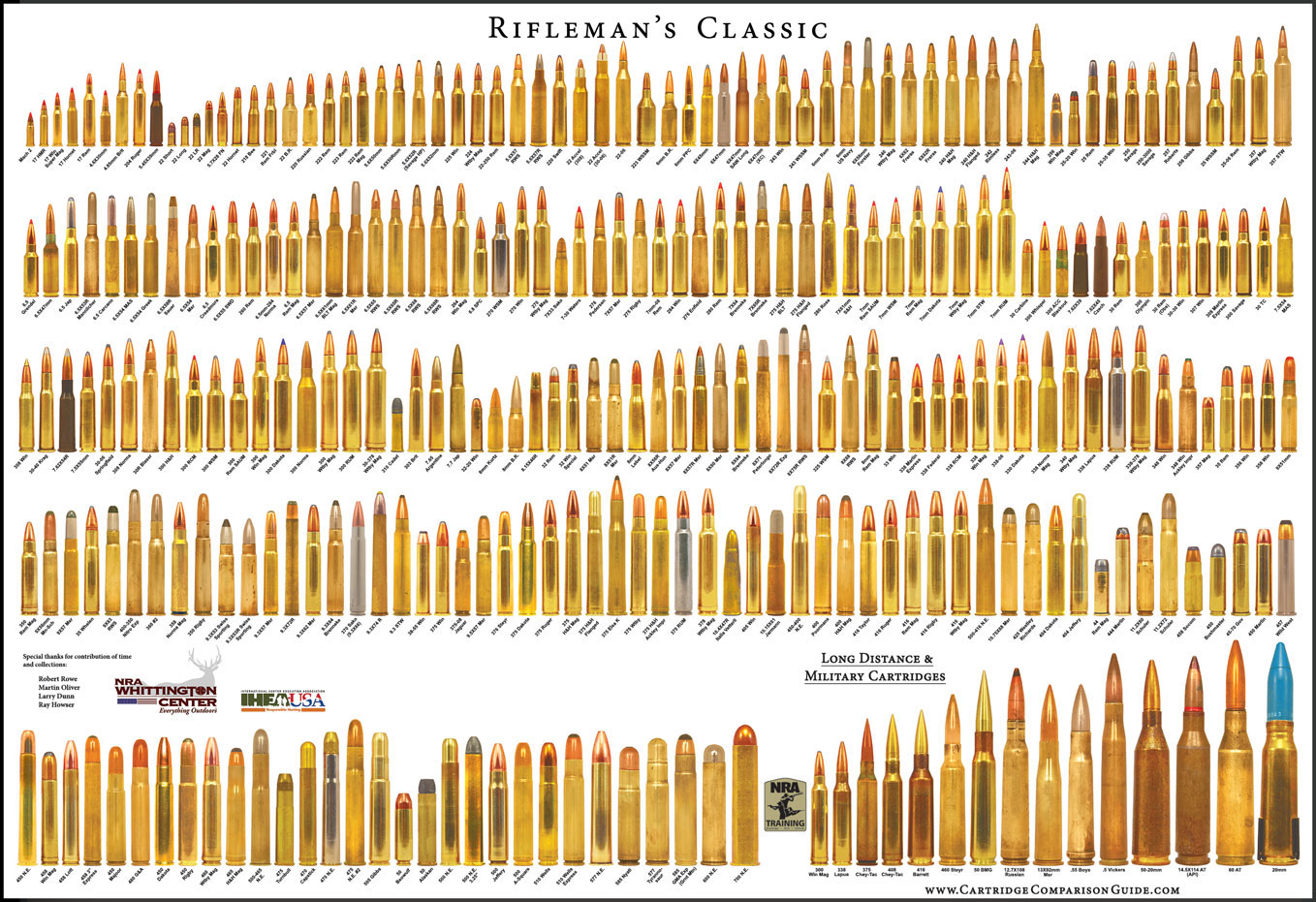
Need something for the walls of your “man cave” or reloading room? Looking for a great birthday gift for one of your shooting buddies? The creators of the Cartridge Comparison Guide offer a collection of wall posters showing ammunition types from 17 caliber rimfire cartridges all the way up to giant 35mm military rounds. ChamberIt.com currently offers 15 different large wall posters that display a huge variety of cartridge types. For example, the American Standard Poster (shown above) contains every standardized cartridge mass produced in the USA as of 2021. The cartridges are 100% to scale (life size). These posters feature full color images on high gloss / high quality 100-lb poster paper.
For example, the Rifleman’s Classic Poster (below), a full 38 inches wide and 27 inches tall, is the most comprehensive. This $17.76 poster displays over 300 rifle cartridge types at true size (within 4/1000 of an inch). Cartridges shown range from .17 caliber all the way up to the big boomers (including some cannon shells). The Rifleman’s Classic Poster includes nearly all American Standardized Rifle Cartridges and many European rifle cartridges.
Rifleman’s Classic Poster Click to view large size poster.
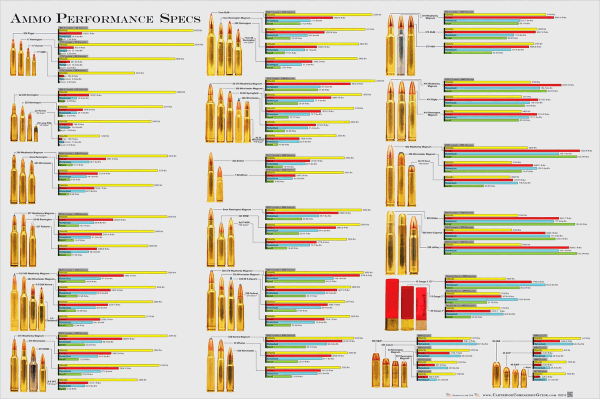
Ammunition Performance Specifications Poster
There is also an interesting Ammo Performance Specs poster. This shows dozens of popular hunting cartridges with the velocity, energy, momentum and recoil for each cartridge displayed in a bar graph.
This shows the actual size of the Ammo Performance Poster as displayed on a wall.
33XC — Popular ELR Cartridge
Paul Phillips is a past King of 2 Miles (K02M) winner. The founder of the Global Precision Group, Paul is one of the top ELR marksmen on the planet. He has also been a team-mate of past K02M winners.
In 2019, Paul had this rifle built for the 25-lb max, .338 caliber-or-under ELR Class. This is chambered for the 33XC, an efficient cartridge devised by 11-time National HP Champion David Tubb. With promising initial testing at 500 yards, it looks like Paul’s 33XC project is a success. The rifle’s first match was the NRA Extreme Long Range Championship held in 2019 at Camp Atterbury, Indiana.
Paul reports: “The 33XC is ready… I have tested loads from 3100-3450 FPS and and will settle on a load around 3250 FPS [which is] my most accurate load so far. The Peterson Cartridge brass is really working well.”
Paul states he would like to look for a higher node from 3300-3400 GPS: “Next stop is with the Applied Ballistics LLC mobile labratory and radar testing with a PDM.” Paul cautions: “I encourage everyone to start low and work up. Every chamber, barrel, and components are a little different.”
During initial testing, Paul’s 33XC put three shots in 0.27″ at 100. Then, at 500 yards, the rifle produced a 3-shot group around 1/3-MOA with just 1.22 inches of vertical. That’s pretty impressive for early testing. Paul will also be trying some Berger bullets soon. When he determines the most accurate load, Phillips will stretch the rifle’s legs, shooting out to 2500 yards and beyond.
Quote: “The Cutting Edge Bullets are not the highest BC but they are very stable and consistent at ELR (sub-sonic) ranges and that’s the most important factor in finding the best ELR bullet. I actually test all my bullets at sub-sonic speeds to make sure they are consistent and stable. Finding a good load at 500 yards is just the first part. The real test is shooting them at sub-sonic speeds and see how consistently they group. This is what gives you the highest percentage to impact at 2 miles and beyond.”
This rifle features a BAT action mated to a 34″ Bartlein barrel chambered for David Tubb’s new 33XC cartridge. Paul Phillips is currently running Cutting Edge 275gr Lazer solid bullets. Paul notes: “I also have a .338 Lapua Magnum barrel and 300gr Berger bullets for the restricted class in France.” Paul gave special thanks to Alex Wheeler for doing the metal work and Alex Sitman for doing the bedding.
Rifle Component List
Action: BAT Machine CTH dual-port action
Trigger: Bullet Central Bix’N Andy
Barrel: Bartlein 1:8″-twist barrel (34″)
Chambering: 33XC for Peterson brass
Stock: McMillan A6 Super Mag, Bedding Alex Sitman
Scope: Nightforce Optics 7-35x56mm F1 ATACR.
Bipod: Duplin Rifles
Paul Phillips notes: “Alex Sitman has been bedding rifles stocks for most of his life. I believe that [bedding] is a very important … to keep consistent accuracy and repeatable zeros after traveling all over the globe.”
Even with the TacomHQ Charlie Tarac scope prism in place, the rifle makes the 25-pound weight limit with Duplin Rifles bipod. Paul says: “I love it when a plan comes together!! I’m under by 2 ounces!”
About the 33XC (eXtra Capacity) Cartridge
David Tubb invented the 33XC cartridge because he thought the CheyTac cases were too much trouble — requiring a larger action, oversize presses, and ultra-expensive dies. The 33XC was designed to fit .338 Lapua Magnum-size actions and use normal reloading presses.
The 33XC (eXtra Capacity) has 137.5 grains of H2O capacity with over 125 grains of usable powder capacity while leaving the 0.393″ neck unfilled for bullet seating.
The 33XC has a .338 Lapua Magnum lineage. Think of it as a better, 35°-shoulder .338 LM. David explains: “The 33XC uses standard reloading dies along with a 7/8″ x 14 TPI reloading press. There is no fire-forming — all case ‘improving’ has already been done with a production case that has 20 grains more powder capacity, 35-degree shoulder, and longer neck compared to a .338 Lapua Magnum. This puts the various .338 Lapua wildcats and the Rem Ultra Mag Improved into the ‘also ran’ category. They simply can’t compete with the velocities attainable with the 33XC.”
The 33XC is based off of a .580″ bolt head. Tubb states that “A fired case will extract with little effort when using a properly-polished chamber with a maximum powder charge after resizing with the Superior Shooting Systems FL sizing die.” Tubb’s 33XC die reaches the case head which is important for accuracy. Peterson Cartridge produces the 33XC brass for Superior Shooting Systems. This high-quality brass costs $260 for 100 cases (i.e. $2.60 per case), and can be purchased directly from Superior Shooting Systems.
Bonus Video — Global Precision Group Team Makes 4-Mile Hit
With a .416 Barrett rifle, Team GPG makes a 4-mile impact that is captured on video during team practice. James Devoglaer was shooting his GPG spec .416 Barrett with Team Captain Paul Phillips doing the ballistics and wind. Spotters were David Parrish and Derek Rodgers. Forward Observers were John Droelle and Mauro Del Mastro. Approximately 60 shots were taken before impact. There were four 3-shot groups that measured under 2 MOA at 4 miles. The .416 Barrett cartridges were loaded with 550gr Cutting Edge bullets and Vihtavuori powder.
Jewell triggers are still the most-used triggers on competition benchrest and F-Class rifles and they are also popular for hunting, varmint, and tactical rifles (with or without safeties). While a Jewell trigger can work for years with minimal maintenance, if the trigger becomes gunked up, it may be necessary to disassemble the trigger for a thorough cleaning. Our friends Ed and Steve, aka the 6.5 Guys, have produced a helpful video that shows how to disassemble and then reassemble a Jewell trigger.
Why You May Need to Disassemble Your Jewell Trigger — the 6.5 Guys
Jewell triggers are a popular choice in the sport of long range precision shooting, and like everything else require regular cleaning and maintenance. In most cases they can be cleaned with charcoal lighter fluid or dropped into an ultrasonic cleaner. Should the situation require, they can be completely disassembled according to the Jewell Trigger Manual.
We ran into a situation where we had to dissemble a trigger due to the entrapment of some sticky dirt that couldn’t be removed with an ultrasonic cleaner. Our first step was to find some step-by-step instructions but we couldn’t find anything.
Recognizing that other shooters might be in the same situation we produced a step-by-step guide and video, published in full on 65Guys.com. These instructions will work with a left- or right-handed trigger. In our case we worked with a left-handed BR model trigger with safety and bolt release.
Step-by-Step Instructions are provided on 65Guys.com website. We recommend you read all the instructions carefully before you even think about disassembling your trigger. This video explains the process so you can get a sense of what is involved.
Today we showcase five YouTube videos that explain basic reloading processes. This article primarily focuses on the .45 ACP cartridge because this a very good choice for hand-loaders getting started. The .45 ACP is one of the easier cartridges to reload, because it has a large case diameter and large primer pocket, and because it operates at relatively low pressures (compared to rifle rounds).
We recommend that new reloaders consider starting with the .45 ACP cartridge. There are many reasons why the .45 ACP is a good choice for those just getting started in hand-loading:
1. The case is fairly short but has a relatively large diameter (and minimal taper), so it is easy to see inside the case. That helps you quickly check powder levels.
2. Many good powders (for the .45 ACP) will fill the case over 60%, so you will have an obvious overflow if you double-charge by accident.
3. The .45 ACP round runs at relatively low pressures, but delivers excellent accuracy.
4. Good .45 ACP brass lasts a long time, is easy to size, and is good for many reloads.
5. Along with 1911s, there are fine .45 ACP revolvers that shoot the round with moon clips.
6. The vast majority of .45 ACP brass uses large pistol primers (although there ARE some small primer pocket varieties*). We find that large primers are easier to pick up and handle if you are using a single primer tool.
The .45 ACP (Automatic Colt Pistol) cartridge is a rimless straight-walled handgun cartridge originally developed in 1904 by John Moses Browning for use in his prototype Colt semi-automatic pistol. After successful military trials, it was adopted as the standard chambering for Colt’s M1911 pistol.
For reloading, there are many good powder choices. We recommend Vihtavuori N320. This is very accurate and burns cleaner than some otherwise good powders, such as Accurate (AA) No. 5 and Unique.
Basic Reloading for the .45 ACP Cartridge
This is the most-viewed .45 ACP reloading video on YouTube. It is directed primarily for the novice or prospective reloader. It covers the basic processes: case inspection, cleaning, trimming, sizing, priming, powder filling, bullet seating, and crimping. The video creator notes: “Trimming pistol/revolver brass is optional and usually not necessary. it was included because that is what I did when I first began reloading, before I found out that handgun brass does not stretch as much as bottleneck rifle brass.”
How To Reload .45 ACP Start to Finish on Progressive Press
This is a detailed 19-minute video that shows the reloading process start to finish, along with an bit of history on the .45 ACP cartridge. The video begins with case cleaning using a tumbler. The cartridges are loaded with Hodgdon CFE pistol powder, Federal primers, and 230gr plated bullet. Equipment used in the video are: Hornady LnL progressive press, Hornady Carbide die set and taper crimp die, RCBS 505 balance scale, and harbor freight wet tumbler. While we like the efficiency of a progressive press, we recommend that novice hand-loader begin with a single stage or turret press. We recommend a powder that fills the .45 ACP case pretty full. That reduces the risk of double-charging.
Safety First When Loading All Cartridges
Along with the first two instructional videos above, we include two important videos focused on reloading safety. In the first video, UltimateReloader’s Gavin Gear explains how to check your cartridge during the loading process to eliminate squib loads and other defects. In the second video, Starline Brass tech Hunter Pilant explains how to avoid double charges.
Load .45 ACP Safely — Avoid Squib Loads and Overcharges
You need to check the powder level of EVERY round you load. Do this visually BEFORE seating a bullet. (Or, with a progressive press, use a lock-out die that monitors powder levels). This is very important because a squib load (with little or no powder) can leave a bullet lodged in the barrel. A subsequent full, live round can cause a Kaboom with dire consequences.
Preventing Double Charges — Use a Case-filling Powder with .45 ACP
IMPORTANT TIP: Use a bulky powder that fills your case more than half way with a correct charge. “This will over-fill the case if it is double-charged, making it impossible to load. This is one safeguard that can keep you from making a big [mistake]” (Hunter Pilant, Starline). A bulky powder with high fill level will also be easier to see inside the case.
Good Powder Choices for the .45 ACP
We know that many of our readers own .45 ACP handguns and load for this extremely accurate “classic” cartridge. When selecting a powder for the .45 ACP, there are many good options. All the major powder manufacturers make propellants with appropriate density and burn rate characteristics for the .45 ACP. Popular choices include: AA #5 (Accurate Powder); Bullseye (Alliant); Clays, HP-38, and Titegroup (Hodgdon); VV N310 and N320 (Vihtavuori); and WW 231 and WST (Winchester). We’ve tried all those powders in a variety of .45 ACP handguns. When we consider all the factors that make for a good pistol powder, we think Vihtavuori N320 is one of the best available propellants for the .45 ACP.
Vihtavuori N320 is very accurate, it meters well, and it burns clean, with minimal smoke and flash. If you haven’t tried VV N320 yet, you should.
Pros and Cons of Different Powders for the .45 ACP
This Editor has personally tried out eight or more different powders for the .45 ACP. Bullseye works but it is very dirty (both smoke out the barrel and sooty powder fouling on case). Though it otherwise burns clean, Titegroup leaves a singular (and nasty) high-temp flame streak on your brass that is hard to remove. AA #5 is a good choice for progressive press newbies as you use more powder so a double charge will (usually) be obvious. I like AA #5 but N320 was more accurate. Clays burns clean but some powder measures struggle with flake powders like this. WW 231 offered excellent accuracy and metered well, but it kicked out sparks with little pieces of carbon that would hit me in the face.
The Progressive Option — Loading .45 ACP on the Dillon 550B
Once you have mastered the basics of reloading for the .45 ACP, if you require large quantities of ammo, you may want to consider getting a progressive press. Progressive presses can significantly increase your ammo output, but there are also important safety considerations. You need to be careful about powder levels and priming. In this video, Gavin Gear explains how to reload safely with a Dillon 550B progressive press. The equivalent current model is the Dillon 550C.
.45 ACP Ammunition Loading Guide — Nosler Data
If you “roll your own” .45 ACP cartridges, there are many good powder choices. Our favorites are Vihtavuori N320, AA No. 5, and Hodgdon TiteGroup, but there are many other good choices. You’ll find these three recommended powders (plus many others) in the .45 ACP Load Data Charts from Nosler. Shown below are the Nosler Guides for 185gr bullets and 230gr bullets. Right-click each image below to access/download printable PDF files.
Click for PDF File
Click for PDF File
* However, be aware that CCI and other companies are now manufacturing .45 ACP brass with SMALL PRIMER POCKETS. Whenever you get new brass, be sure so check ALL the cases for primer size, and segregate large and small in two groups. Attempting to push a large primer into a small primer hole can lead to jams, or worse, dangerous detonation. Be CAREFUL!





 The Benefits of Dry-Fire Training




 33XC — Popular ELR Cartridge


 Good Powder Choices for the .45 ACP


